

PRESENTED TO:
SIR. GHUILAM AHMAD RANA
Group Members
Starbucks
Introduction to Starbucks
 Company started in 1971 in Seattle,
Washington
 Grew from 55 stores in 1989 to over 2,200
stores today
 Products sold include:
- beverages - pastries
- whole coffee beans - coffee-related retail
items
Company History
 1971- Starbucks founded by Jerry
Baldwin, Zev Siegal as a single store in
Seattle’s.
 1982- Schultz joins the Starbucks team.
 1983- While travelling in Italy, Schultz
experiences Italian Coffee bars and
inspires him.
 1985- Schultz leaves Starbucks to open
II Giornale, a company serving espresso
drinks using Starbucks coffee beans.
 1987- Schultz purchases Starbucks from
the founders and begins to expand
throughout the US.
 1992- Starbucks Company goes public.
 1993- Opens first roasting plant in
Washington.
 2011- Celebrates 40th
anniversary.
Company History
 What were the keys for success for Starbucks in
building the brand? What were their brand values?
What were the sources of equity?
Keys for Brand Success, the 4 As framework
Acceptability:
They filled the gap between family and work by being the 3rd
place. They also educated their customers about quality coffee and
build a whole new Starbucks experience
Affordability:
They convinced their customers to pay a premium for the
Starbucks brand by providing superior quality , experience and
service
 Availability:
Cluttering in prime locations to increase market share
and increase the service potential to the maximum, that
left the competitors with little scope to enter
 Awareness:
Word of Mouth, Strategic Alliances, New channels
 Constant Innovation:
When they were working on the nationwide expansion
strategy, they devised a new vacuum packaging system
to make sure the quality of the coffee beans is
maintained even while being shipped large distances,
these were called Flavor Lock Bags. They had
forward bought the machine and equipment to last the
next decade.
 Commitment to quality:
Starbucks had handpicked suppliers for the beans in the
countries like Sumatra, Kenya, Ethiopia. Compromise
on the quality was not an option for Starbucks
 Customer Experience:
Coffee was prepared by the knowledgeable Starbucks
employees, which resulted in the ultimate coffee
experience for the customers who loved high quality
coffee. They also made their stores to reflect the Italian
elegance whilst maintain American informality
 Sources of Brand Equity
• Quality & Service
• Alliances with other companies
• The country wide presence
• Restaurants and Cafes
How would you evaluate Starbucks' growth strategy?
Are there things you would do differently? How would
you evaluate its partnerships (e.g., with United
Airlines)? How do you know whether it is a “good” or
“bad” partnership?
 The growth strategy of Starbucks initially revolved
around developing a world-class product, and creating an
experienced team of innovative people who in turn
established a value chain with partners who were
committed to the core values of Starbucks
 Starbucks focused on expansion into newer markets
based on branches and outlets that were owned by
the company. The expansion followed a purposeful
model of a hub-and-spoke sort where a branch was
set up and in the next two years, 10 – 20 stores were
opened up in the same vicinity, followed by towns
and cities further along in the distance.
United Airlines; Starbucks
Corporation
Starbucks and United Airlines Enter Into Three-Year Supply
and Cooperative Marketing Agreement
 Glenn Tilton, Chairman, CEO and President of United
Air Lines Said
“We are delighted to extend and expand our
relationship with Starbucks, the premium coffee
retailer in the world,”
“Starbucks coffee and our excellent onboard service
are two of the reasons why our customer
satisfaction ratings are at historically high levels.
It's time for this partnership to fly."
What does it take to make a world class global brand?
Can Starbucks become one? What hurdles must it
overcome? In terms of the American market, what do
you see as Starbucks’ biggest challenges?
a global brand has the following characteristics:
“A truly successful brand can be more fully and accurately defined as
a product or line of products that:
1)stands for something very specific in consumers’ minds
2) establishes a trusted relationship with consumers based on its
performance and relevance in their lives.
A global brand has a clear and consistent identity with consumers
across geographies. It is positioned the same from one country to
another; it has essentially the same formula; it delivers the same
benefit and is presented consistently to the consumer through
consistent advertising and packaging.
 The idea of a global brand therefore is that it delivers a
consistent message, and Starbucks in this regards, with
its focus on the coffee experience has been able to
become a truly global brand. While Schultz was able to
bring the Italian experience to America, to truly
successful in the global arena Schultz will have to take
the Starbucks brand to all parts of the world and mould
it to the specific needs of the customers there, and in
doing so also has to maintain its core focus.
Evaluate Starbucks’ move into non-coffee areas like
credit cards, music, and film. Are these natural
extensions of the Starbucks brand, or has the company
gone too far in creating a “lifestyle” brand? Where
should Starbucks go next?
 Starbucks’ wants to be a third place for its customers,
but it is a place for fun and relaxation, music and film
are two completely different genres, which can be
approached through a different brand. The lifestyle
brand that Starbucks wants to create will be too broad
and people will lose the clear crisp focus that they have
of the Starbucks brand in the present. Therefore they
have gone too far.
Brand Expansion
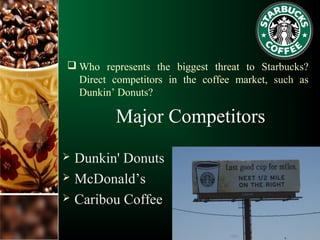
 Who represents the biggest threat to Starbucks?
Direct competitors in the coffee market, such as
Dunkin’ Donuts?
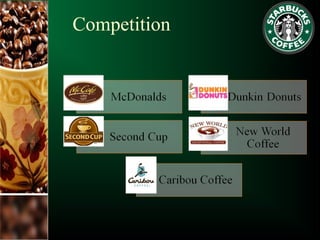
Major Competitors
 Dunkin' Donuts
 McDonald’s
 Caribou Coffee
Competition
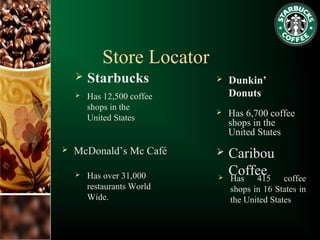
Store Locator
 Has 12,500 coffee
shops in the
United States
 McDonald’s Mc Café
 Starbucks  Dunkin’
Donuts
 Has 6,700 coffee
shops in the
United States
 Caribou
Coffee Has over 31,000
restaurants World
Wide.
 Has 415 coffee
shops in 16 States in
the United States
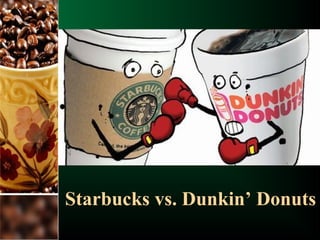
Starbucks vs. Dunkin’ Donuts
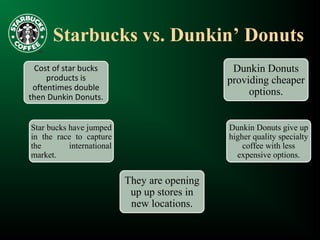
Dunkin Donuts
providing cheaper
options.
Cost of star bucks
products is
oftentimes double
then Dunkin Donuts.
Dunkin Donuts give up
higher quality specialty
coffee with less
expensive options.
Star bucks have jumped
in the race to capture
the international
market.
They are opening
up up stores in
new locations.
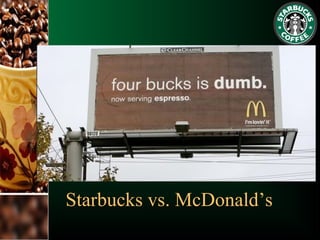
Starbucks vs. McDonald’s
 Lines of coffee drinks all while continually rolling out
new drinks of both the coffee and non-coffee variety,
such as smoothies and frappes, McDonald’s version of
the Starbucks Frappuccino's.
 Starbucks created their Frappuccino for the summer
season while McDonald’s introduced their frozen
strawberry lemonade, a non-coffee beverage under
McCafé.
Starbucks vs. McDonald’s
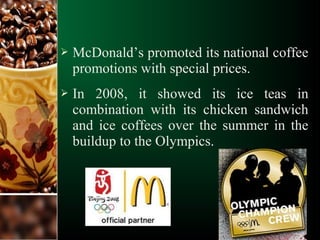
 McDonald’s promoted its national coffee
promotions with special prices.
 In 2008, it showed its ice teas in
combination with its chicken sandwich
and ice coffees over the summer in the
buildup to the Olympics.
Starbucks vs. Caribou Coffee
 Caribou Coffee spent $2 million on U.S. advertising in
2008, compared to the $300,000 it spent in 2007
 Analysis of visitor demographics reveals that Caribou
Coffee could possibly have more online success if they
pull-in some of the same types of online visitors as
Starbucks does.
 While Caribou Coffee attracts a respectable amount of
young adults (32% between the ages of 18 and 34), this
does not compare to the 42% that Starbucks attracts.
How much are customers willing to pay for the
Starbucks Experience?
 Price cuts are always welcome
 High price! Only If the company is fulfilling all desires
about the coffee.
 The pure coffee atmosphere at star bucks.
 willing to pay a premium price to enjoy cup of coffee.
 No! Because of this negative impact.
Customer didn’t like the new noisy star
bucks environment.
 The total number of coffee shops in the US is 21, 400
which means only one coffee house for every 14,000
Americans.
 So yes there is a market for 400+ coffee makers.
Do you agree with Starbucks’ international expansion?
Should the company continue its aggressive expansion
plans? Are there markets where Starbucks cannot
expand?
 The Specialty Coffee Association of America estimates
that:
 16% of the adult population consumes coffee daily
 59% of the adult population consumes coffee occasionally
 Market Size=114 million people in the U.S.
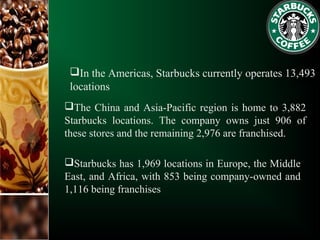
In the Americas, Starbucks currently operates 13,493
locations
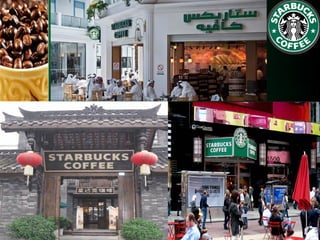
The China and Asia-Pacific region is home to 3,882
Starbucks locations. The company owns just 906 of
these stores and the remaining 2,976 are franchised.
Starbucks has 1,969 locations in Europe, the Middle
East, and Africa, with 853 being company-owned and
1,116 being franchises
Do you agree with Starbucks’ international
expansion?
YES
The Frappuccinos
“At Starbucks its not just an
exchange of coffee over the
counter from one hand to another,
its making a connection, creating
a relation and giving an
experience.”
CONCLUSION
Starbucks

Starbucks

  • 1.
  • 2.
  • 3.
  • 4.
    Introduction to Starbucks Company started in 1971 in Seattle, Washington  Grew from 55 stores in 1989 to over 2,200 stores today  Products sold include: - beverages - pastries - whole coffee beans - coffee-related retail items
  • 5.
    Company History  1971-Starbucks founded by Jerry Baldwin, Zev Siegal as a single store in Seattle’s.  1982- Schultz joins the Starbucks team.  1983- While travelling in Italy, Schultz experiences Italian Coffee bars and inspires him.  1985- Schultz leaves Starbucks to open II Giornale, a company serving espresso drinks using Starbucks coffee beans.
  • 6.
     1987- Schultzpurchases Starbucks from the founders and begins to expand throughout the US.  1992- Starbucks Company goes public.  1993- Opens first roasting plant in Washington.  2011- Celebrates 40th anniversary. Company History
  • 7.
     What werethe keys for success for Starbucks in building the brand? What were their brand values? What were the sources of equity? Keys for Brand Success, the 4 As framework Acceptability: They filled the gap between family and work by being the 3rd place. They also educated their customers about quality coffee and build a whole new Starbucks experience Affordability: They convinced their customers to pay a premium for the Starbucks brand by providing superior quality , experience and service
  • 8.
     Availability: Cluttering inprime locations to increase market share and increase the service potential to the maximum, that left the competitors with little scope to enter  Awareness: Word of Mouth, Strategic Alliances, New channels
  • 9.
     Constant Innovation: Whenthey were working on the nationwide expansion strategy, they devised a new vacuum packaging system to make sure the quality of the coffee beans is maintained even while being shipped large distances, these were called Flavor Lock Bags. They had forward bought the machine and equipment to last the next decade.
  • 10.
     Commitment toquality: Starbucks had handpicked suppliers for the beans in the countries like Sumatra, Kenya, Ethiopia. Compromise on the quality was not an option for Starbucks  Customer Experience: Coffee was prepared by the knowledgeable Starbucks employees, which resulted in the ultimate coffee experience for the customers who loved high quality coffee. They also made their stores to reflect the Italian elegance whilst maintain American informality
  • 11.
     Sources ofBrand Equity • Quality & Service • Alliances with other companies • The country wide presence • Restaurants and Cafes
  • 12.
    How would youevaluate Starbucks' growth strategy? Are there things you would do differently? How would you evaluate its partnerships (e.g., with United Airlines)? How do you know whether it is a “good” or “bad” partnership?  The growth strategy of Starbucks initially revolved around developing a world-class product, and creating an experienced team of innovative people who in turn established a value chain with partners who were committed to the core values of Starbucks
  • 13.
     Starbucks focusedon expansion into newer markets based on branches and outlets that were owned by the company. The expansion followed a purposeful model of a hub-and-spoke sort where a branch was set up and in the next two years, 10 – 20 stores were opened up in the same vicinity, followed by towns and cities further along in the distance.
  • 14.
    United Airlines; Starbucks Corporation Starbucksand United Airlines Enter Into Three-Year Supply and Cooperative Marketing Agreement  Glenn Tilton, Chairman, CEO and President of United Air Lines Said “We are delighted to extend and expand our relationship with Starbucks, the premium coffee retailer in the world,”
  • 15.
    “Starbucks coffee andour excellent onboard service are two of the reasons why our customer satisfaction ratings are at historically high levels. It's time for this partnership to fly."
  • 16.
    What does ittake to make a world class global brand? Can Starbucks become one? What hurdles must it overcome? In terms of the American market, what do you see as Starbucks’ biggest challenges? a global brand has the following characteristics: “A truly successful brand can be more fully and accurately defined as a product or line of products that: 1)stands for something very specific in consumers’ minds 2) establishes a trusted relationship with consumers based on its performance and relevance in their lives. A global brand has a clear and consistent identity with consumers across geographies. It is positioned the same from one country to another; it has essentially the same formula; it delivers the same benefit and is presented consistently to the consumer through consistent advertising and packaging.
  • 17.
     The ideaof a global brand therefore is that it delivers a consistent message, and Starbucks in this regards, with its focus on the coffee experience has been able to become a truly global brand. While Schultz was able to bring the Italian experience to America, to truly successful in the global arena Schultz will have to take the Starbucks brand to all parts of the world and mould it to the specific needs of the customers there, and in doing so also has to maintain its core focus.
  • 18.
    Evaluate Starbucks’ moveinto non-coffee areas like credit cards, music, and film. Are these natural extensions of the Starbucks brand, or has the company gone too far in creating a “lifestyle” brand? Where should Starbucks go next?  Starbucks’ wants to be a third place for its customers, but it is a place for fun and relaxation, music and film are two completely different genres, which can be approached through a different brand. The lifestyle brand that Starbucks wants to create will be too broad and people will lose the clear crisp focus that they have of the Starbucks brand in the present. Therefore they have gone too far.
  • 19.
  • 20.
     Who representsthe biggest threat to Starbucks? Direct competitors in the coffee market, such as Dunkin’ Donuts? Major Competitors  Dunkin' Donuts  McDonald’s  Caribou Coffee
  • 21.
  • 22.
    Store Locator  Has12,500 coffee shops in the United States  McDonald’s Mc Café  Starbucks  Dunkin’ Donuts  Has 6,700 coffee shops in the United States  Caribou Coffee Has over 31,000 restaurants World Wide.  Has 415 coffee shops in 16 States in the United States
  • 23.
  • 24.
    Starbucks vs. Dunkin’Donuts Dunkin Donuts providing cheaper options. Cost of star bucks products is oftentimes double then Dunkin Donuts. Dunkin Donuts give up higher quality specialty coffee with less expensive options. Star bucks have jumped in the race to capture the international market. They are opening up up stores in new locations.
  • 25.
  • 26.
     Lines ofcoffee drinks all while continually rolling out new drinks of both the coffee and non-coffee variety, such as smoothies and frappes, McDonald’s version of the Starbucks Frappuccino's.  Starbucks created their Frappuccino for the summer season while McDonald’s introduced their frozen strawberry lemonade, a non-coffee beverage under McCafé. Starbucks vs. McDonald’s
  • 27.
     McDonald’s promotedits national coffee promotions with special prices.  In 2008, it showed its ice teas in combination with its chicken sandwich and ice coffees over the summer in the buildup to the Olympics.
  • 28.
  • 29.
    Starbucks vs. CaribouCoffee  Caribou Coffee spent $2 million on U.S. advertising in 2008, compared to the $300,000 it spent in 2007  Analysis of visitor demographics reveals that Caribou Coffee could possibly have more online success if they pull-in some of the same types of online visitors as Starbucks does.  While Caribou Coffee attracts a respectable amount of young adults (32% between the ages of 18 and 34), this does not compare to the 42% that Starbucks attracts.
  • 30.
    How much arecustomers willing to pay for the Starbucks Experience?  Price cuts are always welcome  High price! Only If the company is fulfilling all desires about the coffee.  The pure coffee atmosphere at star bucks.  willing to pay a premium price to enjoy cup of coffee.
  • 31.
     No! Becauseof this negative impact. Customer didn’t like the new noisy star bucks environment.
  • 32.
     The totalnumber of coffee shops in the US is 21, 400 which means only one coffee house for every 14,000 Americans.  So yes there is a market for 400+ coffee makers.
  • 33.
    Do you agreewith Starbucks’ international expansion? Should the company continue its aggressive expansion plans? Are there markets where Starbucks cannot expand?  The Specialty Coffee Association of America estimates that:  16% of the adult population consumes coffee daily  59% of the adult population consumes coffee occasionally  Market Size=114 million people in the U.S.
  • 34.
    In the Americas,Starbucks currently operates 13,493 locations The China and Asia-Pacific region is home to 3,882 Starbucks locations. The company owns just 906 of these stores and the remaining 2,976 are franchised. Starbucks has 1,969 locations in Europe, the Middle East, and Africa, with 853 being company-owned and 1,116 being franchises
  • 36.
    Do you agreewith Starbucks’ international expansion? YES
  • 37.
  • 39.
    “At Starbucks itsnot just an exchange of coffee over the counter from one hand to another, its making a connection, creating a relation and giving an experience.” CONCLUSION