Emotion of Change
● Chee Liung Wun ● Lim Shieh Chern ● Ng Yee Jie ●
Change is intensely personal and
fundamentally about feelings.
However, emotions are
frequently perceived as
“uncomfortable knowledge” and
are to be avoided or ignored in
management. Thus, companies
that want their workers to
contribute with their heads and
hearts have to accept that
emotions are essential to the
new management style
(Duck, 1993)
Introduction
Emotions color all perception,
thinking, and behavior, and often are
critical variables in both effective
and ineffective change projects
(Lundberg & Young, 2001)
Terminology of Emotion
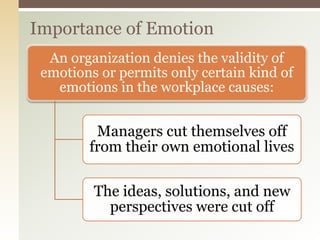
An organization denies the validity of
emotions or permits only certain kind of
emotions in the workplace causes:
Managers cut themselves off
from their own emotional lives
The ideas, solutions, and new
perspectives were cut off
Importance of Emotion
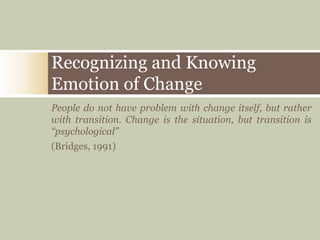
People do not have problem with change itself, but rather
with transition. Change is the situation, but transition is
“psychological”
(Bridges, 1991)
Recognizing and Knowing
Emotion of Change
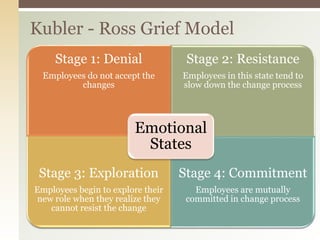
Stage 1: Denial
Employees do not accept the
changes
Stage 2: Resistance
Employees in this state tend to
slow down the change process
Stage 3: Exploration
Employees begin to explore their
new role when they realize they
cannot resist the change
Stage 4: Commitment
Employees are mutually
committed in change process
Emotional
States
Kubler - Ross Grief Model
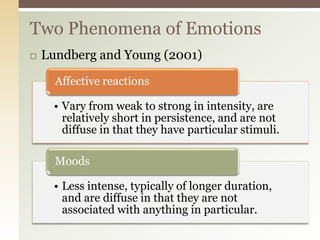
 Lundberg and Young (2001)
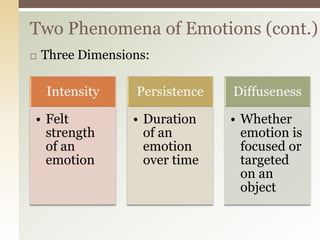
Two Phenomena of Emotions
• Vary from weak to strong in intensity, are
relatively short in persistence, and are not
diffuse in that they have particular stimuli.
Affective reactions
• Less intense, typically of longer duration,
and are diffuse in that they are not
associated with anything in particular.
Moods
 Three Dimensions:
Two Phenomena of Emotions (cont.)
• Felt
strength
of an
emotion
• Duration
of an
emotion
over time
• Whether
emotion is
focused or
targeted
on an
object
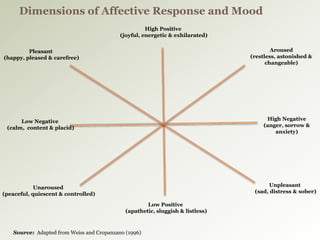
Dimensions of Affective Response and Mood
High Positive
(joyful, energetic & exhilarated)
Low Positive
(apathetic, sluggish & listless)
Low Negative
(calm, content & placid)
High Negative
(anger, sorrow &
anxiety)
Unpleasant
(sad, distress & sober)
Pleasant
(happy, pleased & carefree)
Aroused
(restless, astonished &
changeable)
Unaroused
(peaceful, quiescent & controlled)
Source: Adapted from Weiss and Cropanzano (1996)
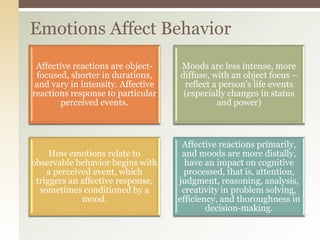
Emotions Affect Behavior
Affective reactions are object-
focused, shorter in durations,
and vary in intensity. Affective
reactions response to particular
perceived events.
Moods are less intense, more
diffuse, with an object focus –
reflect a person’s life events
(especially changes in status
and power)
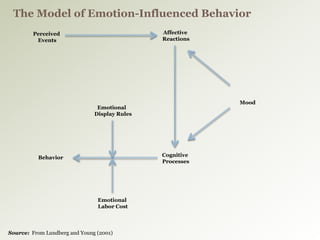
How emotions relate to
observable behavior begins with
a perceived event, which
triggers an affective response,
sometimes conditioned by a
mood.
Affective reactions primarily,
and moods are more distally,
have an impact on cognitive
processed, that is, attention,
judgment, reasoning, analysis,
creativity in problem solving,
efficiency, and thoroughness in
decision-making.
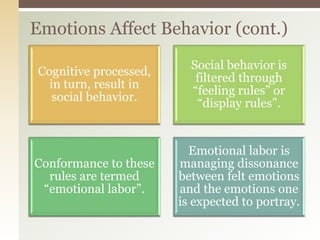
Cognitive processed,
in turn, result in
social behavior.
Social behavior is
filtered through
“feeling rules” or
“display rules”.
Conformance to these
rules are termed
“emotional labor”.
Emotional labor is
managing dissonance
between felt emotions
and the emotions one
is expected to portray.
Emotions Affect Behavior (cont.)
The Model of Emotion-Influenced Behavior
Perceived
Events
Affective
Reactions
Mood
Cognitive
Processes
Behavior
Emotional
Display Rules
Emotional
Labor Cost
Source: From Lundberg and Young (2001)
New management paradigm says that:
Managing people is managing feelings. The issue is not
whether employees have “negative” emotions, but rather
how to manage them.
Managing Emotion of Change
 Edgar Schein
Managing Emotion of Change
SurvivalAnxiety
The
experienced
tension
between what
is desired and
what is
perceived to
be the present
reality
LearningAnxiety
The prospect
of learning
something
new
Greater Than
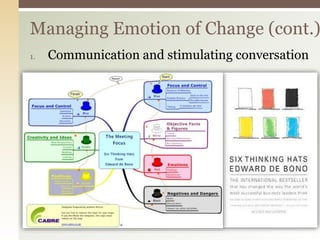
1. Communication and stimulating conversation
Managing Emotion of Change (cont.)
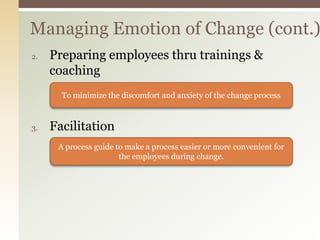
2. Preparing employees thru trainings &
coaching
3. Facilitation
Managing Emotion of Change (cont.)
To minimize the discomfort and anxiety of the change process
A process guide to make a process easier or more convenient for
the employees during change.
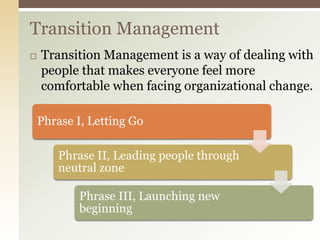
 Transition Management is a way of dealing with
people that makes everyone feel more
comfortable when facing organizational change.
Transition Management
Phrase I, Letting Go
Phrase II, Leading people through
neutral zone
Phrase III, Launching new
beginning
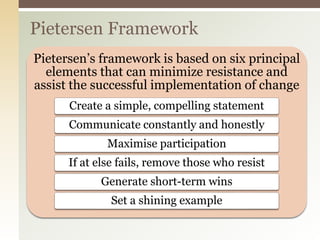
Pietersen’s framework is based on six principal
elements that can minimize resistance and
assist the successful implementation of change
Create a simple, compelling statement
Communicate constantly and honestly
Maximise participation
If at else fails, remove those who resist
Generate short-term wins
Set a shining example
Pietersen Framework
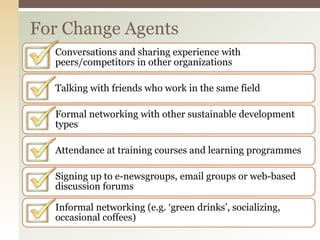
For Change Agents
Conversations and sharing experience with
peers/competitors in other organizations
Talking with friends who work in the same field
Formal networking with other sustainable development
types
Attendance at training courses and learning programmes
Signing up to e-newsgroups, email groups or web-based
discussion forums
Informal networking (e.g. ‘green drinks’, socializing,
occasional coffees)
 Emotion involvement is inevitable part of any
organization change process.
 Employees do not resist change per se but
rather, the impact of the change on them.
 Thus the new paradigm in managing people
during change process is managing emotion.
 The strategy is to make everyone feel more
comfortable during the change process, using
management frameworks and tools that are
discussed above.
Conclusion
Thank You
Q & A Session

Change Agent Strategies: Emotion of Change

  • 1.
    Emotion of Change ●Chee Liung Wun ● Lim Shieh Chern ● Ng Yee Jie ●
  • 2.
    Change is intenselypersonal and fundamentally about feelings. However, emotions are frequently perceived as “uncomfortable knowledge” and are to be avoided or ignored in management. Thus, companies that want their workers to contribute with their heads and hearts have to accept that emotions are essential to the new management style (Duck, 1993) Introduction
  • 3.
    Emotions color allperception, thinking, and behavior, and often are critical variables in both effective and ineffective change projects (Lundberg & Young, 2001) Terminology of Emotion
  • 5.
    An organization deniesthe validity of emotions or permits only certain kind of emotions in the workplace causes: Managers cut themselves off from their own emotional lives The ideas, solutions, and new perspectives were cut off Importance of Emotion
  • 6.
    People do nothave problem with change itself, but rather with transition. Change is the situation, but transition is “psychological” (Bridges, 1991) Recognizing and Knowing Emotion of Change
  • 7.
    Stage 1: Denial Employeesdo not accept the changes Stage 2: Resistance Employees in this state tend to slow down the change process Stage 3: Exploration Employees begin to explore their new role when they realize they cannot resist the change Stage 4: Commitment Employees are mutually committed in change process Emotional States Kubler - Ross Grief Model
  • 8.
     Lundberg andYoung (2001) Two Phenomena of Emotions • Vary from weak to strong in intensity, are relatively short in persistence, and are not diffuse in that they have particular stimuli. Affective reactions • Less intense, typically of longer duration, and are diffuse in that they are not associated with anything in particular. Moods
  • 9.
     Three Dimensions: TwoPhenomena of Emotions (cont.) • Felt strength of an emotion • Duration of an emotion over time • Whether emotion is focused or targeted on an object
  • 10.
    Dimensions of AffectiveResponse and Mood High Positive (joyful, energetic & exhilarated) Low Positive (apathetic, sluggish & listless) Low Negative (calm, content & placid) High Negative (anger, sorrow & anxiety) Unpleasant (sad, distress & sober) Pleasant (happy, pleased & carefree) Aroused (restless, astonished & changeable) Unaroused (peaceful, quiescent & controlled) Source: Adapted from Weiss and Cropanzano (1996)
  • 11.
    Emotions Affect Behavior Affectivereactions are object- focused, shorter in durations, and vary in intensity. Affective reactions response to particular perceived events. Moods are less intense, more diffuse, with an object focus – reflect a person’s life events (especially changes in status and power) How emotions relate to observable behavior begins with a perceived event, which triggers an affective response, sometimes conditioned by a mood. Affective reactions primarily, and moods are more distally, have an impact on cognitive processed, that is, attention, judgment, reasoning, analysis, creativity in problem solving, efficiency, and thoroughness in decision-making.
  • 12.
    Cognitive processed, in turn,result in social behavior. Social behavior is filtered through “feeling rules” or “display rules”. Conformance to these rules are termed “emotional labor”. Emotional labor is managing dissonance between felt emotions and the emotions one is expected to portray. Emotions Affect Behavior (cont.)
  • 13.
    The Model ofEmotion-Influenced Behavior Perceived Events Affective Reactions Mood Cognitive Processes Behavior Emotional Display Rules Emotional Labor Cost Source: From Lundberg and Young (2001)
  • 14.
    New management paradigmsays that: Managing people is managing feelings. The issue is not whether employees have “negative” emotions, but rather how to manage them. Managing Emotion of Change
  • 15.
     Edgar Schein ManagingEmotion of Change SurvivalAnxiety The experienced tension between what is desired and what is perceived to be the present reality LearningAnxiety The prospect of learning something new Greater Than
  • 16.
    1. Communication andstimulating conversation Managing Emotion of Change (cont.)
  • 17.
    2. Preparing employeesthru trainings & coaching 3. Facilitation Managing Emotion of Change (cont.) To minimize the discomfort and anxiety of the change process A process guide to make a process easier or more convenient for the employees during change.
  • 18.
     Transition Managementis a way of dealing with people that makes everyone feel more comfortable when facing organizational change. Transition Management Phrase I, Letting Go Phrase II, Leading people through neutral zone Phrase III, Launching new beginning
  • 19.
    Pietersen’s framework isbased on six principal elements that can minimize resistance and assist the successful implementation of change Create a simple, compelling statement Communicate constantly and honestly Maximise participation If at else fails, remove those who resist Generate short-term wins Set a shining example Pietersen Framework
  • 20.
    For Change Agents Conversationsand sharing experience with peers/competitors in other organizations Talking with friends who work in the same field Formal networking with other sustainable development types Attendance at training courses and learning programmes Signing up to e-newsgroups, email groups or web-based discussion forums Informal networking (e.g. ‘green drinks’, socializing, occasional coffees)
  • 21.
     Emotion involvementis inevitable part of any organization change process.  Employees do not resist change per se but rather, the impact of the change on them.  Thus the new paradigm in managing people during change process is managing emotion.  The strategy is to make everyone feel more comfortable during the change process, using management frameworks and tools that are discussed above. Conclusion
  • 22.
    Thank You Q &A Session

Editor's Notes

  • #2 Welcome back from break Topic speaks right into your heart
  • #3 You know why you emotional just now? Because........... You cannot have change without Emotion, these are like Siamese twins. Insaparable Therefore companies that want their workers to contribute with their heads and hearts have to accept that emotions are essential to the new management style. However most companies if not all Companies frequently perceived emotion as “uncomfortable knowledge” and are to be avoided or ignored in management. “Taboo” Whether u work in MNC of Local companies. Local Company-If too emotional-Useless employee, doesn’t listen to instruction- Fire MNC Company- If too emotional-Too negative – No promotion
  • #4 Every Experience Change Agent, every consultant “know” that We can’t have full understanding of organization event if we ignore emotion Because every action is emotionally laden, whether we acknowledge it or not
  • #6 Why is emotion so important? Because when………2 things happen -The first Even more important, they cut………. …………………..That people can contribute
  • #7 As a good Change Agent, Change- New Boss, Reorganization “Psychology” – Loss of colleague, good friend Loss of comfortable/fun ways of doing things Loss of favorite parking, cozy room.
  • #8 Org. has an element of loss Inherent in the Process & it’s this loss that’s deeply felt by employee To address the emotional issues associated with with, - Kubler Grief Model Why Grief? Introduced by Elizabeth, 1969, “On Death & Dying”- Describe Stage/process by ppl go thru grief & Tragedy(Terminal Illness, loss of loved ones) Stage 1: Can’t be happening” , not me Stage 2: Derail. A) Easiest- Heroes Openly indicate dissatisfaction, B) Denying-Reluctant to accept existing problem C) Understand but resist change, (Extra time & effort), D) Confused- Genuine or Used as Excuse D) Malicious – Pretend Stage 3: Both individual & Overall role of the group are specifically defined in this stage. Stage 4: Obstacles have been removed, focus is on successful implementation of the change
  • #16 Survival Anxiety This is the feeling that unless we learn something new, we are going to be out of business or fail to achieve some important goals. Learning Anxiety Employees realize that new learning might cause them to be temporarily incompetent, expose them to rejection, or even losing their identity. Thus learning anxiety causes employees to react defensively by denying the reality and is the basis for resistance to change.
  • #19 Phrase I, Letting Go: The ending of the old. Acknowledge employees’ feeling of depression & empathy with the reality and importance of perceived losses. Treat people with respect and communicate with them. Phrase II, Leading people through neutral zone: There is nothing to hold on to, and anxiety and self doubt are up. Motivation and efficiency are low. Give time for employees to go thru this tough time but keep them focus.   Phrase III, launching new beginning. Explain purpose, give everyone a picture, have a plan & involve every staff members in brainstorming and encourage creativity.
  • #21 For change agents to overcome the emotional effects, they need to create their own support system. The support system generally consists of trusted people that can provide emotional support and serve as advisor or listener to the change agents. The trusted people could be the change agents’ colleagues, the employees or the top management person in the organization.
  • #22 As our conclusion: Emotion ……………..Like Siamese Twin, inseparable As it might cause them to temporarily incompetent, exposed to rejection worse still loss identity. …. Like facilitation, lots of training & promote communication