



Content:
 Intoduction to Dam
 Purpose of Dam
 Classification of Dam
 Study of Some important Dam
• Gravity Dam
• Arch Dam
• Buttress Dam
• Earth Dam
• Rock fill Dam
 Salient feature of major Dams in India
Introduction To Dam :
 A dam is hydraulic structure constructed across a river or a natural stream to create a reservoir
for impounding water.
 The water stored in the reservoir can be used for various purpose.
Purpose of Dam :
 Water Supply : Dams gather drinking water for people.
 Flood Control : Dams protect areas from flooding.
 Irrigation : Dams help farmers being water to their farms.
 Hydroelectric : Dams help create power and electricity from water.
And also for Recreation, Navigation etc.
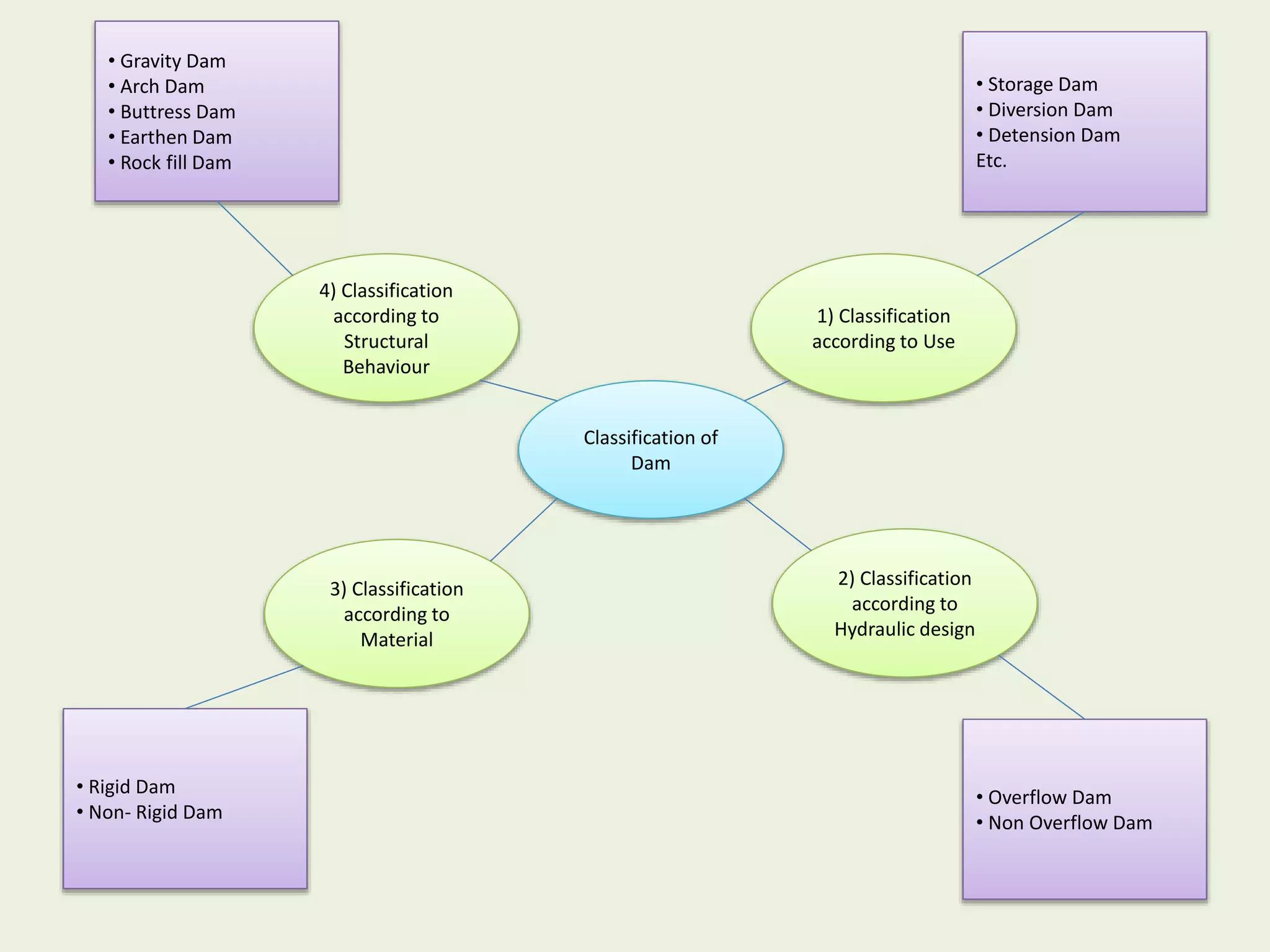
Classification of
Dam
4) Classification
according to
Structural
Behaviour
3) Classification
according to
Material
2) Classification
according to
Hydraulic design
1) Classification
according to Use
• Storage Dam
• Diversion Dam
• Detension Dam
Etc.
• Rigid Dam
• Non- Rigid Dam
• Gravity Dam
• Arch Dam
• Buttress Dam
• Earthen Dam
• Rock fill Dam
• Overflow Dam
• Non Overflow Dam
1) Classification According To Use:
 Storage Dam:
 Storage dams are constructed to store the water during rainy season when there is large flow
in the river.
 The stored water is utilized later during the period when flow in the river is reduced.
 E.g. Gravity Dam, Earthen Dam, Rock fill dam, Arch dam etc.
 Diversion Dam:
 A diversion dam is constructed for the purpose of diverting water of the river into an off taking
canal.
 It is usually of low height and has a small storage reservoir on its upstream.
 E.g. Weir, Barrage etc.
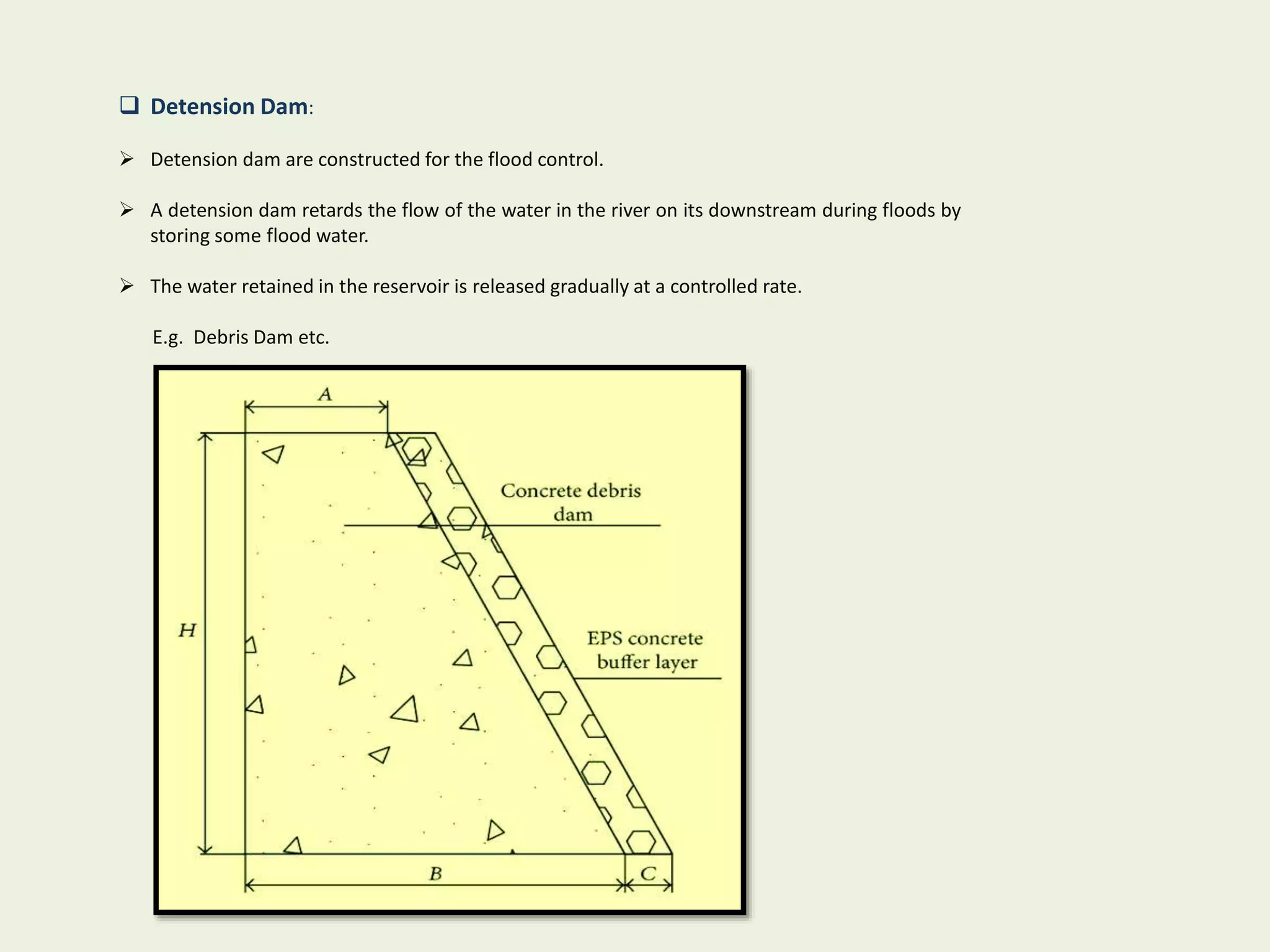
 Detension Dam:
 Detension dam are constructed for the flood control.
 A detension dam retards the flow of the water in the river on its downstream during floods by
storing some flood water.
 The water retained in the reservoir is released gradually at a controlled rate.
E.g. Debris Dam etc.
2) Classification According To Hydraulic Design:
 Overflow Dam:
 An overflow dam is the one which designed to carry surplus discharge over its crest.
 Its crest level is kept lower than the top of the other portion of the dams.
 An overflow dam is commonly known as Spillway.
 Non Overflow Dam:
 It is the one in which the top of the dam is kept at a higher elevation than the maximum
expected high flood level ( HFL ).
 Water is not permitted to overflow the dam.
 E.g. Gravity dam, Earthen dam, Rockfill dam etc.
3) Classification According To Material:
 Rigid Dam:
 Rigid dams are those dam which are constructed of rigid materials such as concrete, masonry,
steel, timber etc.
E.g. Concrete gravity dam,
Solid masonry dam,
Arch dam,
Steel dam etc.
 Non - Rigid Dam:
 Non rigid dams are those dam which are constructed of non rigid materials such as earth, and
rock fill etc.
 These are relatively large settlements and deformation in the non - rigid dam.
E.g. Earth dam,
Rock fill dam etc.
4) Classification According To Structural Behaviour:
 Gravity Dam:
 A gravity dam is one which the external forces such as water pressure, wave pressure, uplift
pressure etc. are resisted by the weight of the dam itself.
 The gravity dams are usually made of cement concrete.
 Advantage of Gravity dam :
 Gravity dams are relatively more strong and durable than earth dams.
 Gravity dams can be constructed of any height, provided suitable foundations are available to
bear the stresses.
 It requires the least maintenance.
 The failure of a gravity dam, if any is not sudden.
 Disadvantage of Gravity dam :
 The initial cost of gravity dam is always higher than an Earth dam.
 Mechanized plants for manufacturing and transporting concrete are required.
 Gravity dams require skilled labour for its construction.
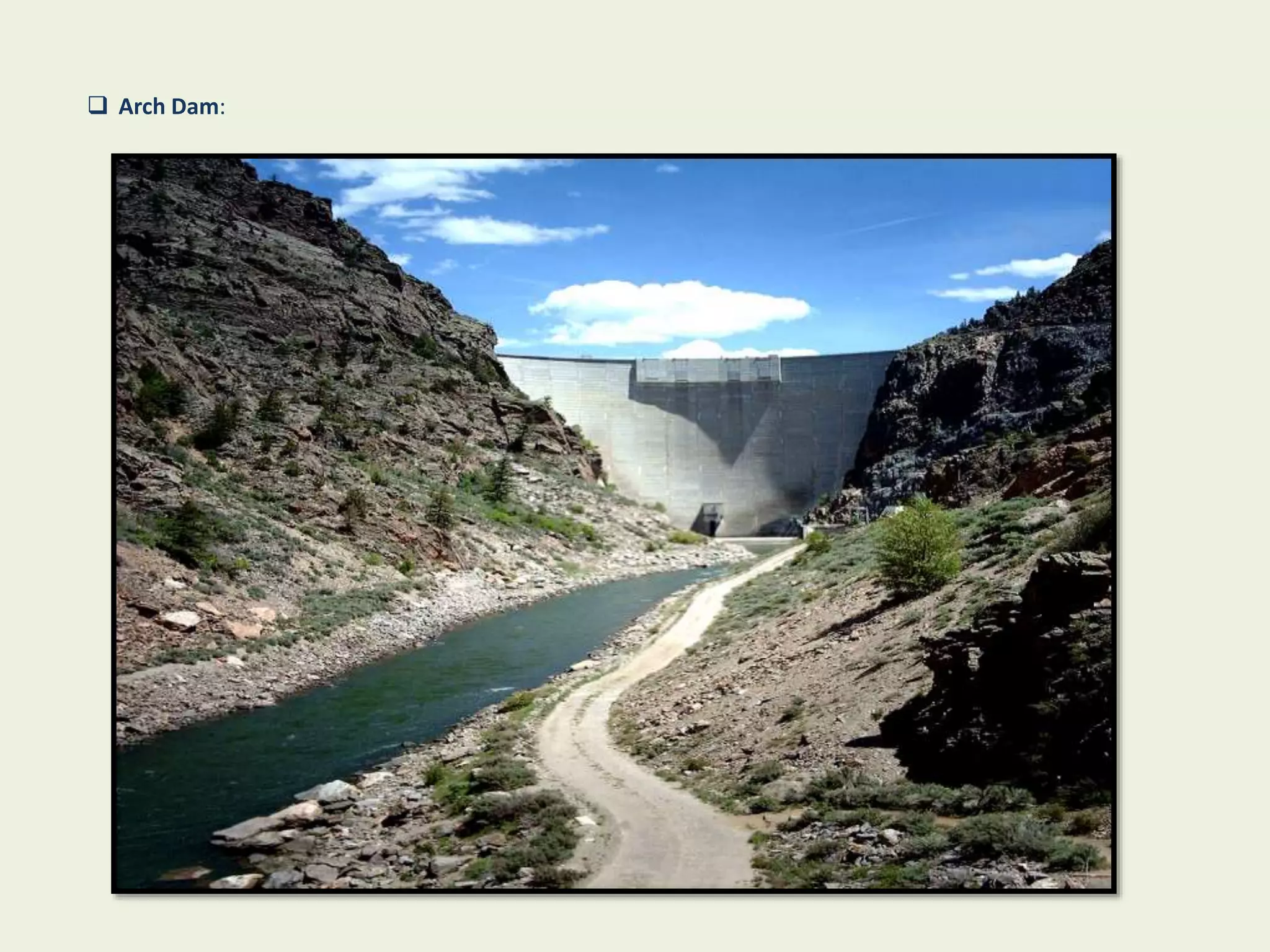
 Arch Dam:
 Arch Dam:
 An arch dam is curved in plan, with its convexity towards the upstream side.
 Arch dams transfer the water pressure and other forces mainly to the abutments by an arch action.
 This is suitable for narrow canyons with the strong banks which are capable of resisting the thrust produced
by the arch action.
 Advantage of Arch dam :
 Arch dams are particularly adopted to the gorges where the length is small in proportion to
the height.
 Because of much less base width, the problem of uplift pressure are minor.
 For a given height, the section of an arch dam is much lesser than a corresponding gravity
dam.
 Disadvantage of Arch dam :
 It required skilled labour and sophisticated framework.
 The speed of construction is usually slow.
 It requires very strong abutments, capable of resisting arch thrusts.
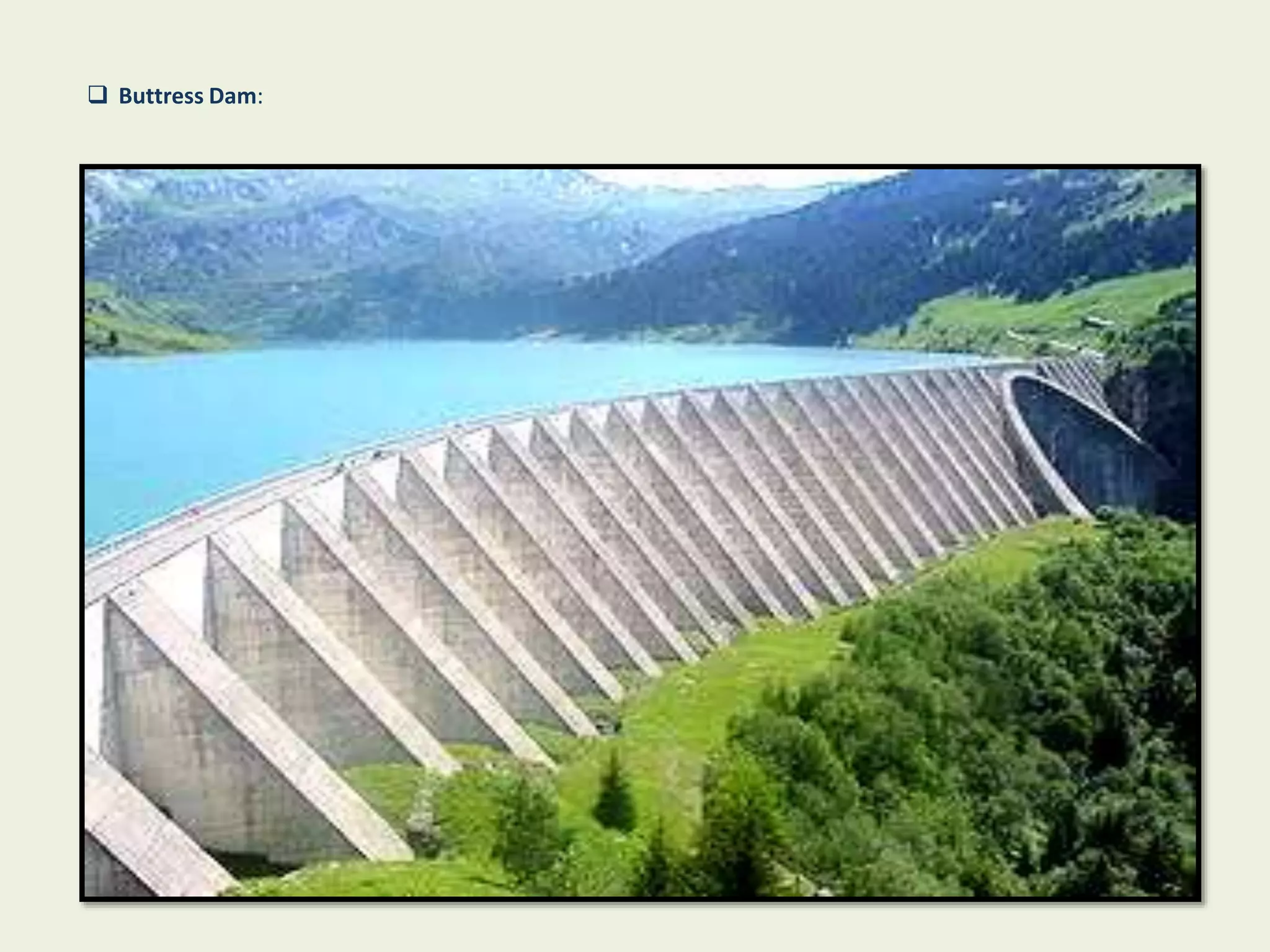
 Buttress Dam:
 Buttress Dam:
 Buttress dam :
 A buttress dam consists of number of buttresses or pier dividing the space.
 To retain water between these buttress, panels are constructed of horizontal arches or flat
slabs.
 When the panels consists of arches, it is know as multiple arch type buttress dam and it
consists of flat slab, it is known as Deck type buttress dam.
 Advantage of Buttress dam :
 A buttress dam is less massive dam than a gravity dam. It can be constructed on a relatively
weak foundation.
 The spacing of buttresses may be adjusted to utilized zones of good foundation.
 The ice pressure is relatively unimportant since the ice tends to slide over the inside upstream
deck.
 Power houses and water treatment plants can be housed in between buttresses, thus saving
same cost of construction.
 The amount of concrete required is about 1/2 to 1/3 of the concrete required for a gravity
dam of the same height.
 The uplift pressure acting on the buttress dam is considerably less which leads to economy in
the concrete and overall stability of the dam.
 Disadvantage of Buttress dam :
 Skilled labours and more shuttering is required.
 Buttress dam is more susceptible to willful damage.
 The number of water seals to be provided and maintained for buttress dam are usually more
than that of other dam.
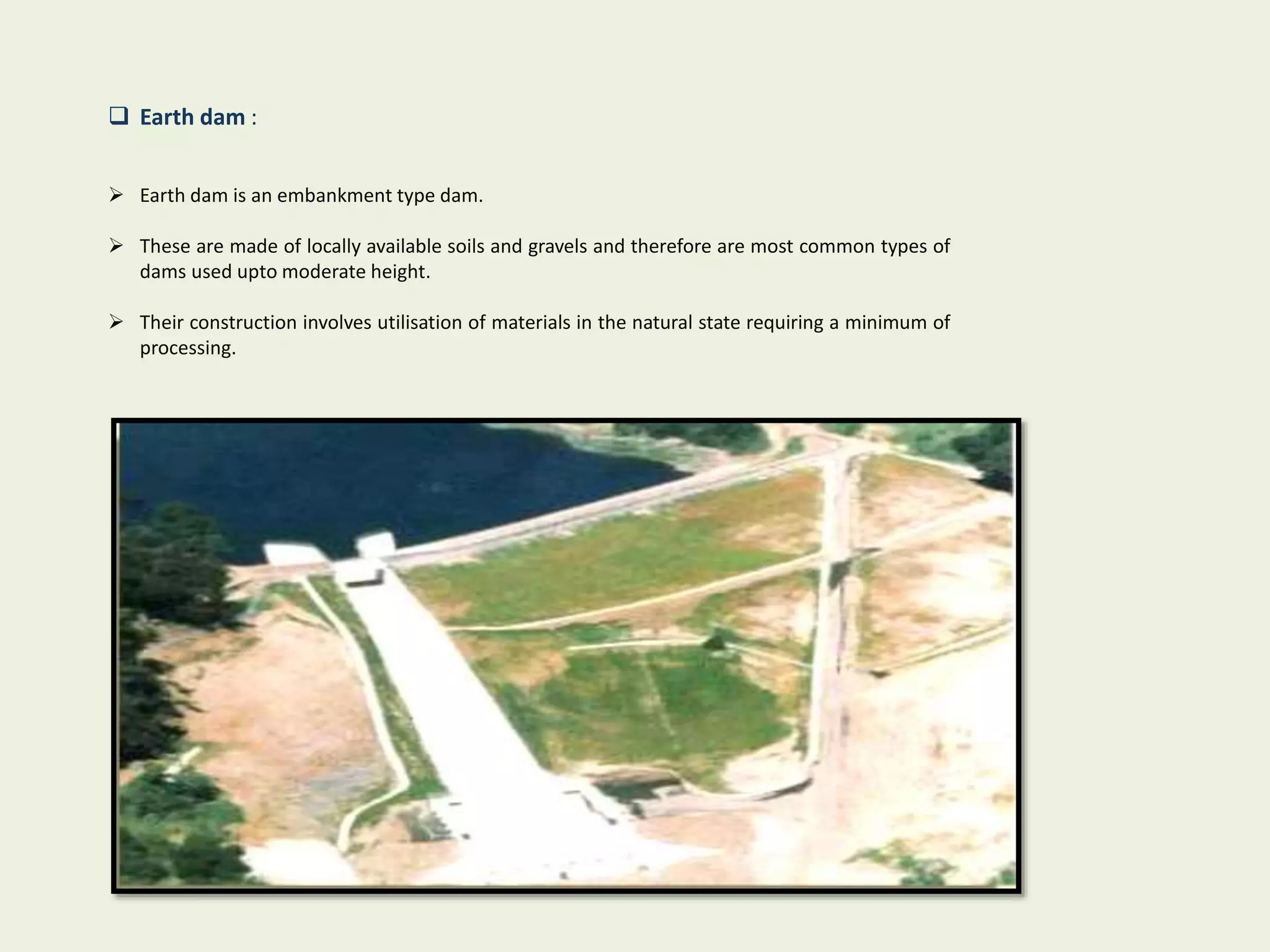
 Earth dam :
 Earth dam is an embankment type dam.
 These are made of locally available soils and gravels and therefore are most common types of
dams used upto moderate height.
 Their construction involves utilisation of materials in the natural state requiring a minimum of
processing.
 Rock Fill dam :
 A rock fill dam is an embankment which uses variable sizes of rock to provide stability and
impervious membrane to provide water tightness.
 Advantage of Earth dam and Rock fill dam :
 Earth dams can be constructed almost on any type of available foundations.
 Unskilled labours also can be employed in the construction.
 They are cheaper than other type of dam.
 They can be subsequently raised in the height without much difficulty.
 Earth dams are more earthquake resistant than gravity dams.
 Earth dams can be constructed in a relatively short period.
 Disadvantage of Earth dam and Rock fill dam :
 An earth dam cannot be designed as an overflow section. A spillway has to be located away
from the dam.
 They are not suitable at locations where heavy downpour is more common.
 The maintenance cost is quite high.
 It requires constant supervision.
 They are more vulnerable to damage by floods and fail suddenly without sufficiently warning.
 Earth dams are not suitable for narrow gorges with steep slopes.
 Salient feature of major Dams in India
1. Bhakhra – Nangal Project ( Punjab ) :
River Satluj
Dam 226 m high Bhakhra dam and 29 m high Nangal dam
Type of dam Concrete gravity dam
Length of dam at the crest 518 m
Catchment area 56876 sq. km.
Type of spillway Overflow spillway in the middle of the dam
Number and type of gates 15.24 m x 14.47 m size 4 nos. radial gates
Flood discharge capacity 8372 cum/s
Flood discharge 11327 cum/s
Area of reservoir at full reservoir 166 sq. km.
Total storage capacity of reservoir 7191 M cum
Installed hydropower capacity 1204 MW
Length of canal 1104 km
Length of ditributaries 3360 km
State benefited Punjab, Hariyana, Rajasthan
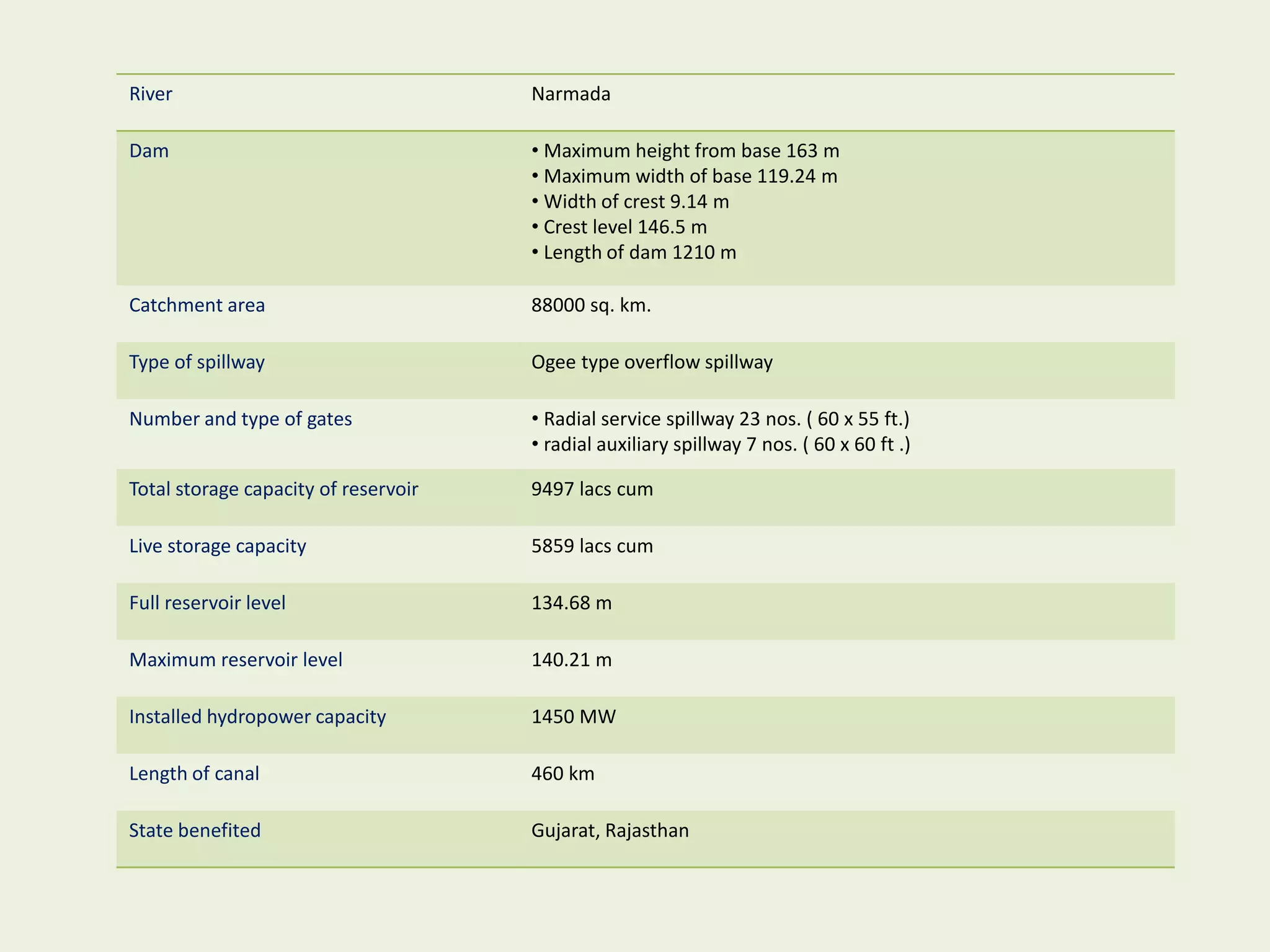
2. Sardar Sarovar Project :
River Narmada
Dam • Maximum height from base 163 m
• Maximum width of base 119.24 m
• Width of crest 9.14 m
• Crest level 146.5 m
• Length of dam 1210 m
Catchment area 88000 sq. km.
Type of spillway Ogee type overflow spillway
Number and type of gates • Radial service spillway 23 nos. ( 60 x 55 ft.)
• radial auxiliary spillway 7 nos. ( 60 x 60 ft .)
Total storage capacity of reservoir 9497 lacs cum
Live storage capacity 5859 lacs cum
Full reservoir level 134.68 m
Maximum reservoir level 140.21 m
Installed hydropower capacity 1450 MW
Length of canal 460 km
State benefited Gujarat, Rajasthan
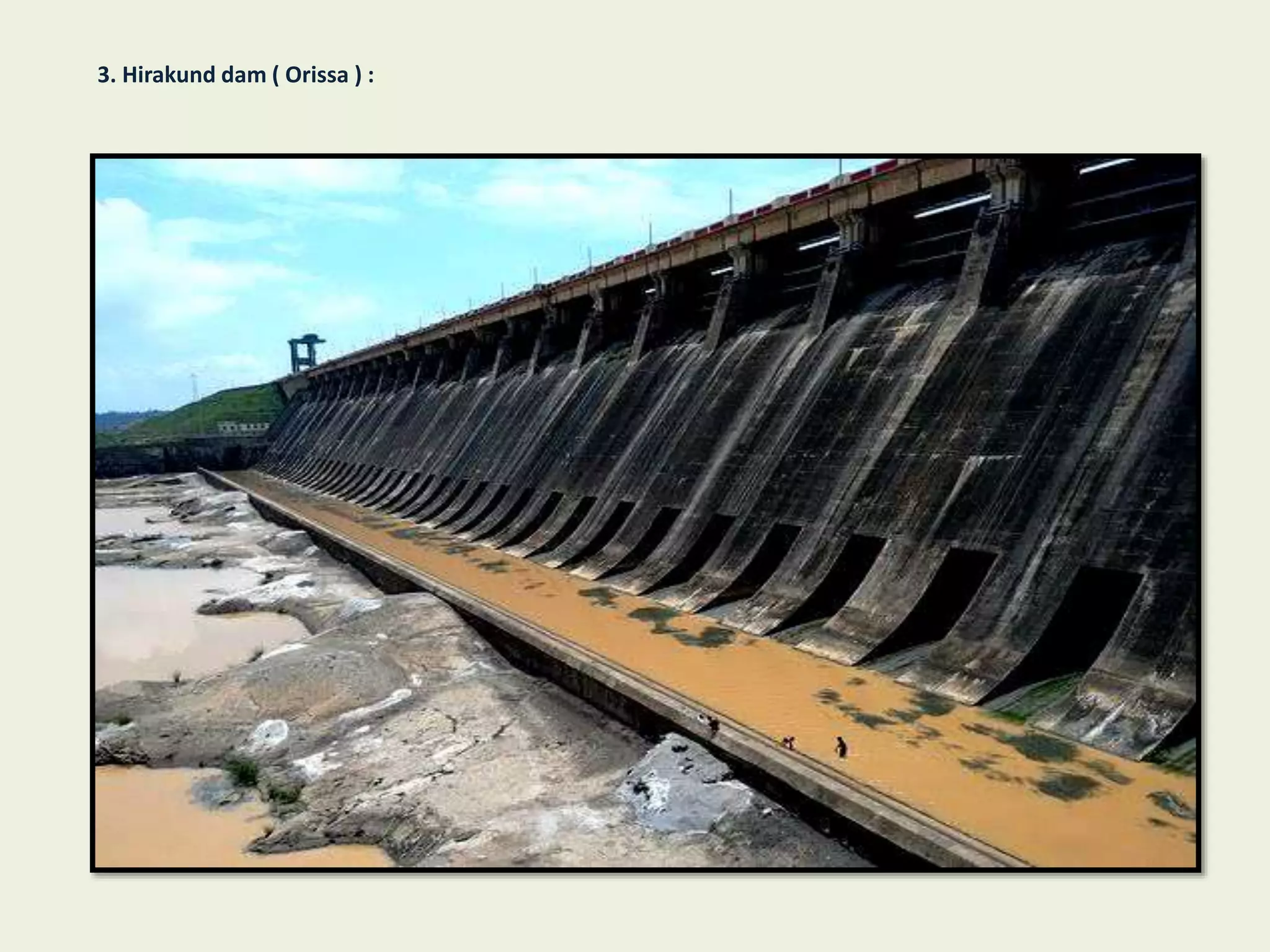
3. Hirakund dam ( Orissa ) :
River Maha river
Dam Concrete, Masonry and Earth composite dam
Maximum height 59 m
Catchment area 82880 sq. km.
Flood discharge 35765 cum/s
Total storage capacity of reservoir 8105 M cum
Installed hydropower capacity 270 MW
Non-overflow masonry, concrete dam
length
3652 m
Length of spillway 1148 m
Length of earthen dam 20666 m
Useful storage capacity 5843 M cum
Irrigation capacity 2.53 lacs hectare
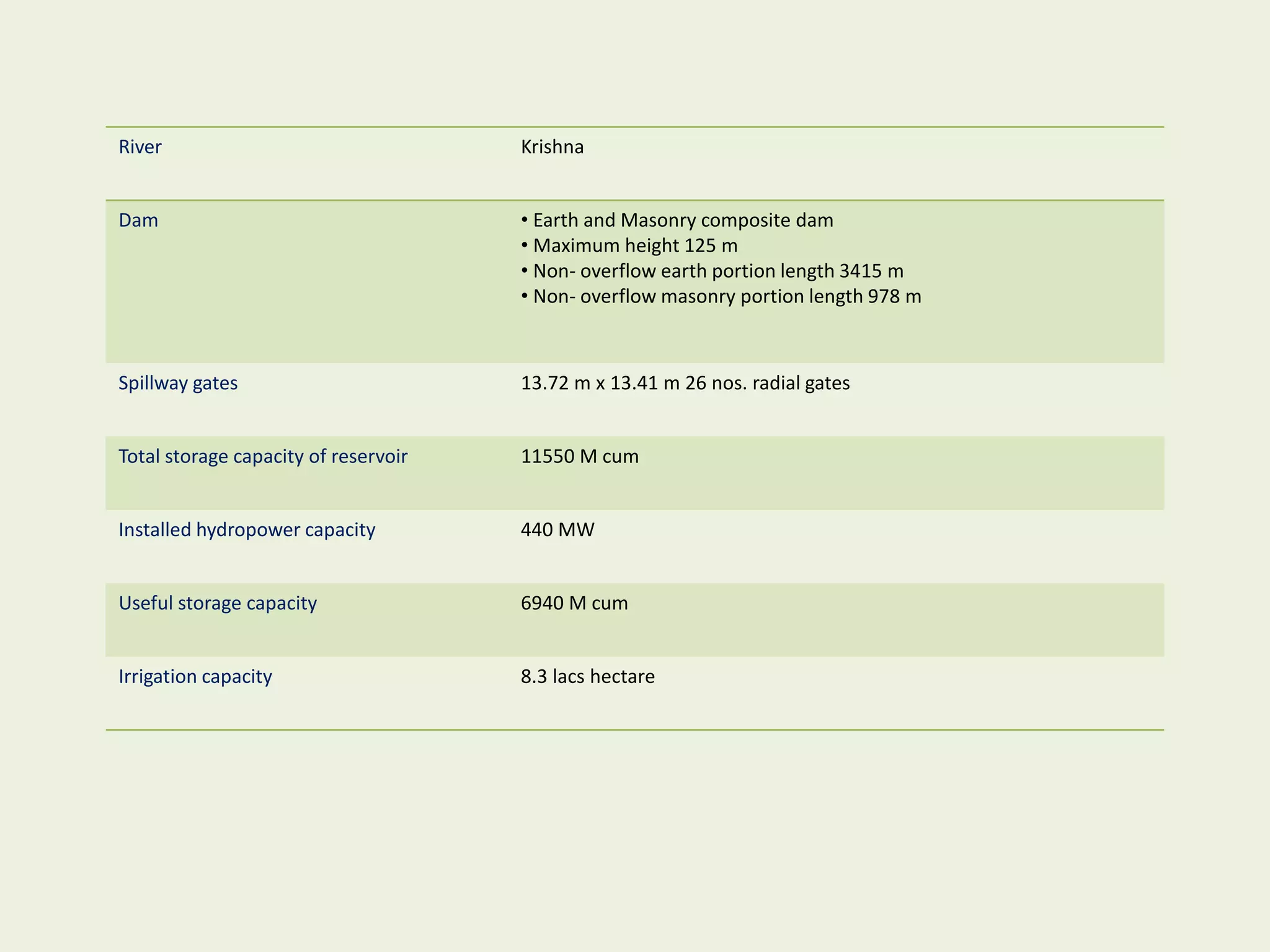
4. Nagarjun sagar project ( Andhra Pradesh) :
River Krishna
Dam • Earth and Masonry composite dam
• Maximum height 125 m
• Non- overflow earth portion length 3415 m
• Non- overflow masonry portion length 978 m
Spillway gates 13.72 m x 13.41 m 26 nos. radial gates
Total storage capacity of reservoir 11550 M cum
Installed hydropower capacity 440 MW
Useful storage capacity 6940 M cum
Irrigation capacity 8.3 lacs hectare
5. Ukai dam ( Gujarat ) :
River Tapi
Dam Earthen and Masonry composite dam
Maximum height 81 m
Total storage capacity of reservoir 8511 M cum
Installed hydropower capacity 300 MW
Length of dam at crest, non- overflow
portion
4640 m
Useful storage capacity 7092 M cum
Overflow portion 425 m
Spillway gates 22 radial gates
Introduction to Dam in Hydrology

Introduction to Dam in Hydrology

  • 1.
    Content:  Intoduction toDam  Purpose of Dam  Classification of Dam  Study of Some important Dam • Gravity Dam • Arch Dam • Buttress Dam • Earth Dam • Rock fill Dam  Salient feature of major Dams in India
  • 3.
    Introduction To Dam:  A dam is hydraulic structure constructed across a river or a natural stream to create a reservoir for impounding water.  The water stored in the reservoir can be used for various purpose.
  • 4.
    Purpose of Dam:  Water Supply : Dams gather drinking water for people.  Flood Control : Dams protect areas from flooding.  Irrigation : Dams help farmers being water to their farms.  Hydroelectric : Dams help create power and electricity from water. And also for Recreation, Navigation etc.
  • 5.
    Classification of Dam 4) Classification accordingto Structural Behaviour 3) Classification according to Material 2) Classification according to Hydraulic design 1) Classification according to Use • Storage Dam • Diversion Dam • Detension Dam Etc. • Rigid Dam • Non- Rigid Dam • Gravity Dam • Arch Dam • Buttress Dam • Earthen Dam • Rock fill Dam • Overflow Dam • Non Overflow Dam
  • 6.
    1) Classification AccordingTo Use:  Storage Dam:  Storage dams are constructed to store the water during rainy season when there is large flow in the river.  The stored water is utilized later during the period when flow in the river is reduced.  E.g. Gravity Dam, Earthen Dam, Rock fill dam, Arch dam etc.
  • 7.
     Diversion Dam: A diversion dam is constructed for the purpose of diverting water of the river into an off taking canal.  It is usually of low height and has a small storage reservoir on its upstream.  E.g. Weir, Barrage etc.
  • 8.
     Detension Dam: Detension dam are constructed for the flood control.  A detension dam retards the flow of the water in the river on its downstream during floods by storing some flood water.  The water retained in the reservoir is released gradually at a controlled rate. E.g. Debris Dam etc.
  • 9.
    2) Classification AccordingTo Hydraulic Design:  Overflow Dam:  An overflow dam is the one which designed to carry surplus discharge over its crest.  Its crest level is kept lower than the top of the other portion of the dams.  An overflow dam is commonly known as Spillway.
  • 10.
     Non OverflowDam:  It is the one in which the top of the dam is kept at a higher elevation than the maximum expected high flood level ( HFL ).  Water is not permitted to overflow the dam.  E.g. Gravity dam, Earthen dam, Rockfill dam etc.
  • 11.
    3) Classification AccordingTo Material:  Rigid Dam:  Rigid dams are those dam which are constructed of rigid materials such as concrete, masonry, steel, timber etc. E.g. Concrete gravity dam, Solid masonry dam, Arch dam, Steel dam etc.
  • 12.
     Non -Rigid Dam:  Non rigid dams are those dam which are constructed of non rigid materials such as earth, and rock fill etc.  These are relatively large settlements and deformation in the non - rigid dam. E.g. Earth dam, Rock fill dam etc.
  • 13.
    4) Classification AccordingTo Structural Behaviour:  Gravity Dam:
  • 14.
     A gravitydam is one which the external forces such as water pressure, wave pressure, uplift pressure etc. are resisted by the weight of the dam itself.  The gravity dams are usually made of cement concrete.
  • 15.
     Advantage ofGravity dam :  Gravity dams are relatively more strong and durable than earth dams.  Gravity dams can be constructed of any height, provided suitable foundations are available to bear the stresses.  It requires the least maintenance.  The failure of a gravity dam, if any is not sudden.
  • 16.
     Disadvantage ofGravity dam :  The initial cost of gravity dam is always higher than an Earth dam.  Mechanized plants for manufacturing and transporting concrete are required.  Gravity dams require skilled labour for its construction.
  • 17.
  • 18.
  • 19.
     An archdam is curved in plan, with its convexity towards the upstream side.  Arch dams transfer the water pressure and other forces mainly to the abutments by an arch action.  This is suitable for narrow canyons with the strong banks which are capable of resisting the thrust produced by the arch action.
  • 20.
     Advantage ofArch dam :  Arch dams are particularly adopted to the gorges where the length is small in proportion to the height.  Because of much less base width, the problem of uplift pressure are minor.  For a given height, the section of an arch dam is much lesser than a corresponding gravity dam.
  • 21.
     Disadvantage ofArch dam :  It required skilled labour and sophisticated framework.  The speed of construction is usually slow.  It requires very strong abutments, capable of resisting arch thrusts.
  • 22.
  • 23.
  • 24.
     Buttress dam:  A buttress dam consists of number of buttresses or pier dividing the space.  To retain water between these buttress, panels are constructed of horizontal arches or flat slabs.  When the panels consists of arches, it is know as multiple arch type buttress dam and it consists of flat slab, it is known as Deck type buttress dam.
  • 25.
     Advantage ofButtress dam :  A buttress dam is less massive dam than a gravity dam. It can be constructed on a relatively weak foundation.  The spacing of buttresses may be adjusted to utilized zones of good foundation.  The ice pressure is relatively unimportant since the ice tends to slide over the inside upstream deck.
  • 26.
     Power housesand water treatment plants can be housed in between buttresses, thus saving same cost of construction.  The amount of concrete required is about 1/2 to 1/3 of the concrete required for a gravity dam of the same height.  The uplift pressure acting on the buttress dam is considerably less which leads to economy in the concrete and overall stability of the dam.
  • 27.
     Disadvantage ofButtress dam :  Skilled labours and more shuttering is required.  Buttress dam is more susceptible to willful damage.  The number of water seals to be provided and maintained for buttress dam are usually more than that of other dam.
  • 28.
     Earth dam:  Earth dam is an embankment type dam.  These are made of locally available soils and gravels and therefore are most common types of dams used upto moderate height.  Their construction involves utilisation of materials in the natural state requiring a minimum of processing.
  • 30.
     Rock Filldam :  A rock fill dam is an embankment which uses variable sizes of rock to provide stability and impervious membrane to provide water tightness.
  • 31.
     Advantage ofEarth dam and Rock fill dam :  Earth dams can be constructed almost on any type of available foundations.  Unskilled labours also can be employed in the construction.  They are cheaper than other type of dam.
  • 32.
     They canbe subsequently raised in the height without much difficulty.  Earth dams are more earthquake resistant than gravity dams.  Earth dams can be constructed in a relatively short period.
  • 33.
     Disadvantage ofEarth dam and Rock fill dam :  An earth dam cannot be designed as an overflow section. A spillway has to be located away from the dam.  They are not suitable at locations where heavy downpour is more common.  The maintenance cost is quite high.
  • 34.
     It requiresconstant supervision.  They are more vulnerable to damage by floods and fail suddenly without sufficiently warning.  Earth dams are not suitable for narrow gorges with steep slopes.
  • 35.
     Salient featureof major Dams in India 1. Bhakhra – Nangal Project ( Punjab ) :
  • 36.
    River Satluj Dam 226m high Bhakhra dam and 29 m high Nangal dam Type of dam Concrete gravity dam Length of dam at the crest 518 m Catchment area 56876 sq. km. Type of spillway Overflow spillway in the middle of the dam Number and type of gates 15.24 m x 14.47 m size 4 nos. radial gates Flood discharge capacity 8372 cum/s Flood discharge 11327 cum/s Area of reservoir at full reservoir 166 sq. km. Total storage capacity of reservoir 7191 M cum Installed hydropower capacity 1204 MW Length of canal 1104 km Length of ditributaries 3360 km State benefited Punjab, Hariyana, Rajasthan
  • 37.
  • 38.
    River Narmada Dam •Maximum height from base 163 m • Maximum width of base 119.24 m • Width of crest 9.14 m • Crest level 146.5 m • Length of dam 1210 m Catchment area 88000 sq. km. Type of spillway Ogee type overflow spillway Number and type of gates • Radial service spillway 23 nos. ( 60 x 55 ft.) • radial auxiliary spillway 7 nos. ( 60 x 60 ft .) Total storage capacity of reservoir 9497 lacs cum Live storage capacity 5859 lacs cum Full reservoir level 134.68 m Maximum reservoir level 140.21 m Installed hydropower capacity 1450 MW Length of canal 460 km State benefited Gujarat, Rajasthan
  • 39.
    3. Hirakund dam( Orissa ) :
  • 40.
    River Maha river DamConcrete, Masonry and Earth composite dam Maximum height 59 m Catchment area 82880 sq. km. Flood discharge 35765 cum/s Total storage capacity of reservoir 8105 M cum Installed hydropower capacity 270 MW Non-overflow masonry, concrete dam length 3652 m Length of spillway 1148 m Length of earthen dam 20666 m Useful storage capacity 5843 M cum Irrigation capacity 2.53 lacs hectare
  • 41.
    4. Nagarjun sagarproject ( Andhra Pradesh) :
  • 42.
    River Krishna Dam •Earth and Masonry composite dam • Maximum height 125 m • Non- overflow earth portion length 3415 m • Non- overflow masonry portion length 978 m Spillway gates 13.72 m x 13.41 m 26 nos. radial gates Total storage capacity of reservoir 11550 M cum Installed hydropower capacity 440 MW Useful storage capacity 6940 M cum Irrigation capacity 8.3 lacs hectare
  • 43.
    5. Ukai dam( Gujarat ) :
  • 44.
    River Tapi Dam Earthenand Masonry composite dam Maximum height 81 m Total storage capacity of reservoir 8511 M cum Installed hydropower capacity 300 MW Length of dam at crest, non- overflow portion 4640 m Useful storage capacity 7092 M cum Overflow portion 425 m Spillway gates 22 radial gates