Reservoirs
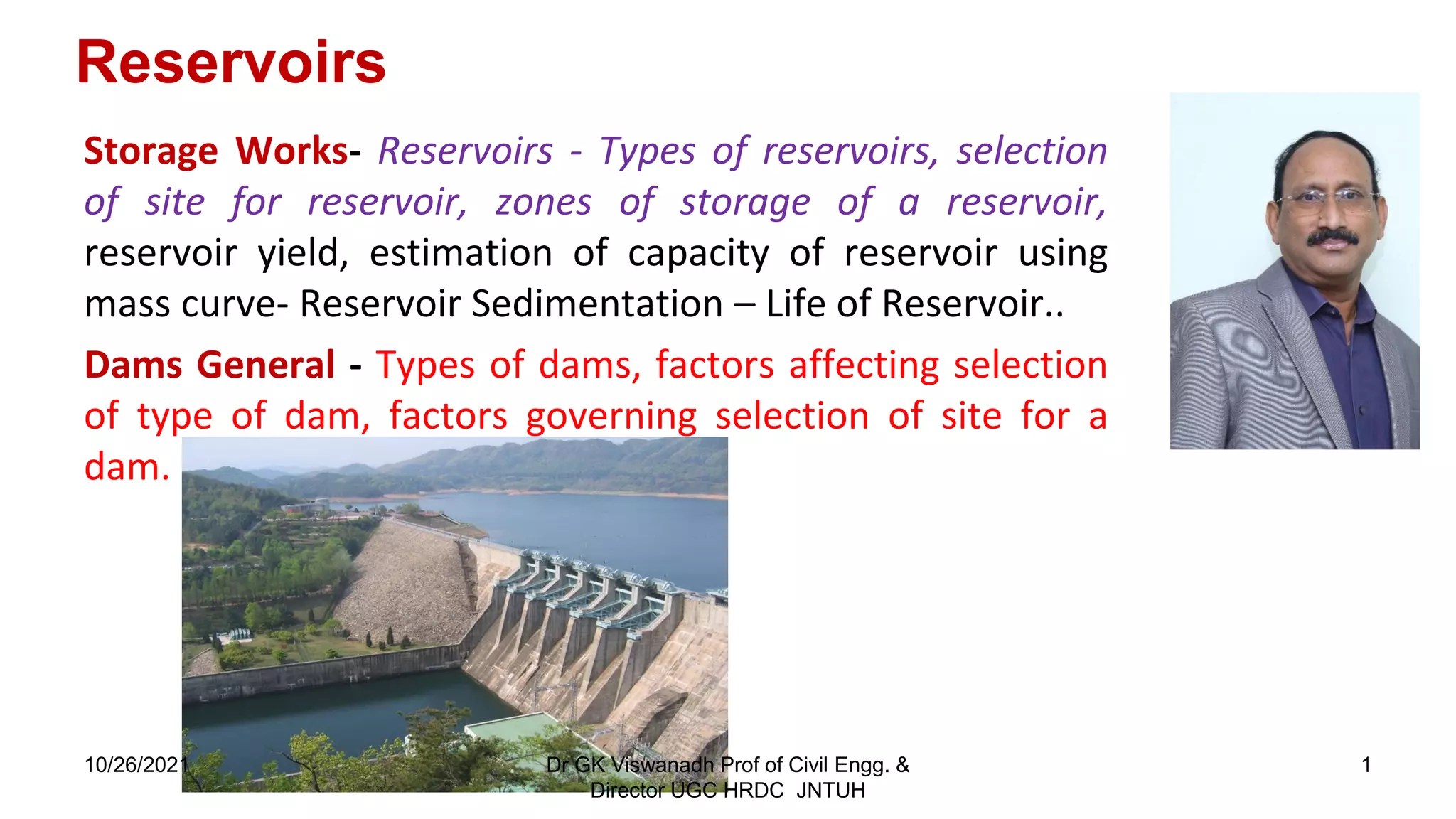
Storage Works- Reservoirs - Types of reservoirs, selection
of site for reservoir, zones of storage of a reservoir,
reservoir yield, estimation of capacity of reservoir using
mass curve- Reservoir Sedimentation – Life of Reservoir..
Dams General - Types of dams, factors affecting selection
of type of dam, factors governing selection of site for a
dam.
10/26/2021 Dr GK Viswanadh Prof of Civil Engg. &
Director UGC HRDC JNTUH
1
Types of Dams
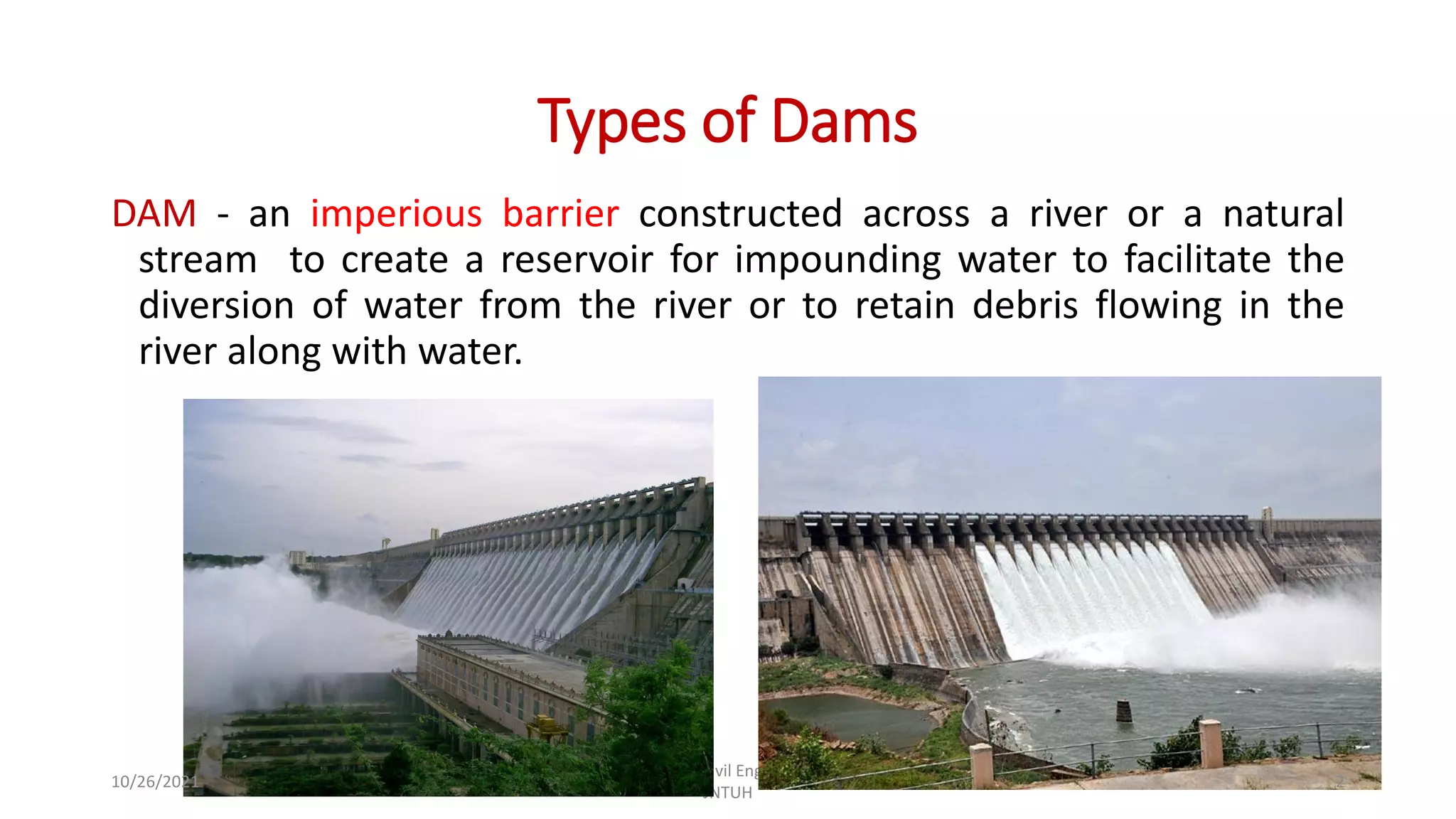
DAM - an imperious barrier constructed across a river or a natural
stream to create a reservoir for impounding water to facilitate the
diversion of water from the river or to retain debris flowing in the
river along with water.
Dr GK Viswanadh Prof of Civil Engg. & Director UGC HRDC
JNTUH
10/26/2021 2
Dr GK Viswanadh Prof of Civil Engg. & Director UGC HRDC
JNTUH
10/26/2021 3
DAMS
Dr GK Viswanadh Prof of Civil Engg. & Director UGC HRDC
JNTUH
10/26/2021 4
Dr GK Viswanadh Prof of Civil Engg. & Director UGC HRDC
JNTUH
10/26/2021 5
Dr GK Viswanadh Prof of Civil Engg. & Director UGC HRDC
JNTUH
10/26/2021 6
About India’s dams
https://www.youtube.com/watch?v=vBaSD_F1IcI
https://www.youtube.com/watch?v=YnmQdWs1epY
Dr GK Viswanadh Prof of Civil Engg. & Director UGC HRDC
JNTUH
10/26/2021 7
Dams
• Dams may be classified on the basis of their
– Function/purpose
– hydraulic design,
– nature of strength
– materials of construction and
– structural design.
• The selection of the type of a dam to be constructed at a particular site
and the selection site for a particular type of dam are based on several
factors.
• The various forces acting on a dam, in particular on a gravity dam are to
be considered in designing the dam.
Dr GK Viswanadh Prof of Civil Engg. & Director UGC HRDC
JNTUH
10/26/2021 8
Classification of Dams:
I. According to the function/Purpose-
i)Storage dam
ii)Diversion dam
iii) Detention dam
iv) Debris dam
v) Coffer dam
Dr GK Viswanadh Prof of Civil Engg. & Director UGC HRDC
JNTUH
10/26/2021 9
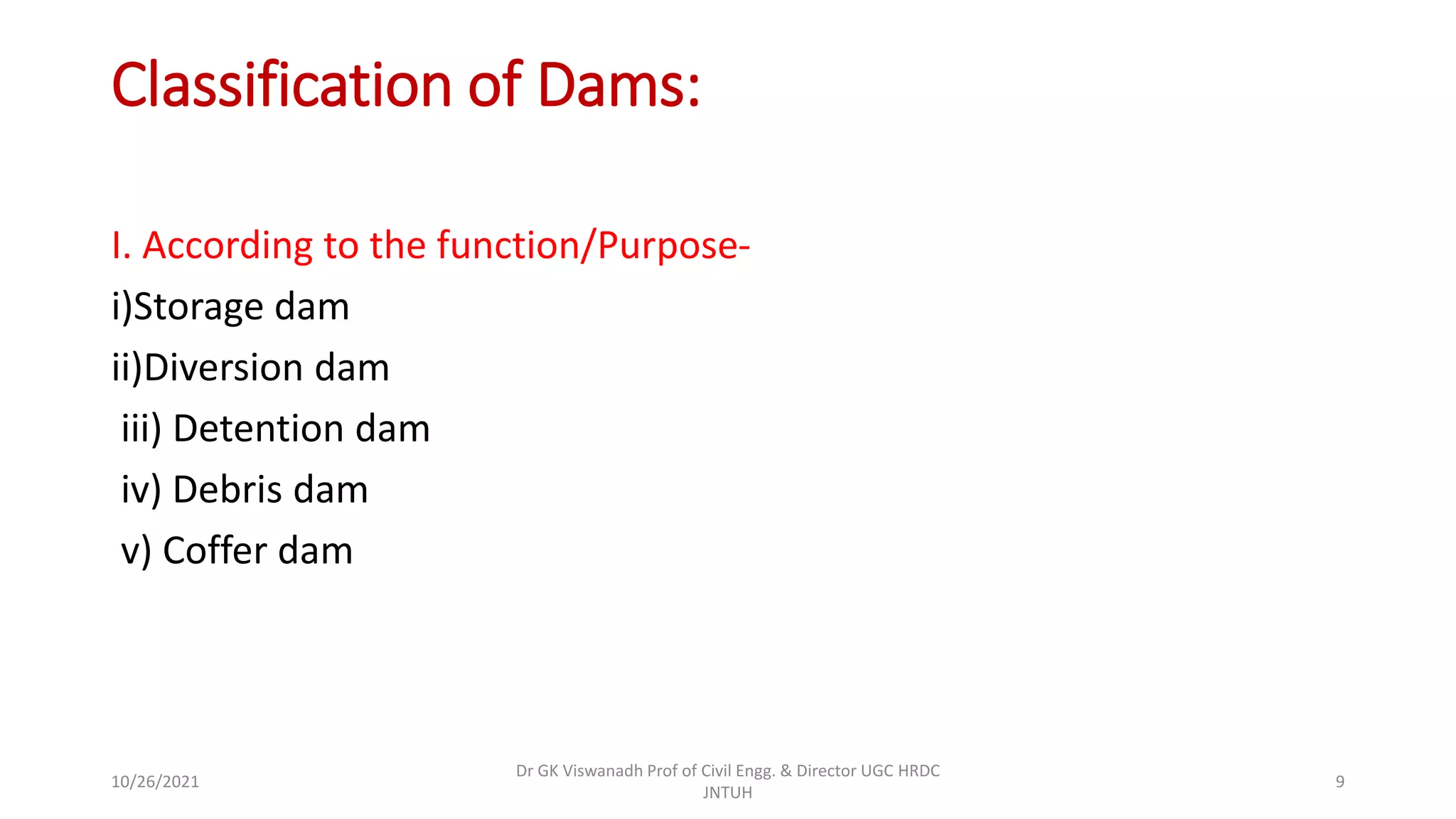
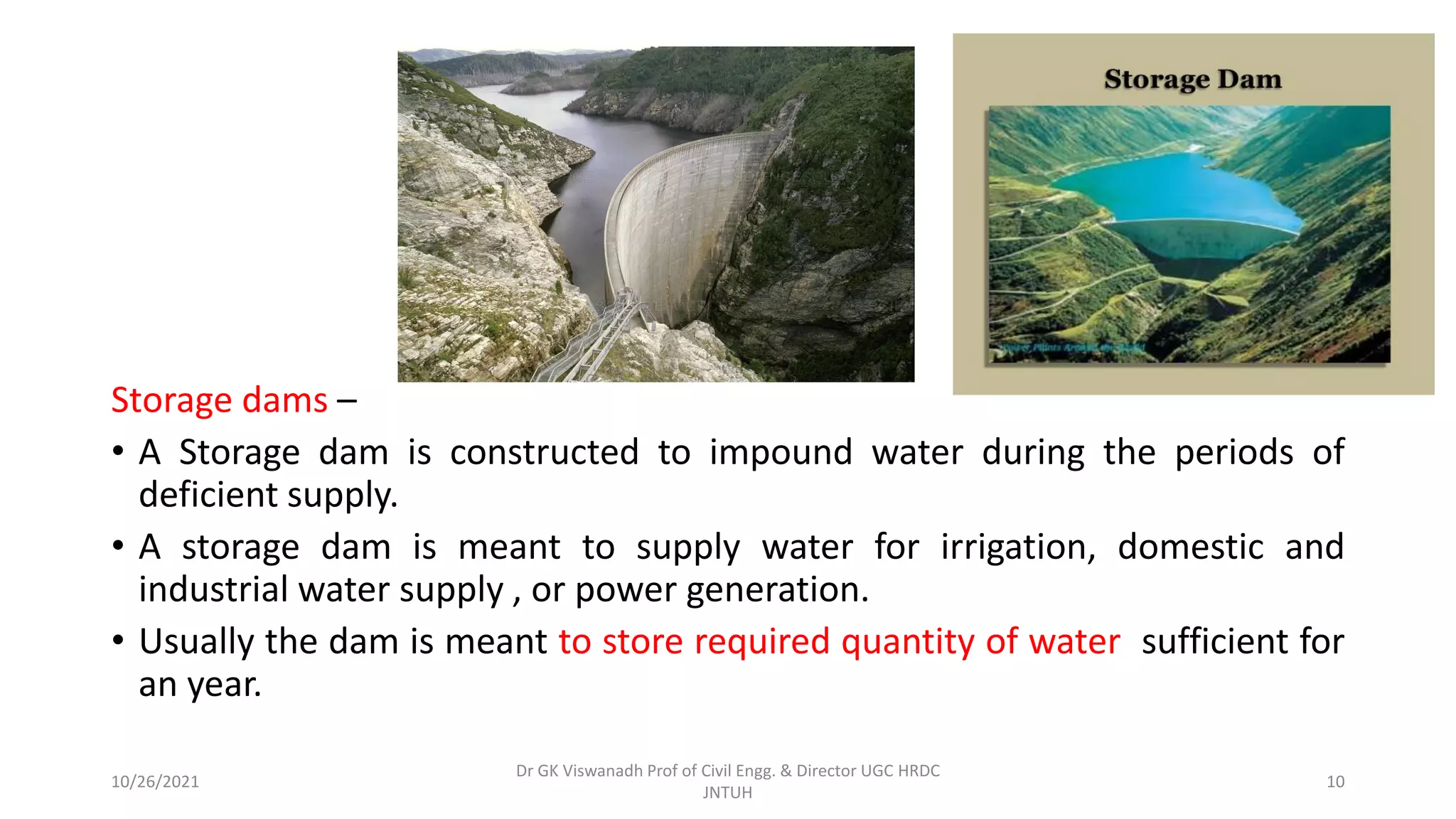
Storage dams –
• A Storage dam is constructed to impound water during the periods of
deficient supply.
• A storage dam is meant to supply water for irrigation, domestic and
industrial water supply , or power generation.
• Usually the dam is meant to store required quantity of water sufficient for
an year.
Dr GK Viswanadh Prof of Civil Engg. & Director UGC HRDC
JNTUH
10/26/2021 10
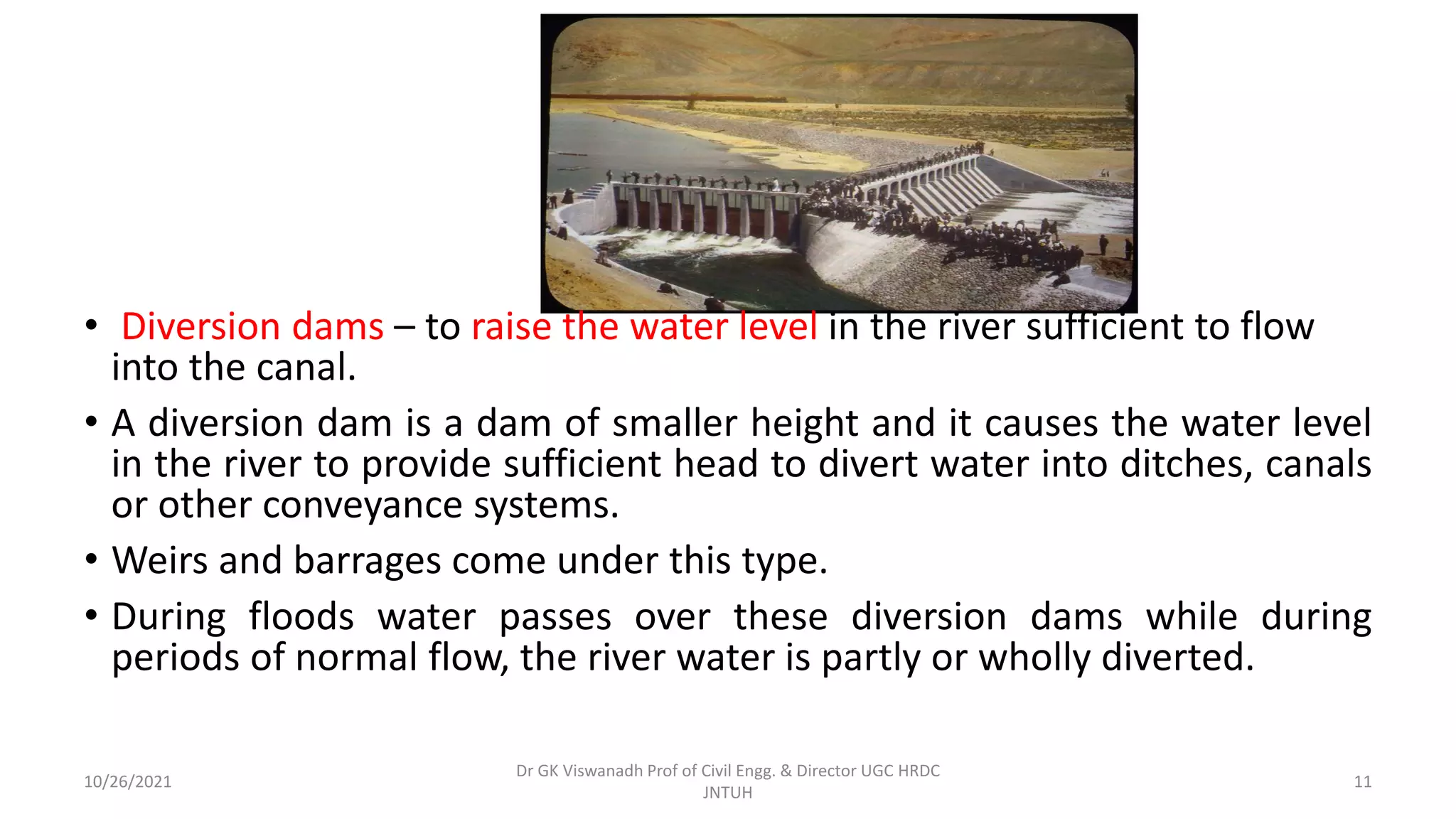
• Diversion dams – to raise the water level in the river sufficient to flow
into the canal.
• A diversion dam is a dam of smaller height and it causes the water level
in the river to provide sufficient head to divert water into ditches, canals
or other conveyance systems.
• Weirs and barrages come under this type.
• During floods water passes over these diversion dams while during
periods of normal flow, the river water is partly or wholly diverted.
Dr GK Viswanadh Prof of Civil Engg. & Director UGC HRDC
JNTUH
10/26/2021 11
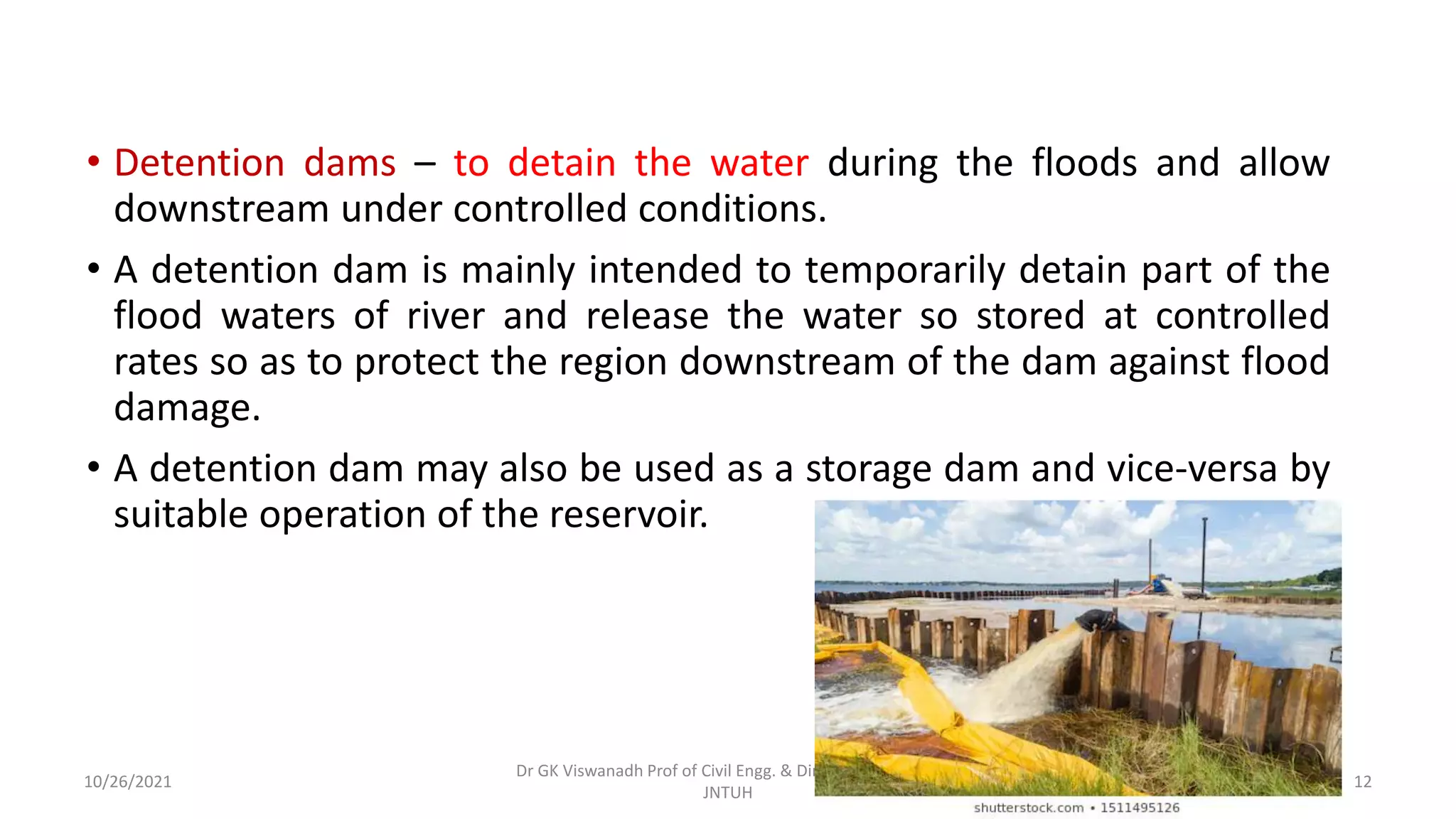
• Detention dams – to detain the water during the floods and allow
downstream under controlled conditions.
• A detention dam is mainly intended to temporarily detain part of the
flood waters of river and release the water so stored at controlled
rates so as to protect the region downstream of the dam against flood
damage.
• A detention dam may also be used as a storage dam and vice-versa by
suitable operation of the reservoir.
Dr GK Viswanadh Prof of Civil Engg. & Director UGC HRDC
JNTUH
10/26/2021 12
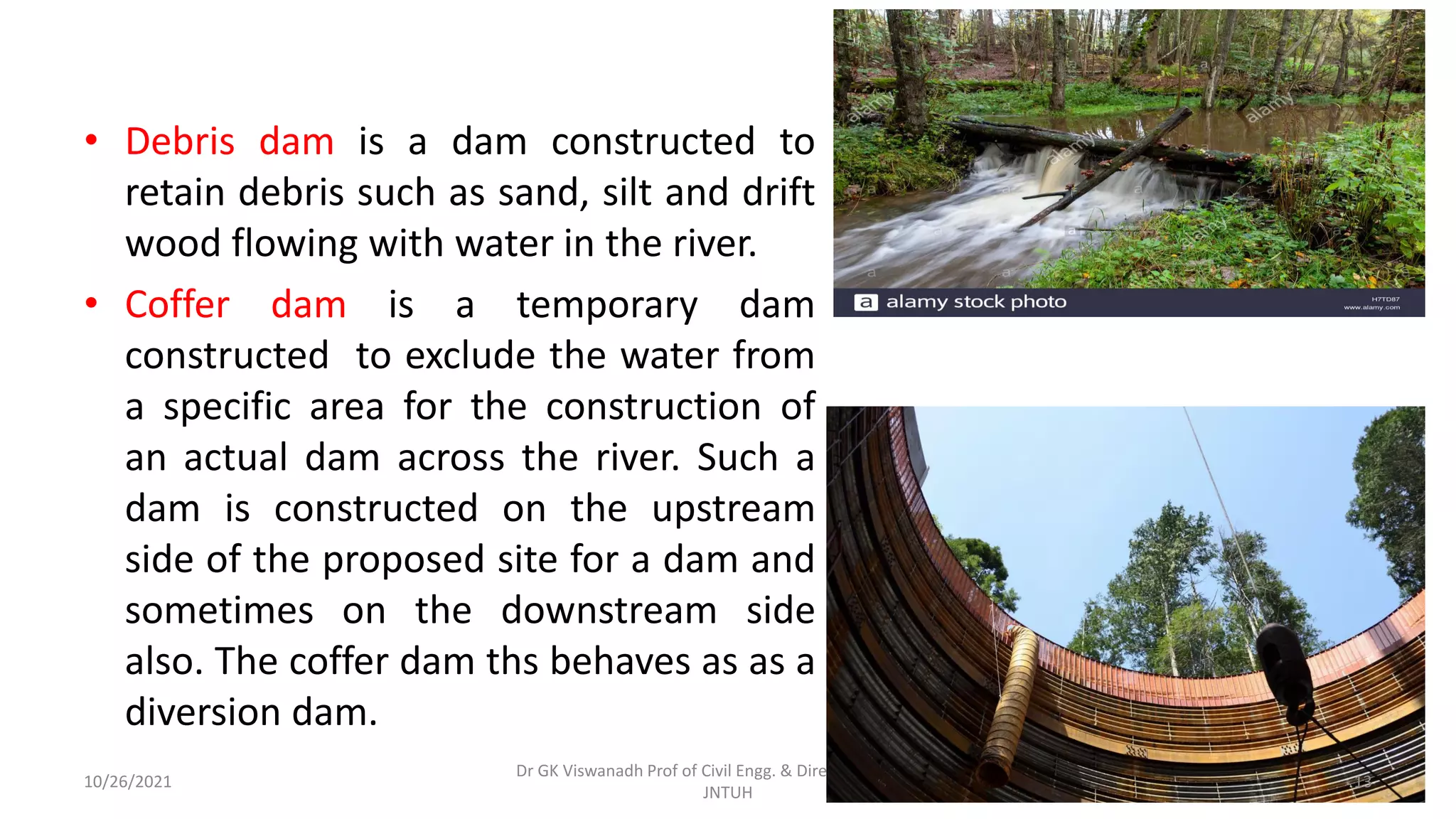
• Debris dam is a dam constructed to
retain debris such as sand, silt and drift
wood flowing with water in the river.
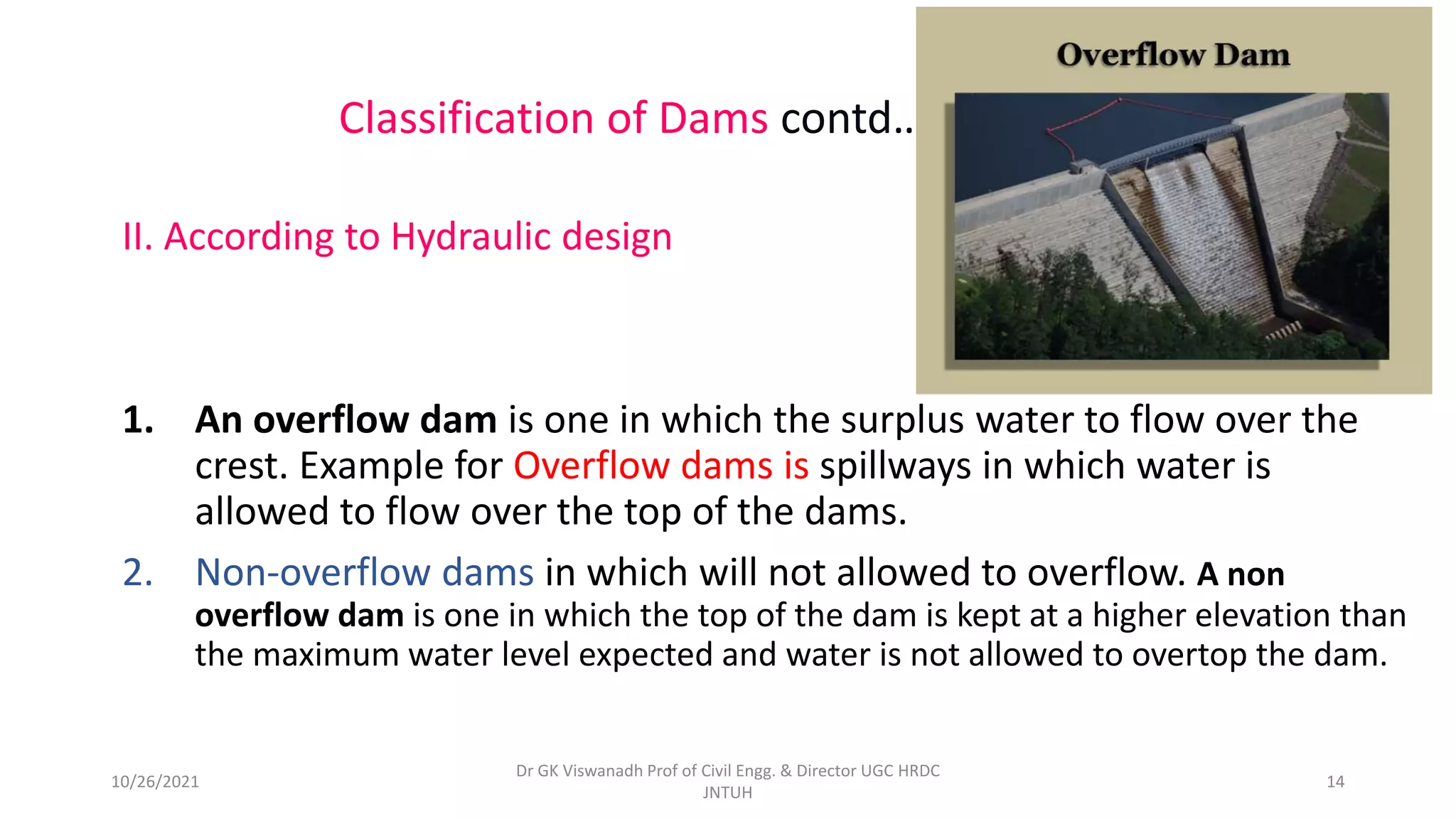
• Coffer dam is a temporary dam
constructed to exclude the water from
a specific area for the construction of
an actual dam across the river. Such a
dam is constructed on the upstream
side of the proposed site for a dam and
sometimes on the downstream side
also. The coffer dam ths behaves as as a
diversion dam.
Dr GK Viswanadh Prof of Civil Engg. & Director UGC HRDC
JNTUH
10/26/2021 13
II. According to Hydraulic design
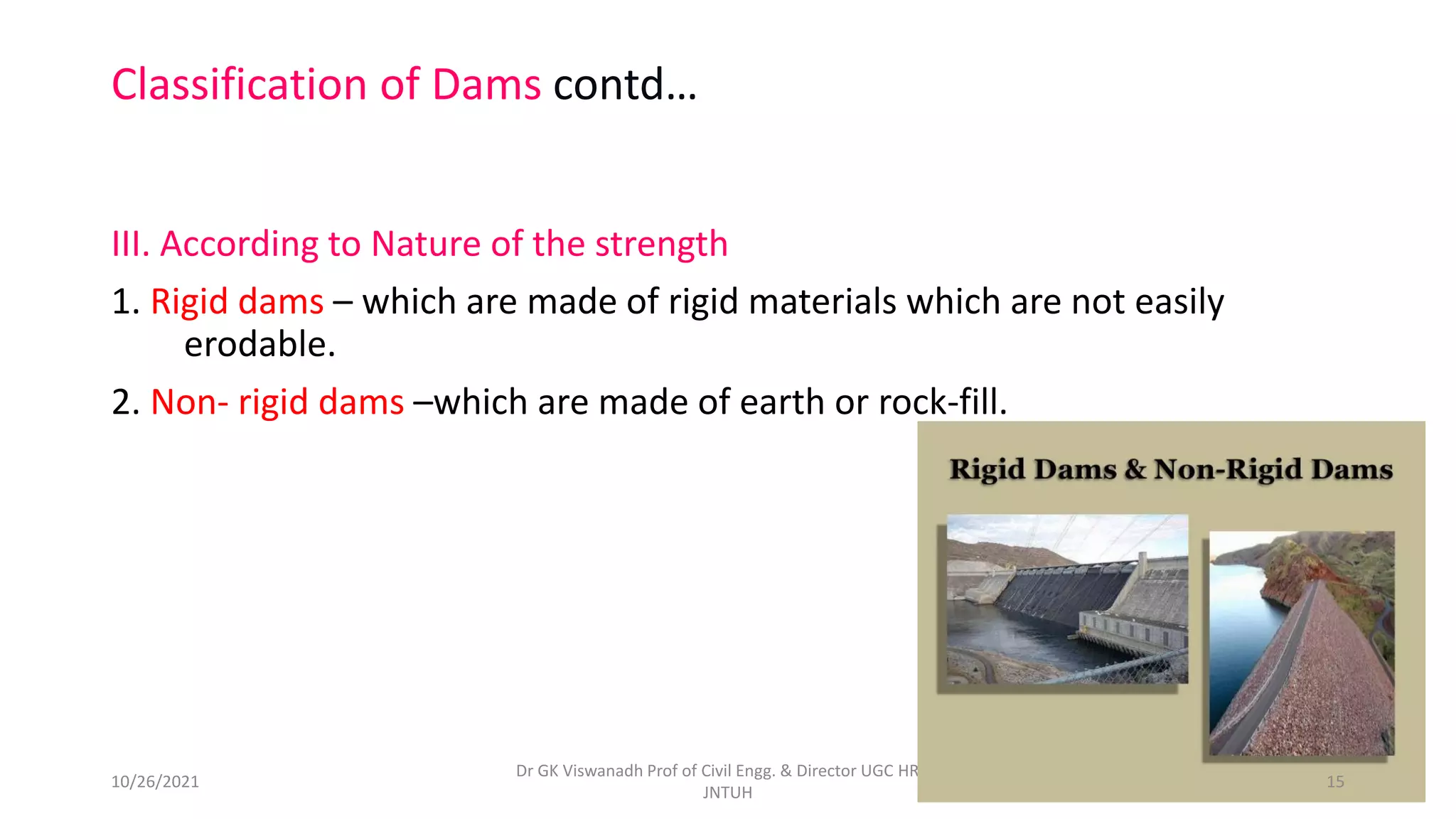
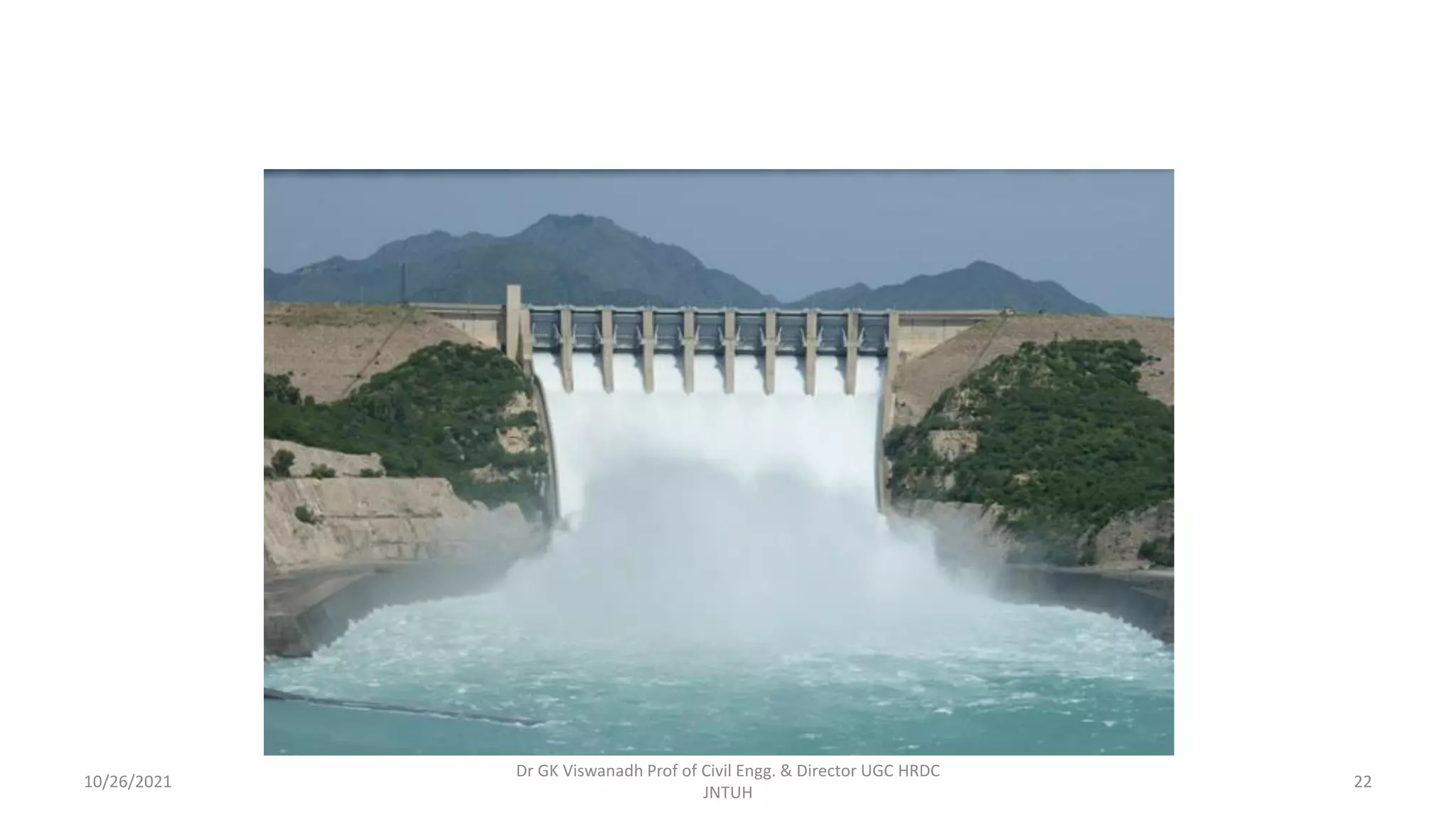
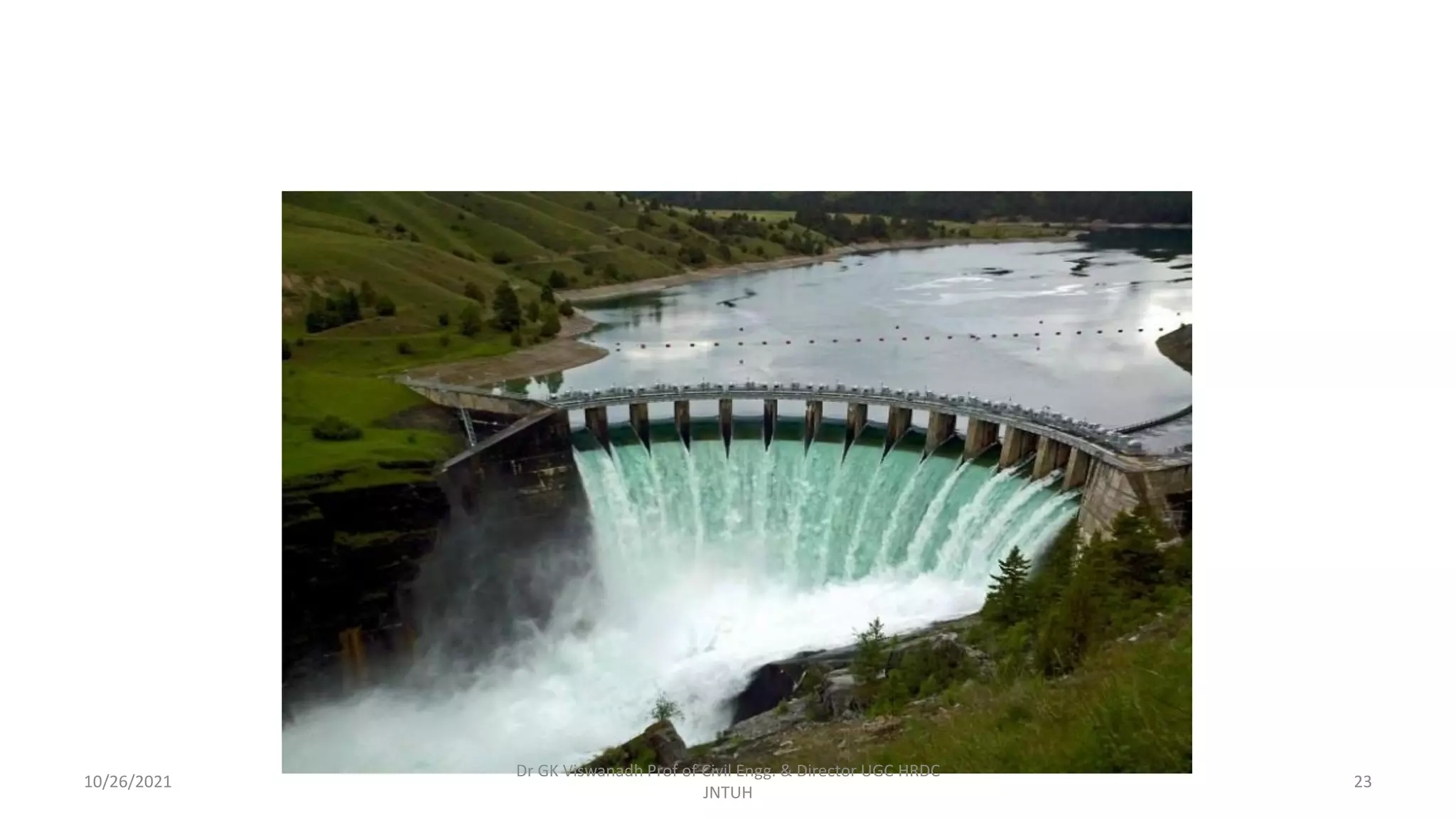
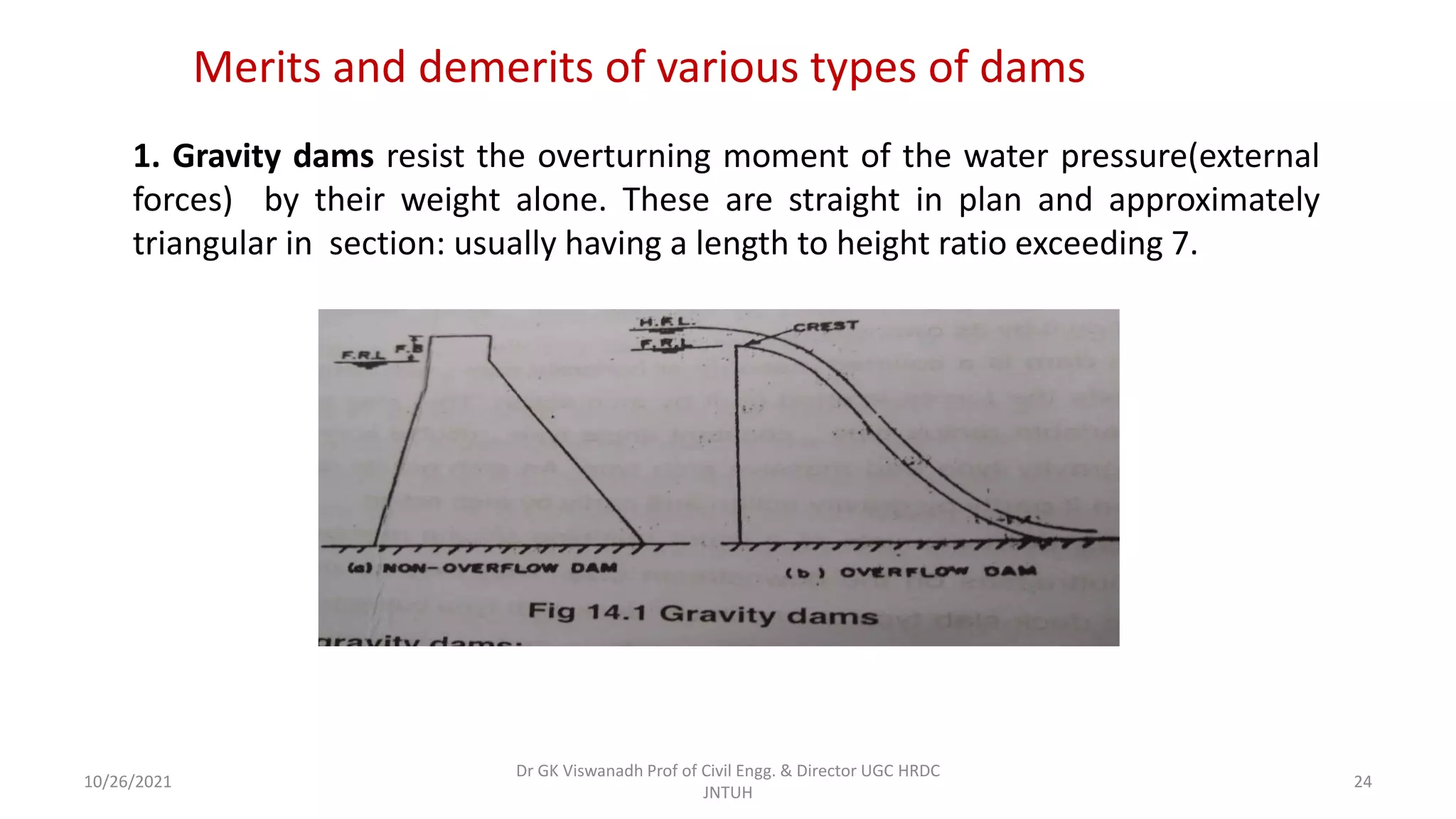
1. An overflow dam is one in which the surplus water to flow over the
crest. Example for Overflow dams is spillways in which water is
allowed to flow over the top of the dams.
2. Non-overflow dams in which will not allowed to overflow. A non
overflow dam is one in which the top of the dam is kept at a higher elevation than
the maximum water level expected and water is not allowed to overtop the dam.
Classification of Dams contd…
Dr GK Viswanadh Prof of Civil Engg. & Director UGC HRDC
JNTUH
10/26/2021 14
Classification of Dams contd…
III. According to Nature of the strength
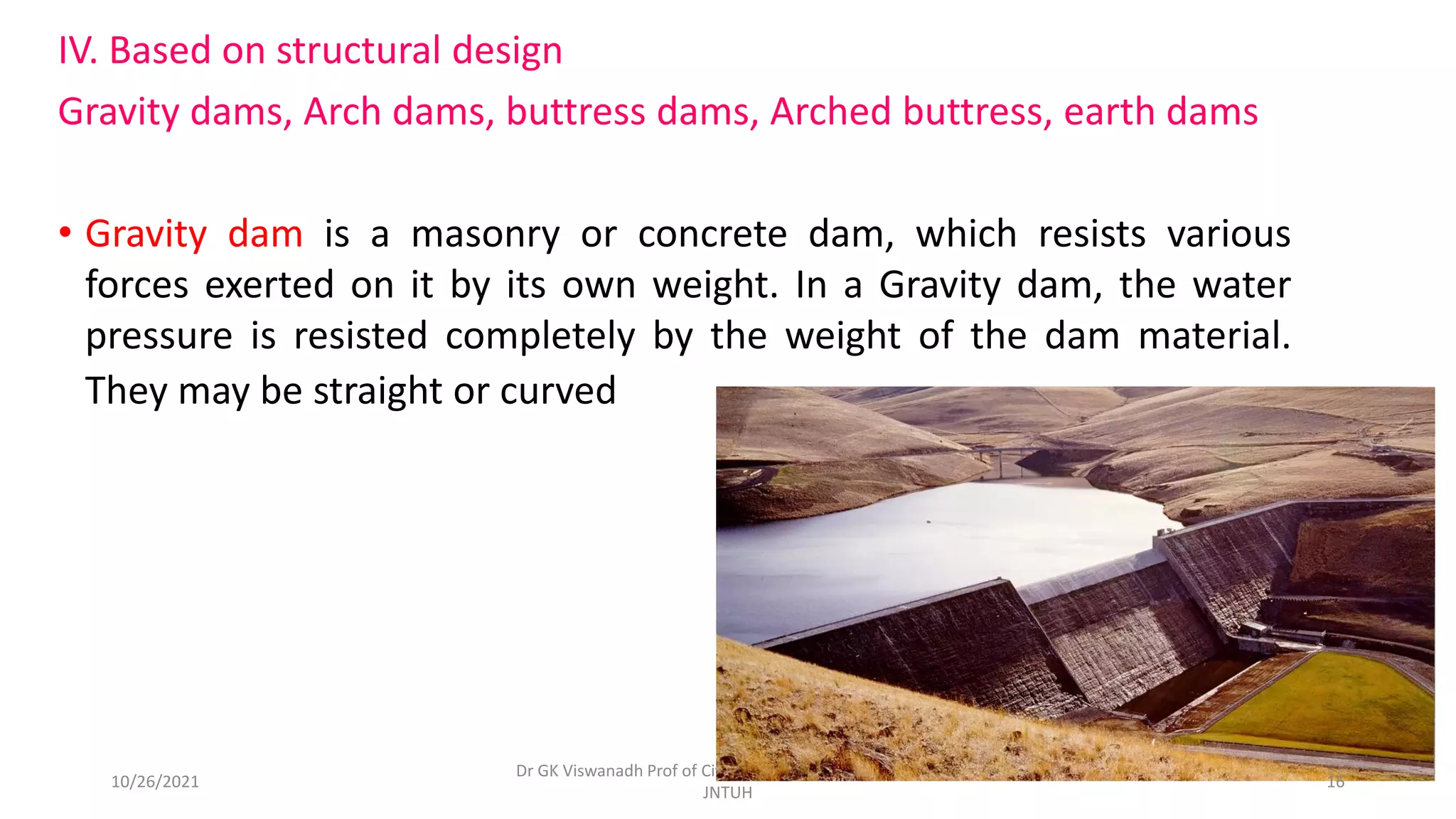
1. Rigid dams – which are made of rigid materials which are not easily
erodable.
2. Non- rigid dams –which are made of earth or rock-fill.
Dr GK Viswanadh Prof of Civil Engg. & Director UGC HRDC
JNTUH
10/26/2021 15
IV. Based on structural design
Gravity dams, Arch dams, buttress dams, Arched buttress, earth dams
• Gravity dam is a masonry or concrete dam, which resists various
forces exerted on it by its own weight. In a Gravity dam, the water
pressure is resisted completely by the weight of the dam material.
They may be straight or curved .
Dr GK Viswanadh Prof of Civil Engg. & Director UGC HRDC
JNTUH
10/26/2021 16
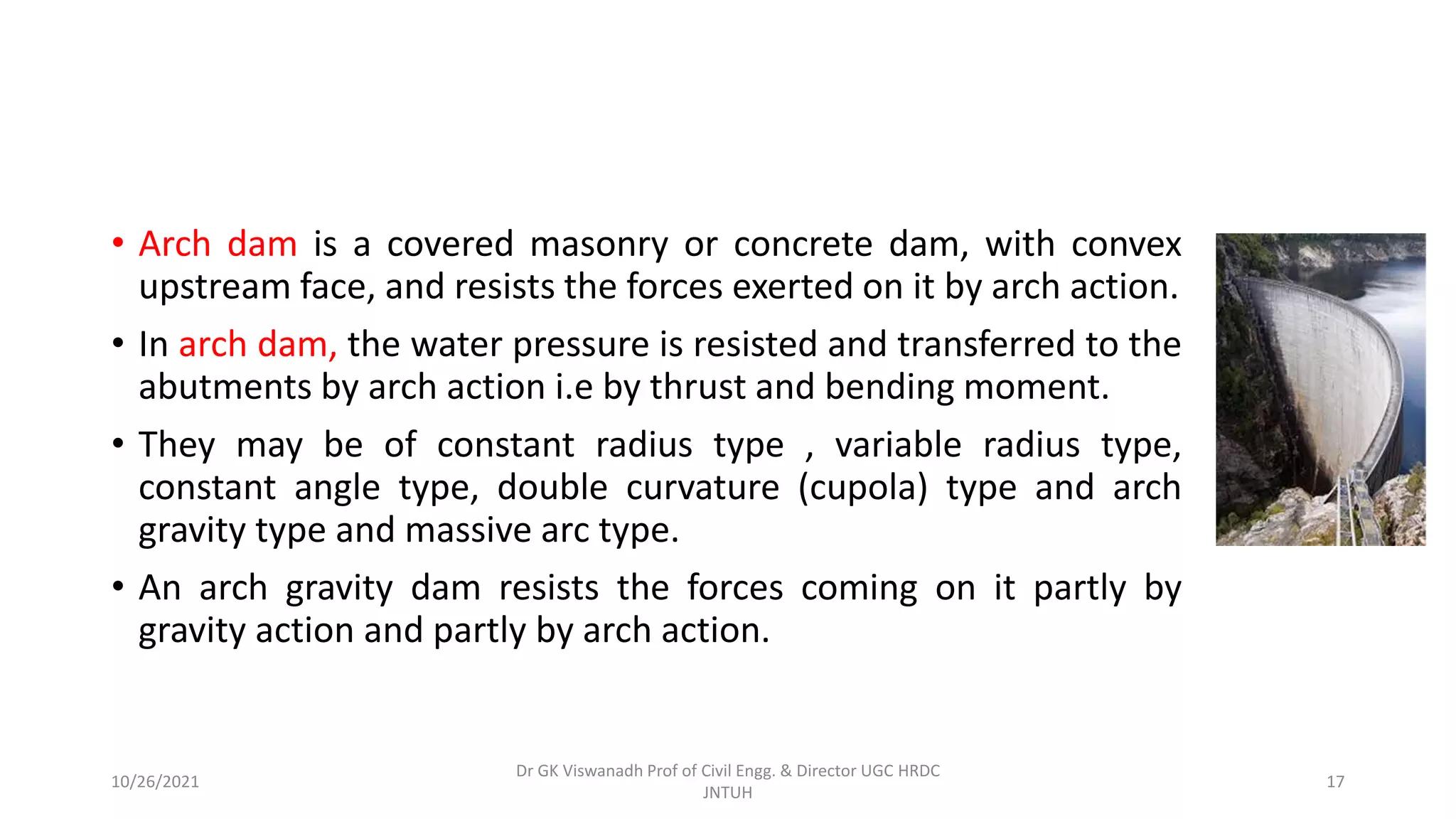
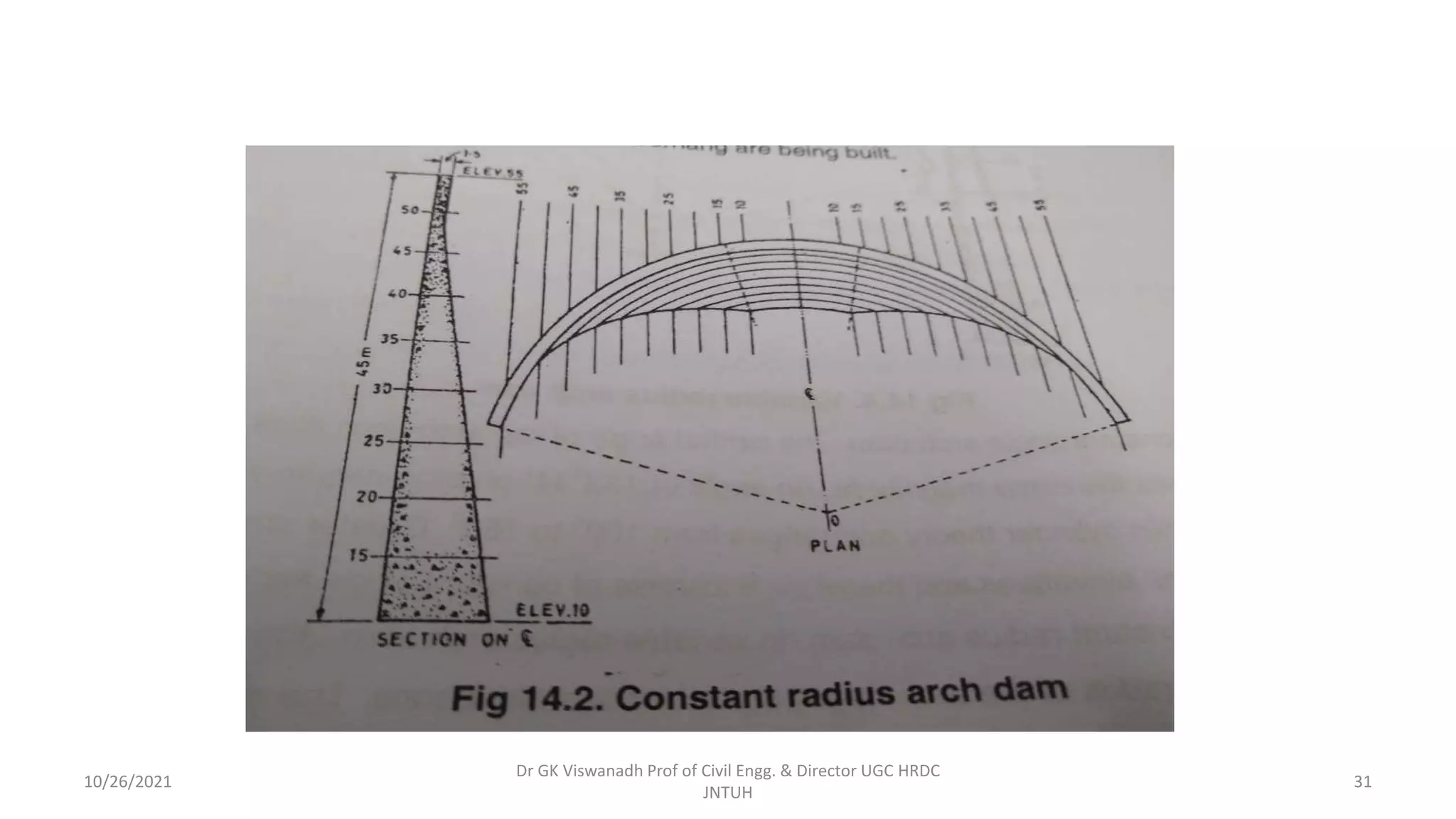
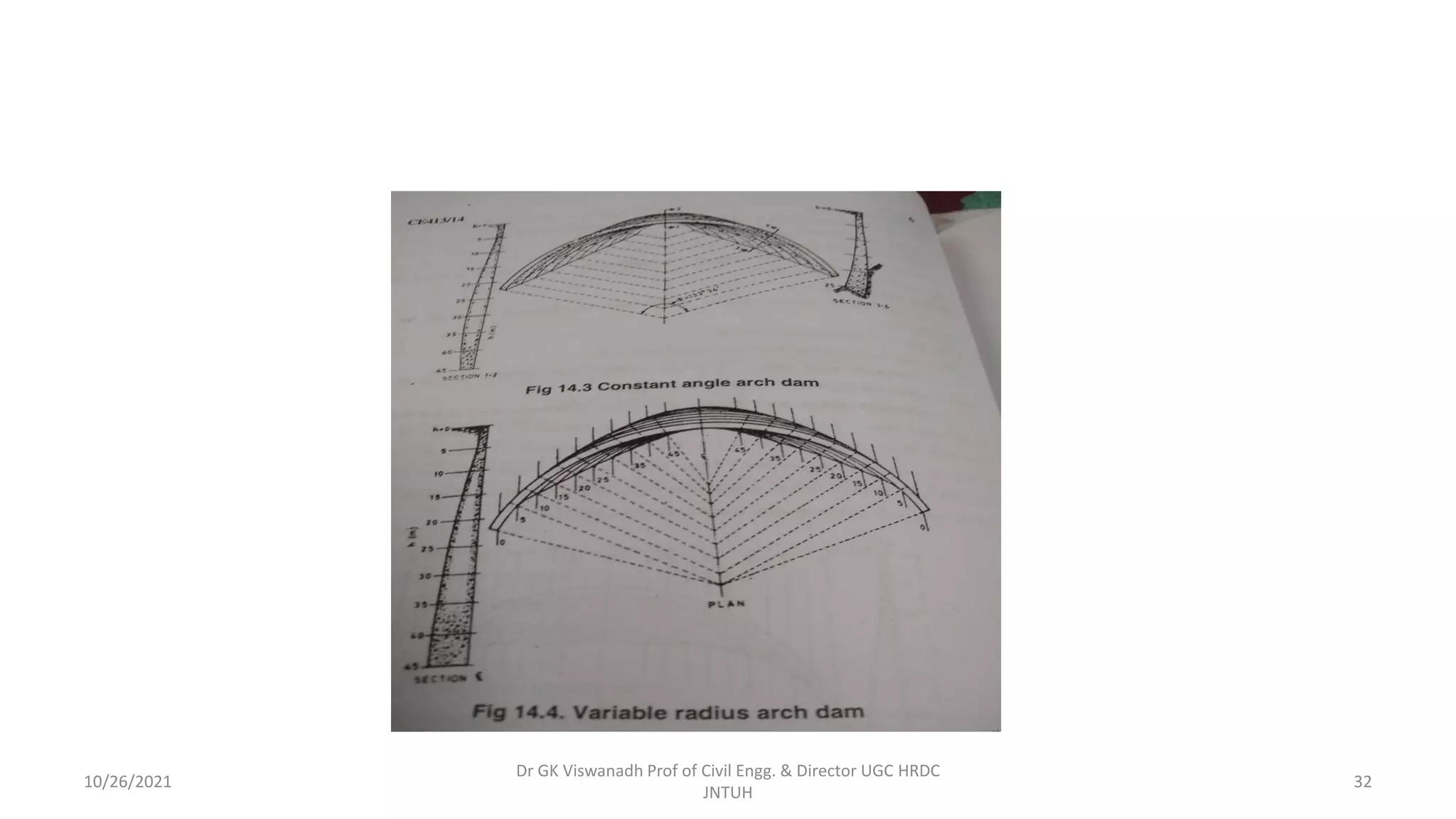
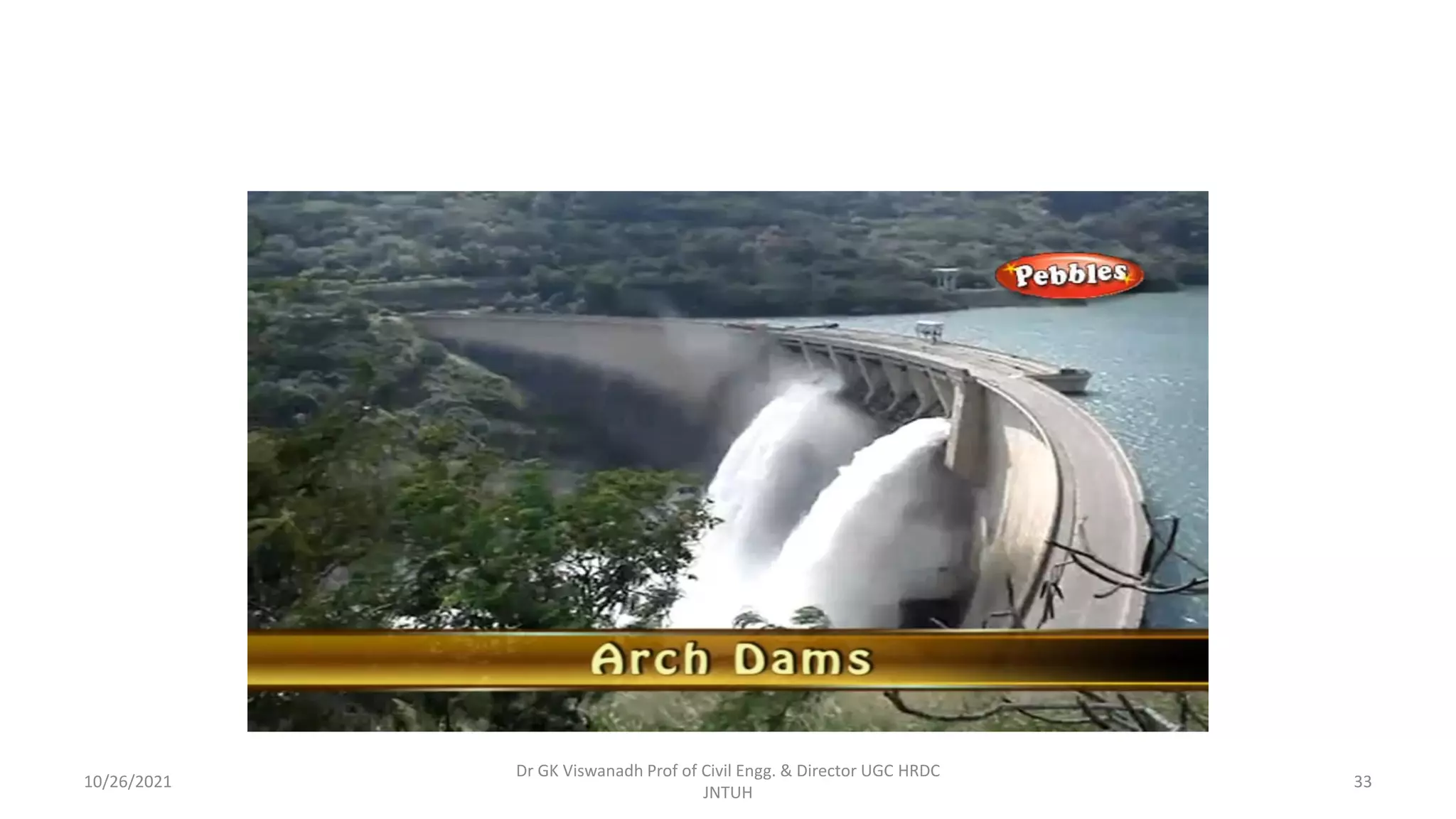
• Arch dam is a covered masonry or concrete dam, with convex
upstream face, and resists the forces exerted on it by arch action.
• In arch dam, the water pressure is resisted and transferred to the
abutments by arch action i.e by thrust and bending moment.
• They may be of constant radius type , variable radius type,
constant angle type, double curvature (cupola) type and arch
gravity type and massive arc type.
• An arch gravity dam resists the forces coming on it partly by
gravity action and partly by arch action.
Dr GK Viswanadh Prof of Civil Engg. & Director UGC HRDC
JNTUH
10/26/2021 17
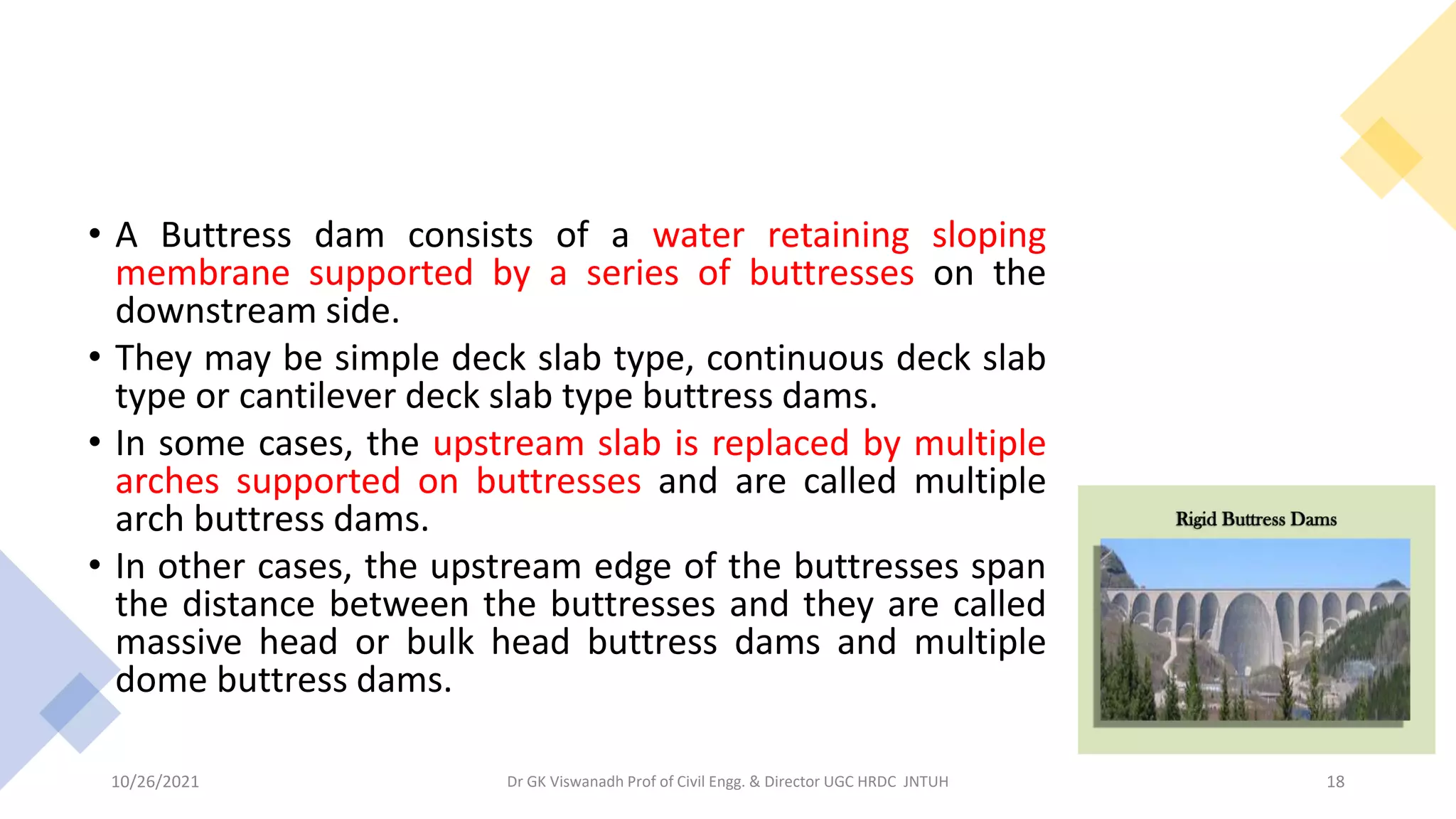
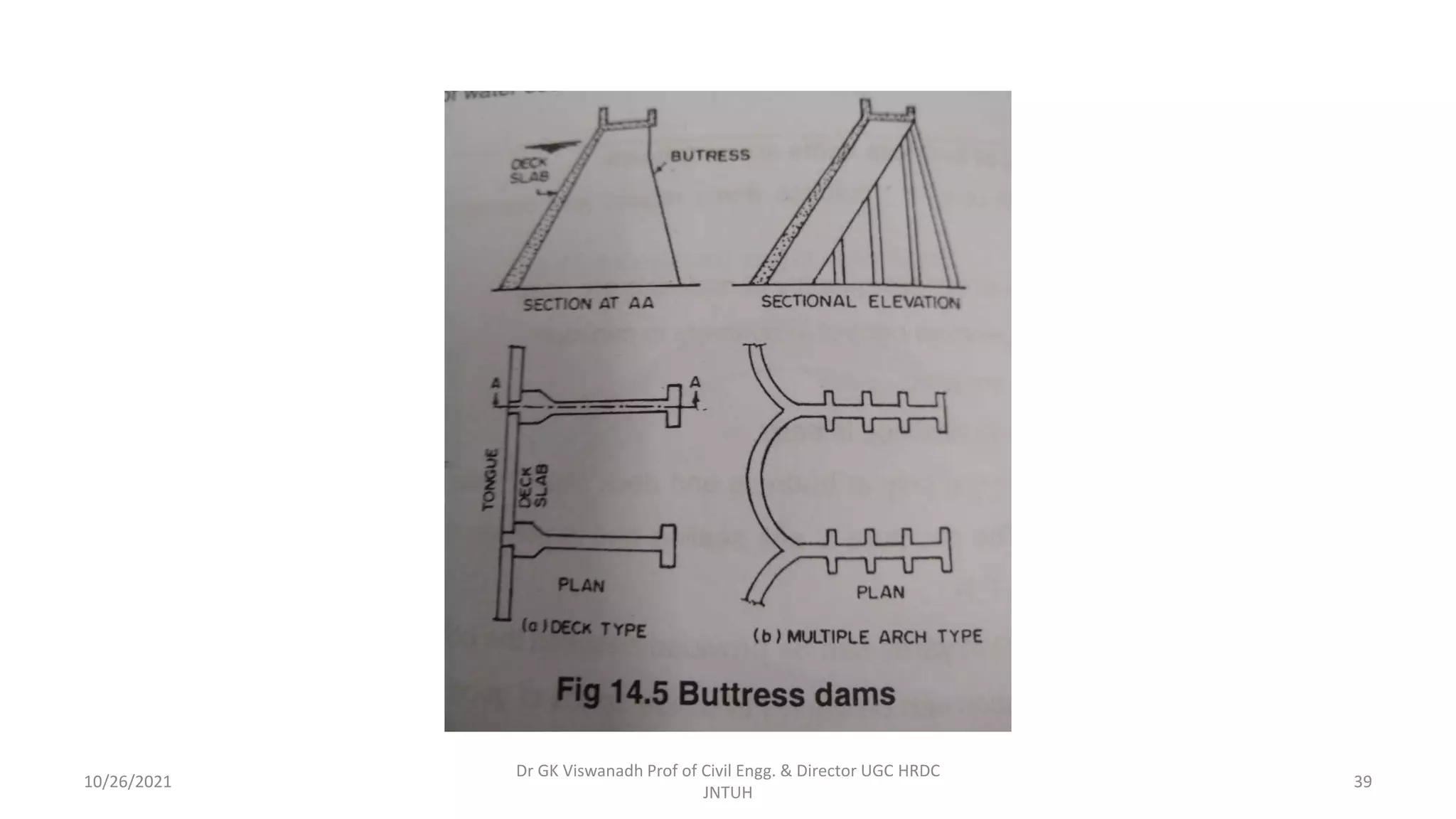
• A Buttress dam consists of a water retaining sloping
membrane supported by a series of buttresses on the
downstream side.
• They may be simple deck slab type, continuous deck slab
type or cantilever deck slab type buttress dams.
• In some cases, the upstream slab is replaced by multiple
arches supported on buttresses and are called multiple
arch buttress dams.
• In other cases, the upstream edge of the buttresses span
the distance between the buttresses and they are called
massive head or bulk head buttress dams and multiple
dome buttress dams.
Dr GK Viswanadh Prof of Civil Engg. & Director UGC HRDC JNTUH
10/26/2021 18
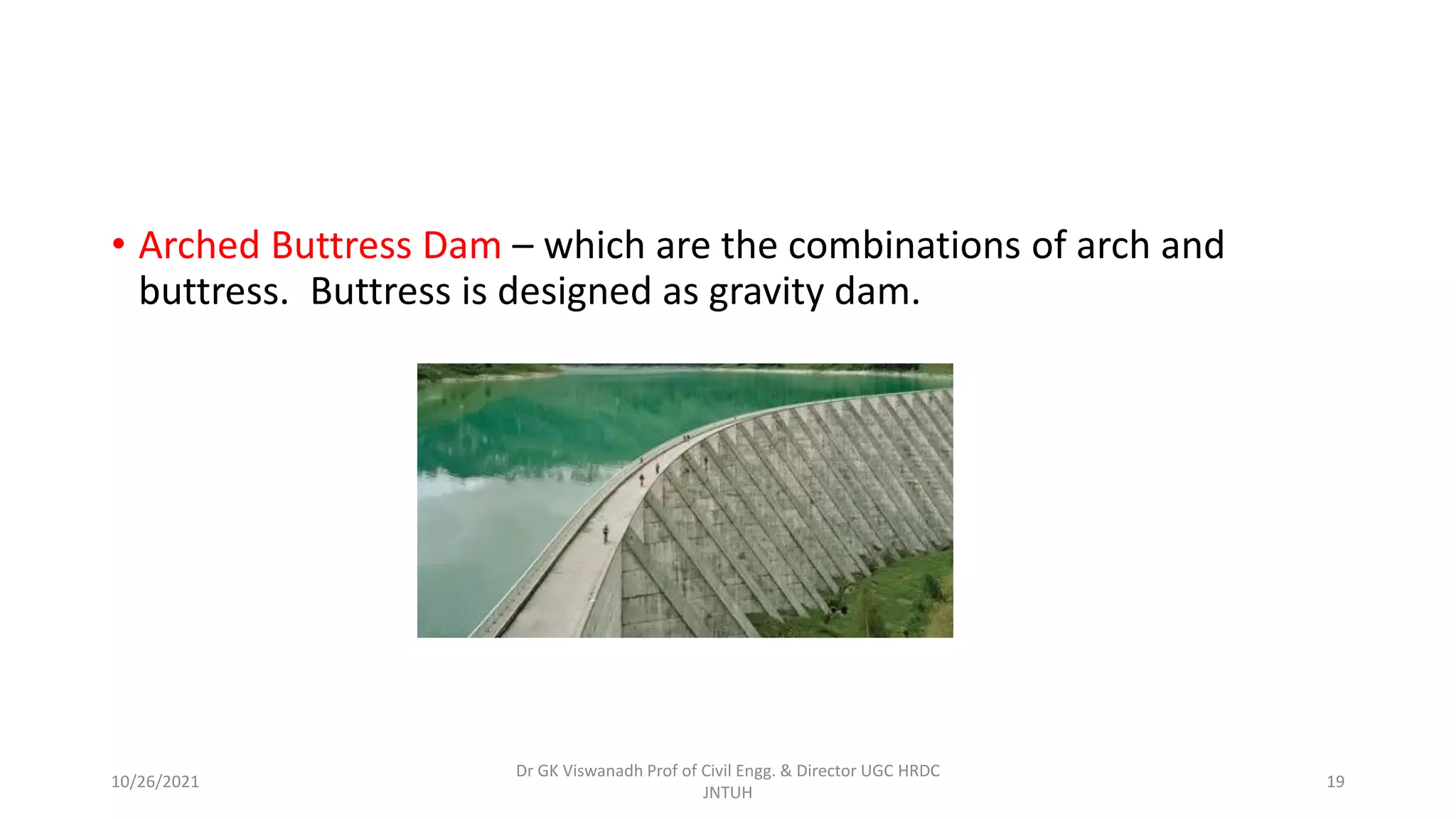
• Arched Buttress Dam – which are the combinations of arch and
buttress. Buttress is designed as gravity dam.
Dr GK Viswanadh Prof of Civil Engg. & Director UGC HRDC
JNTUH
10/26/2021 19
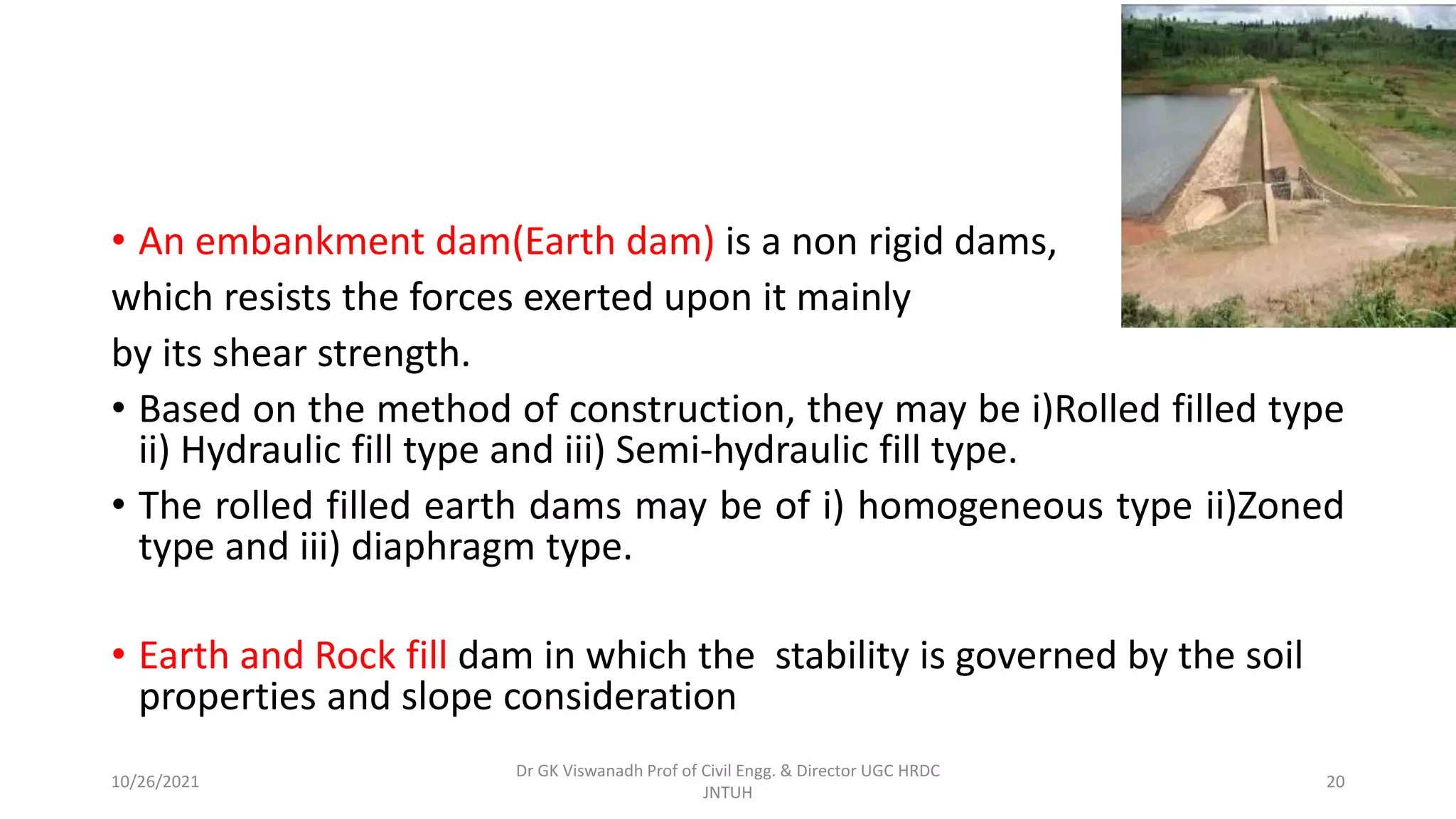
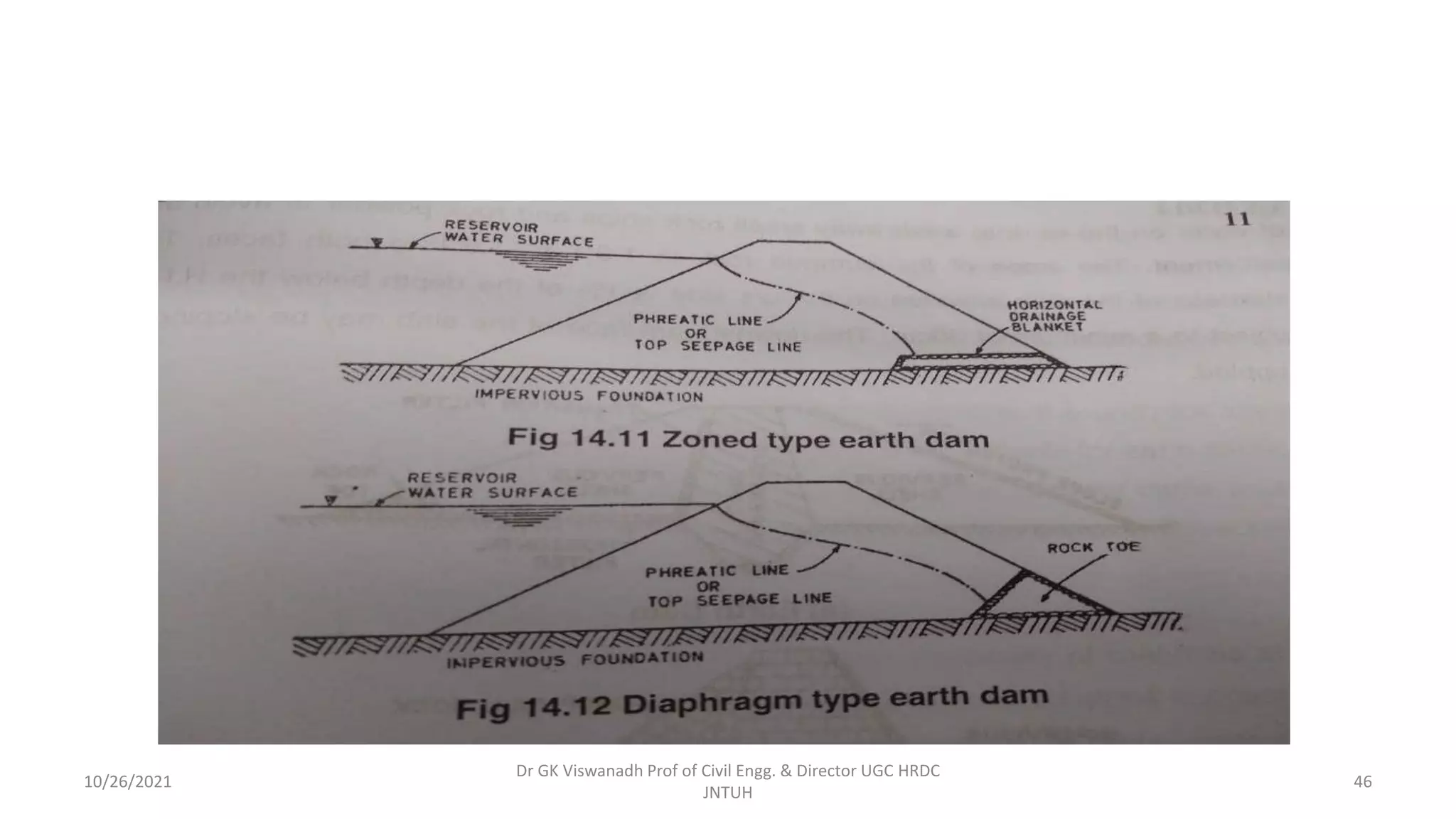
• An embankment dam(Earth dam) is a non rigid dams,
which resists the forces exerted upon it mainly
by its shear strength.
• Based on the method of construction, they may be i)Rolled filled type
ii) Hydraulic fill type and iii) Semi-hydraulic fill type.
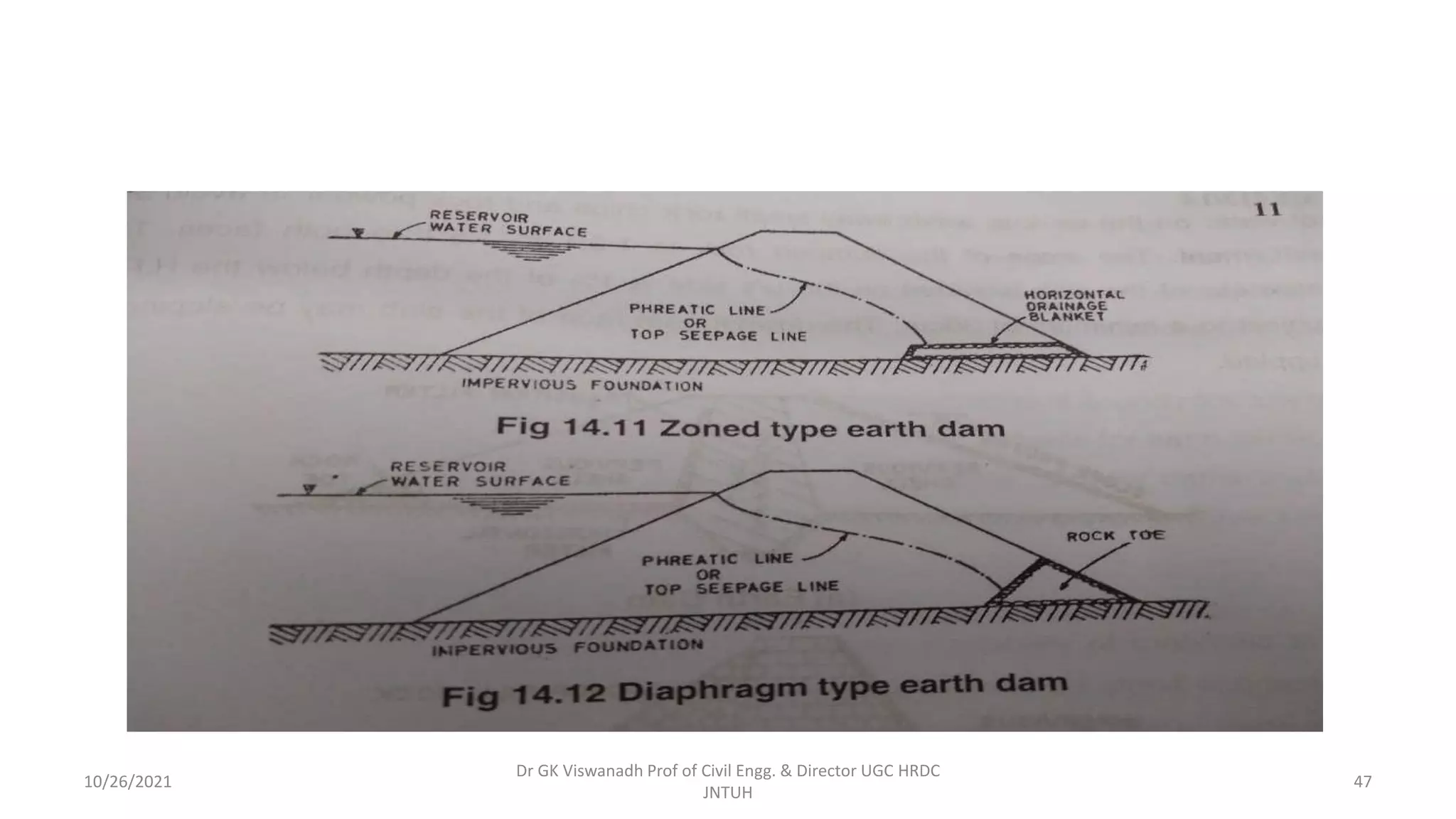
• The rolled filled earth dams may be of i) homogeneous type ii)Zoned
type and iii) diaphragm type.
• Earth and Rock fill dam in which the stability is governed by the soil
properties and slope consideration
Dr GK Viswanadh Prof of Civil Engg. & Director UGC HRDC
JNTUH
10/26/2021 20
V. Based on the material used for construction
1.Masnory or Concrete dams
2.Earth dams
3.Composite dam – A part of the dam is of masonry a and a part of
the dam is to reduce the cost of construction earth.
4.Rock fill dam – Boulders will be based one above the other, to
make the dam imperious a layer of soil is placed above that.
5. Steel dam- lesser height, suitable for small works
6. Timber Dams- purely for temporary purposes. Timber planks
inserted and supported.
Classification of Dams contd…
Dr GK Viswanadh Prof of Civil Engg. & Director UGC HRDC
JNTUH
10/26/2021 21
Dr GK Viswanadh Prof of Civil Engg. & Director UGC HRDC
JNTUH
10/26/2021 22
Dr GK Viswanadh Prof of Civil Engg. & Director UGC HRDC
JNTUH
10/26/2021 23
Merits and demerits of various types of dams
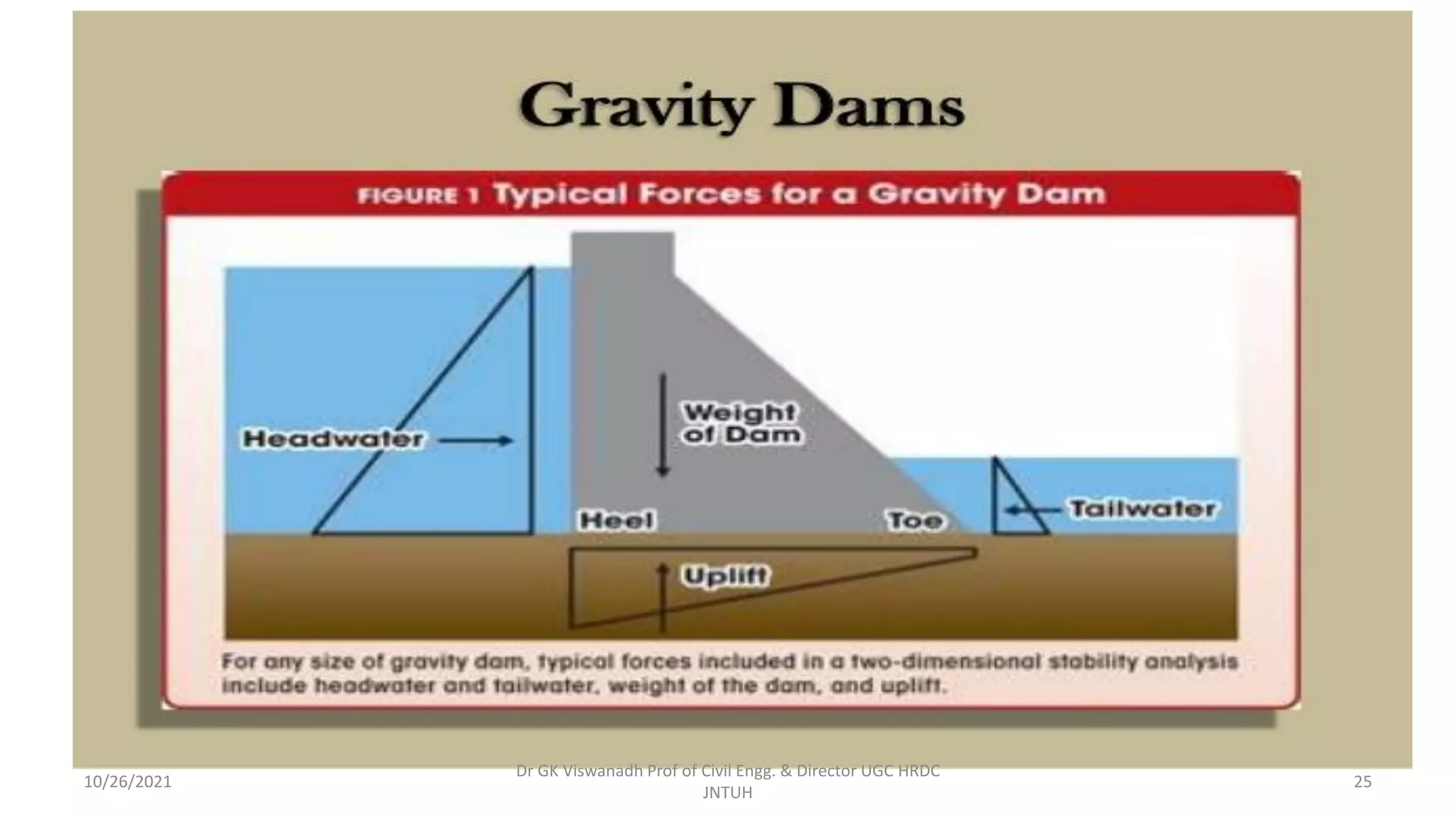
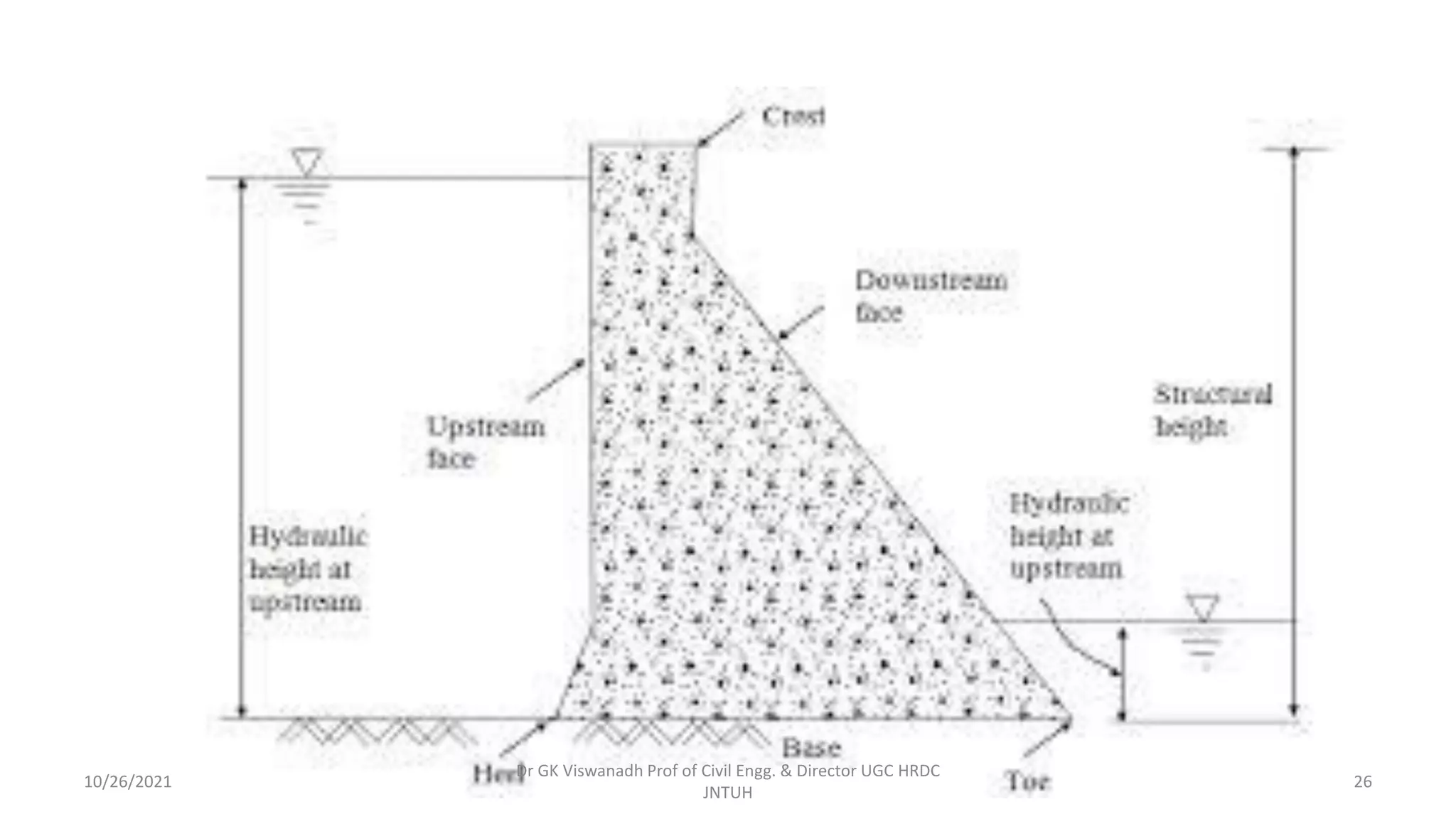
1. Gravity dams resist the overturning moment of the water pressure(external
forces) by their weight alone. These are straight in plan and approximately
triangular in section: usually having a length to height ratio exceeding 7.
Dr GK Viswanadh Prof of Civil Engg. & Director UGC HRDC
JNTUH
10/26/2021 24
Dr GK Viswanadh Prof of Civil Engg. & Director UGC HRDC
JNTUH
10/26/2021 25
Dr GK Viswanadh Prof of Civil Engg. & Director UGC HRDC
JNTUH
10/26/2021 26
Advantages of gravity dams:
1. They are strong and stable.
2. They are adaptable for overflow section.
3. They can be of any height, if suitable foundations are available
4. They require least maintenance cost.
5. Failure, if any, is not sudden.
6. Scouring sluices can be provided in the dam.
7. They are cheaper in the long run.
Dr GK Viswanadh Prof of Civil Engg. & Director UGC HRDC
JNTUH
10/26/2021 27
Disadvantages of gravity dams:
1.They require sound rock foundations
2. Initial cost is high
3. They require skilled labour for construction.
4. They do not allow subsequent raise in the height of dam.
Dr GK Viswanadh Prof of Civil Engg. & Director UGC HRDC
JNTUH
10/26/2021 28
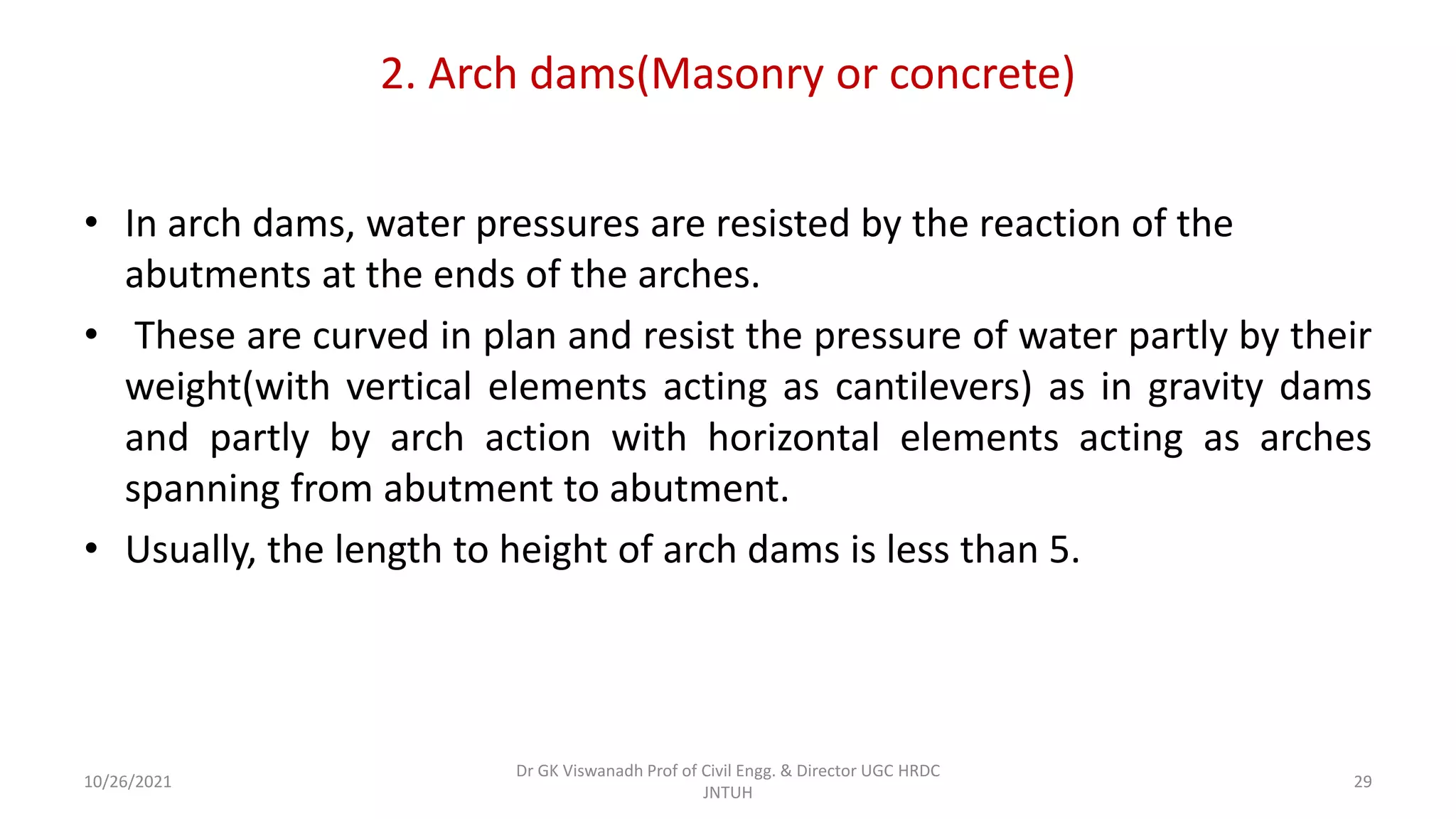
2. Arch dams(Masonry or concrete)
• In arch dams, water pressures are resisted by the reaction of the
abutments at the ends of the arches.
• These are curved in plan and resist the pressure of water partly by their
weight(with vertical elements acting as cantilevers) as in gravity dams
and partly by arch action with horizontal elements acting as arches
spanning from abutment to abutment.
• Usually, the length to height of arch dams is less than 5.
Dr GK Viswanadh Prof of Civil Engg. & Director UGC HRDC
JNTUH
10/26/2021 29
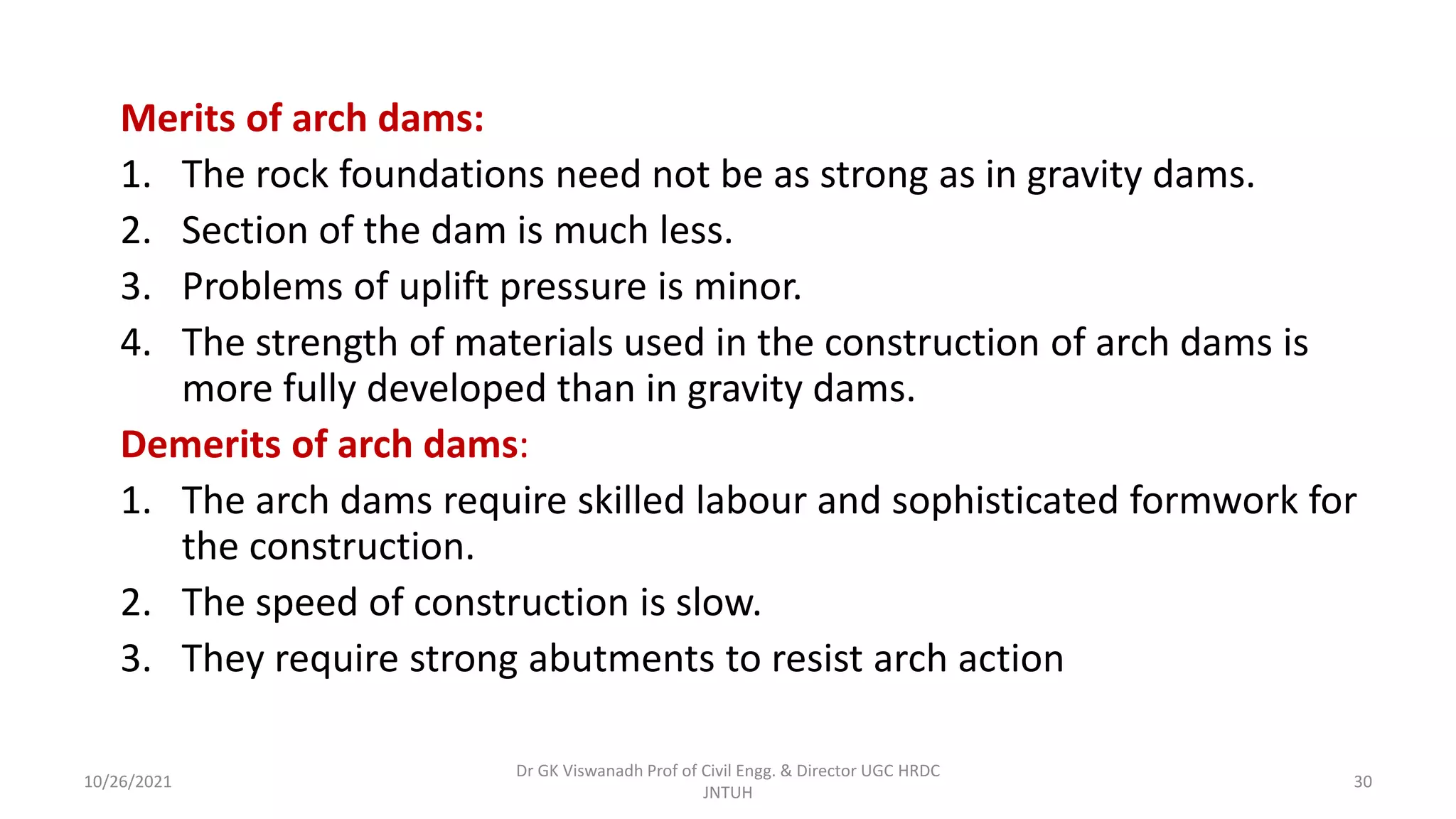
Merits of arch dams:
1. The rock foundations need not be as strong as in gravity dams.
2. Section of the dam is much less.
3. Problems of uplift pressure is minor.
4. The strength of materials used in the construction of arch dams is
more fully developed than in gravity dams.
Demerits of arch dams:
1. The arch dams require skilled labour and sophisticated formwork for
the construction.
2. The speed of construction is slow.
3. They require strong abutments to resist arch action
Dr GK Viswanadh Prof of Civil Engg. & Director UGC HRDC
JNTUH
10/26/2021 30
Dr GK Viswanadh Prof of Civil Engg. & Director UGC HRDC
JNTUH
10/26/2021 31
Dr GK Viswanadh Prof of Civil Engg. & Director UGC HRDC
JNTUH
10/26/2021 32
Dr GK Viswanadh Prof of Civil Engg. & Director UGC HRDC
JNTUH
10/26/2021 33
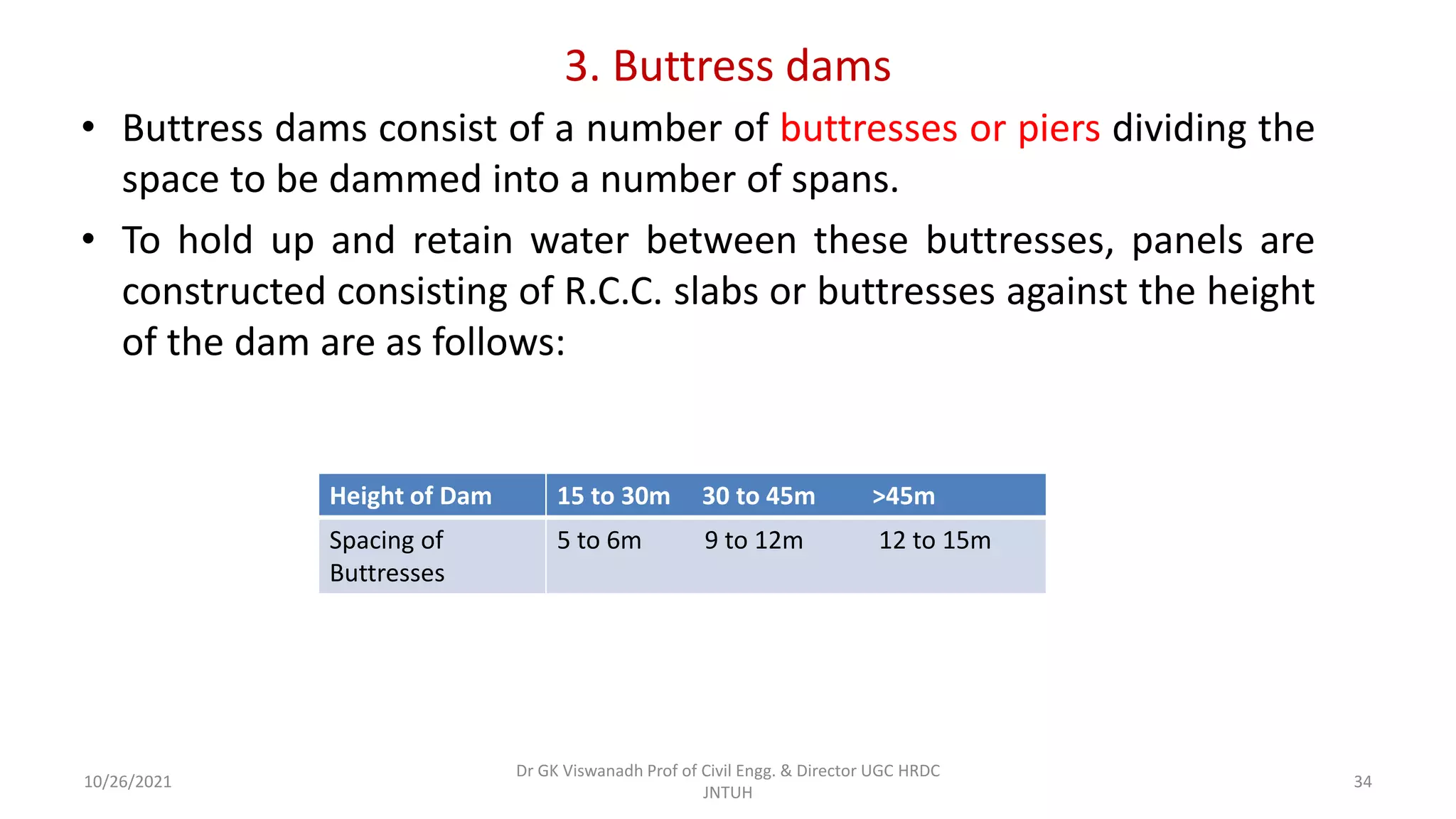
3. Buttress dams
• Buttress dams consist of a number of buttresses or piers dividing the
space to be dammed into a number of spans.
• To hold up and retain water between these buttresses, panels are
constructed consisting of R.C.C. slabs or buttresses against the height
of the dam are as follows:
Height of Dam 15 to 30m 30 to 45m >45m
Spacing of
Buttresses
5 to 6m 9 to 12m 12 to 15m
Dr GK Viswanadh Prof of Civil Engg. & Director UGC HRDC
JNTUH
10/26/2021 34
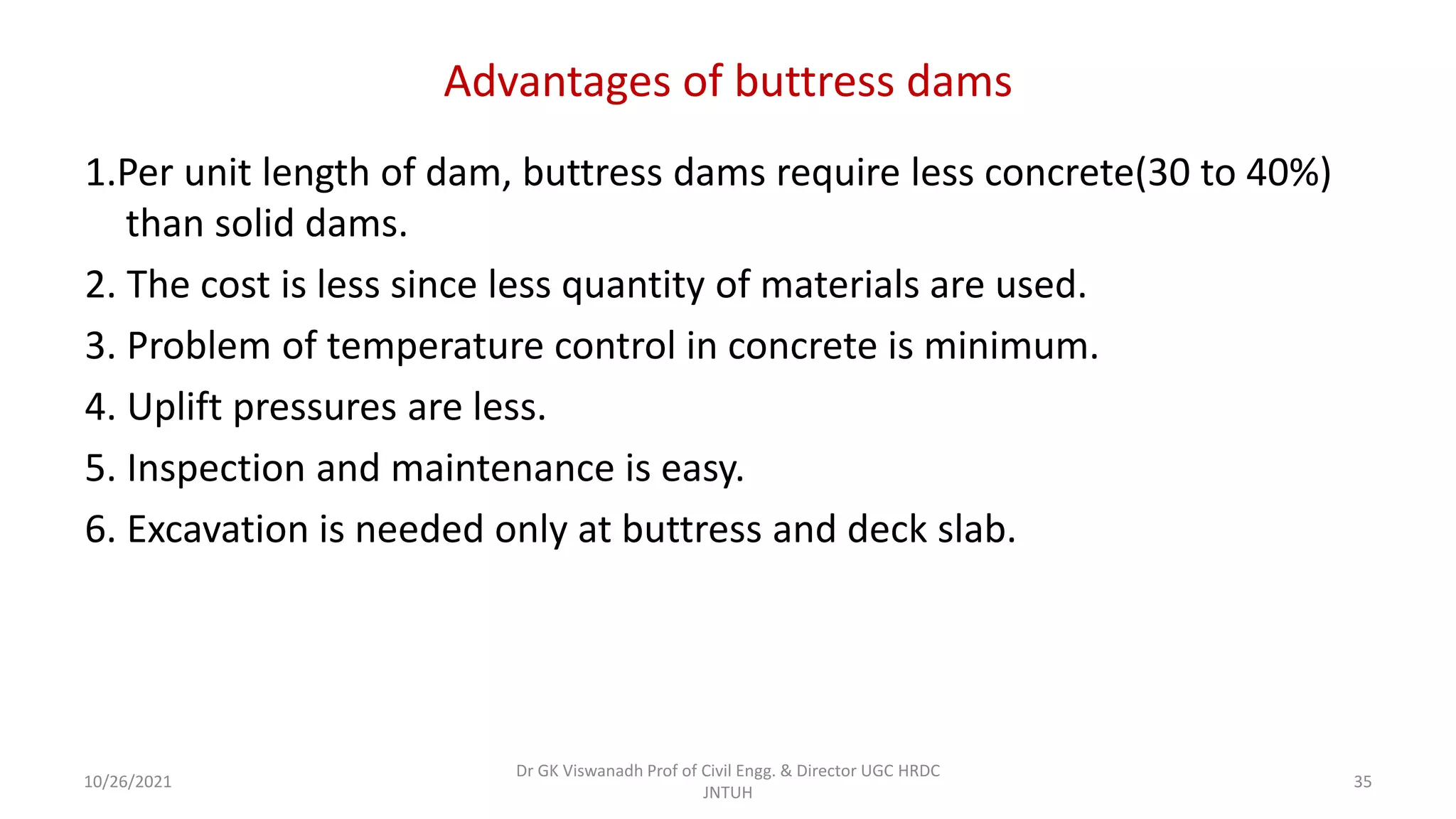
Advantages of buttress dams
1.Per unit length of dam, buttress dams require less concrete(30 to 40%)
than solid dams.
2. The cost is less since less quantity of materials are used.
3. Problem of temperature control in concrete is minimum.
4. Uplift pressures are less.
5. Inspection and maintenance is easy.
6. Excavation is needed only at buttress and deck slab.
Dr GK Viswanadh Prof of Civil Engg. & Director UGC HRDC
JNTUH
10/26/2021 35
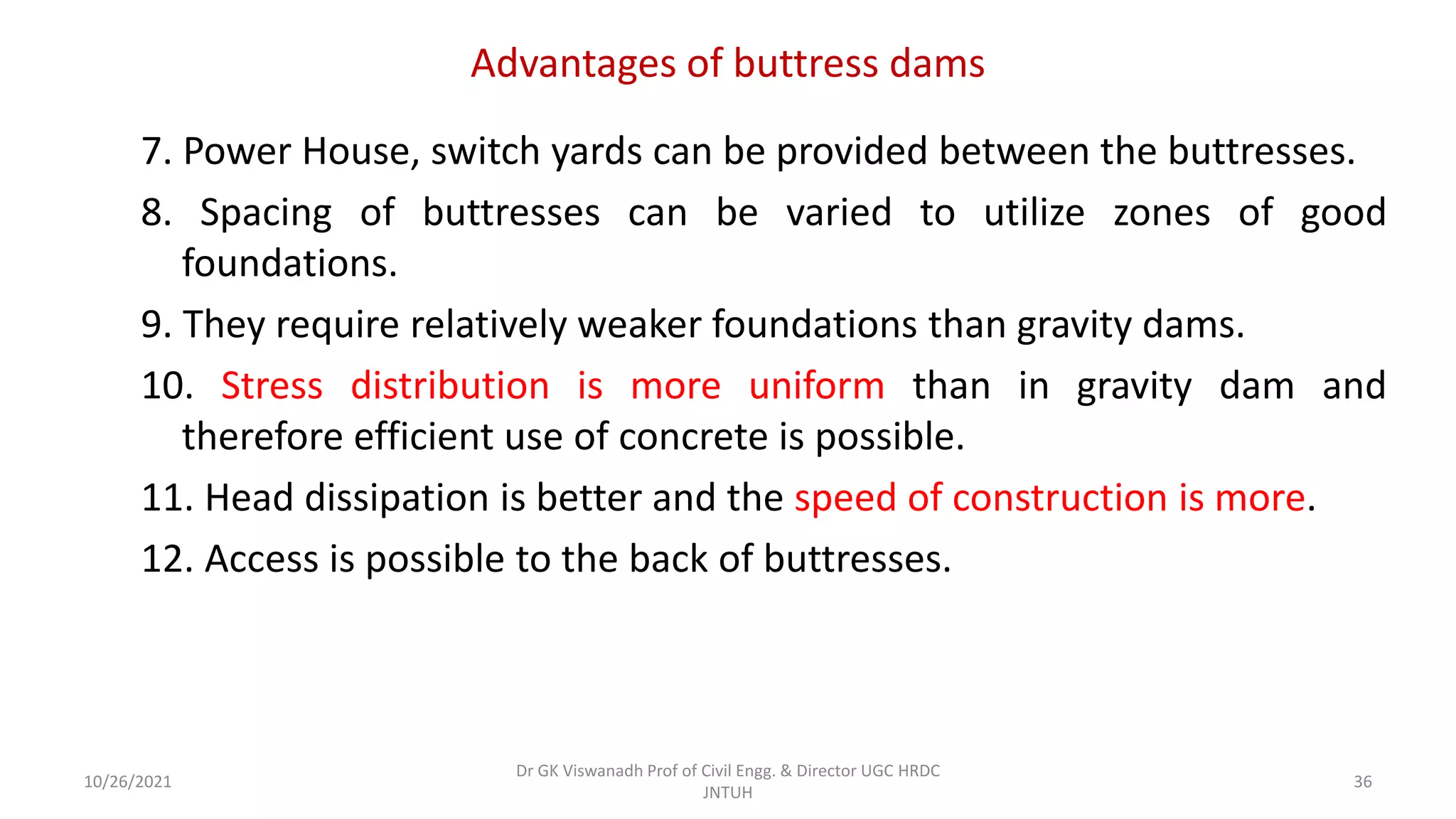
Advantages of buttress dams
7. Power House, switch yards can be provided between the buttresses.
8. Spacing of buttresses can be varied to utilize zones of good
foundations.
9. They require relatively weaker foundations than gravity dams.
10. Stress distribution is more uniform than in gravity dam and
therefore efficient use of concrete is possible.
11. Head dissipation is better and the speed of construction is more.
12. Access is possible to the back of buttresses.
Dr GK Viswanadh Prof of Civil Engg. & Director UGC HRDC
JNTUH
10/26/2021 36
Disadvantages of buttress dams:
1. They require richer mix of concrete,more complicated formwork and
skilled labour.
2. They are susceptible to damage or destruction by sabotage or military
action more easily than in massive dams.
3. They are sensitive to moderate deterioration of concrete and much
care is needed in the construction.
Dr GK Viswanadh Prof of Civil Engg. & Director UGC HRDC
JNTUH
10/26/2021 37
Disadvantages of buttress dams:
4. The pace of construction is slow.
5. Since reinforcement is used, smaller size aggregate is required and
therefore unit cost is high.
6. With more joints, they need greater attention.
7. They do not permit easy means of providing openings for sluices and
penstocks.
8. Overflow arrangements require complicated layout.
9. The number of water seals to be provided and maintained in more.
Dr GK Viswanadh Prof of Civil Engg. & Director UGC HRDC
JNTUH
10/26/2021 38
Dr GK Viswanadh Prof of Civil Engg. & Director UGC HRDC
JNTUH
10/26/2021 39
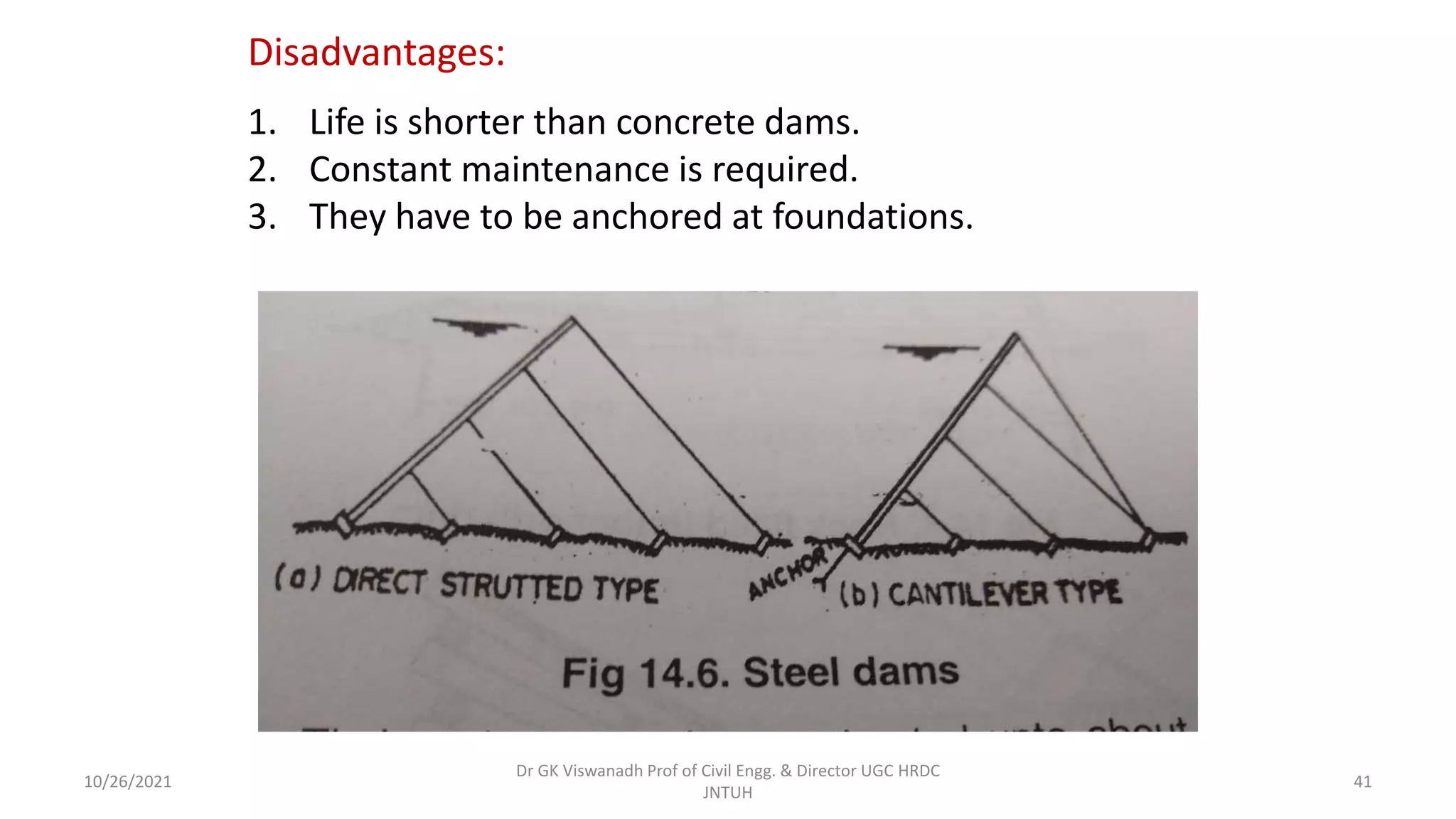
4. Steel Dams
• These dams are constructed of a framework of steel and steel skin
plates on the upstream sides to hold water. They are feasible for
heights upto about 15m and can be constructed quickly and cheaply.
They are direct strutted type or cantilever type.
Advantages of steel dams:
1.The speed of construction is high.
2. They are cheaper than other rigid dams.
3. Leaky joints could be repaired by welding easily.
4. They have greater flexibility to resist unequal settlement without
excessive leakage.
Dr GK Viswanadh Prof of Civil Engg. & Director UGC HRDC
JNTUH
10/26/2021 40
Disadvantages:
1. Life is shorter than concrete dams.
2. Constant maintenance is required.
3. They have to be anchored at foundations.
Dr GK Viswanadh Prof of Civil Engg. & Director UGC HRDC
JNTUH
10/26/2021 41
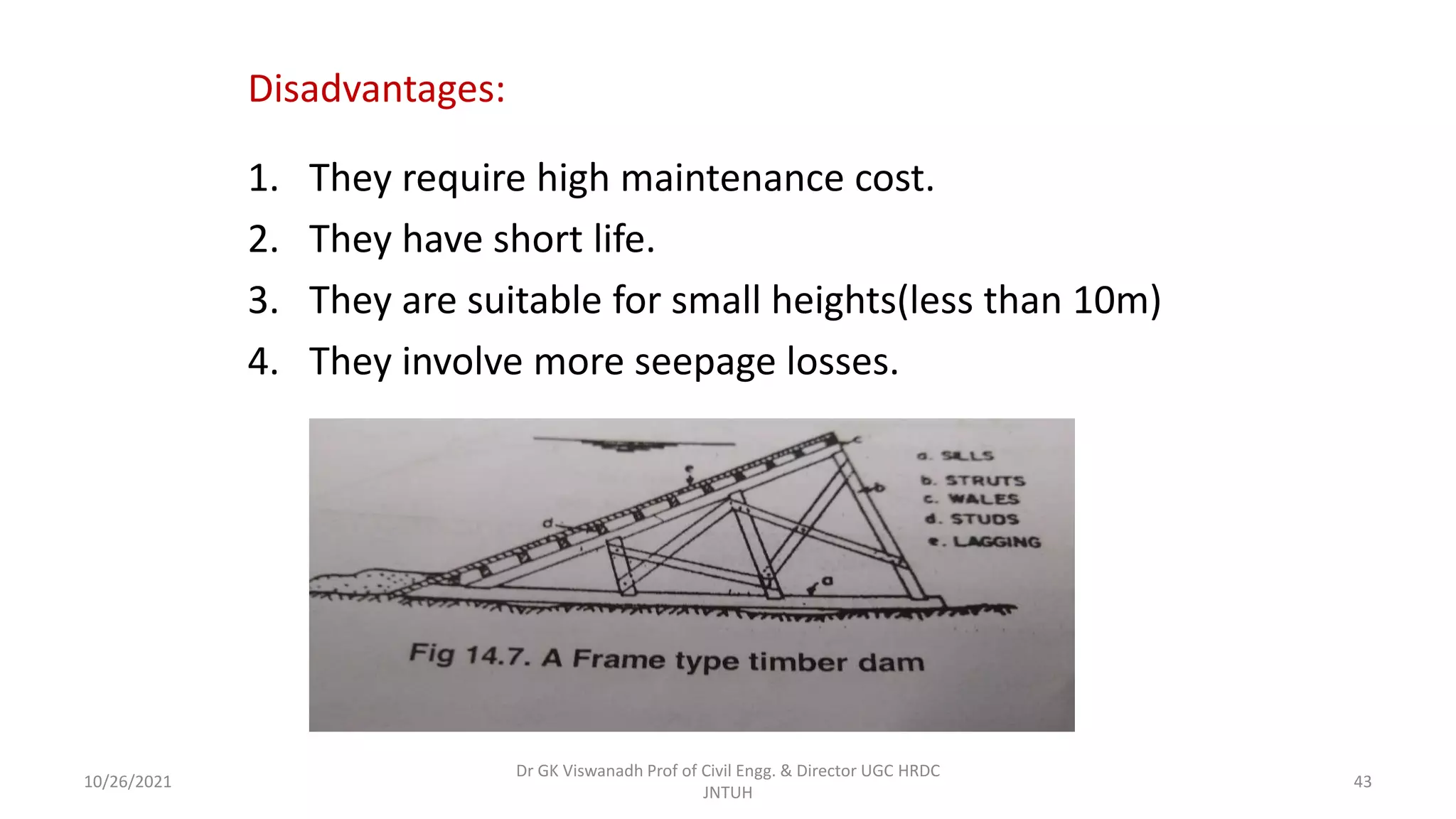
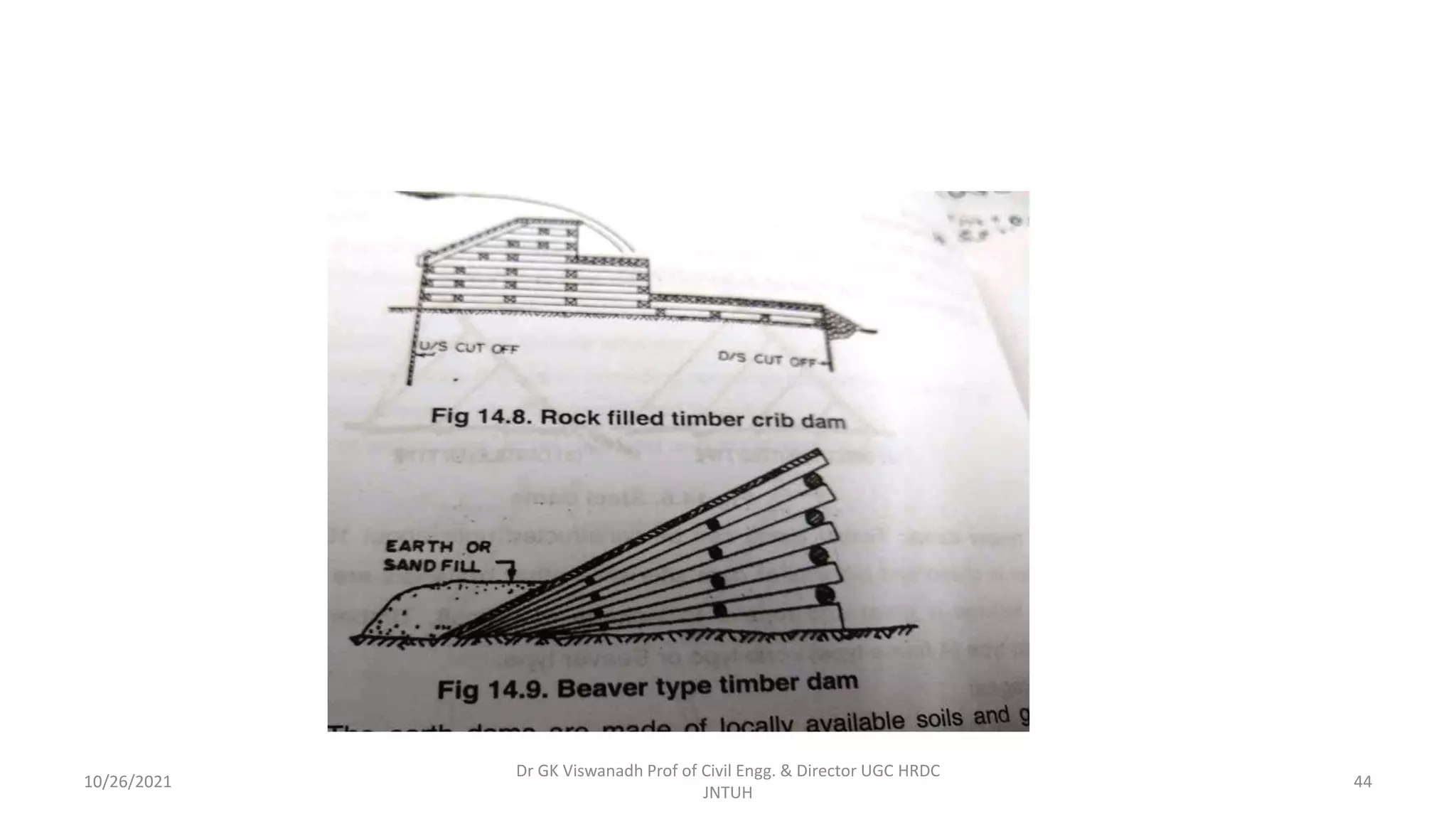
5. Timber dam
• Timber dams can be constructed upto about 10m height where timber
is cheap and plentiful at dam site while other materials are scarce.
• In these dam leakage is great and repairs to leakage is difficult.
• Advantages:
1. Low initial cost.
2. They are suitable for any type of foundations
3. They are used for temporary dams.
4. The speed of construction is great. s
Dr GK Viswanadh Prof of Civil Engg. & Director UGC HRDC
JNTUH
10/26/2021 42
Disadvantages:
1. They require high maintenance cost.
2. They have short life.
3. They are suitable for small heights(less than 10m)
4. They involve more seepage losses.
Dr GK Viswanadh Prof of Civil Engg. & Director UGC HRDC
JNTUH
10/26/2021 43
Dr GK Viswanadh Prof of Civil Engg. & Director UGC HRDC
JNTUH
10/26/2021 44
6.Earth dam:
• The earth dams are made of locally available soils and gravel.
• In rolled filled dams, 15 to 45cm layers of soil is laid and rolled with
power roller(sheep foot roller) with optimum moisture content for
proper compaction.
• Materials reach the site in the form of a flowing mixture of soil and
water(or slurry) from which surplus water will eventually drain out.
• In semi-hydraulic fill dams the materials are excavated and conveyed to
site mechanically and deposited in position hydraulically.
Dr GK Viswanadh Prof of Civil Engg. & Director UGC HRDC
JNTUH
10/26/2021 45
Dr GK Viswanadh Prof of Civil Engg. & Director UGC HRDC
JNTUH
10/26/2021 46
Dr GK Viswanadh Prof of Civil Engg. & Director UGC HRDC
JNTUH
10/26/2021 47
Advantages of earth dams
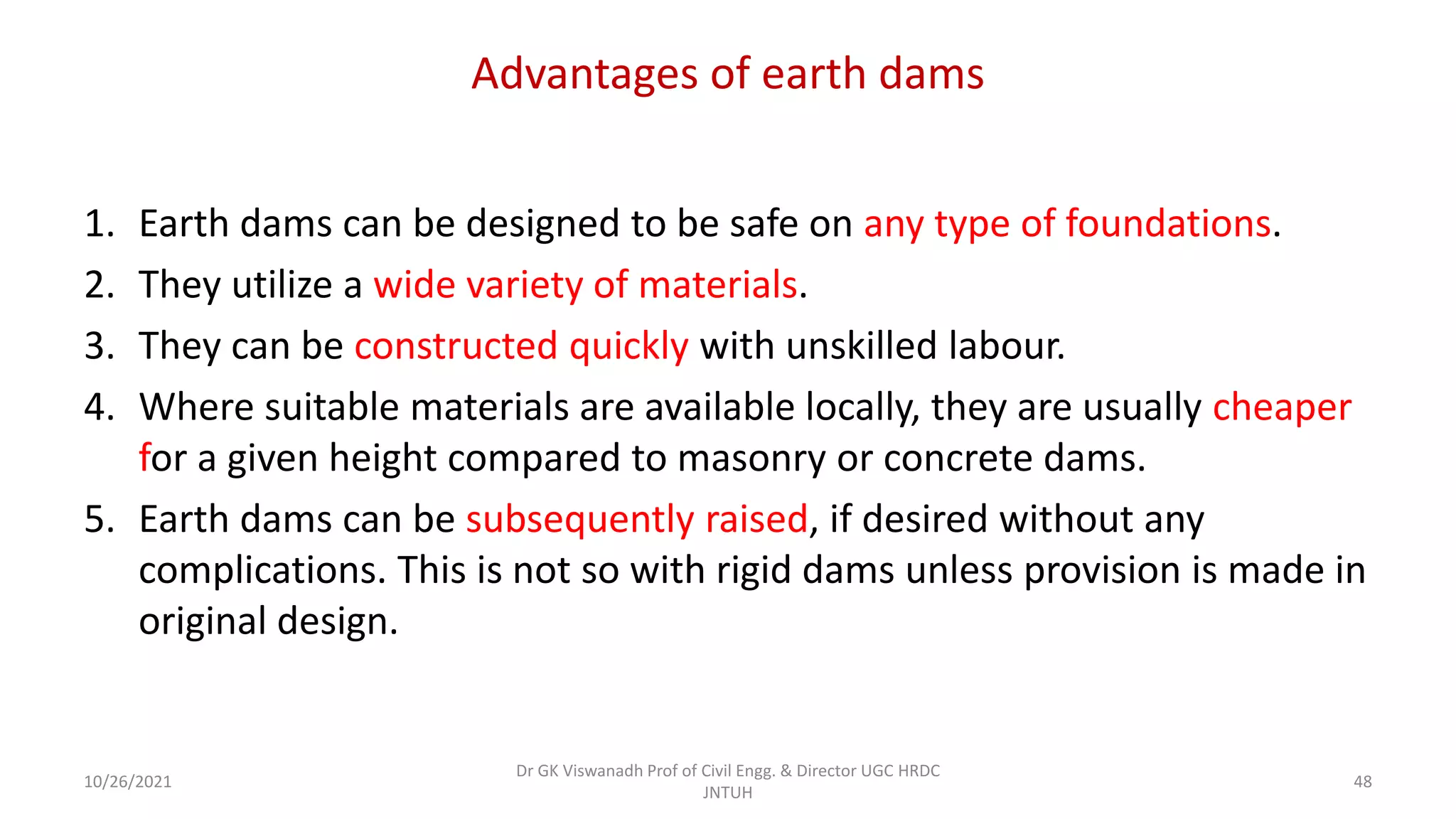
1. Earth dams can be designed to be safe on any type of foundations.
2. They utilize a wide variety of materials.
3. They can be constructed quickly with unskilled labour.
4. Where suitable materials are available locally, they are usually cheaper
for a given height compared to masonry or concrete dams.
5. Earth dams can be subsequently raised, if desired without any
complications. This is not so with rigid dams unless provision is made in
original design.
Dr GK Viswanadh Prof of Civil Engg. & Director UGC HRDC
JNTUH
10/26/2021 48
Disadvantages of earth dams:
1. Earth dams are vulnerable to damage by floods and fail suddenly
without warning.
2. They require a closer watch and heavier maintenance cost.
3. No overflow section can be provided in this dam. Arrangement
for spillway must be made separately.
4. These are not suitable at locations of heavy downpour.
Dr GK Viswanadh Prof of Civil Engg. & Director UGC HRDC
JNTUH
10/26/2021 49
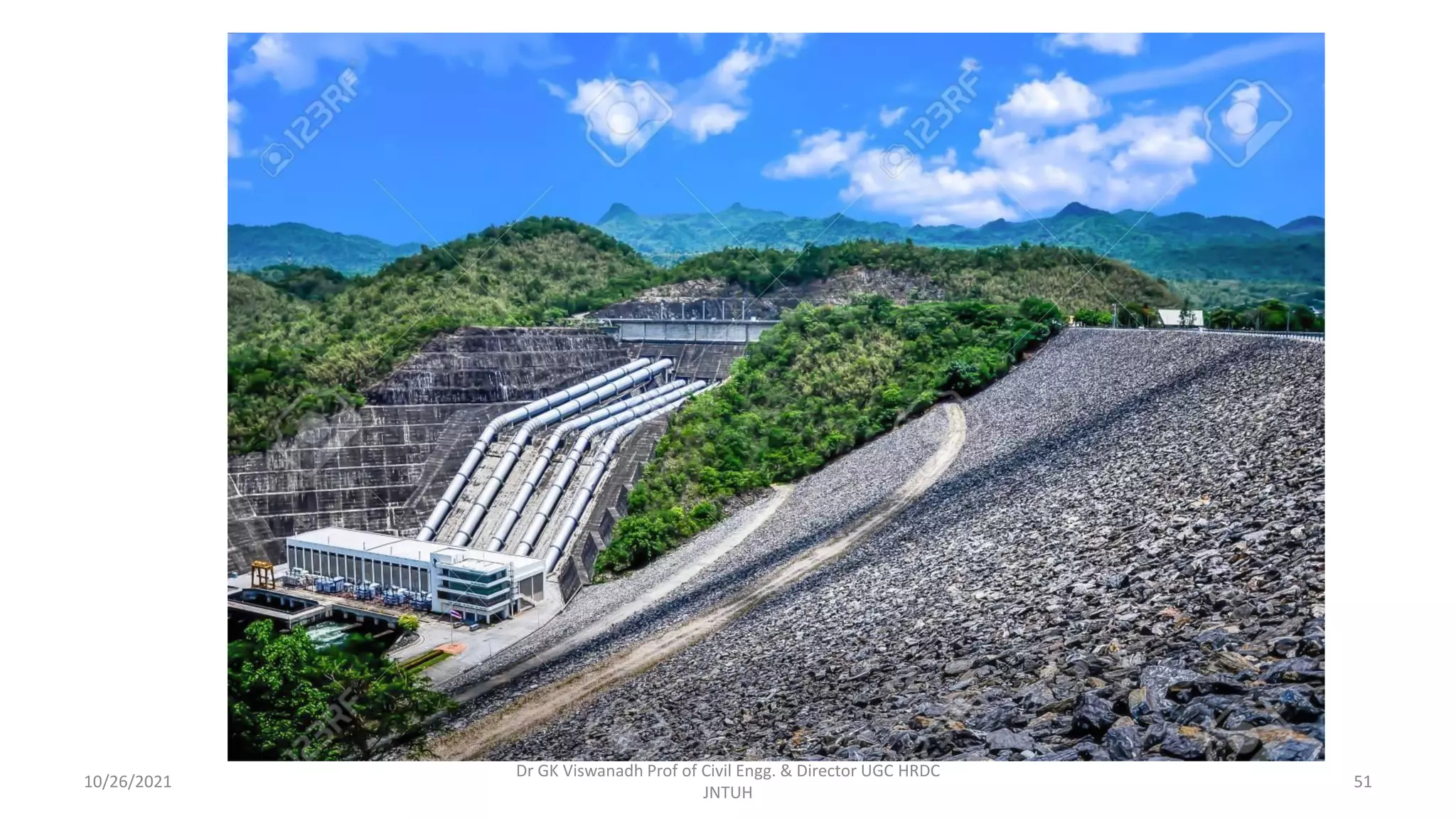
7. Rock fill dams
• Rockfill dams can be provided on less rigid foundations than masonry or
concrete dams.
• They are suitable in remote localities where suitable rock in plenty is
available near the dam site.
• The design of rockfill dams is empirical.
• Rocky foundations are desirable for these dams so that settlement is
absent or negligible.
• They are suited for moderate heights.
• Sluicing is resorted by forcing a jet of water on the work to wash away
small rock chips and rock powder to avoid any settlement.
Dr GK Viswanadh Prof of Civil Engg. & Director UGC HRDC
JNTUH
10/26/2021 50
Dr GK Viswanadh Prof of Civil Engg. & Director UGC HRDC
JNTUH
10/26/2021 51
Dr GK Viswanadh Prof of Civil Engg. & Director UGC HRDC
JNTUH
10/26/2021 52
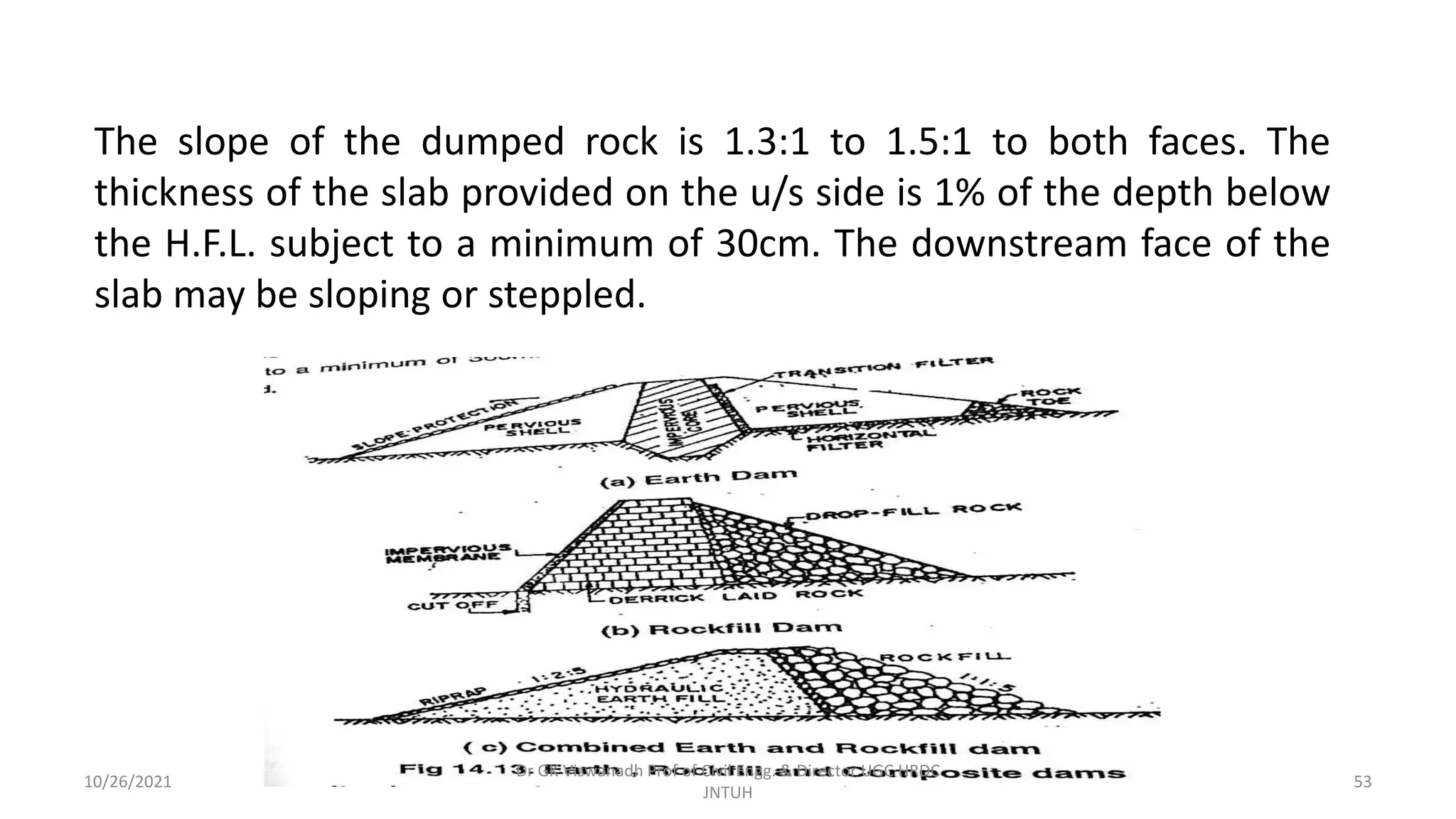
The slope of the dumped rock is 1.3:1 to 1.5:1 to both faces. The
thickness of the slab provided on the u/s side is 1% of the depth below
the H.F.L. subject to a minimum of 30cm. The downstream face of the
slab may be sloping or steppled.
Dr GK Viswanadh Prof of Civil Engg. & Director UGC HRDC
JNTUH
10/26/2021 53
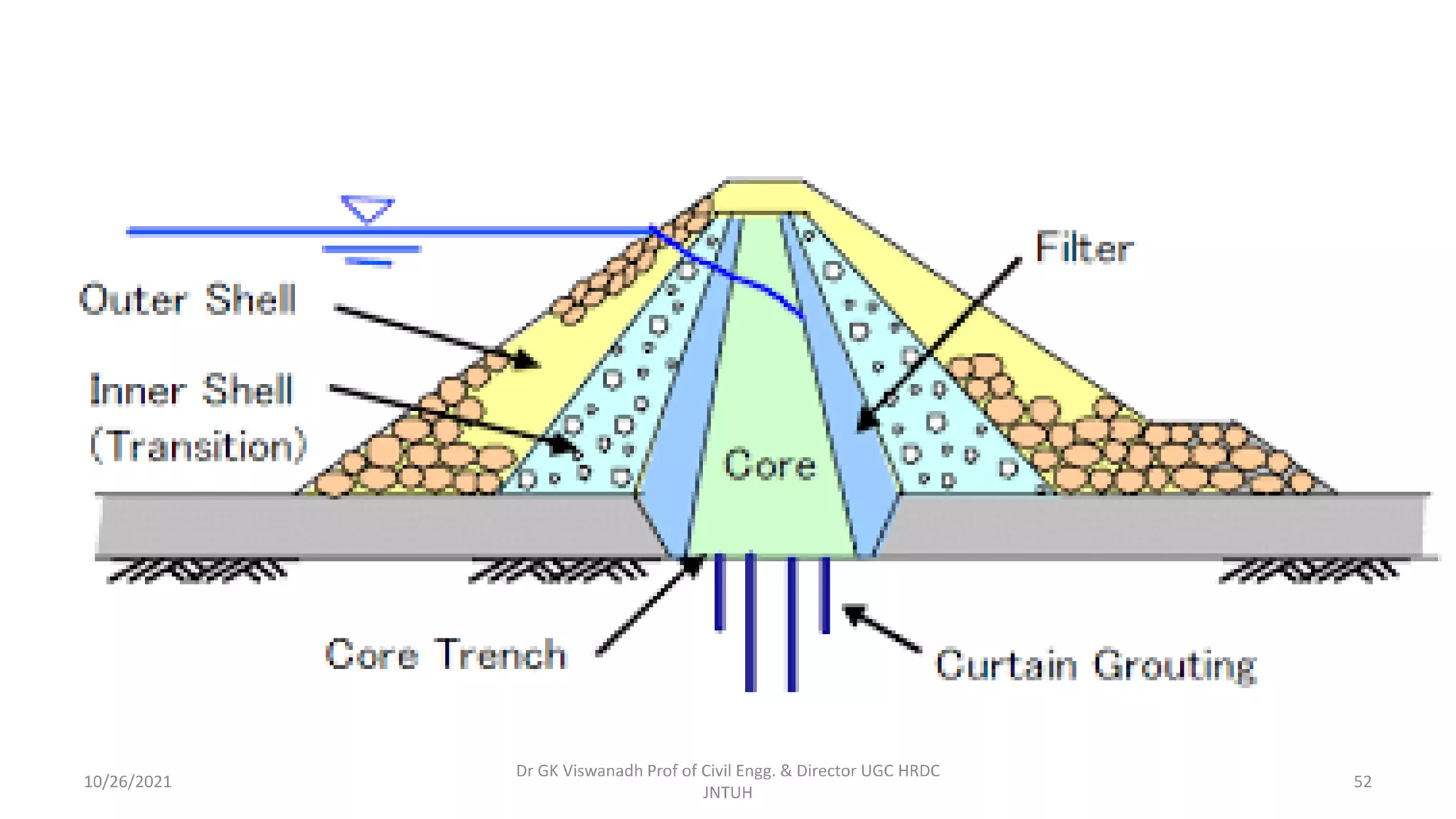
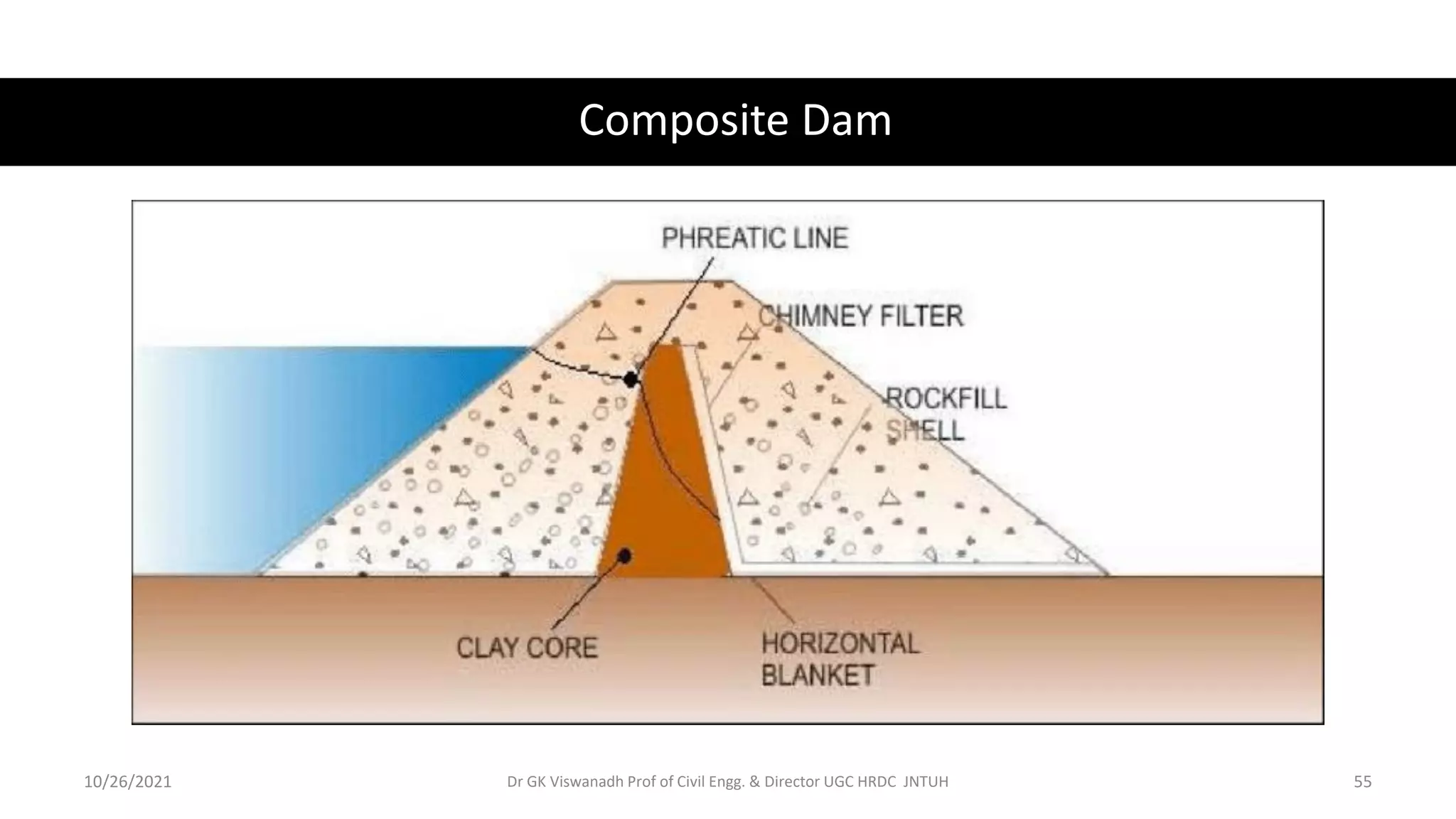
8. Composite dams
• Composite dam consists of earth fill instead of impervious
membrane on the upstream side, supported by rockfill on the d/s
side for stability and drainage.
• Filter layer is provided between the two materials so that the
earthfill may not be washed away through the voids of the rockfill.
• Alternatively, there may be a core of impervious earth supported by
rockfill on both sides.
Dr GK Viswanadh Prof of Civil Engg. & Director UGC HRDC
JNTUH
10/26/2021 54
Composite Dam
Dr GK Viswanadh Prof of Civil Engg. & Director UGC HRDC JNTUH
10/26/2021 55

class 5 types of dams and Merits Demerits .pdf

  • 1.
    Reservoirs Storage Works- Reservoirs- Types of reservoirs, selection of site for reservoir, zones of storage of a reservoir, reservoir yield, estimation of capacity of reservoir using mass curve- Reservoir Sedimentation – Life of Reservoir.. Dams General - Types of dams, factors affecting selection of type of dam, factors governing selection of site for a dam. 10/26/2021 Dr GK Viswanadh Prof of Civil Engg. & Director UGC HRDC JNTUH 1
  • 2.
    Types of Dams DAM- an imperious barrier constructed across a river or a natural stream to create a reservoir for impounding water to facilitate the diversion of water from the river or to retain debris flowing in the river along with water. Dr GK Viswanadh Prof of Civil Engg. & Director UGC HRDC JNTUH 10/26/2021 2
  • 3.
    Dr GK ViswanadhProf of Civil Engg. & Director UGC HRDC JNTUH 10/26/2021 3
  • 4.
    DAMS Dr GK ViswanadhProf of Civil Engg. & Director UGC HRDC JNTUH 10/26/2021 4
  • 5.
    Dr GK ViswanadhProf of Civil Engg. & Director UGC HRDC JNTUH 10/26/2021 5
  • 6.
    Dr GK ViswanadhProf of Civil Engg. & Director UGC HRDC JNTUH 10/26/2021 6
  • 7.
  • 8.
    Dams • Dams maybe classified on the basis of their – Function/purpose – hydraulic design, – nature of strength – materials of construction and – structural design. • The selection of the type of a dam to be constructed at a particular site and the selection site for a particular type of dam are based on several factors. • The various forces acting on a dam, in particular on a gravity dam are to be considered in designing the dam. Dr GK Viswanadh Prof of Civil Engg. & Director UGC HRDC JNTUH 10/26/2021 8
  • 9.
    Classification of Dams: I.According to the function/Purpose- i)Storage dam ii)Diversion dam iii) Detention dam iv) Debris dam v) Coffer dam Dr GK Viswanadh Prof of Civil Engg. & Director UGC HRDC JNTUH 10/26/2021 9
  • 10.
    Storage dams – •A Storage dam is constructed to impound water during the periods of deficient supply. • A storage dam is meant to supply water for irrigation, domestic and industrial water supply , or power generation. • Usually the dam is meant to store required quantity of water sufficient for an year. Dr GK Viswanadh Prof of Civil Engg. & Director UGC HRDC JNTUH 10/26/2021 10
  • 11.
    • Diversion dams– to raise the water level in the river sufficient to flow into the canal. • A diversion dam is a dam of smaller height and it causes the water level in the river to provide sufficient head to divert water into ditches, canals or other conveyance systems. • Weirs and barrages come under this type. • During floods water passes over these diversion dams while during periods of normal flow, the river water is partly or wholly diverted. Dr GK Viswanadh Prof of Civil Engg. & Director UGC HRDC JNTUH 10/26/2021 11
  • 12.
    • Detention dams– to detain the water during the floods and allow downstream under controlled conditions. • A detention dam is mainly intended to temporarily detain part of the flood waters of river and release the water so stored at controlled rates so as to protect the region downstream of the dam against flood damage. • A detention dam may also be used as a storage dam and vice-versa by suitable operation of the reservoir. Dr GK Viswanadh Prof of Civil Engg. & Director UGC HRDC JNTUH 10/26/2021 12
  • 13.
    • Debris damis a dam constructed to retain debris such as sand, silt and drift wood flowing with water in the river. • Coffer dam is a temporary dam constructed to exclude the water from a specific area for the construction of an actual dam across the river. Such a dam is constructed on the upstream side of the proposed site for a dam and sometimes on the downstream side also. The coffer dam ths behaves as as a diversion dam. Dr GK Viswanadh Prof of Civil Engg. & Director UGC HRDC JNTUH 10/26/2021 13
  • 14.
    II. According toHydraulic design 1. An overflow dam is one in which the surplus water to flow over the crest. Example for Overflow dams is spillways in which water is allowed to flow over the top of the dams. 2. Non-overflow dams in which will not allowed to overflow. A non overflow dam is one in which the top of the dam is kept at a higher elevation than the maximum water level expected and water is not allowed to overtop the dam. Classification of Dams contd… Dr GK Viswanadh Prof of Civil Engg. & Director UGC HRDC JNTUH 10/26/2021 14
  • 15.
    Classification of Damscontd… III. According to Nature of the strength 1. Rigid dams – which are made of rigid materials which are not easily erodable. 2. Non- rigid dams –which are made of earth or rock-fill. Dr GK Viswanadh Prof of Civil Engg. & Director UGC HRDC JNTUH 10/26/2021 15
  • 16.
    IV. Based onstructural design Gravity dams, Arch dams, buttress dams, Arched buttress, earth dams • Gravity dam is a masonry or concrete dam, which resists various forces exerted on it by its own weight. In a Gravity dam, the water pressure is resisted completely by the weight of the dam material. They may be straight or curved . Dr GK Viswanadh Prof of Civil Engg. & Director UGC HRDC JNTUH 10/26/2021 16
  • 17.
    • Arch damis a covered masonry or concrete dam, with convex upstream face, and resists the forces exerted on it by arch action. • In arch dam, the water pressure is resisted and transferred to the abutments by arch action i.e by thrust and bending moment. • They may be of constant radius type , variable radius type, constant angle type, double curvature (cupola) type and arch gravity type and massive arc type. • An arch gravity dam resists the forces coming on it partly by gravity action and partly by arch action. Dr GK Viswanadh Prof of Civil Engg. & Director UGC HRDC JNTUH 10/26/2021 17
  • 18.
    • A Buttressdam consists of a water retaining sloping membrane supported by a series of buttresses on the downstream side. • They may be simple deck slab type, continuous deck slab type or cantilever deck slab type buttress dams. • In some cases, the upstream slab is replaced by multiple arches supported on buttresses and are called multiple arch buttress dams. • In other cases, the upstream edge of the buttresses span the distance between the buttresses and they are called massive head or bulk head buttress dams and multiple dome buttress dams. Dr GK Viswanadh Prof of Civil Engg. & Director UGC HRDC JNTUH 10/26/2021 18
  • 19.
    • Arched ButtressDam – which are the combinations of arch and buttress. Buttress is designed as gravity dam. Dr GK Viswanadh Prof of Civil Engg. & Director UGC HRDC JNTUH 10/26/2021 19
  • 20.
    • An embankmentdam(Earth dam) is a non rigid dams, which resists the forces exerted upon it mainly by its shear strength. • Based on the method of construction, they may be i)Rolled filled type ii) Hydraulic fill type and iii) Semi-hydraulic fill type. • The rolled filled earth dams may be of i) homogeneous type ii)Zoned type and iii) diaphragm type. • Earth and Rock fill dam in which the stability is governed by the soil properties and slope consideration Dr GK Viswanadh Prof of Civil Engg. & Director UGC HRDC JNTUH 10/26/2021 20
  • 21.
    V. Based onthe material used for construction 1.Masnory or Concrete dams 2.Earth dams 3.Composite dam – A part of the dam is of masonry a and a part of the dam is to reduce the cost of construction earth. 4.Rock fill dam – Boulders will be based one above the other, to make the dam imperious a layer of soil is placed above that. 5. Steel dam- lesser height, suitable for small works 6. Timber Dams- purely for temporary purposes. Timber planks inserted and supported. Classification of Dams contd… Dr GK Viswanadh Prof of Civil Engg. & Director UGC HRDC JNTUH 10/26/2021 21
  • 22.
    Dr GK ViswanadhProf of Civil Engg. & Director UGC HRDC JNTUH 10/26/2021 22
  • 23.
    Dr GK ViswanadhProf of Civil Engg. & Director UGC HRDC JNTUH 10/26/2021 23
  • 24.
    Merits and demeritsof various types of dams 1. Gravity dams resist the overturning moment of the water pressure(external forces) by their weight alone. These are straight in plan and approximately triangular in section: usually having a length to height ratio exceeding 7. Dr GK Viswanadh Prof of Civil Engg. & Director UGC HRDC JNTUH 10/26/2021 24
  • 25.
    Dr GK ViswanadhProf of Civil Engg. & Director UGC HRDC JNTUH 10/26/2021 25
  • 26.
    Dr GK ViswanadhProf of Civil Engg. & Director UGC HRDC JNTUH 10/26/2021 26
  • 27.
    Advantages of gravitydams: 1. They are strong and stable. 2. They are adaptable for overflow section. 3. They can be of any height, if suitable foundations are available 4. They require least maintenance cost. 5. Failure, if any, is not sudden. 6. Scouring sluices can be provided in the dam. 7. They are cheaper in the long run. Dr GK Viswanadh Prof of Civil Engg. & Director UGC HRDC JNTUH 10/26/2021 27
  • 28.
    Disadvantages of gravitydams: 1.They require sound rock foundations 2. Initial cost is high 3. They require skilled labour for construction. 4. They do not allow subsequent raise in the height of dam. Dr GK Viswanadh Prof of Civil Engg. & Director UGC HRDC JNTUH 10/26/2021 28
  • 29.
    2. Arch dams(Masonryor concrete) • In arch dams, water pressures are resisted by the reaction of the abutments at the ends of the arches. • These are curved in plan and resist the pressure of water partly by their weight(with vertical elements acting as cantilevers) as in gravity dams and partly by arch action with horizontal elements acting as arches spanning from abutment to abutment. • Usually, the length to height of arch dams is less than 5. Dr GK Viswanadh Prof of Civil Engg. & Director UGC HRDC JNTUH 10/26/2021 29
  • 30.
    Merits of archdams: 1. The rock foundations need not be as strong as in gravity dams. 2. Section of the dam is much less. 3. Problems of uplift pressure is minor. 4. The strength of materials used in the construction of arch dams is more fully developed than in gravity dams. Demerits of arch dams: 1. The arch dams require skilled labour and sophisticated formwork for the construction. 2. The speed of construction is slow. 3. They require strong abutments to resist arch action Dr GK Viswanadh Prof of Civil Engg. & Director UGC HRDC JNTUH 10/26/2021 30
  • 31.
    Dr GK ViswanadhProf of Civil Engg. & Director UGC HRDC JNTUH 10/26/2021 31
  • 32.
    Dr GK ViswanadhProf of Civil Engg. & Director UGC HRDC JNTUH 10/26/2021 32
  • 33.
    Dr GK ViswanadhProf of Civil Engg. & Director UGC HRDC JNTUH 10/26/2021 33
  • 34.
    3. Buttress dams •Buttress dams consist of a number of buttresses or piers dividing the space to be dammed into a number of spans. • To hold up and retain water between these buttresses, panels are constructed consisting of R.C.C. slabs or buttresses against the height of the dam are as follows: Height of Dam 15 to 30m 30 to 45m >45m Spacing of Buttresses 5 to 6m 9 to 12m 12 to 15m Dr GK Viswanadh Prof of Civil Engg. & Director UGC HRDC JNTUH 10/26/2021 34
  • 35.
    Advantages of buttressdams 1.Per unit length of dam, buttress dams require less concrete(30 to 40%) than solid dams. 2. The cost is less since less quantity of materials are used. 3. Problem of temperature control in concrete is minimum. 4. Uplift pressures are less. 5. Inspection and maintenance is easy. 6. Excavation is needed only at buttress and deck slab. Dr GK Viswanadh Prof of Civil Engg. & Director UGC HRDC JNTUH 10/26/2021 35
  • 36.
    Advantages of buttressdams 7. Power House, switch yards can be provided between the buttresses. 8. Spacing of buttresses can be varied to utilize zones of good foundations. 9. They require relatively weaker foundations than gravity dams. 10. Stress distribution is more uniform than in gravity dam and therefore efficient use of concrete is possible. 11. Head dissipation is better and the speed of construction is more. 12. Access is possible to the back of buttresses. Dr GK Viswanadh Prof of Civil Engg. & Director UGC HRDC JNTUH 10/26/2021 36
  • 37.
    Disadvantages of buttressdams: 1. They require richer mix of concrete,more complicated formwork and skilled labour. 2. They are susceptible to damage or destruction by sabotage or military action more easily than in massive dams. 3. They are sensitive to moderate deterioration of concrete and much care is needed in the construction. Dr GK Viswanadh Prof of Civil Engg. & Director UGC HRDC JNTUH 10/26/2021 37
  • 38.
    Disadvantages of buttressdams: 4. The pace of construction is slow. 5. Since reinforcement is used, smaller size aggregate is required and therefore unit cost is high. 6. With more joints, they need greater attention. 7. They do not permit easy means of providing openings for sluices and penstocks. 8. Overflow arrangements require complicated layout. 9. The number of water seals to be provided and maintained in more. Dr GK Viswanadh Prof of Civil Engg. & Director UGC HRDC JNTUH 10/26/2021 38
  • 39.
    Dr GK ViswanadhProf of Civil Engg. & Director UGC HRDC JNTUH 10/26/2021 39
  • 40.
    4. Steel Dams •These dams are constructed of a framework of steel and steel skin plates on the upstream sides to hold water. They are feasible for heights upto about 15m and can be constructed quickly and cheaply. They are direct strutted type or cantilever type. Advantages of steel dams: 1.The speed of construction is high. 2. They are cheaper than other rigid dams. 3. Leaky joints could be repaired by welding easily. 4. They have greater flexibility to resist unequal settlement without excessive leakage. Dr GK Viswanadh Prof of Civil Engg. & Director UGC HRDC JNTUH 10/26/2021 40
  • 41.
    Disadvantages: 1. Life isshorter than concrete dams. 2. Constant maintenance is required. 3. They have to be anchored at foundations. Dr GK Viswanadh Prof of Civil Engg. & Director UGC HRDC JNTUH 10/26/2021 41
  • 42.
    5. Timber dam •Timber dams can be constructed upto about 10m height where timber is cheap and plentiful at dam site while other materials are scarce. • In these dam leakage is great and repairs to leakage is difficult. • Advantages: 1. Low initial cost. 2. They are suitable for any type of foundations 3. They are used for temporary dams. 4. The speed of construction is great. s Dr GK Viswanadh Prof of Civil Engg. & Director UGC HRDC JNTUH 10/26/2021 42
  • 43.
    Disadvantages: 1. They requirehigh maintenance cost. 2. They have short life. 3. They are suitable for small heights(less than 10m) 4. They involve more seepage losses. Dr GK Viswanadh Prof of Civil Engg. & Director UGC HRDC JNTUH 10/26/2021 43
  • 44.
    Dr GK ViswanadhProf of Civil Engg. & Director UGC HRDC JNTUH 10/26/2021 44
  • 45.
    6.Earth dam: • Theearth dams are made of locally available soils and gravel. • In rolled filled dams, 15 to 45cm layers of soil is laid and rolled with power roller(sheep foot roller) with optimum moisture content for proper compaction. • Materials reach the site in the form of a flowing mixture of soil and water(or slurry) from which surplus water will eventually drain out. • In semi-hydraulic fill dams the materials are excavated and conveyed to site mechanically and deposited in position hydraulically. Dr GK Viswanadh Prof of Civil Engg. & Director UGC HRDC JNTUH 10/26/2021 45
  • 46.
    Dr GK ViswanadhProf of Civil Engg. & Director UGC HRDC JNTUH 10/26/2021 46
  • 47.
    Dr GK ViswanadhProf of Civil Engg. & Director UGC HRDC JNTUH 10/26/2021 47
  • 48.
    Advantages of earthdams 1. Earth dams can be designed to be safe on any type of foundations. 2. They utilize a wide variety of materials. 3. They can be constructed quickly with unskilled labour. 4. Where suitable materials are available locally, they are usually cheaper for a given height compared to masonry or concrete dams. 5. Earth dams can be subsequently raised, if desired without any complications. This is not so with rigid dams unless provision is made in original design. Dr GK Viswanadh Prof of Civil Engg. & Director UGC HRDC JNTUH 10/26/2021 48
  • 49.
    Disadvantages of earthdams: 1. Earth dams are vulnerable to damage by floods and fail suddenly without warning. 2. They require a closer watch and heavier maintenance cost. 3. No overflow section can be provided in this dam. Arrangement for spillway must be made separately. 4. These are not suitable at locations of heavy downpour. Dr GK Viswanadh Prof of Civil Engg. & Director UGC HRDC JNTUH 10/26/2021 49
  • 50.
    7. Rock filldams • Rockfill dams can be provided on less rigid foundations than masonry or concrete dams. • They are suitable in remote localities where suitable rock in plenty is available near the dam site. • The design of rockfill dams is empirical. • Rocky foundations are desirable for these dams so that settlement is absent or negligible. • They are suited for moderate heights. • Sluicing is resorted by forcing a jet of water on the work to wash away small rock chips and rock powder to avoid any settlement. Dr GK Viswanadh Prof of Civil Engg. & Director UGC HRDC JNTUH 10/26/2021 50
  • 51.
    Dr GK ViswanadhProf of Civil Engg. & Director UGC HRDC JNTUH 10/26/2021 51
  • 52.
    Dr GK ViswanadhProf of Civil Engg. & Director UGC HRDC JNTUH 10/26/2021 52
  • 53.
    The slope ofthe dumped rock is 1.3:1 to 1.5:1 to both faces. The thickness of the slab provided on the u/s side is 1% of the depth below the H.F.L. subject to a minimum of 30cm. The downstream face of the slab may be sloping or steppled. Dr GK Viswanadh Prof of Civil Engg. & Director UGC HRDC JNTUH 10/26/2021 53
  • 54.
    8. Composite dams •Composite dam consists of earth fill instead of impervious membrane on the upstream side, supported by rockfill on the d/s side for stability and drainage. • Filter layer is provided between the two materials so that the earthfill may not be washed away through the voids of the rockfill. • Alternatively, there may be a core of impervious earth supported by rockfill on both sides. Dr GK Viswanadh Prof of Civil Engg. & Director UGC HRDC JNTUH 10/26/2021 54
  • 55.
    Composite Dam Dr GKViswanadh Prof of Civil Engg. & Director UGC HRDC JNTUH 10/26/2021 55