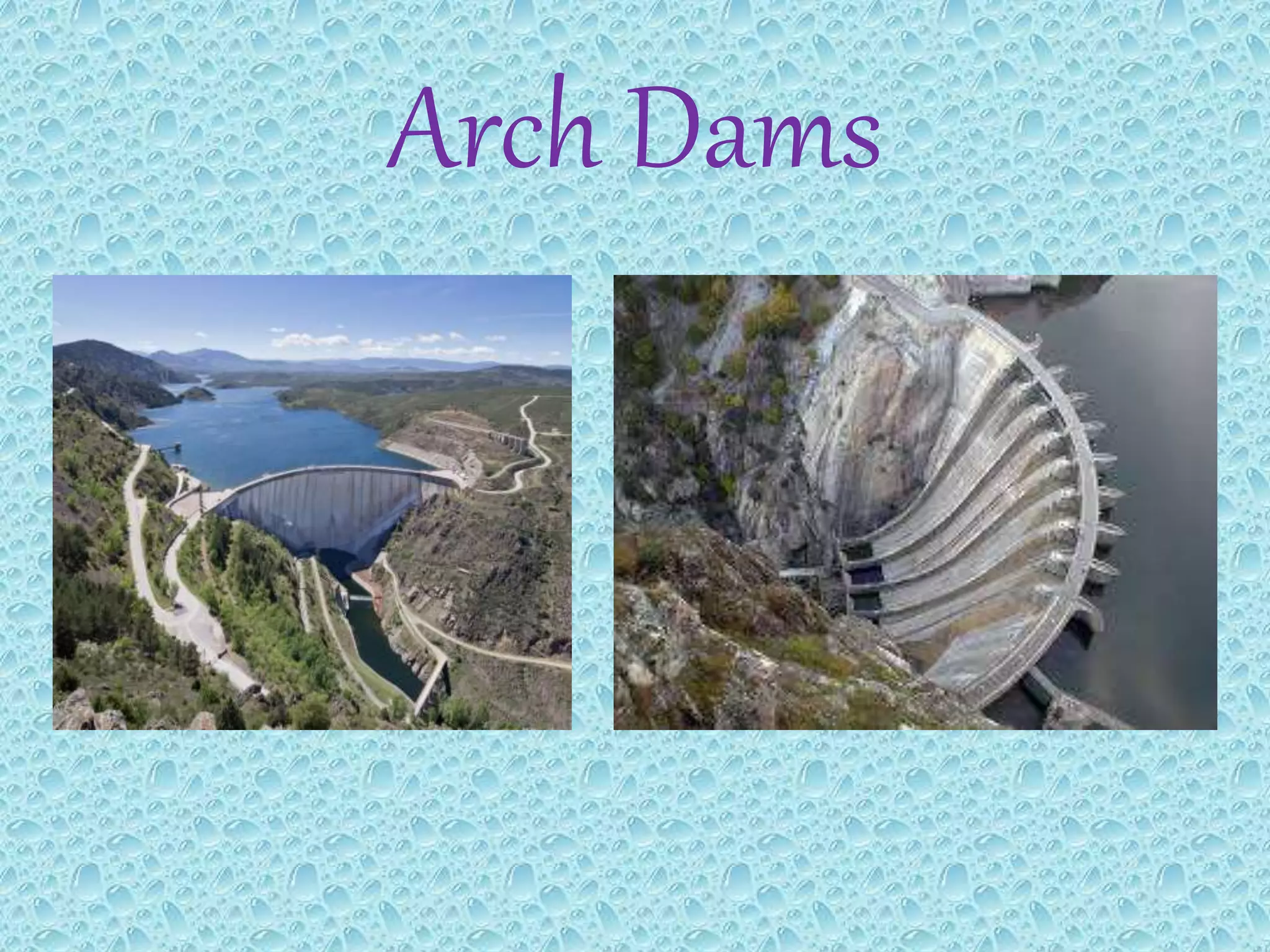
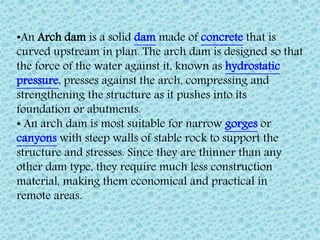
Arch Dams
•An Arch dam is a solid dam made of concrete that is
curved upstream in plan. The arch dam is designed so that
the force of the water against it, known as hydrostatic
pressure, presses against the arch, compressing and
strengthening the structure as it pushes into its
foundation or abutments.
• An arch dam is most suitable for narrow gorges or
canyons with steep walls of stable rock to support the
structure and stresses. Since they are thinner than any
other dam type, they require much less construction
material, making them economical and practical in
remote areas.
• In general, arch dams are classified based on the ratio
of the base thickness to the structural height (b/h) as:
• Thin, for b/h less than 0.2,
• Medium-thick, for b/h between 0.2 and 0.3, and
• Thick, for b/h ratio over 0.3.
• Arch dams classified with respect to their structural
height are
• Low dams up to 100 feet,
• Medium high dams between 100– 300 feet,
• High dams over 300 feet.
CLASSIFICATION
The main loads for which an arch dam is designed are
•Dead load
•Hydrostatic load generated by the reservoir and the tail
water
•Temperature load
•Earthquake load
Other miscellaneous loads that affect a dam include: ice
and silt loads, and uplift pressure.[1] [10]
LOADS
• Most often, the arch dam is made of concrete and
placed in a "V"-shaped valley. The foundation or
abutments for an arch dam must be very stable and
proportionate to the concrete. There are two basic
designs for an arch dam: constant-radius dams,
which have constant radius of curvature, and
variable-radius dams, which have both upstream and
downstream curves that systematically decrease in
radius below the crest. A dam that is double-curved
in both its horizontal and vertical planes may be
called a dome dam. Arch dams with more than one
contiguous arch or plane are described as multiple-
arch dams
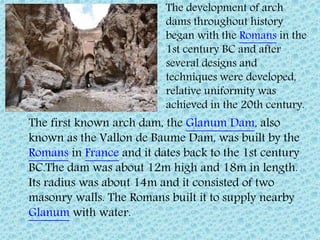
The first known arch dam, the Glanum Dam, also
known as the Vallon de Baume Dam, was built by the
Romans in France and it dates back to the 1st century
BC.The dam was about 12m high and 18m in length.
Its radius was about 14m and it consisted of two
masonry walls. The Romans built it to supply nearby
Glanum with water.
The development of arch
dams throughout history
began with the Romans in the
1st century BC and after
several designs and
techniques were developed,
relative uniformity was
achieved in the 20th century.
IDUKKI DAM
• Location Idukki,Kerala,India
• Purpose: Power Generation, Flood Control
• Type of Dam: Concrete, double curvature parabolic, thin arch.
• Height :168.91 m (554 ft)
• Length :365.85 m (1,200 ft)
• Dam volume: 450,000 m3 (16,000,000 cu ft)
• Spillways: Nil
• Reservoir Total capacity: 1,996×106 m3 (1,618,184 acre·ft)
• Active capacity :1,459×106 m3 (1,182,831 acre·ft)
• Inactive capacity: 536×106 m3 (434,542 acre·ft)
• Catchment Area: 649.3 km2 (251 sq mi)
• Surface area :60 km2 (23 sq mi)
• Normal elevation :732.62 km2 (283 sq mi)
• Installed capacity :780 MW
• This dam was constructed along with two
other dams at Cheruthoni and Kulamavu.
Together, the three dams have created an
artificial lake that is 60 km² in area. The
stored water is used to produce electricity
at the Moolamattom Power house, which
is located inside nearby rocky caves. The
Government of Canada aided in the
building of the dam with long term loans
and grants
• The idea of constructing a dam for power
generation was first conceived in 1919. As per
history, Shri Kolumban, the head of 'OOrali'
race during 1922, showed the way to the
Malankara Estate Superintendent and his friend
AC Thomas Edattu, who were on hunting spree
in the forest, the spot of present Arch Dam. He
told them of the legend of Kuravan and Kurathi
Hills. Mr. Thomas was impressed by the sight of
water flow between the mountains and it was
his idea that has materialized in the form of
Idukki Arch Dam.
• The construction of this Dam commenced on
30 April 1969. Storage of water in Idukki
reservoir commenced in February, 1973. The
inauguration of trial run of the first machine
was celebrated on 4 October 1975.
Commercial operation of the Power Station
was Commissioned on 12 February 1976 by
the then Hon. Prime Minister Smt. Indira
Gandhi
• Twice in the past, the shutters had to be opened;
during the northeast monsoon on both occasions.
The first time was in 1981 (when the shutters
were repeatedly opened and shut between
October 29 and November 13) and the second
time was in 1992 (when they were kept open for
12 days from October 12 to 23).
• On both occasions, the water level in the dam
touched the brim only when the storage built up
during the southwest monsoon was augmented
by the inflow received immediately afterwards
following heavy downpour early in the northeast
monsoon
• Power Generation:
• The Project harnesses a major portion of the power potential of
Periyar, the largest river in Kerala, by the creation of a reservoir
of 2 Billion Tones capacity, diversion of waters thus impounded
through a water conductor system consisting of a power tunnel
and two underground pressure shafts to an underground
power house situated in Moolamattom.
• The installed capacity of the Power House is 780MW consisting
of 6 Units of Pelton type turbines with a power generation
capacity of 130 MW each. The regulated waters of Periyar falls
through a drop of about 669.2 meters while generating power
in the underground power house.
• Irrigation
• The tail waters flowing to Kudayathurpuzha through tunnel
and open channel is diverted for irrigation purposes in the
Muvattupuzha Valley.
THANK YOU
Deekshith Rishi
Sandeep Goud

Arch dam

  • 1.
  • 2.
    •An Arch damis a solid dam made of concrete that is curved upstream in plan. The arch dam is designed so that the force of the water against it, known as hydrostatic pressure, presses against the arch, compressing and strengthening the structure as it pushes into its foundation or abutments. • An arch dam is most suitable for narrow gorges or canyons with steep walls of stable rock to support the structure and stresses. Since they are thinner than any other dam type, they require much less construction material, making them economical and practical in remote areas.
  • 3.
    • In general,arch dams are classified based on the ratio of the base thickness to the structural height (b/h) as: • Thin, for b/h less than 0.2, • Medium-thick, for b/h between 0.2 and 0.3, and • Thick, for b/h ratio over 0.3. • Arch dams classified with respect to their structural height are • Low dams up to 100 feet, • Medium high dams between 100– 300 feet, • High dams over 300 feet. CLASSIFICATION
  • 4.
    The main loadsfor which an arch dam is designed are •Dead load •Hydrostatic load generated by the reservoir and the tail water •Temperature load •Earthquake load Other miscellaneous loads that affect a dam include: ice and silt loads, and uplift pressure.[1] [10] LOADS
  • 5.
    • Most often,the arch dam is made of concrete and placed in a "V"-shaped valley. The foundation or abutments for an arch dam must be very stable and proportionate to the concrete. There are two basic designs for an arch dam: constant-radius dams, which have constant radius of curvature, and variable-radius dams, which have both upstream and downstream curves that systematically decrease in radius below the crest. A dam that is double-curved in both its horizontal and vertical planes may be called a dome dam. Arch dams with more than one contiguous arch or plane are described as multiple- arch dams
  • 6.
    The first knownarch dam, the Glanum Dam, also known as the Vallon de Baume Dam, was built by the Romans in France and it dates back to the 1st century BC.The dam was about 12m high and 18m in length. Its radius was about 14m and it consisted of two masonry walls. The Romans built it to supply nearby Glanum with water. The development of arch dams throughout history began with the Romans in the 1st century BC and after several designs and techniques were developed, relative uniformity was achieved in the 20th century.
  • 7.
  • 8.
    • Location Idukki,Kerala,India •Purpose: Power Generation, Flood Control • Type of Dam: Concrete, double curvature parabolic, thin arch. • Height :168.91 m (554 ft) • Length :365.85 m (1,200 ft) • Dam volume: 450,000 m3 (16,000,000 cu ft) • Spillways: Nil • Reservoir Total capacity: 1,996×106 m3 (1,618,184 acre·ft) • Active capacity :1,459×106 m3 (1,182,831 acre·ft) • Inactive capacity: 536×106 m3 (434,542 acre·ft) • Catchment Area: 649.3 km2 (251 sq mi) • Surface area :60 km2 (23 sq mi) • Normal elevation :732.62 km2 (283 sq mi) • Installed capacity :780 MW
  • 9.
    • This damwas constructed along with two other dams at Cheruthoni and Kulamavu. Together, the three dams have created an artificial lake that is 60 km² in area. The stored water is used to produce electricity at the Moolamattom Power house, which is located inside nearby rocky caves. The Government of Canada aided in the building of the dam with long term loans and grants
  • 10.
    • The ideaof constructing a dam for power generation was first conceived in 1919. As per history, Shri Kolumban, the head of 'OOrali' race during 1922, showed the way to the Malankara Estate Superintendent and his friend AC Thomas Edattu, who were on hunting spree in the forest, the spot of present Arch Dam. He told them of the legend of Kuravan and Kurathi Hills. Mr. Thomas was impressed by the sight of water flow between the mountains and it was his idea that has materialized in the form of Idukki Arch Dam.
  • 11.
    • The constructionof this Dam commenced on 30 April 1969. Storage of water in Idukki reservoir commenced in February, 1973. The inauguration of trial run of the first machine was celebrated on 4 October 1975. Commercial operation of the Power Station was Commissioned on 12 February 1976 by the then Hon. Prime Minister Smt. Indira Gandhi
  • 12.
    • Twice inthe past, the shutters had to be opened; during the northeast monsoon on both occasions. The first time was in 1981 (when the shutters were repeatedly opened and shut between October 29 and November 13) and the second time was in 1992 (when they were kept open for 12 days from October 12 to 23). • On both occasions, the water level in the dam touched the brim only when the storage built up during the southwest monsoon was augmented by the inflow received immediately afterwards following heavy downpour early in the northeast monsoon
  • 13.
    • Power Generation: •The Project harnesses a major portion of the power potential of Periyar, the largest river in Kerala, by the creation of a reservoir of 2 Billion Tones capacity, diversion of waters thus impounded through a water conductor system consisting of a power tunnel and two underground pressure shafts to an underground power house situated in Moolamattom. • The installed capacity of the Power House is 780MW consisting of 6 Units of Pelton type turbines with a power generation capacity of 130 MW each. The regulated waters of Periyar falls through a drop of about 669.2 meters while generating power in the underground power house. • Irrigation • The tail waters flowing to Kudayathurpuzha through tunnel and open channel is diverted for irrigation purposes in the Muvattupuzha Valley.
  • 14.