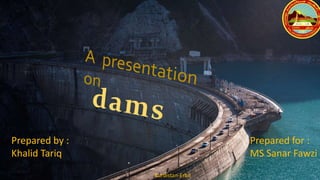
Prepared by :
Khalid Tariq
Prepared for :
MS Sanar Fawzi
Kurdistan-Erbil
Introduction
Purpose of
Types of dam
Design and
conclusion
Introduction
What is dam?
A dam is a barrier that stops or restricts the flow of water or
underground streams.
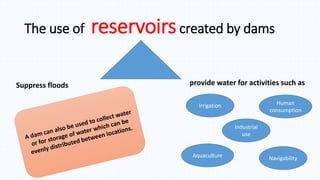
The use of reservoirscreated by dams
Suppress floods provide water for activities such as
Irrigation Human
consumption
Industrial
use
Aquaculture Navigability
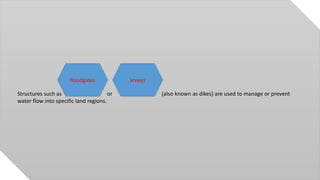
Structures such as or (also known as dikes) are used to manage or prevent
water flow into specific land regions.
floodgates levees
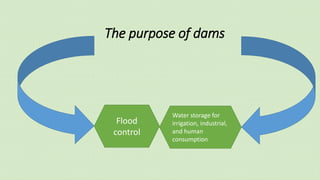
The purpose of dams
Flood
control
Water storage for
irrigation, industrial,
and human
consumption
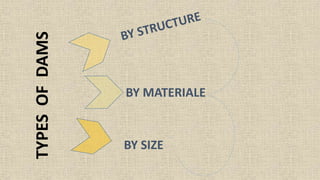
TYPESOFDAMS
BY SIZE
BY MATERIALE
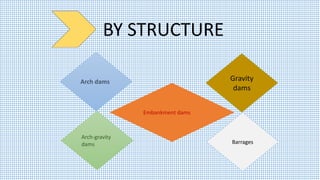
BY STRUCTURE
Arch dams Gravity
dams
Embankment dams
Arch-gravity
dams Barrages
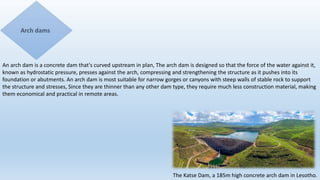
The Katse Dam, a 185m high concrete arch dam in Lesotho.
An arch dam is a concrete dam that's curved upstream in plan, The arch dam is designed so that the force of the water against it,
known as hydrostatic pressure, presses against the arch, compressing and strengthening the structure as it pushes into its
foundation or abutments. An arch dam is most suitable for narrow gorges or canyons with steep walls of stable rock to support
the structure and stresses, Since they are thinner than any other dam type, they require much less construction material, making
them economical and practical in remote areas.
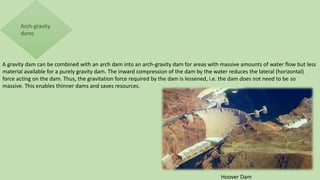
A gravity dam can be combined with an arch dam into an arch-gravity dam for areas with massive amounts of water flow but less
material available for a purely gravity dam. The inward compression of the dam by the water reduces the lateral (horizontal)
force acting on the dam. Thus, the gravitation force required by the dam is lessened, i.e. the dam does not need to be so
massive. This enables thinner dams and saves resources.
Hoover Dam
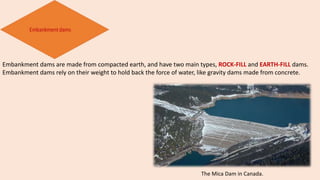
Embankment dams are made from compacted earth, and have two main types, ROCK-FILL and EARTH-FILL dams.
Embankment dams rely on their weight to hold back the force of water, like gravity dams made from concrete.
The Mica Dam in Canada.
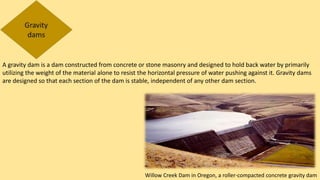
A gravity dam is a dam constructed from concrete or stone masonry and designed to hold back water by primarily
utilizing the weight of the material alone to resist the horizontal pressure of water pushing against it. Gravity dams
are designed so that each section of the dam is stable, independent of any other dam section.
Willow Creek Dam in Oregon, a roller-compacted concrete gravity dam
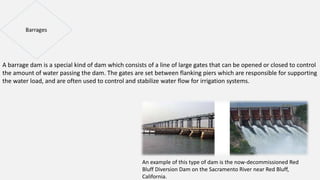
A barrage dam is a special kind of dam which consists of a line of large gates that can be opened or closed to control
the amount of water passing the dam. The gates are set between flanking piers which are responsible for supporting
the water load, and are often used to control and stabilize water flow for irrigation systems.
An example of this type of dam is the now-decommissioned Red
Bluff Diversion Dam on the Sacramento River near Red Bluff,
California.
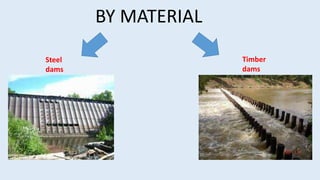
BY MATERIAL
Steel
dams
Timber
dams
BY SIZE
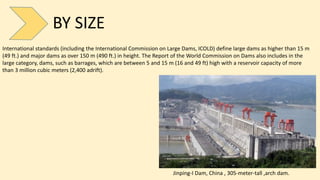
International standards (including the International Commission on Large Dams, ICOLD) define large dams as higher than 15 m
(49 ft.) and major dams as over 150 m (490 ft.) in height. The Report of the World Commission on Dams also includes in the
large category, dams, such as barrages, which are between 5 and 15 m (16 and 49 ft) high with a reservoir capacity of more
than 3 million cubic meters (2,400 adrift).
Jinping-I Dam, China , 305-meter-tall ,arch dam.
DESIGN AND CONSTRUCTION
General comments
• All dams are different.
• The consequences of dam failure may be disastrous.
• The force of water pressure is enormous.
• The level of acceptable leakage is low; usually it is in the range of liters per second, and often totals less
than the losses by reservoir evaporation.
• The foundation is a key part of the structure and needs careful exploration and improvement.
• The control of floods is an essential element in dam design and may also be a difficult problem during
construction on large rivers.
• The local seismic risk may modify the design.
• The impact of reservoirs on the environment demands special study.
CONCLUSION
Dams have been used to provide a store of water for agriculture, industrial uses,
household uses for thousands of years. Hydroelectric dams, additionally, act as an
alternative to non-renewable energy resources that constitutes the majority of the
world’s energy. In the 20th century, over $2 trillion was spent on making dams
around the world. However, dams have drastic damaging effects on the
environment and on the populations that live near the dams and so have become
the subject of great scrutiny, with organizations concerned with environmental
health such as World Wildlife Fund (WWF) and International Rivers advocating the
removal of old dams and the use of Fund (WWF) and International Rivers
advocating the removal of old dams and the use of alternatives. In this article,
Mission 2017 looks into the uses of dams and ways of maximizing their efficiency
and minimizing their environmental damage. The first part of the article looks into
the details of dams and their problems and the second part deals with possible
solutions to the problems.
Dams

Dams

  • 1.
    Prepared by : KhalidTariq Prepared for : MS Sanar Fawzi Kurdistan-Erbil
  • 2.
    Introduction Purpose of Types ofdam Design and conclusion
  • 3.
    Introduction What is dam? Adam is a barrier that stops or restricts the flow of water or underground streams.
  • 4.
    The use ofreservoirscreated by dams Suppress floods provide water for activities such as Irrigation Human consumption Industrial use Aquaculture Navigability
  • 5.
    Structures such asor (also known as dikes) are used to manage or prevent water flow into specific land regions. floodgates levees
  • 6.
    The purpose ofdams Flood control Water storage for irrigation, industrial, and human consumption
  • 7.
  • 8.
    BY STRUCTURE Arch damsGravity dams Embankment dams Arch-gravity dams Barrages
  • 9.
    The Katse Dam,a 185m high concrete arch dam in Lesotho. An arch dam is a concrete dam that's curved upstream in plan, The arch dam is designed so that the force of the water against it, known as hydrostatic pressure, presses against the arch, compressing and strengthening the structure as it pushes into its foundation or abutments. An arch dam is most suitable for narrow gorges or canyons with steep walls of stable rock to support the structure and stresses, Since they are thinner than any other dam type, they require much less construction material, making them economical and practical in remote areas.
  • 10.
    A gravity damcan be combined with an arch dam into an arch-gravity dam for areas with massive amounts of water flow but less material available for a purely gravity dam. The inward compression of the dam by the water reduces the lateral (horizontal) force acting on the dam. Thus, the gravitation force required by the dam is lessened, i.e. the dam does not need to be so massive. This enables thinner dams and saves resources. Hoover Dam
  • 11.
    Embankment dams aremade from compacted earth, and have two main types, ROCK-FILL and EARTH-FILL dams. Embankment dams rely on their weight to hold back the force of water, like gravity dams made from concrete. The Mica Dam in Canada.
  • 12.
    A gravity damis a dam constructed from concrete or stone masonry and designed to hold back water by primarily utilizing the weight of the material alone to resist the horizontal pressure of water pushing against it. Gravity dams are designed so that each section of the dam is stable, independent of any other dam section. Willow Creek Dam in Oregon, a roller-compacted concrete gravity dam
  • 13.
    A barrage damis a special kind of dam which consists of a line of large gates that can be opened or closed to control the amount of water passing the dam. The gates are set between flanking piers which are responsible for supporting the water load, and are often used to control and stabilize water flow for irrigation systems. An example of this type of dam is the now-decommissioned Red Bluff Diversion Dam on the Sacramento River near Red Bluff, California.
  • 14.
  • 15.
    BY SIZE International standards(including the International Commission on Large Dams, ICOLD) define large dams as higher than 15 m (49 ft.) and major dams as over 150 m (490 ft.) in height. The Report of the World Commission on Dams also includes in the large category, dams, such as barrages, which are between 5 and 15 m (16 and 49 ft) high with a reservoir capacity of more than 3 million cubic meters (2,400 adrift). Jinping-I Dam, China , 305-meter-tall ,arch dam.
  • 16.
    DESIGN AND CONSTRUCTION Generalcomments • All dams are different. • The consequences of dam failure may be disastrous. • The force of water pressure is enormous. • The level of acceptable leakage is low; usually it is in the range of liters per second, and often totals less than the losses by reservoir evaporation. • The foundation is a key part of the structure and needs careful exploration and improvement. • The control of floods is an essential element in dam design and may also be a difficult problem during construction on large rivers. • The local seismic risk may modify the design. • The impact of reservoirs on the environment demands special study.
  • 17.
    CONCLUSION Dams have beenused to provide a store of water for agriculture, industrial uses, household uses for thousands of years. Hydroelectric dams, additionally, act as an alternative to non-renewable energy resources that constitutes the majority of the world’s energy. In the 20th century, over $2 trillion was spent on making dams around the world. However, dams have drastic damaging effects on the environment and on the populations that live near the dams and so have become the subject of great scrutiny, with organizations concerned with environmental health such as World Wildlife Fund (WWF) and International Rivers advocating the removal of old dams and the use of Fund (WWF) and International Rivers advocating the removal of old dams and the use of alternatives. In this article, Mission 2017 looks into the uses of dams and ways of maximizing their efficiency and minimizing their environmental damage. The first part of the article looks into the details of dams and their problems and the second part deals with possible solutions to the problems.