Defects in crystal
Dr.R.Vidhya
Introduction
• Crystalline solids – The constituent atoms or molecules
are arranged in an orderly fashion throughout in a
three dimensional pattern. The atoms are arranged
like soldiers on a parade ground in a well defined
columns and rows.
• Crystal defect – The irregularities in the structure of
crystal.
2
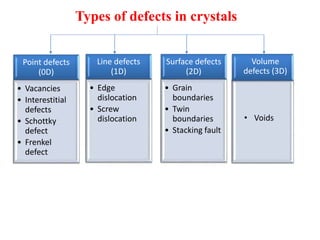
Types of defects in crystals
Point defects
(0D)
• Vacancies
• Interestitial
defects
• Schottky
defect
• Frenkel
defect
Line defects
(1D)
• Edge
dislocation
• Screw
dislocation
Surface defects
(2D)
• Grain
boundaries
• Twin
boundaries
• Stacking fault
Volume
defects (3D)
• Voids
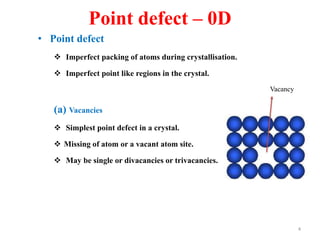
Point defect – 0D
• Point defect
 Imperfect packing of atoms during crystallisation.
 Imperfect point like regions in the crystal.
(a) Vacancies
 Simplest point defect in a crystal.
 Missing of atom or a vacant atom site.
 May be single or divacancies or trivacancies.
4
Vacancy
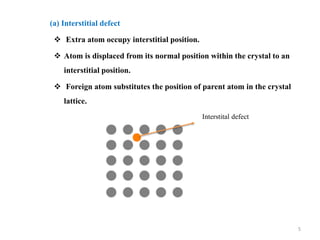
(a) Interstitial defect
 Extra atom occupy interstitial position.
 Atom is displaced from its normal position within the crystal to an
interstitial position.
 Foreign atom substitutes the position of parent atom in the crystal
lattice.
5
Interstital defect
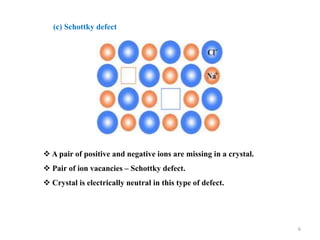
(c) Schottky defect
6
 A pair of positive and negative ions are missing in a crystal.
 Pair of ion vacancies – Schottky defect.
 Crystal is electrically neutral in this type of defect.
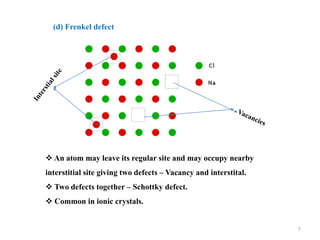
(d) Frenkel defect
7
 An atom may leave its regular site and may occupy nearby
interstitial site giving two defects – Vacancy and interstital.
 Two defects together – Schottky defect.
 Common in ionic crystals.
Line defect – 1D
• Line defect
 Due to dislocation or distortion of atoms along a line in some direction.
 Dislocation is a boundary between slipped and unslipped region.
 Types – Edge dislocation
Screw dislocation
8
(a) Edge dislocation
9
 Due to insertion of an extra half plane of atoms.
 Extra plane of inserted atoms is above the slip plane – Positive dislocation
represented by
 Extra plane is inserted below the slip plane – Negative dislocation
represented by T
 Burger vector – indicates the direction and magnitude of the shift of the
lattice on the slip plane.
(b) Screw dislocation
10
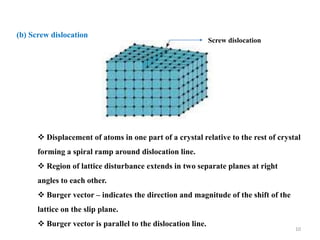
 Displacement of atoms in one part of a crystal relative to the rest of crystal
forming a spiral ramp around dislocation line.
 Region of lattice disturbance extends in two separate planes at right
angles to each other.
 Burger vector – indicates the direction and magnitude of the shift of the
lattice on the slip plane.
 Burger vector is parallel to the dislocation line.
Screw dislocation
Surface defect – 2D
• Surface defect
 Takes place on the surface of a material.
 Due to imperfect placing of atoms during crystallization or defective
orientation of the surface.
 Types - Grain boundary
- Twin boundary
- Stacking fault
11
(a) Grain boundary
12
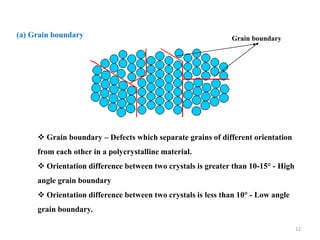
 Grain boundary – Defects which separate grains of different orientation
from each other in a polycrystalline material.
 Orientation difference between two crystals is greater than 10-15° - High
angle grain boundary
 Orientation difference between two crystals is less than 10° - Low angle
grain boundary.
Grain boundary
(b) Twin boundary
13
 Boundaries in the grains at which the atomic arrangement on one side of
the boundary is the mirror image of the atoms on the other side.
 Volume of material which has orientation similar to the mirror image of
the matrix operation – Twin
 Mirror – Twinning plane.
(c) Stacking fault
14
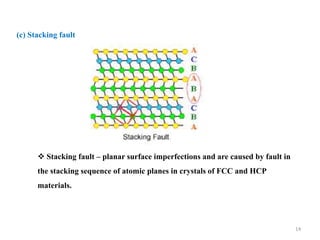
 Stacking fault – planar surface imperfections and are caused by fault in
the stacking sequence of atomic planes in crystals of FCC and HCP
materials.
Volume defect – 3D
• Volume defect
 Cracks may arise when there is only small electrostatic dissimilarity
between the stacking sequences of close packed planes in metals.
 Whenever a cluster of atoms are missing large vacancy or void is got.
 Foreign particle inclusions, large voids or non crystalline regions which
have the dimensions of the order of 20 Å - volume imperfection.
15
Defects in crystal

Defects in crystal

  • 1.
  • 2.
    Introduction • Crystalline solids– The constituent atoms or molecules are arranged in an orderly fashion throughout in a three dimensional pattern. The atoms are arranged like soldiers on a parade ground in a well defined columns and rows. • Crystal defect – The irregularities in the structure of crystal. 2
  • 3.
    Types of defectsin crystals Point defects (0D) • Vacancies • Interestitial defects • Schottky defect • Frenkel defect Line defects (1D) • Edge dislocation • Screw dislocation Surface defects (2D) • Grain boundaries • Twin boundaries • Stacking fault Volume defects (3D) • Voids
  • 4.
    Point defect –0D • Point defect  Imperfect packing of atoms during crystallisation.  Imperfect point like regions in the crystal. (a) Vacancies  Simplest point defect in a crystal.  Missing of atom or a vacant atom site.  May be single or divacancies or trivacancies. 4 Vacancy
  • 5.
    (a) Interstitial defect Extra atom occupy interstitial position.  Atom is displaced from its normal position within the crystal to an interstitial position.  Foreign atom substitutes the position of parent atom in the crystal lattice. 5 Interstital defect
  • 6.
    (c) Schottky defect 6 A pair of positive and negative ions are missing in a crystal.  Pair of ion vacancies – Schottky defect.  Crystal is electrically neutral in this type of defect.
  • 7.
    (d) Frenkel defect 7 An atom may leave its regular site and may occupy nearby interstitial site giving two defects – Vacancy and interstital.  Two defects together – Schottky defect.  Common in ionic crystals.
  • 8.
    Line defect –1D • Line defect  Due to dislocation or distortion of atoms along a line in some direction.  Dislocation is a boundary between slipped and unslipped region.  Types – Edge dislocation Screw dislocation 8
  • 9.
    (a) Edge dislocation 9 Due to insertion of an extra half plane of atoms.  Extra plane of inserted atoms is above the slip plane – Positive dislocation represented by  Extra plane is inserted below the slip plane – Negative dislocation represented by T  Burger vector – indicates the direction and magnitude of the shift of the lattice on the slip plane.
  • 10.
    (b) Screw dislocation 10 Displacement of atoms in one part of a crystal relative to the rest of crystal forming a spiral ramp around dislocation line.  Region of lattice disturbance extends in two separate planes at right angles to each other.  Burger vector – indicates the direction and magnitude of the shift of the lattice on the slip plane.  Burger vector is parallel to the dislocation line. Screw dislocation
  • 11.
    Surface defect –2D • Surface defect  Takes place on the surface of a material.  Due to imperfect placing of atoms during crystallization or defective orientation of the surface.  Types - Grain boundary - Twin boundary - Stacking fault 11
  • 12.
    (a) Grain boundary 12 Grain boundary – Defects which separate grains of different orientation from each other in a polycrystalline material.  Orientation difference between two crystals is greater than 10-15° - High angle grain boundary  Orientation difference between two crystals is less than 10° - Low angle grain boundary. Grain boundary
  • 13.
    (b) Twin boundary 13 Boundaries in the grains at which the atomic arrangement on one side of the boundary is the mirror image of the atoms on the other side.  Volume of material which has orientation similar to the mirror image of the matrix operation – Twin  Mirror – Twinning plane.
  • 14.
    (c) Stacking fault 14 Stacking fault – planar surface imperfections and are caused by fault in the stacking sequence of atomic planes in crystals of FCC and HCP materials.
  • 15.
    Volume defect –3D • Volume defect  Cracks may arise when there is only small electrostatic dissimilarity between the stacking sequences of close packed planes in metals.  Whenever a cluster of atoms are missing large vacancy or void is got.  Foreign particle inclusions, large voids or non crystalline regions which have the dimensions of the order of 20 Å - volume imperfection. 15