ELBOW INSTABILITY
By:
Dr. Ahmed saleh
Ass.lect. Of orthopaedic surgery
HAND AND UPPER LIMB SURGERY UNIT
Mansoura University Hospitals
Department Of Orthopedic Surgery
Hand & Upper Limb Surgery Unit
OBJECTIVES
• FUNCTIONAL ANATOMY
• STABILIZING FACTORS
• PATHOMECHANICS
• CLASSIFICATION
• DIAGNOSIS
• MANAGEMENT
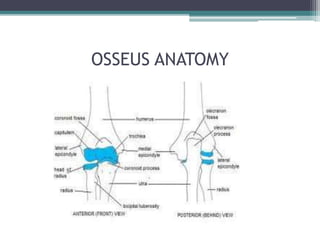
OSSEUS ANATOMY
SOFT TISSUE ANATOMY
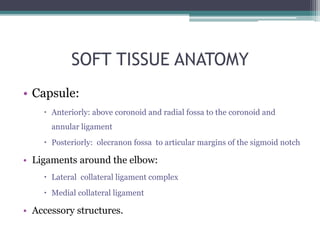
• Capsule:
 Anteriorly: above coronoid and radial fossa to the coronoid and
annular ligament
 Posteriorly: olecranon fossa to articular margins of the sigmoid notch
• Ligaments around the elbow:
 Lateral collateral ligament complex
 Medial collateral ligament
• Accessory structures.
SOFT TISSUE ANATOMY
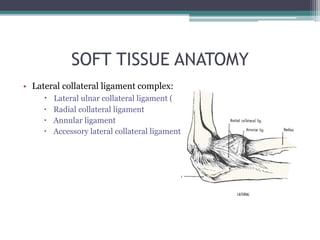
• Lateral collateral ligament complex:
 Lateral ulnar collateral ligament (
 Radial collateral ligament
 Annular ligament
 Accessory lateral collateral ligament
SOFT TISSUE ANATOMY
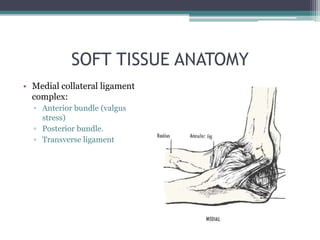
• Medial collateral ligament
complex:
▫ Anterior bundle (valgus
stress)
▫ Posterior bundle.
▫ Transverse ligament
SOFT TISSUE ANATOMY
• Accessory structures:
 The quadrate ligament: connecting the inferior margin of the annular
ligament to the ulna.
 The accessory lateral collateral ligament: stabilizes the annular
ligament by connecting its inferior fibres to the supinator crest.
 Oblique cord: from the lateral ulnar tubercle to the radius just below
the radial tuberosity.
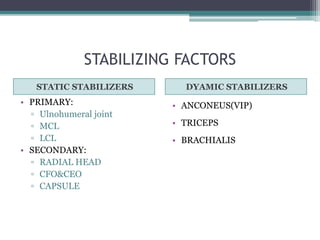
STABILIZING FACTORS
STATIC STABILIZERS DYAMIC STABILIZERS
• PRIMARY:
▫ Ulnohumeral joint
▫ MCL
▫ LCL
• SECONDARY:
▫ RADIAL HEAD
▫ CFO&CEO
▫ CAPSULE
• ANCONEUS(VIP)
• TRICEPS
• BRACHIALIS
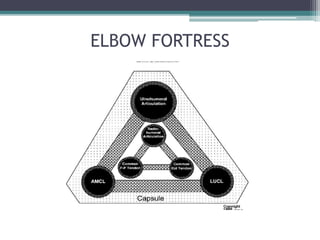
ELBOW FORTRESS
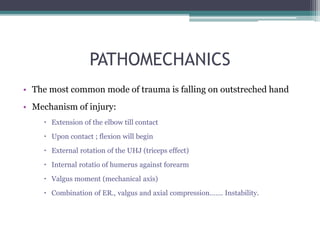
PATHOMECHANICS
• The most common mode of trauma is falling on outstreched hand
• Mechanism of injury:
 Extension of the elbow till contact
 Upon contact ; flexion will begin
 External rotation of the UHJ (triceps effect)
 Internal rotatio of humerus against forearm
 Valgus moment (mechanical axis)
 Combination of ER., valgus and axial compression……. Instability.
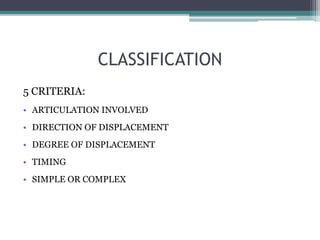
CLASSIFICATION
5 CRITERIA:
• ARTICULATION INVOLVED
• DIRECTION OF DISPLACEMENT
• DEGREE OF DISPLACEMENT
• TIMING
• SIMPLE OR COMPLEX
CLASSIFICATION
DEGREE OF DISPLACEMENT
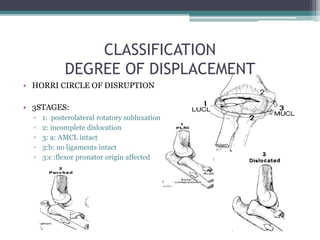
• HORRI CIRCLE OF DISRUPTION
• 3STAGES:
▫ 1: posterolateral rotatory subluxation
▫ 2: incomplete dislocation
▫ 3: a: AMCL intact
▫ 3:b: no ligaments intact
▫ 3:c :flexor pronator origin affected
DIAGNOSIS & MANAGEMENT
• Diagnosis of acute dislocation
• Diagnosis of posterolateral instability
• Diagnosis of complex instability
• Diagnosis of valgus instability
DIAGNOSIS
ACUTE DISLOCATIOAN
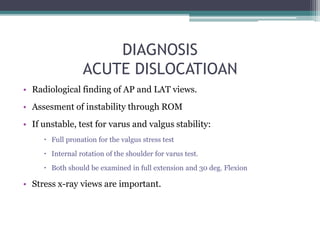
• Radiological finding of AP and LAT views.
• Assesment of instability through ROM
• If unstable, test for varus and valgus stability:
 Full pronation for the valgus stress test
 Internal rotation of the shoulder for varus test.
 Both should be examined in full extension and 30 deg. Flexion
• Stress x-ray views are important.
DIAGNOSIS
POSTEROLATERAL INSTABILITY
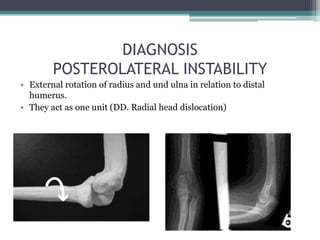
• External rotation of radius and und ulna in relation to distal
humerus.
• They act as one unit (DD. Radial head dislocation)
DIAGNOSIS
POSTEROLATERAL INSTABILITY
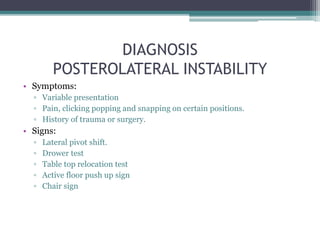
• Symptoms:
▫ Variable presentation
▫ Pain, clicking popping and snapping on certain positions.
▫ History of trauma or surgery.
• Signs:
▫ Lateral pivot shift.
▫ Drower test
▫ Table top relocation test
▫ Active floor push up sign
▫ Chair sign
DIAGNOSIS
POSTEROLATERAL INSTABILITY
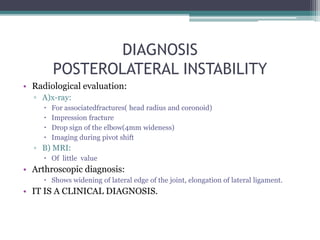
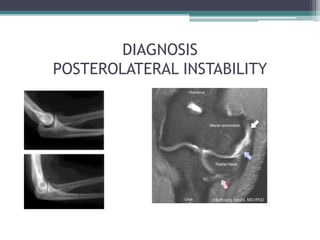
• Radiological evaluation:
▫ A)x-ray:
 For associatedfractures( head radius and coronoid)
 Impression fracture
 Drop sign of the elbow(4mm wideness)
 Imaging during pivot shift
▫ B) MRI:
 Of little value
• Arthroscopic diagnosis:
 Shows widening of lateral edge of the joint, elongation of lateral ligament.
• IT IS A CLINICAL DIAGNOSIS.
DIAGNOSIS
POSTEROLATERAL INSTABILITY
MANAGEMENT
POSTEROLATERAL INSTABILITY
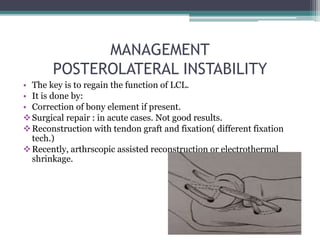
• The key is to regain the function of LCL.
• It is done by:
• Correction of bony element if present.
Surgical repair : in acute cases. Not good results.
Reconstruction with tendon graft and fixation( different fixation
tech.)
Recently, arthrscopic assisted reconstruction or electrothermal
shrinkage.
DIAGNOSIS
COMPLEX INSTABILITY
• Elbow dislocation associated with bony element.
• Uncommon, poor prognosis.
• Most common: radial head and coronid fracture
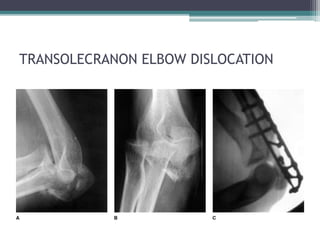
• Others include: transolecranon , terrible triad & posterior
monteggia
ASSOCIATED
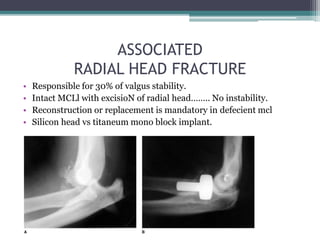
RADIAL HEAD FRACTURE
• Responsible for 30% of valgus stability.
• Intact MCLl with excisioN of radial head…….. No instability.
• Reconstruction or replacement is mandatory in defecient mcl
• Silicon head vs titaneum mono block implant.
ASSOCIATED
CORONOID FRACTURE
• Regan-Morrey classification
• O’driscoll:
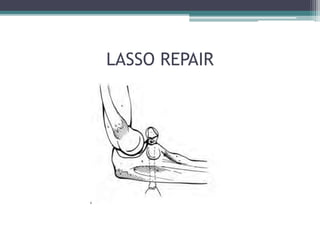
LASSO REPAIR
TERRIBLE TRIAD
• Elbow dislocation , radial head fracture and coronoid fracture
• Management must be done by correction of the 3 elemnts.
• Radial head fixation or replacement alone ….. 50% failure.
• Ligament reconstruction and not reapir (avulsion not
midsubstance)
POSTERIOR MONTEGGIA LESION
• Posterior dislocation of the radial head and a proximal ulna fracture
with an anterior triangular fracture fragment at the level of the
coronoid process
• Fixation of the coronoid process is mandatory for acquiring
stability.
TRANSOLECRANON ELBOW DISLOCATION
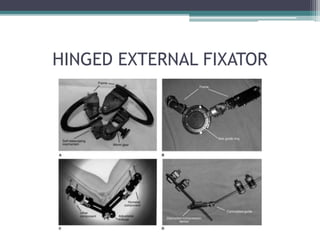
HINGED EXTERNAL FIXATOR
• DYNAMIC OR STATIC
• STATIC FIXATOR : Easily applied , no elbow motion
• DYNAMIC FIXATOR: demanding frame , active and passive.
• Indiations:
▫ Temporary stabilization
▫ persistent elbow instability
▫ protection of comminuted radial head or capitellum
▫ Maintenance of elbow stability in the setting of comminuted coronoid
fractures
▫ Hinged fixators also hava role in providing stability in chronic unreduced
elbow
HINGED EXTERNAL FIXATOR
VALGUS INSTABILITY
• Mainly occurred in throwing athletes.1st discovered 1946.
• MCL injury is the cause.
• Diagnosis based on :
▫ History
▫ +ve valgus stress test( baseball player ….+ve)
▫ MRI . MR arthrography with gadolinium.
▫ Dynamic ultrasonography
• It is contraindicated to do surgery in:
▫ Asymptomatic athletes who will quit the game
▫ Patient associated with HU or RCJ arthritis.
VALGUS INSTABILITY
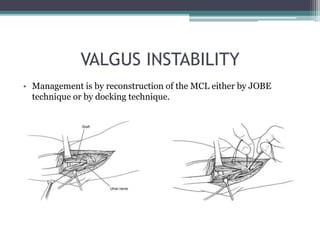
• Management is by reconstruction of the MCL either by JOBE
technique or by docking technique.
TAKING HOME MESSAGE
• Stability of the elbow is gained by osseus and soft tissue.
• Ulnar lateral collateral and anterior band of medial collateral are the
passwords for elbow stability.
• Horri circle will define the degree of displacement.
• Homework of elbow dislocation does not end by reduction.test the
stability before going home.
• Pivot shift done in supination and valgus stress test done in pronation.
• X-ray is important to assess simplicity of dislocation.
• Instability of the elbow is mainly a clinical entity
Elbow instability

Elbow instability

  • 1.
    ELBOW INSTABILITY By: Dr. Ahmedsaleh Ass.lect. Of orthopaedic surgery HAND AND UPPER LIMB SURGERY UNIT Mansoura University Hospitals Department Of Orthopedic Surgery Hand & Upper Limb Surgery Unit
  • 2.
    OBJECTIVES • FUNCTIONAL ANATOMY •STABILIZING FACTORS • PATHOMECHANICS • CLASSIFICATION • DIAGNOSIS • MANAGEMENT
  • 3.
  • 4.
    SOFT TISSUE ANATOMY •Capsule:  Anteriorly: above coronoid and radial fossa to the coronoid and annular ligament  Posteriorly: olecranon fossa to articular margins of the sigmoid notch • Ligaments around the elbow:  Lateral collateral ligament complex  Medial collateral ligament • Accessory structures.
  • 5.
    SOFT TISSUE ANATOMY •Lateral collateral ligament complex:  Lateral ulnar collateral ligament (  Radial collateral ligament  Annular ligament  Accessory lateral collateral ligament
  • 6.
    SOFT TISSUE ANATOMY •Medial collateral ligament complex: ▫ Anterior bundle (valgus stress) ▫ Posterior bundle. ▫ Transverse ligament
  • 7.
    SOFT TISSUE ANATOMY •Accessory structures:  The quadrate ligament: connecting the inferior margin of the annular ligament to the ulna.  The accessory lateral collateral ligament: stabilizes the annular ligament by connecting its inferior fibres to the supinator crest.  Oblique cord: from the lateral ulnar tubercle to the radius just below the radial tuberosity.
  • 8.
    STABILIZING FACTORS STATIC STABILIZERSDYAMIC STABILIZERS • PRIMARY: ▫ Ulnohumeral joint ▫ MCL ▫ LCL • SECONDARY: ▫ RADIAL HEAD ▫ CFO&CEO ▫ CAPSULE • ANCONEUS(VIP) • TRICEPS • BRACHIALIS
  • 9.
  • 10.
    PATHOMECHANICS • The mostcommon mode of trauma is falling on outstreched hand • Mechanism of injury:  Extension of the elbow till contact  Upon contact ; flexion will begin  External rotation of the UHJ (triceps effect)  Internal rotatio of humerus against forearm  Valgus moment (mechanical axis)  Combination of ER., valgus and axial compression……. Instability.
  • 11.
    CLASSIFICATION 5 CRITERIA: • ARTICULATIONINVOLVED • DIRECTION OF DISPLACEMENT • DEGREE OF DISPLACEMENT • TIMING • SIMPLE OR COMPLEX
  • 12.
    CLASSIFICATION DEGREE OF DISPLACEMENT •HORRI CIRCLE OF DISRUPTION • 3STAGES: ▫ 1: posterolateral rotatory subluxation ▫ 2: incomplete dislocation ▫ 3: a: AMCL intact ▫ 3:b: no ligaments intact ▫ 3:c :flexor pronator origin affected
  • 13.
    DIAGNOSIS & MANAGEMENT •Diagnosis of acute dislocation • Diagnosis of posterolateral instability • Diagnosis of complex instability • Diagnosis of valgus instability
  • 14.
    DIAGNOSIS ACUTE DISLOCATIOAN • Radiologicalfinding of AP and LAT views. • Assesment of instability through ROM • If unstable, test for varus and valgus stability:  Full pronation for the valgus stress test  Internal rotation of the shoulder for varus test.  Both should be examined in full extension and 30 deg. Flexion • Stress x-ray views are important.
  • 15.
    DIAGNOSIS POSTEROLATERAL INSTABILITY • Externalrotation of radius and und ulna in relation to distal humerus. • They act as one unit (DD. Radial head dislocation)
  • 16.
    DIAGNOSIS POSTEROLATERAL INSTABILITY • Symptoms: ▫Variable presentation ▫ Pain, clicking popping and snapping on certain positions. ▫ History of trauma or surgery. • Signs: ▫ Lateral pivot shift. ▫ Drower test ▫ Table top relocation test ▫ Active floor push up sign ▫ Chair sign
  • 17.
    DIAGNOSIS POSTEROLATERAL INSTABILITY • Radiologicalevaluation: ▫ A)x-ray:  For associatedfractures( head radius and coronoid)  Impression fracture  Drop sign of the elbow(4mm wideness)  Imaging during pivot shift ▫ B) MRI:  Of little value • Arthroscopic diagnosis:  Shows widening of lateral edge of the joint, elongation of lateral ligament. • IT IS A CLINICAL DIAGNOSIS.
  • 18.
  • 19.
    MANAGEMENT POSTEROLATERAL INSTABILITY • Thekey is to regain the function of LCL. • It is done by: • Correction of bony element if present. Surgical repair : in acute cases. Not good results. Reconstruction with tendon graft and fixation( different fixation tech.) Recently, arthrscopic assisted reconstruction or electrothermal shrinkage.
  • 20.
    DIAGNOSIS COMPLEX INSTABILITY • Elbowdislocation associated with bony element. • Uncommon, poor prognosis. • Most common: radial head and coronid fracture • Others include: transolecranon , terrible triad & posterior monteggia
  • 21.
    ASSOCIATED RADIAL HEAD FRACTURE •Responsible for 30% of valgus stability. • Intact MCLl with excisioN of radial head…….. No instability. • Reconstruction or replacement is mandatory in defecient mcl • Silicon head vs titaneum mono block implant.
  • 22.
    ASSOCIATED CORONOID FRACTURE • Regan-Morreyclassification • O’driscoll:
  • 23.
  • 24.
    TERRIBLE TRIAD • Elbowdislocation , radial head fracture and coronoid fracture • Management must be done by correction of the 3 elemnts. • Radial head fixation or replacement alone ….. 50% failure. • Ligament reconstruction and not reapir (avulsion not midsubstance)
  • 25.
    POSTERIOR MONTEGGIA LESION •Posterior dislocation of the radial head and a proximal ulna fracture with an anterior triangular fracture fragment at the level of the coronoid process • Fixation of the coronoid process is mandatory for acquiring stability.
  • 26.
  • 27.
    HINGED EXTERNAL FIXATOR •DYNAMIC OR STATIC • STATIC FIXATOR : Easily applied , no elbow motion • DYNAMIC FIXATOR: demanding frame , active and passive. • Indiations: ▫ Temporary stabilization ▫ persistent elbow instability ▫ protection of comminuted radial head or capitellum ▫ Maintenance of elbow stability in the setting of comminuted coronoid fractures ▫ Hinged fixators also hava role in providing stability in chronic unreduced elbow
  • 28.
  • 29.
    VALGUS INSTABILITY • Mainlyoccurred in throwing athletes.1st discovered 1946. • MCL injury is the cause. • Diagnosis based on : ▫ History ▫ +ve valgus stress test( baseball player ….+ve) ▫ MRI . MR arthrography with gadolinium. ▫ Dynamic ultrasonography • It is contraindicated to do surgery in: ▫ Asymptomatic athletes who will quit the game ▫ Patient associated with HU or RCJ arthritis.
  • 30.
    VALGUS INSTABILITY • Managementis by reconstruction of the MCL either by JOBE technique or by docking technique.
  • 31.
    TAKING HOME MESSAGE •Stability of the elbow is gained by osseus and soft tissue. • Ulnar lateral collateral and anterior band of medial collateral are the passwords for elbow stability. • Horri circle will define the degree of displacement. • Homework of elbow dislocation does not end by reduction.test the stability before going home. • Pivot shift done in supination and valgus stress test done in pronation. • X-ray is important to assess simplicity of dislocation. • Instability of the elbow is mainly a clinical entity