
PROTEOLYSIS
SUBMITTED BY – UDAYPAL
ROLL NO -CUHP20PLS30
WHAT IS PROTEIN DEGRADATION?
• Protein degradation, also known as proteolysis, refers to a set of
enzymatic reactions by which the proteins are broken down into
smaller polypeptides or amino acids by protease. Proteolysis may
also occur in some special conditions that are absent from the
enzymes, such as mineral acids and high temperatures. Proteolysis
includes two main pathways: ubiquitin-mediated proteolysis and
lysosomal proteolysis
METHODS OF PROTEOLYSIS
1. Within Proteasomes
2. Within Lysosomes
PROTEASOMES....?
• Proteasomes are cylindrical found in both prokaryotes and
eukaryotes
In eukaryotes they are present in both nucleus and cytosol
In eukaryotes Proteasomes are two types 20S and 26S
proteasome
It catalyses the ATP-Dependent degradation of
polyubiquitinated proteins
STRUCTURE OF PROTEASOME
The 20S proteasome is a cylindrical barrel-shaped structure consisting
of 28 subunit arranged as four rings of heptamers stacked upon one
another
All subunits are members of the same superfamily of proteins which
group into two family’s designated alpha and beta
In eukaryotic cells the 20S proteasome assembles with two 19S
regulatory complexes(RC) in an ATP dependent manner to form 26S
proteasome
UBIQUITINATION OF PROTEIN
• Ubiquitin is a highly conserved eukaryotic protein of 76 amino acid
residues
The process by which ubiquitin is covalently attached to a lysine
rsidue on a target protin is called ubiquitination
In the process of ubiquitination ,an isopeptide Bond forms between
lysine residue of a target protein and C-triminal glycine of ubiquitin
• Proteins can be monoubiquitinated ,multiubiquitinated or
polyubiquitinated (Minimum 4 ubiquitin requrire for proteolysis)
THE PROCESS OF UBIQUITINATION
• Occurs in following steps
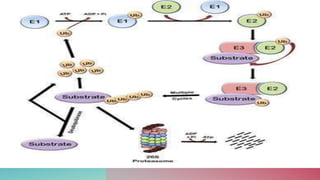
1. Activation of ubiquitin: Ubiquitin is activated by an (Ubiquitin-activation
enzyme) E1 becomes covalently linked to free ubiquitin through the C-
terminal residue of ubiquitin ,in an energy-dependent manner
2.Transfer of ubiquitin from E1 to E2: The activated ubiquitin is
subsequently transferred to a Cysteine residue present on an
E2(ubiquitin-conjugating enzyme)
• 3.Ligation of ubiquitin to target protein: Finally ,E3(ubiquitin
ligases)transfer the activated ubiquitin from E2 to a lysine amino acid
residue of its target protein ,forming an Isopeptide bond
FORMATION OF POLYUBIQUITIN CHAIN
Covalently attached ubiquitin on target protein used for
formation of ubiquitin polymers in which an inernal Lysine
resdue of one ubiquitin is attached to the C-terminal residue of
another (Ubiquitin has seven lysine residue)
Ubiquitin can also be covalently linked to N-terminal alpha-
amino group via peptide linkage to yeild linear polyubiquitin
chains
(A small region of a target protein thet is recognised by the E3
ubiquitin ligase and is required for substrate binding and
ubiquitination is called Degrons
LYSOSOMAL PROTEIN DEGRADATION
• Lysosomes contain various digestive enzymes, including proteases. Lysosomes
take up cellular proteins by fusion with autophagosomes, which are formed by the
enclosure of areas of cytoplasm or organelles (e.g., a mitochondrion) in fragments
of the endoplasmic reticulum. This fusion yields a phagolysosome, which digests
the contents of the autophagosome.
THANK YOU

PROTEOLYSIS .pptx

  • 1.
    PROTEOLYSIS SUBMITTED BY –UDAYPAL ROLL NO -CUHP20PLS30
  • 2.
    WHAT IS PROTEINDEGRADATION? • Protein degradation, also known as proteolysis, refers to a set of enzymatic reactions by which the proteins are broken down into smaller polypeptides or amino acids by protease. Proteolysis may also occur in some special conditions that are absent from the enzymes, such as mineral acids and high temperatures. Proteolysis includes two main pathways: ubiquitin-mediated proteolysis and lysosomal proteolysis
  • 3.
    METHODS OF PROTEOLYSIS 1.Within Proteasomes 2. Within Lysosomes
  • 4.
    PROTEASOMES....? • Proteasomes arecylindrical found in both prokaryotes and eukaryotes In eukaryotes they are present in both nucleus and cytosol In eukaryotes Proteasomes are two types 20S and 26S proteasome It catalyses the ATP-Dependent degradation of polyubiquitinated proteins
  • 5.
    STRUCTURE OF PROTEASOME The20S proteasome is a cylindrical barrel-shaped structure consisting of 28 subunit arranged as four rings of heptamers stacked upon one another All subunits are members of the same superfamily of proteins which group into two family’s designated alpha and beta In eukaryotic cells the 20S proteasome assembles with two 19S regulatory complexes(RC) in an ATP dependent manner to form 26S proteasome
  • 8.
    UBIQUITINATION OF PROTEIN •Ubiquitin is a highly conserved eukaryotic protein of 76 amino acid residues The process by which ubiquitin is covalently attached to a lysine rsidue on a target protin is called ubiquitination In the process of ubiquitination ,an isopeptide Bond forms between lysine residue of a target protein and C-triminal glycine of ubiquitin • Proteins can be monoubiquitinated ,multiubiquitinated or polyubiquitinated (Minimum 4 ubiquitin requrire for proteolysis)
  • 9.
    THE PROCESS OFUBIQUITINATION • Occurs in following steps 1. Activation of ubiquitin: Ubiquitin is activated by an (Ubiquitin-activation enzyme) E1 becomes covalently linked to free ubiquitin through the C- terminal residue of ubiquitin ,in an energy-dependent manner 2.Transfer of ubiquitin from E1 to E2: The activated ubiquitin is subsequently transferred to a Cysteine residue present on an E2(ubiquitin-conjugating enzyme) • 3.Ligation of ubiquitin to target protein: Finally ,E3(ubiquitin ligases)transfer the activated ubiquitin from E2 to a lysine amino acid residue of its target protein ,forming an Isopeptide bond
  • 11.
    FORMATION OF POLYUBIQUITINCHAIN Covalently attached ubiquitin on target protein used for formation of ubiquitin polymers in which an inernal Lysine resdue of one ubiquitin is attached to the C-terminal residue of another (Ubiquitin has seven lysine residue) Ubiquitin can also be covalently linked to N-terminal alpha- amino group via peptide linkage to yeild linear polyubiquitin chains (A small region of a target protein thet is recognised by the E3 ubiquitin ligase and is required for substrate binding and ubiquitination is called Degrons
  • 13.
    LYSOSOMAL PROTEIN DEGRADATION •Lysosomes contain various digestive enzymes, including proteases. Lysosomes take up cellular proteins by fusion with autophagosomes, which are formed by the enclosure of areas of cytoplasm or organelles (e.g., a mitochondrion) in fragments of the endoplasmic reticulum. This fusion yields a phagolysosome, which digests the contents of the autophagosome.
  • 15.