







Problem Based Learning
Karl S. Olimpo
Problem Based Learning
• An instructional method which focuses on
the investigation and resolution of messy,
“real world” problems as a context for
students to learn critical thinking and
problem solving skills
• “Students work individually and/or in
groups to solve challenging problems that
are authentic, curriculum-based, and often
interdisciplinary”
Benefits of PBL
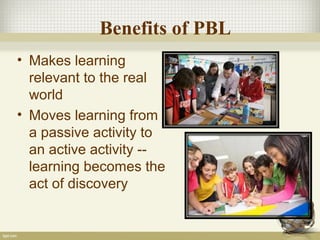
• Makes learning
relevant to the real
world
• Moves learning from
a passive activity to
an active activity --
learning becomes the
act of discovery
Benefits of PBL
• Increases motivation -- students are more
engaged, interested, and energetic learners as
they make a personal investment in the
outcome of their inquiry
• Promotes an interdisciplinary approach to
learning
• Promotes collaborative learning
• Requires advanced cognitive skills, higher
order thinking
Comparison of teaching methods
Role of Teacher:
• As expert:
– Directs Thinking
– Holds Knowledge
– Evaluates
Students
Role of Student:
• As receiver:
– Inert
– Inactive
– Empty
Lecture
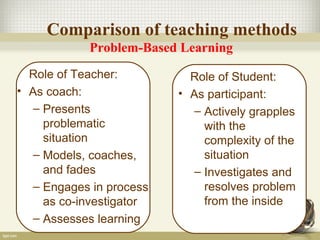
Comparison of teaching methods
Role of Teacher:
• As coach:
– Presents
problematic
situation
– Models, coaches,
and fades
– Engages in process
as co-investigator
– Assesses learning
Role of Student:
• As participant:
– Actively grapples
with the
complexity of the
situation
– Investigates and
resolves problem
from the inside
Problem-Based Learning
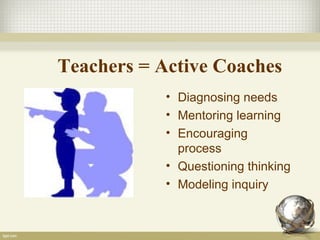
Teachers = Active Coaches
• Diagnosing needs
• Mentoring learning
• Encouraging
process
• Questioning thinking
• Modeling inquiry
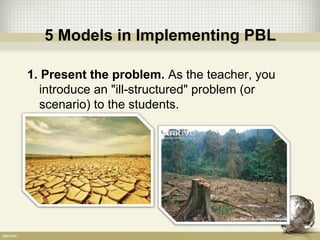
5 Models in Implementing PBL
1. Present the problem. As the teacher, you
introduce an "ill-structured" problem (or
scenario) to the students.
2. List what is
known. In
answering the
basic questions
above, students
begin by listing
what they know
about the
problem.
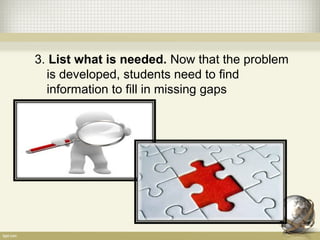
3. List what is needed. Now that the problem
is developed, students need to find
information to fill in missing gaps
4. List possible
actions,
recommendation
s, solutions, or
hypotheses. Unde
r the heading:
"What should we
do?"
5. Present and
support the
solution. As part
of closure,
teachers
generally require
students to
communicate
their findings and
recommendation
s.
Angels, this is your mission
It's a steamy summer day in Atlanta when
suddenly 
the power blinks out
over the entire city!
To make matters
worse, all of the
electricians in the
area are out of town
at a conference.
Mayor Shirley
Franklin is offering a
$20,000 reward to
anyone who can put
together a proposal
that details what
probably went wrong
and how to fix it.
Since you are in a
suburb that still has
power, help your Atlanta
friends put together a
presentation for the
mayor so the problem
can be fixed and you
can win the reward.

Problem Based Learning

  • 2.
  • 3.
    Problem Based Learning •An instructional method which focuses on the investigation and resolution of messy, “real world” problems as a context for students to learn critical thinking and problem solving skills • “Students work individually and/or in groups to solve challenging problems that are authentic, curriculum-based, and often interdisciplinary”
  • 4.
    Benefits of PBL •Makes learning relevant to the real world • Moves learning from a passive activity to an active activity -- learning becomes the act of discovery
  • 5.
    Benefits of PBL •Increases motivation -- students are more engaged, interested, and energetic learners as they make a personal investment in the outcome of their inquiry • Promotes an interdisciplinary approach to learning • Promotes collaborative learning • Requires advanced cognitive skills, higher order thinking
  • 6.
    Comparison of teachingmethods Role of Teacher: • As expert: – Directs Thinking – Holds Knowledge – Evaluates Students Role of Student: • As receiver: – Inert – Inactive – Empty Lecture
  • 7.
    Comparison of teachingmethods Role of Teacher: • As coach: – Presents problematic situation – Models, coaches, and fades – Engages in process as co-investigator – Assesses learning Role of Student: • As participant: – Actively grapples with the complexity of the situation – Investigates and resolves problem from the inside Problem-Based Learning
  • 8.
    Teachers = ActiveCoaches • Diagnosing needs • Mentoring learning • Encouraging process • Questioning thinking • Modeling inquiry
  • 9.
    5 Models inImplementing PBL 1. Present the problem. As the teacher, you introduce an "ill-structured" problem (or scenario) to the students.
  • 10.
    2. List whatis known. In answering the basic questions above, students begin by listing what they know about the problem.
  • 11.
    3. List whatis needed. Now that the problem is developed, students need to find information to fill in missing gaps
  • 12.
    4. List possible actions, recommendation s,solutions, or hypotheses. Unde r the heading: "What should we do?"
  • 13.
    5. Present and supportthe solution. As part of closure, teachers generally require students to communicate their findings and recommendation s.
  • 16.
    Angels, this isyour mission
  • 17.
    It's a steamysummer day in Atlanta when suddenly 
  • 18.
    the power blinksout over the entire city! To make matters worse, all of the electricians in the area are out of town at a conference.
  • 19.
    Mayor Shirley Franklin isoffering a $20,000 reward to anyone who can put together a proposal that details what probably went wrong and how to fix it.
  • 20.
    Since you arein a suburb that still has power, help your Atlanta friends put together a presentation for the mayor so the problem can be fixed and you can win the reward.