PROBLEM BASED LEARNING
Prepared by : Mrs. Namita Batra Guin
Associate Professor, Community Health Nursing
“Live as if you were to die tomorrow. Learn as if you were to live forever.”-
Gandhi.
INTRODUCTION
The word learn means to gain knowledge or information of; to ascertain by
inquiry, study, or investigation; to receive instruction concerning; to fix in
the mind; to acquire understanding of, or skill; as, to learn the way;
to learn a lesson; to learn dancing; to learn to skate; to learn the violin;
to learn the truth about something. Learning is acquiring new knowledge,
behaviours, skills, values, preferences or understanding and may involve
synthesizing different types of information. The ability to learn is possessed
by humans, animals and some machines. Progress over time tends to follow
learning curves. Learning may occur as a result of habituation or classical
conditioning. It can also occur as a result of complex activities such as –
play. Play has been approached by several theorists as the first form of
learning. Children play, experiment with the world, learn the rules and learn
to interact.
It is said that for learning to take place with any kind of efficiency students
must be motivated. To be motivated, they must become interested. And they
become interested when they are actively working on projects which they
can relate to their values and goals of life.
PROBLEM BASED LEARNING:-
Problem-based learning (PBL) is a student-centred instructional strategy in
which students collaboratively solve problems and reflect on their
experiences. It is one educational model that drives curriculum design,
educational culture, instructional delivery and student assessment. It shifts
the centre of teaching/ learning enterprise from teachers to student. It is
designed to move beyond educational models that deliver content and
technical knowledge. In this students are encouraged to take responsibilities
for their group and organize and direct the learning process with the
support from tutor or instructor. PBL can be used to enhance content
knowledge and foster the development of communication, problem-solving,
self- directed learning skill.
PBL for nursing students:-
It is designed to prepare prospective registered nurses to manage rapid
changes in health care, access, organise and interpret the wealth of
knowledge available and its diminished lifespan, respond to the increasing
complexity of practice. In many nursing programs, PBL plays vital role in
helping student nurses to develop the competencies required of beginning
practitioners and lifelong learning skills that can be transferred into clinical
practice.
CHARACTERISTICS OF PBL:-
 Learning is driven by challenging, open- ended problems.
 Students work in small collaborative groups.
 Teachers take on the role as “facilitator” of learning.
APPROACHES IN PBL:-
 GUIDED DISCOVERY:- In this courses are structured as series of
modules containing problems that lead students to learn content.
 OPEN DISCOVERY:- in this students have much greater responsibility
for determining what they should learn.
ADVANTAGES AND DISADVANTAGES OF PBL
ADVANTAGES:-
1. It fosters active learning, improved learning/ understanding. (student
centred).
2. Generic competencies- allow students to develop skills and attitudes
desirable in their future practice.
3. Integration- it facilitates an integrated core curriculum.
4. Motivation – it is fun for students as it requires all students to be
engaged in learning process.
5. Deep learning – fosters deep learning as students interact with
learning materials, relate concepts to everyday activities and improve
their understanding.
6. Constructivist approach – students activate prior knowledge and build
on existing conceptual knowledge framework.
DISADVANTAGES:-
1. Tutors who cannot teach enjoy passing on their own knowledge and
understanding so may find it difficult and frustrating.
2. Human resources – more staff have to take part in tutoring process.
3. Other resources – large number of students need access to the same
library and computer resources simultaneously.
4. Role models- students may be deprived access to a particular
inspirational teacher.
5. Information overload – students may be unsure of how much self
directed study to do and what information is relevant and useful.
PROBLEM BASED LEARNING PROCESS
In the PBL learning process learners encounter a problem and attempt to
solve it with information they already possess allowing them to appreciate
what they already know. They also identify what they need to learn to better
understand the problem and how to resolve it.
Once they have worked with the problem as far as possible and identified
what they need to learn, the learners engage in self-directed study to
research the information needed finding and using a variety of information
resources (books, journals, reports, online information, and a variety of
people with appropriate areas of expertise). In this way learning is
personalized to the needs and learning styles of the individual.
The learners then return to the problem and apply what they learned to
their work with the problem in order to more fully understand and resolve
the problem.
After they have finished their problem work the learners assess themselves
and each other to develop skills in self-assessment and the constructive
assessment of peers. Self-assessment is a skill essential to effective
independent learning.
STEPS OF THE PBL PROCESS
The essential steps of the PBL process are as follows:
1. The Case: The facilitator will present an introduction to the issues, to
establish a personal connection to the problem(s) for their students.
This may take the form of a guest speaker, a video, a newspaper story,
a photograph, or a written case study.
2. The Questions: The facilitator will lead discussion with the class to
determine the answers to the following questions: (Teachers may wish
to have students work in groups first to answer these questions before
leading a large group discussion.)
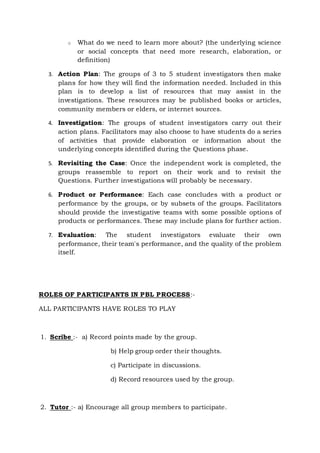
o What do we know? (the facts of the case)
o What do we need to know? (other facts that are missing at this
point)
o What do we need to learn more about? (the underlying science
or social concepts that need more research, elaboration, or
definition)
3. Action Plan: The groups of 3 to 5 student investigators then make
plans for how they will find the information needed. Included in this
plan is to develop a list of resources that may assist in the
investigations. These resources may be published books or articles,
community members or elders, or internet sources.
4. Investigation: The groups of student investigators carry out their
action plans. Facilitators may also choose to have students do a series
of activities that provide elaboration or information about the
underlying concepts identified during the Questions phase.
5. Revisiting the Case: Once the independent work is completed, the
groups reassemble to report on their work and to revisit the
Questions. Further investigations will probably be necessary.
6. Product or Performance: Each case concludes with a product or
performance by the groups, or by subsets of the groups. Facilitators
should provide the investigative teams with some possible options of
products or performances. These may include plans for further action.
7. Evaluation: The student investigators evaluate their own
performance, their team's performance, and the quality of the problem
itself.
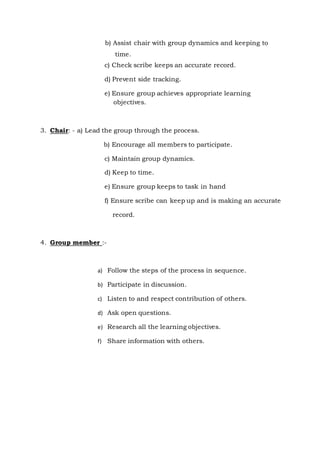
ROLES OF PARTICIPANTS IN PBL PROCESS:-
ALL PARTICIPANTS HAVE ROLES TO PLAY
1. Scribe :- a) Record points made by the group.
b) Help group order their thoughts.
c) Participate in discussions.
d) Record resources used by the group.
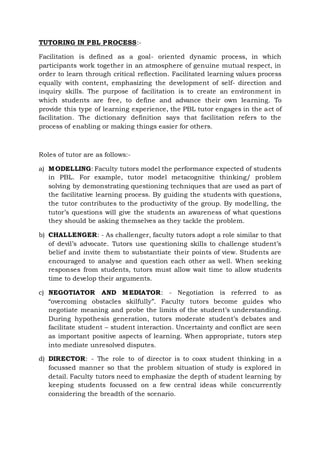
2. Tutor :- a) Encourage all group members to participate.
b) Assist chair with group dynamics and keeping to
time.
c) Check scribe keeps an accurate record.
d) Prevent side tracking.
e) Ensure group achieves appropriate learning
objectives.
3. Chair: - a) Lead the group through the process.
b) Encourage all members to participate.
c) Maintain group dynamics.
d) Keep to time.
e) Ensure group keeps to task in hand
f) Ensure scribe can keep up and is making an accurate
record.
4. Group member :-
a) Follow the steps of the process in sequence.
b) Participate in discussion.
c) Listen to and respect contribution of others.
d) Ask open questions.
e) Research all the learning objectives.
f) Share information with others.
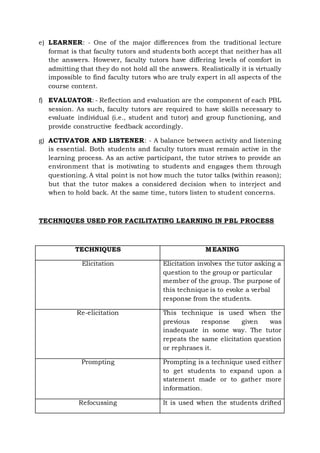
TUTORING IN PBL PROCESS:-
Facilitation is defined as a goal- oriented dynamic process, in which
participants work together in an atmosphere of genuine mutual respect, in
order to learn through critical reflection. Facilitated learning values process
equally with content, emphasizing the development of self- direction and
inquiry skills. The purpose of facilitation is to create an environment in
which students are free, to define and advance their own learning. To
provide this type of learning experience, the PBL tutor engages in the act of
facilitation. The dictionary definition says that facilitation refers to the
process of enabling or making things easier for others.
Roles of tutor are as follows:-
a) MODELLING: Faculty tutors model the performance expected of students
in PBL. For example, tutor model metacognitive thinking/ problem
solving by demonstrating questioning techniques that are used as part of
the facilitative learning process. By guiding the students with questions,
the tutor contributes to the productivity of the group. By modelling, the
tutor’s questions will give the students an awareness of what questions
they should be asking themselves as they tackle the problem.
b) CHALLENGER: - As challenger, faculty tutors adopt a role similar to that
of devil’s advocate. Tutors use questioning skills to challenge student’s
belief and invite them to substantiate their points of view. Students are
encouraged to analyse and question each other as well. When seeking
responses from students, tutors must allow wait time to allow students
time to develop their arguments.
c) NEGOTIATOR AND MEDIATOR: - Negotiation is referred to as
“overcoming obstacles skilfully”. Faculty tutors become guides who
negotiate meaning and probe the limits of the student’s understanding.
During hypothesis generation, tutors moderate student’s debates and
facilitate student – student interaction. Uncertainty and conflict are seen
as important positive aspects of learning. When appropriate, tutors step
into mediate unresolved disputes.
d) DIRECTOR: - The role to of director is to coax student thinking in a
focussed manner so that the problem situation of study is explored in
detail. Faculty tutors need to emphasize the depth of student learning by
keeping students focussed on a few central ideas while concurrently
considering the breadth of the scenario.
e) LEARNER: - One of the major differences from the traditional lecture
format is that faculty tutors and students both accept that neither has all
the answers. However, faculty tutors have differing levels of comfort in
admitting that they do not hold all the answers. Realistically it is virtually
impossible to find faculty tutors who are truly expert in all aspects of the
course content.
f) EVALUATOR: - Reflection and evaluation are the component of each PBL
session. As such, faculty tutors are required to have skills necessary to
evaluate individual (i.e., student and tutor) and group functioning, and
provide constructive feedback accordingly.
g) ACTIVATOR AND LISTENER: - A balance between activity and listening
is essential. Both students and faculty tutors must remain active in the
learning process. As an active participant, the tutor strives to provide an
environment that is motivating to students and engages them through
questioning. A vital point is not how much the tutor talks (within reason);
but that the tutor makes a considered decision when to interject and
when to hold back. At the same time, tutors listen to student concerns.
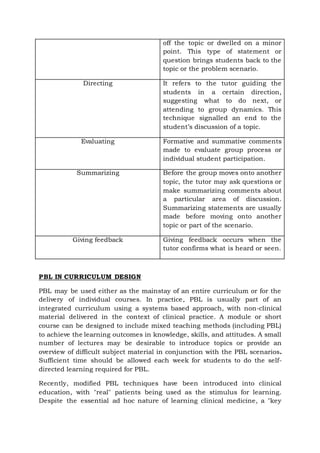
TECHNIQUES USED FOR FACILITATING LEARNING IN PBL PROCESS
TECHNIQUES MEANING
Elicitation Elicitation involves the tutor asking a
question to the group or particular
member of the group. The purpose of
this technique is to evoke a verbal
response from the students.
Re-elicitation This technique is used when the
previous response given was
inadequate in some way. The tutor
repeats the same elicitation question
or rephrases it.
Prompting Prompting is a technique used either
to get students to expand upon a
statement made or to gather more
information.
Refocussing It is used when the students drifted
off the topic or dwelled on a minor
point. This type of statement or
question brings students back to the
topic or the problem scenario.
Directing It refers to the tutor guiding the
students in a certain direction,
suggesting what to do next, or
attending to group dynamics. This
technique signalled an end to the
student’s discussion of a topic.
Evaluating Formative and summative comments
made to evaluate group process or
individual student participation.
Summarizing Before the group moves onto another
topic, the tutor may ask questions or
make summarizing comments about
a particular area of discussion.
Summarizing statements are usually
made before moving onto another
topic or part of the scenario.
Giving feedback Giving feedback occurs when the
tutor confirms what is heard or seen.
PBL IN CURRICULUM DESIGN
PBL may be used either as the mainstay of an entire curriculum or for the
delivery of individual courses. In practice, PBL is usually part of an
integrated curriculum using a systems based approach, with non-clinical
material delivered in the context of clinical practice. A module or short
course can be designed to include mixed teaching methods (including PBL)
to achieve the learning outcomes in knowledge, skills, and attitudes. A small
number of lectures may be desirable to introduce topics or provide an
overview of difficult subject material in conjunction with the PBL scenarios.
Sufficient time should be allowed each week for students to do the self-
directed learning required for PBL.
Recently, modified PBL techniques have been introduced into clinical
education, with "real" patients being used as the stimulus for learning.
Despite the essential ad hoc nature of learning clinical medicine, a "key
cases" approach can enable PBL to be used to deliver the core clinical
curriculum.
Introducing PBL into a course makes new demands on tutors, requiring
them to function as facilitators for small group learning rather than acting
as providers of information. Staff development is essential and should focus
on enabling the PBL tutors to acquire skills in facilitation and in
management of group dynamics (including dysfunctional groups).
Tutors should be also given information about the institution's educational
strategy and curriculum programme so that they can help students to
understand the learning objectives of individual modules in the context of
the curriculum as a whole. Methods of assessment and evaluation should be
described, and time should be available to discuss anxieties.
ASSESSMENT OF PBL
Student learning is influenced greatly by the assessment methods used. If
assessment methods rely solely on factual recall then PBL is unlikely to
succeed in the curriculum. All assessment schedules should follow the basic
principles of testing the student in relation to the curriculum outcomes and
should use an appropriate range of assessment methods.
Assessment of students' activities in their PBL groups is advisable. Tutors
should give feedback or use formative or summative assessment procedures
as dictated by the faculty assessment schedule. It is also helpful to consider
assessment of the group as a whole. The group should be encouraged to
reflect on its PBL performance including its adherence to the process,
communication skills, respect for others, and individual contributions. Peer
pressure in the group reduces the likelihood of students failing to keep up
with workload, and the award of a group mark added to each individual's
assessment schedule encourages students to achieve the generic goals
associated with PBL.
Peer-and self-assessment are often used in PBL to encourage students to
take responsibility for their own learning and assessment. Of course this
goal is important in any course, so self- and peer-assessment are not
necessarily associated with PBL.
Peer-assessment may involve the PBL group as a whole contributing to the
assessment of each member of the group—after all; they know best who did
the most valuable work. The books by Woods in the resources section have
more on this.
SUMMARY:-
PBL is an effective way of delivering education in a coherent, integrated
program and offers several advantages over traditional teaching methods. It
is based on principles of adult learning theory, including motivating the
students, encouraging them to set their own learning goals and giving them
a role in decisions that affect their own learning.
Predictably, however, PBL does not offer a universal panacea for
teaching and learning in nursing, and it has several recognised
disadvantages.
But PBL generates more stimulating and challenging educational
environment, and the beneficial effects from the generic attributes acquired
through PBL should not be underestimated.
BIBLIOGRAPHY:-
a) Lynne E. Young and Barbara L. Paterson, Teaching Nursing Developing a
Student Centred Learning environment,1st edition, Lippincott
Publications (Philadelphia), 2007, 242-274.
b) Dochy, F, Segers, M & Sluysmans, D (1999) The use of self-, peer- and
co-assessment in higher education: A review. Studies in Higher
Education, 24, 331-350
c) Gupinar E, Musal B, Aksakoglu G, Ucko R. Comparison of Knowledge
scores of medical students in problem-based learning and traditional
curriculum on public health topics. BMC Med Educ. 2005. Feb 10;5(1):7
d) Dr OMU Amasya. Effectiveness on Development of Logical Thinking Skills
of Problem Based Learning Skills in Science Teaching. Journal of Turkish
Science Education Volume 2, Issue 1, May 2005
e) www.c-sap.bham.ac.uk
f) www.bmj.com
g) www.adelaide.edu.au

Problem based learning

  • 1.
    PROBLEM BASED LEARNING Preparedby : Mrs. Namita Batra Guin Associate Professor, Community Health Nursing “Live as if you were to die tomorrow. Learn as if you were to live forever.”- Gandhi. INTRODUCTION The word learn means to gain knowledge or information of; to ascertain by inquiry, study, or investigation; to receive instruction concerning; to fix in the mind; to acquire understanding of, or skill; as, to learn the way; to learn a lesson; to learn dancing; to learn to skate; to learn the violin; to learn the truth about something. Learning is acquiring new knowledge, behaviours, skills, values, preferences or understanding and may involve synthesizing different types of information. The ability to learn is possessed by humans, animals and some machines. Progress over time tends to follow learning curves. Learning may occur as a result of habituation or classical conditioning. It can also occur as a result of complex activities such as – play. Play has been approached by several theorists as the first form of learning. Children play, experiment with the world, learn the rules and learn to interact. It is said that for learning to take place with any kind of efficiency students must be motivated. To be motivated, they must become interested. And they become interested when they are actively working on projects which they can relate to their values and goals of life. PROBLEM BASED LEARNING:- Problem-based learning (PBL) is a student-centred instructional strategy in which students collaboratively solve problems and reflect on their experiences. It is one educational model that drives curriculum design, educational culture, instructional delivery and student assessment. It shifts the centre of teaching/ learning enterprise from teachers to student. It is designed to move beyond educational models that deliver content and
  • 2.
    technical knowledge. Inthis students are encouraged to take responsibilities for their group and organize and direct the learning process with the support from tutor or instructor. PBL can be used to enhance content knowledge and foster the development of communication, problem-solving, self- directed learning skill. PBL for nursing students:- It is designed to prepare prospective registered nurses to manage rapid changes in health care, access, organise and interpret the wealth of knowledge available and its diminished lifespan, respond to the increasing complexity of practice. In many nursing programs, PBL plays vital role in helping student nurses to develop the competencies required of beginning practitioners and lifelong learning skills that can be transferred into clinical practice. CHARACTERISTICS OF PBL:-  Learning is driven by challenging, open- ended problems.  Students work in small collaborative groups.  Teachers take on the role as “facilitator” of learning. APPROACHES IN PBL:-  GUIDED DISCOVERY:- In this courses are structured as series of modules containing problems that lead students to learn content.  OPEN DISCOVERY:- in this students have much greater responsibility for determining what they should learn.
  • 3.
    ADVANTAGES AND DISADVANTAGESOF PBL ADVANTAGES:- 1. It fosters active learning, improved learning/ understanding. (student centred). 2. Generic competencies- allow students to develop skills and attitudes desirable in their future practice. 3. Integration- it facilitates an integrated core curriculum. 4. Motivation – it is fun for students as it requires all students to be engaged in learning process. 5. Deep learning – fosters deep learning as students interact with learning materials, relate concepts to everyday activities and improve their understanding. 6. Constructivist approach – students activate prior knowledge and build on existing conceptual knowledge framework. DISADVANTAGES:- 1. Tutors who cannot teach enjoy passing on their own knowledge and understanding so may find it difficult and frustrating. 2. Human resources – more staff have to take part in tutoring process. 3. Other resources – large number of students need access to the same library and computer resources simultaneously. 4. Role models- students may be deprived access to a particular inspirational teacher. 5. Information overload – students may be unsure of how much self directed study to do and what information is relevant and useful.
  • 4.
    PROBLEM BASED LEARNINGPROCESS In the PBL learning process learners encounter a problem and attempt to solve it with information they already possess allowing them to appreciate what they already know. They also identify what they need to learn to better understand the problem and how to resolve it. Once they have worked with the problem as far as possible and identified what they need to learn, the learners engage in self-directed study to research the information needed finding and using a variety of information resources (books, journals, reports, online information, and a variety of people with appropriate areas of expertise). In this way learning is personalized to the needs and learning styles of the individual. The learners then return to the problem and apply what they learned to their work with the problem in order to more fully understand and resolve the problem. After they have finished their problem work the learners assess themselves and each other to develop skills in self-assessment and the constructive assessment of peers. Self-assessment is a skill essential to effective independent learning. STEPS OF THE PBL PROCESS The essential steps of the PBL process are as follows: 1. The Case: The facilitator will present an introduction to the issues, to establish a personal connection to the problem(s) for their students. This may take the form of a guest speaker, a video, a newspaper story, a photograph, or a written case study. 2. The Questions: The facilitator will lead discussion with the class to determine the answers to the following questions: (Teachers may wish to have students work in groups first to answer these questions before leading a large group discussion.) o What do we know? (the facts of the case) o What do we need to know? (other facts that are missing at this point)
  • 5.
    o What dowe need to learn more about? (the underlying science or social concepts that need more research, elaboration, or definition) 3. Action Plan: The groups of 3 to 5 student investigators then make plans for how they will find the information needed. Included in this plan is to develop a list of resources that may assist in the investigations. These resources may be published books or articles, community members or elders, or internet sources. 4. Investigation: The groups of student investigators carry out their action plans. Facilitators may also choose to have students do a series of activities that provide elaboration or information about the underlying concepts identified during the Questions phase. 5. Revisiting the Case: Once the independent work is completed, the groups reassemble to report on their work and to revisit the Questions. Further investigations will probably be necessary. 6. Product or Performance: Each case concludes with a product or performance by the groups, or by subsets of the groups. Facilitators should provide the investigative teams with some possible options of products or performances. These may include plans for further action. 7. Evaluation: The student investigators evaluate their own performance, their team's performance, and the quality of the problem itself. ROLES OF PARTICIPANTS IN PBL PROCESS:- ALL PARTICIPANTS HAVE ROLES TO PLAY 1. Scribe :- a) Record points made by the group. b) Help group order their thoughts. c) Participate in discussions. d) Record resources used by the group. 2. Tutor :- a) Encourage all group members to participate.
  • 6.
    b) Assist chairwith group dynamics and keeping to time. c) Check scribe keeps an accurate record. d) Prevent side tracking. e) Ensure group achieves appropriate learning objectives. 3. Chair: - a) Lead the group through the process. b) Encourage all members to participate. c) Maintain group dynamics. d) Keep to time. e) Ensure group keeps to task in hand f) Ensure scribe can keep up and is making an accurate record. 4. Group member :- a) Follow the steps of the process in sequence. b) Participate in discussion. c) Listen to and respect contribution of others. d) Ask open questions. e) Research all the learning objectives. f) Share information with others.
  • 7.
    TUTORING IN PBLPROCESS:- Facilitation is defined as a goal- oriented dynamic process, in which participants work together in an atmosphere of genuine mutual respect, in order to learn through critical reflection. Facilitated learning values process equally with content, emphasizing the development of self- direction and inquiry skills. The purpose of facilitation is to create an environment in which students are free, to define and advance their own learning. To provide this type of learning experience, the PBL tutor engages in the act of facilitation. The dictionary definition says that facilitation refers to the process of enabling or making things easier for others. Roles of tutor are as follows:- a) MODELLING: Faculty tutors model the performance expected of students in PBL. For example, tutor model metacognitive thinking/ problem solving by demonstrating questioning techniques that are used as part of the facilitative learning process. By guiding the students with questions, the tutor contributes to the productivity of the group. By modelling, the tutor’s questions will give the students an awareness of what questions they should be asking themselves as they tackle the problem. b) CHALLENGER: - As challenger, faculty tutors adopt a role similar to that of devil’s advocate. Tutors use questioning skills to challenge student’s belief and invite them to substantiate their points of view. Students are encouraged to analyse and question each other as well. When seeking responses from students, tutors must allow wait time to allow students time to develop their arguments. c) NEGOTIATOR AND MEDIATOR: - Negotiation is referred to as “overcoming obstacles skilfully”. Faculty tutors become guides who negotiate meaning and probe the limits of the student’s understanding. During hypothesis generation, tutors moderate student’s debates and facilitate student – student interaction. Uncertainty and conflict are seen as important positive aspects of learning. When appropriate, tutors step into mediate unresolved disputes. d) DIRECTOR: - The role to of director is to coax student thinking in a focussed manner so that the problem situation of study is explored in detail. Faculty tutors need to emphasize the depth of student learning by keeping students focussed on a few central ideas while concurrently considering the breadth of the scenario.
  • 8.
    e) LEARNER: -One of the major differences from the traditional lecture format is that faculty tutors and students both accept that neither has all the answers. However, faculty tutors have differing levels of comfort in admitting that they do not hold all the answers. Realistically it is virtually impossible to find faculty tutors who are truly expert in all aspects of the course content. f) EVALUATOR: - Reflection and evaluation are the component of each PBL session. As such, faculty tutors are required to have skills necessary to evaluate individual (i.e., student and tutor) and group functioning, and provide constructive feedback accordingly. g) ACTIVATOR AND LISTENER: - A balance between activity and listening is essential. Both students and faculty tutors must remain active in the learning process. As an active participant, the tutor strives to provide an environment that is motivating to students and engages them through questioning. A vital point is not how much the tutor talks (within reason); but that the tutor makes a considered decision when to interject and when to hold back. At the same time, tutors listen to student concerns. TECHNIQUES USED FOR FACILITATING LEARNING IN PBL PROCESS TECHNIQUES MEANING Elicitation Elicitation involves the tutor asking a question to the group or particular member of the group. The purpose of this technique is to evoke a verbal response from the students. Re-elicitation This technique is used when the previous response given was inadequate in some way. The tutor repeats the same elicitation question or rephrases it. Prompting Prompting is a technique used either to get students to expand upon a statement made or to gather more information. Refocussing It is used when the students drifted
  • 9.
    off the topicor dwelled on a minor point. This type of statement or question brings students back to the topic or the problem scenario. Directing It refers to the tutor guiding the students in a certain direction, suggesting what to do next, or attending to group dynamics. This technique signalled an end to the student’s discussion of a topic. Evaluating Formative and summative comments made to evaluate group process or individual student participation. Summarizing Before the group moves onto another topic, the tutor may ask questions or make summarizing comments about a particular area of discussion. Summarizing statements are usually made before moving onto another topic or part of the scenario. Giving feedback Giving feedback occurs when the tutor confirms what is heard or seen. PBL IN CURRICULUM DESIGN PBL may be used either as the mainstay of an entire curriculum or for the delivery of individual courses. In practice, PBL is usually part of an integrated curriculum using a systems based approach, with non-clinical material delivered in the context of clinical practice. A module or short course can be designed to include mixed teaching methods (including PBL) to achieve the learning outcomes in knowledge, skills, and attitudes. A small number of lectures may be desirable to introduce topics or provide an overview of difficult subject material in conjunction with the PBL scenarios. Sufficient time should be allowed each week for students to do the self- directed learning required for PBL. Recently, modified PBL techniques have been introduced into clinical education, with "real" patients being used as the stimulus for learning. Despite the essential ad hoc nature of learning clinical medicine, a "key
  • 10.
    cases" approach canenable PBL to be used to deliver the core clinical curriculum. Introducing PBL into a course makes new demands on tutors, requiring them to function as facilitators for small group learning rather than acting as providers of information. Staff development is essential and should focus on enabling the PBL tutors to acquire skills in facilitation and in management of group dynamics (including dysfunctional groups). Tutors should be also given information about the institution's educational strategy and curriculum programme so that they can help students to understand the learning objectives of individual modules in the context of the curriculum as a whole. Methods of assessment and evaluation should be described, and time should be available to discuss anxieties. ASSESSMENT OF PBL Student learning is influenced greatly by the assessment methods used. If assessment methods rely solely on factual recall then PBL is unlikely to succeed in the curriculum. All assessment schedules should follow the basic principles of testing the student in relation to the curriculum outcomes and should use an appropriate range of assessment methods. Assessment of students' activities in their PBL groups is advisable. Tutors should give feedback or use formative or summative assessment procedures as dictated by the faculty assessment schedule. It is also helpful to consider assessment of the group as a whole. The group should be encouraged to reflect on its PBL performance including its adherence to the process, communication skills, respect for others, and individual contributions. Peer pressure in the group reduces the likelihood of students failing to keep up with workload, and the award of a group mark added to each individual's assessment schedule encourages students to achieve the generic goals associated with PBL. Peer-and self-assessment are often used in PBL to encourage students to take responsibility for their own learning and assessment. Of course this goal is important in any course, so self- and peer-assessment are not necessarily associated with PBL.
  • 11.
    Peer-assessment may involvethe PBL group as a whole contributing to the assessment of each member of the group—after all; they know best who did the most valuable work. The books by Woods in the resources section have more on this. SUMMARY:- PBL is an effective way of delivering education in a coherent, integrated program and offers several advantages over traditional teaching methods. It is based on principles of adult learning theory, including motivating the students, encouraging them to set their own learning goals and giving them a role in decisions that affect their own learning. Predictably, however, PBL does not offer a universal panacea for teaching and learning in nursing, and it has several recognised disadvantages. But PBL generates more stimulating and challenging educational environment, and the beneficial effects from the generic attributes acquired through PBL should not be underestimated. BIBLIOGRAPHY:- a) Lynne E. Young and Barbara L. Paterson, Teaching Nursing Developing a Student Centred Learning environment,1st edition, Lippincott Publications (Philadelphia), 2007, 242-274. b) Dochy, F, Segers, M & Sluysmans, D (1999) The use of self-, peer- and co-assessment in higher education: A review. Studies in Higher Education, 24, 331-350 c) Gupinar E, Musal B, Aksakoglu G, Ucko R. Comparison of Knowledge scores of medical students in problem-based learning and traditional curriculum on public health topics. BMC Med Educ. 2005. Feb 10;5(1):7 d) Dr OMU Amasya. Effectiveness on Development of Logical Thinking Skills of Problem Based Learning Skills in Science Teaching. Journal of Turkish Science Education Volume 2, Issue 1, May 2005 e) www.c-sap.bham.ac.uk f) www.bmj.com g) www.adelaide.edu.au