Creating opportunities for inquiry, 
investigation, research, and resolution
A learning method based on the principle of 
using problems as a starting point for the 
acquisition and integration of new knowledge. 
Students work individually and/or in groups to 
solve challenging problems that are authentic, 
curriculum-based, and often interdisciplinary
 Understanding is built through what we 
experience 
 Meaning is created from efforts to answer our 
own questions and solve our own problems 
 We should appeal to students’ natural instincts 
to investigate and create 
 Student-centered strategies build critical 
thinking and reasoning skills and further their 
creativity and independence
 Learning is student centered. 
 Learning occurs in small student groups. 
 Teachers are facilitators or guides. 
 Problems form the organizing focus and 
stimulus for learning. 
 Problems are a vehicle for the development of 
problem-solving skills. 
 New information is acquired through self-directed 
learning.
 Shifts away from short, isolated teacher 
centered lessons 
 Integrates real world issues and practices 
 Creates long term, interdisciplinary student 
centered Lessons 
 Teaches students to apply what they have 
learned to life-long endeavors
 Students confront a problem. 
 In groups, students organize prior knowledge and 
attempt to identify the nature of the problem. 
 Students pose questions about what they do not 
understand. 
 Students design a plan to solve the problem and 
identify the resources they need. 
 Students begin to gather information as they work 
to solve the problem.
 Makes learning relevant to the real world. 
 Moves learning from a passive activity to an 
active activity 
 learning becomes the act of discovery 
 Increases motivation 
 students are more engaged, interested, and 
energetic learners as they make a personal 
investment in the outcome of their inquiry
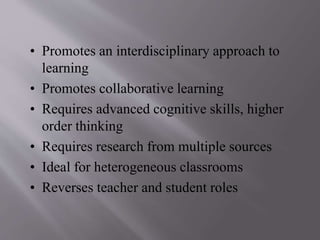
• Promotes an interdisciplinary approach to 
learning 
• Promotes collaborative learning 
• Requires advanced cognitive skills, higher 
order thinking 
• Requires research from multiple sources 
• Ideal for heterogeneous classrooms 
• Reverses teacher and student roles
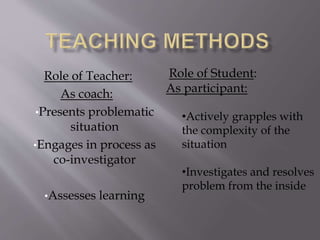
Role of Teacher: 
As coach: 
•Presents problematic 
situation 
•Engages in process as 
co-investigator 
•Assesses learning 
Role of Student: 
As participant: 
•Actively grapples with 
the complexity of the 
situation 
•Investigates and resolves 
problem from the inside
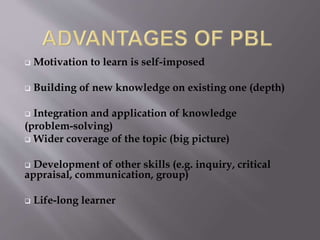
 Motivation to learn is self-imposed 
 Building of new knowledge on existing one (depth) 
 Integration and application of knowledge 
(problem-solving) 
 Wider coverage of the topic (big picture) 
 Development of other skills (e.g. inquiry, critical 
appraisal, communication, group) 
 Life-long learner
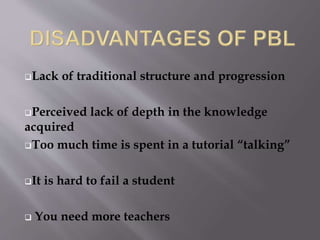
Lack of traditional structure and progression 
Perceived lack of depth in the knowledge 
acquired 
Too much time is spent in a tutorial “talking” 
It is hard to fail a student 
 You need more teachers

Problem based learning

  • 1.
    Creating opportunities forinquiry, investigation, research, and resolution
  • 2.
    A learning methodbased on the principle of using problems as a starting point for the acquisition and integration of new knowledge. Students work individually and/or in groups to solve challenging problems that are authentic, curriculum-based, and often interdisciplinary
  • 3.
     Understanding isbuilt through what we experience  Meaning is created from efforts to answer our own questions and solve our own problems  We should appeal to students’ natural instincts to investigate and create  Student-centered strategies build critical thinking and reasoning skills and further their creativity and independence
  • 4.
     Learning isstudent centered.  Learning occurs in small student groups.  Teachers are facilitators or guides.  Problems form the organizing focus and stimulus for learning.  Problems are a vehicle for the development of problem-solving skills.  New information is acquired through self-directed learning.
  • 5.
     Shifts awayfrom short, isolated teacher centered lessons  Integrates real world issues and practices  Creates long term, interdisciplinary student centered Lessons  Teaches students to apply what they have learned to life-long endeavors
  • 6.
     Students confronta problem.  In groups, students organize prior knowledge and attempt to identify the nature of the problem.  Students pose questions about what they do not understand.  Students design a plan to solve the problem and identify the resources they need.  Students begin to gather information as they work to solve the problem.
  • 7.
     Makes learningrelevant to the real world.  Moves learning from a passive activity to an active activity  learning becomes the act of discovery  Increases motivation  students are more engaged, interested, and energetic learners as they make a personal investment in the outcome of their inquiry
  • 8.
    • Promotes aninterdisciplinary approach to learning • Promotes collaborative learning • Requires advanced cognitive skills, higher order thinking • Requires research from multiple sources • Ideal for heterogeneous classrooms • Reverses teacher and student roles
  • 9.
    Role of Teacher: As coach: •Presents problematic situation •Engages in process as co-investigator •Assesses learning Role of Student: As participant: •Actively grapples with the complexity of the situation •Investigates and resolves problem from the inside
  • 10.
     Motivation tolearn is self-imposed  Building of new knowledge on existing one (depth)  Integration and application of knowledge (problem-solving)  Wider coverage of the topic (big picture)  Development of other skills (e.g. inquiry, critical appraisal, communication, group)  Life-long learner
  • 11.
    Lack of traditionalstructure and progression Perceived lack of depth in the knowledge acquired Too much time is spent in a tutorial “talking” It is hard to fail a student  You need more teachers