ELECTRONIC NAVIGATION 12/M  Crispin Echavezinstructor
Navigational Equipments(RDF) Radio Direction Finder
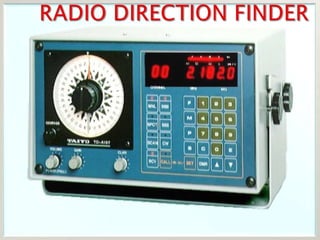
RADIO DIRECTION FINDER
Radio direction finder (RDF)device for finding the direction to a radio source.Radio's ability to travel very long distances and "over the horizon“.Good navigation system for ships, small boats, and aircraft that might be some distance from their destination.
HISTORYJohn Stone Stonein 1902(U.S. Patent 716,134)Lee de Forest in 1904 (U.S. Patent 771,819)EttoreBellini and Alessandro Tosi in 1909(U.S. Patent 943,960)Frank Adcock in 1919(UK Patent 130,490)The US Army Air Corps in 1931
OPERATIONworks by comparing the signal strength of a directional antenna pointing in different directions.used by land and marine-based radio operators.adopted for both ships and aircraft,
OPERATION con’tused in the 1930s and 1940s.circular loops mounted above or below the fuselage.enclosed in an aerodynamic, teardrop-shaped fairing.employed large metal loop antennae, similar to aircraft
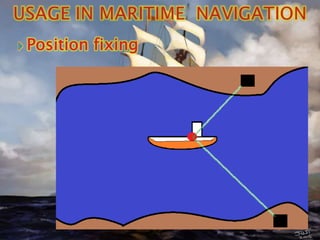
OPERATION con’tRDF operator would first tune the receiver to the correct frequency.turn the loop.long wave (LW)medium wave (AM)By taking bearings to two or more broadcast stations and plotting the intersecting bearings, the navigator could locate the relative position of his ship or aircraft.
USAGE IN MARITIME  NAVIGATIONPosition fixing
Also called Radio Compass.radio receiver and directional antenna system used to determine the direction of the source of a signal. It most often refers to a device used to check the position of a ship or aircraft, although it may also direct a craft’s course or be used for military or investigative purposes.
Thanks for listening!

Radio direction finder

  • 1.
    ELECTRONIC NAVIGATION 12/M Crispin Echavezinstructor
  • 2.
  • 3.
  • 4.
    Radio direction finder(RDF)device for finding the direction to a radio source.Radio's ability to travel very long distances and "over the horizon“.Good navigation system for ships, small boats, and aircraft that might be some distance from their destination.
  • 5.
    HISTORYJohn Stone Stonein1902(U.S. Patent 716,134)Lee de Forest in 1904 (U.S. Patent 771,819)EttoreBellini and Alessandro Tosi in 1909(U.S. Patent 943,960)Frank Adcock in 1919(UK Patent 130,490)The US Army Air Corps in 1931
  • 6.
    OPERATIONworks by comparingthe signal strength of a directional antenna pointing in different directions.used by land and marine-based radio operators.adopted for both ships and aircraft,
  • 7.
    OPERATION con’tused inthe 1930s and 1940s.circular loops mounted above or below the fuselage.enclosed in an aerodynamic, teardrop-shaped fairing.employed large metal loop antennae, similar to aircraft
  • 8.
    OPERATION con’tRDF operatorwould first tune the receiver to the correct frequency.turn the loop.long wave (LW)medium wave (AM)By taking bearings to two or more broadcast stations and plotting the intersecting bearings, the navigator could locate the relative position of his ship or aircraft.
  • 9.
    USAGE IN MARITIME NAVIGATIONPosition fixing
  • 10.
    Also called RadioCompass.radio receiver and directional antenna system used to determine the direction of the source of a signal. It most often refers to a device used to check the position of a ship or aircraft, although it may also direct a craft’s course or be used for military or investigative purposes.
  • 11.