COMPARISON-
CONTRAST
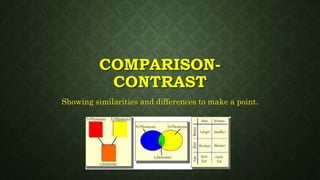
Showing similarities and differences to make a point.
WHAT IS A COMPARISON? A CONTRAST?
• Comparing things mean
pointing out their
similarities, or what they
have in common.
• Contrasting things mean
pointing out their
differences, or where they
diverge from one another.
WHEN TO USE COMPARISON-CONTRAST
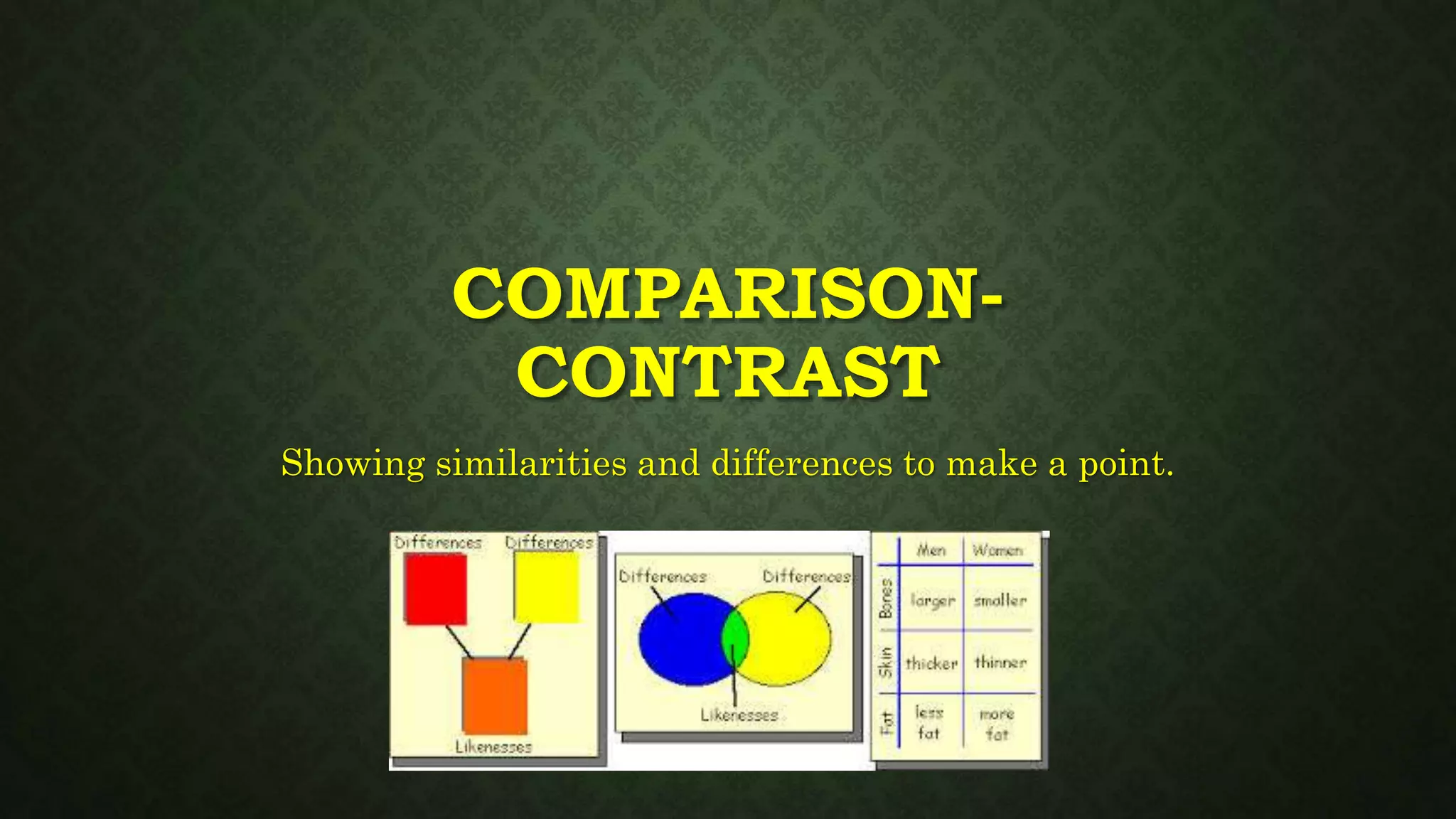
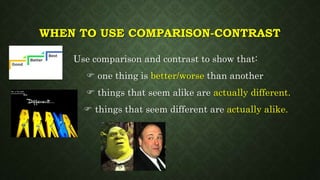
Use comparison and contrast to show that:
 one thing is better/worse than another
 things that seem alike are actually different.
 things that seem different are actually alike.
WHAT CAN YOU COMPARE/CONTRAST?
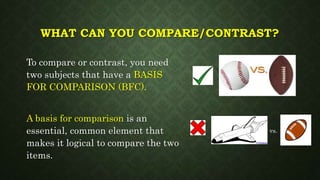
To compare or contrast, you need
two subjects that have a BASIS
FOR COMPARISON (BFC).
A basis for comparison is an
essential, common element that
makes it logical to compare the two
items.
vs.
THE COMPARISON/CONTRAST THESIS
SUBJECT: The two items you will compare/contrast
FOCUS: The reason you are comparing/contrasting them (to
rate them, to show similarities, to show differences)
REASONS/PROOFS: The three (or more) major aspects of each subject that
you will explore to prove your focus.
SAMPLE COMPARE-CONTRAST THESIS
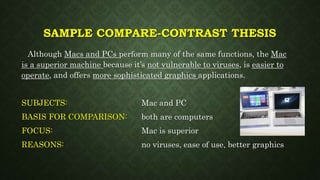
Although Macs and PCs perform many of the same functions, the Mac
is a superior machine because it’s not vulnerable to viruses, is easier to
operate, and offers more sophisticated graphics applications.
SUBJECTS: Mac and PC
BASIS FOR COMPARISON: both are computers
FOCUS: Mac is superior
REASONS: no viruses, ease of use, better graphics
ORGANIZING A COMPARISON-CONTRAST
Once you create your thesis, you will decide how to
organize your essay.
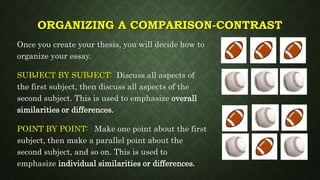
SUBJECT BY SUBJECT: Discuss all aspects of
the first subject, then discuss all aspects of the
second subject. This is used to emphasize overall
similarities or differences.
POINT BY POINT: Make one point about the first
subject, then make a parallel point about the
second subject, and so on. This is used to
emphasize individual similarities or differences.
BE CONSISTENT!
Because you will be switching between two subjects, you
may forget to be consistent in style, tone, and grammar.
Remember:
• Use the same verb tense to discuss both subjects
• Discuss the same aspects of each subject
• Talk about aspects in the same order for each subject
• Use transitions to move the reader from one subject to the
next
COMPARISON-CONTRAST: IN SUMMARY
Comparing points out similarities
Contrasting points out differences
Subjects must have a basis for comparison (an essential
similarity)
Thesis includes subject (two or more items with a basis
for comparison), focus (the reason for
comparing/contrasting) and reasons (three or more
aspects of each item that you will compare-contrast)
Remember to stay consistent in style, tone, grammar
and order.

Comparison contrast+ppt

  • 1.
  • 2.
    WHAT IS ACOMPARISON? A CONTRAST? • Comparing things mean pointing out their similarities, or what they have in common. • Contrasting things mean pointing out their differences, or where they diverge from one another.
  • 3.
    WHEN TO USECOMPARISON-CONTRAST Use comparison and contrast to show that:  one thing is better/worse than another  things that seem alike are actually different.  things that seem different are actually alike.
  • 4.
    WHAT CAN YOUCOMPARE/CONTRAST? To compare or contrast, you need two subjects that have a BASIS FOR COMPARISON (BFC). A basis for comparison is an essential, common element that makes it logical to compare the two items. vs.
  • 5.
    THE COMPARISON/CONTRAST THESIS SUBJECT:The two items you will compare/contrast FOCUS: The reason you are comparing/contrasting them (to rate them, to show similarities, to show differences) REASONS/PROOFS: The three (or more) major aspects of each subject that you will explore to prove your focus.
  • 6.
    SAMPLE COMPARE-CONTRAST THESIS AlthoughMacs and PCs perform many of the same functions, the Mac is a superior machine because it’s not vulnerable to viruses, is easier to operate, and offers more sophisticated graphics applications. SUBJECTS: Mac and PC BASIS FOR COMPARISON: both are computers FOCUS: Mac is superior REASONS: no viruses, ease of use, better graphics
  • 7.
    ORGANIZING A COMPARISON-CONTRAST Onceyou create your thesis, you will decide how to organize your essay. SUBJECT BY SUBJECT: Discuss all aspects of the first subject, then discuss all aspects of the second subject. This is used to emphasize overall similarities or differences. POINT BY POINT: Make one point about the first subject, then make a parallel point about the second subject, and so on. This is used to emphasize individual similarities or differences.
  • 8.
    BE CONSISTENT! Because youwill be switching between two subjects, you may forget to be consistent in style, tone, and grammar. Remember: • Use the same verb tense to discuss both subjects • Discuss the same aspects of each subject • Talk about aspects in the same order for each subject • Use transitions to move the reader from one subject to the next
  • 9.
    COMPARISON-CONTRAST: IN SUMMARY Comparingpoints out similarities Contrasting points out differences Subjects must have a basis for comparison (an essential similarity) Thesis includes subject (two or more items with a basis for comparison), focus (the reason for comparing/contrasting) and reasons (three or more aspects of each item that you will compare-contrast) Remember to stay consistent in style, tone, grammar and order.