Introduction to NavigationGary Law, Yuuji IzumoVATSIM Hong KongStanding Committee on Aviation Resource and Education Development12/23/2009MTR Corporation
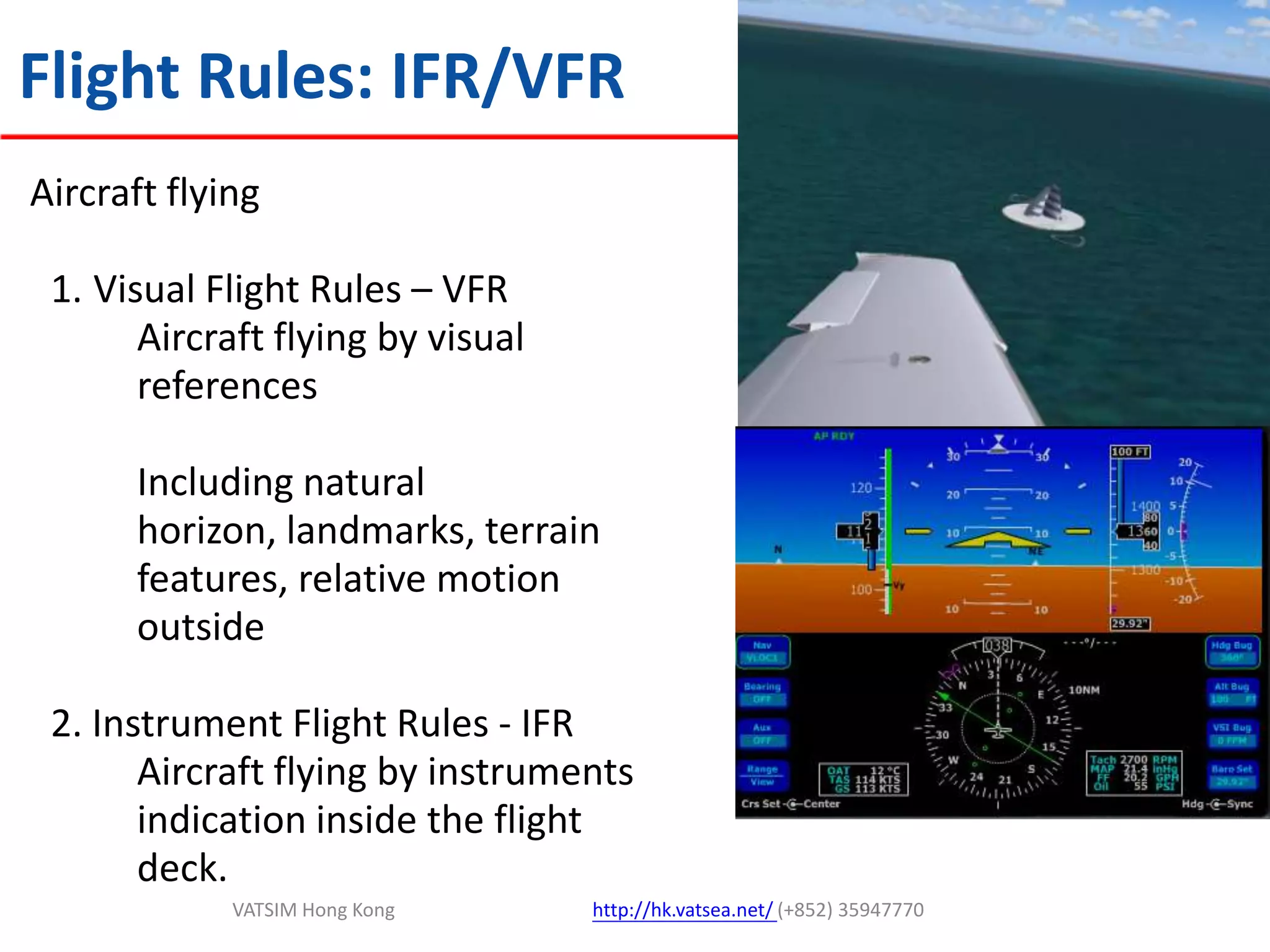
Flight Rules: IFR/VFRAircraft flying Visual Flight Rules – VFR Aircraft flying by visual references
Including natural horizon, landmarks, terrain features, relative motion outside2. Instrument Flight Rules - IFRAircraft flying byinstruments indication inside the flight deck.http://hk.vatsea.net/(+852) 35947770VATSIM Hong Kong
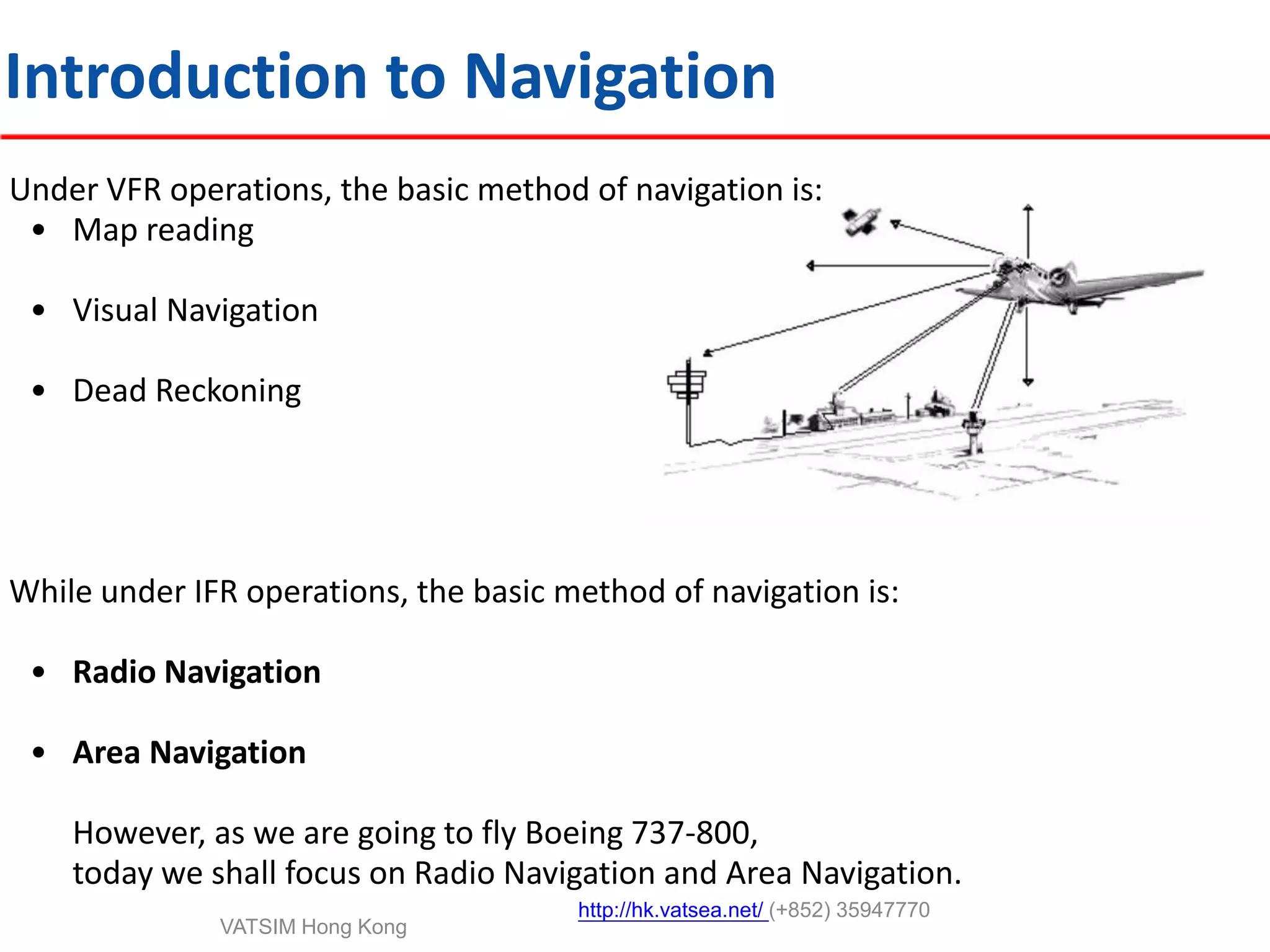
Introduction to Navigation Under VFR operations, the basic method of navigation is:Map reading
Visual Navigation
Dead ReckoningWhile under IFR operations, the basic method of navigation is:Radio Navigation
Area NavigationHowever, as we are going to fly Boeing 737-800, today we shall focus on Radio Navigation and Area Navigation.http://hk.vatsea.net/(+852) 35947770VATSIM Hong Kong
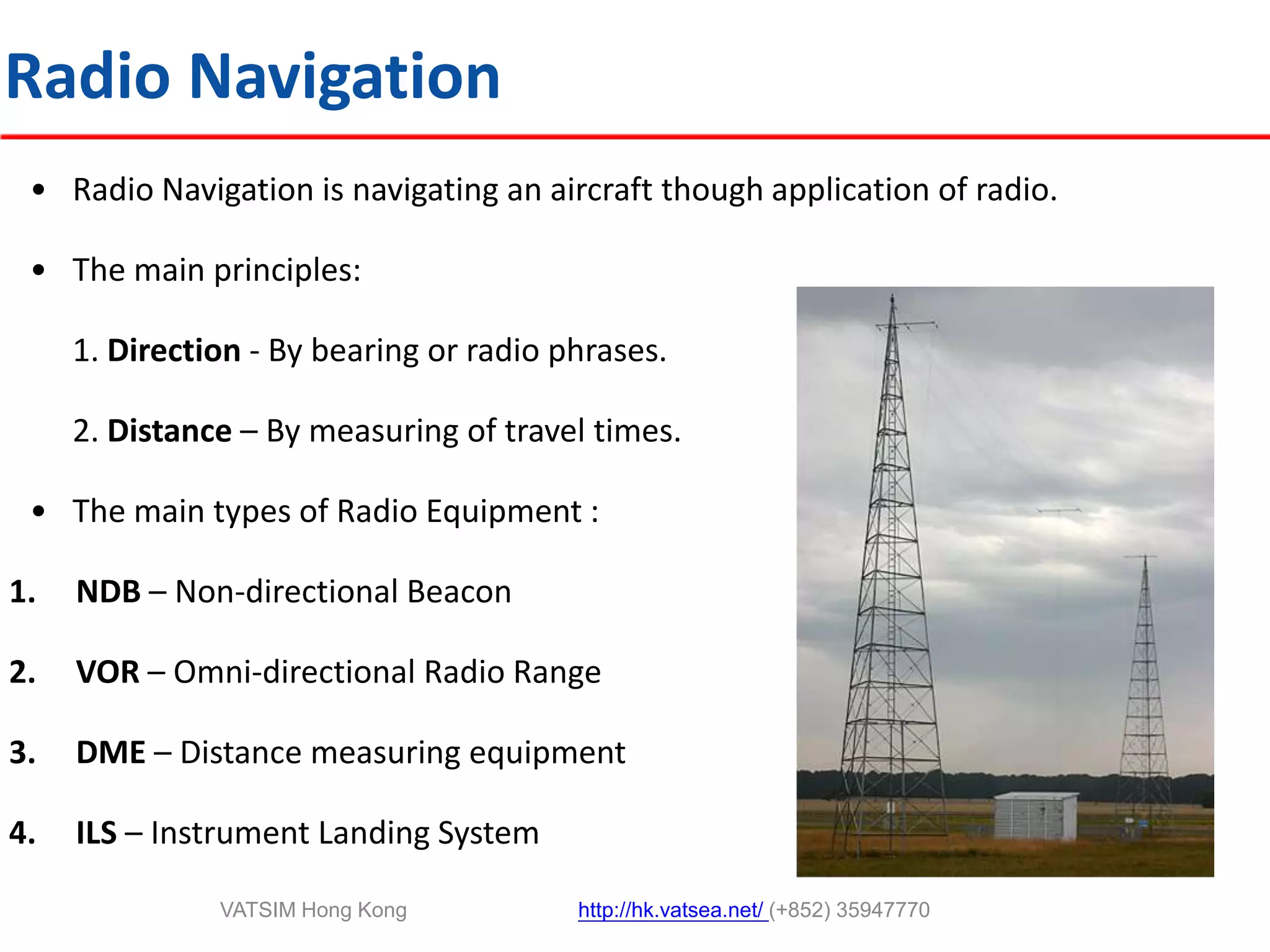
Radio Navigation Radio Navigation is navigating an aircraft though application of radio.
The main principles:1. Direction - By bearing or radio phrases.2. Distance – By measuring of travel times.
The main types of Radio Equipment :1.     NDB – Non-directional Beacon 2.     VOR – Omni-directional Radio Range3.     DME – Distance measuring equipment 4.     ILS – Instrument Landing Systemhttp://hk.vatsea.net/(+852) 35947770VATSIM Hong Kong
NDB  Non-Directional BeaconNDB stands for Non-directional Beacon
Early type of navigation aids – on Medium Freq.
Simple, reliable and relatively inexpensive

Introduction to Navigation

  • 1.
    Introduction to NavigationGaryLaw, Yuuji IzumoVATSIM Hong KongStanding Committee on Aviation Resource and Education Development12/23/2009MTR Corporation
  • 2.
    Flight Rules: IFR/VFRAircraftflying Visual Flight Rules – VFR Aircraft flying by visual references
  • 3.
    Including natural horizon,landmarks, terrain features, relative motion outside2. Instrument Flight Rules - IFRAircraft flying byinstruments indication inside the flight deck.http://hk.vatsea.net/(+852) 35947770VATSIM Hong Kong
  • 4.
    Introduction to NavigationUnder VFR operations, the basic method of navigation is:Map reading
  • 5.
  • 6.
    Dead ReckoningWhile underIFR operations, the basic method of navigation is:Radio Navigation
  • 7.
    Area NavigationHowever, aswe are going to fly Boeing 737-800, today we shall focus on Radio Navigation and Area Navigation.http://hk.vatsea.net/(+852) 35947770VATSIM Hong Kong
  • 8.
    Radio Navigation RadioNavigation is navigating an aircraft though application of radio.
  • 9.
    The main principles:1.Direction - By bearing or radio phrases.2. Distance – By measuring of travel times.
  • 10.
    The main typesof Radio Equipment :1.     NDB – Non-directional Beacon 2.     VOR – Omni-directional Radio Range3.     DME – Distance measuring equipment 4.     ILS – Instrument Landing Systemhttp://hk.vatsea.net/(+852) 35947770VATSIM Hong Kong
  • 11.
    NDB Non-DirectionalBeaconNDB stands for Non-directional Beacon
  • 12.
    Early type ofnavigation aids – on Medium Freq.
  • 13.
    Simple, reliable andrelatively inexpensive
  • 14.
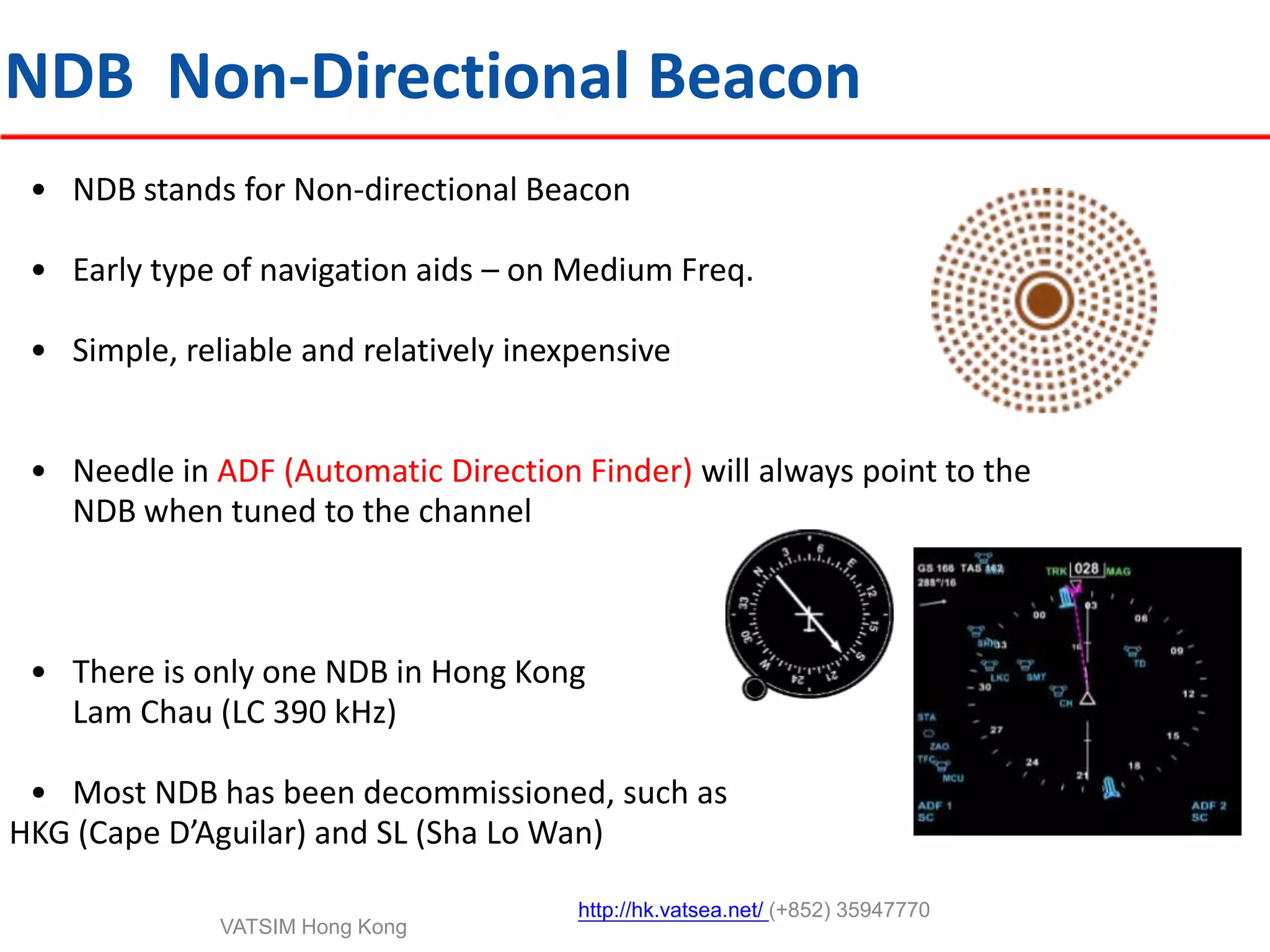
    Needle in ADF(Automatic Direction Finder) will always point to the NDB when tuned to the channel
  • 15.
    There is onlyone NDB in Hong Kong Lam Chau (LC 390 kHz)
  • 16.
    Most NDB hasbeen decommissioned, such asHKG (Cape D’Aguilar) and SL (Sha Lo Wan)http://hk.vatsea.net/(+852) 35947770VATSIM Hong Kong
  • 17.
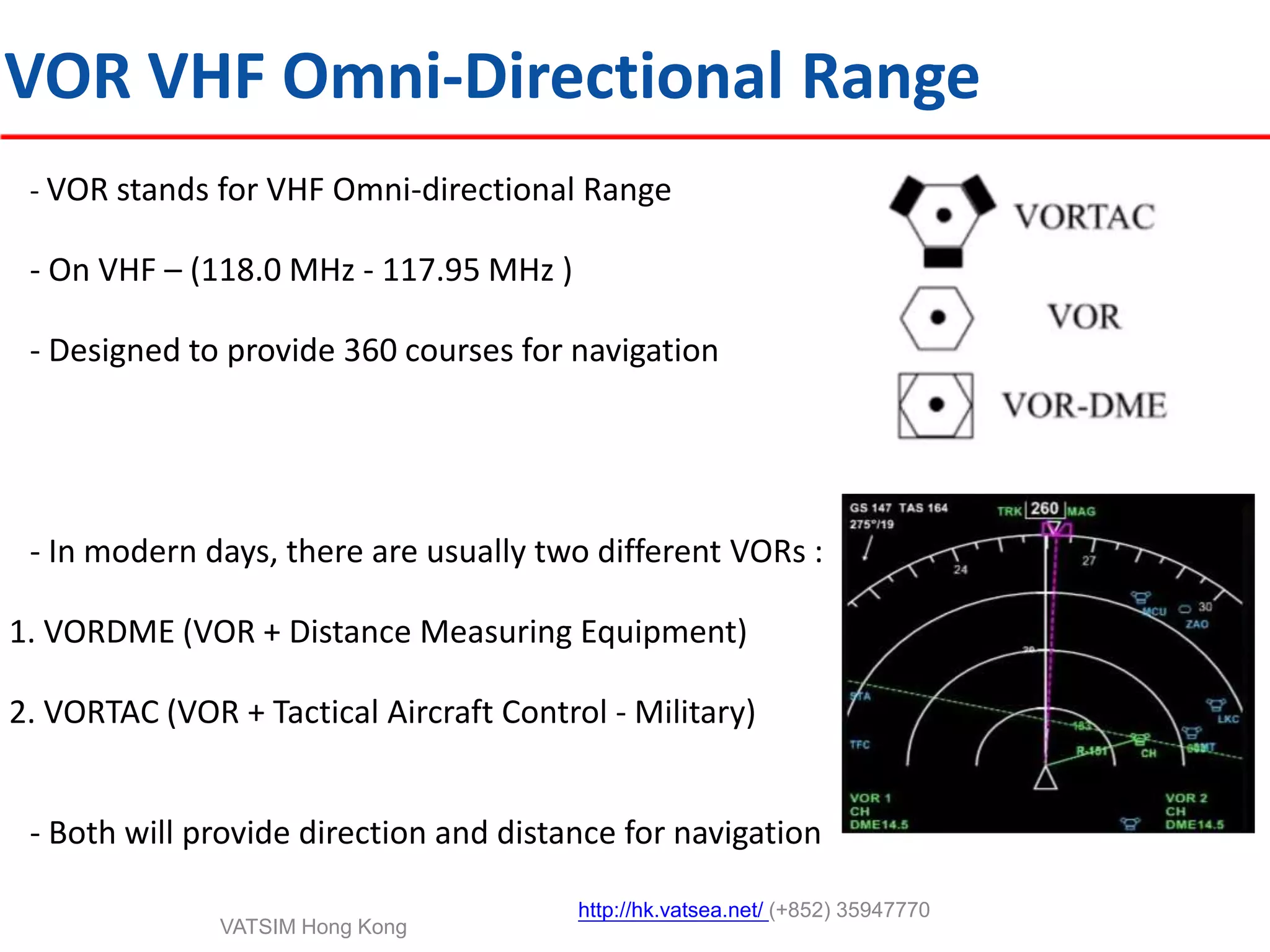
    VOR VHF Omni-DirectionalRange- VOR stands for VHF Omni-directional Range- On VHF – (118.0 MHz - 117.95 MHz )- Designed to provide 360 courses for navigation- In modern days, there are usually two different VORs :1. VORDME (VOR + Distance Measuring Equipment) 2. VORTAC (VOR + Tactical Aircraft Control - Military)- Both will provide direction and distance for navigationhttp://hk.vatsea.net/(+852) 35947770VATSIM Hong Kong
  • 18.
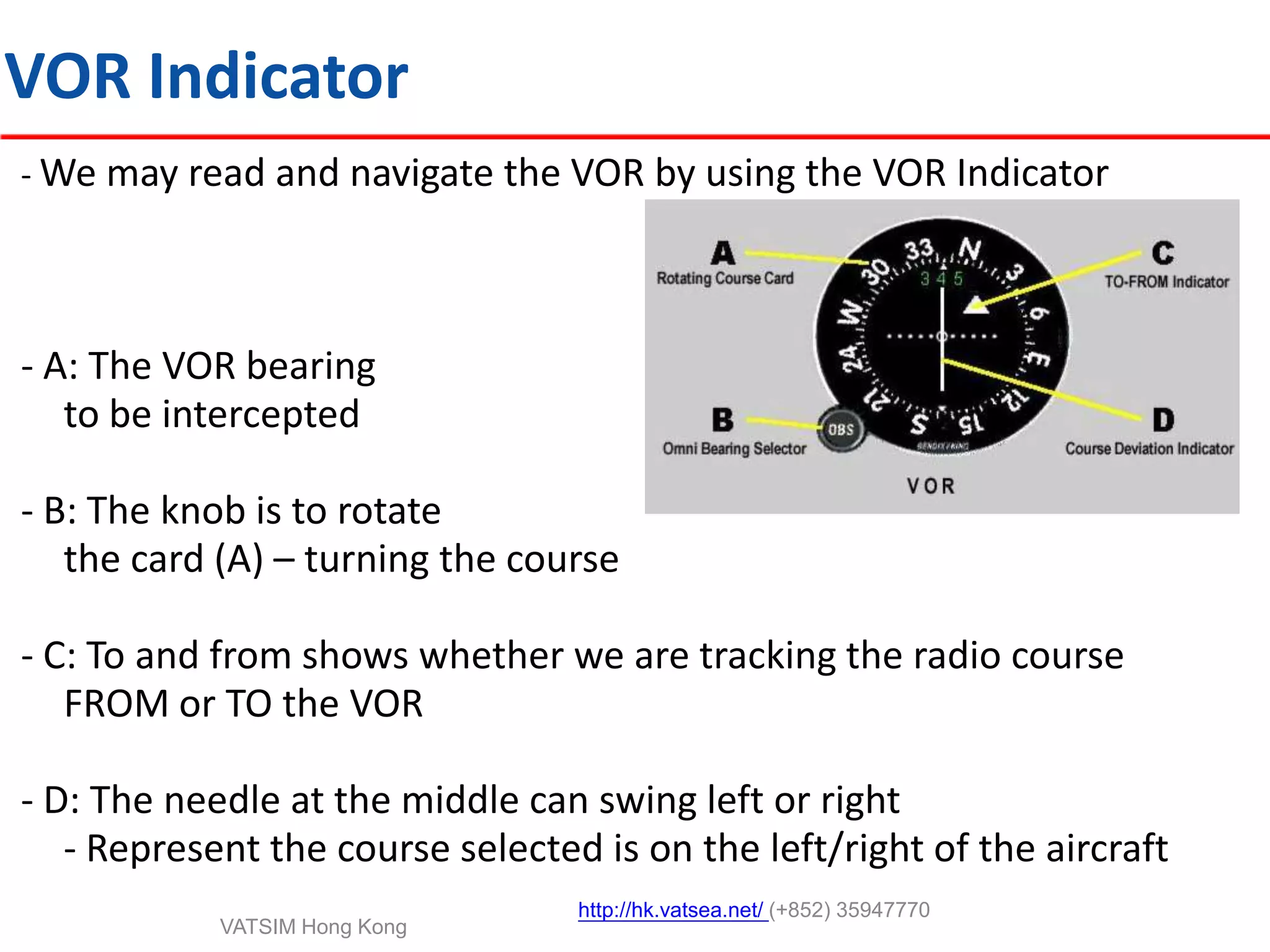
    VOR Indicator- Wemay read and navigate the VOR by using the VOR Indicator- A: The VOR bearing to be intercepted- B: The knob is to rotate the card (A) – turning the course- C: To and from shows whether we are tracking the radio courseFROM or TO the VOR- D: The needle at the middle can swing left or right- Represent the course selected is on the left/right of the aircrafthttp://hk.vatsea.net/(+852) 35947770VATSIM Hong Kong
  • 19.
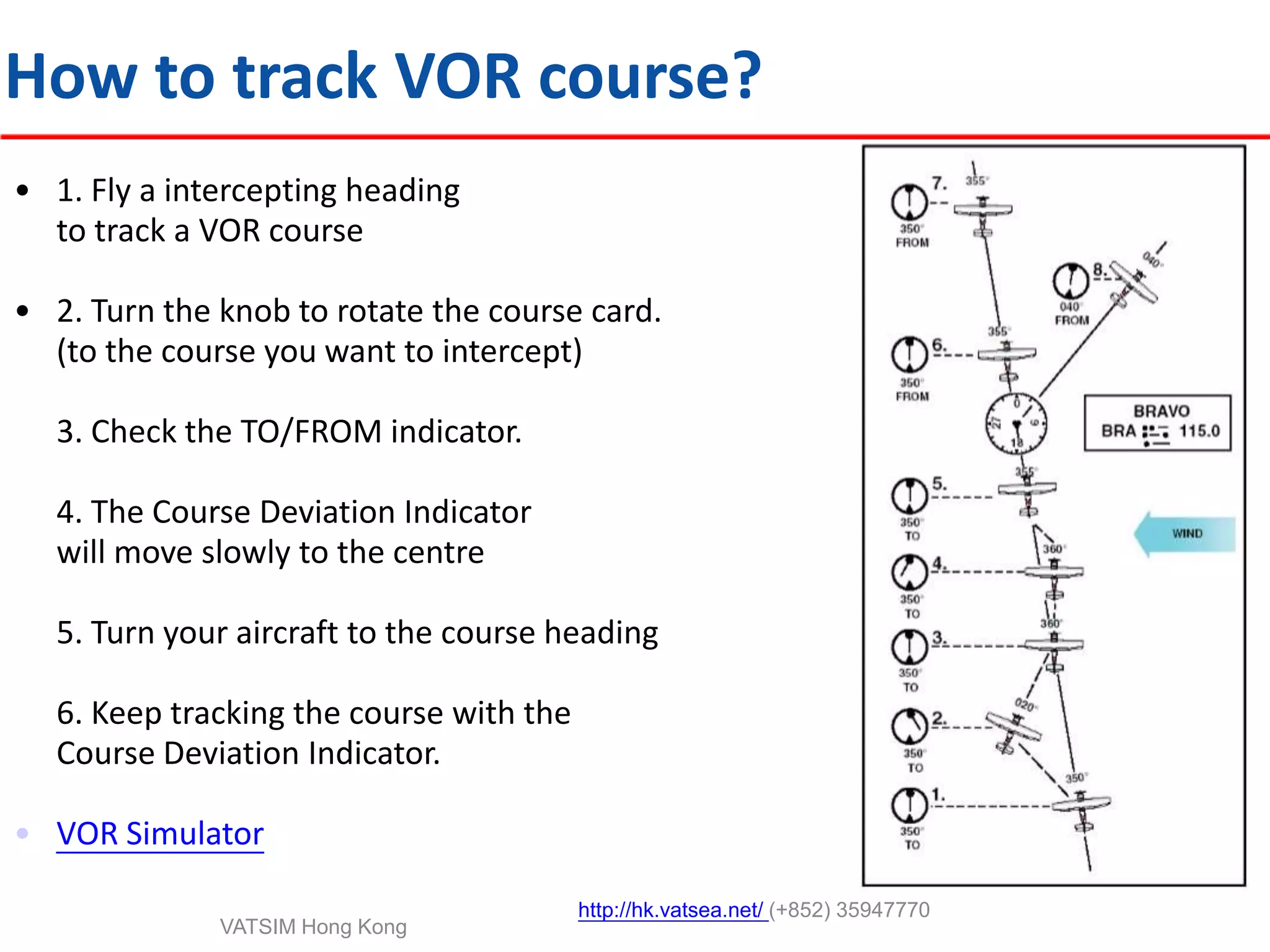
    How to trackVOR course?1. Fly a intercepting heading to track a VOR course
  • 20.
    2. Turn theknob to rotate the course card. (to the course you want to intercept)3. Check the TO/FROM indicator.4. The Course Deviation Indicator will move slowly to the centre5. Turn your aircraft to the course heading6. Keep tracking the course with the Course Deviation Indicator.
  • 21.
  • 22.
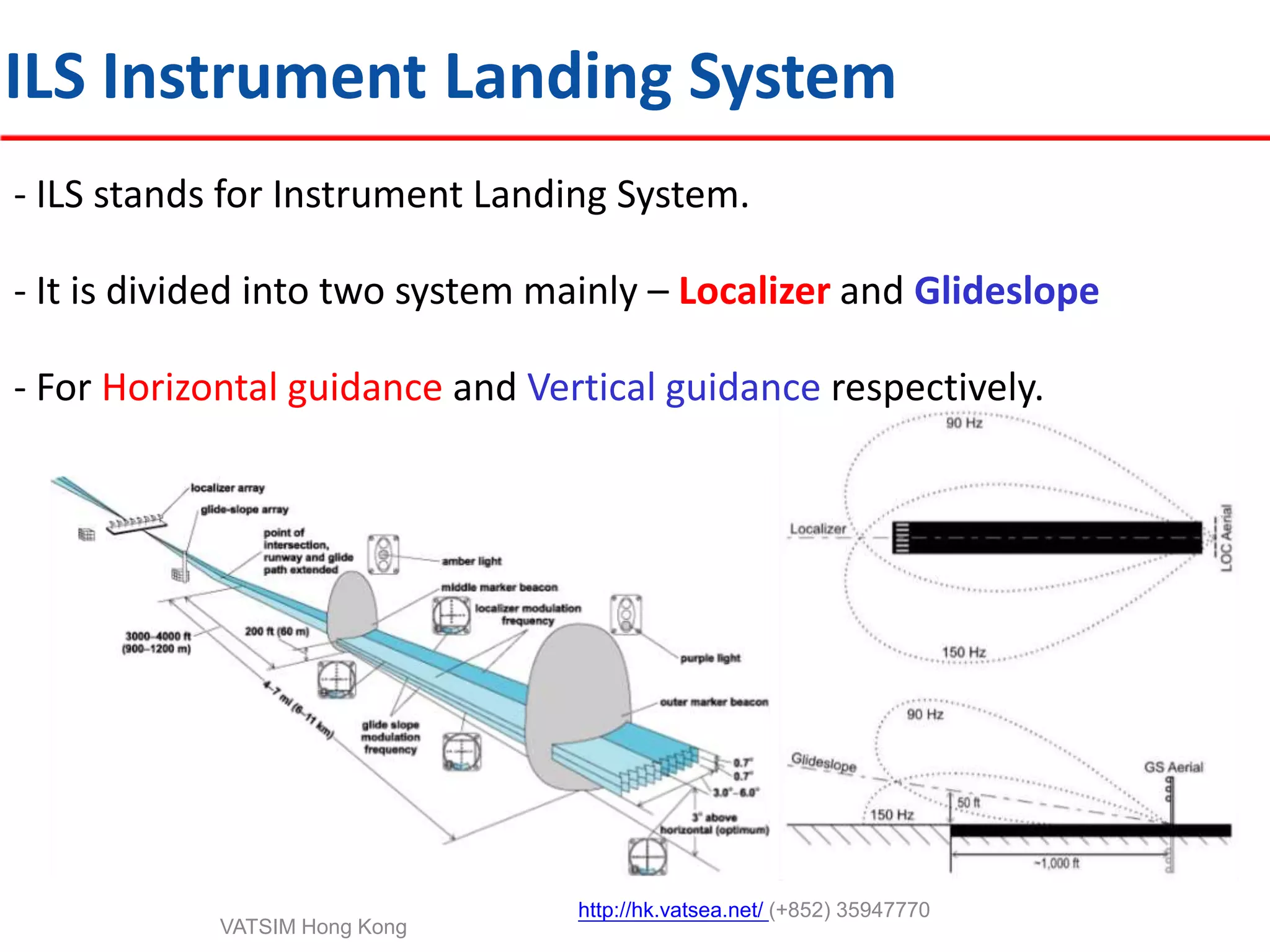
    ILS Instrument LandingSystem- ILS stands for Instrument Landing System. - It is divided into two system mainly – Localizerand Glideslope- For Horizontal guidance and Vertical guidance respectively.http://hk.vatsea.net/(+852) 35947770VATSIM Hong Kong
  • 23.
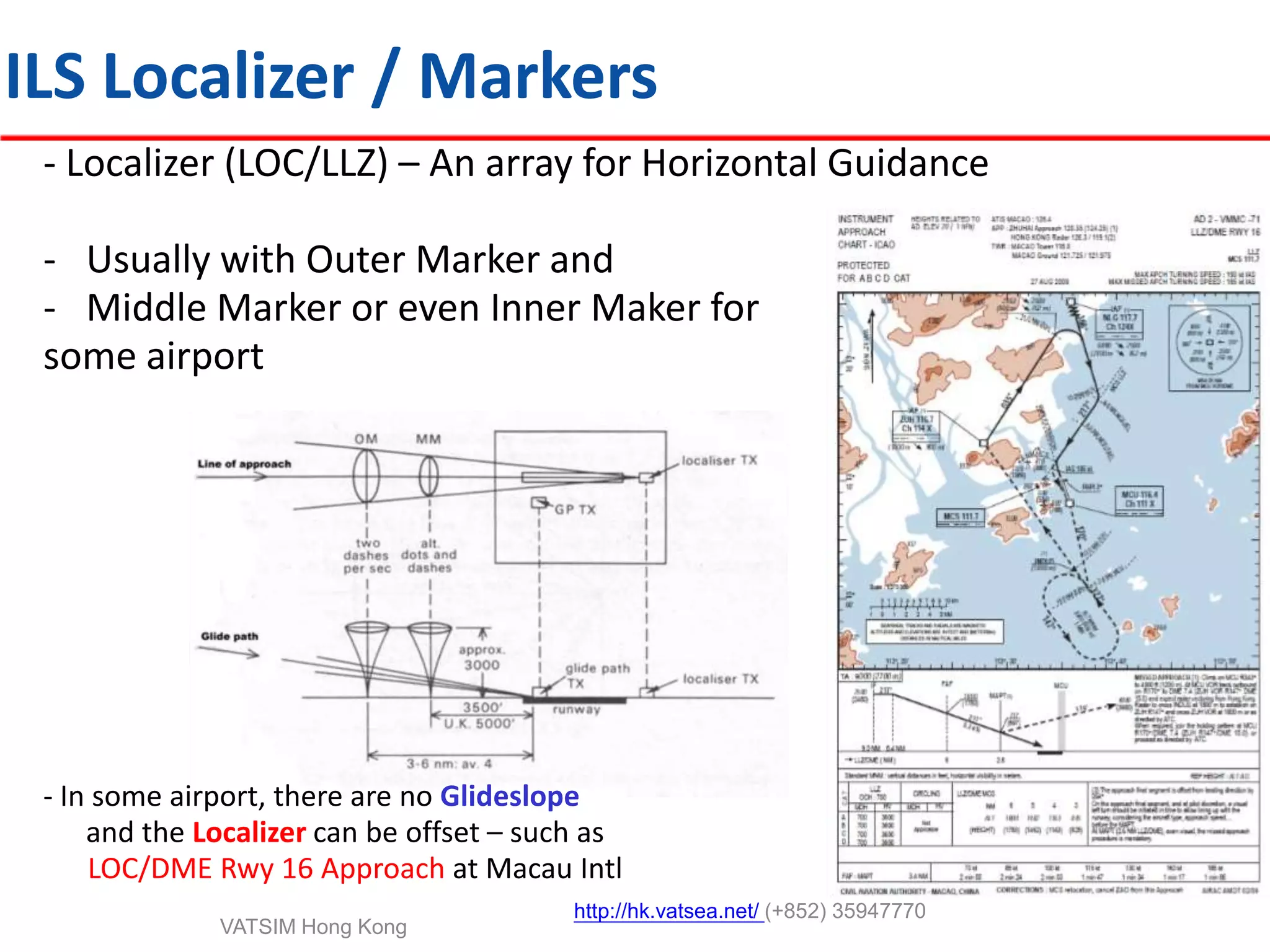
    ILS Localizer /Markers- Localizer (LOC/LLZ) – An array for Horizontal GuidanceUsually with Outer Marker and
  • 24.
    Middle Marker oreven Inner Maker for some airport- In some airport, there are no Glideslopeand the Localizer can be offset – such as LOC/DME Rwy 16 Approach at Macau Intlhttp://hk.vatsea.net/(+852) 35947770VATSIM Hong Kong
  • 25.
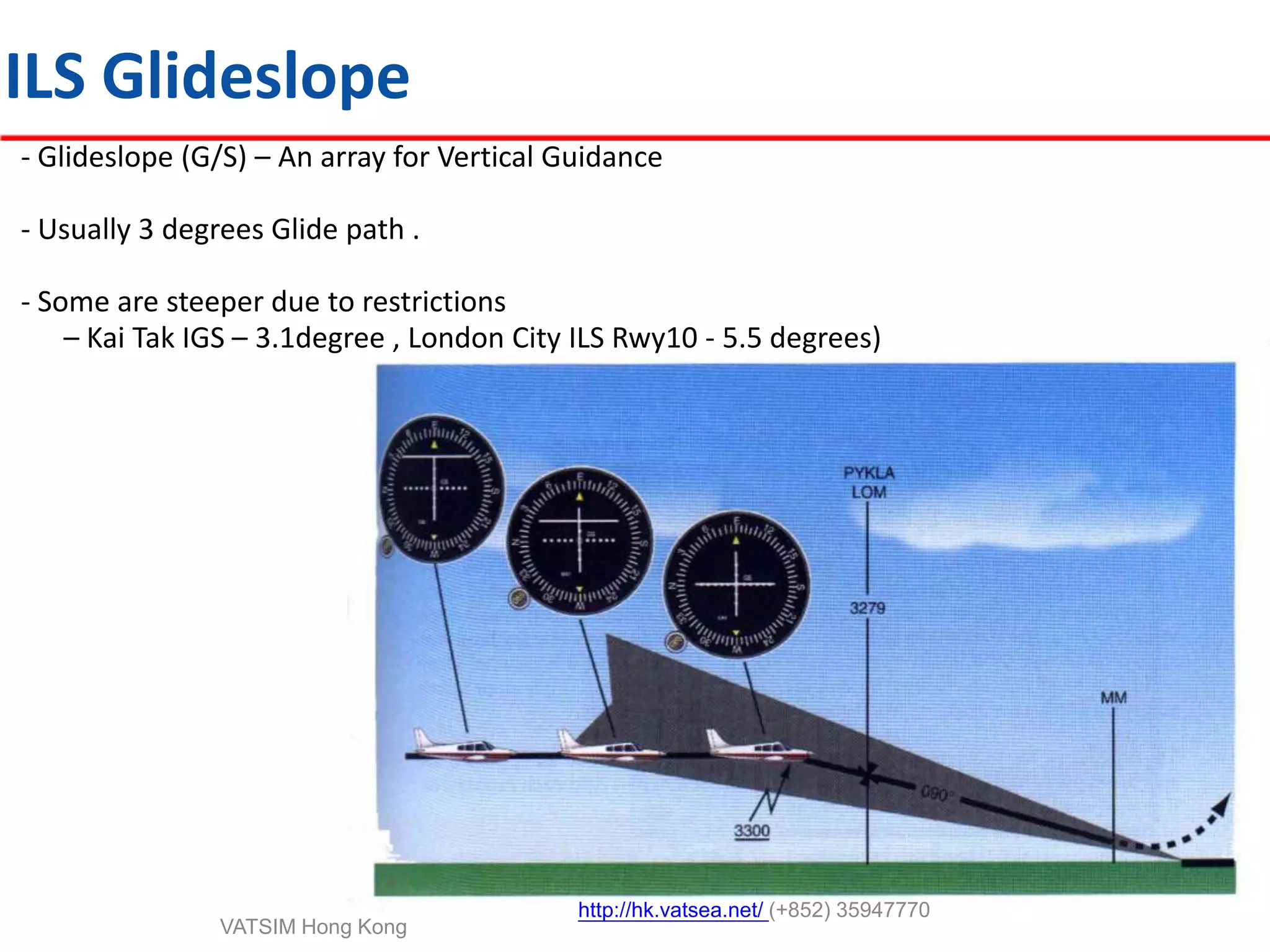
    ILS Glideslope- Glideslope(G/S) – An array for Vertical Guidance- Usually 3 degrees Glide path .- Some are steeper due to restrictions– Kai TakIGS – 3.1degree , London City ILS Rwy10 - 5.5 degrees)http://hk.vatsea.net/(+852) 35947770VATSIM Hong Kong
  • 26.
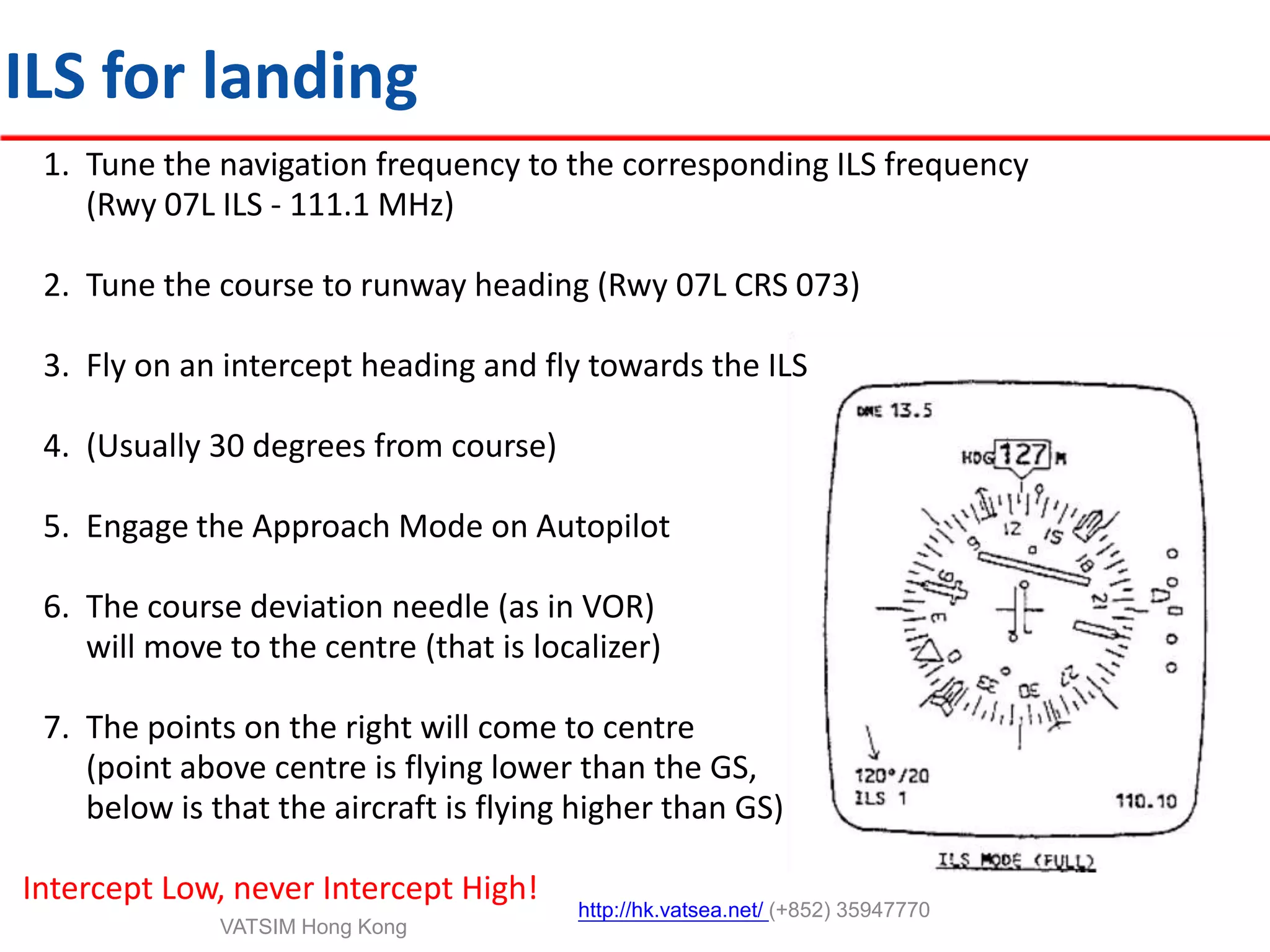
    ILS for landingTunethe navigation frequency to the corresponding ILS frequency(Rwy 07L ILS - 111.1 MHz)Tune the course to runway heading (Rwy 07L CRS 073)Fly on an intercept heading and fly towards the ILS(Usually 30 degrees from course)Engage the Approach Mode on AutopilotThe course deviation needle (as in VOR) will move to the centre (that is localizer)The points on the right will come to centre(point above centre is flying lower than the GS, below is that the aircraft is flying higher than GS) Intercept Low, never Intercept High!http://hk.vatsea.net/(+852) 35947770VATSIM Hong Kong
  • 27.
    ILS Categories 3main Categories for ILS
  • 28.
    CAT I,CAT II and CAT III They have different requirements on decision height (Decision on LAND or GO AROUND)and on Visibility or Runway Visual RangeCategory IIIc is capable for full autoland (Good but much expensive due to equipment!)At Hong Kong International Airport, 07R, 07L and 25L are capable forCat II landing, while 25R is capable for Cat II and Cat III landing.http://hk.vatsea.net/(+852) 35947770VATSIM Hong Kong