Click to edit Master title style
Heading heading heading
Date
TPT CE’s Procurement Imbizo
KZN Region
Tender and Three Quote Educational Presentation
2nd November 2015
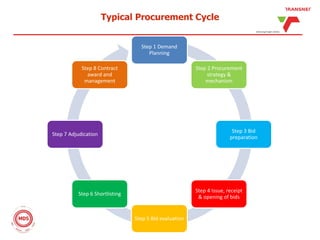
Step 1 Demand
Planning
Step 2 Procurement
strategy &
mechanism
Step 3 Bid
preparation
Step 4 Issue, receipt
& opening of bids
Step 5 Bid evaluation
Step 6 Shortlisting
Step 7 Adjudication
Step 8 Contract
award and
management
Typical Procurement Cycle
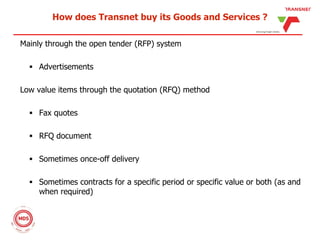
How does Transnet buy its Goods and Services ?
Mainly through the open tender (RFP) system
 Advertisements
Low value items through the quotation (RFQ) method
 Fax quotes
 RFQ document
 Sometimes once-off delivery
 Sometimes contracts for a specific period or specific value or both (as and
when required)
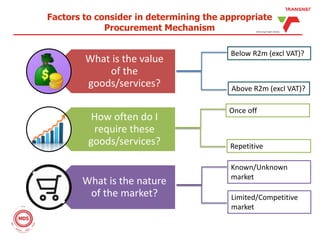
What is the value
of the
goods/services?
How often do I
require these
goods/services?
What is the nature
of the market?
Below R2m (excl VAT)?
Above R2m (excl VAT)?
Once off
Repetitive
Known/Unknown
market
Limited/Competitive
market
Factors to consider in determining the appropriate
Procurement Mechanism
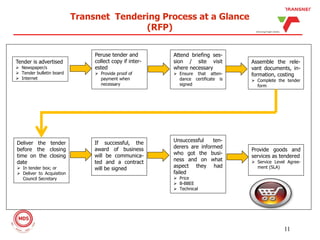
Tender is advertised
 Newspaper/s
 Tender bulletin board
 Internet
Transnet Tendering Process at a Glance
(RFP)
Peruse tender and
collect copy if inter-
ested
 Provide proof of
payment when
necessary
Attend briefing ses-
sion / site visit
where necessary
 Ensure that atten-
dance certificate is
signed
Assemble the rele-
vant documents, in-
formation, costing
 Complete the tender
form
Provide goods and
services as tendered
 Service Level Agree-
ment (SLA)
Unsuccessful ten-
derers are informed
who got the busi-
ness and on what
aspect they had
failed
 Price
 B-BBEE
 Technical
If successful, the
award of business
will be communica-
ted and a contract
will be signed
Deliver the tender
before the closing
time on the closing
date
 In tender box; or
 Deliver to Acquisition
Council Secretary
11
Where are tenders advertised?
Transnet tenders are normally advertised in the following publications:
 National Treasury eTender Publication Portal at
www.etenders.gov.za
with effect form the 1st May 2015.
 National Newspapers (e.g. Sowetan, Sunday Times, City Press, New Age,
etc.).
 CIDB website –for engineering & construction tenders.
 Tender notice boards at Transnet offices.
 For those who do not have access to internet, bid documents can still be
obtained at a relevant Transnet office where the bid is advertised.
Briefing Sessions
 The tender document will sometimes indicate that a compulsory briefing
session / site visit will be held.
 Briefing sessions / site visits may also be non-compulsory in which case
tenderers may attend if they wish, to obtain more information or to look at the
site.
 The purpose of the briefing session / site visit is to explain Transnet’s
requirements in more detail and to allow questions from prospective tenderers
so that tenderers may be sure as to what is expected of them when they
respond to the tender.
 If you don’t attend a compulsory briefing session / site visit, you will not be
allowed to participate in the tender process.
 Even if the briefing session is non compulsory you are strongly encouraged to
attend.
Lets look at the basic structure of a tender document
 Notice to tenderers / bidders.
 Background, Overview and Scope of Requirements.
 Pricing and Delivery Schedule.
 Proposal Form and List of Returnable Documents.
 RFP Declaration and Breach of Law Form.
 Clarification Request Form.
 B-BBEE Preference Points Claim Form.
 Certification of Attendance of RFP Compulsory Briefing.
 Supplier Development Initiatives.
 Declaration of Supplier Development Commitments.
 B-BBEE Improvement Plan
Notice to tenderers / bidders
 Description of services/goods required.
 Contract period / anticipated contract period.*
 Date, time and address for tender briefing/site meeting (if any).
 Date and time of tender closing.*
 Address where tender should be submitted.
 Manner in which tender can be submitted, e.g. original and 2 copies, in tender
box or per courier.*
 Information on B-BBEE, Supplier Development, Subcontracting,
Confidentiality.
 Communication:- who to contact for clarity, when to contact that person and
how to communicate with that person.
 The secretary’s address and that of the tender box will be indicated in the
tender document.
Background, Overview & Scope of Requirements
The tenderer needs to be aware of the following:
 Background of the services needed by Transnet and the overview thereof.
 Scope of requirements:- this is the actual scope of work that the bidder will
be required to provide.
 Green Economy:- the bidder is required to provide its policy on Green
economy.
 General Service Provider Obligation:- a commitment from the bidder that, it
will comply with all requirements as per the RFP and shall be responsible
for the acts of its employees.
 Evaluation Method, this shall be explained in detail on slide 22*
Pricing and Delivery Schedule
The bidders need to:
 State the total price and applicable VAT separately.*
 Give a breakdown of the different component costs that make up that price
so it is clear how you got to the final price.
 The breakdown should include the labour portion, materials costs, import
costs, fuel/transport costs, etc.
 Service Levels:- bidders to accept service levels with Transnet.
 Suppliers must indicate how prices will increase and what factors will inform
such increases.*
 Financial stability:- bidders are required to submit their audited financial
statements
NOTE: Suppliers MUST NOT intentionally quote lower prices with the hope
of increasing the price at a later stage *
Proposal Form & List of Returnable Documents
Examples of returnable documents include:
 − Copy of ID
 − Financial Statements
 − Confirmation of turnover
 − References
 − B-BBEE certificate
 − Original valid tax clearance certificate
 - Pricing Schedule
 - Declaration of Supplier Development Commitment
And where applicable:
• Joint Venture Agreement
• Share agreements/certification
• CIBD grading
• Technical specifications and drawings
• Tender briefing attendance form
• Receipt for payment re. tender form
RFP Declaration & Breach of Law Form
In this section bidders are expected to declare that:
 All the questions they might have had and submitted to Transnet for clarity
have been answered to their satisfaction by Transnet.
 They have been afforded access to Transnet operational sites for them to
assess Transnet so that they will be in a better position to bid.
 They are satisfied with the bidding process and with the required
information as per RFP
 They have no family, business or social relationship with the employees,
Board members of Transnet or with any person who might be involved in
the evaluation process
 They have not been found guilty of breaching any law in the last five years
(company law for an example). This does not include minor offences such
as traffic offences.
Clarification Request Form
 This is the form that bidders are required to complete for purposes
for seeking or requesting clarity for a particular bid.
 The form has the contact details of the person to whom request for
clarity should be addressed to.
 In turn the response for clarity will be sent to all bidders who are
participating in the bid to ensure fairness to all bidders.
 It is important that, the bidders who sought clarity fill in their
correct details in the form as the response is sent back as per the
details appearing on the form.
B-BBEE Preference Points Claim Form
It is important to note that, in this section a total of ten (10) points shall be
awarded for B-BBEE Status level of contribution. It is therefore important for
the bidders to:-
 Complete the form and state their B-BBEE Status Level of Contribution, and
this should be accompanied with the accredited Verification Agencies’
Certificate
 In the absence of the Certificate by the accredited Verification Agencies a
sworn affidavit will suffice, but this is only applicable to Exempted Micro
Enterprises (EMEs) and Qualifying Small Enterprises (QSEs)
 In the event that the bidder intends to subcontract, then the B-BBEE
Status Level of the company to be subcontracted must also be reflected on
the form.
 The percentage of the contract to be subcontracted must also be reflected
on the form.
 The bidder must declare that, the level of B-BBEE status claimed is correct
and true, and is not fraudulent.
Certificate of Attendance of RFP Briefing
 It is important to note that, where a briefing session is compulsory, then
bidders must complete and submit the certificate of attendance of the RFP
briefing together with their proposal as proof of attendance.
 A bidder who does not have in their possession valid RFP documents will
not be allowed to attend a briefing session.
 It must be noted further that, a failure by the bidders to attend a
compulsory briefing session will result in disqualification.
 It is also important that bidders stick to the time for a briefing session as
stipulated in the RFP document as there will not be time allocated to repeat
what has already been discuss for purposes of accommodating those that
arrive late.
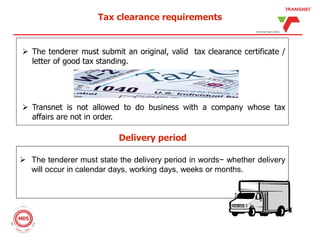
Tax clearance requirements
 The tenderer must submit an original, valid tax clearance certificate /
letter of good tax standing.
 Transnet is not allowed to do business with a company whose tax
affairs are not in order.
Delivery period
 The tenderer must state the delivery period in words− whether delivery
will occur in calendar days, working days, weeks or months.
Tender evaluation criteria
 Always remember : Price is not the only factor !!
 Various criteria are taken into account when evaluating tender
responses (including quality, proposed supplier development and
B-BBEE status).
 The mere fact that the tenderer has offered the cheapest price
does not guarantee that business will be awarded to him/her.
Tender evaluation criteria contd…
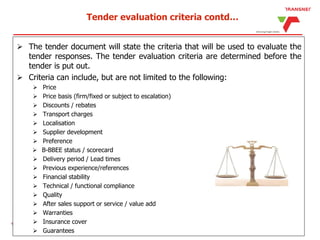
 The tender document will state the criteria that will be used to evaluate the
tender responses. The tender evaluation criteria are determined before the
tender is put out.
 Criteria can include, but are not limited to the following:
 Price
 Price basis (firm/fixed or subject to escalation)
 Discounts / rebates
 Transport charges
 Localisation
 Supplier development
 Preference
 B-BBEE status / scorecard
 Delivery period / Lead times
 Previous experience/references
 Financial stability
 Technical / functional compliance
 Quality
 After sales support or service / value add
 Warranties
 Insurance cover
 Guarantees
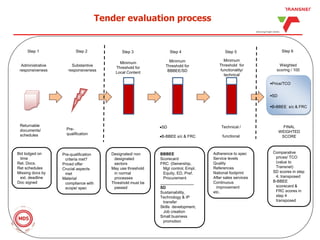
Tender evaluation process
Step 3 Step 4 Step 5
Administrative
responsiveness
Substantive
responsiveness
Minimum
Threshold for
Local Content
Minimum
Threshold for
BBBEE/SD
Weighted
scoring / 100
Price/TCO
SD
B-BBEE s/c & FRC
Returnable
documents/
schedules
Pre-
qualification
SD
B-BBEE s/c & FRC
Technical /
functional
FINAL
WEIGHTED
SCORE
Minimum
Threshold for
functionality/
technical
Step 2Step 1 Step 6
Bid lodged on
time
Ret. Docs.
Ret schedules
Missing docs by
ext. deadline
Doc signed
Pre-qualification
criteria met?
Priced offer
Crucial aspects
met
Material
compliance with
scope/ spec
Designated/ non
designated
sectors
May use threshold
in normal
processes
Threshold must be
passed
BBBEE
Scorecard
FRC: (0wnership,
Mgt control, Empl.
Equity, ED, Pref.
Procurement
_______________
SD
Sustainability,
Technology & IP
transfer
Skills development,
Job creation
Small business
promotion
Adherence to spec
Service levels
Quality
References
National footprint
After sales services
Continuous
improvement
etc.
Comparative
prices/ TCO
(value to
Transnet)
SD scores in step
4, transposed
B-BBEE
scorecard &
FRC scores in
step 4
transposed
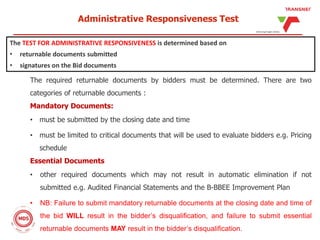
The required returnable documents by bidders must be determined. There are two
categories of returnable documents :
Mandatory Documents:
• must be submitted by the closing date and time
• must be limited to critical documents that will be used to evaluate bidders e.g. Pricing
schedule
Essential Documents
• other required documents which may not result in automatic elimination if not
submitted e.g. Audited Financial Statements and the B-BBEE Improvement Plan
• NB: Failure to submit mandatory returnable documents at the closing date and time of
the bid WILL result in the bidder’s disqualification, and failure to submit essential
returnable documents MAY result in the bidder’s disqualification.
Administrative Responsiveness Test
The TEST FOR ADMINISTRATIVE RESPONSIVENESS is determined based on
• returnable documents submitted
• signatures on the Bid documents
Substantive Responsiveness Test
Whether any pre-qualification criteria (Yes or No Questions) set by
Transnet, have been met:
Technical/Functional
Supplier Development
Financial Stability
Whether the Bid contains a priced offer as prescribed in the RFP
Whether the Bid materially complies with the scope and/or
specification given
What could disqualify a tender response
 Failure to attend compulsory site/clarification meeting.
 Unsigned tender documents.
 Tenders deposited after the closing time and date or at the wrong address.
 Failure to submit returnable documents asked for e.g. original valid tax clearance or
B-BBEE certificate.
 Being blacklisted from doing business with Transnet or Government.
 No CIDB registration for required grading for construction tenders.
 Non-compliance with or contravening legislative provisions.
 Not signing a non-disclosure agreement where this was a requirement.
 Not complying with material forms and conditions of tender.
 Not quoting a price.
 Misrepresentation of facts.
 Fraud and corruption.
 Failure to declare an interest.
 Other breaches of law.
Tips for successful tendering
Do your homework and start early
 Get a copy of the tender documents as soon as you can, preferably on the day the
tender is issued to the market. (You can read a draft tender document before
deciding to buy the document.)
 Give yourself enough time to plan and prepare your submission.
Review and understand the requirements
 Read the tender document carefully and thoroughly.
 Attend any scheduled briefing session and ask questions if the information is
unclear.
 If you need further help or clarification, ask the Transnet contact person, mentioned
in the tender document.
 Make sure you have all the requested accreditations and documents.
 Read the contract terms and conditions and make sure you can comply.
Tips for successful tendering contd…
Study the evaluation criteria and respond as requested in the RFP
 Note any weighting placed on each of them (i.e. how big a role does each
criterion play in the final evaluation).
 Satisfy each of the criteria as best you can.
 Work out the budget and resources required to do the work.
 Do not under-quote as you will not be allowed to increase your price once the
tender is awarded. The contract may be cancelled and you and your company
may be blacklisted for under-performance.
 Give a breakdown of your price/cost.
Tips for successful tendering contd…
Check your tender response for completeness and accuracy
 Make sure you include all the requirements and specifications for goods and
services to be supplied.
 Be 100% sure that you will be able to deliver as tendered.
 Inform Transnet how you will meet the requirements.
 Check for arithmetical errors in your tender price or other calculations.
 Include details of the relevant experience you have in relation to the proposed
contract.
 Indicate who can give reference for your work/performance on previous
contracts.
 Attach all returnable documents.
Tips for successful tendering contd…
Check the closing date, time and place for delivering the tender
 Late tenders and tenders delivered to an incorrect address will not be
considered.
 Make sure you have enough time to prepare and submit your tender.
 Submit the tender in the right place/tender box.
 Make sure the document is completed in full and that all the pages
have been signed/initialled.
 Don’t wait until the last minute to deliver/submit your documents.
 Do not submit more than one tender in the same envelope.
Common Challenges
 Incorrect or incomplete completion of tender documents;
 Failure to seek clarity when unsure;
 Failure to ask relevant information during briefing sessions;
 Failure to return mandatory documents on or before the closing date;
 Failure to submit essential documents on or before the closing date, even when
requested to submit within a reasonable time after the closing date;
 Failure to read and understand what is required in the tender documents;
 Failure to correctly fill in the required information on the pricing schedule;
 NB: the Bid document always has a schedule of Mandatory Returnable Documents
and Essential Returnable Documents.
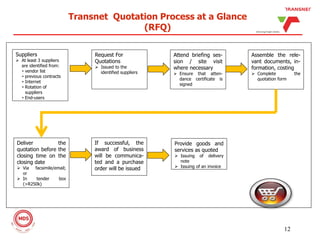
Suppliers
 At least 3 suppliers
are identified from:
• vendor list
• previous contracts
• Internet
• Rotation of
suppliers
• End-users
Transnet Quotation Process at a Glance
(RFQ)
Request For
Quotations
 Issued to the
identified suppliers
Attend briefing ses-
sion / site visit
where necessary
 Ensure that atten-
dance certificate is
signed
Assemble the rele-
vant documents, in-
formation, costing
 Complete the
quotation form
Provide goods and
services as quoted
 Issuing of delivery
note
 Issuing of an invoice
If successful, the
award of business
will be communica-
ted and a purchase
order will be issued
Deliver the
quotation before the
closing time on the
closing date
 Via facsimile/email;
or
 In tender box
(>R250k)
12
Common Challenges – 3 Quote System
 Incorrect or incomplete quotation (missing stock availability details, delivery time,
warranty details);
 Failure to attend briefing sessions resulting in bidders not understanding the Scope
of work (if compulsory, any non-attending vendors’ quotes will be disallowed);
 Failure to price according to the pricing schedule provided by the Buyer, (Quoting
total price instead of a breakdown provided; using a different Unit of Measure);
 Sending quotations to the wrong fax number or e-mail;
Common Challenges in Payments of Invoices
 Supplier engaged on emergencies whereas tax matters are not correct –
payment is withheld by Finance until the tax matters are resolved;
 Changes to the PO during delivery without Procurement’s involvement –
changes to PO to be done upon Procurement’s instruction or revised PO;
 Delivering a service without a Purchase Order – this is a violation;
 Sending invoices without PO numbers and signed delivery notes/job cards;
 Only original invoices are considered for payment – not copies;
 Incorrect Terminals invoiced and statement is not sent by the 10th of the next
month;
 Backdating invoices to quicken the payment period – invoice date cannot be
earlier than the PO date unless it was an emergency.
Click to edit Master title style

Tpt's tendering process at a glance

  • 1.
    Click to editMaster title style Heading heading heading Date TPT CE’s Procurement Imbizo KZN Region Tender and Three Quote Educational Presentation 2nd November 2015
  • 2.
    Step 1 Demand Planning Step2 Procurement strategy & mechanism Step 3 Bid preparation Step 4 Issue, receipt & opening of bids Step 5 Bid evaluation Step 6 Shortlisting Step 7 Adjudication Step 8 Contract award and management Typical Procurement Cycle
  • 3.
    How does Transnetbuy its Goods and Services ? Mainly through the open tender (RFP) system  Advertisements Low value items through the quotation (RFQ) method  Fax quotes  RFQ document  Sometimes once-off delivery  Sometimes contracts for a specific period or specific value or both (as and when required)
  • 4.
    What is thevalue of the goods/services? How often do I require these goods/services? What is the nature of the market? Below R2m (excl VAT)? Above R2m (excl VAT)? Once off Repetitive Known/Unknown market Limited/Competitive market Factors to consider in determining the appropriate Procurement Mechanism
  • 5.
    Tender is advertised Newspaper/s  Tender bulletin board  Internet Transnet Tendering Process at a Glance (RFP) Peruse tender and collect copy if inter- ested  Provide proof of payment when necessary Attend briefing ses- sion / site visit where necessary  Ensure that atten- dance certificate is signed Assemble the rele- vant documents, in- formation, costing  Complete the tender form Provide goods and services as tendered  Service Level Agree- ment (SLA) Unsuccessful ten- derers are informed who got the busi- ness and on what aspect they had failed  Price  B-BBEE  Technical If successful, the award of business will be communica- ted and a contract will be signed Deliver the tender before the closing time on the closing date  In tender box; or  Deliver to Acquisition Council Secretary 11
  • 6.
    Where are tendersadvertised? Transnet tenders are normally advertised in the following publications:  National Treasury eTender Publication Portal at www.etenders.gov.za with effect form the 1st May 2015.  National Newspapers (e.g. Sowetan, Sunday Times, City Press, New Age, etc.).  CIDB website –for engineering & construction tenders.  Tender notice boards at Transnet offices.  For those who do not have access to internet, bid documents can still be obtained at a relevant Transnet office where the bid is advertised.
  • 7.
    Briefing Sessions  Thetender document will sometimes indicate that a compulsory briefing session / site visit will be held.  Briefing sessions / site visits may also be non-compulsory in which case tenderers may attend if they wish, to obtain more information or to look at the site.  The purpose of the briefing session / site visit is to explain Transnet’s requirements in more detail and to allow questions from prospective tenderers so that tenderers may be sure as to what is expected of them when they respond to the tender.  If you don’t attend a compulsory briefing session / site visit, you will not be allowed to participate in the tender process.  Even if the briefing session is non compulsory you are strongly encouraged to attend.
  • 8.
    Lets look atthe basic structure of a tender document  Notice to tenderers / bidders.  Background, Overview and Scope of Requirements.  Pricing and Delivery Schedule.  Proposal Form and List of Returnable Documents.  RFP Declaration and Breach of Law Form.  Clarification Request Form.  B-BBEE Preference Points Claim Form.  Certification of Attendance of RFP Compulsory Briefing.  Supplier Development Initiatives.  Declaration of Supplier Development Commitments.  B-BBEE Improvement Plan
  • 9.
    Notice to tenderers/ bidders  Description of services/goods required.  Contract period / anticipated contract period.*  Date, time and address for tender briefing/site meeting (if any).  Date and time of tender closing.*  Address where tender should be submitted.  Manner in which tender can be submitted, e.g. original and 2 copies, in tender box or per courier.*  Information on B-BBEE, Supplier Development, Subcontracting, Confidentiality.  Communication:- who to contact for clarity, when to contact that person and how to communicate with that person.  The secretary’s address and that of the tender box will be indicated in the tender document.
  • 10.
    Background, Overview &Scope of Requirements The tenderer needs to be aware of the following:  Background of the services needed by Transnet and the overview thereof.  Scope of requirements:- this is the actual scope of work that the bidder will be required to provide.  Green Economy:- the bidder is required to provide its policy on Green economy.  General Service Provider Obligation:- a commitment from the bidder that, it will comply with all requirements as per the RFP and shall be responsible for the acts of its employees.  Evaluation Method, this shall be explained in detail on slide 22*
  • 11.
    Pricing and DeliverySchedule The bidders need to:  State the total price and applicable VAT separately.*  Give a breakdown of the different component costs that make up that price so it is clear how you got to the final price.  The breakdown should include the labour portion, materials costs, import costs, fuel/transport costs, etc.  Service Levels:- bidders to accept service levels with Transnet.  Suppliers must indicate how prices will increase and what factors will inform such increases.*  Financial stability:- bidders are required to submit their audited financial statements NOTE: Suppliers MUST NOT intentionally quote lower prices with the hope of increasing the price at a later stage *
  • 12.
    Proposal Form &List of Returnable Documents Examples of returnable documents include:  − Copy of ID  − Financial Statements  − Confirmation of turnover  − References  − B-BBEE certificate  − Original valid tax clearance certificate  - Pricing Schedule  - Declaration of Supplier Development Commitment And where applicable: • Joint Venture Agreement • Share agreements/certification • CIBD grading • Technical specifications and drawings • Tender briefing attendance form • Receipt for payment re. tender form
  • 13.
    RFP Declaration &Breach of Law Form In this section bidders are expected to declare that:  All the questions they might have had and submitted to Transnet for clarity have been answered to their satisfaction by Transnet.  They have been afforded access to Transnet operational sites for them to assess Transnet so that they will be in a better position to bid.  They are satisfied with the bidding process and with the required information as per RFP  They have no family, business or social relationship with the employees, Board members of Transnet or with any person who might be involved in the evaluation process  They have not been found guilty of breaching any law in the last five years (company law for an example). This does not include minor offences such as traffic offences.
  • 14.
    Clarification Request Form This is the form that bidders are required to complete for purposes for seeking or requesting clarity for a particular bid.  The form has the contact details of the person to whom request for clarity should be addressed to.  In turn the response for clarity will be sent to all bidders who are participating in the bid to ensure fairness to all bidders.  It is important that, the bidders who sought clarity fill in their correct details in the form as the response is sent back as per the details appearing on the form.
  • 15.
    B-BBEE Preference PointsClaim Form It is important to note that, in this section a total of ten (10) points shall be awarded for B-BBEE Status level of contribution. It is therefore important for the bidders to:-  Complete the form and state their B-BBEE Status Level of Contribution, and this should be accompanied with the accredited Verification Agencies’ Certificate  In the absence of the Certificate by the accredited Verification Agencies a sworn affidavit will suffice, but this is only applicable to Exempted Micro Enterprises (EMEs) and Qualifying Small Enterprises (QSEs)  In the event that the bidder intends to subcontract, then the B-BBEE Status Level of the company to be subcontracted must also be reflected on the form.  The percentage of the contract to be subcontracted must also be reflected on the form.  The bidder must declare that, the level of B-BBEE status claimed is correct and true, and is not fraudulent.
  • 16.
    Certificate of Attendanceof RFP Briefing  It is important to note that, where a briefing session is compulsory, then bidders must complete and submit the certificate of attendance of the RFP briefing together with their proposal as proof of attendance.  A bidder who does not have in their possession valid RFP documents will not be allowed to attend a briefing session.  It must be noted further that, a failure by the bidders to attend a compulsory briefing session will result in disqualification.  It is also important that bidders stick to the time for a briefing session as stipulated in the RFP document as there will not be time allocated to repeat what has already been discuss for purposes of accommodating those that arrive late.
  • 17.
    Tax clearance requirements The tenderer must submit an original, valid tax clearance certificate / letter of good tax standing.  Transnet is not allowed to do business with a company whose tax affairs are not in order. Delivery period  The tenderer must state the delivery period in words− whether delivery will occur in calendar days, working days, weeks or months.
  • 18.
    Tender evaluation criteria Always remember : Price is not the only factor !!  Various criteria are taken into account when evaluating tender responses (including quality, proposed supplier development and B-BBEE status).  The mere fact that the tenderer has offered the cheapest price does not guarantee that business will be awarded to him/her.
  • 19.
    Tender evaluation criteriacontd…  The tender document will state the criteria that will be used to evaluate the tender responses. The tender evaluation criteria are determined before the tender is put out.  Criteria can include, but are not limited to the following:  Price  Price basis (firm/fixed or subject to escalation)  Discounts / rebates  Transport charges  Localisation  Supplier development  Preference  B-BBEE status / scorecard  Delivery period / Lead times  Previous experience/references  Financial stability  Technical / functional compliance  Quality  After sales support or service / value add  Warranties  Insurance cover  Guarantees
  • 20.
    Tender evaluation process Step3 Step 4 Step 5 Administrative responsiveness Substantive responsiveness Minimum Threshold for Local Content Minimum Threshold for BBBEE/SD Weighted scoring / 100 Price/TCO SD B-BBEE s/c & FRC Returnable documents/ schedules Pre- qualification SD B-BBEE s/c & FRC Technical / functional FINAL WEIGHTED SCORE Minimum Threshold for functionality/ technical Step 2Step 1 Step 6 Bid lodged on time Ret. Docs. Ret schedules Missing docs by ext. deadline Doc signed Pre-qualification criteria met? Priced offer Crucial aspects met Material compliance with scope/ spec Designated/ non designated sectors May use threshold in normal processes Threshold must be passed BBBEE Scorecard FRC: (0wnership, Mgt control, Empl. Equity, ED, Pref. Procurement _______________ SD Sustainability, Technology & IP transfer Skills development, Job creation Small business promotion Adherence to spec Service levels Quality References National footprint After sales services Continuous improvement etc. Comparative prices/ TCO (value to Transnet) SD scores in step 4, transposed B-BBEE scorecard & FRC scores in step 4 transposed
  • 21.
    The required returnabledocuments by bidders must be determined. There are two categories of returnable documents : Mandatory Documents: • must be submitted by the closing date and time • must be limited to critical documents that will be used to evaluate bidders e.g. Pricing schedule Essential Documents • other required documents which may not result in automatic elimination if not submitted e.g. Audited Financial Statements and the B-BBEE Improvement Plan • NB: Failure to submit mandatory returnable documents at the closing date and time of the bid WILL result in the bidder’s disqualification, and failure to submit essential returnable documents MAY result in the bidder’s disqualification. Administrative Responsiveness Test The TEST FOR ADMINISTRATIVE RESPONSIVENESS is determined based on • returnable documents submitted • signatures on the Bid documents
  • 22.
    Substantive Responsiveness Test Whetherany pre-qualification criteria (Yes or No Questions) set by Transnet, have been met: Technical/Functional Supplier Development Financial Stability Whether the Bid contains a priced offer as prescribed in the RFP Whether the Bid materially complies with the scope and/or specification given
  • 23.
    What could disqualifya tender response  Failure to attend compulsory site/clarification meeting.  Unsigned tender documents.  Tenders deposited after the closing time and date or at the wrong address.  Failure to submit returnable documents asked for e.g. original valid tax clearance or B-BBEE certificate.  Being blacklisted from doing business with Transnet or Government.  No CIDB registration for required grading for construction tenders.  Non-compliance with or contravening legislative provisions.  Not signing a non-disclosure agreement where this was a requirement.  Not complying with material forms and conditions of tender.  Not quoting a price.  Misrepresentation of facts.  Fraud and corruption.  Failure to declare an interest.  Other breaches of law.
  • 24.
    Tips for successfultendering Do your homework and start early  Get a copy of the tender documents as soon as you can, preferably on the day the tender is issued to the market. (You can read a draft tender document before deciding to buy the document.)  Give yourself enough time to plan and prepare your submission. Review and understand the requirements  Read the tender document carefully and thoroughly.  Attend any scheduled briefing session and ask questions if the information is unclear.  If you need further help or clarification, ask the Transnet contact person, mentioned in the tender document.  Make sure you have all the requested accreditations and documents.  Read the contract terms and conditions and make sure you can comply.
  • 25.
    Tips for successfultendering contd… Study the evaluation criteria and respond as requested in the RFP  Note any weighting placed on each of them (i.e. how big a role does each criterion play in the final evaluation).  Satisfy each of the criteria as best you can.  Work out the budget and resources required to do the work.  Do not under-quote as you will not be allowed to increase your price once the tender is awarded. The contract may be cancelled and you and your company may be blacklisted for under-performance.  Give a breakdown of your price/cost.
  • 26.
    Tips for successfultendering contd… Check your tender response for completeness and accuracy  Make sure you include all the requirements and specifications for goods and services to be supplied.  Be 100% sure that you will be able to deliver as tendered.  Inform Transnet how you will meet the requirements.  Check for arithmetical errors in your tender price or other calculations.  Include details of the relevant experience you have in relation to the proposed contract.  Indicate who can give reference for your work/performance on previous contracts.  Attach all returnable documents.
  • 27.
    Tips for successfultendering contd… Check the closing date, time and place for delivering the tender  Late tenders and tenders delivered to an incorrect address will not be considered.  Make sure you have enough time to prepare and submit your tender.  Submit the tender in the right place/tender box.  Make sure the document is completed in full and that all the pages have been signed/initialled.  Don’t wait until the last minute to deliver/submit your documents.  Do not submit more than one tender in the same envelope.
  • 28.
    Common Challenges  Incorrector incomplete completion of tender documents;  Failure to seek clarity when unsure;  Failure to ask relevant information during briefing sessions;  Failure to return mandatory documents on or before the closing date;  Failure to submit essential documents on or before the closing date, even when requested to submit within a reasonable time after the closing date;  Failure to read and understand what is required in the tender documents;  Failure to correctly fill in the required information on the pricing schedule;  NB: the Bid document always has a schedule of Mandatory Returnable Documents and Essential Returnable Documents.
  • 29.
    Suppliers  At least3 suppliers are identified from: • vendor list • previous contracts • Internet • Rotation of suppliers • End-users Transnet Quotation Process at a Glance (RFQ) Request For Quotations  Issued to the identified suppliers Attend briefing ses- sion / site visit where necessary  Ensure that atten- dance certificate is signed Assemble the rele- vant documents, in- formation, costing  Complete the quotation form Provide goods and services as quoted  Issuing of delivery note  Issuing of an invoice If successful, the award of business will be communica- ted and a purchase order will be issued Deliver the quotation before the closing time on the closing date  Via facsimile/email; or  In tender box (>R250k) 12
  • 30.
    Common Challenges –3 Quote System  Incorrect or incomplete quotation (missing stock availability details, delivery time, warranty details);  Failure to attend briefing sessions resulting in bidders not understanding the Scope of work (if compulsory, any non-attending vendors’ quotes will be disallowed);  Failure to price according to the pricing schedule provided by the Buyer, (Quoting total price instead of a breakdown provided; using a different Unit of Measure);  Sending quotations to the wrong fax number or e-mail;
  • 31.
    Common Challenges inPayments of Invoices  Supplier engaged on emergencies whereas tax matters are not correct – payment is withheld by Finance until the tax matters are resolved;  Changes to the PO during delivery without Procurement’s involvement – changes to PO to be done upon Procurement’s instruction or revised PO;  Delivering a service without a Purchase Order – this is a violation;  Sending invoices without PO numbers and signed delivery notes/job cards;  Only original invoices are considered for payment – not copies;  Incorrect Terminals invoiced and statement is not sent by the 10th of the next month;  Backdating invoices to quicken the payment period – invoice date cannot be earlier than the PO date unless it was an emergency.
  • 32.
    Click to editMaster title style