PURCHASE P ROCEDURE 
For AUTONOMOUS EDUCATIONAL ORGANISATIONS 
1
What is Purchase? 
Purchasing also known as procurement. 
Means buying of all the materials, services, 
works needed by the organization. 
2
PUBLIC PROCUREMENT 
What is Public Procurement / public buying? 
Public buying is different from private 
buying in many ways. 
Public buying needs to be transparent and 
follow applicable rules, regulations and 
existing policies. 
3
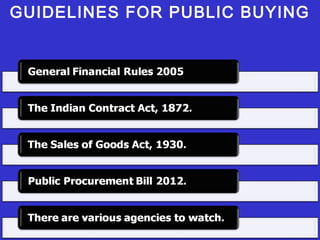
GUIDELINES FOR PUBLIC BUYING 
4
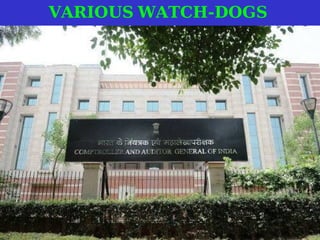
VARIOUS WATCH-DOGS
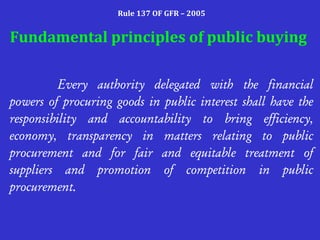
Rule 137 OF GFR – 2005 
Fundamental principles of public buying 
Every authority delegated with the financial 
powers of procuring goods in public interest shall have the 
responsibility and accountability to bring efficiency, 
economy, transparency in matters relating to public 
procurement and for fair and equitable treatment of 
suppliers and promotion of competition in public 
procurement.
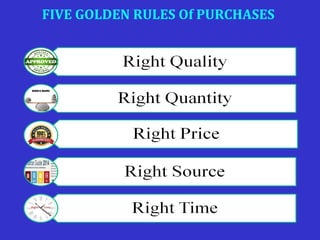
FIVE GOLDEN RULES Of PURCHASES
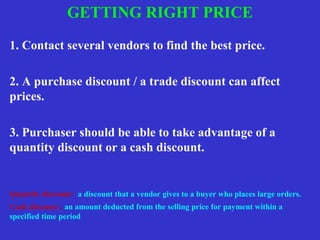
GETTING RIGHT PRICE 
1. Contact several vendors to find the best price. 
2. A purchase discount / a trade discount can affect 
prices. 
3. Purchaser should be able to take advantage of a 
quantity discount or a cash discount. 
Quantity discount: a discount that a vendor gives to a buyer who places large orders. 
Cash discount : an amount deducted from the selling price for payment within a 
specified time period
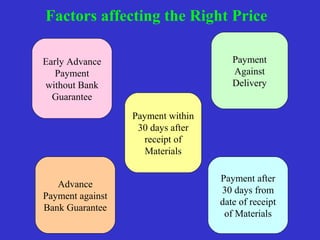
Factors affecting the Right Price 
Early Advance 
Payment 
without Bank 
Guarantee 
Advance 
Payment against 
Bank Guarantee 
Payment within 
30 days after 
receipt of 
Materials 
Payment 
Against 
Delivery 
Payment after 
30 days from 
date of receipt 
of Materials
REASONABLE PRICE 
14 
Important: 
Last purchase price of same (or in its 
absence, similar) item. 
Current Market Price of the same or 
similar item. 
Price of raw materials which goes into the 
item.
L1’s PRICE ABOVE“REASONABLE” 
15 
LIMIT 
• At first, we need to recheck the correctness of the 
estimated value. 
• If estimated price is the same then :- 
• Price negotiation with the lowest technically accepted 
tenderer. 
• Re-tender with wide publicity with same terms and 
conditions or with suitable modifications if necessary. 
• IF L1’s PRICE IS BELOW REASONABLE LIMIT, 
WHAT TO DO?
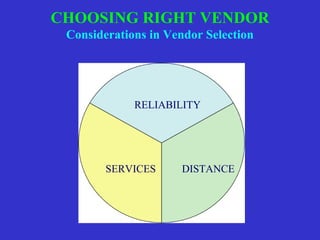
CHOOSING RIGHT VENDOR 
Considerations in Vendor Selection 
RELIABILITY 
SERVICES DISTANCE
17
STANDARD PURCHASE TERMS 
TENDER - To invite bid as per requirement or to 
accept a formal offer. QUOTATIONS – Same but for 
smaller value. 
BIDS – Same. Used when tenders are called in two 
parts - Technical bid & financial bid. 
NIT – Notice Inviting Tender through Newspapers / 
website / . 
18
STANDARD PURCHASE TERMS 
EVALUATION CRITERIA – Technical and financial 
evaluation. 
TECHNICAL BID – Technical specifications of goods / services 
in question. Technical bid also include pre-qualification 
criteria, details of quality and quantity of items to be 
purchased. Period of supply, guarantee, warranty, etc. Should 
also be included. 
FINANCIAL BID – Financial quotation stating amount for 
tender. It is also called PRICE BID. 
19
STANDARD PURCHASE TERMS 
PENALTY CLAUSE – It is also called as Liquidated 
Damages Clause. If contract is not honored then penalty 
clause to be triggered. Penalty appx. 0.5% per week max. 
5% of the contract value to be charged. 
TERMINATION OF CONTRACT – One month notice from 
both the side. 
20 
FORCE MAJEURE – Natural Calamities. 
AWARD OF CONTRACT – Issue of Purchase order / work 
order or Service Contract to the bidder.
STANDARD PURCHASE TERMS 
21 
INDENTER – Name of the Purchaser. 
EVALUATION OF BIDS – Technical and financial 
evaluation of bid for award of contract. 
LAST DATE & TIME OF RECEIPT OF TENDERS – 
Date and time after which tenders are not accepted. 
PURCHASE ORDER – Contract Agreement.
TYPES OF TENDERS 
Expression of Interest 
Public Tender 
Limited Tender 
Global Tender 
Request for Proposal (RFP) 
Request for Quotations(RFQ) 
E-tender 
Percentage Rate Tender
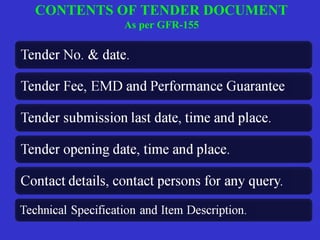
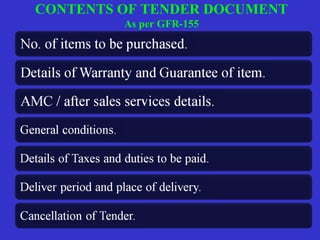
CONTENTS OF TENDER DOCUMENT 
As per GFR-155
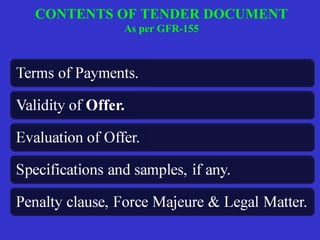
CONTENTS OF TENDER DOCUMENT 
As per GFR-155
CONTENTS OF TENDER DOCUMENT 
As per GFR-155
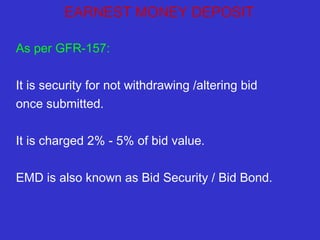
EARNEST MONEY DEPOSIT 
As per GFR-157: 
It is security for not withdrawing /altering bid 
once submitted. 
It is charged 2% - 5% of bid value. 
EMD is also known as Bid Security / Bid Bond.
PERFORMANCE SECURITY 
As per GFR-158: 
To ensure due performance of the contract, 
performance security is taken from bidders. 
It is charged 5% to 10% of Purchase Value. 
Taken in the from of DD or Performance Bank 
Guarantee. 
Validity of PBG can very for 1 to 2 years. 
32
PROCUREMENT PROCESS 
https://www.youtube.com/watch?v=aPO3fwYnaXA
TECHNICAL SPECIFICATIONS & 
STANDARDS OF ITEMS 
• Technical Specification and Standards of items 
can be done by: 
35 
 Reference sample. 
 Drawings. 
 Written technical specifications. 
In many tenders, we may have to use combination 
of two or more methods to make it more specific 
to the bidders.
QUALITY ASSURANCE 
We have to ensure that the ordered goods meets 
contract specification and quality parameters as per 
the purchase order. 
We can do following following inspections and can 
be written in tender document also such as: 
1) Factory Inspection. 
2) Pre-dispatch Inspection 
3) Final Inspection after installation. 
4) Commissioning & Acceptance at site. 
36
37 
DUTIES & TAXES 
Custom Duty: At concessional Rate – 5% of Invoice 
Value for RESEARCH ITEMS Only. 
Excise Duty : Fully exempted for all RESEARCH 
ITEMS Only. 
Octroi: 5.5%. 
Service Tax: 12.36%. But for auxiliary services, it is 
exempted. 
VAT/ CST: To be paid at actuals.
TECHNICALLY ACCEPTABLE SUPPLIER 
A supplier who fulfils following two 
criteria are technically accepted 
suppliers: 
38 
• Eligibility Criteria 
• Qualification criteria.
ELIGIBILITY CRITERIA 
• Supplier should be registered with 
Government as Company, etc, having valid 
PAN, Service Tax number, Gumasta 
Licence, authorised Indian Agent, etc. as 
per the Government norms. 
• Suitable stipulations are to be incorporated 
to ensure above norms in tender 
documents. 
• Many organisations do Vendor Registration 
to confirm above facts before hand. 
39
QUALIFICATION CRITERIA 
• The tenderer should be technically 
capable with acceptable past record and 
also financially sound to deliver the 
goods as required. 
• To ensure above, suitable stipulations to 
be incorporated accordingly in the tender 
enquiry document. 
40
LATE TENDERS 
As per GFR-153: 
In case of Advertised Tender Inquiry or Limited 
Tender Inquiry, Late Bids (i.e. Bids received after 
the specified date & time for receipt of bids) 
should NOT be considered.
Tender Opening Procedure 
Quotation / Tenders must be opened in the presence of 
three members. 
Suppliers may be allowed to attend tender opening 
meeting. 
All tenders / quotations including cover must be signed by 
all members of the committee / Indentor or their 
representative. 
All corrections, overwriting should be attested by the 
bidder and duly initialed by tender opining committee.
TENDER EVALUATION METHODS 
1. Quality and Cost Based Selection (QCBS) 
2. Quality Based Selection (QBS) 
3. Fixed Budget Selection (FBS) 
4. Least Cost selection (LCS)
TENDER EVALUATION 
R E S P O N S I V E 
T E N D E R S 
T E N D E R S E V A L U A T E D 
E Q U I T A B L E B A S I S 
44 
(Single Envelop Model) 
T E C H N I C A L L Y 
U N R E S P O N S I V E 
C O M M E R C I A L L Y 
U N R E S P O N S I V E 
T E N D E R S R E C E I V E D 
T E N D E R S O P E N E D 
B O T H 
T E C H N I C A L L Y A N D 
C O M M E R C I A L L Y 
U N R E S P O N S I V E 
T E N D E R S 
1 S T 
L O W E S T 
T E N D E R [ L 1 ] 
O N 
2 N D 
L O W E S T 
T E N D E R [ L 2 ] 
3 R D 
L O W E S T 
T E N D E R [ L 3 ] 
T E N D E R S R A N K E D 
A N D E N T E R E D 
I N T H E R A N K I N G 
S T A T E M E N T 
T E N D E R S A N A L Y S E D
45 
TENDER 
EVALUATION 
(Two Envelop Model) Technical Evaluation 
Sanction of Estimate 
Procedure of Inviting Tender 
Technical Credentials 
Project Delivery 
Validity of Tender 
Eligibility of Tenderer 
Experience and capability 
Quality & Functionality
46 
TENDER 
EVALUATION 
(Two Envelop Model) 
Commercial Evaluation 
Financial Profile 
Price 
Reasonableness of Rate
PAYMENT TERMS 
Variety of payment terms & conditions are: 
1) 100% payment after delivery & acceptance. 
2) 100% payment against delivery. 
3) Part payment in instalments. 
4) Advance payment to party. 
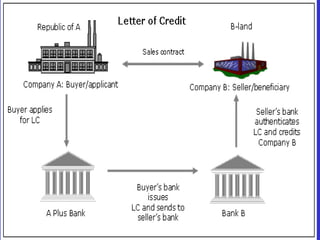
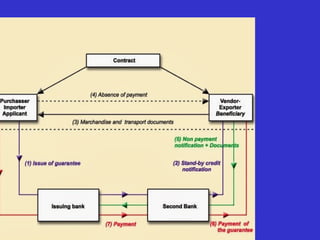
5) Payment through Letter of Credit. 
6) Wire Transfer. 
8) RTGS / NEFT payment (e-payment).
PAYMENT TO PARTY 
Difference between: 
1) Invoice. 
2) Proforma Invoice. 
3) Tax Invoice. 
4) Bill. 
5) Cash Memo. 
6) Credit Memo. 
7) Debit Note.
IMPORT PURCHASE 
TERMINOLOGIES 
49
INTERNATIONAL COMMERCIAL TERMS 
50 
(INCOTERMS) 
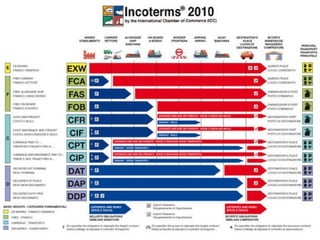
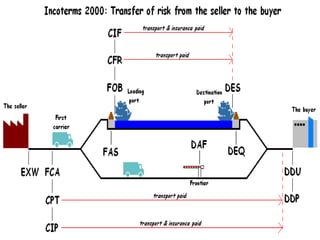
• Published by the Internal Chamber of 
Commerce, Paris. 
The purpose of INCOTERMS is to provide a 
set of International Rules dealing with the 
relations between buyers and sellers in 
foreign trade.
51
52
53
LETTER OF CREDIT 
https://www.youtube.com/watch?v=cz91gPU2bms 
54
55
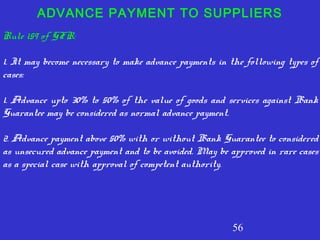
ADVANCE PAYMENT TO SUPPLIERS 
Rule 159 of GFR: 
1. It may become necessary to make advance payments in the following types of 
cases: 
1. Advance upto 30% to 50% of the value of goods and services against Bank 
Guarantee may be considered as normal advance payment. 
2. Advance payment above 50% with or without Bank Guarantee to considered 
as unsecured advance payment and to be avoided. May be approved in rare cases 
as a special case with approval of competent authority. 
56
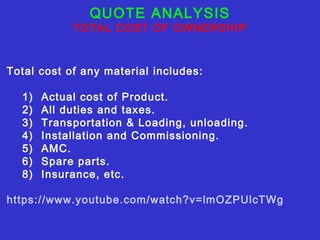
QUOTE ANALYSIS 
TOTAL COST OF OWNERSHIP 
Total cost of any material includes: 
1) Actual cost of Product. 
2) All duties and taxes. 
3) Transportation & Loading, unloading. 
4) Installation and Commissioning. 
5) AMC. 
6) Spare parts. 
8) Insurance, etc. 
https://www.youtube.com/watch?v=lmOZPUlcTWg
STANDARD PRUCHASE COMMITTEE 
REPORT 
Purchase Committee should be approved by 
Competent Authority. 
Purchase Committee should includes: 
1) Reason for acceptance of L1 or L2 as the 
case may be. 
2) Reason for rejection of Tenders in detail. 
3) Reasons for recommending purchase from 
technically qualified bidders. 
4) Any other important information to be 
documented related to said purchase.
E-PROCUREMENT 
E-procurement means purchase using network through 
software. In includes : 
1. Indent management 
2. E-Tendering 
3. E-Auctioning 
4. Vendor management 
5. Catalogue management 
6. Purchase Order Integration 
7. Order Status 
8. Ship Notice 
9. E-Invoicing, 
10. E-Payment 
11. contract management

PURCHASE PROCEDURE IN AUTONOMOUS EDUCATIONAL ORGANISATIONS

  • 1.
    PURCHASE P ROCEDURE For AUTONOMOUS EDUCATIONAL ORGANISATIONS 1
  • 2.
    What is Purchase? Purchasing also known as procurement. Means buying of all the materials, services, works needed by the organization. 2
  • 3.
    PUBLIC PROCUREMENT Whatis Public Procurement / public buying? Public buying is different from private buying in many ways. Public buying needs to be transparent and follow applicable rules, regulations and existing policies. 3
  • 4.
  • 5.
  • 10.
    Rule 137 OFGFR – 2005 Fundamental principles of public buying Every authority delegated with the financial powers of procuring goods in public interest shall have the responsibility and accountability to bring efficiency, economy, transparency in matters relating to public procurement and for fair and equitable treatment of suppliers and promotion of competition in public procurement.
  • 11.
    FIVE GOLDEN RULESOf PURCHASES
  • 12.
    GETTING RIGHT PRICE 1. Contact several vendors to find the best price. 2. A purchase discount / a trade discount can affect prices. 3. Purchaser should be able to take advantage of a quantity discount or a cash discount. Quantity discount: a discount that a vendor gives to a buyer who places large orders. Cash discount : an amount deducted from the selling price for payment within a specified time period
  • 13.
    Factors affecting theRight Price Early Advance Payment without Bank Guarantee Advance Payment against Bank Guarantee Payment within 30 days after receipt of Materials Payment Against Delivery Payment after 30 days from date of receipt of Materials
  • 14.
    REASONABLE PRICE 14 Important: Last purchase price of same (or in its absence, similar) item. Current Market Price of the same or similar item. Price of raw materials which goes into the item.
  • 15.
    L1’s PRICE ABOVE“REASONABLE” 15 LIMIT • At first, we need to recheck the correctness of the estimated value. • If estimated price is the same then :- • Price negotiation with the lowest technically accepted tenderer. • Re-tender with wide publicity with same terms and conditions or with suitable modifications if necessary. • IF L1’s PRICE IS BELOW REASONABLE LIMIT, WHAT TO DO?
  • 16.
    CHOOSING RIGHT VENDOR Considerations in Vendor Selection RELIABILITY SERVICES DISTANCE
  • 17.
  • 18.
    STANDARD PURCHASE TERMS TENDER - To invite bid as per requirement or to accept a formal offer. QUOTATIONS – Same but for smaller value. BIDS – Same. Used when tenders are called in two parts - Technical bid & financial bid. NIT – Notice Inviting Tender through Newspapers / website / . 18
  • 19.
    STANDARD PURCHASE TERMS EVALUATION CRITERIA – Technical and financial evaluation. TECHNICAL BID – Technical specifications of goods / services in question. Technical bid also include pre-qualification criteria, details of quality and quantity of items to be purchased. Period of supply, guarantee, warranty, etc. Should also be included. FINANCIAL BID – Financial quotation stating amount for tender. It is also called PRICE BID. 19
  • 20.
    STANDARD PURCHASE TERMS PENALTY CLAUSE – It is also called as Liquidated Damages Clause. If contract is not honored then penalty clause to be triggered. Penalty appx. 0.5% per week max. 5% of the contract value to be charged. TERMINATION OF CONTRACT – One month notice from both the side. 20 FORCE MAJEURE – Natural Calamities. AWARD OF CONTRACT – Issue of Purchase order / work order or Service Contract to the bidder.
  • 21.
    STANDARD PURCHASE TERMS 21 INDENTER – Name of the Purchaser. EVALUATION OF BIDS – Technical and financial evaluation of bid for award of contract. LAST DATE & TIME OF RECEIPT OF TENDERS – Date and time after which tenders are not accepted. PURCHASE ORDER – Contract Agreement.
  • 22.
    TYPES OF TENDERS Expression of Interest Public Tender Limited Tender Global Tender Request for Proposal (RFP) Request for Quotations(RFQ) E-tender Percentage Rate Tender
  • 27.
    CONTENTS OF TENDERDOCUMENT As per GFR-155
  • 28.
    CONTENTS OF TENDERDOCUMENT As per GFR-155
  • 29.
    CONTENTS OF TENDERDOCUMENT As per GFR-155
  • 31.
    EARNEST MONEY DEPOSIT As per GFR-157: It is security for not withdrawing /altering bid once submitted. It is charged 2% - 5% of bid value. EMD is also known as Bid Security / Bid Bond.
  • 32.
    PERFORMANCE SECURITY Asper GFR-158: To ensure due performance of the contract, performance security is taken from bidders. It is charged 5% to 10% of Purchase Value. Taken in the from of DD or Performance Bank Guarantee. Validity of PBG can very for 1 to 2 years. 32
  • 34.
  • 35.
    TECHNICAL SPECIFICATIONS & STANDARDS OF ITEMS • Technical Specification and Standards of items can be done by: 35  Reference sample.  Drawings.  Written technical specifications. In many tenders, we may have to use combination of two or more methods to make it more specific to the bidders.
  • 36.
    QUALITY ASSURANCE Wehave to ensure that the ordered goods meets contract specification and quality parameters as per the purchase order. We can do following following inspections and can be written in tender document also such as: 1) Factory Inspection. 2) Pre-dispatch Inspection 3) Final Inspection after installation. 4) Commissioning & Acceptance at site. 36
  • 37.
    37 DUTIES &TAXES Custom Duty: At concessional Rate – 5% of Invoice Value for RESEARCH ITEMS Only. Excise Duty : Fully exempted for all RESEARCH ITEMS Only. Octroi: 5.5%. Service Tax: 12.36%. But for auxiliary services, it is exempted. VAT/ CST: To be paid at actuals.
  • 38.
    TECHNICALLY ACCEPTABLE SUPPLIER A supplier who fulfils following two criteria are technically accepted suppliers: 38 • Eligibility Criteria • Qualification criteria.
  • 39.
    ELIGIBILITY CRITERIA •Supplier should be registered with Government as Company, etc, having valid PAN, Service Tax number, Gumasta Licence, authorised Indian Agent, etc. as per the Government norms. • Suitable stipulations are to be incorporated to ensure above norms in tender documents. • Many organisations do Vendor Registration to confirm above facts before hand. 39
  • 40.
    QUALIFICATION CRITERIA •The tenderer should be technically capable with acceptable past record and also financially sound to deliver the goods as required. • To ensure above, suitable stipulations to be incorporated accordingly in the tender enquiry document. 40
  • 41.
    LATE TENDERS Asper GFR-153: In case of Advertised Tender Inquiry or Limited Tender Inquiry, Late Bids (i.e. Bids received after the specified date & time for receipt of bids) should NOT be considered.
  • 42.
    Tender Opening Procedure Quotation / Tenders must be opened in the presence of three members. Suppliers may be allowed to attend tender opening meeting. All tenders / quotations including cover must be signed by all members of the committee / Indentor or their representative. All corrections, overwriting should be attested by the bidder and duly initialed by tender opining committee.
  • 43.
    TENDER EVALUATION METHODS 1. Quality and Cost Based Selection (QCBS) 2. Quality Based Selection (QBS) 3. Fixed Budget Selection (FBS) 4. Least Cost selection (LCS)
  • 44.
    TENDER EVALUATION RE S P O N S I V E T E N D E R S T E N D E R S E V A L U A T E D E Q U I T A B L E B A S I S 44 (Single Envelop Model) T E C H N I C A L L Y U N R E S P O N S I V E C O M M E R C I A L L Y U N R E S P O N S I V E T E N D E R S R E C E I V E D T E N D E R S O P E N E D B O T H T E C H N I C A L L Y A N D C O M M E R C I A L L Y U N R E S P O N S I V E U N R E S P O N S I V E T E N D E R S 1 S T L O W E S T T E N D E R [ L 1 ] O N 2 N D L O W E S T T E N D E R [ L 2 ] 3 R D L O W E S T T E N D E R [ L 3 ] T E N D E R S R A N K E D A N D E N T E R E D I N T H E R A N K I N G S T A T E M E N T T E N D E R S A N A L Y S E D
  • 45.
    45 TENDER EVALUATION (Two Envelop Model) Technical Evaluation Sanction of Estimate Procedure of Inviting Tender Technical Credentials Project Delivery Validity of Tender Eligibility of Tenderer Experience and capability Quality & Functionality
  • 46.
    46 TENDER EVALUATION (Two Envelop Model) Commercial Evaluation Financial Profile Price Reasonableness of Rate
  • 47.
    PAYMENT TERMS Varietyof payment terms & conditions are: 1) 100% payment after delivery & acceptance. 2) 100% payment against delivery. 3) Part payment in instalments. 4) Advance payment to party. 5) Payment through Letter of Credit. 6) Wire Transfer. 8) RTGS / NEFT payment (e-payment).
  • 48.
    PAYMENT TO PARTY Difference between: 1) Invoice. 2) Proforma Invoice. 3) Tax Invoice. 4) Bill. 5) Cash Memo. 6) Credit Memo. 7) Debit Note.
  • 49.
  • 50.
    INTERNATIONAL COMMERCIAL TERMS 50 (INCOTERMS) • Published by the Internal Chamber of Commerce, Paris. The purpose of INCOTERMS is to provide a set of International Rules dealing with the relations between buyers and sellers in foreign trade.
  • 51.
  • 52.
  • 53.
  • 54.
    LETTER OF CREDIT https://www.youtube.com/watch?v=cz91gPU2bms 54
  • 55.
  • 56.
    ADVANCE PAYMENT TOSUPPLIERS Rule 159 of GFR: 1. It may become necessary to make advance payments in the following types of cases: 1. Advance upto 30% to 50% of the value of goods and services against Bank Guarantee may be considered as normal advance payment. 2. Advance payment above 50% with or without Bank Guarantee to considered as unsecured advance payment and to be avoided. May be approved in rare cases as a special case with approval of competent authority. 56
  • 57.
    QUOTE ANALYSIS TOTALCOST OF OWNERSHIP Total cost of any material includes: 1) Actual cost of Product. 2) All duties and taxes. 3) Transportation & Loading, unloading. 4) Installation and Commissioning. 5) AMC. 6) Spare parts. 8) Insurance, etc. https://www.youtube.com/watch?v=lmOZPUlcTWg
  • 58.
    STANDARD PRUCHASE COMMITTEE REPORT Purchase Committee should be approved by Competent Authority. Purchase Committee should includes: 1) Reason for acceptance of L1 or L2 as the case may be. 2) Reason for rejection of Tenders in detail. 3) Reasons for recommending purchase from technically qualified bidders. 4) Any other important information to be documented related to said purchase.
  • 59.
    E-PROCUREMENT E-procurement meanspurchase using network through software. In includes : 1. Indent management 2. E-Tendering 3. E-Auctioning 4. Vendor management 5. Catalogue management 6. Purchase Order Integration 7. Order Status 8. Ship Notice 9. E-Invoicing, 10. E-Payment 11. contract management