
Procurement Technical
Assistance Center (PTAC)
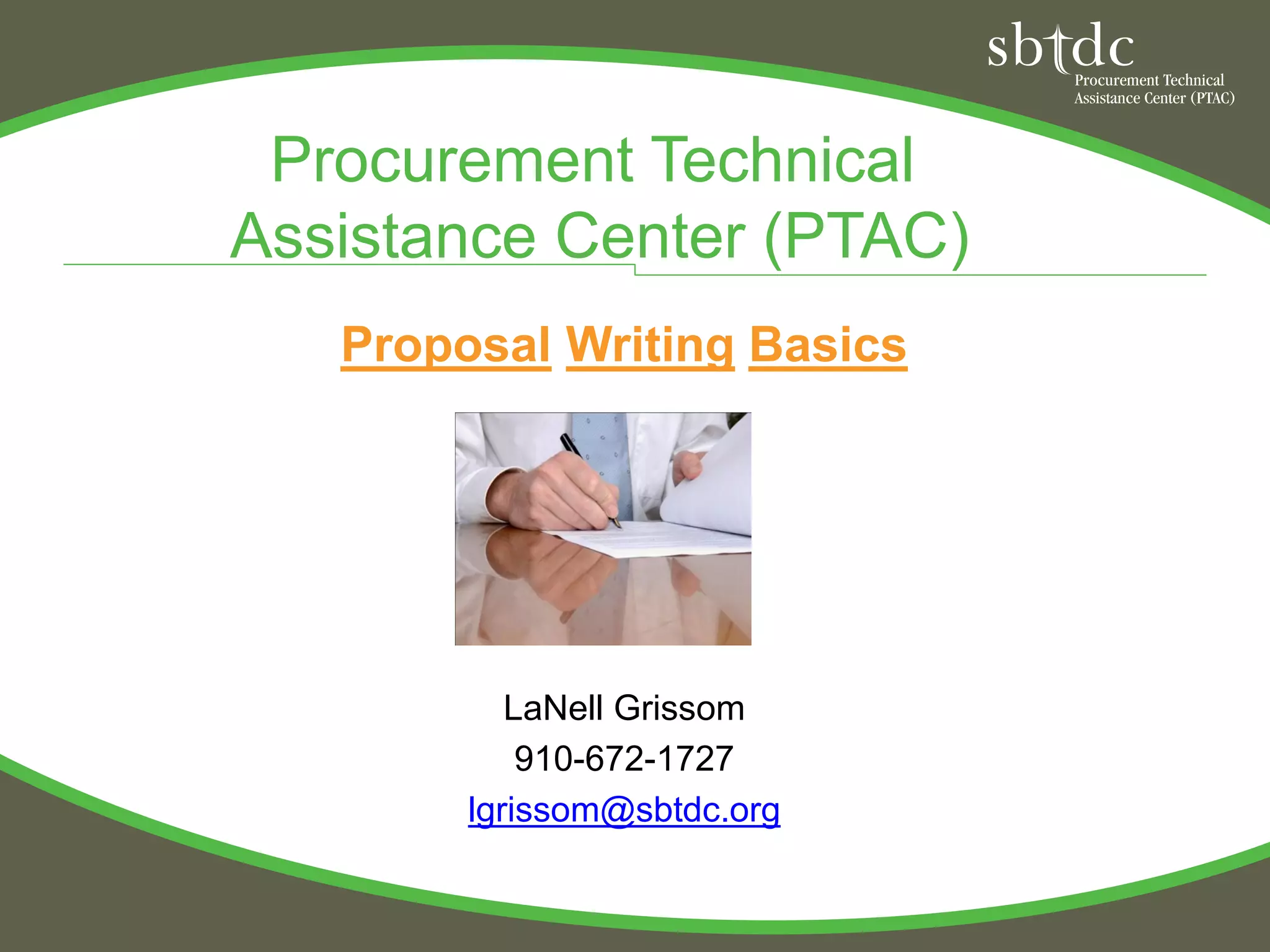
   Proposal Writing Basics


           LaNell Grissom
            910-672-1727
        lgrissom@sbtdc.org
Agenda
           Please turn all cell phones to vibrate
             Please feel free to ask questions

•   SBTDC and PTAC Services
•   Writing Proposals
•   Submission and Award
•   Final Thoughts
Small Business and Technology
         Development Center (SBTDC)
            Confidential one-on-one counseling
•   General Business Services – planning, marketing,
    financing, human resources, operations
•   Strategy and Organization Development Services
•   Export Financing Assistance
•   Technology Development and Commercialization
•   Boating Industry Services
•   Government Procurement Assistance
    – Procurement Technical Assistance Center
                         www.sbtdc.org
Procurement Technical
             Assistance Center (PTAC)
         Assistance selling to federal, state and local
                       government entities
•   Understanding government rules and regulations
•   Completing mandatory registrations and certifications
•   Researching award histories
•   Identifying contracting opportunities
•   Reviewing bids and proposals
•   Understanding Federal Supply Schedules
Getting Started
Before Submitting Response

• Determine solicitation type, procurement method, and
  contract type
• Read all solicitation documents associated with the
  opportunity
• Understand applicable Terms and Conditions
• Determine capacity for timely delivery or successful
  performance
Understanding Federal Procurement
          Public Notices
  •   Presolicitation
  •   Sources Sought
  •   Special Notices
  •   Request for Information
  •   Solicitation
      – Request for Quote
      – Request for Proposal
      – Invitation for Bids
  • Modifications
  • Award Notice
Procurement Methods & Solicitation Types

 Procurement Method          Solicitation Type
 • Simplified Acquisitions   • Request for Quotation (RFQ)

 • Formal Acquisitions       • Invitation for Bid (IFB)
                             • Request for Proposal (RFP)

 • Commercial Items          • Request for Quotation (RFQ)
                             • Request for Proposal (RFP)
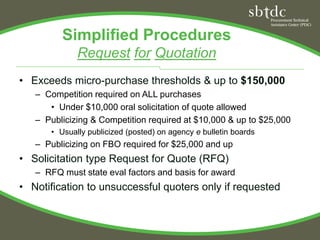
Simplified Procedures
             Request for Quotation
• Exceeds micro-purchase thresholds & up to $150,000
   – Competition required on ALL purchases
      • Under $10,000 oral solicitation of quote allowed
   – Publicizing & Competition required at $10,000 & up to $25,000
      • Usually publicized (posted) on agency e bulletin boards
   – Publicizing on FBO required for $25,000 and up
• Solicitation type Request for Quote (RFQ)
   – RFQ must state eval factors and basis for award
• Notification to unsuccessful quoters only if requested
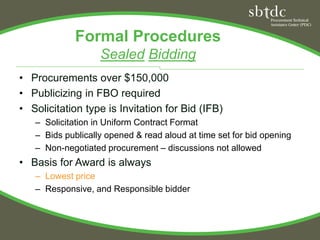
Formal Procedures
                   Sealed Bidding
• Procurements over $150,000
• Publicizing in FBO required
• Solicitation type is Invitation for Bid (IFB)
   – Solicitation in Uniform Contract Format
   – Bids publically opened & read aloud at time set for bid opening
   – Non-negotiated procurement – discussions not allowed
• Basis for Award is always
   – Lowest price
   – Responsive, and Responsible bidder
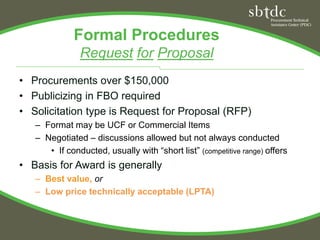
Formal Procedures
               Request for Proposal
• Procurements over $150,000
• Publicizing in FBO required
• Solicitation type is Request for Proposal (RFP)
   – Format may be UCF or Commercial Items
   – Negotiated – discussions allowed but not always conducted
      • If conducted, usually with “short list” (competitive range) offers
• Basis for Award is generally
   – Best value, or
   – Low price technically acceptable (LPTA)
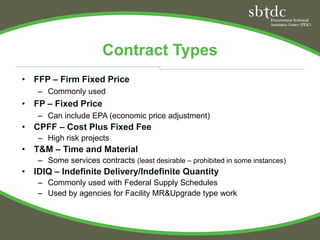
Contract Types
• FFP – Firm Fixed Price
   – Commonly used
• FP – Fixed Price
   – Can include EPA (economic price adjustment)
• CPFF – Cost Plus Fixed Fee
   – High risk projects
• T&M – Time and Material
   – Some services contracts (least desirable – prohibited in some instances)
• IDIQ – Indefinite Delivery/Indefinite Quantity
   – Commonly used with Federal Supply Schedules
   – Used by agencies for Facility MR&Upgrade type work
Solicitation Forms

• SF 1449 - more simplified format
      • RFQ (Simplified Procedures)
      • RFP (Formal Procedures – usually commercial items/svcs
• SF 33 – UCF (Uniform Contract Format)
      • Sealed Bidding
      • Negotiated Procurements
• SF 1447 – SCF (Simplified Contract Format)
      • Simplified “construction” procurements
Uniform Contract Format (UCF)
                Solicitation Parts

• PART I – The Schedule
  –   Section A – Solicitation/Contract Form
  –   Section B - Supplies/Services and Prices/Costs
  –   Section C - Description/Specifications/Statement of Work
  –   Section D - Packaging and Marking
  –   Section E - Inspection and Acceptance
  –   Section F - Deliveries or Performance
  –   Section G - Contract Administration Data
  –   Section H - Special Contract Requirements
Uniform Contract Format (UCF)
                    Solicitation Parts

• PART II – Clauses
   – Section I: Contract Clauses


• PART III – List of Documents, Exhibits, & Other Attachments
   – Section J: List of Required Attachments


• PART IV – Representations & Instructions
   – Section K: Representations, Certifications, & Other Statements
   – Section L: Instructions, Conditions, & Notices to Offerors or Quotes
   – Section M: Evaluation Factors & Basis for Award
Uniform Contract Format

• Section L: Instructions, Conditions, and Notices to Bidders
   – How to
      • Prepare,
      • Organize,
      • Format, and
      • Submit your proposal
• Section M: Evaluation Factors/Subfactors & Basis for Award
   – Criteria to measure all offers against solicitation requirements
   – Basis used to select awardee from among all evaluated offers
Determine Your Potential
              (Competiveness & Successful Performance)


• Is the opportunity consistent with your business plan?
• Do you have adequate plant capacity, equipment, and
  personnel?
• Can you beat the competition?
• Is the risk manageable?
• Can you make money?
Preparing a Response
Response Preparation
• Analyze solicitation and make working copy
   – Supporting documents (specs, drawings, SOW)
   – Amendments too!
• Research websites
   – Rules and regulations, Government language
   – Purchase and award histories
• Prepare and Compile proposal documents
   – Solicitations instructions
   – Evaluation factors & subfactors
   – Basis for Award
Analysis
• Read through solicitation again more carefully, marking
  all action items
• Note actions required to prepare the proposal and tasks
  specific to contract performance
• Identify requirements or tasks that are unclear or for
  which you need assistance
• Write all questions to submit to the contract POC
Research
                Rules and Regulations

• Federal Acquisition Regulation (FAR)
  http://farsite.hill.af.mil/ or http://www.acquisition.gov/far
• Code of Federal Regulations (CFR)
  http://www.gpoaccess.gov/cfr/
• United States Code (USC)
  http://uscode.house.gov/
• Government Acronyms
  http://usgovinfo.about.com/od/acronyms
Research
           Purchase and Award History
• Federal Acquisition Jumpstation
  http://prod.nais.nasa.gov/pub/fedproc/home.html
   – Research contracts and opportunities
• Federal Procurement Data System (FPDS)
  https://www.fpds.gov/fpdsng_cms/
   – Statistical information on federal contracting
   – Detailed data for >$25K, Summary data for <$25K
• USASpending.gov
  www.usaspending.gov
   – Pulls information from FPDS
Preparing the Proposal
• Check SAM.gov
   – Registration current (CCR)
   – Online Representations & Certifications are current (ORCA)

• Create an Action Plan and assign tasks

• Outline your proposal
   – Administrative Data
   – Technical Proposal
   – Pricing Proposal
Proposal Writing Tips
• You can never take back a first impression
• Identify company & solicitation # on each page
• Be sure the narrative description of your approach to the
  work is clear to non-techies
• Use simple, straightforward writing style
• Spell and grammar check, use page numbers
• Observe specified page limitations
• Identify each line of proprietary data
• Provide current and accurate POC information
Proposal Pricing Tips
•   Charge Enough
•   Know your competition
•   Know your costs of doing business
•   Include a reasonable profit and G&A
•   Have an accountant calculate indirect costs
•   Avoid perpetuating a losing operation
•   Clearly prove the price is fair & reasonable
•   Verify numbers
Format of the Proposal
• Follow all of the instructions and sequence given in the
  solicitation
• Focus on customer’s mission and goals, being mindful of
  evaluation factors
• Check and recheck all cost and pricing data, provide
  supporting documentation
• Provide all the required information in enough detail to
  give the customer confidence that you understand
  thoroughly.
Compiling the Proposal
• Using the tasks list or action items list, collect all the
  parts
• Arrange them in the specified sequence
• Make a Table of Contents; use divider tabs
• Make a cover page, brief cover letter or Executive
  Summary
• Conduct an "in-house" scrub down
Proposal Writing Basics
 Submission and Award
Submitting the Proposal
• Use checklists provided by the contracting agency

• Proof read the "fully compiled" proposal packet

• Sign all documents as indicated

• Submit the original and keep a copy

• Submit your proposal on time in the manner prescribed
Proposal Evaluation
• Responsive – Required documents in the required format

• Responsible – Company's qualifications and capacity

• Technically Acceptable - Product or service meets the minimum
  technical requirements of the solicitation

• Past Performance – Prior successful contract performance of similar
  size, scope, and complexity

  Competitive - “Fairness & Reasonableness” of price/cost
Win or Lose
• Ask for a Debrief

• If you win, find your weak areas for improvement

• If you did not win –
   –   Request debrief from contracting officer within 3 days
   –   Don’t be discouraged - No one wins every time
   –   Learn from the experience.
   –   Prepare for the next opportunity
Final Thoughts
•   Proactive and persistent in looking for right opportunity
•   When responding, determine if cost is worth item/service
•   Ensure all proposal documents are signed as required
•   Do not be late with your submission
•   Get everything in writing
•   Learn from your experiences
North Carolina PTAC Counselors

• Clark Fields – Asheville: 828.251.6025 or cfields@sbtdc.org

• George Griffin – Greensboro: 336.779.7339 or ggriffin@sbtdc.org

• Rebecca Barbour – Raleigh: 919-715-7373 or rbarbour@sbtdc.org

• LaNell Grissom – Fayetteville: 910-672-1727 or lgrissom@sbtdc.org

• Mark Mills – Program Director: 828-345-1115 or mmills@sbtdc.org
QUESTIONS?

Basic Proposal Writing, PTAC

  • 1.
    Procurement Technical Assistance Center(PTAC) Proposal Writing Basics LaNell Grissom 910-672-1727 lgrissom@sbtdc.org
  • 2.
    Agenda Please turn all cell phones to vibrate Please feel free to ask questions • SBTDC and PTAC Services • Writing Proposals • Submission and Award • Final Thoughts
  • 3.
    Small Business andTechnology Development Center (SBTDC) Confidential one-on-one counseling • General Business Services – planning, marketing, financing, human resources, operations • Strategy and Organization Development Services • Export Financing Assistance • Technology Development and Commercialization • Boating Industry Services • Government Procurement Assistance – Procurement Technical Assistance Center www.sbtdc.org
  • 4.
    Procurement Technical Assistance Center (PTAC) Assistance selling to federal, state and local government entities • Understanding government rules and regulations • Completing mandatory registrations and certifications • Researching award histories • Identifying contracting opportunities • Reviewing bids and proposals • Understanding Federal Supply Schedules
  • 5.
  • 6.
    Before Submitting Response •Determine solicitation type, procurement method, and contract type • Read all solicitation documents associated with the opportunity • Understand applicable Terms and Conditions • Determine capacity for timely delivery or successful performance
  • 7.
    Understanding Federal Procurement Public Notices • Presolicitation • Sources Sought • Special Notices • Request for Information • Solicitation – Request for Quote – Request for Proposal – Invitation for Bids • Modifications • Award Notice
  • 8.
    Procurement Methods &Solicitation Types Procurement Method Solicitation Type • Simplified Acquisitions • Request for Quotation (RFQ) • Formal Acquisitions • Invitation for Bid (IFB) • Request for Proposal (RFP) • Commercial Items • Request for Quotation (RFQ) • Request for Proposal (RFP)
  • 9.
    Simplified Procedures Request for Quotation • Exceeds micro-purchase thresholds & up to $150,000 – Competition required on ALL purchases • Under $10,000 oral solicitation of quote allowed – Publicizing & Competition required at $10,000 & up to $25,000 • Usually publicized (posted) on agency e bulletin boards – Publicizing on FBO required for $25,000 and up • Solicitation type Request for Quote (RFQ) – RFQ must state eval factors and basis for award • Notification to unsuccessful quoters only if requested
  • 10.
    Formal Procedures Sealed Bidding • Procurements over $150,000 • Publicizing in FBO required • Solicitation type is Invitation for Bid (IFB) – Solicitation in Uniform Contract Format – Bids publically opened & read aloud at time set for bid opening – Non-negotiated procurement – discussions not allowed • Basis for Award is always – Lowest price – Responsive, and Responsible bidder
  • 11.
    Formal Procedures Request for Proposal • Procurements over $150,000 • Publicizing in FBO required • Solicitation type is Request for Proposal (RFP) – Format may be UCF or Commercial Items – Negotiated – discussions allowed but not always conducted • If conducted, usually with “short list” (competitive range) offers • Basis for Award is generally – Best value, or – Low price technically acceptable (LPTA)
  • 12.
    Contract Types • FFP– Firm Fixed Price – Commonly used • FP – Fixed Price – Can include EPA (economic price adjustment) • CPFF – Cost Plus Fixed Fee – High risk projects • T&M – Time and Material – Some services contracts (least desirable – prohibited in some instances) • IDIQ – Indefinite Delivery/Indefinite Quantity – Commonly used with Federal Supply Schedules – Used by agencies for Facility MR&Upgrade type work
  • 13.
    Solicitation Forms • SF1449 - more simplified format • RFQ (Simplified Procedures) • RFP (Formal Procedures – usually commercial items/svcs • SF 33 – UCF (Uniform Contract Format) • Sealed Bidding • Negotiated Procurements • SF 1447 – SCF (Simplified Contract Format) • Simplified “construction” procurements
  • 14.
    Uniform Contract Format(UCF) Solicitation Parts • PART I – The Schedule – Section A – Solicitation/Contract Form – Section B - Supplies/Services and Prices/Costs – Section C - Description/Specifications/Statement of Work – Section D - Packaging and Marking – Section E - Inspection and Acceptance – Section F - Deliveries or Performance – Section G - Contract Administration Data – Section H - Special Contract Requirements
  • 15.
    Uniform Contract Format(UCF) Solicitation Parts • PART II – Clauses – Section I: Contract Clauses • PART III – List of Documents, Exhibits, & Other Attachments – Section J: List of Required Attachments • PART IV – Representations & Instructions – Section K: Representations, Certifications, & Other Statements – Section L: Instructions, Conditions, & Notices to Offerors or Quotes – Section M: Evaluation Factors & Basis for Award
  • 16.
    Uniform Contract Format •Section L: Instructions, Conditions, and Notices to Bidders – How to • Prepare, • Organize, • Format, and • Submit your proposal • Section M: Evaluation Factors/Subfactors & Basis for Award – Criteria to measure all offers against solicitation requirements – Basis used to select awardee from among all evaluated offers
  • 17.
    Determine Your Potential (Competiveness & Successful Performance) • Is the opportunity consistent with your business plan? • Do you have adequate plant capacity, equipment, and personnel? • Can you beat the competition? • Is the risk manageable? • Can you make money?
  • 18.
  • 19.
    Response Preparation • Analyzesolicitation and make working copy – Supporting documents (specs, drawings, SOW) – Amendments too! • Research websites – Rules and regulations, Government language – Purchase and award histories • Prepare and Compile proposal documents – Solicitations instructions – Evaluation factors & subfactors – Basis for Award
  • 20.
    Analysis • Read throughsolicitation again more carefully, marking all action items • Note actions required to prepare the proposal and tasks specific to contract performance • Identify requirements or tasks that are unclear or for which you need assistance • Write all questions to submit to the contract POC
  • 21.
    Research Rules and Regulations • Federal Acquisition Regulation (FAR) http://farsite.hill.af.mil/ or http://www.acquisition.gov/far • Code of Federal Regulations (CFR) http://www.gpoaccess.gov/cfr/ • United States Code (USC) http://uscode.house.gov/ • Government Acronyms http://usgovinfo.about.com/od/acronyms
  • 22.
    Research Purchase and Award History • Federal Acquisition Jumpstation http://prod.nais.nasa.gov/pub/fedproc/home.html – Research contracts and opportunities • Federal Procurement Data System (FPDS) https://www.fpds.gov/fpdsng_cms/ – Statistical information on federal contracting – Detailed data for >$25K, Summary data for <$25K • USASpending.gov www.usaspending.gov – Pulls information from FPDS
  • 23.
    Preparing the Proposal •Check SAM.gov – Registration current (CCR) – Online Representations & Certifications are current (ORCA) • Create an Action Plan and assign tasks • Outline your proposal – Administrative Data – Technical Proposal – Pricing Proposal
  • 24.
    Proposal Writing Tips •You can never take back a first impression • Identify company & solicitation # on each page • Be sure the narrative description of your approach to the work is clear to non-techies • Use simple, straightforward writing style • Spell and grammar check, use page numbers • Observe specified page limitations • Identify each line of proprietary data • Provide current and accurate POC information
  • 25.
    Proposal Pricing Tips • Charge Enough • Know your competition • Know your costs of doing business • Include a reasonable profit and G&A • Have an accountant calculate indirect costs • Avoid perpetuating a losing operation • Clearly prove the price is fair & reasonable • Verify numbers
  • 26.
    Format of theProposal • Follow all of the instructions and sequence given in the solicitation • Focus on customer’s mission and goals, being mindful of evaluation factors • Check and recheck all cost and pricing data, provide supporting documentation • Provide all the required information in enough detail to give the customer confidence that you understand thoroughly.
  • 27.
    Compiling the Proposal •Using the tasks list or action items list, collect all the parts • Arrange them in the specified sequence • Make a Table of Contents; use divider tabs • Make a cover page, brief cover letter or Executive Summary • Conduct an "in-house" scrub down
  • 28.
    Proposal Writing Basics Submission and Award
  • 29.
    Submitting the Proposal •Use checklists provided by the contracting agency • Proof read the "fully compiled" proposal packet • Sign all documents as indicated • Submit the original and keep a copy • Submit your proposal on time in the manner prescribed
  • 30.
    Proposal Evaluation • Responsive– Required documents in the required format • Responsible – Company's qualifications and capacity • Technically Acceptable - Product or service meets the minimum technical requirements of the solicitation • Past Performance – Prior successful contract performance of similar size, scope, and complexity Competitive - “Fairness & Reasonableness” of price/cost
  • 31.
    Win or Lose •Ask for a Debrief • If you win, find your weak areas for improvement • If you did not win – – Request debrief from contracting officer within 3 days – Don’t be discouraged - No one wins every time – Learn from the experience. – Prepare for the next opportunity
  • 32.
    Final Thoughts • Proactive and persistent in looking for right opportunity • When responding, determine if cost is worth item/service • Ensure all proposal documents are signed as required • Do not be late with your submission • Get everything in writing • Learn from your experiences
  • 33.
    North Carolina PTACCounselors • Clark Fields – Asheville: 828.251.6025 or cfields@sbtdc.org • George Griffin – Greensboro: 336.779.7339 or ggriffin@sbtdc.org • Rebecca Barbour – Raleigh: 919-715-7373 or rbarbour@sbtdc.org • LaNell Grissom – Fayetteville: 910-672-1727 or lgrissom@sbtdc.org • Mark Mills – Program Director: 828-345-1115 or mmills@sbtdc.org
  • 34.