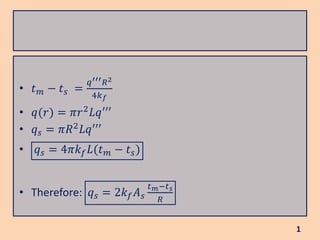
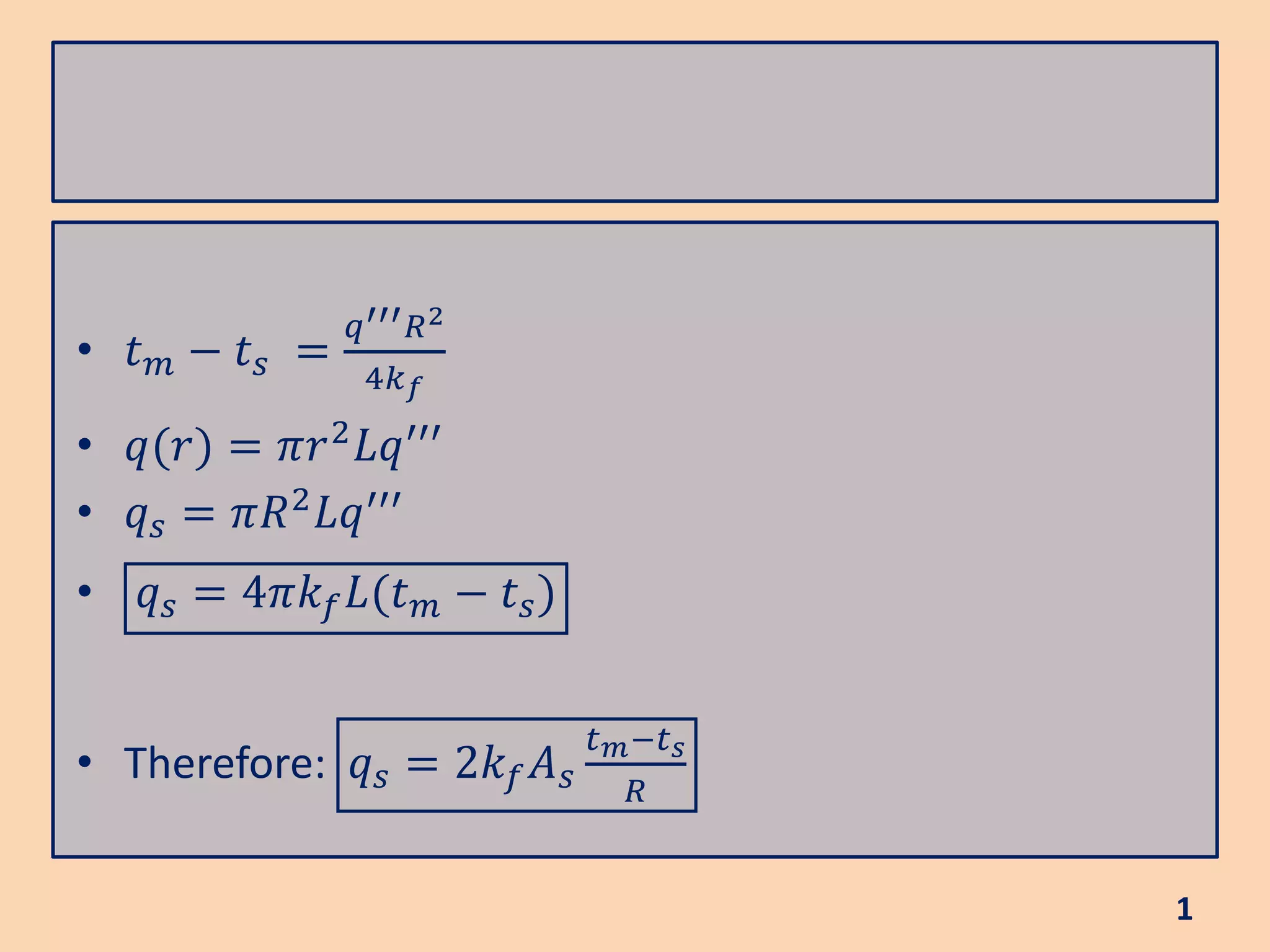
• 𝑡𝑚 − 𝑡𝑠 =
𝑞′′′𝑅2
4𝑘𝑓
• 𝑞(𝑟) = 𝜋𝑟2
𝐿𝑞′′′
• 𝑞𝑠 = 𝜋𝑅2𝐿𝑞′′′
• 𝑞𝑠 = 4𝜋𝑘𝑓𝐿(𝑡𝑚 − 𝑡𝑠)
• Therefore: 𝑞𝑠 = 2𝑘𝑓𝐴𝑠
𝑡𝑚−𝑡𝑠
𝑅
1
Syed Muhammad Haris
Chapter 5
Lecture 2
Heat Flow out of Solid-Plate-Type Fuel
Element
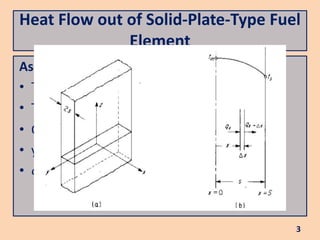
Assumptions:
• Thin, Bare and Plate-type fuel element
• Thermal Conductivity 𝑘𝑓
• Cross-Sectional Area = Constant
• y and z dimension → infinity
• 𝜙 𝑎𝑛𝑑 𝑞′′′
= Constant
3
Heat Flow out of Solid-Plate-Type Fuel
Element (Contd.)
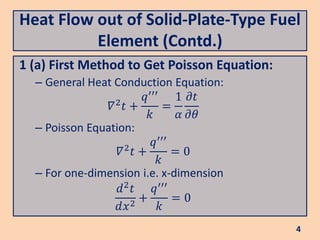
1 (a) First Method to Get Poisson Equation:
– General Heat Conduction Equation:
𝛻2𝑡 +
𝑞′′′
𝑘
=
1
𝛼
𝜕𝑡
𝜕𝜃
– Poisson Equation:
𝛻2𝑡 +
𝑞′′′
𝑘
= 0
– For one-dimension i.e. x-dimension
𝑑2
𝑡
𝑑𝑥2
+
𝑞′′′
𝑘
= 0
4
Heat Flow out of Solid-Plate-Type Fuel
Element (Contd.)
1 (b) Second Method to Get Poisson
Equation:
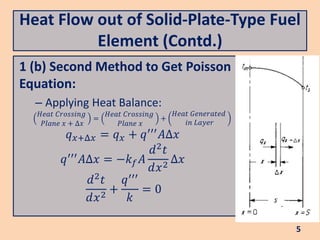
– Applying Heat Balance:
𝐻𝑒𝑎𝑡 𝐶𝑟𝑜𝑠𝑠𝑖𝑛𝑔
𝑃𝑙𝑎𝑛𝑒 𝑥 + Δ𝑥
=
𝐻𝑒𝑎𝑡 𝐶𝑟𝑜𝑠𝑠𝑖𝑛𝑔
𝑃𝑙𝑎𝑛𝑒 𝑥
+
𝐻𝑒𝑎𝑡 𝐺𝑒𝑛𝑒𝑟𝑎𝑡𝑒𝑑
𝑖𝑛 𝐿𝑎𝑦𝑒𝑟
𝑞𝑥+Δ𝑥 = 𝑞𝑥 + 𝑞′′′
𝐴Δ𝑥
𝑞′′′𝐴Δ𝑥 = −𝑘𝑓𝐴
𝑑2𝑡
𝑑𝑥2
Δ𝑥
𝑑2𝑡
𝑑𝑥2
+
𝑞′′′
𝑘
= 0
5
Heat Flow out of Solid-Plate-Type Fuel
Element (Contd.)
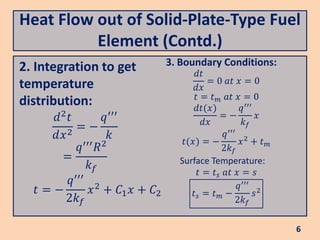
2. Integration to get
temperature
distribution:
𝑑2𝑡
𝑑𝑥2
= −
𝑞′′′
𝑘
=
𝑞′′′𝑅2
𝑘𝑓
𝑡 = −
𝑞′′′
2𝑘𝑓
𝑥2
+ 𝐶1𝑥 + 𝐶2
6
3. Boundary Conditions:
𝑑𝑡
𝑑𝑥
= 0 𝑎𝑡 𝑥 = 0
𝑡 = 𝑡𝑚 𝑎𝑡 𝑥 = 0
𝑑𝑡(𝑥)
𝑑𝑥
= −
𝑞′′′
𝑘𝑓
𝑥
𝑡(𝑥) = −
𝑞′′′
2𝑘𝑓
𝑥2 + 𝑡𝑚
Surface Temperature:
𝑡 = 𝑡𝑠 𝑎𝑡 𝑥 = 𝑠
𝑡𝑠 = 𝑡𝑚 −
𝑞′′′
2𝑘𝑓
𝑠2
Heat Flow out of Solid-Plate-Type Fuel
Element (Contd.)
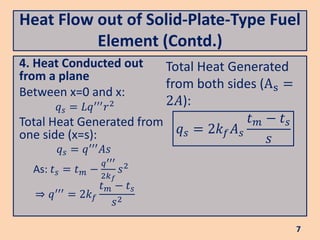
4. Heat Conducted out
from a plane
Between x=0 and x:
𝑞𝑠 = 𝐿𝑞′′′
𝑟2
Total Heat Generated from
one side (x=s):
𝑞𝑠 = 𝑞′′′
𝐴𝑠
As: 𝑡𝑠 = 𝑡𝑚 −
𝑞′′′
2𝑘𝑓
𝑠2
⇒ 𝑞′′′ = 2𝑘𝑓
𝑡𝑚 − 𝑡𝑠
𝑠2
7
Total Heat Generated
from both sides (As =
2𝐴):
𝑞𝑠 = 2𝑘𝑓𝐴𝑠
𝑡𝑚 − 𝑡𝑠
𝑠
Heat Flow out of Solid-Plate-Type Fuel
Element With Clad
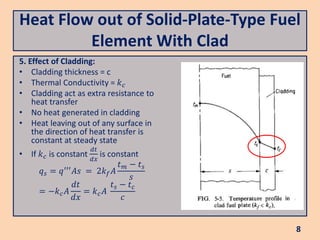
5. Effect of Cladding:
• Cladding thickness = c
• Thermal Conductivity = 𝑘𝑐
• Cladding act as extra resistance to
heat transfer
• No heat generated in cladding
• Heat leaving out of any surface in
the direction of heat transfer is
constant at steady state
• If 𝑘𝑐 is constant
𝑑𝑡
𝑑𝑥
is constant
𝑞𝑠 = 𝑞′′′𝐴𝑠 = 2𝑘𝑓𝐴
𝑡𝑚 − 𝑡𝑠
𝑠
= −𝑘𝑐𝐴
𝑑𝑡
𝑑𝑥
= 𝑘𝑐𝐴
𝑡𝑠 − 𝑡𝑐
𝑐
8
Heat Flow out of Solid-Plate-Type Fuel
Element With Clad (Contd.)
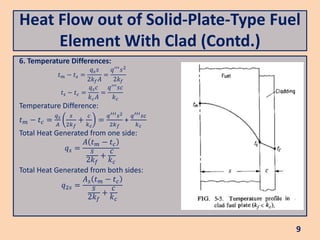
6. Temperature Differences:
𝑡𝑚 − 𝑡𝑠 =
𝑞𝑠𝑠
2𝑘𝑓𝐴
=
𝑞′′′
𝑠2
2𝑘𝑓
𝑡𝑠 − 𝑡𝑐 =
𝑞𝑠𝑐
𝑘𝑐𝐴
=
𝑞′′′
𝑠𝑐
𝑘𝑐
Temperature Difference:
𝑡𝑚 − 𝑡𝑐 =
𝑞𝑠
𝐴
𝑠
2𝑘𝑓
+
𝑐
𝑘𝑐
=
𝑞′′′𝑠2
2𝑘𝑓
+
𝑞′′′𝑠𝑐
𝑘𝑐
Total Heat Generated from one side:
𝑞𝑠 =
𝐴 𝑡𝑚 − 𝑡𝑐
𝑠
2𝑘𝑓
+
𝑐
𝑘𝑐
Total Heat Generated from both sides:
𝑞2𝑠 =
𝐴𝑠 𝑡𝑚 − 𝑡𝑐
𝑠
2𝑘𝑓
+
𝑐
𝑘𝑐
9
Heat Flow out of Solid-Plate-Type Fuel
Element With Clad and Coolant
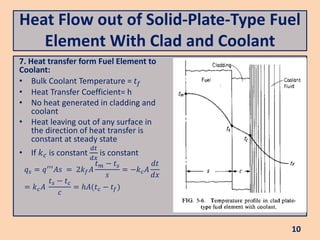
7. Heat transfer form Fuel Element to
Coolant:
• Bulk Coolant Temperature = 𝑡𝑓
• Heat Transfer Coefficient= h
• No heat generated in cladding and
coolant
• Heat leaving out of any surface in
the direction of heat transfer is
constant at steady state
• If 𝑘𝑐 is constant
𝑑𝑡
𝑑𝑥
is constant
𝑞𝑠 = 𝑞′′′𝐴𝑠 = 2𝑘𝑓𝐴
𝑡𝑚 − 𝑡𝑠
𝑠
= −𝑘𝑐𝐴
𝑑𝑡
𝑑𝑥
= 𝑘𝑐𝐴
𝑡𝑠 − 𝑡𝑐
𝑐
= ℎ𝐴(𝑡𝑐 − 𝑡𝑓)
10
Heat Flow out of Solid-Plate-Type Fuel
Element With Clad (Contd.)
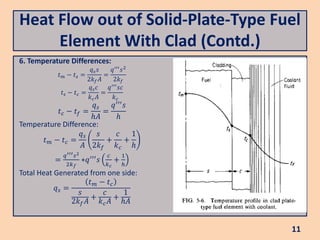
6. Temperature Differences:
𝑡𝑚 − 𝑡𝑠 =
𝑞𝑠𝑠
2𝑘𝑓𝐴
=
𝑞′′′
𝑠2
2𝑘𝑓
𝑡𝑠 − 𝑡𝑐 =
𝑞𝑠𝑐
𝑘𝑐𝐴
=
𝑞′′′
𝑠𝑐
𝑘𝑐
𝑡𝑐 − 𝑡𝑓 =
𝑞𝑠
ℎ𝐴
=
𝑞′′′
𝑠
ℎ
Temperature Difference:
𝑡𝑚 − 𝑡𝑐 =
𝑞𝑠
𝐴
𝑠
2𝑘𝑓
+
𝑐
𝑘𝑐
+
1
ℎ
=
𝑞′′′𝑠2
2𝑘𝑓
+𝑞′′′
𝑠
𝑐
𝑘𝑐
+
1
ℎ
Total Heat Generated from one side:
𝑞𝑠 =
𝑡𝑚 − 𝑡𝑐
𝑠
2𝑘𝑓𝐴
+
𝑐
𝑘𝑐𝐴
+
1
ℎ𝐴
11

heat transfer equation.pptx

  • 1.
    • 𝑡𝑚 −𝑡𝑠 = 𝑞′′′𝑅2 4𝑘𝑓 • 𝑞(𝑟) = 𝜋𝑟2 𝐿𝑞′′′ • 𝑞𝑠 = 𝜋𝑅2𝐿𝑞′′′ • 𝑞𝑠 = 4𝜋𝑘𝑓𝐿(𝑡𝑚 − 𝑡𝑠) • Therefore: 𝑞𝑠 = 2𝑘𝑓𝐴𝑠 𝑡𝑚−𝑡𝑠 𝑅 1
  • 2.
  • 3.
    Heat Flow outof Solid-Plate-Type Fuel Element Assumptions: • Thin, Bare and Plate-type fuel element • Thermal Conductivity 𝑘𝑓 • Cross-Sectional Area = Constant • y and z dimension → infinity • 𝜙 𝑎𝑛𝑑 𝑞′′′ = Constant 3
  • 4.
    Heat Flow outof Solid-Plate-Type Fuel Element (Contd.) 1 (a) First Method to Get Poisson Equation: – General Heat Conduction Equation: 𝛻2𝑡 + 𝑞′′′ 𝑘 = 1 𝛼 𝜕𝑡 𝜕𝜃 – Poisson Equation: 𝛻2𝑡 + 𝑞′′′ 𝑘 = 0 – For one-dimension i.e. x-dimension 𝑑2 𝑡 𝑑𝑥2 + 𝑞′′′ 𝑘 = 0 4
  • 5.
    Heat Flow outof Solid-Plate-Type Fuel Element (Contd.) 1 (b) Second Method to Get Poisson Equation: – Applying Heat Balance: 𝐻𝑒𝑎𝑡 𝐶𝑟𝑜𝑠𝑠𝑖𝑛𝑔 𝑃𝑙𝑎𝑛𝑒 𝑥 + Δ𝑥 = 𝐻𝑒𝑎𝑡 𝐶𝑟𝑜𝑠𝑠𝑖𝑛𝑔 𝑃𝑙𝑎𝑛𝑒 𝑥 + 𝐻𝑒𝑎𝑡 𝐺𝑒𝑛𝑒𝑟𝑎𝑡𝑒𝑑 𝑖𝑛 𝐿𝑎𝑦𝑒𝑟 𝑞𝑥+Δ𝑥 = 𝑞𝑥 + 𝑞′′′ 𝐴Δ𝑥 𝑞′′′𝐴Δ𝑥 = −𝑘𝑓𝐴 𝑑2𝑡 𝑑𝑥2 Δ𝑥 𝑑2𝑡 𝑑𝑥2 + 𝑞′′′ 𝑘 = 0 5
  • 6.
    Heat Flow outof Solid-Plate-Type Fuel Element (Contd.) 2. Integration to get temperature distribution: 𝑑2𝑡 𝑑𝑥2 = − 𝑞′′′ 𝑘 = 𝑞′′′𝑅2 𝑘𝑓 𝑡 = − 𝑞′′′ 2𝑘𝑓 𝑥2 + 𝐶1𝑥 + 𝐶2 6 3. Boundary Conditions: 𝑑𝑡 𝑑𝑥 = 0 𝑎𝑡 𝑥 = 0 𝑡 = 𝑡𝑚 𝑎𝑡 𝑥 = 0 𝑑𝑡(𝑥) 𝑑𝑥 = − 𝑞′′′ 𝑘𝑓 𝑥 𝑡(𝑥) = − 𝑞′′′ 2𝑘𝑓 𝑥2 + 𝑡𝑚 Surface Temperature: 𝑡 = 𝑡𝑠 𝑎𝑡 𝑥 = 𝑠 𝑡𝑠 = 𝑡𝑚 − 𝑞′′′ 2𝑘𝑓 𝑠2
  • 7.
    Heat Flow outof Solid-Plate-Type Fuel Element (Contd.) 4. Heat Conducted out from a plane Between x=0 and x: 𝑞𝑠 = 𝐿𝑞′′′ 𝑟2 Total Heat Generated from one side (x=s): 𝑞𝑠 = 𝑞′′′ 𝐴𝑠 As: 𝑡𝑠 = 𝑡𝑚 − 𝑞′′′ 2𝑘𝑓 𝑠2 ⇒ 𝑞′′′ = 2𝑘𝑓 𝑡𝑚 − 𝑡𝑠 𝑠2 7 Total Heat Generated from both sides (As = 2𝐴): 𝑞𝑠 = 2𝑘𝑓𝐴𝑠 𝑡𝑚 − 𝑡𝑠 𝑠
  • 8.
    Heat Flow outof Solid-Plate-Type Fuel Element With Clad 5. Effect of Cladding: • Cladding thickness = c • Thermal Conductivity = 𝑘𝑐 • Cladding act as extra resistance to heat transfer • No heat generated in cladding • Heat leaving out of any surface in the direction of heat transfer is constant at steady state • If 𝑘𝑐 is constant 𝑑𝑡 𝑑𝑥 is constant 𝑞𝑠 = 𝑞′′′𝐴𝑠 = 2𝑘𝑓𝐴 𝑡𝑚 − 𝑡𝑠 𝑠 = −𝑘𝑐𝐴 𝑑𝑡 𝑑𝑥 = 𝑘𝑐𝐴 𝑡𝑠 − 𝑡𝑐 𝑐 8
  • 9.
    Heat Flow outof Solid-Plate-Type Fuel Element With Clad (Contd.) 6. Temperature Differences: 𝑡𝑚 − 𝑡𝑠 = 𝑞𝑠𝑠 2𝑘𝑓𝐴 = 𝑞′′′ 𝑠2 2𝑘𝑓 𝑡𝑠 − 𝑡𝑐 = 𝑞𝑠𝑐 𝑘𝑐𝐴 = 𝑞′′′ 𝑠𝑐 𝑘𝑐 Temperature Difference: 𝑡𝑚 − 𝑡𝑐 = 𝑞𝑠 𝐴 𝑠 2𝑘𝑓 + 𝑐 𝑘𝑐 = 𝑞′′′𝑠2 2𝑘𝑓 + 𝑞′′′𝑠𝑐 𝑘𝑐 Total Heat Generated from one side: 𝑞𝑠 = 𝐴 𝑡𝑚 − 𝑡𝑐 𝑠 2𝑘𝑓 + 𝑐 𝑘𝑐 Total Heat Generated from both sides: 𝑞2𝑠 = 𝐴𝑠 𝑡𝑚 − 𝑡𝑐 𝑠 2𝑘𝑓 + 𝑐 𝑘𝑐 9
  • 10.
    Heat Flow outof Solid-Plate-Type Fuel Element With Clad and Coolant 7. Heat transfer form Fuel Element to Coolant: • Bulk Coolant Temperature = 𝑡𝑓 • Heat Transfer Coefficient= h • No heat generated in cladding and coolant • Heat leaving out of any surface in the direction of heat transfer is constant at steady state • If 𝑘𝑐 is constant 𝑑𝑡 𝑑𝑥 is constant 𝑞𝑠 = 𝑞′′′𝐴𝑠 = 2𝑘𝑓𝐴 𝑡𝑚 − 𝑡𝑠 𝑠 = −𝑘𝑐𝐴 𝑑𝑡 𝑑𝑥 = 𝑘𝑐𝐴 𝑡𝑠 − 𝑡𝑐 𝑐 = ℎ𝐴(𝑡𝑐 − 𝑡𝑓) 10
  • 11.
    Heat Flow outof Solid-Plate-Type Fuel Element With Clad (Contd.) 6. Temperature Differences: 𝑡𝑚 − 𝑡𝑠 = 𝑞𝑠𝑠 2𝑘𝑓𝐴 = 𝑞′′′ 𝑠2 2𝑘𝑓 𝑡𝑠 − 𝑡𝑐 = 𝑞𝑠𝑐 𝑘𝑐𝐴 = 𝑞′′′ 𝑠𝑐 𝑘𝑐 𝑡𝑐 − 𝑡𝑓 = 𝑞𝑠 ℎ𝐴 = 𝑞′′′ 𝑠 ℎ Temperature Difference: 𝑡𝑚 − 𝑡𝑐 = 𝑞𝑠 𝐴 𝑠 2𝑘𝑓 + 𝑐 𝑘𝑐 + 1 ℎ = 𝑞′′′𝑠2 2𝑘𝑓 +𝑞′′′ 𝑠 𝑐 𝑘𝑐 + 1 ℎ Total Heat Generated from one side: 𝑞𝑠 = 𝑡𝑚 − 𝑡𝑐 𝑠 2𝑘𝑓𝐴 + 𝑐 𝑘𝑐𝐴 + 1 ℎ𝐴 11