Iodometric &
Iodimetric
Titration
CONTENT
• Titration
• Types of Titration
• Redox titration
• Iodometry
• Iodimetry
• Difference between
iodometric and iodimetric
titration
• Analytical applications
on Idometric and
Iodimetric titration
• Conclusion
Titration
A titration is technique where a solution of known concentration
is used to determine the concentration of unknown solution.
A solution whose concentration is known is called as
standard solution
The solution whose concentration is unknown is called as
sample solution
Types of Titration
• Acid-base titration
• Redox titration
• Gas-phase titration
• Complexometric titration
• Zeta potential titration
• Assay
Redox titration
A redox reaction involves an oxidation and reduction reaction between the analyte
and the titrant.
There are a lot of redox titrations classified according to the titrant used:
1) Permanganimetric: Titrant KMnO4
2) Dichromatometric: Titrant K2Cr2O7
3) Titrations involving iodine (I2)
• Iodimetry
• Iodometry
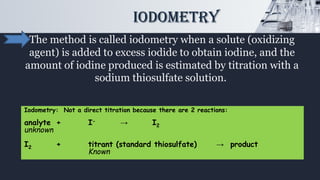
IODOMETRY
Iodometry: Not a direct titration because there are 2 reactions:
analyte + I- → I2
unknown
I2 + titrant (standard thiosulfate) → product
Known
The method is called iodometry when a solute (oxidizing
agent) is added to excess iodide to obtain iodine, and the
amount of iodine produced is estimated by titration with a
sodium thiosulfate solution.
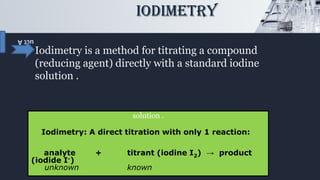
Iodimetry
Prod
uct
A
solution .
Iodimetry: A direct titration with only 1 reaction:
analyte + titrant (iodine I2) → product
(iodide I-)
unknown known
Iodimetry is a method for titrating a compound
(reducing agent) directly with a standard iodine
solution .
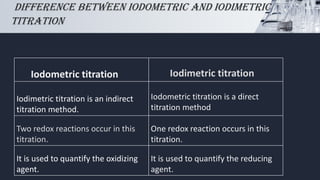
Difference between iodometric and iodimetric
titration
Iodometric titration Iodimetric titration
Iodimetric titration is an indirect
titration method.
Iodometric titration is a direct
titration method.
Two redox reactions occur in this
titration.
One redox reaction occurs in this
titration.
It is used to quantify the oxidizing
agent.
It is used to quantify the reducing
agent.
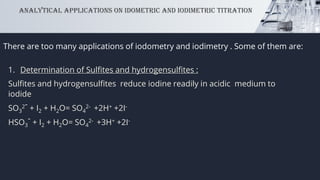
Analytical applications on Idometric and Iodimetric titration
There are too many applications of iodometry and iodimetry . Some of them are:
1. Determination of Sulfites and hydrogensulfites :
Sulfites and hydrogensulfites reduce iodine readily in acidic medium to
iodide
SO3
2- + I2 + H2O= SO4
2- +2H+ +2I-
HSO3
- + I2 + H2O= SO4
2- +3H+ +2I-
2.Determination of Sulfides and hydrogensulfides :
The excess arsenic trioxide is then determined by titrating against standard
iodine solution using starch indicator
As2O3 + 3H2S=As2S3 + 3H2O
Analytical applications on Idometric and Iodimetric titration
Conclusion
Although the names iodometry and iodimetry seem
similar, they represent two distinct analytical chemistry
methods. The main distinction between iodometry and
iodimetry is that iodometry may be used to measure oxidising
agents whereas iodimetry can be used to measure reducing
agents.
THANK YOU

Iodometric and iodimetric Titration

  • 1.
  • 2.
    CONTENT • Titration • Typesof Titration • Redox titration • Iodometry • Iodimetry • Difference between iodometric and iodimetric titration • Analytical applications on Idometric and Iodimetric titration • Conclusion
  • 3.
    Titration A titration istechnique where a solution of known concentration is used to determine the concentration of unknown solution. A solution whose concentration is known is called as standard solution The solution whose concentration is unknown is called as sample solution
  • 4.
    Types of Titration •Acid-base titration • Redox titration • Gas-phase titration • Complexometric titration • Zeta potential titration • Assay
  • 5.
    Redox titration A redoxreaction involves an oxidation and reduction reaction between the analyte and the titrant. There are a lot of redox titrations classified according to the titrant used: 1) Permanganimetric: Titrant KMnO4 2) Dichromatometric: Titrant K2Cr2O7 3) Titrations involving iodine (I2) • Iodimetry • Iodometry
  • 6.
    IODOMETRY Iodometry: Not adirect titration because there are 2 reactions: analyte + I- → I2 unknown I2 + titrant (standard thiosulfate) → product Known The method is called iodometry when a solute (oxidizing agent) is added to excess iodide to obtain iodine, and the amount of iodine produced is estimated by titration with a sodium thiosulfate solution.
  • 7.
    Iodimetry Prod uct A solution . Iodimetry: Adirect titration with only 1 reaction: analyte + titrant (iodine I2) → product (iodide I-) unknown known Iodimetry is a method for titrating a compound (reducing agent) directly with a standard iodine solution .
  • 8.
    Difference between iodometricand iodimetric titration Iodometric titration Iodimetric titration Iodimetric titration is an indirect titration method. Iodometric titration is a direct titration method. Two redox reactions occur in this titration. One redox reaction occurs in this titration. It is used to quantify the oxidizing agent. It is used to quantify the reducing agent.
  • 9.
    Analytical applications onIdometric and Iodimetric titration There are too many applications of iodometry and iodimetry . Some of them are: 1. Determination of Sulfites and hydrogensulfites : Sulfites and hydrogensulfites reduce iodine readily in acidic medium to iodide SO3 2- + I2 + H2O= SO4 2- +2H+ +2I- HSO3 - + I2 + H2O= SO4 2- +3H+ +2I-
  • 10.
    2.Determination of Sulfidesand hydrogensulfides : The excess arsenic trioxide is then determined by titrating against standard iodine solution using starch indicator As2O3 + 3H2S=As2S3 + 3H2O Analytical applications on Idometric and Iodimetric titration
  • 11.
    Conclusion Although the namesiodometry and iodimetry seem similar, they represent two distinct analytical chemistry methods. The main distinction between iodometry and iodimetry is that iodometry may be used to measure oxidising agents whereas iodimetry can be used to measure reducing agents.
  • 12.