13. Unsupervised Learning –
Clustering
-- When we don’t have the output of our training examples…
we just have different input features… this is called UNLABELLED
DATASET.
All we want is to group those inputs into different clusters
≫ In SUPERVISED LEARNING:
≫ In UNSUPERVISED LEARNING:
≫ K-MEANS ALGORITHM:
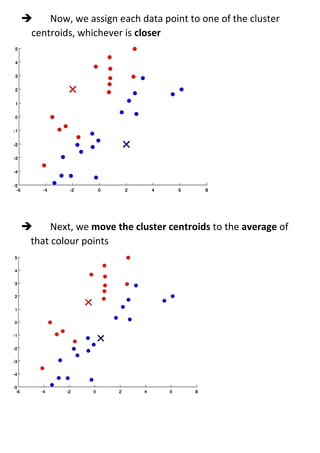
➔ First, we randomly initialize two cluster centroids in the
data plot:
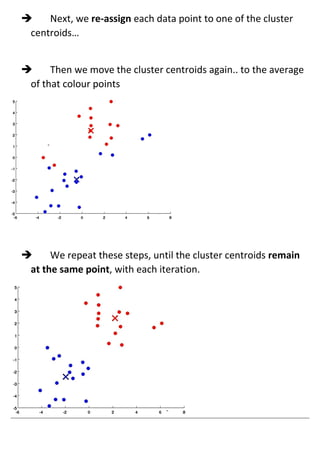
➔ Now, we assign each data point to one of the cluster
centroids, whichever is closer
➔ Next, we move the cluster centroids to the average of
that colour points
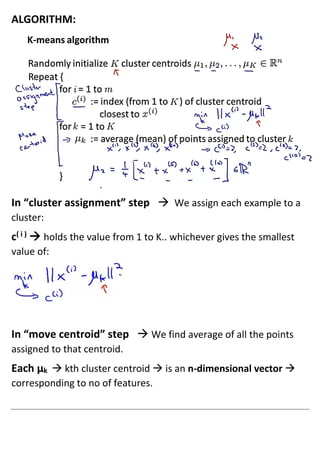
➔ Next, we re-assign each data point to one of the cluster
centroids…
➔ Then we move the cluster centroids again.. to the average
of that colour points
➔ We repeat these steps, until the cluster centroids remain
at the same point, with each iteration.
ALGORITHM:
In “cluster assignment” step → We assign each example to a
cluster:
c( i ) → holds the value from 1 to K.. whichever gives the smallest
value of:
In “move centroid” step → We find average of all the points
assigned to that centroid.
Each µk → kth cluster centroid → is an n-dimensional vector →
corresponding to no of features.
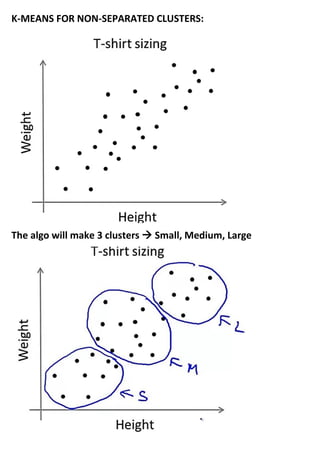
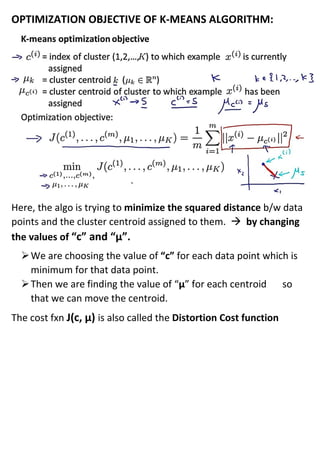
K-MEANS FOR NON-SEPARATED CLUSTERS:
The algo will make 3 clusters → Small, Medium, Large
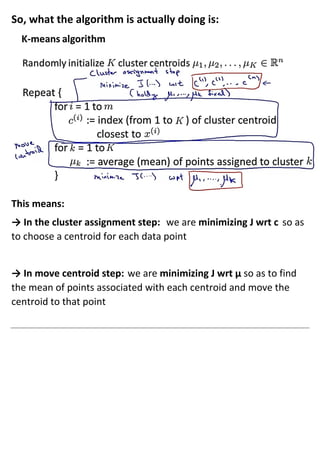
OPTIMIZATION OBJECTIVE OF K-MEANS ALGORITHM:
Here, the algo is trying to minimize the squared distance b/w data
points and the cluster centroid assigned to them. → by changing
the values of “c” and “µ”.
➢We are choosing the value of “c” for each data point which is
minimum for that data point.
➢Then we are finding the value of “µ” for each centroid so
that we can move the centroid.
The cost fxn J(c, µ) is also called the Distortion Cost function
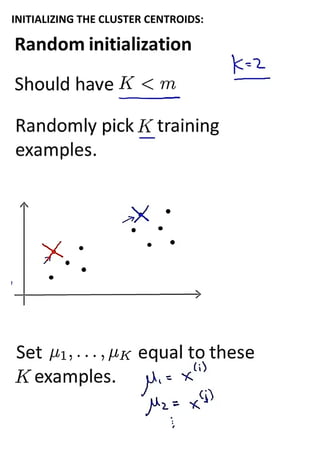
So, what the algorithm is actually doing is:
This means:
→ In the cluster assignment step: we are minimizing J wrt c so as
to choose a centroid for each data point
→ In move centroid step: we are minimizing J wrt µ so as to find
the mean of points associated with each centroid and move the
centroid to that point
INITIALIZING THE CLUSTER CENTROIDS:
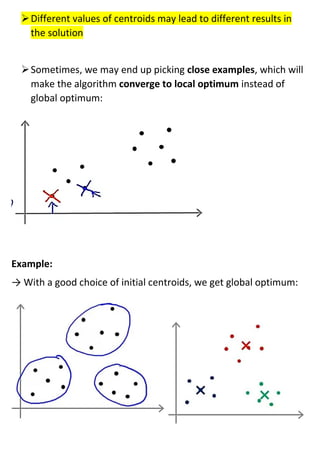
➢Different values of centroids may lead to different results in
the solution
➢Sometimes, we may end up picking close examples, which will
make the algorithm converge to local optimum instead of
global optimum:
Example:
→ With a good choice of initial centroids, we get global optimum:
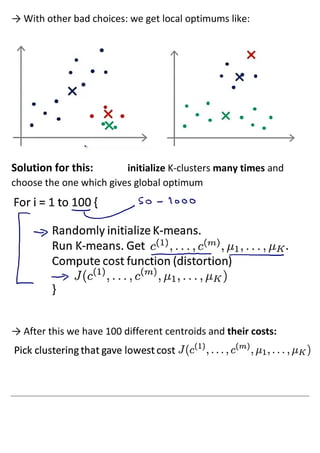
→ With other bad choices: we get local optimums like:
Solution for this: initialize K-clusters many times and
choose the one which gives global optimum
→ After this we have 100 different centroids and their costs:
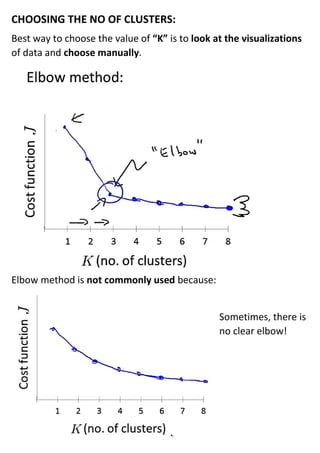
CHOOSING THE NO OF CLUSTERS:
Best way to choose the value of “K” is to look at the visualizations
of data and choose manually.
Elbow method is not commonly used because:
Sometimes, there is
no clear elbow!
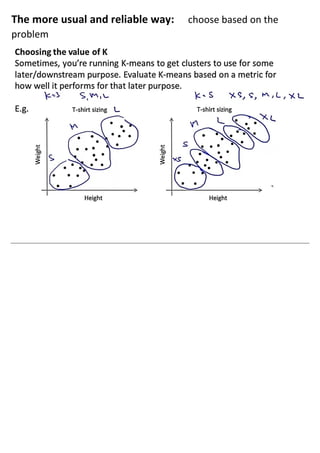
The more usual and reliable way: choose based on the
problem

13 unsupervised learning clustering

  • 1.
    13. Unsupervised Learning– Clustering -- When we don’t have the output of our training examples… we just have different input features… this is called UNLABELLED DATASET. All we want is to group those inputs into different clusters ≫ In SUPERVISED LEARNING: ≫ In UNSUPERVISED LEARNING:
  • 2.
    ≫ K-MEANS ALGORITHM: ➔First, we randomly initialize two cluster centroids in the data plot:
  • 3.
    ➔ Now, weassign each data point to one of the cluster centroids, whichever is closer ➔ Next, we move the cluster centroids to the average of that colour points
  • 4.
    ➔ Next, were-assign each data point to one of the cluster centroids… ➔ Then we move the cluster centroids again.. to the average of that colour points ➔ We repeat these steps, until the cluster centroids remain at the same point, with each iteration.
  • 5.
    ALGORITHM: In “cluster assignment”step → We assign each example to a cluster: c( i ) → holds the value from 1 to K.. whichever gives the smallest value of: In “move centroid” step → We find average of all the points assigned to that centroid. Each µk → kth cluster centroid → is an n-dimensional vector → corresponding to no of features.
  • 6.
    K-MEANS FOR NON-SEPARATEDCLUSTERS: The algo will make 3 clusters → Small, Medium, Large
  • 7.
    OPTIMIZATION OBJECTIVE OFK-MEANS ALGORITHM: Here, the algo is trying to minimize the squared distance b/w data points and the cluster centroid assigned to them. → by changing the values of “c” and “µ”. ➢We are choosing the value of “c” for each data point which is minimum for that data point. ➢Then we are finding the value of “µ” for each centroid so that we can move the centroid. The cost fxn J(c, µ) is also called the Distortion Cost function
  • 8.
    So, what thealgorithm is actually doing is: This means: → In the cluster assignment step: we are minimizing J wrt c so as to choose a centroid for each data point → In move centroid step: we are minimizing J wrt µ so as to find the mean of points associated with each centroid and move the centroid to that point
  • 9.
  • 10.
    ➢Different values ofcentroids may lead to different results in the solution ➢Sometimes, we may end up picking close examples, which will make the algorithm converge to local optimum instead of global optimum: Example: → With a good choice of initial centroids, we get global optimum:
  • 11.
    → With otherbad choices: we get local optimums like: Solution for this: initialize K-clusters many times and choose the one which gives global optimum → After this we have 100 different centroids and their costs:
  • 12.
    CHOOSING THE NOOF CLUSTERS: Best way to choose the value of “K” is to look at the visualizations of data and choose manually. Elbow method is not commonly used because: Sometimes, there is no clear elbow!
  • 13.
    The more usualand reliable way: choose based on the problem