Tahmina Zebin
tahmina.zebin@manchester.ac.uk
 Introductory Electronic Devices and Circuits
 By Robert T. Paynter
 Example of Small signals:
 Sound from a microphone(low
frequency)
 Radio Signals received by an
antenna(High Frequency)
4
Typical amplifier operation.
RB
RC
Q1
VCC
VB(ac)
IB(ac)
VCE(ac)
IC(ac)
• Step 1: Fix the Q-point of Transistor
• Step 2: Find hfe
• Step 3: Design CE Amplifier
-Bias /Voltage Divider Circuit
-Calculating the value of the resistances and
capacitances
• Step 4: Ac analysis and results
Amplifier Design Steps
6
A generic dc load line.
IC
VCE
(sat)
CC
C
C
V
I
R

(off )CE CCV V
CC CE
C
C
V V
I
R


7
Example : Load line
Plot the dc load line for the circuit shown in
the figure. Then, find the values of VCE for IC
= 1, 2, 5 mA respectively.
RB
RC
1 k
Q1
+10 V
VCE
2 4 6 8 10
2
4
6
8
IC
10 IC (mA) VCE (V)
1 9
2 8
5 5
CE CC C CV V I R 
8
Optimum Q-point with amplifier
operation.
βC BI I
CE CC C CV V I R 
VCE
IB = 0 A
IB = 10 A
IB = 20 A
IB = 30 A
IB = 40 A
IB
= 50 A
IC
Q-Point
VCCVCC/2
IC(sat)
IC(sat)/2
IB
9
Options for biasing
• Base bias circuits(Fixed bias)
• Voltage-divider bias circuits
• Emitter-bias circuits
• Feedback-bias circuits
– Collector-feedback bias circuits
– Emitter-feedback bias circuits
10
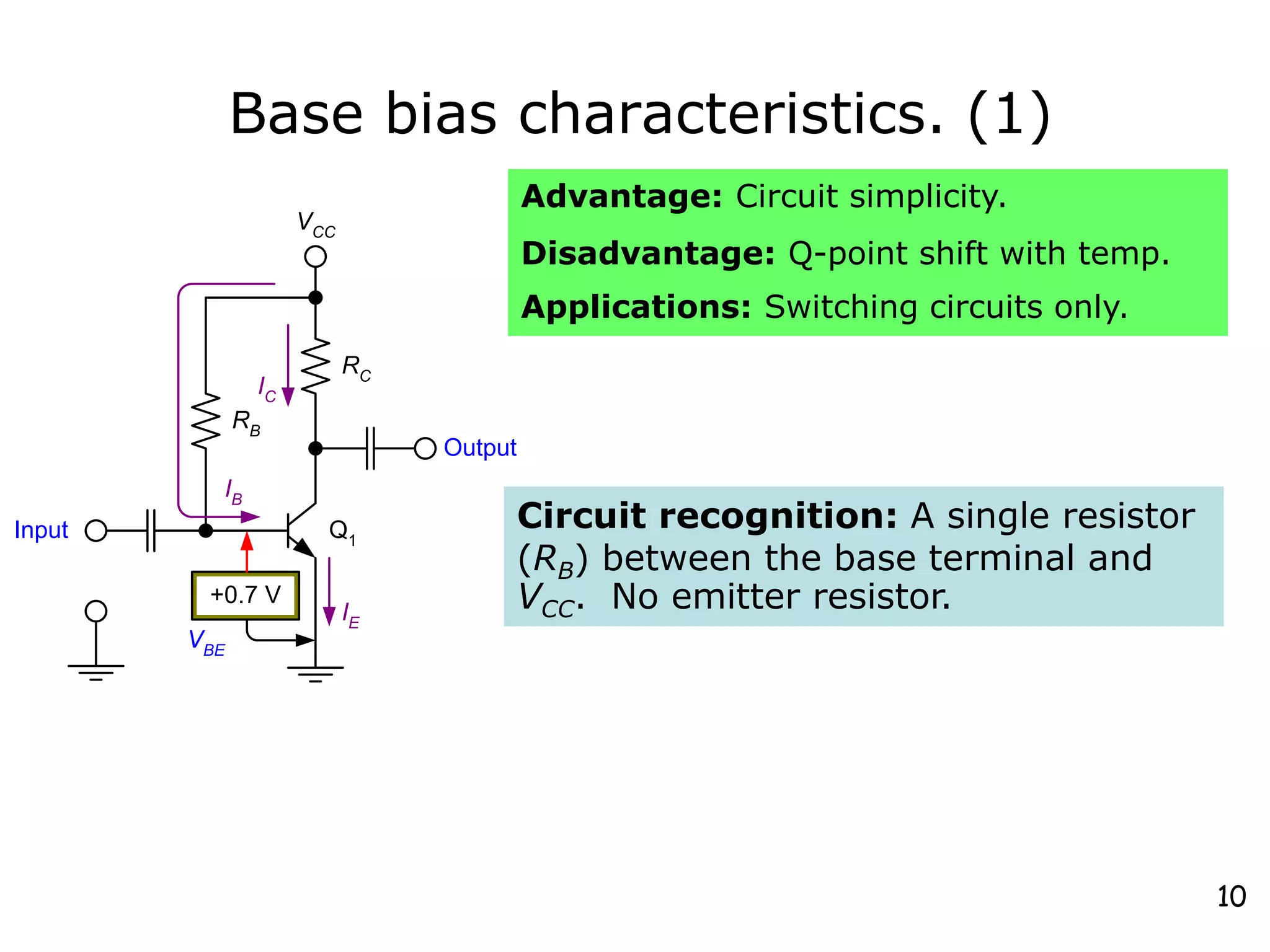
Base bias characteristics. (1)
RC
RB
+0.7 V
IC
IB
IE
Input
Output
VBE
VCC
Q1
Advantage: Circuit simplicity.
Disadvantage: Q-point shift with temp.
Applications: Switching circuits only.
Circuit recognition: A single resistor
(RB) between the base terminal and
VCC. No emitter resistor.
11
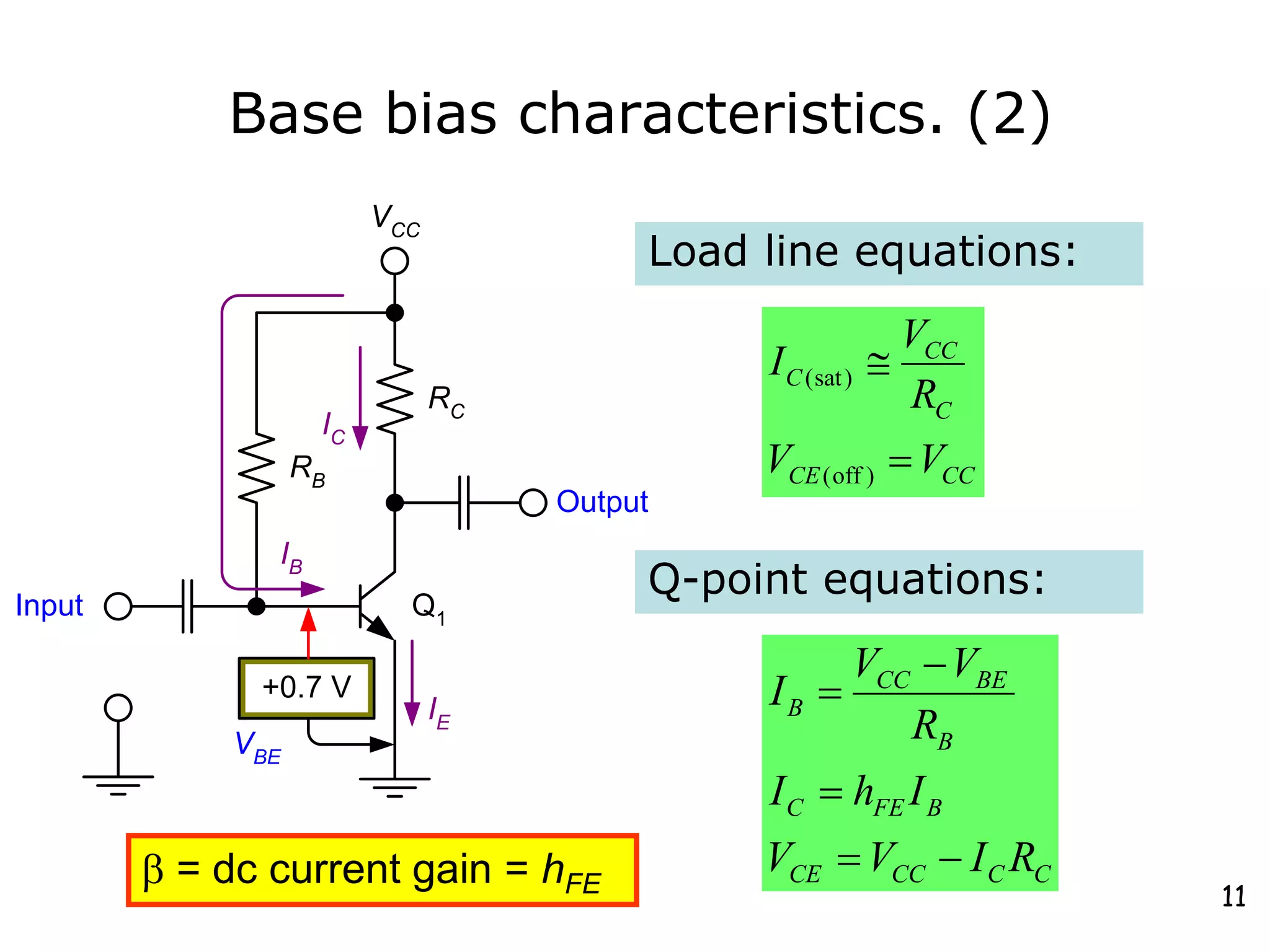
Base bias characteristics. (2)
RC
RB
+0.7 V
IC
IB
IE
Input
Output
VBE
VCC
Q1
(sat)
(off )
CC
C
C
CE CC
V
I
R
V V


Load line equations:
Q-point equations:
CC BE
B
B
C FE B
CE CC C C
V V
I
R
I h I
V V I R



 b = dc current gain = hFE
12
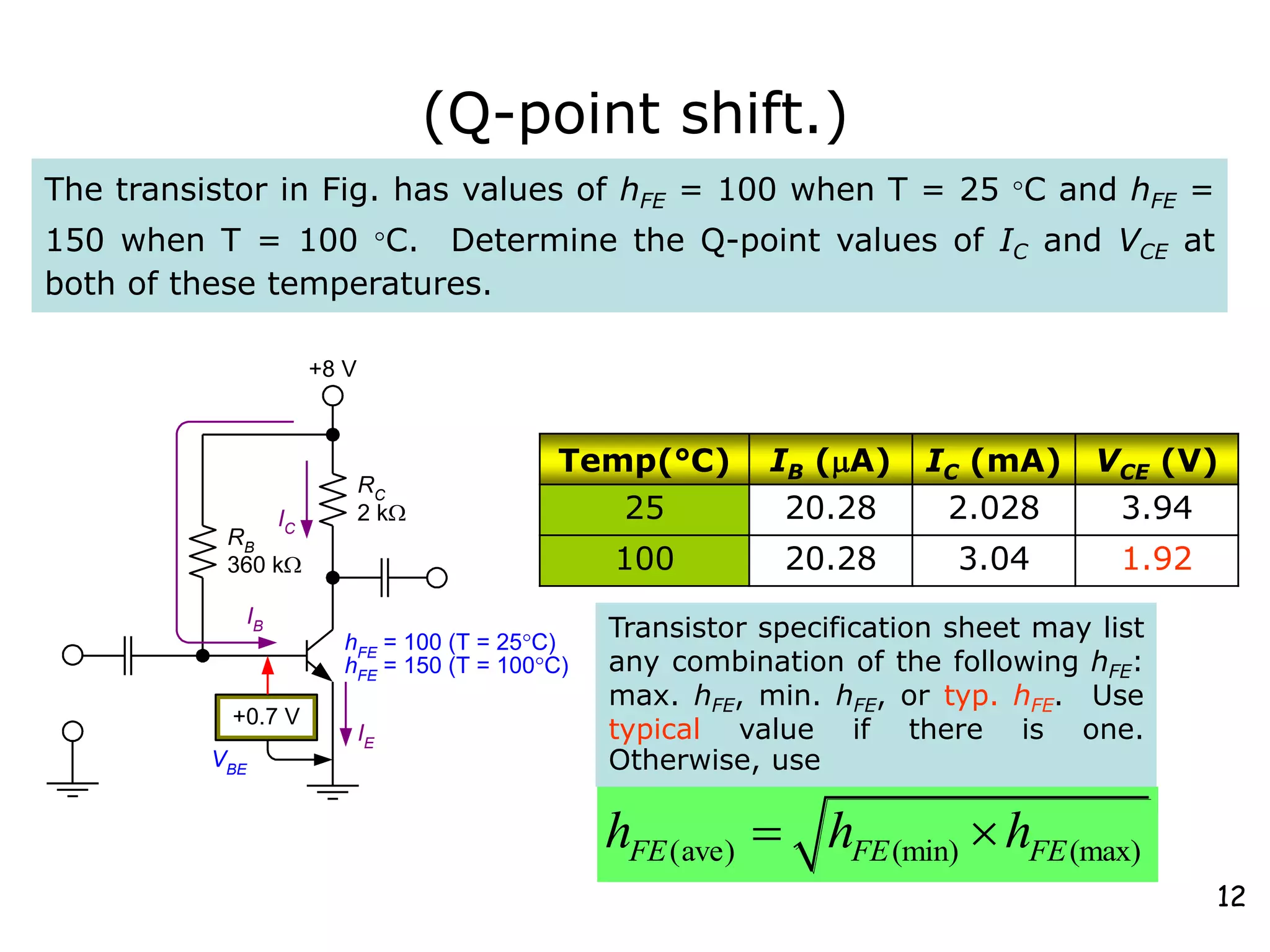
(Q-point shift.)
The transistor in Fig. has values of hFE = 100 when T = 25 °C and hFE =
150 when T = 100 °C. Determine the Q-point values of IC and VCE at
both of these temperatures.
Temp(°C) IB (A) IC (mA) VCE (V)
25 20.28 2.028 3.94
100 20.28 3.04 1.92
RC
2 k
RB
360 k
+0.7 V
IC
IB
IE
VBE
+8 V
hFE
= 100 (T = 25C)
hFE
= 150 (T = 100C)
Transistor specification sheet may list
any combination of the following hFE:
max. hFE, min. hFE, or typ. hFE. Use
typical value if there is one.
Otherwise, use
(ave) (min) (max)FE FE FEh h h 
13
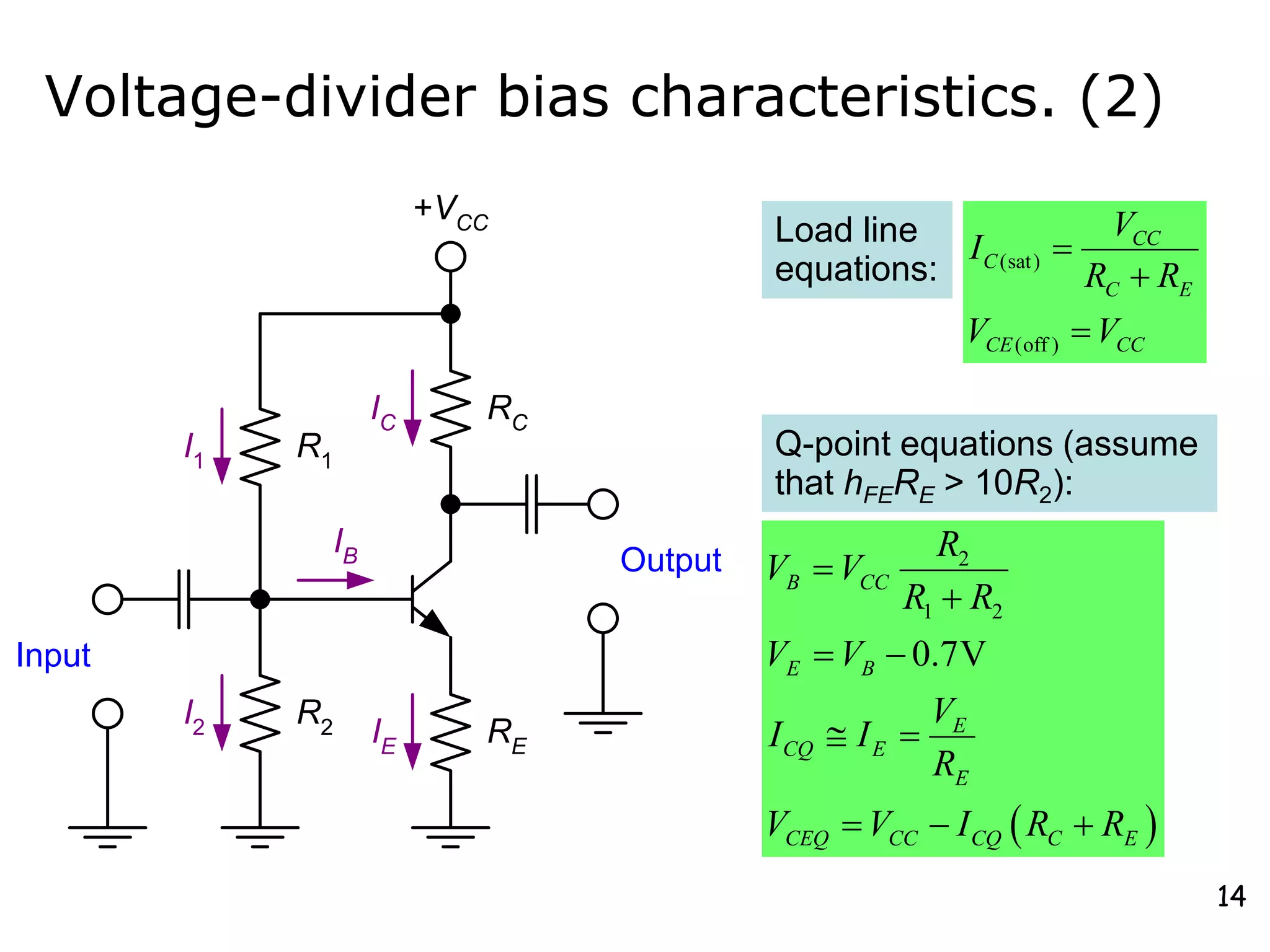
Voltage-divider bias characteristics. (1)
R1
R2 RE
RC
+VCC
Input
Output
I1
I2 IE
IB
IC
Circuit recognition: The
voltage divider in the base
circuit.
Advantages: The circuit Q-
point values are stable
against changes in hFE.
Disadvantages: Requires
more components than most
other biasing circuits.
Applications: Used primarily
to bias linear amplifier.
14
Voltage-divider bias characteristics. (2)
R1
R2 RE
RC
+VCC
Input
Output
I1
I2 IE
IB
IC
Load line
equations: (sat)
(off )
CC
C
C E
CE CC
V
I
R R
V V



Q-point equations (assume
that hFERE > 10R2):
 
2
1 2
0.7V
B CC
E B
E
CQ E
E
CEQ CC CQ C E
R
V V
R R
V V
V
I I
R
V V I R R


 
 
  
15
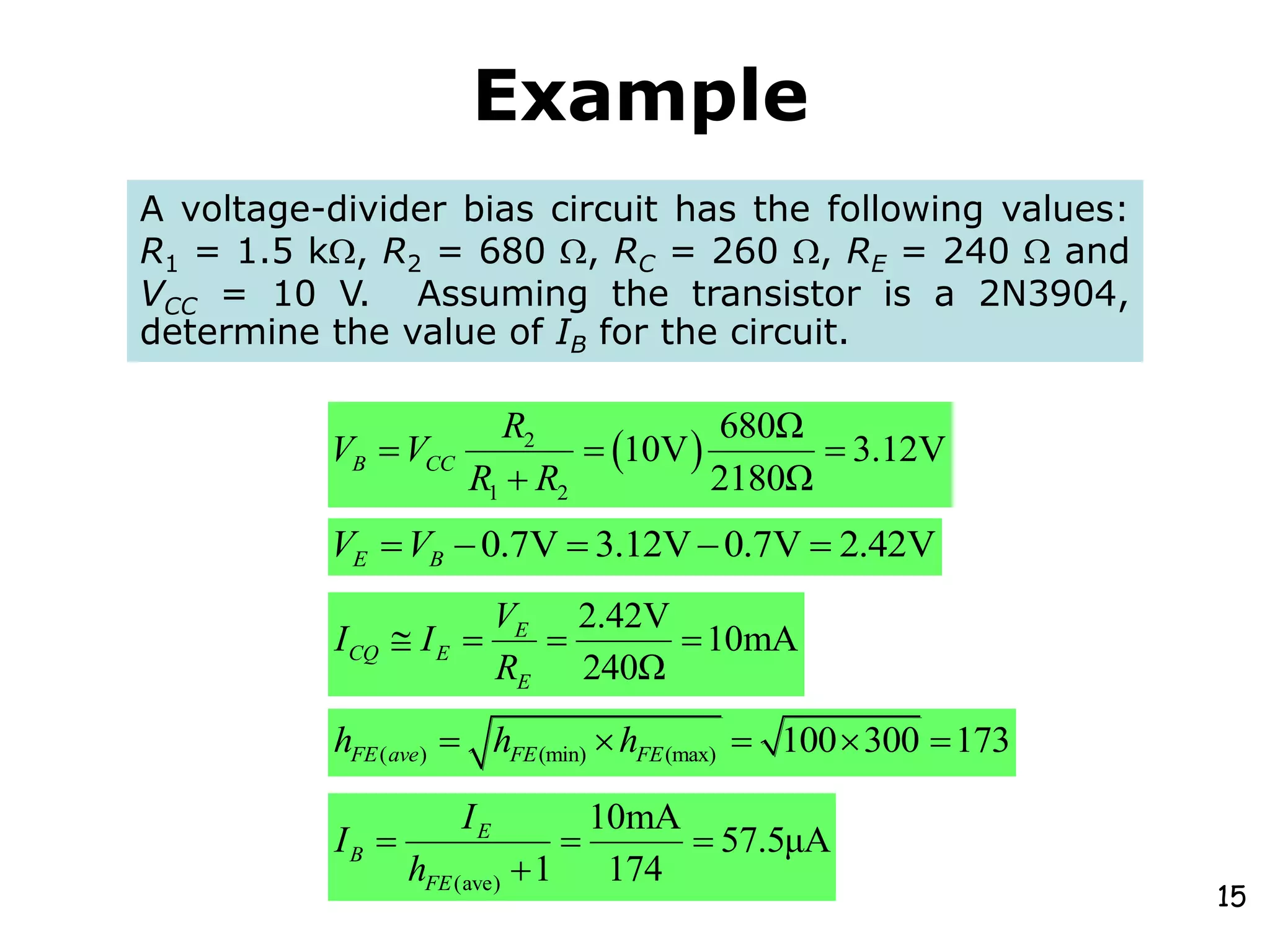
Example
A voltage-divider bias circuit has the following values:
R1 = 1.5 k, R2 = 680 , RC = 260 , RE = 240  and
VCC = 10 V. Assuming the transistor is a 2N3904,
determine the value of IB for the circuit.
 2
1 2
680Ω
10V 3.12V
2180Ω
B CC
R
V V
R R
  

0.7V 3.12V 0.7V 2.42VE BV V    
2.42V
10mA
240Ω
E
CQ E
E
V
I I
R
   
( ) (min) (max) 100 300 173FE ave FE FEh h h    
(ave)
10mA
57.5μA
1 174
E
B
FE
I
I
h
  

16
Load line for voltage divider bias
circuit.
2 4 6 8 10 12
5
10
15
20
25
IC (mA)
VCE (V)
(sat)
10V
20mA
260Ω+240Ω
CC
C
C E
V
I
R R
  

(off ) 10VCE CCV V 
17
Stability of Voltage Divider
Bias Circuit
The Q-point of voltage divider bias circuit is less
dependent on hFE than that of the base bias (fixed
bias).
For example, if IE is exactly 10 mA, the range of hFE is
100 to 300. Then
10mA
At 100, 100μA and 9.90mA
1 101
E
FE B CQ E B
FE
I
h I I I I
h
      

10mA
At 300, 33μA and 9.97mA
1 301
E
FE B CQ E B
FE
I
h I I I I
h
      

ICQ hardly changes over the entire range of hFE.
18
Other Transistor Biasing
Circuits
• Emitter-bias circuits
• Feedback-bias circuits
– Collector-feedback bias
– Emitter-feedback bias
19
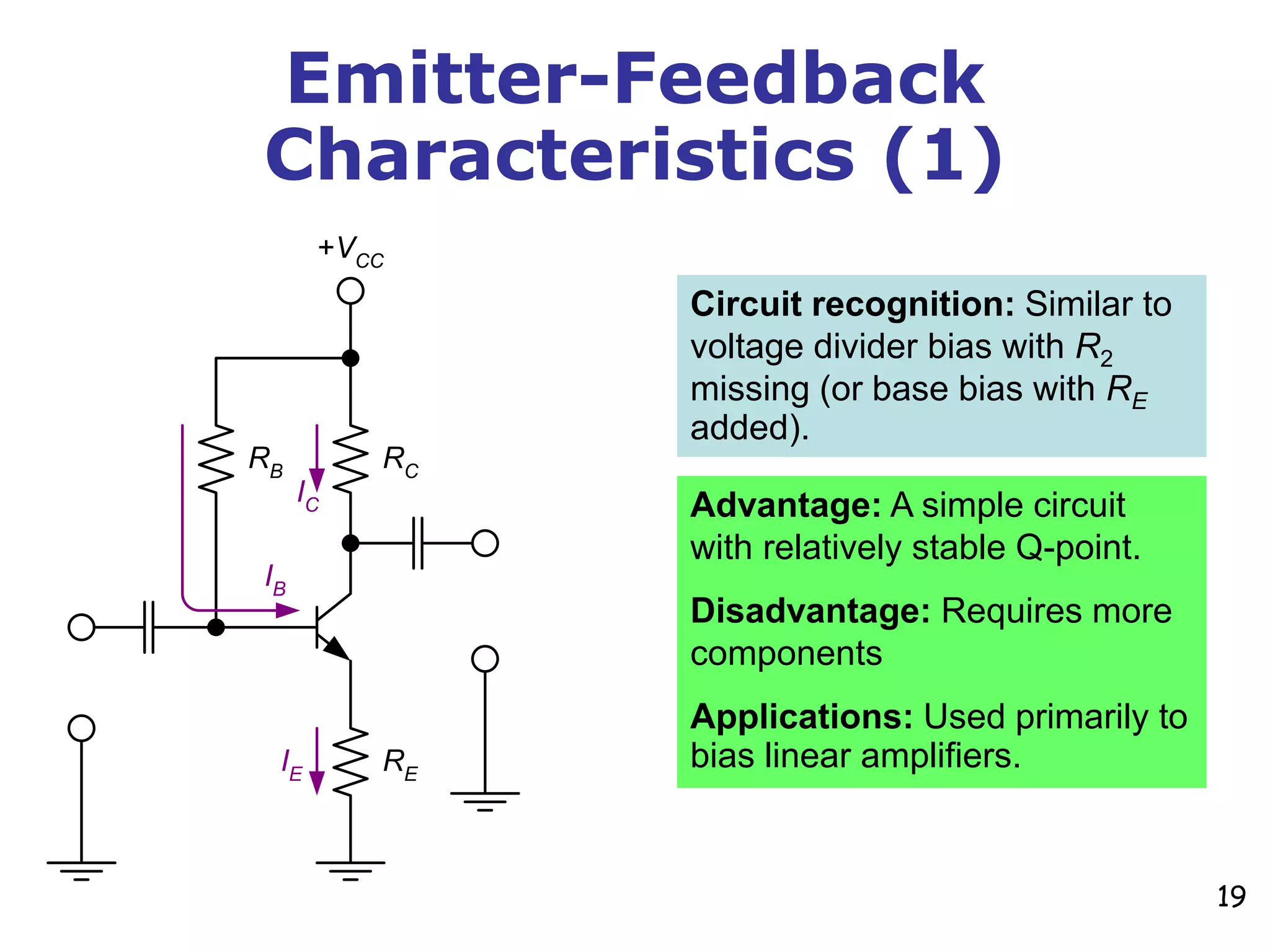
Emitter-Feedback
Characteristics (1)
Circuit recognition: Similar to
voltage divider bias with R2
missing (or base bias with RE
added).
Advantage: A simple circuit
with relatively stable Q-point.
Disadvantage: Requires more
components
Applications: Used primarily to
bias linear amplifiers.
RB RC
+VCC
RE
IB
IE
IC
20
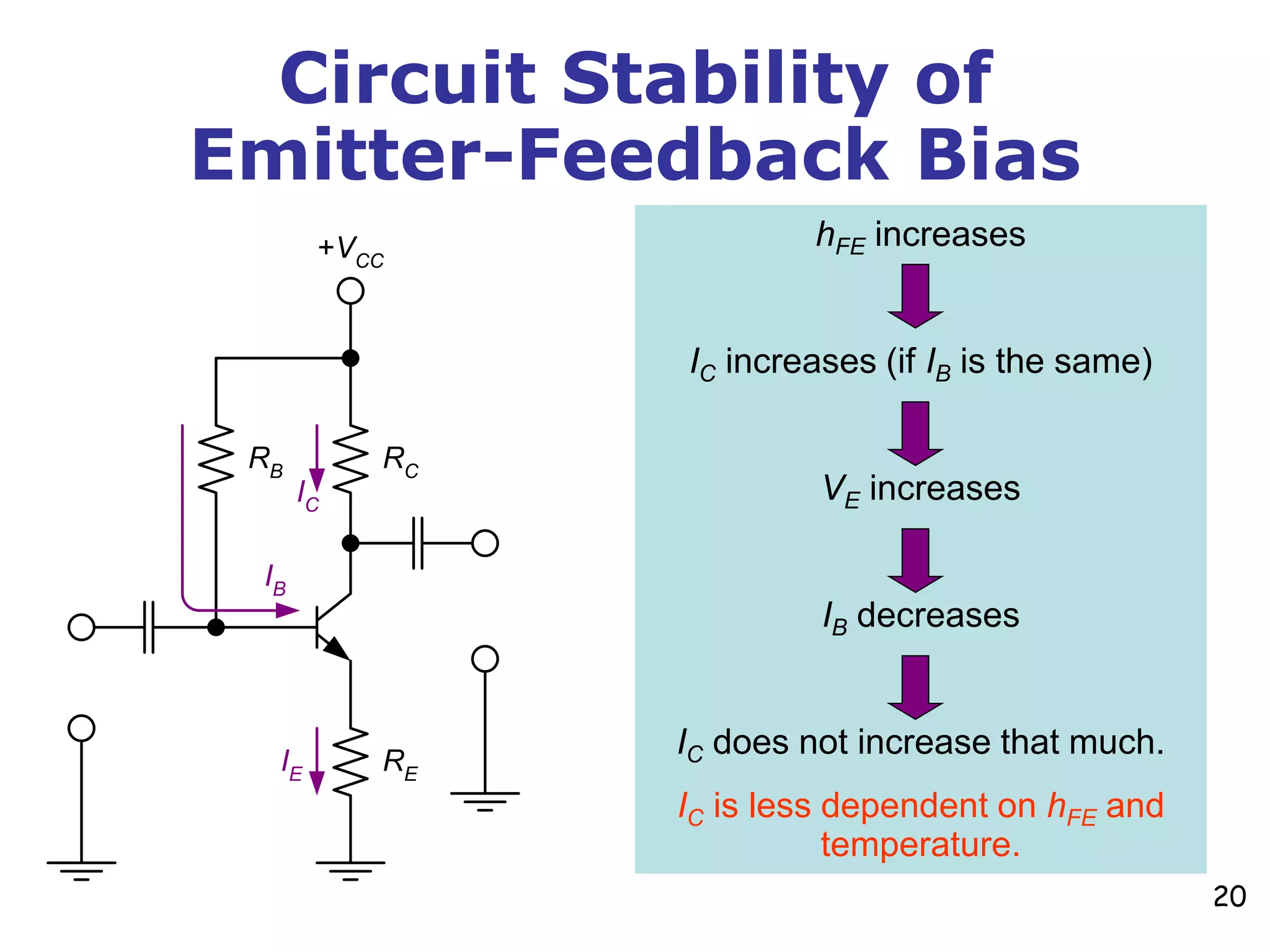
Circuit Stability of
Emitter-Feedback Bias
hFE increases
IC increases (if IB is the same)
VE increases
IB decreases
IC does not increase that much.
IC is less dependent on hFE and
temperature.
RB RC
+VCC
RE
IB
IE
IC
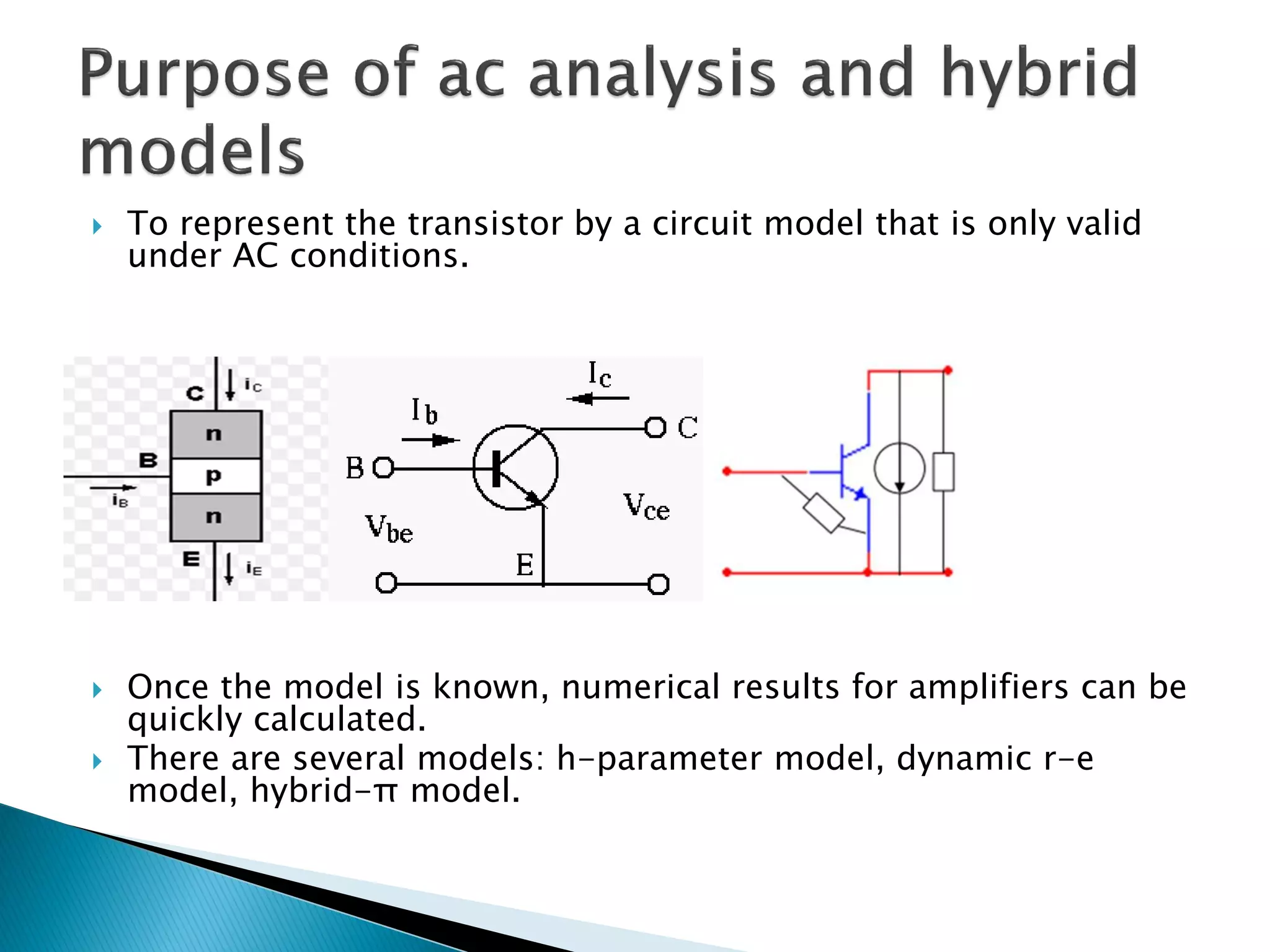
 To represent the transistor by a circuit model that is only valid
under AC conditions.
 Once the model is known, numerical results for amplifiers can be
quickly calculated.
 There are several models: h-parameter model, dynamic r-e
model, hybrid-π model.
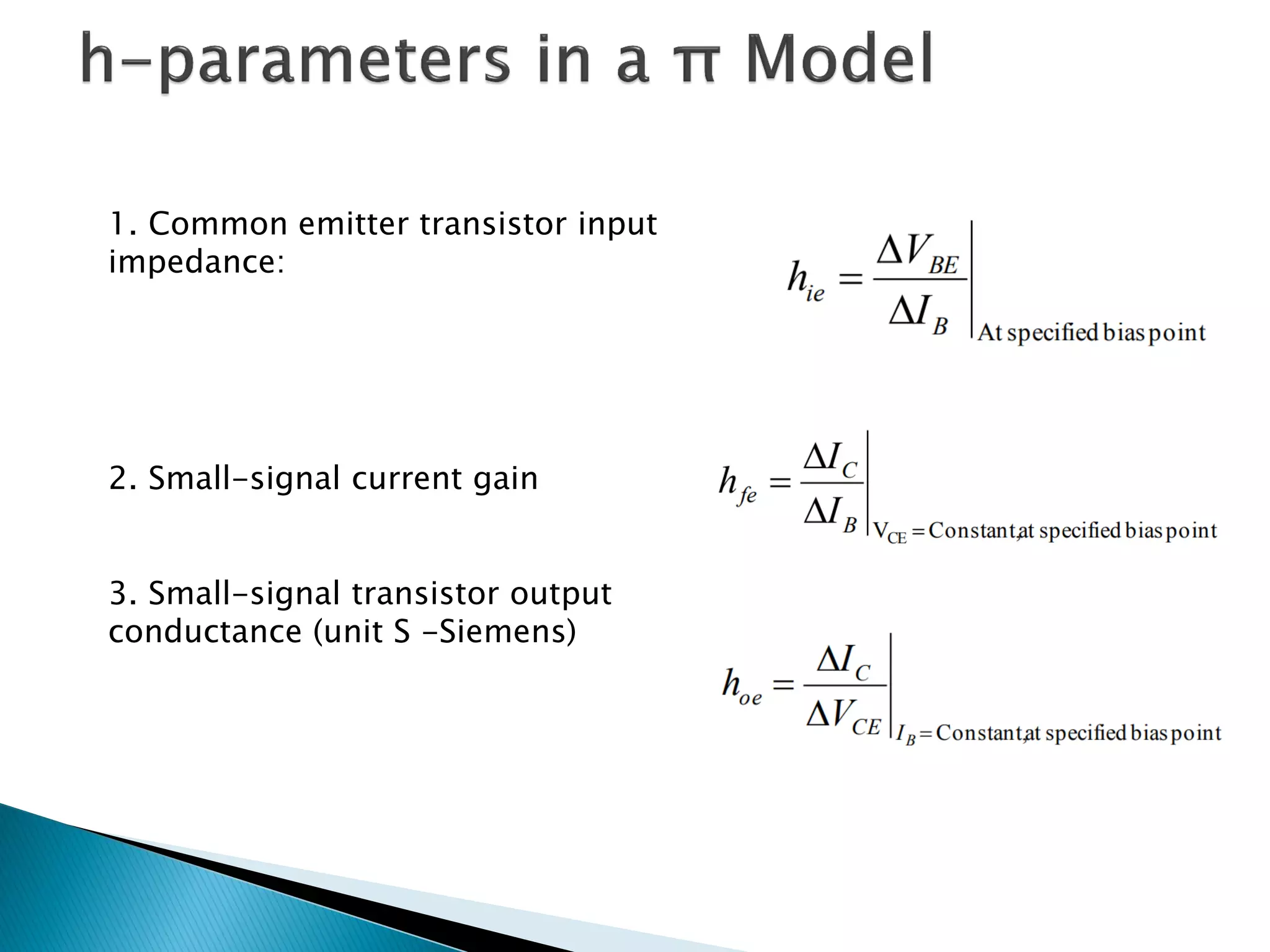
1. Common emitter transistor input
impedance:
2. Small-signal current gain
3. Small-signal transistor output
conductance (unit S -Siemens)
Minus sign due to current direction
Defined as the ratio of input voltage to
input current for the amplifier:
 Defined as the ratio of open circuit output
voltage to short circuit output current
𝑖 𝑜 = −ℎ 𝑓𝑒 𝑖 𝑏 =
−ℎ 𝑓𝑒 𝑣𝑖
ℎ𝑖𝑒
𝑣 𝑜 =
−ℎ 𝑓𝑒 𝑣𝑖
ℎ𝑖𝑒
(1/ℎ 𝑜𝑒| 𝑅1
𝑖 𝑏 =
𝑣𝑖
ℎ𝑖𝑒
𝑅 𝑜 =
𝑣 𝑜
𝑖 𝑜
Bipolar junction transistor : Biasing and AC Analysis

Bipolar junction transistor : Biasing and AC Analysis

  • 1.
  • 2.
     Introductory ElectronicDevices and Circuits  By Robert T. Paynter
  • 3.
     Example ofSmall signals:  Sound from a microphone(low frequency)  Radio Signals received by an antenna(High Frequency)
  • 4.
  • 5.
    • Step 1:Fix the Q-point of Transistor • Step 2: Find hfe • Step 3: Design CE Amplifier -Bias /Voltage Divider Circuit -Calculating the value of the resistances and capacitances • Step 4: Ac analysis and results Amplifier Design Steps
  • 6.
    6 A generic dcload line. IC VCE (sat) CC C C V I R  (off )CE CCV V CC CE C C V V I R  
  • 7.
    7 Example : Loadline Plot the dc load line for the circuit shown in the figure. Then, find the values of VCE for IC = 1, 2, 5 mA respectively. RB RC 1 k Q1 +10 V VCE 2 4 6 8 10 2 4 6 8 IC 10 IC (mA) VCE (V) 1 9 2 8 5 5 CE CC C CV V I R 
  • 8.
    8 Optimum Q-point withamplifier operation. βC BI I CE CC C CV V I R  VCE IB = 0 A IB = 10 A IB = 20 A IB = 30 A IB = 40 A IB = 50 A IC Q-Point VCCVCC/2 IC(sat) IC(sat)/2 IB
  • 9.
    9 Options for biasing •Base bias circuits(Fixed bias) • Voltage-divider bias circuits • Emitter-bias circuits • Feedback-bias circuits – Collector-feedback bias circuits – Emitter-feedback bias circuits
  • 10.
    10 Base bias characteristics.(1) RC RB +0.7 V IC IB IE Input Output VBE VCC Q1 Advantage: Circuit simplicity. Disadvantage: Q-point shift with temp. Applications: Switching circuits only. Circuit recognition: A single resistor (RB) between the base terminal and VCC. No emitter resistor.
  • 11.
    11 Base bias characteristics.(2) RC RB +0.7 V IC IB IE Input Output VBE VCC Q1 (sat) (off ) CC C C CE CC V I R V V   Load line equations: Q-point equations: CC BE B B C FE B CE CC C C V V I R I h I V V I R     b = dc current gain = hFE
  • 12.
    12 (Q-point shift.) The transistorin Fig. has values of hFE = 100 when T = 25 °C and hFE = 150 when T = 100 °C. Determine the Q-point values of IC and VCE at both of these temperatures. Temp(°C) IB (A) IC (mA) VCE (V) 25 20.28 2.028 3.94 100 20.28 3.04 1.92 RC 2 k RB 360 k +0.7 V IC IB IE VBE +8 V hFE = 100 (T = 25C) hFE = 150 (T = 100C) Transistor specification sheet may list any combination of the following hFE: max. hFE, min. hFE, or typ. hFE. Use typical value if there is one. Otherwise, use (ave) (min) (max)FE FE FEh h h 
  • 13.
    13 Voltage-divider bias characteristics.(1) R1 R2 RE RC +VCC Input Output I1 I2 IE IB IC Circuit recognition: The voltage divider in the base circuit. Advantages: The circuit Q- point values are stable against changes in hFE. Disadvantages: Requires more components than most other biasing circuits. Applications: Used primarily to bias linear amplifier.
  • 14.
    14 Voltage-divider bias characteristics.(2) R1 R2 RE RC +VCC Input Output I1 I2 IE IB IC Load line equations: (sat) (off ) CC C C E CE CC V I R R V V    Q-point equations (assume that hFERE > 10R2):   2 1 2 0.7V B CC E B E CQ E E CEQ CC CQ C E R V V R R V V V I I R V V I R R         
  • 15.
    15 Example A voltage-divider biascircuit has the following values: R1 = 1.5 k, R2 = 680 , RC = 260 , RE = 240  and VCC = 10 V. Assuming the transistor is a 2N3904, determine the value of IB for the circuit.  2 1 2 680Ω 10V 3.12V 2180Ω B CC R V V R R     0.7V 3.12V 0.7V 2.42VE BV V     2.42V 10mA 240Ω E CQ E E V I I R     ( ) (min) (max) 100 300 173FE ave FE FEh h h     (ave) 10mA 57.5μA 1 174 E B FE I I h    
  • 16.
    16 Load line forvoltage divider bias circuit. 2 4 6 8 10 12 5 10 15 20 25 IC (mA) VCE (V) (sat) 10V 20mA 260Ω+240Ω CC C C E V I R R     (off ) 10VCE CCV V 
  • 17.
    17 Stability of VoltageDivider Bias Circuit The Q-point of voltage divider bias circuit is less dependent on hFE than that of the base bias (fixed bias). For example, if IE is exactly 10 mA, the range of hFE is 100 to 300. Then 10mA At 100, 100μA and 9.90mA 1 101 E FE B CQ E B FE I h I I I I h         10mA At 300, 33μA and 9.97mA 1 301 E FE B CQ E B FE I h I I I I h         ICQ hardly changes over the entire range of hFE.
  • 18.
    18 Other Transistor Biasing Circuits •Emitter-bias circuits • Feedback-bias circuits – Collector-feedback bias – Emitter-feedback bias
  • 19.
    19 Emitter-Feedback Characteristics (1) Circuit recognition:Similar to voltage divider bias with R2 missing (or base bias with RE added). Advantage: A simple circuit with relatively stable Q-point. Disadvantage: Requires more components Applications: Used primarily to bias linear amplifiers. RB RC +VCC RE IB IE IC
  • 20.
    20 Circuit Stability of Emitter-FeedbackBias hFE increases IC increases (if IB is the same) VE increases IB decreases IC does not increase that much. IC is less dependent on hFE and temperature. RB RC +VCC RE IB IE IC
  • 21.
     To representthe transistor by a circuit model that is only valid under AC conditions.  Once the model is known, numerical results for amplifiers can be quickly calculated.  There are several models: h-parameter model, dynamic r-e model, hybrid-π model.
  • 23.
    1. Common emittertransistor input impedance: 2. Small-signal current gain 3. Small-signal transistor output conductance (unit S -Siemens)
  • 24.
    Minus sign dueto current direction
  • 25.
    Defined as theratio of input voltage to input current for the amplifier:
  • 26.
     Defined asthe ratio of open circuit output voltage to short circuit output current 𝑖 𝑜 = −ℎ 𝑓𝑒 𝑖 𝑏 = −ℎ 𝑓𝑒 𝑣𝑖 ℎ𝑖𝑒 𝑣 𝑜 = −ℎ 𝑓𝑒 𝑣𝑖 ℎ𝑖𝑒 (1/ℎ 𝑜𝑒| 𝑅1 𝑖 𝑏 = 𝑣𝑖 ℎ𝑖𝑒 𝑅 𝑜 = 𝑣 𝑜 𝑖 𝑜