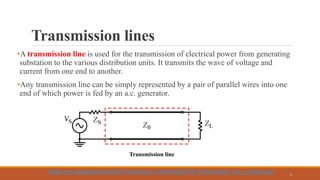
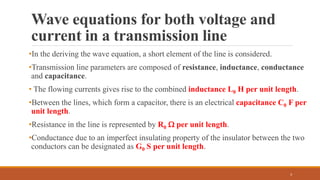
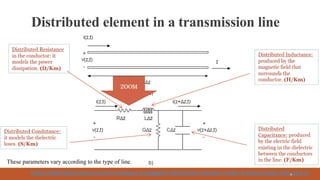
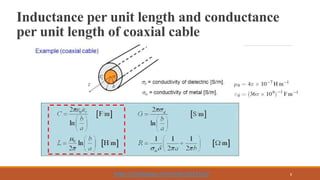
1) Transmission lines carry electrical power as waves of voltage and current from generating stations to distribution points. They can be modeled as parallel wires with distributed inductance, capacitance, resistance, and conductance per unit length.
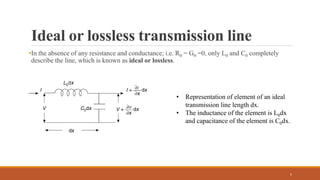
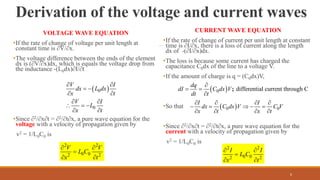
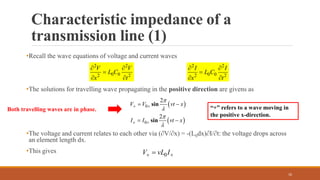
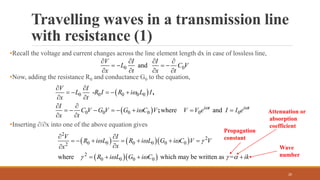
2) Wave equations can be derived for the voltage and current on an ideal lossless transmission line. These equations have wave solutions that propagate down the line at a characteristic velocity.
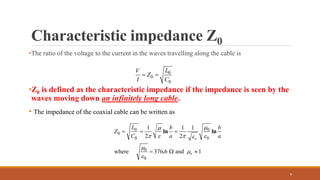
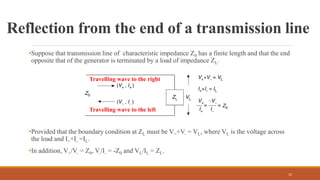
3) The ratio of the voltage and current amplitudes of a propagating wave gives the characteristic impedance of the transmission line. Mismatches with the load impedance cause wave reflections at the terminating end.








![RF Circuit Design - [Ch1-2] Transmission Line Theory](https://cdn.slidesharecdn.com/ss_thumbnails/ch1-2-150613064349-lva1-app6892-thumbnail.jpg?width=640&height=640&fit=bounds)


