
The document provides an overview of referencing and citation styles in academic writing, stressing their importance for proper attribution, research integrity, and avoiding plagiarism. It distinguishes between citations, which occur within the text, and references, which are detailed lists of sources, highlighting different referencing styles such as APA, MLA, and Chicago. Additionally, the document includes examples of how to format citations and references according to APA style, including various types of sources.
Referencing and ItsStyles
And Citation
DR.NAHEED BI
ASSISTANT PROFESSOR
FACULTY OF EDUCATION, TEERTHANKER MAHAVEER UNIVERSITY
MORADABAD
2.
What is Referencing?
Referencingis an essential aspect of academic and scholarly
writing that ensures proper attribution of sources, demonstrates
research integrity, and helps readers find the materials used to
support the writer's arguments. Referencing is the practice of
acknowledging the sources of information used in a piece of
academic or scholarly work. When conducting research, writers
often consult various books, articles, websites, and other materials
to gather information and support their arguments.
3.
Why Referencing?
GivingCredit to Original Authors: Referencing allows writers to
acknowledge and give credit to the original authors or creators of the
information, ideas, or quotes used in their work. It demonstrates
academic integrity and ethical research practices by recognizing the
contributions of others.
Allowing Verification and Further Exploration
Avoiding Plagiarism
Demonstrating Extensive Research
Following Academic Standards: Different academic disciplines and
institutions often have specific referencing styles they prefer (e.g., APA,
MLA, Chicago).
•
4.
What is Citation?
Citations can appear as in-text citations, which are brief references within the body of
the paper, or as footnotes/endnotes, depending on the citation style being used. In-text
citations are more common and are typically used in styles like APA (American
Psychological Association) and MLA (Modern Language Association).
When a writer includes a citation in their work, they are essentially pointing readers to
the exact source from which the information was obtained. This is typically done by
mentioning the author's name, publication year, and, if applicable, page numbers.
Citation, in the context of academic or scholarly writing, refers to the act of providing a
reference or acknowledgment within the text to indicate the source of specific
information, ideas, or quotes used in the paper. Citations are used to give credit to the
original authors or creators of the information being used and to allow readers to locate
the full reference in the bibliography or reference list.
5.
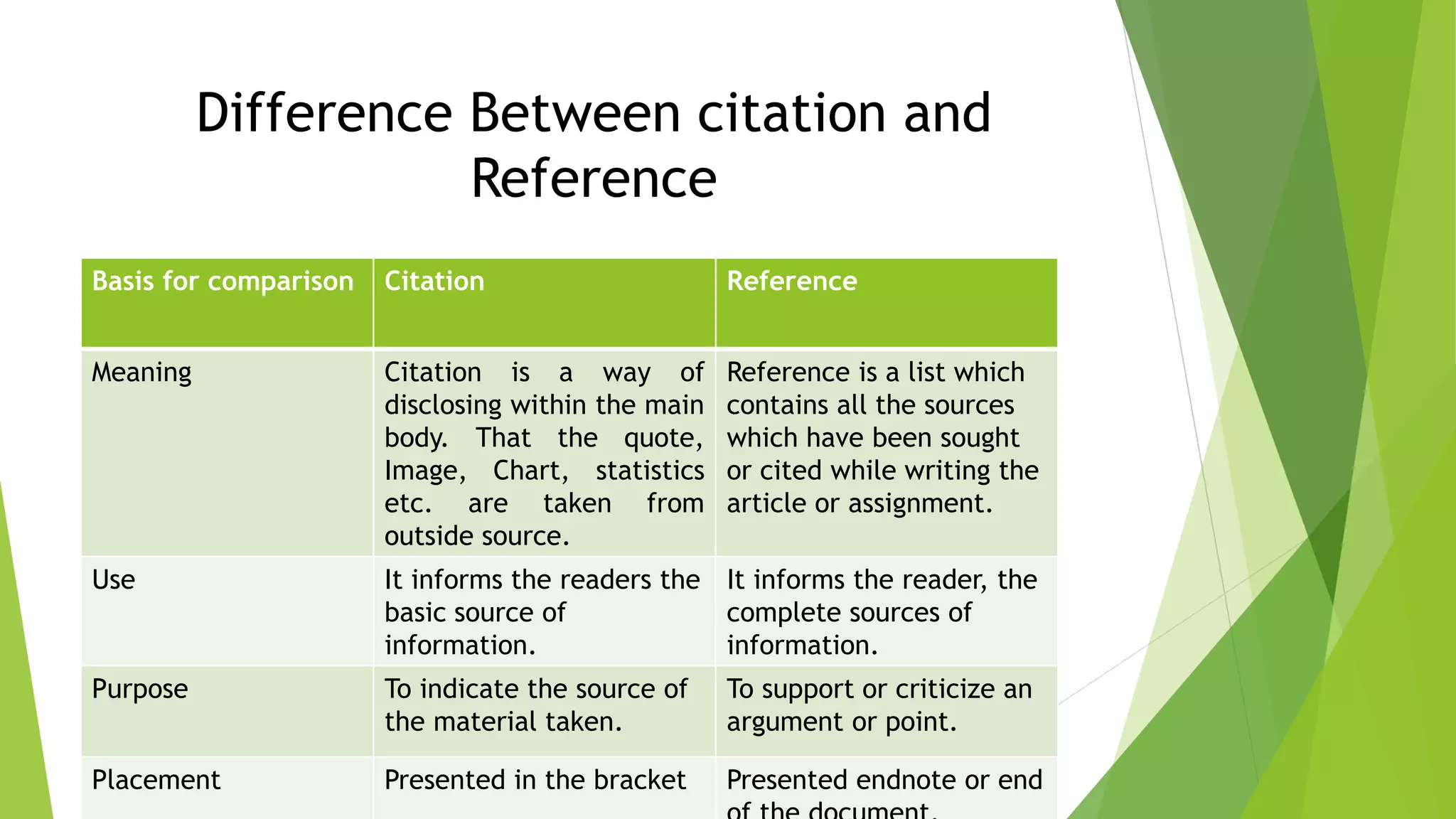
Difference Between citationand
Reference
Basis for comparison Citation Reference
Meaning Citation is a way of
disclosing within the main
body. That the quote,
Image, Chart, statistics
etc. are taken from
outside source.
Reference is a list which
contains all the sources
which have been sought
or cited while writing the
article or assignment.
Use It informs the readers the
basic source of
information.
It informs the reader, the
complete sources of
information.
Purpose To indicate the source of
the material taken.
To support or criticize an
argument or point.
Placement Presented in the bracket Presented endnote or end
6.
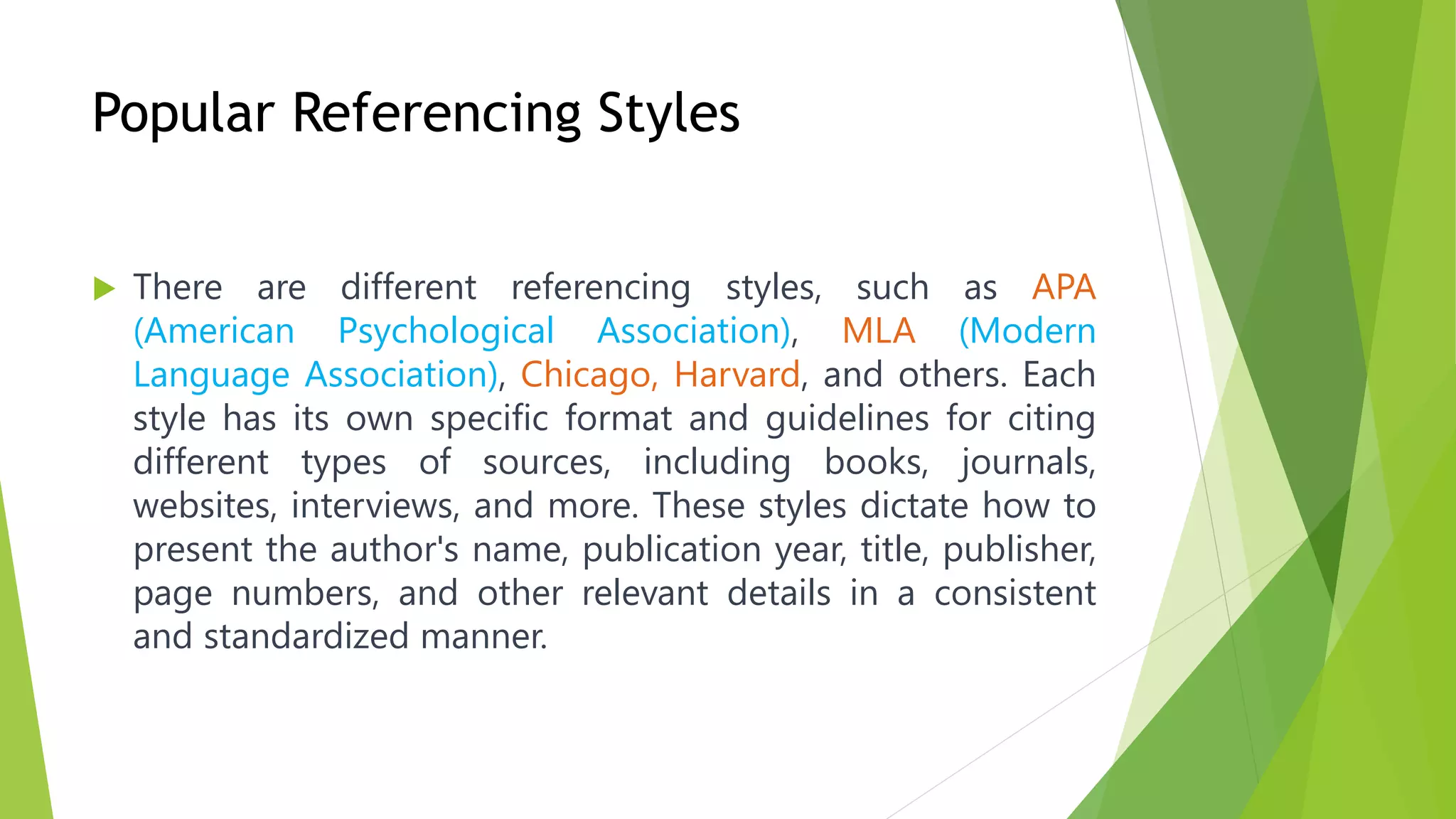
Popular Referencing Styles
There are different referencing styles, such as APA
(American Psychological Association), MLA (Modern
Language Association), Chicago, Harvard, and others. Each
style has its own specific format and guidelines for citing
different types of sources, including books, journals,
websites, interviews, and more. These styles dictate how to
present the author's name, publication year, title, publisher,
page numbers, and other relevant details in a consistent
and standardized manner.
7.
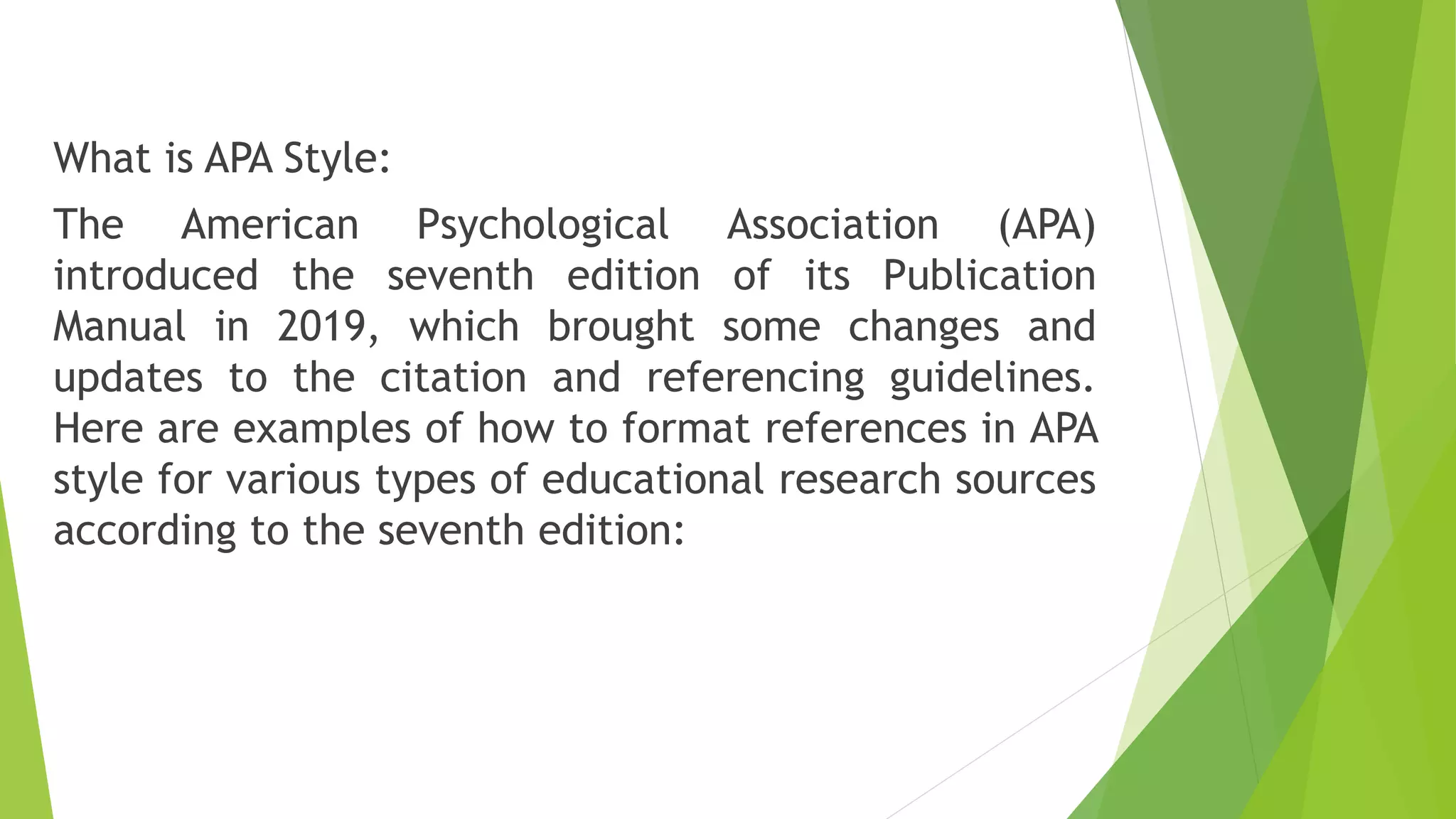
What is APAStyle:
The American Psychological Association (APA)
introduced the seventh edition of its Publication
Manual in 2019, which brought some changes and
updates to the citation and referencing guidelines.
Here are examples of how to format references in APA
style for various types of educational research sources
according to the seventh edition:
8.
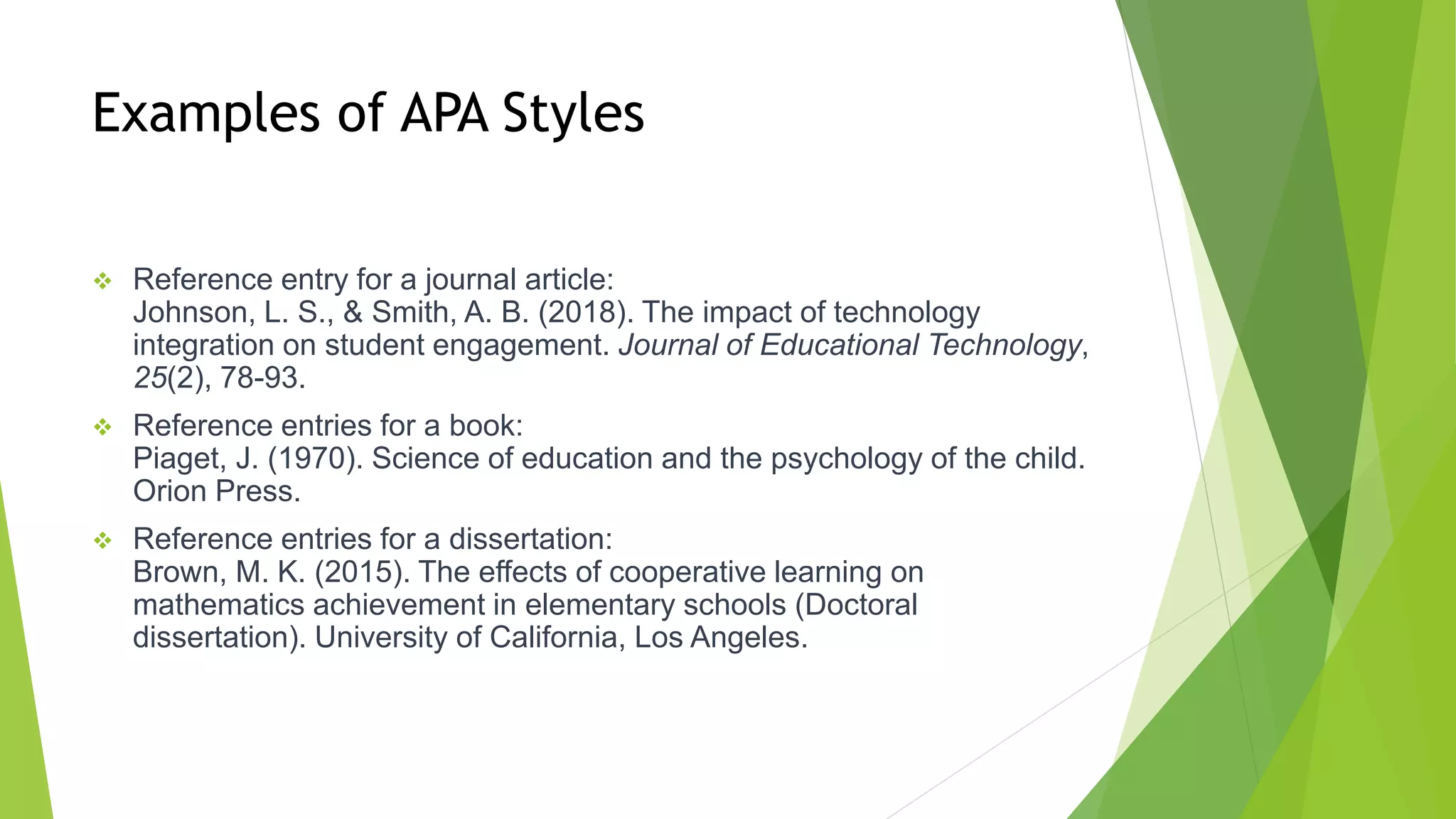
Examples of APAStyles
Reference entry for a journal article:
Johnson, L. S., & Smith, A. B. (2018). The impact of technology
integration on student engagement. Journal of Educational Technology,
25(2), 78-93.
Reference entries for a book:
Piaget, J. (1970). Science of education and the psychology of the child.
Orion Press.
Reference entries for a dissertation:
Brown, M. K. (2015). The effects of cooperative learning on
mathematics achievement in elementary schools (Doctoral
dissertation). University of California, Los Angeles.
9.
Examples of APAStyles
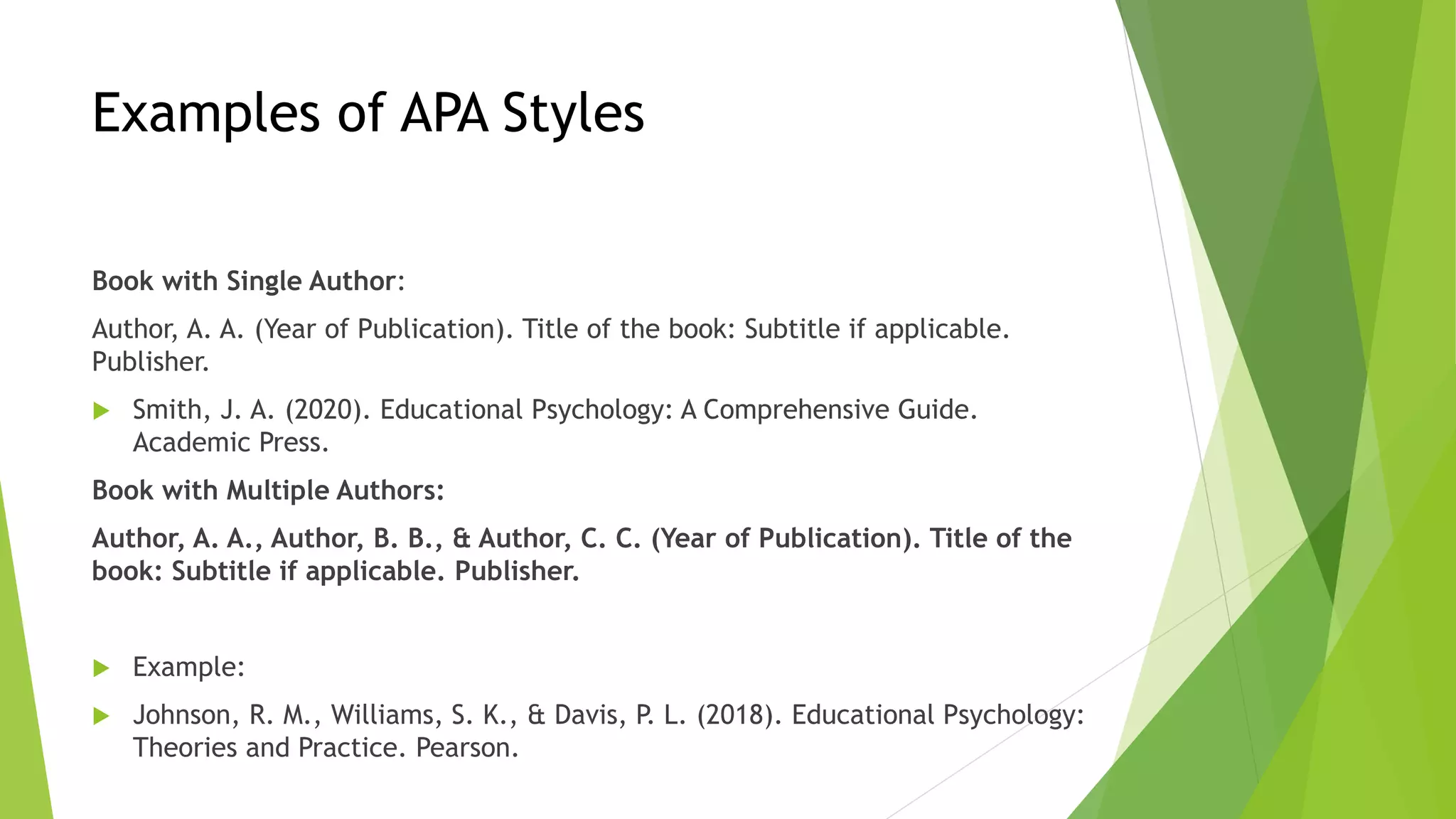
Book with Single Author:
Author, A. A. (Year of Publication). Title of the book: Subtitle if applicable.
Publisher.
Smith, J. A. (2020). Educational Psychology: A Comprehensive Guide.
Academic Press.
Book with Multiple Authors:
Author, A. A., Author, B. B., & Author, C. C. (Year of Publication). Title of the
book: Subtitle if applicable. Publisher.
Example:
Johnson, R. M., Williams, S. K., & Davis, P. L. (2018). Educational Psychology:
Theories and Practice. Pearson.
10.
Examples of APAStyles:
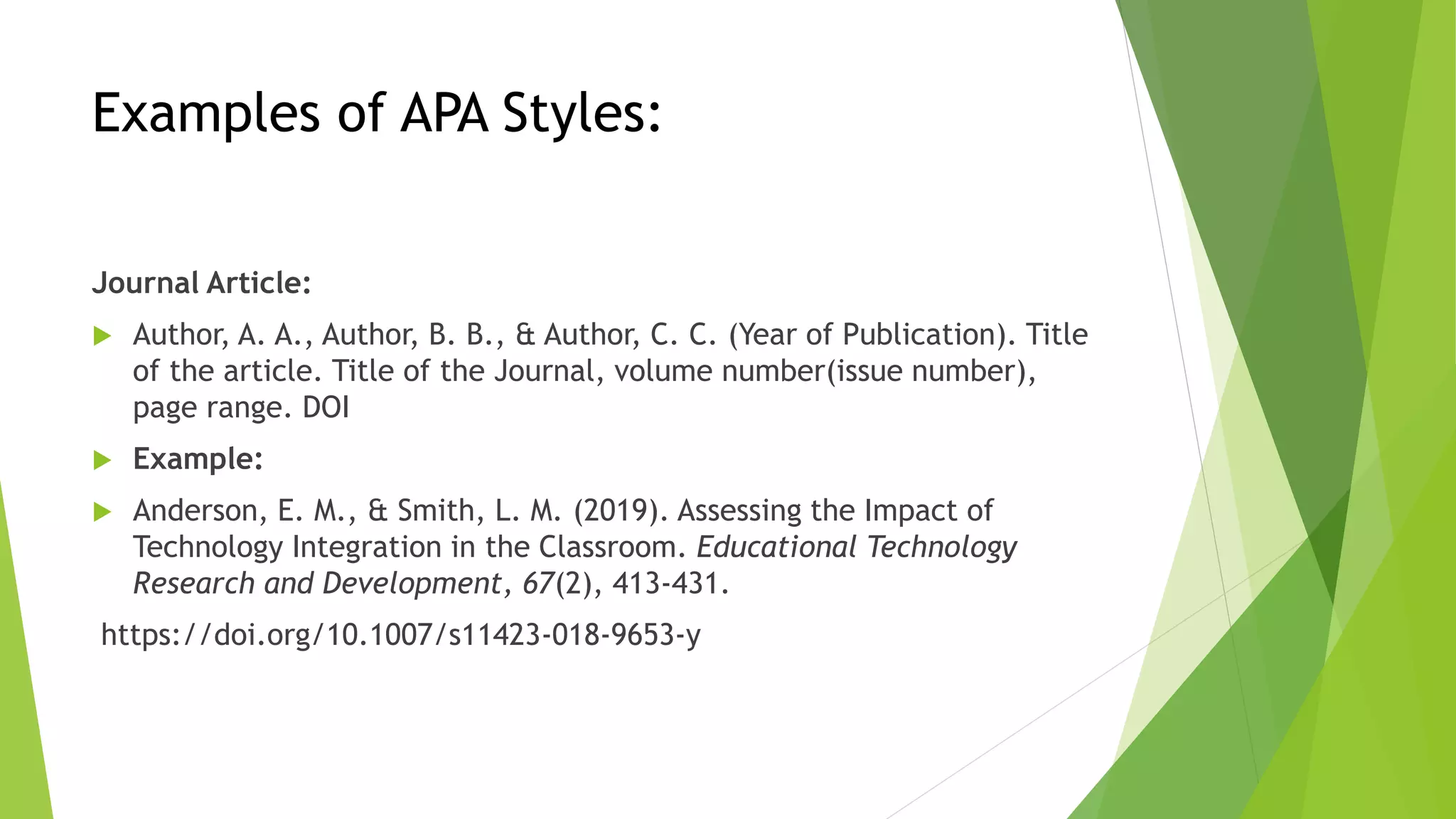
Journal Article:
Author, A. A., Author, B. B., & Author, C. C. (Year of Publication). Title
of the article. Title of the Journal, volume number(issue number),
page range. DOI
Example:
Anderson, E. M., & Smith, L. M. (2019). Assessing the Impact of
Technology Integration in the Classroom. Educational Technology
Research and Development, 67(2), 413-431.
https://doi.org/10.1007/s11423-018-9653-y
11.
Examples of APAStyles
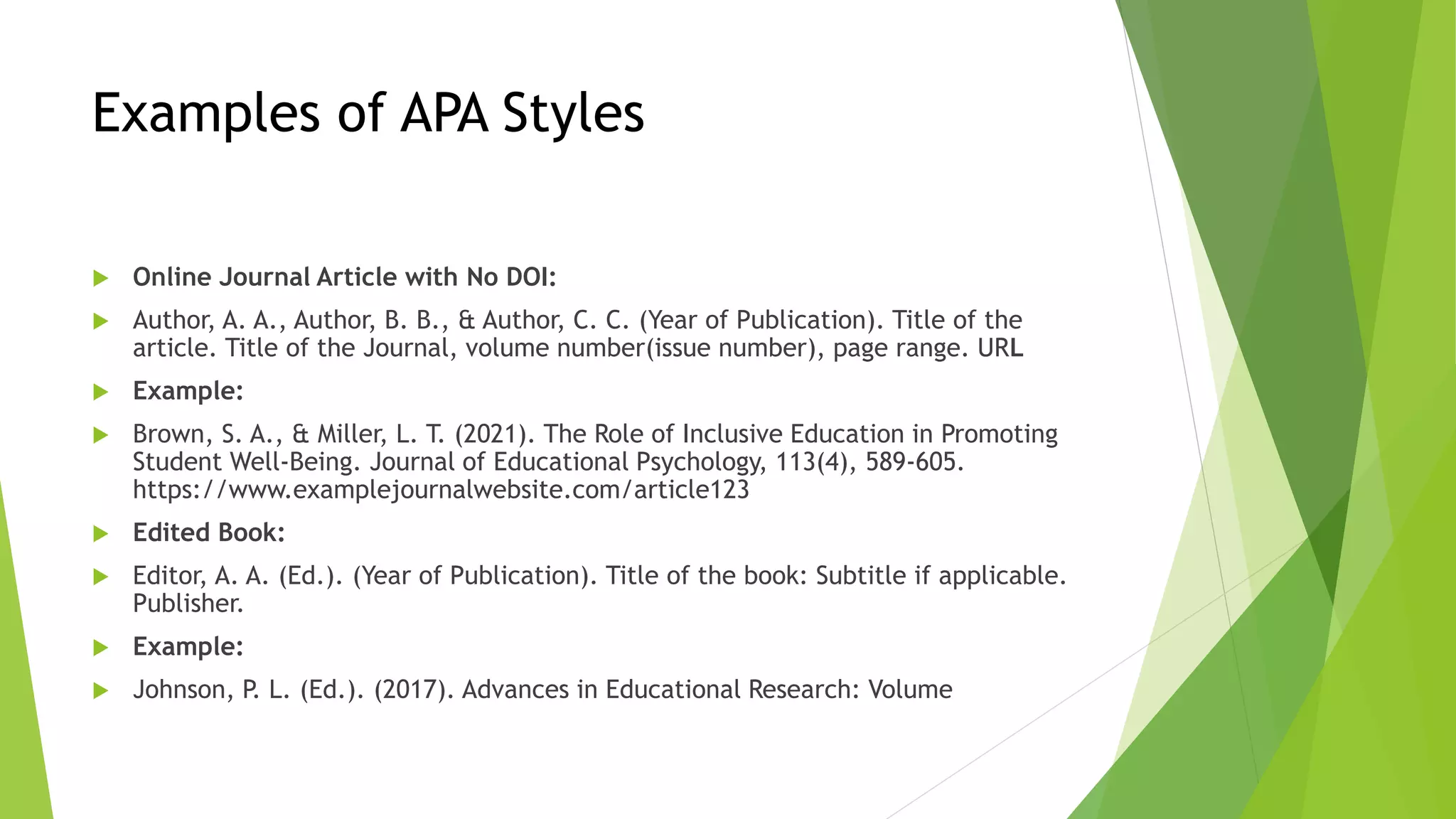
Online Journal Article with No DOI:
Author, A. A., Author, B. B., & Author, C. C. (Year of Publication). Title of the
article. Title of the Journal, volume number(issue number), page range. URL
Example:
Brown, S. A., & Miller, L. T. (2021). The Role of Inclusive Education in Promoting
Student Well-Being. Journal of Educational Psychology, 113(4), 589-605.
https://www.examplejournalwebsite.com/article123
Edited Book:
Editor, A. A. (Ed.). (Year of Publication). Title of the book: Subtitle if applicable.
Publisher.
Example:
Johnson, P. L. (Ed.). (2017). Advances in Educational Research: Volume
12.
Examples of APAStyles
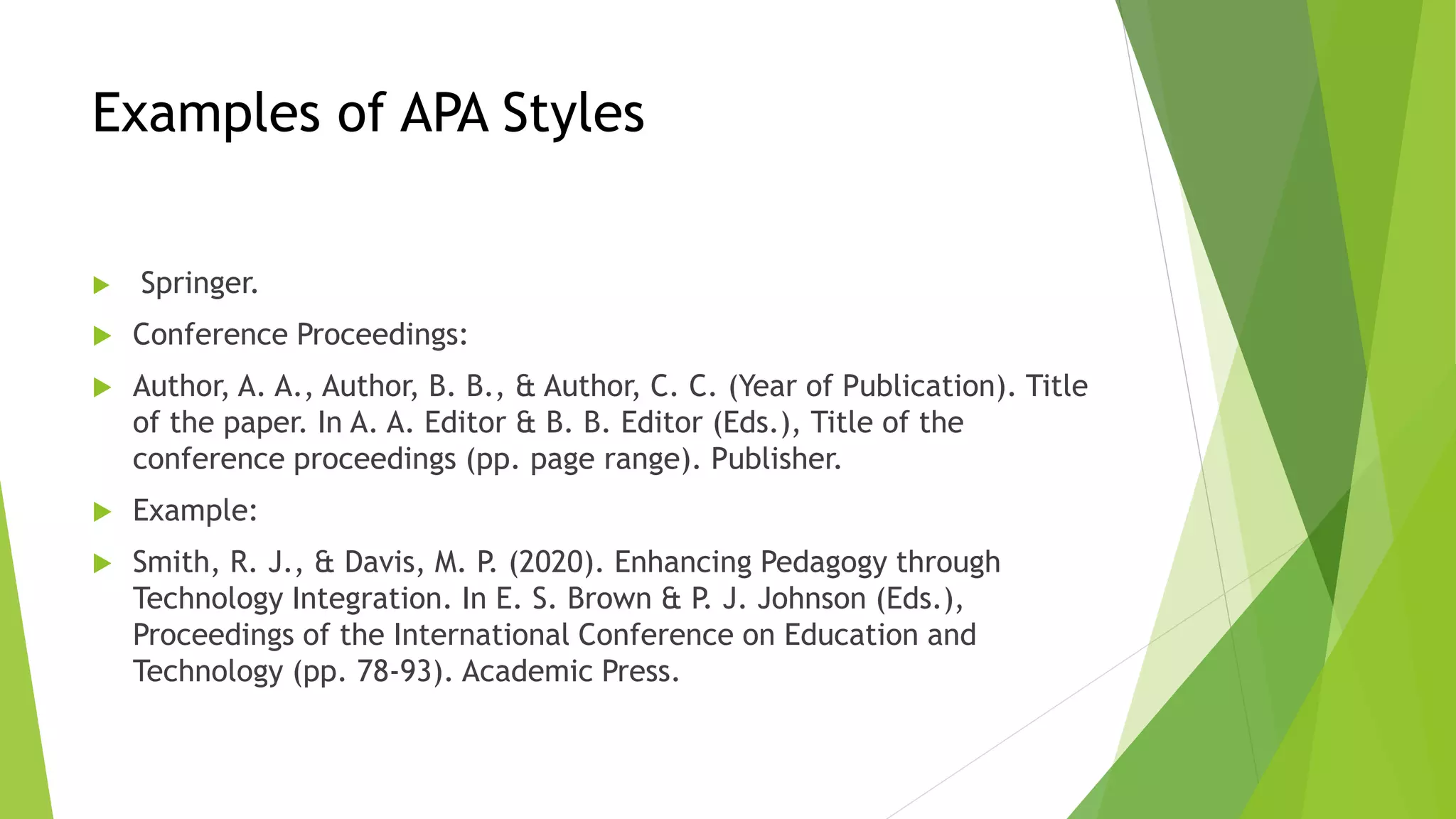
Springer.
Conference Proceedings:
Author, A. A., Author, B. B., & Author, C. C. (Year of Publication). Title
of the paper. In A. A. Editor & B. B. Editor (Eds.), Title of the
conference proceedings (pp. page range). Publisher.
Example:
Smith, R. J., & Davis, M. P. (2020). Enhancing Pedagogy through
Technology Integration. In E. S. Brown & P. J. Johnson (Eds.),
Proceedings of the International Conference on Education and
Technology (pp. 78-93). Academic Press.
13.
Examples of APAStyles
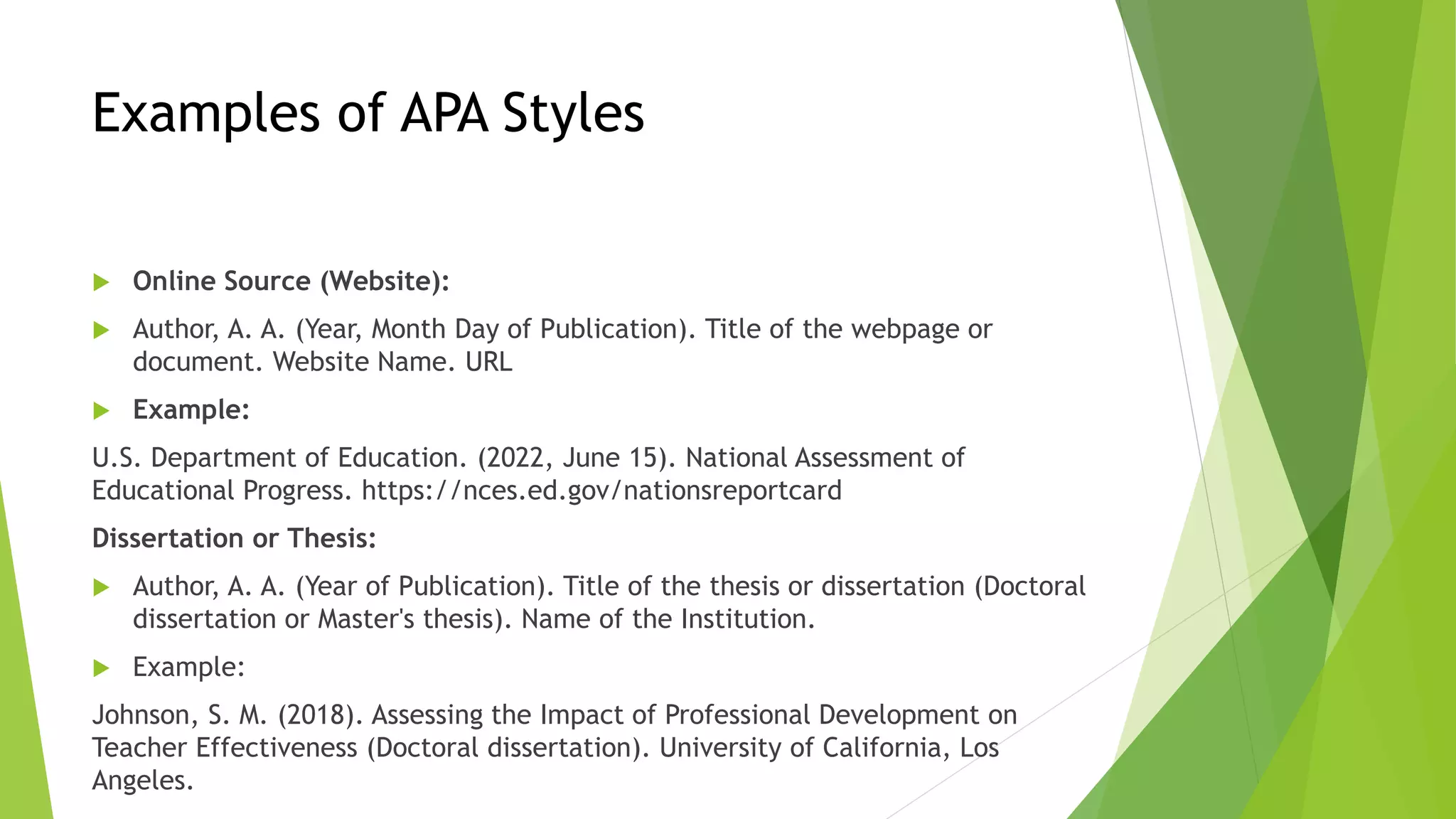
Online Source (Website):
Author, A. A. (Year, Month Day of Publication). Title of the webpage or
document. Website Name. URL
Example:
U.S. Department of Education. (2022, June 15). National Assessment of
Educational Progress. https://nces.ed.gov/nationsreportcard
Dissertation or Thesis:
Author, A. A. (Year of Publication). Title of the thesis or dissertation (Doctoral
dissertation or Master's thesis). Name of the Institution.
Example:
Johnson, S. M. (2018). Assessing the Impact of Professional Development on
Teacher Effectiveness (Doctoral dissertation). University of California, Los
Angeles.
14.
These are justa few examples of how to format
references in APA style according to the seventh
edition. Remember to follow the specific guidelines
provided in the Publication Manual or your
institution's requirements for your educational
research papers.