RESEARCH ARTICLE
STRUCTURE
Dr. Ahmed Meri
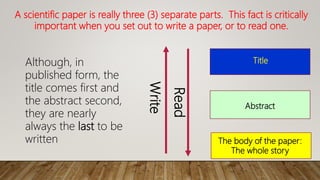
The body of the paper:
The whole story
Title
Abstract
A scientific paper is really three (3) separate parts. This fact is critically
important when you set out to write a paper, or to read one.
Although, in
published form, the
title comes first and
the abstract second,
they are nearly
always the last to be
written
Read
Write
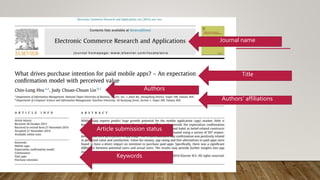
Journal name
Title
Authors
Authors’ affiliations
Article submission status
Keywords
Article’s structure varied based on the
type of the article and based on the
journal’s requirements
We will follow the standard structure
1. Helps your reader understand your
arguments.
2. Allow readers to cross-reference your
sources
easily once they are doing further research.
3. Provides consistent format.
4. Gives you credibility and reliability as a
writer.
Why use a consistent format?
A number of journals, including
some highly impacted ones like
Science and Nature, have very
different formats, but we’ll
focus on the standard format
used by the vast majority of
journals.
Standard structure
• Introduction
• Literature review OR Related works
• Research methodology OR Experimental procedure
• Results and discussion
• Conclusion
• Acknowledgement
• Bibliography
• Appendix (if any)
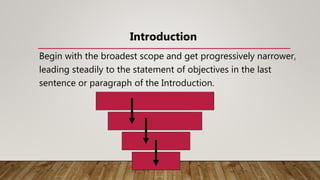
Begin with the broadest scope and get progressively narrower,
leading steadily to the statement of objectives in the last
sentence or paragraph of the Introduction.
Introduction
Introduction
• Define terms and context of the study.
• Background - the reasons the author(s) conducted the study;
theoretical framework
• Problem statement
• Significance of study OR Purpose of the study- the goal of the
research (the destination)
• Hypotheses OR RQs
• Paper organization (optional but preferable)
• Why is this work important?
• What are the implications of conducting this research?
• How does it stand to inform policy making and scientists?
• This should show how this project is significant to our body of
knowledge.
• It should establish why I would want to read on.
• It should also tell attract the reader to cite this work.
Significant of the study
Literature review
• The purpose of the literature review is to situate your research in
the context of what is already known about a topic.
• It need not be exhaustive.
• It should provide the theoretical basis for your work, show what has
been done in the area by others, and set the stage for your work.
• It should probably move from the more general to the more
focused studies, but need not be exhaustive, only relevant.
Four guide questions:
• What is the present state of knowledge regarding the topic
under consideration?
• How are the studies related to the one being proposed?
• What is the quality of the studies reviewed?
• How will the proposed study contribute to the existing
literature?
Literature review
MOST STUDENTS' LITERATURE REVIEWS SUFFER FROM THE
FOLLOWING PROBLEMS:
• Lacking organization and structure
• Lacking focus and unity
• Being repetitive
• Failing to cite influential papers
• Failing to keep up with recent developments
• Failing to critically evaluate cited papers
• Citing irrelevant references
• Depending too much on secondary sources
• Research approach and design should be highlighted first.
• What did you do to achieve your RO(s)?
• Materials (equipment, apparatus, measuring instruments) - what
was used, quality of measuring instruments.
• Procedures - how study was conducted; what subjects did or what
was done to them.
• Sometimes, the researchers rename this section into “Experimental
procedure” which indicate the same meaning depending on the
type of research you are conducting.
Research methodology
Results
• The technical interpretation of the research results.
• A description of the findings of the study as they pertain
to the hypotheses and goals.
• Should be presented in the form of text, figures, and/or
tables.
• No interpretation, no comparison, just the facts, with no
editorializing.
Discussion
• The style depends on the journals’ requirements to integrate
or separate results with the discussion section.
• Sometimes, results must be discussed in order to logically
point to the next stage in the research. In this case, combine
both sections.
• Compare and discuss the outcome of the study results.
• Give the reasons of any anomaly results.
• Contrast the study findings with other related works.
• Try to lead to the conclusion section,
Conclusion
• To sum up your findings and highlight the significance of
the outcomes of your study.
• To outline any implication or recommendations indicated
by the findings.
• To state any anomaly findings.
• To highlight the limitations of your research.
• To give direction for future works.
Acknowledgement
• Indicate source(s) of financial support.
• People who contributed with help in the field and/or
experiment (those whose contributions were less than
those expected for co-authorship).
• Only professional, not emotional help (find other ways to
thank your mother or your wife).
Bibliography
• All cited in-text references should be listed in this
section.
• Use a citation manager software (e.g. Mendeley,
Endnote, etc.).
• Follow the journals citation style.
• Avoid self-citation unless it is compulsory.
The whole story has been completed
Now we must write the Title and Abstract
Abstract
• To briefly introduce the reader to the aims of the study, the
methodology, results and findings.
• Questions that an abstract answers:
• Why did you do this study or project?
• What did you do and how?
• What did you find?
• What do your findings mean?
Abstract
• Scholars write their abstracts in different ways, some
start with the significant of the research and some others
start introducing the topic.
• After that, the method used.
• The findings and what is that means.
Title
• Simple and informative
• Attractive
• Most significant sentence of your entire paper
• Should focus on your keywords
• Reflect the area of research
• No abbreviations
• No tools (unless it made a contribution)
Title
• Most significant sentence of your entire paper
• Title should be attractive and grab your readers
• The title should say exactly what the paper is all about and no
more
• The title is not details of your paper
• Title should focus on your keywords
• Title should be short and informative not long and complex
Paraphrase!!!
Most of us never read a paper from start to finish:
Read the title first,
then the abstract,
then the last paragraph of the Introduction,
then the first paragraph of the Discussion/Conclusion,
look at the figures and tables.
Q & A
Thank You
Dr. Ahmed Meri
dr.meri@huciraq.edu.iq

Research article structure

  • 1.
  • 3.
    The body ofthe paper: The whole story Title Abstract A scientific paper is really three (3) separate parts. This fact is critically important when you set out to write a paper, or to read one. Although, in published form, the title comes first and the abstract second, they are nearly always the last to be written Read Write
  • 4.
  • 5.
    Article’s structure variedbased on the type of the article and based on the journal’s requirements We will follow the standard structure
  • 6.
    1. Helps yourreader understand your arguments. 2. Allow readers to cross-reference your sources easily once they are doing further research. 3. Provides consistent format. 4. Gives you credibility and reliability as a writer. Why use a consistent format?
  • 7.
    A number ofjournals, including some highly impacted ones like Science and Nature, have very different formats, but we’ll focus on the standard format used by the vast majority of journals.
  • 8.
    Standard structure • Introduction •Literature review OR Related works • Research methodology OR Experimental procedure • Results and discussion • Conclusion • Acknowledgement • Bibliography • Appendix (if any)
  • 9.
    Begin with thebroadest scope and get progressively narrower, leading steadily to the statement of objectives in the last sentence or paragraph of the Introduction. Introduction
  • 10.
    Introduction • Define termsand context of the study. • Background - the reasons the author(s) conducted the study; theoretical framework • Problem statement • Significance of study OR Purpose of the study- the goal of the research (the destination) • Hypotheses OR RQs • Paper organization (optional but preferable)
  • 11.
    • Why isthis work important? • What are the implications of conducting this research? • How does it stand to inform policy making and scientists? • This should show how this project is significant to our body of knowledge. • It should establish why I would want to read on. • It should also tell attract the reader to cite this work. Significant of the study
  • 12.
    Literature review • Thepurpose of the literature review is to situate your research in the context of what is already known about a topic. • It need not be exhaustive. • It should provide the theoretical basis for your work, show what has been done in the area by others, and set the stage for your work. • It should probably move from the more general to the more focused studies, but need not be exhaustive, only relevant.
  • 13.
    Four guide questions: •What is the present state of knowledge regarding the topic under consideration? • How are the studies related to the one being proposed? • What is the quality of the studies reviewed? • How will the proposed study contribute to the existing literature? Literature review
  • 14.
    MOST STUDENTS' LITERATUREREVIEWS SUFFER FROM THE FOLLOWING PROBLEMS: • Lacking organization and structure • Lacking focus and unity • Being repetitive • Failing to cite influential papers • Failing to keep up with recent developments • Failing to critically evaluate cited papers • Citing irrelevant references • Depending too much on secondary sources
  • 15.
    • Research approachand design should be highlighted first. • What did you do to achieve your RO(s)? • Materials (equipment, apparatus, measuring instruments) - what was used, quality of measuring instruments. • Procedures - how study was conducted; what subjects did or what was done to them. • Sometimes, the researchers rename this section into “Experimental procedure” which indicate the same meaning depending on the type of research you are conducting. Research methodology
  • 16.
    Results • The technicalinterpretation of the research results. • A description of the findings of the study as they pertain to the hypotheses and goals. • Should be presented in the form of text, figures, and/or tables. • No interpretation, no comparison, just the facts, with no editorializing.
  • 17.
    Discussion • The styledepends on the journals’ requirements to integrate or separate results with the discussion section. • Sometimes, results must be discussed in order to logically point to the next stage in the research. In this case, combine both sections. • Compare and discuss the outcome of the study results. • Give the reasons of any anomaly results. • Contrast the study findings with other related works. • Try to lead to the conclusion section,
  • 18.
    Conclusion • To sumup your findings and highlight the significance of the outcomes of your study. • To outline any implication or recommendations indicated by the findings. • To state any anomaly findings. • To highlight the limitations of your research. • To give direction for future works.
  • 19.
    Acknowledgement • Indicate source(s)of financial support. • People who contributed with help in the field and/or experiment (those whose contributions were less than those expected for co-authorship). • Only professional, not emotional help (find other ways to thank your mother or your wife).
  • 20.
    Bibliography • All citedin-text references should be listed in this section. • Use a citation manager software (e.g. Mendeley, Endnote, etc.). • Follow the journals citation style. • Avoid self-citation unless it is compulsory.
  • 21.
    The whole storyhas been completed Now we must write the Title and Abstract
  • 22.
    Abstract • To brieflyintroduce the reader to the aims of the study, the methodology, results and findings. • Questions that an abstract answers: • Why did you do this study or project? • What did you do and how? • What did you find? • What do your findings mean?
  • 23.
    Abstract • Scholars writetheir abstracts in different ways, some start with the significant of the research and some others start introducing the topic. • After that, the method used. • The findings and what is that means.
  • 24.
    Title • Simple andinformative • Attractive • Most significant sentence of your entire paper • Should focus on your keywords • Reflect the area of research • No abbreviations • No tools (unless it made a contribution)
  • 25.
    Title • Most significantsentence of your entire paper • Title should be attractive and grab your readers • The title should say exactly what the paper is all about and no more • The title is not details of your paper • Title should focus on your keywords • Title should be short and informative not long and complex
  • 26.
  • 27.
    Most of usnever read a paper from start to finish: Read the title first, then the abstract, then the last paragraph of the Introduction, then the first paragraph of the Discussion/Conclusion, look at the figures and tables.
  • 28.
  • 29.
    Thank You Dr. AhmedMeri dr.meri@huciraq.edu.iq