Ethics and Referencing Styles
Dr Goitom A. Portion 6
Research Ethics:
• Research ethics are the moral principles that
govern how researchers should carry out their
work.
• These principles are used to shape research
regulations agreed by groups such as university
governing bodies, communities or governments.
• All researchers should follow any regulations
that apply to their work.
Research Ethics.....
• As a concept, ‘research ethics’ refers to a
complex set of values, standards and
institutional schemes that help constitute and
regulate scientific activity.
• Ultimately, research ethics is a codification of
ethics of science in practice.
• In other words, it is based on general ethics of
science, just as general ethics is based on
commonsense morality.
Research Ethics guidelines and
concerns:
• Freedom of Research and Society
• Respects for Individuals
• Regard for Groups and Institutions
• The Research Community
• Contract Research
• Science Communication
The Meaning of Referencing :
• It is a method used to demonstrate to your
readers that you have conducted a thorough
and appropriate literature search, and reading.
• Referencing is an acknowledgement that you
have used the ideas and written material
belonging to other authors in your own work.
• As with all referencing styles, there are two
parts: citing, and the reference list.
Reasons for the Referencing :
• Reference use to standardized style to
acknowledge the source of information used in
your assignment.
• It is important (morally & legally) to
acknowledge someone else’s ideas or words
you have used.
• If you use someone else’s words or work and
fail to acknowledge them – you may be accused
of plagiarism and infringing copyright.
• Referencing correctly enables the marker or
reader of your assignment to locate the source
of the information.
• They can verify the information or read further
on the topic.
• Referencing also allows for you to retrace your
steps and locate information you have used for
assignments and discover further views or ideas
discussed by the author.
• By referencing clearly and correctly, it
demonstrates you have undertaken research on
the assignment topic and located relevant
information.
• Accurate referencing is a key component of
good academic practice and enhances the
presentation of your work: it shows that your
writing is based on knowledge and informed by
appropriate academic reading.
• You will ensure that anyone reading your work
can trace the sources you have used in the
development of your work, and give you credit
for your research efforts and quality.
Common Referencing Styles:
1. APA (American Psychological Association)
Style
• APA style (also known as APA format) is a writing style and format
for academic documents such as scholarly journal articles and books.
• It is commonly used for citing sources within the field of behavioral
and social sciences, including sociology, education, health sciences,
criminal justice, and anthropology, as well as psychology.
• It is described in the style guide of the
American Psychological Association (APA), which is titled
the Publication Manual of the American Psychological Association.
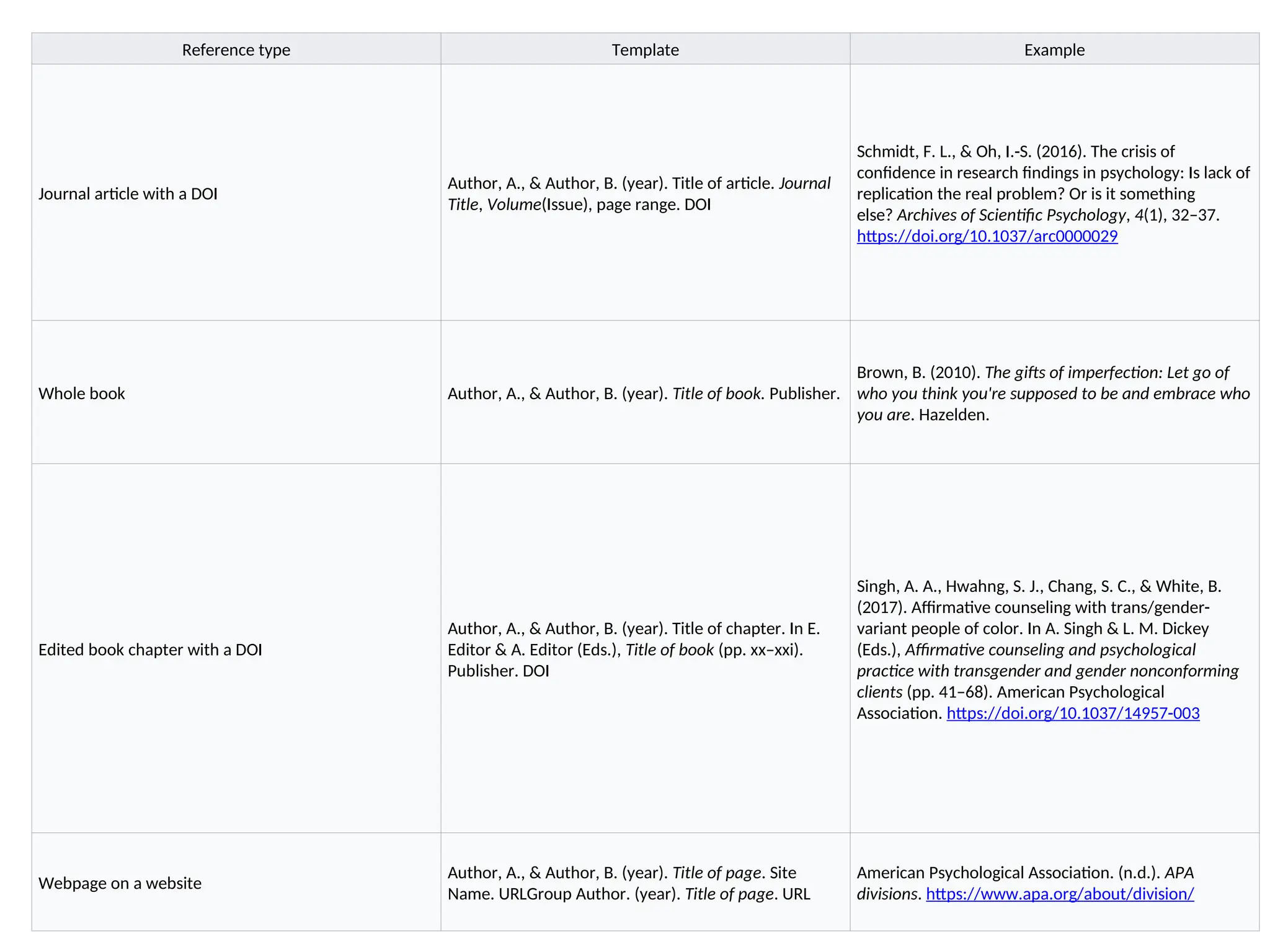
Reference type Template Example
Journal article with a DOI
Author, A., & Author, B. (year). Title of article. Journal
Title, Volume(Issue), page range. DOI
Schmidt, F. L., & Oh, I.-S. (2016). The crisis of
confidence in research findings in psychology: Is lack of
replication the real problem? Or is it something
else? Archives of Scientific Psychology, 4(1), 32–37.
https://doi.org/10.1037/arc0000029
Whole book Author, A., & Author, B. (year). Title of book. Publisher.
Brown, B. (2010). The gifts of imperfection: Let go of
who you think you're supposed to be and embrace who
you are. Hazelden.
Edited book chapter with a DOI
Author, A., & Author, B. (year). Title of chapter. In E.
Editor & A. Editor (Eds.), Title of book (pp. xx–xxi).
Publisher. DOI
Singh, A. A., Hwahng, S. J., Chang, S. C., & White, B.
(2017). Affirmative counseling with trans/gender-
variant people of color. In A. Singh & L. M. Dickey
(Eds.), Affirmative counseling and psychological
practice with transgender and gender nonconforming
clients (pp. 41–68). American Psychological
Association. https://doi.org/10.1037/14957-003
Webpage on a website
Author, A., & Author, B. (year). Title of page. Site
Name. URLGroup Author. (year). Title of page. URL
American Psychological Association. (n.d.). APA
divisions. https://www.apa.org/about/division/
2. Harvard Referencing Style
• The Harvard citation style is a system that
students, writers and researchers can use to
incorporate other people’s quotes, findings and
ideas into their work in order to support and
validate their conclusions without breaching any
intellectual property laws.
• The popular format is typically used in
assignments and publications for humanities as
well as natural, social and behavioral sciences.
• In the author–date method (Harvard
referencing),[4]
the in-text citation is placed in
parentheses after the sentence or part
thereof that the citation supports.
• The citation includes the author's name, year
of publication, and page number(s) when a
specific part of the source is referred to (Smith
2008, p. 1) or (Smith 2008:1).
• An example of a journal reference:
• Heilman, J. M. and West, A. G. (2015). "Wikipedia and Medicine: Quantifying
Readership, Editors, and the Significance of Natural Language." Journal of Medical
Internet Research, 17(3), p. e62. doi:10.2196/jmir.4069.
• Following is an explanation of the components, where the coloring is for
demonstration purposes and is not used in actual formatting:
Heilman, J. M. and West, A. G. (2015). "Wikipedia and Medicine: Quantifying
Readership, Editors, and the Significance of Natural Language." Journal of Medical
Internet Research, 17 (3), p.e62. doi:10.2196/jmir.4069.
• Author(s) first listed author's name inverted in the bibliography entry
• Year
• Article title
• Journal title in italic type
• Volume[10]
• Issue[10]
• Page numbers[note 1]
specific page number in a note; page range in a bibliography
entry
• Digital object identifier
Thanks
Questions/Comments

Research Methodology Lecture Portion 6.ppt

  • 1.
    Ethics and ReferencingStyles Dr Goitom A. Portion 6
  • 2.
    Research Ethics: • Researchethics are the moral principles that govern how researchers should carry out their work. • These principles are used to shape research regulations agreed by groups such as university governing bodies, communities or governments. • All researchers should follow any regulations that apply to their work.
  • 3.
    Research Ethics..... • Asa concept, ‘research ethics’ refers to a complex set of values, standards and institutional schemes that help constitute and regulate scientific activity. • Ultimately, research ethics is a codification of ethics of science in practice. • In other words, it is based on general ethics of science, just as general ethics is based on commonsense morality.
  • 4.
    Research Ethics guidelinesand concerns: • Freedom of Research and Society • Respects for Individuals • Regard for Groups and Institutions • The Research Community • Contract Research • Science Communication
  • 5.
    The Meaning ofReferencing : • It is a method used to demonstrate to your readers that you have conducted a thorough and appropriate literature search, and reading. • Referencing is an acknowledgement that you have used the ideas and written material belonging to other authors in your own work. • As with all referencing styles, there are two parts: citing, and the reference list.
  • 6.
    Reasons for theReferencing : • Reference use to standardized style to acknowledge the source of information used in your assignment. • It is important (morally & legally) to acknowledge someone else’s ideas or words you have used. • If you use someone else’s words or work and fail to acknowledge them – you may be accused of plagiarism and infringing copyright.
  • 7.
    • Referencing correctlyenables the marker or reader of your assignment to locate the source of the information. • They can verify the information or read further on the topic. • Referencing also allows for you to retrace your steps and locate information you have used for assignments and discover further views or ideas discussed by the author. • By referencing clearly and correctly, it demonstrates you have undertaken research on the assignment topic and located relevant information.
  • 8.
    • Accurate referencingis a key component of good academic practice and enhances the presentation of your work: it shows that your writing is based on knowledge and informed by appropriate academic reading. • You will ensure that anyone reading your work can trace the sources you have used in the development of your work, and give you credit for your research efforts and quality.
  • 9.
    Common Referencing Styles: 1.APA (American Psychological Association) Style • APA style (also known as APA format) is a writing style and format for academic documents such as scholarly journal articles and books. • It is commonly used for citing sources within the field of behavioral and social sciences, including sociology, education, health sciences, criminal justice, and anthropology, as well as psychology. • It is described in the style guide of the American Psychological Association (APA), which is titled the Publication Manual of the American Psychological Association.
  • 10.
    Reference type TemplateExample Journal article with a DOI Author, A., & Author, B. (year). Title of article. Journal Title, Volume(Issue), page range. DOI Schmidt, F. L., & Oh, I.-S. (2016). The crisis of confidence in research findings in psychology: Is lack of replication the real problem? Or is it something else? Archives of Scientific Psychology, 4(1), 32–37. https://doi.org/10.1037/arc0000029 Whole book Author, A., & Author, B. (year). Title of book. Publisher. Brown, B. (2010). The gifts of imperfection: Let go of who you think you're supposed to be and embrace who you are. Hazelden. Edited book chapter with a DOI Author, A., & Author, B. (year). Title of chapter. In E. Editor & A. Editor (Eds.), Title of book (pp. xx–xxi). Publisher. DOI Singh, A. A., Hwahng, S. J., Chang, S. C., & White, B. (2017). Affirmative counseling with trans/gender- variant people of color. In A. Singh & L. M. Dickey (Eds.), Affirmative counseling and psychological practice with transgender and gender nonconforming clients (pp. 41–68). American Psychological Association. https://doi.org/10.1037/14957-003 Webpage on a website Author, A., & Author, B. (year). Title of page. Site Name. URLGroup Author. (year). Title of page. URL American Psychological Association. (n.d.). APA divisions. https://www.apa.org/about/division/
  • 11.
    2. Harvard ReferencingStyle • The Harvard citation style is a system that students, writers and researchers can use to incorporate other people’s quotes, findings and ideas into their work in order to support and validate their conclusions without breaching any intellectual property laws. • The popular format is typically used in assignments and publications for humanities as well as natural, social and behavioral sciences.
  • 12.
    • In theauthor–date method (Harvard referencing),[4] the in-text citation is placed in parentheses after the sentence or part thereof that the citation supports. • The citation includes the author's name, year of publication, and page number(s) when a specific part of the source is referred to (Smith 2008, p. 1) or (Smith 2008:1).
  • 13.
    • An exampleof a journal reference: • Heilman, J. M. and West, A. G. (2015). "Wikipedia and Medicine: Quantifying Readership, Editors, and the Significance of Natural Language." Journal of Medical Internet Research, 17(3), p. e62. doi:10.2196/jmir.4069. • Following is an explanation of the components, where the coloring is for demonstration purposes and is not used in actual formatting: Heilman, J. M. and West, A. G. (2015). "Wikipedia and Medicine: Quantifying Readership, Editors, and the Significance of Natural Language." Journal of Medical Internet Research, 17 (3), p.e62. doi:10.2196/jmir.4069. • Author(s) first listed author's name inverted in the bibliography entry • Year • Article title • Journal title in italic type • Volume[10] • Issue[10] • Page numbers[note 1] specific page number in a note; page range in a bibliography entry • Digital object identifier
  • 14.