MT 402 - FINANCIAL ACCOUNTING & MANAGEMENT
OPERATING LEVERAGE
Group Members-
1. Susmita Maity – MBA/10023/21
2. Priyanka Kumari – MBA/10024/21
3. Nishi Rani- MBA/10073/21
4. Sabina Sinku – MBA/10074/21
CONTENTS -
• Introduction of Operating Leverages
• Importance of operating leverages
• Degree of operating leverages
• Positive / negative DOL
• Advantages and disadvantages
• Which operating leverages is better {higher/lower}?
• Conclusion
INTRODUCTION
• Operating leverages affects a firm’s operating profit
(EBIT).
• Operating leverage measures a company’s change in the
earning before interest taxes relative to a given change in
sales.
• It is used to evaluate the breakeven point of a business.
The combined effect of two leverages can be significant
for the earnings available to ordinary shareholder.
IMPORTANCE
• Operating leverage is one of the techniques to measure
the impact of changes in sales which lead for change in
the profits of the company.
• It helps understand the appropriate price-point for
covering your costs and generating a profit.
• It drives a company's pricing strategy.
DEGREE OF OPERATING LEVERAGE
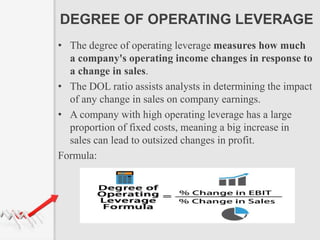
• The degree of operating leverage measures how much
a company's operating income changes in response to
a change in sales.
• The DOL ratio assists analysts in determining the impact
of any change in sales on company earnings.
• A company with high operating leverage has a large
proportion of fixed costs, meaning a big increase in
sales can lead to outsized changes in profit.
Formula:
POSITIVE / NEGATIVE DOL
A negative value means that a business is operating under its break
-even point.
A positive ratio indicates that the level of business activity exceeds
the break-even point.
Red – negative value
Blue – positive value
ADVANTAGE DISADVANTAGE
• Allows to improve the company`s
utility in efficient way
• Overviews the sales of operating
income
• Helps in formulating more
accurately project by analyzing the
previous years figures
• High operating leverage result
in higher risk
• High capital cost of
equipment which makes such
investment it expensive
Which operating leverages is better?
Higher operating leverage –
• In a high operating leverage situation, a large
proportion of the companies costs are fixed
cost
• In this case, the firm earns a large profit on
each incremental sale.
• Companies with high degree of operating
leverage experience more significant changes
in profit when revenue changes
Lower operating leverage –
• In a low operating leverage, a large proportion
of the companies sale are variable costs.
• In this case, the firms earns a smaller profit on
each incremental sale.
• A Companies with relatively low degree of
operating leverage has mild changes when sale
revenue fluctuates.
From this we get to know that high operating leverage
is better than low operating leverage, as it allows
businesses to earn large profit on each incremental sale.
But most of the companies generally prefer lower
operating leverage so that even in cases where the
market is slow, it would not be difficult for them to
cover the fixed costs.
REFERENCE
• http://managerialaccountingpro.com/degree-of-operating-
leverage/
• https://www.investopedia.com/terms/o/operatingleverage.
asp
• https://www.slideshare.net/operating-financial-and-combin
ed-leverage
• https://slideplayer.com/slide/7462556/
• https://www.slideshare.net/leverage-operating-financial-co
mbined-leverage
THANK YOU

Operating Leverage

  • 1.
    MT 402 -FINANCIAL ACCOUNTING & MANAGEMENT OPERATING LEVERAGE Group Members- 1. Susmita Maity – MBA/10023/21 2. Priyanka Kumari – MBA/10024/21 3. Nishi Rani- MBA/10073/21 4. Sabina Sinku – MBA/10074/21
  • 2.
    CONTENTS - • Introductionof Operating Leverages • Importance of operating leverages • Degree of operating leverages • Positive / negative DOL • Advantages and disadvantages • Which operating leverages is better {higher/lower}? • Conclusion
  • 3.
    INTRODUCTION • Operating leveragesaffects a firm’s operating profit (EBIT). • Operating leverage measures a company’s change in the earning before interest taxes relative to a given change in sales. • It is used to evaluate the breakeven point of a business. The combined effect of two leverages can be significant for the earnings available to ordinary shareholder.
  • 4.
    IMPORTANCE • Operating leverageis one of the techniques to measure the impact of changes in sales which lead for change in the profits of the company. • It helps understand the appropriate price-point for covering your costs and generating a profit. • It drives a company's pricing strategy.
  • 5.
    DEGREE OF OPERATINGLEVERAGE • The degree of operating leverage measures how much a company's operating income changes in response to a change in sales. • The DOL ratio assists analysts in determining the impact of any change in sales on company earnings. • A company with high operating leverage has a large proportion of fixed costs, meaning a big increase in sales can lead to outsized changes in profit. Formula:
  • 6.
    POSITIVE / NEGATIVEDOL A negative value means that a business is operating under its break -even point. A positive ratio indicates that the level of business activity exceeds the break-even point. Red – negative value Blue – positive value
  • 7.
    ADVANTAGE DISADVANTAGE • Allowsto improve the company`s utility in efficient way • Overviews the sales of operating income • Helps in formulating more accurately project by analyzing the previous years figures • High operating leverage result in higher risk • High capital cost of equipment which makes such investment it expensive
  • 8.
    Which operating leveragesis better? Higher operating leverage – • In a high operating leverage situation, a large proportion of the companies costs are fixed cost • In this case, the firm earns a large profit on each incremental sale. • Companies with high degree of operating leverage experience more significant changes in profit when revenue changes
  • 9.
    Lower operating leverage– • In a low operating leverage, a large proportion of the companies sale are variable costs. • In this case, the firms earns a smaller profit on each incremental sale. • A Companies with relatively low degree of operating leverage has mild changes when sale revenue fluctuates.
  • 10.
    From this weget to know that high operating leverage is better than low operating leverage, as it allows businesses to earn large profit on each incremental sale. But most of the companies generally prefer lower operating leverage so that even in cases where the market is slow, it would not be difficult for them to cover the fixed costs.
  • 11.
    REFERENCE • http://managerialaccountingpro.com/degree-of-operating- leverage/ • https://www.investopedia.com/terms/o/operatingleverage. asp •https://www.slideshare.net/operating-financial-and-combin ed-leverage • https://slideplayer.com/slide/7462556/ • https://www.slideshare.net/leverage-operating-financial-co mbined-leverage
  • 12.