Cutting Tools
(specifically on
Punches)
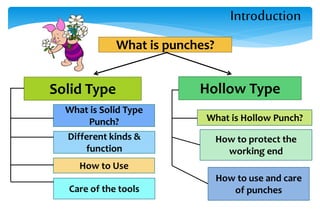
Introduction
What is punches?
Solid Type
What is Solid Type
Punch?
Different kinds &
function
How to Use
Care of the tools
Hollow Type
How to use and care
of punches
What is Hollow Punch?
How to protect the
working end
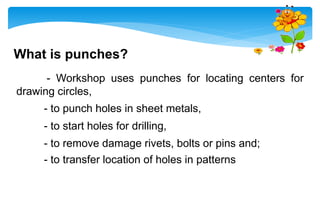
What is punches?
- Workshop uses punches for locating centers for
drawing circles,
- to punch holes in sheet metals,
- to start holes for drilling,
- to remove damage rivets, bolts or pins and;
- to transfer location of holes in patterns
2 Basic Types
of Punches
 SOLID TYPE
 HOLLOW TYPE
What is SOLID TYPE?
- are the one-piece rod shaped tools made of metal
designed to be struck by hammer,
- it is used to mark metal, drive pins, align holes and to do
other similar jobs to form on a work piece
- can vary in diameter, length and tip, depending on the
job to be performed
What is HOLLOW TYPE?
- are usually designed for punching holes in leather, paper
and other similar materials to create a hole
- is easily identified by its “exit hole” located near the
working end
- the exit hole allows the punched material to be removed
and discarded
- the working end can vary in shape and size depending
on the hole required and the material being pierced
MOST COMMON SOLID PUNCHES
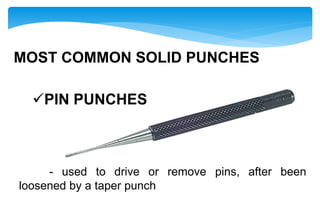
PIN PUNCHES
- used to drive or remove pins, after been
loosened by a taper punch
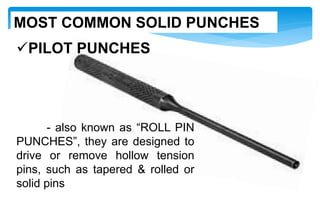
PILOT PUNCHES
- also known as “ROLL PIN
PUNCHES”, they are designed to
drive or remove hollow tension
pins, such as tapered & rolled or
solid pins
MOST COMMON SOLID PUNCHES
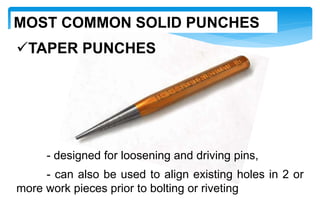
TAPER PUNCHES
- designed for loosening and driving pins,
- can also be used to align existing holes in 2 or
more work pieces prior to bolting or riveting
MOST COMMON SOLID PUNCHES
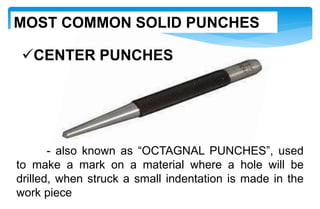
CENTER PUNCHES
- also known as “OCTAGNAL PUNCHES”, used
to make a mark on a material where a hole will be
drilled, when struck a small indentation is made in the
work piece
MOST COMMON SOLID PUNCHES
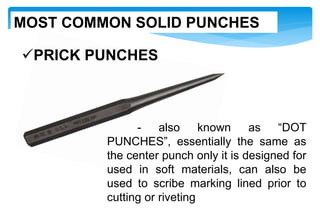
PRICK PUNCHES
- also known as “DOT
PUNCHES”, essentially the same as
the center punch only it is designed for
used in soft materials, can also be
used to scribe marking lined prior to
cutting or riveting
MOST COMMON SOLID PUNCHES
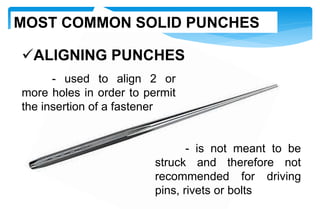
ALIGNING PUNCHES
- used to align 2 or
more holes in order to permit
the insertion of a fastener
- is not meant to be
struck and therefore not
recommended for driving
pins, rivets or bolts
MOST COMMON SOLID PUNCHES
 Grabbing a PIN PUNCH to break/loose a pin,
when the proper tool to use would be a
TAPERED PUNCH
COMMON MISTAKES AND
CORRECT USE
 A TAPERED PUNCH is specifically designed
to take the heavy pounding needed to loosen
pins
 Using a PIN PUNCH to start the initial
removal can damage punch and the part
being driven, the result is reduced
productivity and increased risk to personal
safety
COMMON MISTAKES AND
CORRECT USE
 The correct approach for breaking a pin loose is
to start with a taper punch then switch to the pin
punch to complete the removal
 For this reason, it is highly recommended that
mechanics have a matching tapered punch
every pin punch in their tool box
COMMON MISTAKES AND
CORRECT USE
 It is recommended that a board made of either
wood or plastic be placed between work
surface and material being pierced
 This board should be strong enough to protect
the work surface and yet soft enough to prevent
the working end from being damage
HOW TO PROTECT THE
WORKING END
 PRICK OR DOT PUNCH
 CENTER OR OCTAGONAL PUNCHES
METAL WORKS
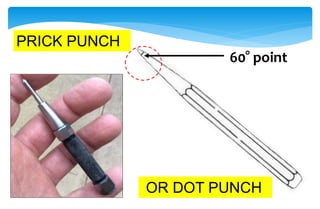
60° point
OR DOT PUNCH
PRICK PUNCH
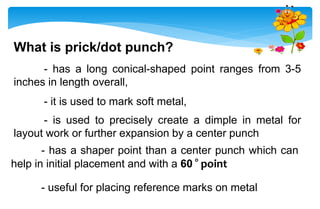
What is prick/dot punch?
- has a long conical-shaped point ranges from 3-5
inches in length overall,
- it is used to mark soft metal,
- is used to precisely create a dimple in metal for
layout work or further expansion by a center punch
- has a shaper point than a center punch which can
help in initial placement and with a 60 ° point
- useful for placing reference marks on metal
STEPS IN USING
PRICK PUNCH
IN
PLACING
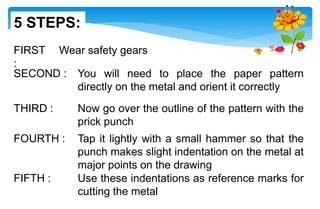
FIRST
:
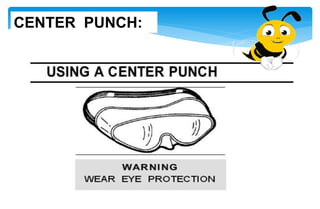
Wear safety gears
SECOND : You will need to place the paper pattern
directly on the metal and orient it correctly
THIRD : Now go over the outline of the pattern with the
prick punch
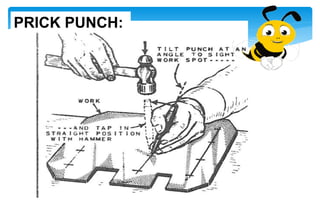
FOURTH : Tap it lightly with a small hammer so that the
punch makes slight indentation on the metal at
major points on the drawing
FIFTH : Use these indentations as reference marks for
cutting the metal
5 STEPS:
REMEMBER :
Be careful NEVER TO STRIKE A
HEAVY BLOW with the hammer as
it may cause the PRICK PUNCH to
bend or even damage the work
material excessively
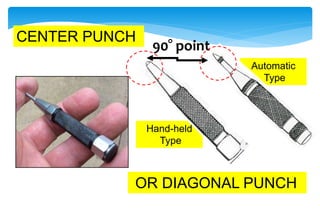
Automatic
Type
Hand-held
Type
90° point
OR DIAGONAL PUNCH
CENTER PUNCH
What is center/octagonal punch?
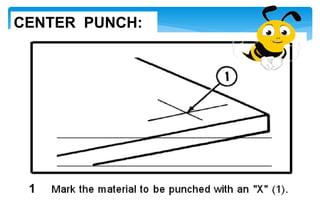
- is useful when making large indentations in
metal, such as necessary to engage a twist drill
- usually a center punch is heavier than a prick
punch and has a point ground to an angle of 60 ° point
 HAND-HELD TYPE
 THE AUTOMATIC TYPE
2 Kinds of Center
Punches
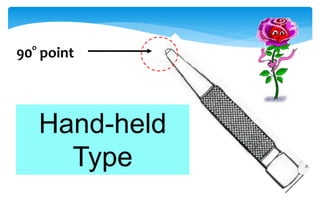
HAND-HELD TYPE
- has a narrow, cone-shaped point terminating in
a sharp conical tip
- hand-held types; range from 1/8 to 5/8 inches
in diameter and from 3 to 6 inches in long
- the hand-held punch must be stuck with a
hammer
Hand-held
Type
90° point
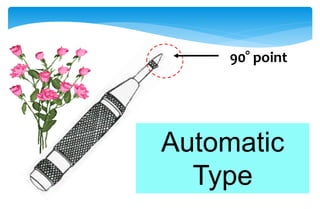
AUTOMATIC TYPE
- it has an adjustable regulator for determining the
impact of the punch
- it has also interchangeable points
- the automatic punch contains a tension spring
for marking without the use of a hammer
Automatic
Type
90° point
PARTS
OF
A
PUNCH TOOL
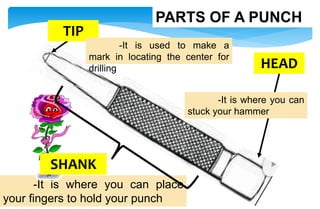
-It is where you can place
your fingers to hold your punch
HEAD
SHANK
TIP
PARTS OF A PUNCH
-It is where you can
stuck your hammer
-It is used to make a
mark in locating the center for
drilling
HOW TO
USE
A
PUNCH TOOL
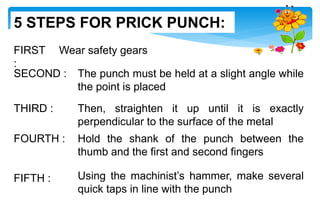
FIRST
:
Wear safety gears
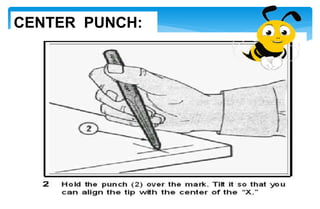
SECOND : The punch must be held at a slight angle while
the point is placed
THIRD : Then, straighten it up until it is exactly
perpendicular to the surface of the metal
FOURTH : Hold the shank of the punch between the
thumb and the first and second fingers
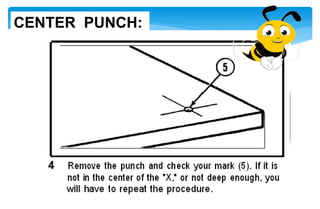
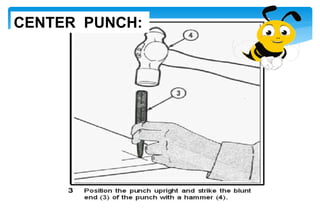
FIFTH : Using the machinist’s hammer, make several
quick taps in line with the punch
5 STEPS FOR PRICK PUNCH:
PRICK PUNCH:
CENTER PUNCH:
CENTER PUNCH:
CENTER PUNCH:
CENTER PUNCH:
CENTER PUNCH:
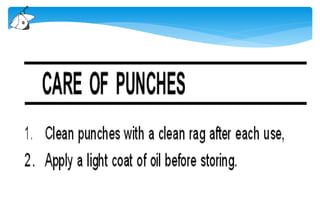
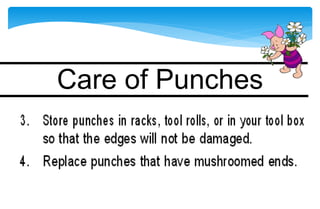
Care
of
Punches
Care of Punches
Thank
You ! 

Punches

  • 1.
  • 2.
    Introduction What is punches? SolidType What is Solid Type Punch? Different kinds & function How to Use Care of the tools Hollow Type How to use and care of punches What is Hollow Punch? How to protect the working end
  • 3.
    What is punches? -Workshop uses punches for locating centers for drawing circles, - to punch holes in sheet metals, - to start holes for drilling, - to remove damage rivets, bolts or pins and; - to transfer location of holes in patterns
  • 4.
    2 Basic Types ofPunches  SOLID TYPE  HOLLOW TYPE
  • 5.
    What is SOLIDTYPE? - are the one-piece rod shaped tools made of metal designed to be struck by hammer, - it is used to mark metal, drive pins, align holes and to do other similar jobs to form on a work piece - can vary in diameter, length and tip, depending on the job to be performed
  • 6.
    What is HOLLOWTYPE? - are usually designed for punching holes in leather, paper and other similar materials to create a hole - is easily identified by its “exit hole” located near the working end - the exit hole allows the punched material to be removed and discarded - the working end can vary in shape and size depending on the hole required and the material being pierced
  • 7.
    MOST COMMON SOLIDPUNCHES PIN PUNCHES - used to drive or remove pins, after been loosened by a taper punch
  • 8.
    PILOT PUNCHES - alsoknown as “ROLL PIN PUNCHES”, they are designed to drive or remove hollow tension pins, such as tapered & rolled or solid pins MOST COMMON SOLID PUNCHES
  • 9.
    TAPER PUNCHES - designedfor loosening and driving pins, - can also be used to align existing holes in 2 or more work pieces prior to bolting or riveting MOST COMMON SOLID PUNCHES
  • 10.
    CENTER PUNCHES - alsoknown as “OCTAGNAL PUNCHES”, used to make a mark on a material where a hole will be drilled, when struck a small indentation is made in the work piece MOST COMMON SOLID PUNCHES
  • 11.
    PRICK PUNCHES - alsoknown as “DOT PUNCHES”, essentially the same as the center punch only it is designed for used in soft materials, can also be used to scribe marking lined prior to cutting or riveting MOST COMMON SOLID PUNCHES
  • 12.
    ALIGNING PUNCHES - usedto align 2 or more holes in order to permit the insertion of a fastener - is not meant to be struck and therefore not recommended for driving pins, rivets or bolts MOST COMMON SOLID PUNCHES
  • 13.
     Grabbing aPIN PUNCH to break/loose a pin, when the proper tool to use would be a TAPERED PUNCH COMMON MISTAKES AND CORRECT USE  A TAPERED PUNCH is specifically designed to take the heavy pounding needed to loosen pins
  • 14.
     Using aPIN PUNCH to start the initial removal can damage punch and the part being driven, the result is reduced productivity and increased risk to personal safety COMMON MISTAKES AND CORRECT USE
  • 15.
     The correctapproach for breaking a pin loose is to start with a taper punch then switch to the pin punch to complete the removal  For this reason, it is highly recommended that mechanics have a matching tapered punch every pin punch in their tool box COMMON MISTAKES AND CORRECT USE
  • 16.
     It isrecommended that a board made of either wood or plastic be placed between work surface and material being pierced  This board should be strong enough to protect the work surface and yet soft enough to prevent the working end from being damage HOW TO PROTECT THE WORKING END
  • 17.
     PRICK ORDOT PUNCH  CENTER OR OCTAGONAL PUNCHES METAL WORKS
  • 18.
    60° point OR DOTPUNCH PRICK PUNCH
  • 19.
    What is prick/dotpunch? - has a long conical-shaped point ranges from 3-5 inches in length overall, - it is used to mark soft metal, - is used to precisely create a dimple in metal for layout work or further expansion by a center punch - has a shaper point than a center punch which can help in initial placement and with a 60 ° point - useful for placing reference marks on metal
  • 20.
    STEPS IN USING PRICKPUNCH IN PLACING
  • 21.
    FIRST : Wear safety gears SECOND: You will need to place the paper pattern directly on the metal and orient it correctly THIRD : Now go over the outline of the pattern with the prick punch FOURTH : Tap it lightly with a small hammer so that the punch makes slight indentation on the metal at major points on the drawing FIFTH : Use these indentations as reference marks for cutting the metal 5 STEPS:
  • 22.
    REMEMBER : Be carefulNEVER TO STRIKE A HEAVY BLOW with the hammer as it may cause the PRICK PUNCH to bend or even damage the work material excessively
  • 23.
  • 24.
    What is center/octagonalpunch? - is useful when making large indentations in metal, such as necessary to engage a twist drill - usually a center punch is heavier than a prick punch and has a point ground to an angle of 60 ° point
  • 25.
     HAND-HELD TYPE THE AUTOMATIC TYPE 2 Kinds of Center Punches
  • 26.
    HAND-HELD TYPE - hasa narrow, cone-shaped point terminating in a sharp conical tip - hand-held types; range from 1/8 to 5/8 inches in diameter and from 3 to 6 inches in long - the hand-held punch must be stuck with a hammer
  • 27.
  • 28.
    AUTOMATIC TYPE - ithas an adjustable regulator for determining the impact of the punch - it has also interchangeable points - the automatic punch contains a tension spring for marking without the use of a hammer
  • 29.
  • 30.
  • 31.
    -It is whereyou can place your fingers to hold your punch HEAD SHANK TIP PARTS OF A PUNCH -It is where you can stuck your hammer -It is used to make a mark in locating the center for drilling
  • 32.
  • 33.
    FIRST : Wear safety gears SECOND: The punch must be held at a slight angle while the point is placed THIRD : Then, straighten it up until it is exactly perpendicular to the surface of the metal FOURTH : Hold the shank of the punch between the thumb and the first and second fingers FIFTH : Using the machinist’s hammer, make several quick taps in line with the punch 5 STEPS FOR PRICK PUNCH:
  • 34.
  • 35.
  • 36.
  • 37.
  • 38.
  • 39.
  • 40.
  • 42.
  • 43.