Basic Punching Theory
The ‘BIG 3’ Problems Die clearance too small  Poor or no maintenance on the tool Turret alignment requires adjustment
   Punching a hole Die Clearance Punch Tonnage Choosing the right tool Correct tool maintenance … Basic Hole Punching Theory
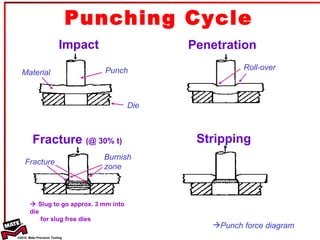
Punching Cycle Impact Penetration Fracture  (@ 30% t) Stripping Material Punch Die    Slug to go approx. 3 mm into die   for slug free dies Roll-over Burnish zone Fracture Punch force diagram
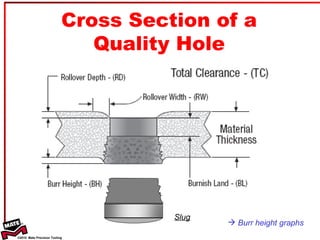
Cross Section of a Quality Hole Burr height graphs Slug
The ‘BIG 3’ Problems Die clearance too small Poor or no maintenance on the tool Turret alignment requires adjustment
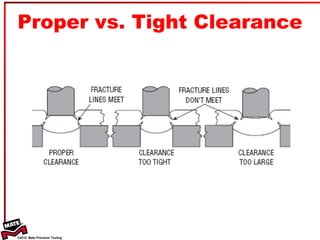
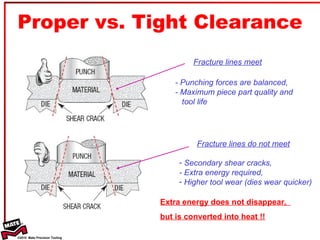
Proper vs. Tight Clearance
Proper vs. Tight Clearance Extra energy does not disappear,  but is converted into heat !! - Punching forces are balanced,  - Maximum piece part quality and   tool life Fracture lines meet Fracture lines do not meet Secondary shear cracks,  - Extra energy required, Higher tool wear (dies wear quicker)
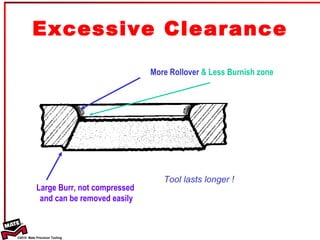
Excessive Clearance Tool lasts longer ! Large Burr, not compressed  and can be removed easily More Rollover   & Less Burnish zone
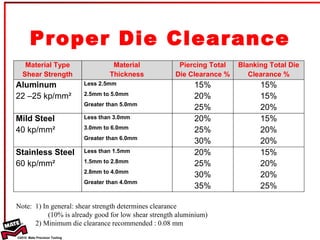
Proper Die Clearance Note:  1) In general: shear strength determines clearance  (10% is already good for low shear strength aluminium)  2) Minimum die clearance recommended : 0.08 mm
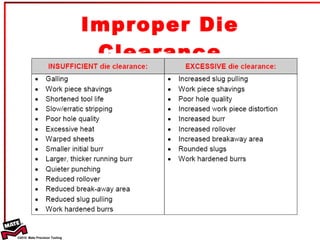
Improper Die Clearance
Piercing The slug is scrap.  The interior of the sheet is the product.  Depending on the tool design, more than one hole can be punched at one time.  Cluster tools for example. In piercing operations, the die clearance is calculated from the punch size. Piercing vs. Blanking
Blanking The punched item is of value.  The slug is important. Special shapes are used mostly in blanking operations. Blanking operations calculate the die clearance from the desired blank dimensions. Piercing vs. Blanking
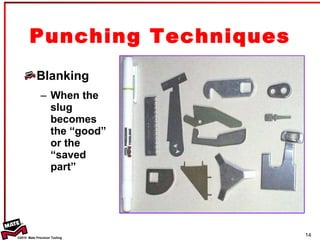
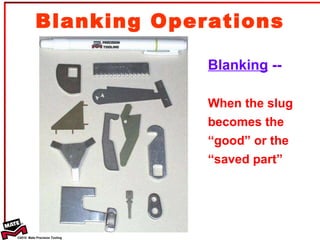
Punching Techniques Blanking When the slug becomes the “good” or the “saved part”
Ordering Punches and Dies Piercing a Hole Punch Size =  Desired Hole Size Die Size = Punch Size +  Total Clearance Blanking a Part Die Size =  Desired Blank Size (no Slug Free dies !) Punch Size =  Die Size – Total Clearance
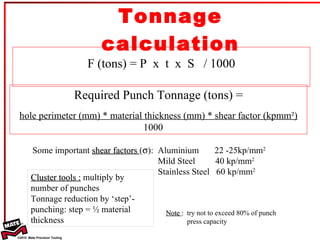
Tonnage calculation Required Punch Tonnage (tons) = hole perimeter (mm) * material thickness (mm) * shear factor (kpmm²)   1000 Some important  shear factors  (  ):  Aluminium  22 -25kp/mm 2 Mild Steel  40 kp/mm 2 Stainless Steel  60 kp/mm 2 Cluster tools :  multiply by number of punches Tonnage reduction by ‘step’-punching: step = ½ material thickness F (tons) = P  x  t  x  S  / 1000 Note  :  try not to exceed 80% of punch   press capacity
Material shear factors (    ) :  Aluminum  =  22-25 kp/mm 2 Mild steel  =  40 kp / mm 2 Stainless steel =  60 kp /mm 2   Tonnage calculation
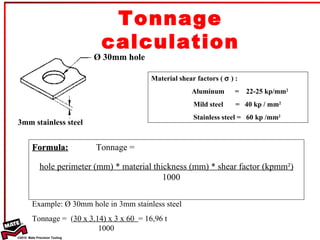
Formula: Tonnage =  hole perimeter (mm) * material thickness (mm) * shear factor (kpmm²)   1000 Ø 30mm hole 3mm stainless steel Material shear factors (    ) :  Aluminum  =  22-25 kp/mm 2 Mild steel  =  40 kp / mm 2 Stainless steel =  60 kp /mm 2   Example: Ø 30mm hole in 3mm stainless steel Tonnage =  ( 30 x 3.14) x 3 x 60  = 16,96 t   1000  Tonnage calculation
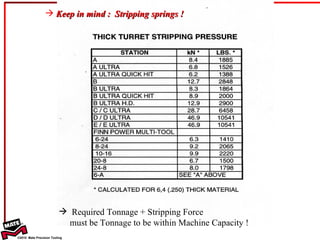
Required Tonnage + Stripping Force   must be Tonnage to be within Machine Capacity ! Keep in mind :  Stripping springs !
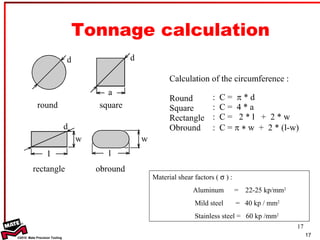
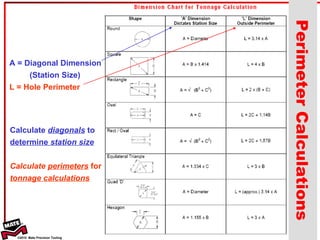
Perimeter Calculations Calculate   diagonals  to  determine  station size Calculate  perimeters  for  tonnage calculations   A = Diagonal Dimension (Station Size) L = Hole Perimeter
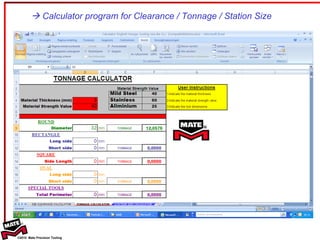
   Calculator program for Clearance / Tonnage / Station Size
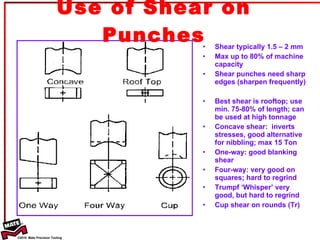
Use of Shear on Punches Shear typically 1.5 – 2 mm Max up to 80% of machine capacity Shear punches need sharp edges (sharpen frequently) Best shear is rooftop; use min. 75-80% of length; can be used at high tonnage Concave shear:  inverts stresses, good alternative for nibbling; max 15 Ton One-way: good blanking shear Four-way: very good on squares; hard to regrind Trumpf ‘Whisper’ very good, but hard to regrind Cup shear on rounds (Tr)
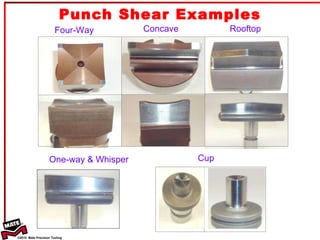
Punch Shear Examples One-way & Whisper Cup Concave Rooftop Four-Way
Tonnage reduction Noise reduction Slug control Reduced shock loads on the machine Flatter sheets Improved stripping Increased tool life Advantages of Shear
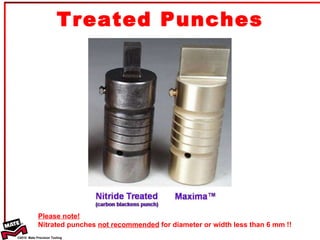
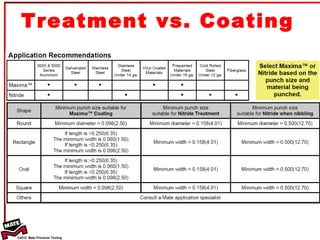
Treated Punches Please note!   Nitrated punches  not recommended  for diameter or width less than 6 mm !!
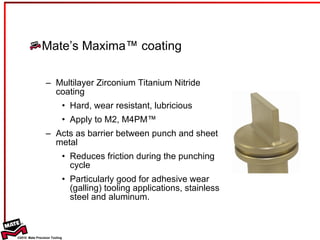
Mate’s Maxima™ coating Multilayer Zirconium Titanium Nitride coating Hard, wear resistant, lubricious Apply to M2, M4PM™  Acts as barrier between punch and sheet metal  Reduces friction during the punching cycle Particularly good for adhesive wear (galling) tooling applications, stainless steel and aluminum. WHAT IS MAXIMA™?
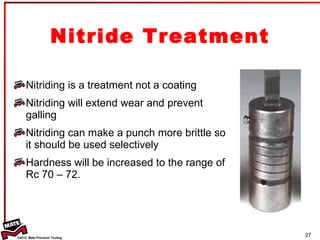
Nitride Treatment Nitriding is a treatment not a coating Nitriding will extend wear and prevent galling Nitriding can make a punch more brittle so it should be used selectively Hardness will be increased to the range of Rc 70 – 72.
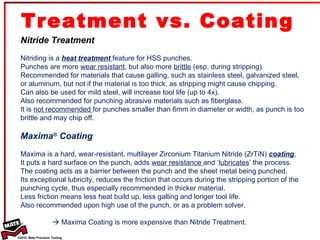
Treatment vs. Coating  Nitride Treatment Nitriding is a  heat treatment  feature for HSS punches.  Punches are more  wear resistant , but also more  brittle  (esp. during stripping). Recommended for materials that cause galling, such as stainless steel, galvanized steel, or aluminum, but not if the material is too thick, as stripping might cause chipping.  Can also be used for mild steel, will increase tool life (up to 4x). Also recommended for punching abrasive materials such as fiberglass. It is  not recommended  for punches smaller than 6mm in diameter or width, as punch is too brittle and may chip off. Maxima ®  Coating Maxima is a hard, wear-resistant, multilayer Zirconium Titanium Nitride (ZrTiN)  coating , It puts a hard surface on the punch, adds  wear resistance  and ‘ lubricates ’ the process. The coating acts as a barrier between the punch and the sheet metal being punched.  Its exceptional lubricity, reduces the friction that occurs during the stripping portion of the punching cycle, thus especially recommended in thicker material. Less friction means less heat build up, less galling and longer tool life.  Also recommended upon high use of the punch, or as a problem solver.    Maxima Coating is more expensive than Nitride Treatment.
Treatment vs. Coating
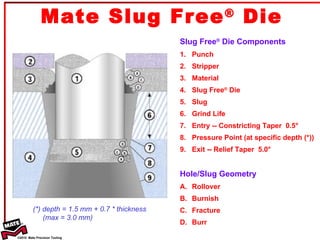
Mate Slug Free ®  Die Slug Free ®  Die Components 1. Punch 2. Stripper 3. Material 4. Slug Free ®  Die 5. Slug 6. Grind Life 7. Entry -- Constricting Taper  0.5° 8. Pressure Point (at specific depth (*)) 9. Exit -- Relief Taper  5.0° Hole/Slug Geometry A. Rollover B. Burnish C. Fracture D. Burr (*) depth = 1.5 mm + 0.7 * thickness   (max = 3.0 mm)
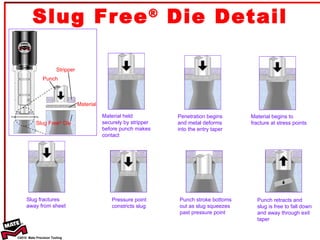
Slug Free ®  Die Detail Material held securely by stripper before punch makes contact Penetration begins and metal deforms into the entry taper Material begins to fracture at stress points Slug fractures away from sheet Pressure point constricts slug Punch stroke bottoms  out as slug squeezes  past pressure point Punch retracts and slug is free to fall down and away through exit taper Punch Stripper Material Slug Free ®  Die
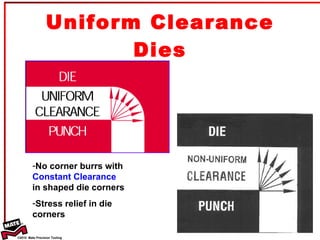
Uniform Clearance Dies No corner burrs with  Constant Clearance  in shaped die corners  Stress relief in die corners
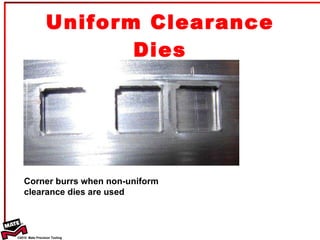
Uniform Clearance Dies Corner burrs when non-uniform clearance dies are used
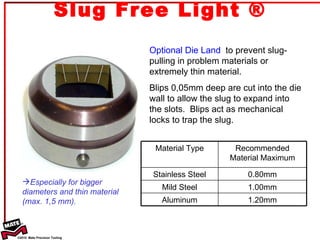
Slug Free Light ® Optional Die Land   to prevent slug-pulling in problem materials or extremely thin material. Blips 0,05mm deep are cut into the die wall to allow the slug to expand into the slots.  Blips act as mechanical locks to trap the slug. Especially for bigger  diameters and thin material  (max. 1,5 mm). Material Type Recommended Material Maximum Stainless Steel 0.80mm Mild Steel 1.00mm Aluminum 1.20mm
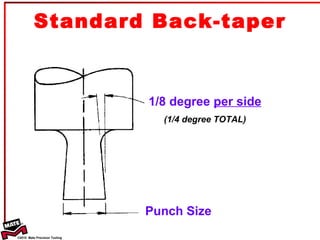
Standard Back-taper 1/8 degree  per side (1/4 degree TOTAL) Punch Size
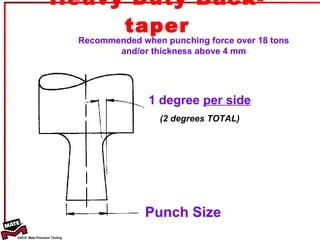
Heavy Duty Back-taper 1 degree  per side (2 degrees TOTAL) Punch Size Recommended when punching force over 18 tons and/or thickness above 4 mm
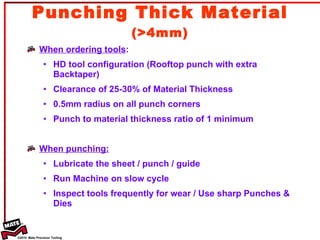
Punching Thick Material  (>4mm) When ordering tools :  HD tool configuration (Rooftop punch with extra Backtaper) Clearance of 25-30% of Material Thickness 0.5mm radius on all punch corners Punch to material thickness ratio of 1 minimum When punching: Lubricate the sheet / punch / guide Run Machine on slow cycle Inspect tools frequently for wear / Use sharp Punches & Dies
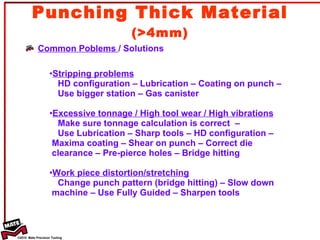
Punching Thick Material  (>4mm) Common Poblems  / Solutions Stripping problems HD configuration – Lubrication – Coating on punch –  Use bigger station – Gas canister  Excessive tonnage / High tool wear / High vibrations Make sure tonnage calculation is correct  –  Use Lubrication – Sharp tools – HD configuration –  Maxima coating – Shear on punch – Correct die  clearance – Pre-pierce holes – Bridge hitting Work piece distortion/stretching Change punch pattern (bridge hitting) – Slow down  machine – Use Fully Guided – Sharpen tools
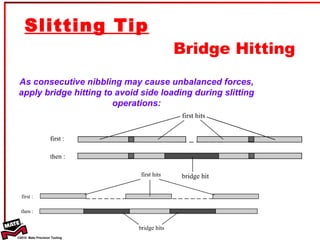
Slitting Tip Bridge Hitting As consecutive nibbling may cause unbalanced forces, apply bridge hitting to avoid side loading during slitting operations:
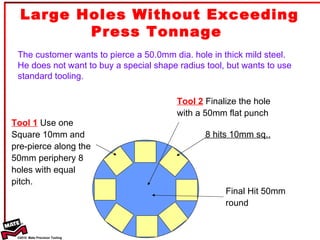
Large Holes Without Exceeding Press Tonnage  The customer wants to pierce a 50.0mm dia. hole in thick mild steel. He does not want to buy a special shape radius tool, but wants to use standard tooling. Tool 1  Use one Square 10mm and pre-pierce along the 50mm periphery 8 holes with equal pitch. Tool 2  Finalize the hole with a 50mm flat punch 8 hits 10mm sq.. Final Hit 50mm round
Punching Thin Material  (<1mm) When ordering tools : You may require  Ultra Light canisters Light shear on punches Fully Guided guide/stripper solution Urethane stripper pads Slug Free Light dies When punching: Run Machine on slower cycle Inspect tools frequently for wear  Use sharp punches & dies
Punching Thin Material  (<1mm) Common Poblems  / Solutions Sheet marking Urethane stripper pads – Ultra Light  Slug pulling Maximize die penetration – Demagnetise tools – Slug  Free Light – Correct die clearance – Slug ejectors – Shear on punch High tool wear due to small clearance Maintain turret alignment Work piece distortion/stretching Change punch pattern – Slow down machine –  Sharpen tools – Use Fully Guided
Punching non-metallic material Use concave shear punches Use Maxima or Nitride punches Reduce die clearance with 5 % Use sharp punches and dies Run the machine on a slower cycle Lubricate hard plastics if possible Use urethane pads if marking occurs Support thin material if needed
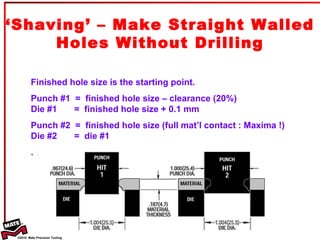
‘ Shaving’ – Make Straight Walled Holes Without Drilling Finished hole size is the starting point.  Punch #1  =  finished hole size – clearance (20%) Die #1  =  finished hole size + 0.1 mm Punch #2  =  finished hole size (full mat’l contact : Maxima !) Die #2  =  die #1 .
Preventing Slug Pulling Use Slug Free ®  Dies Eliminate Magnetism In Tools Lightly Dull Recently Sharpened Tools (with oil stone) Decrease Die Clearance Maximize Die Penetration Use Shear on Punches Use Urethane Slug Ejectors (need replacement !)
Overcoming Stripping Problems Use Sharp Punches & Dies Lubricate Sheets Remove Galling Check Stripping Springs For Fatigue Use Additional Back-Taper on Punches Increase Die Clearance Use HD Tool Configurations With Spring Tooling Use Larger Station
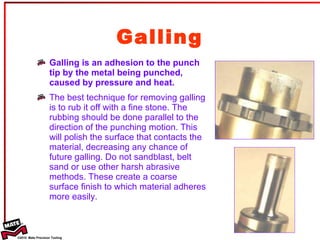
Galling Galling is an adhesion to the punch tip by the metal being punched, caused by pressure and heat.  The best technique for removing galling is to rub it off with a fine stone. The rubbing should be done parallel to the direction of the punching motion. This will polish the surface that contacts the material, decreasing any chance of future galling. Do not sandblast, belt sand or use other harsh abrasive methods. These create a coarse surface finish to which material  adheres more easily.
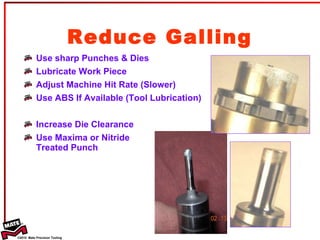
Reduce Galling Use sharp Punches & Dies Lubricate Work Piece Adjust Machine Hit Rate (Slower) Use ABS If Available (Tool Lubrication) Increase Die Clearance Use Maxima or Nitride  Treated Punch
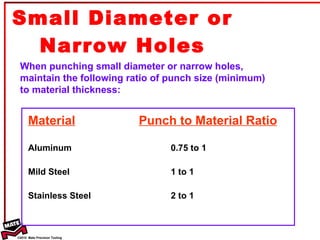
Small Diameter or Narrow Holes Material Aluminum Mild Steel Stainless Steel Punch to Material Ratio 0.75 to 1 1 to 1 2 to 1 When punching small diameter or narrow holes,  maintain the following ratio of punch size (minimum)  to material thickness:
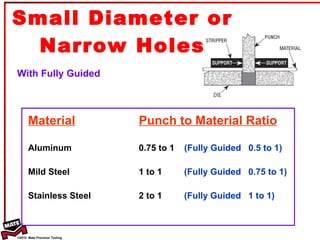
Material Aluminum Mild Steel Stainless Steel Punch to Material Ratio 0.75 to 1  (Fully Guided  0.5 to 1) 1 to 1  (Fully Guided  0.75 to 1) 2 to 1  (Fully Guided  1 to 1) Small Diameter or Narrow Holes With Fully Guided
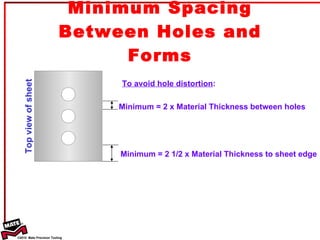
Minimum Spacing Between Holes and Forms Minimum = 2 x Material Thickness between holes Minimum = 2 1/2 x Material Thickness to sheet edge Top view of sheet To avoid hole distortion :
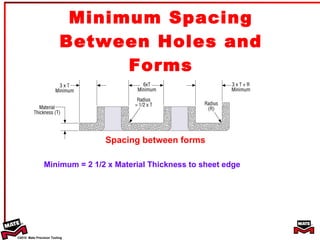
Minimum Spacing Between Holes and Forms Minimum = 2 1/2 x Material Thickness to sheet edge Spacing between forms
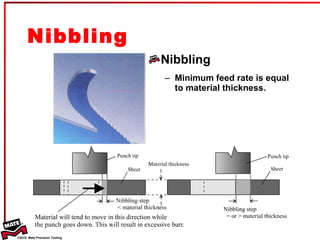
Nibbling Nibbling  Minimum feed rate is equal to material thickness.
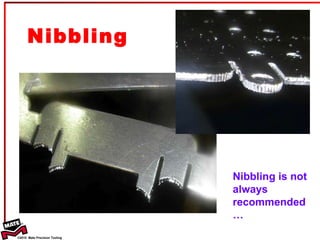
Nibbling Nibbling is not always recommended …
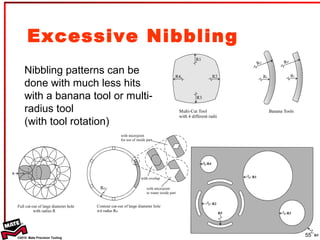
Excessive Nibbling Nibbling patterns can be done with much less hits with a banana tool or multi-radius tool  (with tool rotation)
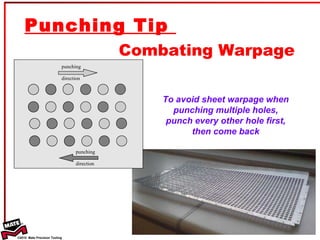
Punching Tip  Combating Warpage To avoid sheet warpage when punching multiple holes, punch every other hole first, then come back
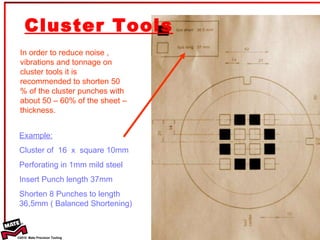
Cluster Tools In order to reduce noise , vibrations and tonnage on cluster tools it is recommended to shorten 50 % of the cluster punches with about 50 – 60% of the sheet – thickness. Example:   Cluster of  16  x  square 10mm  Perforating in 1mm mild steel Insert Punch length 37mm Shorten 8 Punches to length 36,5mm ( Balanced Shortening)
Blanking  -- When the slug becomes the “good” or the “saved part” Blanking Operations
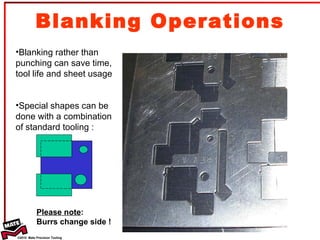
Blanking Operations Blanking rather than punching can save time, tool life and sheet usage Special shapes can be done with a combination of standard tooling : Please note :  Burrs change side !
Blanking Operations Extremely sharp punches and dies Reduce die clearance by 5% Determine which blank dimensions & tolerances are critical Notify tooling provider that tooling required will be used for blanking Use non-slug free or straight taper dies Punches should be flat faced or with slight one-way shear Frequently inspect tools for wear Note: Be aware of the changing of burr side when  piercing and blanking is combined.
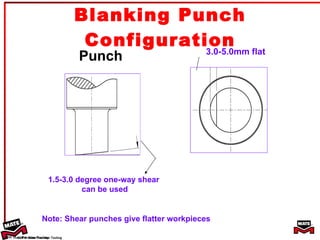
Blanking Punch Configuration Punch 3.0-5.0mm flat 1.5-3.0 degree one-way shear  can be used ©1999 Mate Precision Tooling Note: Shear punches give flatter workpieces
The ‘BIG 3’ Problems Die clearance too small Poor or no maintenance on the tool Turret alignment requires adjustment
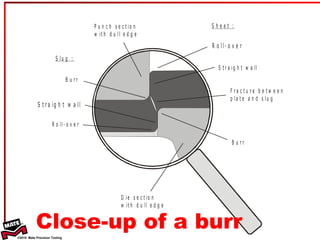
Close-up of a burr
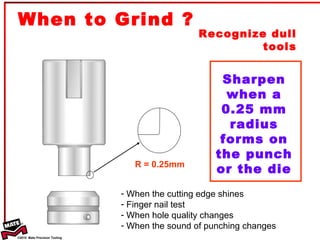
R = 0.25mm Sharpen when a 0.25 mm radius forms on the punch or the die When the cutting edge shines Finger nail test When hole quality changes When the sound of punching changes Recognize dull tools When to Grind ?
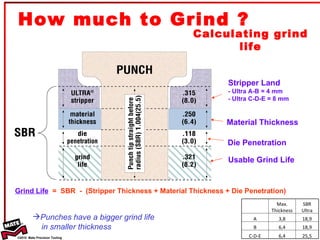
Grind Life   =  SBR  -  (Stripper Thickness + Material Thickness + Die Penetration) Stripper Land  - Ultra A-B = 4 mm - Ultra C-D-E = 8 mm Material Thickness Die Penetration Usable Grind Life Punches have a bigger grind life    in smaller thickness  Calculating grind life How much to Grind ?   Max. Thickness SBR Ultra A 3,8 18,9 B 6,4 18,9 C-D-E 6,4 25,5
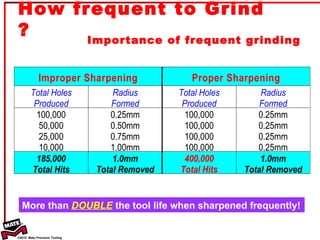
More than  DOUBLE  the tool life when sharpened frequently! Importance of frequent grinding  How frequent to Grind ?
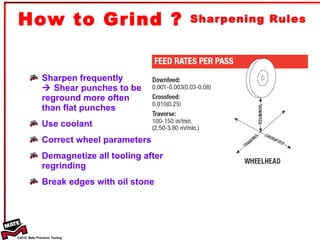
Sharpen frequently   Shear punches to be reground more often  than flat punches  Use coolant Correct wheel parameters Demagnetize all tooling after regrinding Break edges with oil stone Sharpening Rules  How to Grind ?
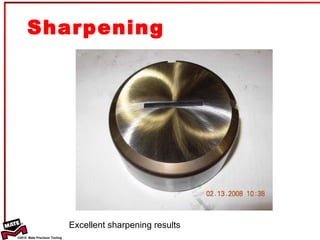
Sharpening Excellent sharpening results
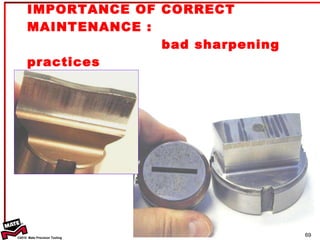
IMPORTANCE OF CORRECT MAINTENANCE :    bad sharpening practices
Benefits of Proper Tool Maintenance Flatter sheets   (Note: Shear punches give flatter sheets) Cleaner holes Less stress on tool and machine Longer tool life     Maxima coating not affected
Sharpen frequently Use proper die clearance Use proper shear configuration Lubricate punch, guide and sheet Inspect tool holders for wear Use treated tools for special applications Use radii on all sharp corners Demagnetize all tooling after regrinding Check turret alignment regularly Maximizing Tool Life
The ‘BIG 3’ Problems Die clearance too small Poor or no maintenance on the tool Turret alignment requires adjustment
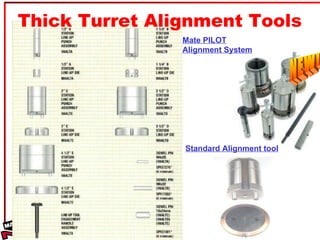
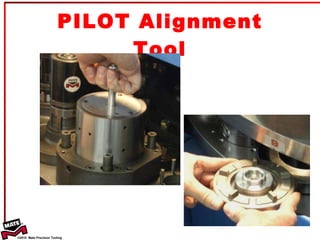
Thick Turret Alignment Tools Mate PILOT Alignment System NEW! Standard Alignment tool
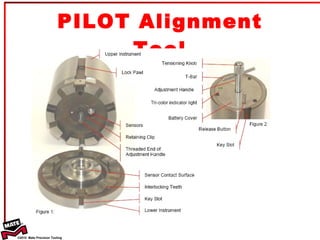
PILOT Alignment Tool
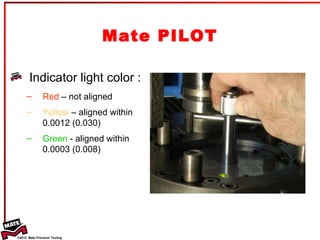
Mate PILOT Indicator light color : Red  – not aligned Yellow  – aligned within 0.0012 (0.030) Green  - aligned within 0.0003 (0.008)
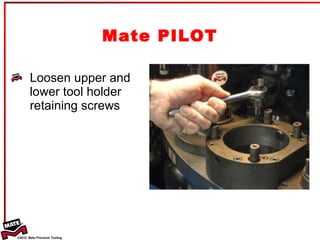
Loosen upper and lower tool holder retaining screws Mate PILOT
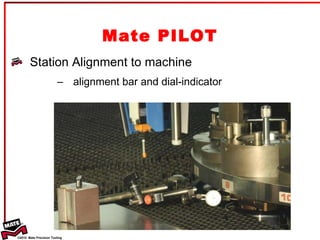
Station Alignment to machine alignment bar and dial-indicator Mate PILOT
Questions?
Thank you ! www.mate.com

1 Basic Punching Tt 2010

  • 1.
  • 2.
    The ‘BIG 3’Problems Die clearance too small Poor or no maintenance on the tool Turret alignment requires adjustment
  • 3.
    Punching a hole Die Clearance Punch Tonnage Choosing the right tool Correct tool maintenance … Basic Hole Punching Theory
  • 4.
    Punching Cycle ImpactPenetration Fracture (@ 30% t) Stripping Material Punch Die  Slug to go approx. 3 mm into die for slug free dies Roll-over Burnish zone Fracture Punch force diagram
  • 5.
    Cross Section ofa Quality Hole Burr height graphs Slug
  • 6.
    The ‘BIG 3’Problems Die clearance too small Poor or no maintenance on the tool Turret alignment requires adjustment
  • 7.
  • 8.
    Proper vs. TightClearance Extra energy does not disappear, but is converted into heat !! - Punching forces are balanced, - Maximum piece part quality and tool life Fracture lines meet Fracture lines do not meet Secondary shear cracks, - Extra energy required, Higher tool wear (dies wear quicker)
  • 9.
    Excessive Clearance Toollasts longer ! Large Burr, not compressed and can be removed easily More Rollover & Less Burnish zone
  • 10.
    Proper Die ClearanceNote: 1) In general: shear strength determines clearance (10% is already good for low shear strength aluminium) 2) Minimum die clearance recommended : 0.08 mm
  • 11.
  • 12.
    Piercing The slugis scrap. The interior of the sheet is the product. Depending on the tool design, more than one hole can be punched at one time. Cluster tools for example. In piercing operations, the die clearance is calculated from the punch size. Piercing vs. Blanking
  • 13.
    Blanking The puncheditem is of value. The slug is important. Special shapes are used mostly in blanking operations. Blanking operations calculate the die clearance from the desired blank dimensions. Piercing vs. Blanking
  • 14.
    Punching Techniques BlankingWhen the slug becomes the “good” or the “saved part”
  • 15.
    Ordering Punches andDies Piercing a Hole Punch Size = Desired Hole Size Die Size = Punch Size + Total Clearance Blanking a Part Die Size = Desired Blank Size (no Slug Free dies !) Punch Size = Die Size – Total Clearance
  • 16.
    Tonnage calculation RequiredPunch Tonnage (tons) = hole perimeter (mm) * material thickness (mm) * shear factor (kpmm²) 1000 Some important shear factors (  ): Aluminium 22 -25kp/mm 2 Mild Steel 40 kp/mm 2 Stainless Steel 60 kp/mm 2 Cluster tools : multiply by number of punches Tonnage reduction by ‘step’-punching: step = ½ material thickness F (tons) = P x t x S / 1000 Note : try not to exceed 80% of punch press capacity
  • 17.
    Material shear factors(  ) : Aluminum = 22-25 kp/mm 2 Mild steel = 40 kp / mm 2 Stainless steel = 60 kp /mm 2 Tonnage calculation
  • 18.
    Formula: Tonnage = hole perimeter (mm) * material thickness (mm) * shear factor (kpmm²) 1000 Ø 30mm hole 3mm stainless steel Material shear factors (  ) : Aluminum = 22-25 kp/mm 2 Mild steel = 40 kp / mm 2 Stainless steel = 60 kp /mm 2 Example: Ø 30mm hole in 3mm stainless steel Tonnage = ( 30 x 3.14) x 3 x 60 = 16,96 t 1000 Tonnage calculation
  • 19.
    Required Tonnage +Stripping Force must be Tonnage to be within Machine Capacity ! Keep in mind : Stripping springs !
  • 20.
    Perimeter Calculations Calculate diagonals to determine station size Calculate perimeters for tonnage calculations A = Diagonal Dimension (Station Size) L = Hole Perimeter
  • 21.
    Calculator program for Clearance / Tonnage / Station Size
  • 22.
    Use of Shearon Punches Shear typically 1.5 – 2 mm Max up to 80% of machine capacity Shear punches need sharp edges (sharpen frequently) Best shear is rooftop; use min. 75-80% of length; can be used at high tonnage Concave shear: inverts stresses, good alternative for nibbling; max 15 Ton One-way: good blanking shear Four-way: very good on squares; hard to regrind Trumpf ‘Whisper’ very good, but hard to regrind Cup shear on rounds (Tr)
  • 23.
    Punch Shear ExamplesOne-way & Whisper Cup Concave Rooftop Four-Way
  • 24.
    Tonnage reduction Noisereduction Slug control Reduced shock loads on the machine Flatter sheets Improved stripping Increased tool life Advantages of Shear
  • 25.
    Treated Punches Pleasenote! Nitrated punches not recommended for diameter or width less than 6 mm !!
  • 26.
    Mate’s Maxima™ coatingMultilayer Zirconium Titanium Nitride coating Hard, wear resistant, lubricious Apply to M2, M4PM™ Acts as barrier between punch and sheet metal Reduces friction during the punching cycle Particularly good for adhesive wear (galling) tooling applications, stainless steel and aluminum. WHAT IS MAXIMA™?
  • 27.
    Nitride Treatment Nitridingis a treatment not a coating Nitriding will extend wear and prevent galling Nitriding can make a punch more brittle so it should be used selectively Hardness will be increased to the range of Rc 70 – 72.
  • 28.
    Treatment vs. Coating Nitride Treatment Nitriding is a heat treatment feature for HSS punches. Punches are more wear resistant , but also more brittle (esp. during stripping). Recommended for materials that cause galling, such as stainless steel, galvanized steel, or aluminum, but not if the material is too thick, as stripping might cause chipping. Can also be used for mild steel, will increase tool life (up to 4x). Also recommended for punching abrasive materials such as fiberglass. It is not recommended for punches smaller than 6mm in diameter or width, as punch is too brittle and may chip off. Maxima ® Coating Maxima is a hard, wear-resistant, multilayer Zirconium Titanium Nitride (ZrTiN) coating , It puts a hard surface on the punch, adds wear resistance and ‘ lubricates ’ the process. The coating acts as a barrier between the punch and the sheet metal being punched. Its exceptional lubricity, reduces the friction that occurs during the stripping portion of the punching cycle, thus especially recommended in thicker material. Less friction means less heat build up, less galling and longer tool life. Also recommended upon high use of the punch, or as a problem solver.  Maxima Coating is more expensive than Nitride Treatment.
  • 29.
  • 30.
    Mate Slug Free® Die Slug Free ® Die Components 1. Punch 2. Stripper 3. Material 4. Slug Free ® Die 5. Slug 6. Grind Life 7. Entry -- Constricting Taper 0.5° 8. Pressure Point (at specific depth (*)) 9. Exit -- Relief Taper 5.0° Hole/Slug Geometry A. Rollover B. Burnish C. Fracture D. Burr (*) depth = 1.5 mm + 0.7 * thickness (max = 3.0 mm)
  • 31.
    Slug Free ® Die Detail Material held securely by stripper before punch makes contact Penetration begins and metal deforms into the entry taper Material begins to fracture at stress points Slug fractures away from sheet Pressure point constricts slug Punch stroke bottoms out as slug squeezes past pressure point Punch retracts and slug is free to fall down and away through exit taper Punch Stripper Material Slug Free ® Die
  • 32.
    Uniform Clearance DiesNo corner burrs with Constant Clearance in shaped die corners Stress relief in die corners
  • 33.
    Uniform Clearance DiesCorner burrs when non-uniform clearance dies are used
  • 34.
    Slug Free Light® Optional Die Land to prevent slug-pulling in problem materials or extremely thin material. Blips 0,05mm deep are cut into the die wall to allow the slug to expand into the slots. Blips act as mechanical locks to trap the slug. Especially for bigger diameters and thin material (max. 1,5 mm). Material Type Recommended Material Maximum Stainless Steel 0.80mm Mild Steel 1.00mm Aluminum 1.20mm
  • 35.
    Standard Back-taper 1/8degree per side (1/4 degree TOTAL) Punch Size
  • 36.
    Heavy Duty Back-taper1 degree per side (2 degrees TOTAL) Punch Size Recommended when punching force over 18 tons and/or thickness above 4 mm
  • 37.
    Punching Thick Material (>4mm) When ordering tools : HD tool configuration (Rooftop punch with extra Backtaper) Clearance of 25-30% of Material Thickness 0.5mm radius on all punch corners Punch to material thickness ratio of 1 minimum When punching: Lubricate the sheet / punch / guide Run Machine on slow cycle Inspect tools frequently for wear / Use sharp Punches & Dies
  • 38.
    Punching Thick Material (>4mm) Common Poblems / Solutions Stripping problems HD configuration – Lubrication – Coating on punch – Use bigger station – Gas canister Excessive tonnage / High tool wear / High vibrations Make sure tonnage calculation is correct – Use Lubrication – Sharp tools – HD configuration – Maxima coating – Shear on punch – Correct die clearance – Pre-pierce holes – Bridge hitting Work piece distortion/stretching Change punch pattern (bridge hitting) – Slow down machine – Use Fully Guided – Sharpen tools
  • 39.
    Slitting Tip BridgeHitting As consecutive nibbling may cause unbalanced forces, apply bridge hitting to avoid side loading during slitting operations:
  • 40.
    Large Holes WithoutExceeding Press Tonnage The customer wants to pierce a 50.0mm dia. hole in thick mild steel. He does not want to buy a special shape radius tool, but wants to use standard tooling. Tool 1 Use one Square 10mm and pre-pierce along the 50mm periphery 8 holes with equal pitch. Tool 2 Finalize the hole with a 50mm flat punch 8 hits 10mm sq.. Final Hit 50mm round
  • 41.
    Punching Thin Material (<1mm) When ordering tools : You may require Ultra Light canisters Light shear on punches Fully Guided guide/stripper solution Urethane stripper pads Slug Free Light dies When punching: Run Machine on slower cycle Inspect tools frequently for wear Use sharp punches & dies
  • 42.
    Punching Thin Material (<1mm) Common Poblems / Solutions Sheet marking Urethane stripper pads – Ultra Light Slug pulling Maximize die penetration – Demagnetise tools – Slug Free Light – Correct die clearance – Slug ejectors – Shear on punch High tool wear due to small clearance Maintain turret alignment Work piece distortion/stretching Change punch pattern – Slow down machine – Sharpen tools – Use Fully Guided
  • 43.
    Punching non-metallic materialUse concave shear punches Use Maxima or Nitride punches Reduce die clearance with 5 % Use sharp punches and dies Run the machine on a slower cycle Lubricate hard plastics if possible Use urethane pads if marking occurs Support thin material if needed
  • 44.
    ‘ Shaving’ –Make Straight Walled Holes Without Drilling Finished hole size is the starting point. Punch #1 = finished hole size – clearance (20%) Die #1 = finished hole size + 0.1 mm Punch #2 = finished hole size (full mat’l contact : Maxima !) Die #2 = die #1 .
  • 45.
    Preventing Slug PullingUse Slug Free ® Dies Eliminate Magnetism In Tools Lightly Dull Recently Sharpened Tools (with oil stone) Decrease Die Clearance Maximize Die Penetration Use Shear on Punches Use Urethane Slug Ejectors (need replacement !)
  • 46.
    Overcoming Stripping ProblemsUse Sharp Punches & Dies Lubricate Sheets Remove Galling Check Stripping Springs For Fatigue Use Additional Back-Taper on Punches Increase Die Clearance Use HD Tool Configurations With Spring Tooling Use Larger Station
  • 47.
    Galling Galling isan adhesion to the punch tip by the metal being punched, caused by pressure and heat. The best technique for removing galling is to rub it off with a fine stone. The rubbing should be done parallel to the direction of the punching motion. This will polish the surface that contacts the material, decreasing any chance of future galling. Do not sandblast, belt sand or use other harsh abrasive methods. These create a coarse surface finish to which material adheres more easily.
  • 48.
    Reduce Galling Usesharp Punches & Dies Lubricate Work Piece Adjust Machine Hit Rate (Slower) Use ABS If Available (Tool Lubrication) Increase Die Clearance Use Maxima or Nitride Treated Punch
  • 49.
    Small Diameter orNarrow Holes Material Aluminum Mild Steel Stainless Steel Punch to Material Ratio 0.75 to 1 1 to 1 2 to 1 When punching small diameter or narrow holes, maintain the following ratio of punch size (minimum) to material thickness:
  • 50.
    Material Aluminum MildSteel Stainless Steel Punch to Material Ratio 0.75 to 1 (Fully Guided 0.5 to 1) 1 to 1 (Fully Guided 0.75 to 1) 2 to 1 (Fully Guided 1 to 1) Small Diameter or Narrow Holes With Fully Guided
  • 51.
    Minimum Spacing BetweenHoles and Forms Minimum = 2 x Material Thickness between holes Minimum = 2 1/2 x Material Thickness to sheet edge Top view of sheet To avoid hole distortion :
  • 52.
    Minimum Spacing BetweenHoles and Forms Minimum = 2 1/2 x Material Thickness to sheet edge Spacing between forms
  • 53.
    Nibbling Nibbling Minimum feed rate is equal to material thickness.
  • 54.
    Nibbling Nibbling isnot always recommended …
  • 55.
    Excessive Nibbling Nibblingpatterns can be done with much less hits with a banana tool or multi-radius tool (with tool rotation)
  • 56.
    Punching Tip Combating Warpage To avoid sheet warpage when punching multiple holes, punch every other hole first, then come back
  • 57.
    Cluster Tools Inorder to reduce noise , vibrations and tonnage on cluster tools it is recommended to shorten 50 % of the cluster punches with about 50 – 60% of the sheet – thickness. Example: Cluster of 16 x square 10mm Perforating in 1mm mild steel Insert Punch length 37mm Shorten 8 Punches to length 36,5mm ( Balanced Shortening)
  • 58.
    Blanking --When the slug becomes the “good” or the “saved part” Blanking Operations
  • 59.
    Blanking Operations Blankingrather than punching can save time, tool life and sheet usage Special shapes can be done with a combination of standard tooling : Please note : Burrs change side !
  • 60.
    Blanking Operations Extremelysharp punches and dies Reduce die clearance by 5% Determine which blank dimensions & tolerances are critical Notify tooling provider that tooling required will be used for blanking Use non-slug free or straight taper dies Punches should be flat faced or with slight one-way shear Frequently inspect tools for wear Note: Be aware of the changing of burr side when piercing and blanking is combined.
  • 61.
    Blanking Punch ConfigurationPunch 3.0-5.0mm flat 1.5-3.0 degree one-way shear can be used ©1999 Mate Precision Tooling Note: Shear punches give flatter workpieces
  • 62.
    The ‘BIG 3’Problems Die clearance too small Poor or no maintenance on the tool Turret alignment requires adjustment
  • 63.
  • 64.
    R = 0.25mmSharpen when a 0.25 mm radius forms on the punch or the die When the cutting edge shines Finger nail test When hole quality changes When the sound of punching changes Recognize dull tools When to Grind ?
  • 65.
    Grind Life = SBR - (Stripper Thickness + Material Thickness + Die Penetration) Stripper Land - Ultra A-B = 4 mm - Ultra C-D-E = 8 mm Material Thickness Die Penetration Usable Grind Life Punches have a bigger grind life in smaller thickness Calculating grind life How much to Grind ?   Max. Thickness SBR Ultra A 3,8 18,9 B 6,4 18,9 C-D-E 6,4 25,5
  • 66.
    More than DOUBLE the tool life when sharpened frequently! Importance of frequent grinding How frequent to Grind ?
  • 67.
    Sharpen frequently  Shear punches to be reground more often than flat punches Use coolant Correct wheel parameters Demagnetize all tooling after regrinding Break edges with oil stone Sharpening Rules How to Grind ?
  • 68.
  • 69.
    IMPORTANCE OF CORRECTMAINTENANCE : bad sharpening practices
  • 70.
    Benefits of ProperTool Maintenance Flatter sheets (Note: Shear punches give flatter sheets) Cleaner holes Less stress on tool and machine Longer tool life  Maxima coating not affected
  • 71.
    Sharpen frequently Useproper die clearance Use proper shear configuration Lubricate punch, guide and sheet Inspect tool holders for wear Use treated tools for special applications Use radii on all sharp corners Demagnetize all tooling after regrinding Check turret alignment regularly Maximizing Tool Life
  • 72.
    The ‘BIG 3’Problems Die clearance too small Poor or no maintenance on the tool Turret alignment requires adjustment
  • 73.
    Thick Turret AlignmentTools Mate PILOT Alignment System NEW! Standard Alignment tool
  • 74.
  • 75.
  • 76.
    Mate PILOT Indicatorlight color : Red – not aligned Yellow – aligned within 0.0012 (0.030) Green - aligned within 0.0003 (0.008)
  • 77.
    Loosen upper andlower tool holder retaining screws Mate PILOT
  • 78.
    Station Alignment tomachine alignment bar and dial-indicator Mate PILOT
  • 79.
  • 80.
    Thank you !www.mate.com

Editor's Notes

  • #27 Won’t break or wear out