COMMON TOOLS USED
IN CNC MILLING
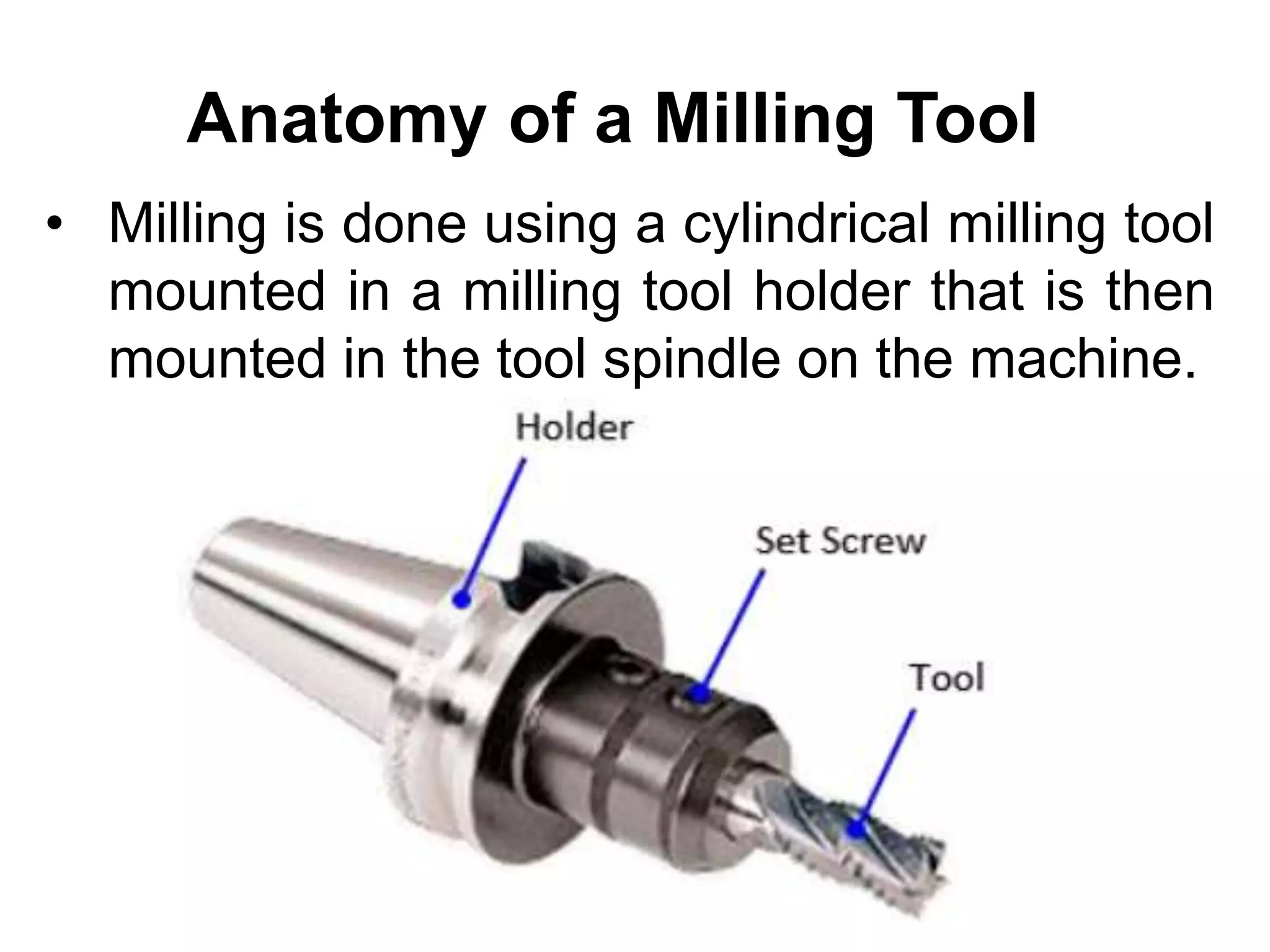
Anatomy of a Milling Tool
• Milling is done using a cylindrical milling tool
mounted in a milling tool holder that is then
mounted in the tool spindle on the machine.
End Mills
• End mills are the most common milling
cutters. End mills are available in a wide
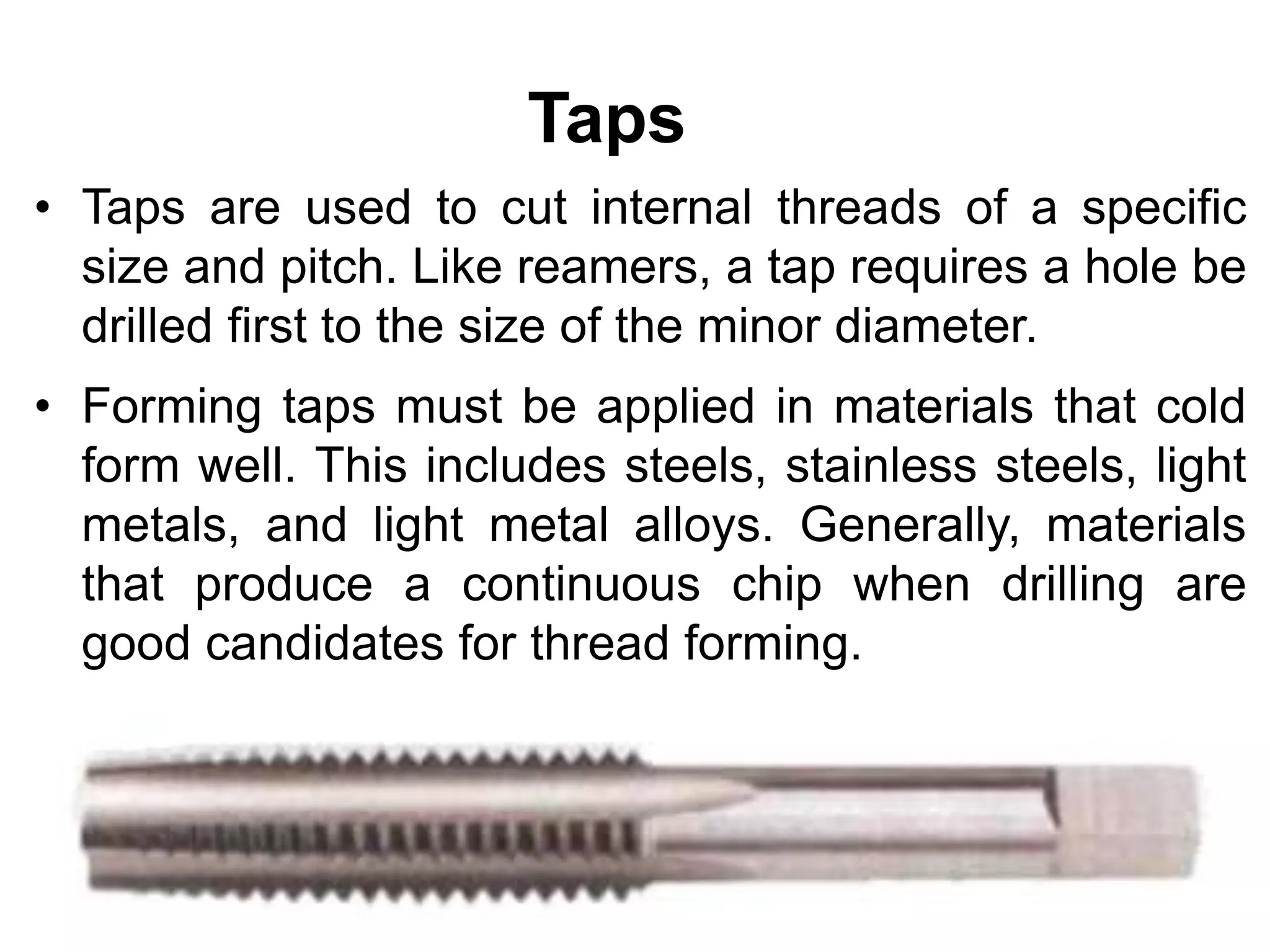
variety of lengths, diameters, and types.
• A square end mill is used for most general
milling applications. It produces a sharp
edge at the bottom of pockets and slots.
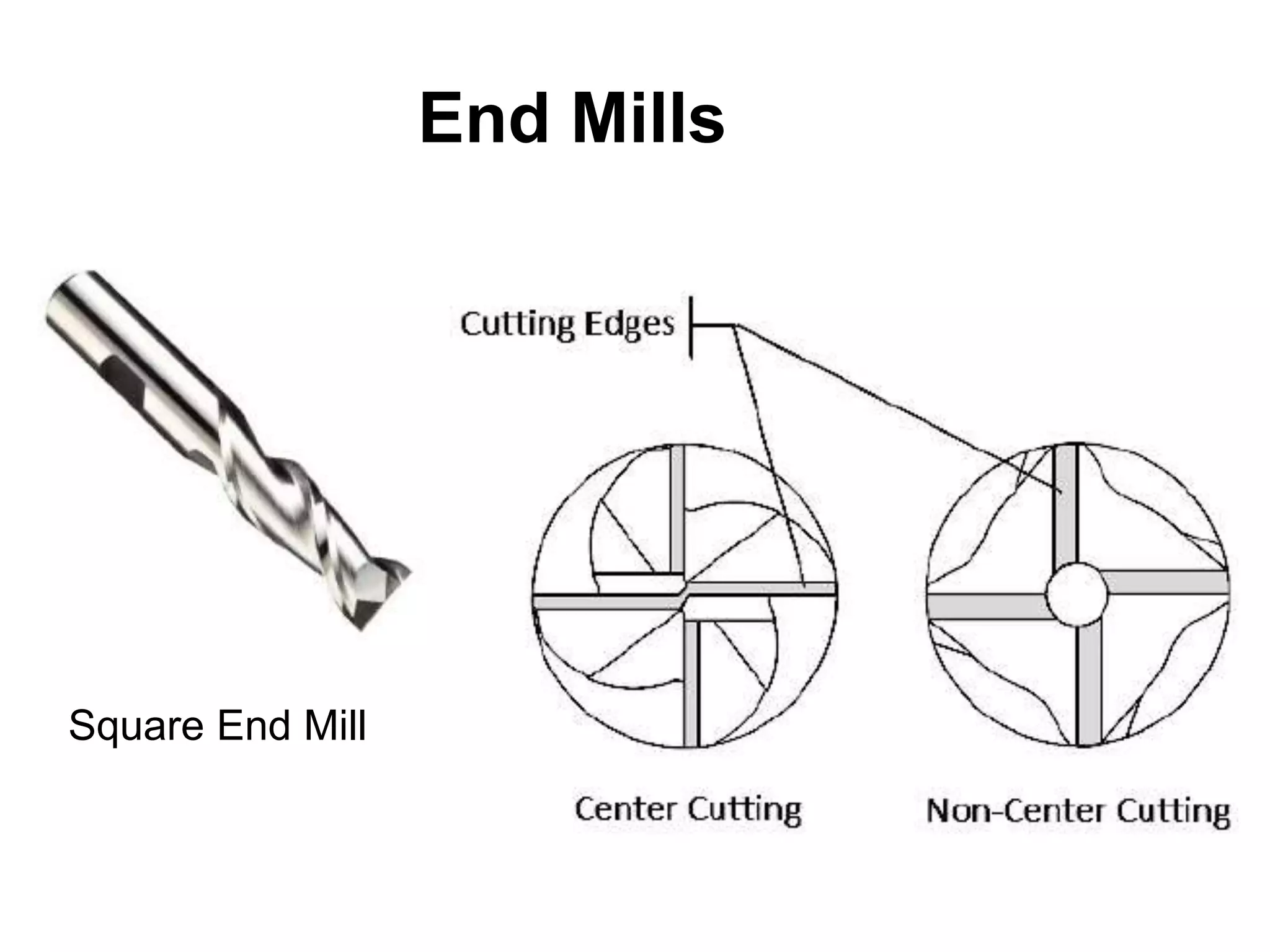
• End mills can be center cutting and non-
center cutting.
End Mills
Square End Mill
End Mills
• Center cutting end mills have cutting edges on
both the end face of the cutter and the sides.
Center cutting end mills are essential for plunge
milling.
• Non-center cutting end mills have cutting edges
only on the sides and are used only for side
milling. These tools are identified by a small hole
at the center.
• Roughing end mills have serrations in the teeth to
quickly remove large amounts of material without
creating vibration. The serrations produce many
small chips and a rough finish.
End Mills
Non centre cutting
Roughing end mills
End Mills
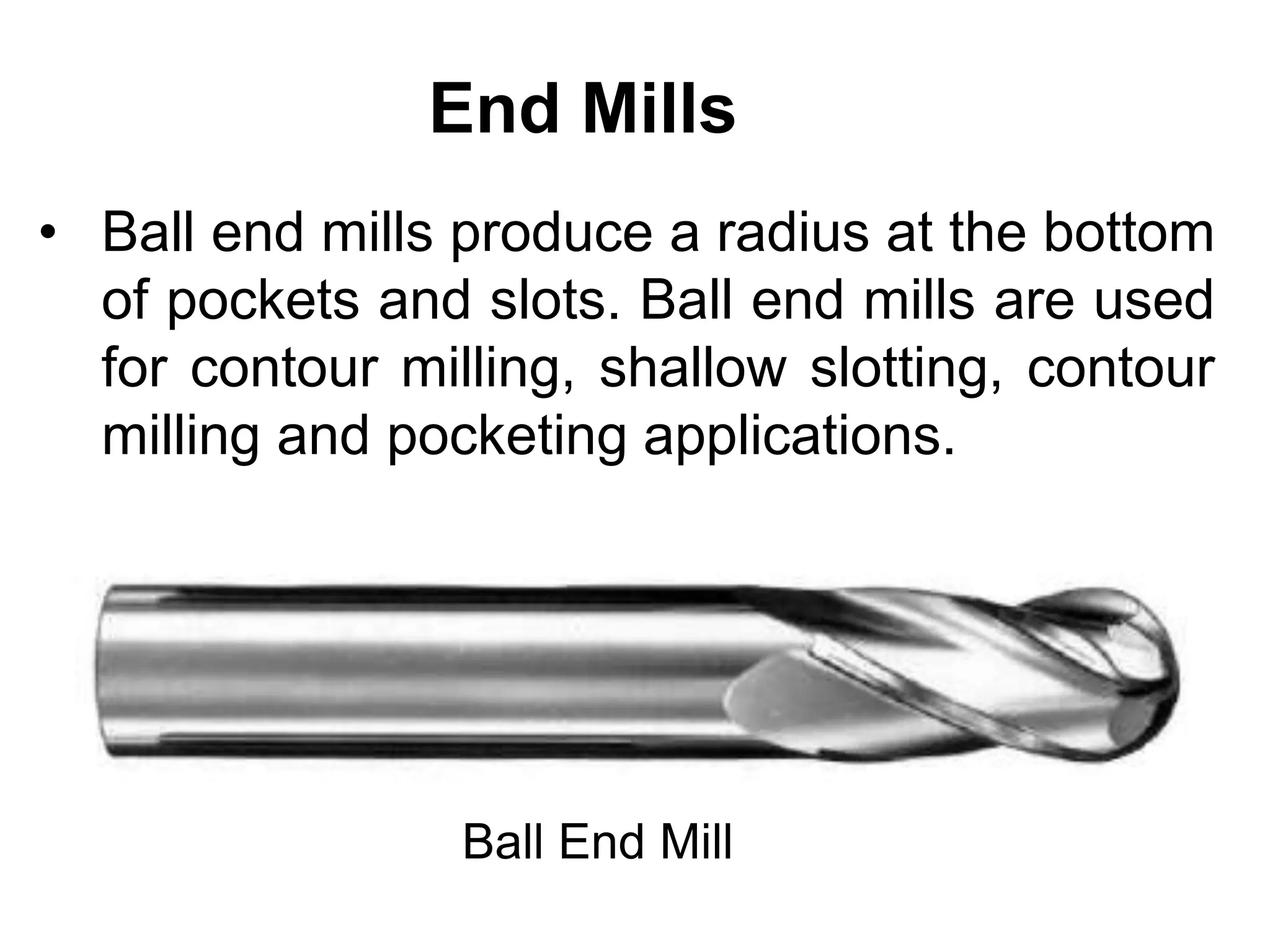
• Ball end mills produce a radius at the bottom
of pockets and slots. Ball end mills are used
for contour milling, shallow slotting, contour
milling and pocketing applications.
Ball End Mill
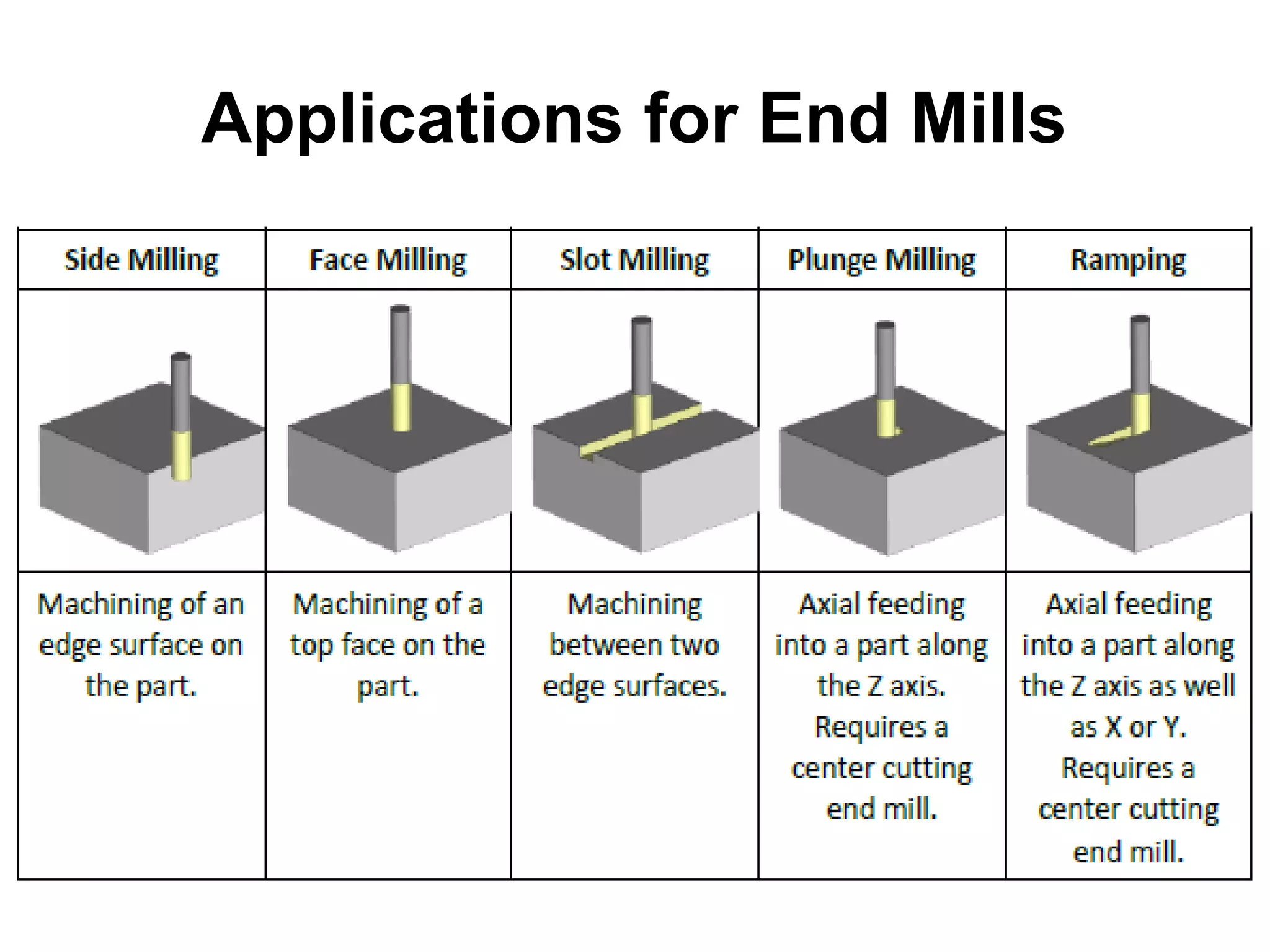
Applications for End Mills
Flutes
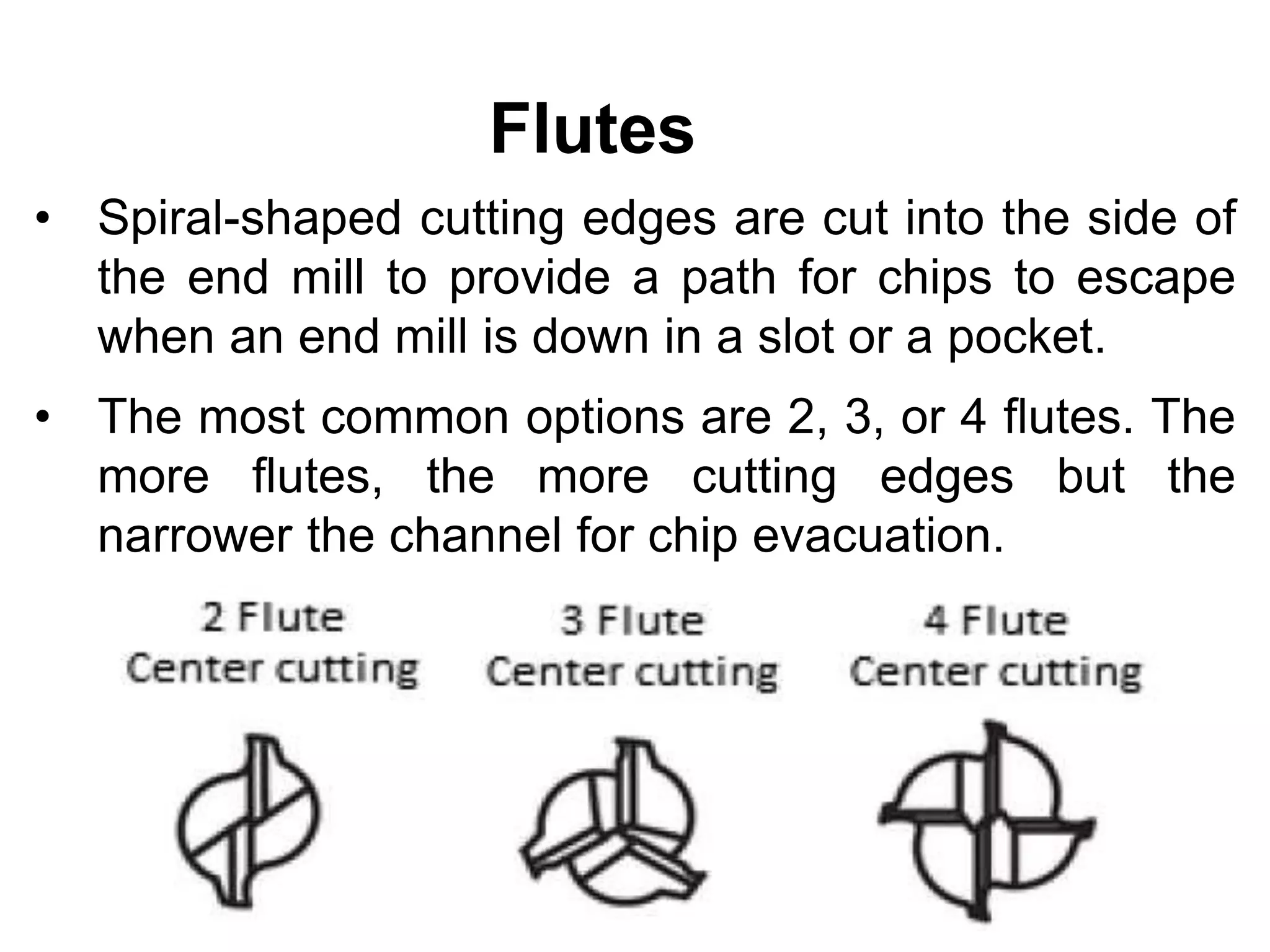
• Spiral-shaped cutting edges are cut into the side of
the end mill to provide a path for chips to escape
when an end mill is down in a slot or a pocket.
• The most common options are 2, 3, or 4 flutes. The
more flutes, the more cutting edges but the
narrower the channel for chip evacuation.
Flutes
• An important consideration when choosing
the number of flutes is called “chip load”.
• “Chip load” is a measurement of the
thickness of material removed by each
cutting edge during a cut.
• The number of flutes you choose depends
on the material you want to cut and the
capabilities of your machine.
Flutes
• A material like aluminum produces large chips
compared to other materials. For that reason, 4
flute end mills are rarely used with aluminum
because the flutes can get jammed with chips and
break the cutter.
• For harder materials, you want to use more flutes.
Having more flutes reduces chip load and
improves surface finish.
• The most common flute numbers for general
milling operations are two (better space for chip
ejection) and four (better surface finish).
Flutes
• Two Flute: Has the greatest amount of flute space,
allowing for more chip carrying capacity in softer materials.
Used primarily in slotting and pocketing of non-ferrous
materials like aluminum where chip removal is a concern.
• Three Flute: Allows for better part finish in harder
materials. The three flutes provide for greater strength and
the ability to pocket and slot both ferrous and non-ferrous
materials.
• Four Flute: Ideal for finish milling. The extra flutes allow for
faster feed rates to produce a much finer finish than two or
three flute tools. However, the reduced flute space may
cause problems with chip removal.
End Mill Materials
• End mills are made out of either cobalt steel
alloys (known as high speed steel, or HSS), or
from tungsten carbide in a cobalt lattice
(shortened to "carbide").
• High Speed Steel (HSS): Provides good wear
resistance and costs less than cobalt or carbide
end mills. HSS is used for general purpose milling
of both ferrous and non-ferrous materials. While
usually inexpensive, HSS does not offer the tool
life or speed advantages of cobalt and carbide
end mills.
End Mill Materials
• Cobalt: Cobalt is an M42 tool steel with an 8% cobalt
content. Cobalt is more expensive but provides better wear
resistance and toughness than HSS (M7). Because the tool
can run 10% faster than HSS, metal removal rates and
finish are better than HSS.
• Solid Carbide: Carbide is considerably harder, more rigid,
and more wear resistant than HSS. However, carbide is
brittle and tends to chip instead of wear. Carbide is used
primarily in finishing applications. Carbide tools are best
suited for shops operating newer milling machines or
machines with minimal spindle wear. Rigidity is critical when
using carbide tools. Carbide end mills may require a
premium price over the cobalt end mills, but they can also
be run at speeds 2 1/2 times faster than HSS end mills.
End Mill Materials
• The choice of tool material depends on the
material to be cut as well as on the
maximum spindle speed of the machine.
• Smaller milling machines may not be
capable of reaching the spindle speeds
recommended for carbide end mills.
End Mill Coatings
• The use of coatings will increase the surface
hardness of the tool. This will allow for
greater tool life and faster cutting speed.
• Standard coatings include Titanium Nitride
(TiN), Titanium Carbonitride (TiCN), and
Aluminum Titanium Nitride (AlTiN).
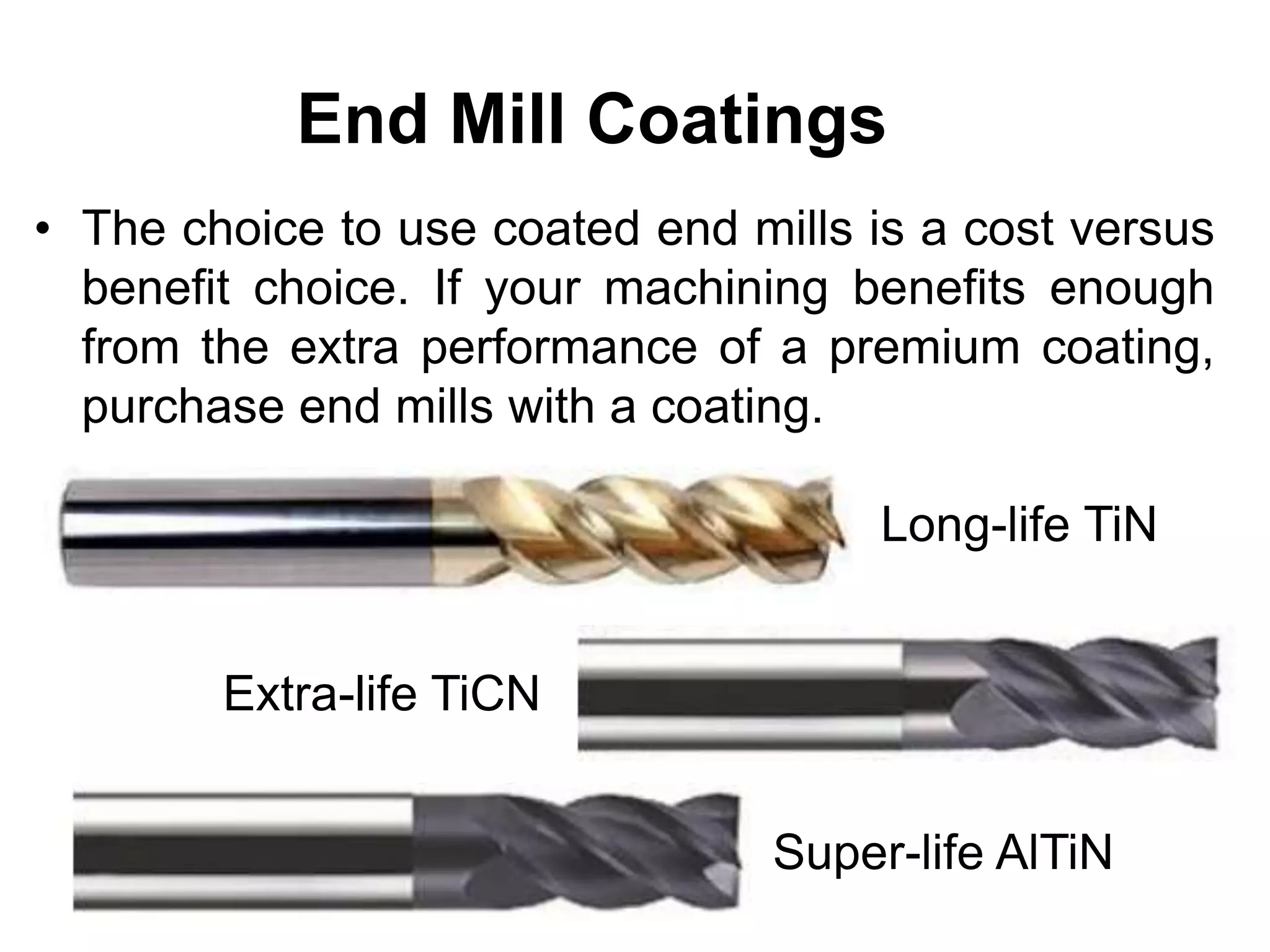
• Long-life TiN (titanium nitride) coating is good
for use on alloy steel, aluminum, and plastic.
Color is gold.
End Mill Coatings
• Extra-life TiCN (titanium carbonitride) coating has
better wear resistance than TiN coating, making it a
good choice for tough-to-machine materials such
as ductile cast iron, stainless steel, aluminum, and
plastic. Color is blue-gray.
• Super-life AlTiN (aluminum titanium nitride) coating
is the best for very high feeds/speeds and high-
temperature applications. Use to mill cast iron,
stainless steel, nickel-based alloys, and titanium.
Not for use on aluminum. Color is purple-gray.
End Mill Coatings
• The choice to use coated end mills is a cost versus
benefit choice. If your machining benefits enough
from the extra performance of a premium coating,
purchase end mills with a coating.
Long-life TiN
Extra-life TiCN
Super-life AlTiN
Face Mills & Indexable End Mills
• Face mills are tools with a large diameter
that are used to cut a wide shallow path for
facing operations.
• A face mill is a solid body that holds multiple
carbide inserts that can be replaced as they
wear out. The more inserts, the faster the
metal removal rate.
• Cutters with a 45o lead angle are used most
frequently.
Face Mills & Indexable End Mills
Face Mill Cutter
Face Mills & Indexable End Mills
• Square shoulder (90o) and round insert
cutters are also used for certain conditions.
• Indexable end mills also use replaceable
carbide inserts. Indexable end mills are
convenient for efficient roughing and to save
costs on the larger sizes of solid end mills.
• Indexable end mills are typically used to
rough the part, which is then finished with a
solid end mill.
Face Mills & Indexable End Mills
Square shouldered round insert indexable
end mill cutters
Face Mills & Indexable End Mills
Indexable end
mill cutter
Drills, Taps and Reamers
• High Speed Steel (HSS) tools such as
drills, taps and reamers are commonly
used on CNC machining centers for hole
making operations.
• The material removal rate of twist drills is
outstanding, and usually better than
equivalent sized end mills. Twist drills come
in many more diameters and sizes than
end mills.
Drills, Taps and Reamers
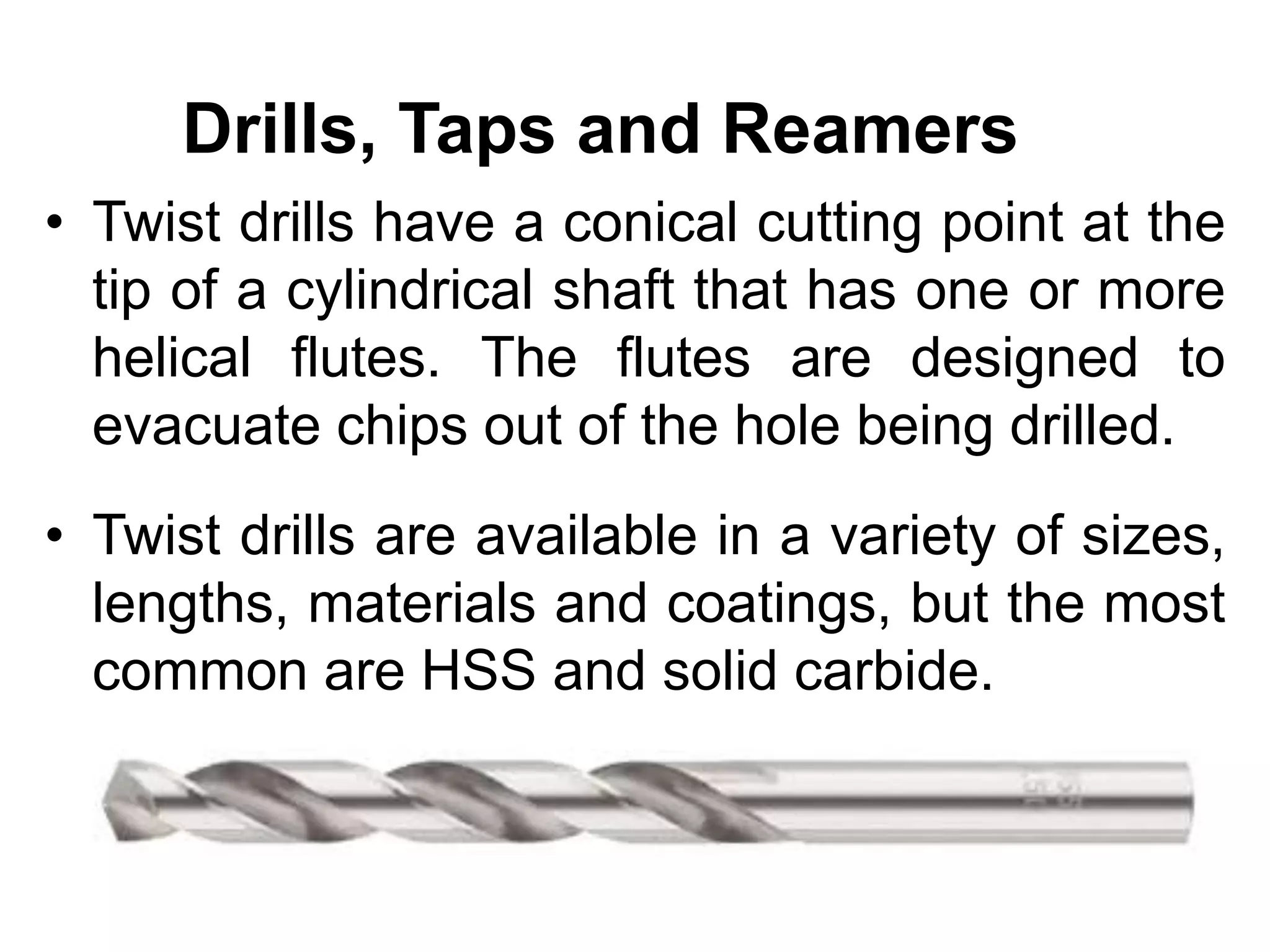
• Twist drills have a conical cutting point at the
tip of a cylindrical shaft that has one or more
helical flutes. The flutes are designed to
evacuate chips out of the hole being drilled.
• Twist drills are available in a variety of sizes,
lengths, materials and coatings, but the most
common are HSS and solid carbide.
Coated Twist Drills
• Tool coatings have an influence on the cutting
process by increasing cutting speed and tool life.
• Coatings such as titanium nitride (TiN) increase the
initial cost but reduce wear and increase tool life.
• Applied as a thin coating, TiN is used to harden and
protect cutting surfaces.
• Twist drills coated with titanium nitride (TiN) are
easily identified by a gold like color.
• This coating increases the hardness of the bit and
adds a self-lubricating property.
Indexable Drills
• Considering how often holes are made and
the advantages of indexable tooling for end
and face milling, indexable drills are also
available.
• These are generally used for larger holes.
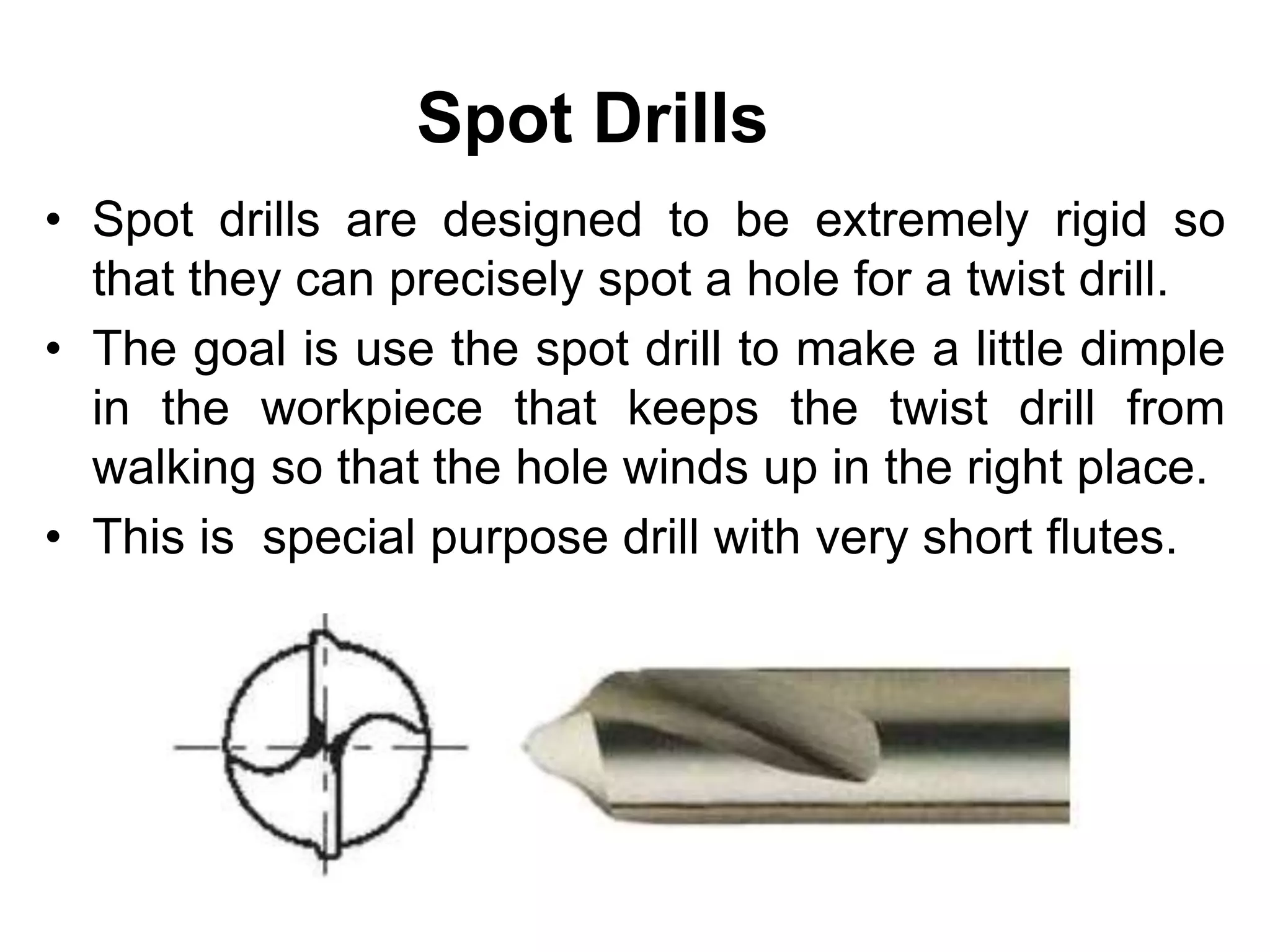
Spot Drills
• Spot drills are designed to be extremely rigid so
that they can precisely spot a hole for a twist drill.
• The goal is use the spot drill to make a little dimple
in the workpiece that keeps the twist drill from
walking so that the hole winds up in the right place.
• This is special purpose drill with very short flutes.
Centre Drills
• Center drills are intended to be used to create a 60o
center in the end of lathe stock.
• These are also has very short flutes like spot drills.
• They have a 2-part tip that has a small pilot as well
as the larger countersinking area of the bit.
• If you use a carbide drill, spotting is typically not
needed. The carbide itself is so rigid compared to
HSS that the drill will go where it is pointed.
Reamers
• Reamers are used to enlarge an existing hole to a
precise tolerance and to add a high quality surface
finish.
• Reamers require a hole be drilled first that is fairly
close to the final size so that the reamer actually
removes relatively little material.
• Reamers ensure a hole has an accurate diameter,
roundness, and good surface finish.
Taps
• Taps are used to cut internal threads of a specific
size and pitch. Like reamers, a tap requires a hole be
drilled first to the size of the minor diameter.
• Forming taps must be applied in materials that cold
form well. This includes steels, stainless steels, light
metals, and light metal alloys. Generally, materials
that produce a continuous chip when drilling are
good candidates for thread forming.
Tool Holders
• Tool holders are used to adapt tools of different
shapes and sizes accurately and securely to a
milling machine spindle.
• Shanks are shaped to fit various standard machine
tapers such as R8, NT 40, CAT 40, and BT 40.
• Pull studs (retention knobs) are threaded into the
tapered end of the tool holder so the holder can
seat securely in the CNC machine.
• The successful application of milling depends on
how well the tool is supported by the tool holder. To
achieve best results an end mill must be mounted
concentric in a tool holder.
Tool Holders
Tool Holders
Pull Stud
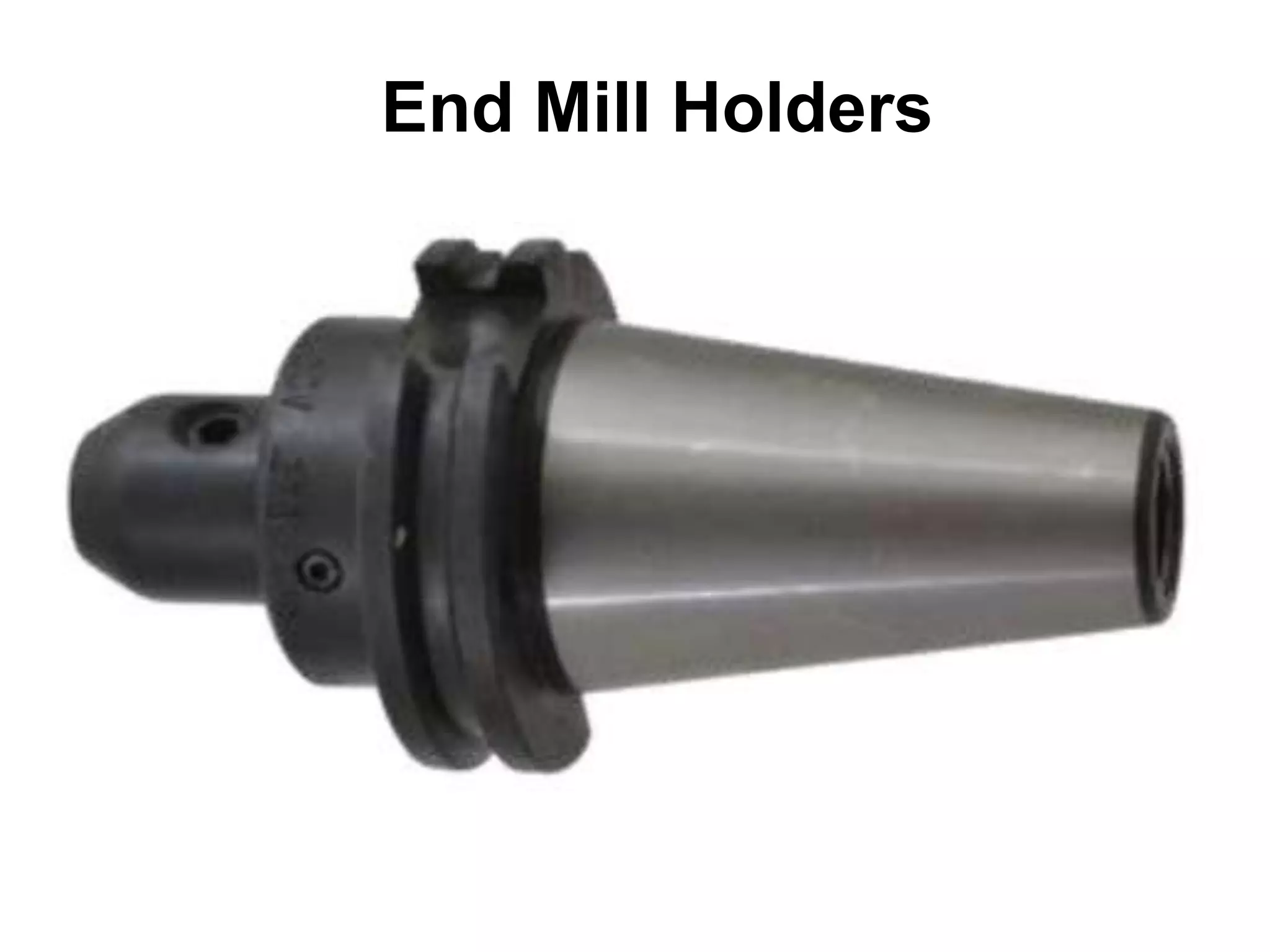
End Mill Holders
• A solid end mill holder consists of a precision bored
hole and a set screw. An end mill that has a shank
with a Weldon flat is slid into the holder and then
secured by the set screw from the side.
• The set screw clamps down on the Weldon flat,
providing a strong grip with a slight loss in
concentricity.
• Solid end mill holders are often preferred for
roughing and heavy duty milling because of their
secure holding ability.
End Mill Holders
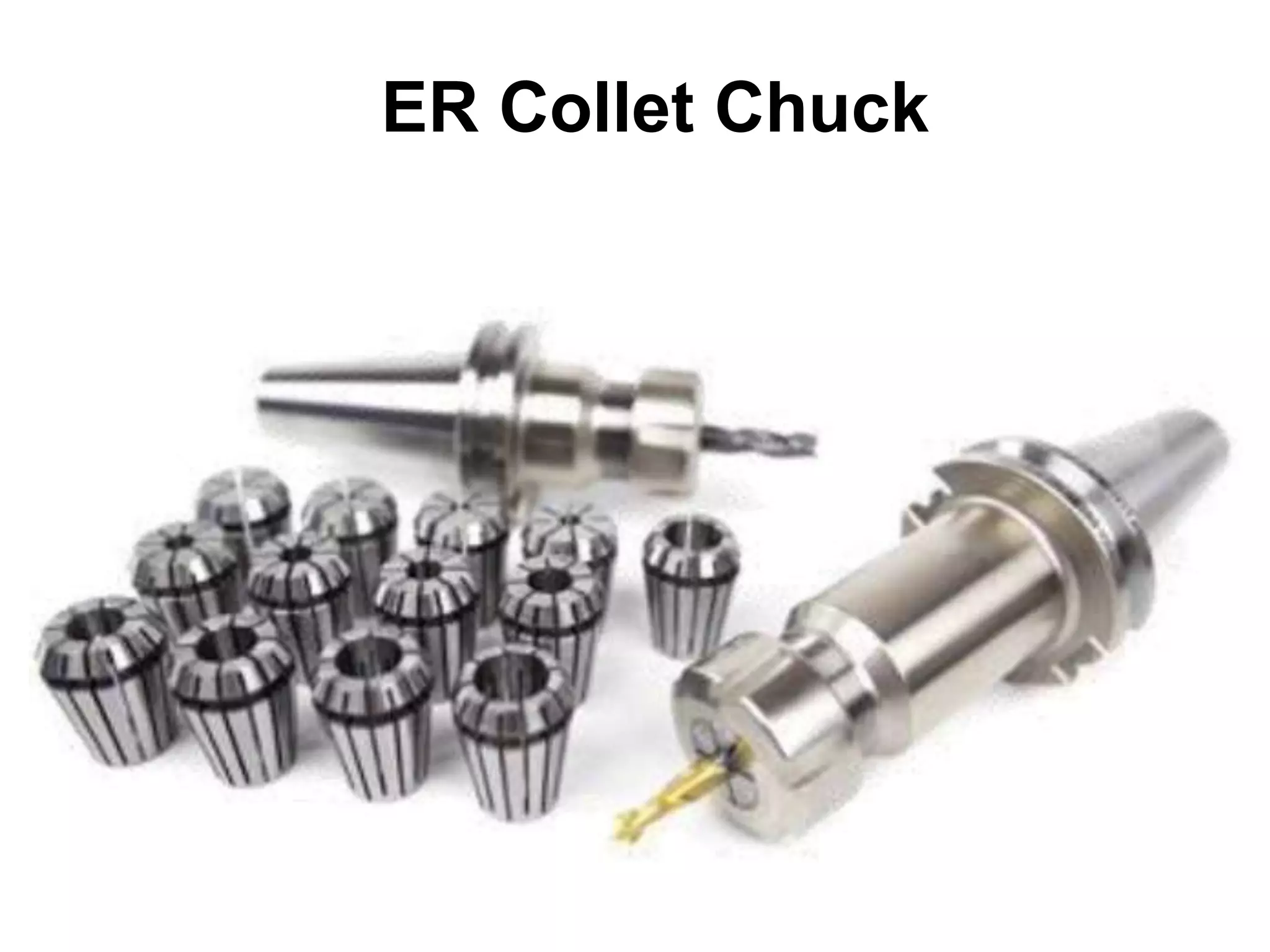
ER Collet Chuck
• An ER collet chuck consists of a collet nut, a
collet, and a tapered socket.
• Collet chucks have high accuracy and a wide
range of gripping sizes, allowing the chuck to
hold many different sizes and types of tools.
• Collet chucks are often preferred for finishing
because of their accuracy and versatility.
Collet chucks have less holding security than
solid end mill holders.
ER Collet Chuck
Milling Chuck
• Milling chucks have a
greater gripping power
than traditional collet
chucks and are more
rigid and accurate.
Milling chucks are
preferred for larger
milling tools and high-
speed applications.
Drill Chuck
• Drill chucks are
convenient and
versatile for general
hole drilling.
• ER collet chucks
can also be used to
hold drills that do
not need to be
switched out often.
Hydraulic Holders & Shrink Fit Holders
• These two are specialty holders for high-speed
applications.
• Hydraulic holders use fluid to center and compress
the tool with uniform pressure, allowing for
outstanding concentricity and rigidity of the tool
during machining.
• Shrink fit holders use thermal expansion to center
the tool. The diameter of the bored hole is
intentionally undersized so that it can expand
sufficiently to accommodate the tool after it is
heated in an induction heater. Cooling of the holder
then creates the clamp when the metal contracts.

DIFFERENT TOOLS IN CNC MACHINES

  • 1.
  • 2.
    Anatomy of aMilling Tool • Milling is done using a cylindrical milling tool mounted in a milling tool holder that is then mounted in the tool spindle on the machine.
  • 3.
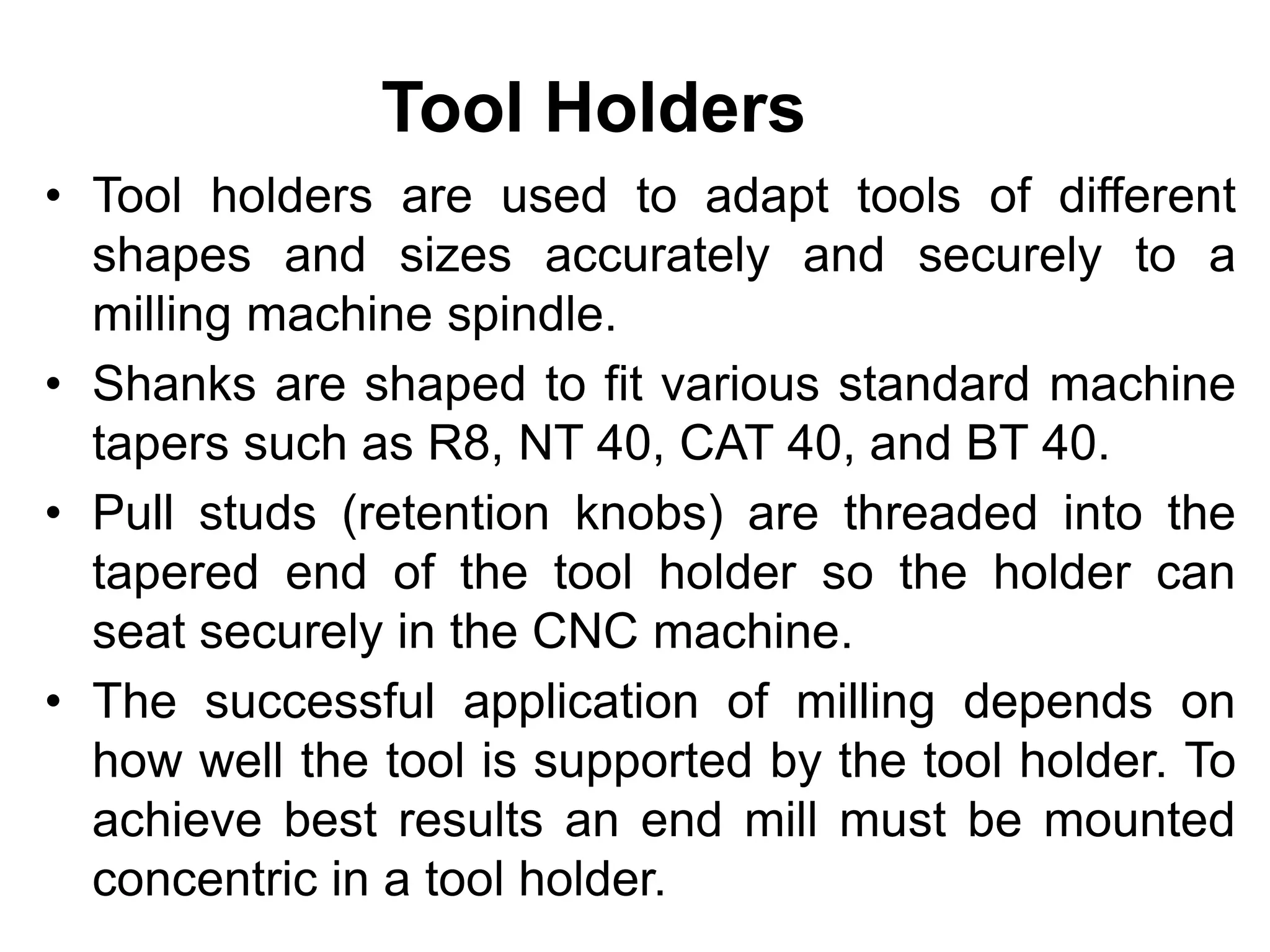
    End Mills • Endmills are the most common milling cutters. End mills are available in a wide variety of lengths, diameters, and types. • A square end mill is used for most general milling applications. It produces a sharp edge at the bottom of pockets and slots. • End mills can be center cutting and non- center cutting.
  • 4.
  • 5.
    End Mills • Centercutting end mills have cutting edges on both the end face of the cutter and the sides. Center cutting end mills are essential for plunge milling. • Non-center cutting end mills have cutting edges only on the sides and are used only for side milling. These tools are identified by a small hole at the center. • Roughing end mills have serrations in the teeth to quickly remove large amounts of material without creating vibration. The serrations produce many small chips and a rough finish.
  • 6.
    End Mills Non centrecutting Roughing end mills
  • 7.
    End Mills • Ballend mills produce a radius at the bottom of pockets and slots. Ball end mills are used for contour milling, shallow slotting, contour milling and pocketing applications. Ball End Mill
  • 8.
  • 9.
    Flutes • Spiral-shaped cuttingedges are cut into the side of the end mill to provide a path for chips to escape when an end mill is down in a slot or a pocket. • The most common options are 2, 3, or 4 flutes. The more flutes, the more cutting edges but the narrower the channel for chip evacuation.
  • 10.
    Flutes • An importantconsideration when choosing the number of flutes is called “chip load”. • “Chip load” is a measurement of the thickness of material removed by each cutting edge during a cut. • The number of flutes you choose depends on the material you want to cut and the capabilities of your machine.
  • 11.
    Flutes • A materiallike aluminum produces large chips compared to other materials. For that reason, 4 flute end mills are rarely used with aluminum because the flutes can get jammed with chips and break the cutter. • For harder materials, you want to use more flutes. Having more flutes reduces chip load and improves surface finish. • The most common flute numbers for general milling operations are two (better space for chip ejection) and four (better surface finish).
  • 12.
    Flutes • Two Flute:Has the greatest amount of flute space, allowing for more chip carrying capacity in softer materials. Used primarily in slotting and pocketing of non-ferrous materials like aluminum where chip removal is a concern. • Three Flute: Allows for better part finish in harder materials. The three flutes provide for greater strength and the ability to pocket and slot both ferrous and non-ferrous materials. • Four Flute: Ideal for finish milling. The extra flutes allow for faster feed rates to produce a much finer finish than two or three flute tools. However, the reduced flute space may cause problems with chip removal.
  • 13.
    End Mill Materials •End mills are made out of either cobalt steel alloys (known as high speed steel, or HSS), or from tungsten carbide in a cobalt lattice (shortened to "carbide"). • High Speed Steel (HSS): Provides good wear resistance and costs less than cobalt or carbide end mills. HSS is used for general purpose milling of both ferrous and non-ferrous materials. While usually inexpensive, HSS does not offer the tool life or speed advantages of cobalt and carbide end mills.
  • 14.
    End Mill Materials •Cobalt: Cobalt is an M42 tool steel with an 8% cobalt content. Cobalt is more expensive but provides better wear resistance and toughness than HSS (M7). Because the tool can run 10% faster than HSS, metal removal rates and finish are better than HSS. • Solid Carbide: Carbide is considerably harder, more rigid, and more wear resistant than HSS. However, carbide is brittle and tends to chip instead of wear. Carbide is used primarily in finishing applications. Carbide tools are best suited for shops operating newer milling machines or machines with minimal spindle wear. Rigidity is critical when using carbide tools. Carbide end mills may require a premium price over the cobalt end mills, but they can also be run at speeds 2 1/2 times faster than HSS end mills.
  • 15.
    End Mill Materials •The choice of tool material depends on the material to be cut as well as on the maximum spindle speed of the machine. • Smaller milling machines may not be capable of reaching the spindle speeds recommended for carbide end mills.
  • 16.
    End Mill Coatings •The use of coatings will increase the surface hardness of the tool. This will allow for greater tool life and faster cutting speed. • Standard coatings include Titanium Nitride (TiN), Titanium Carbonitride (TiCN), and Aluminum Titanium Nitride (AlTiN). • Long-life TiN (titanium nitride) coating is good for use on alloy steel, aluminum, and plastic. Color is gold.
  • 17.
    End Mill Coatings •Extra-life TiCN (titanium carbonitride) coating has better wear resistance than TiN coating, making it a good choice for tough-to-machine materials such as ductile cast iron, stainless steel, aluminum, and plastic. Color is blue-gray. • Super-life AlTiN (aluminum titanium nitride) coating is the best for very high feeds/speeds and high- temperature applications. Use to mill cast iron, stainless steel, nickel-based alloys, and titanium. Not for use on aluminum. Color is purple-gray.
  • 18.
    End Mill Coatings •The choice to use coated end mills is a cost versus benefit choice. If your machining benefits enough from the extra performance of a premium coating, purchase end mills with a coating. Long-life TiN Extra-life TiCN Super-life AlTiN
  • 19.
    Face Mills &Indexable End Mills • Face mills are tools with a large diameter that are used to cut a wide shallow path for facing operations. • A face mill is a solid body that holds multiple carbide inserts that can be replaced as they wear out. The more inserts, the faster the metal removal rate. • Cutters with a 45o lead angle are used most frequently.
  • 20.
    Face Mills &Indexable End Mills Face Mill Cutter
  • 21.
    Face Mills &Indexable End Mills • Square shoulder (90o) and round insert cutters are also used for certain conditions. • Indexable end mills also use replaceable carbide inserts. Indexable end mills are convenient for efficient roughing and to save costs on the larger sizes of solid end mills. • Indexable end mills are typically used to rough the part, which is then finished with a solid end mill.
  • 22.
    Face Mills &Indexable End Mills Square shouldered round insert indexable end mill cutters
  • 23.
    Face Mills &Indexable End Mills Indexable end mill cutter
  • 24.
    Drills, Taps andReamers • High Speed Steel (HSS) tools such as drills, taps and reamers are commonly used on CNC machining centers for hole making operations. • The material removal rate of twist drills is outstanding, and usually better than equivalent sized end mills. Twist drills come in many more diameters and sizes than end mills.
  • 25.
    Drills, Taps andReamers • Twist drills have a conical cutting point at the tip of a cylindrical shaft that has one or more helical flutes. The flutes are designed to evacuate chips out of the hole being drilled. • Twist drills are available in a variety of sizes, lengths, materials and coatings, but the most common are HSS and solid carbide.
  • 26.
    Coated Twist Drills •Tool coatings have an influence on the cutting process by increasing cutting speed and tool life. • Coatings such as titanium nitride (TiN) increase the initial cost but reduce wear and increase tool life. • Applied as a thin coating, TiN is used to harden and protect cutting surfaces. • Twist drills coated with titanium nitride (TiN) are easily identified by a gold like color. • This coating increases the hardness of the bit and adds a self-lubricating property.
  • 27.
    Indexable Drills • Consideringhow often holes are made and the advantages of indexable tooling for end and face milling, indexable drills are also available. • These are generally used for larger holes.
  • 28.
    Spot Drills • Spotdrills are designed to be extremely rigid so that they can precisely spot a hole for a twist drill. • The goal is use the spot drill to make a little dimple in the workpiece that keeps the twist drill from walking so that the hole winds up in the right place. • This is special purpose drill with very short flutes.
  • 29.
    Centre Drills • Centerdrills are intended to be used to create a 60o center in the end of lathe stock. • These are also has very short flutes like spot drills. • They have a 2-part tip that has a small pilot as well as the larger countersinking area of the bit. • If you use a carbide drill, spotting is typically not needed. The carbide itself is so rigid compared to HSS that the drill will go where it is pointed.
  • 30.
    Reamers • Reamers areused to enlarge an existing hole to a precise tolerance and to add a high quality surface finish. • Reamers require a hole be drilled first that is fairly close to the final size so that the reamer actually removes relatively little material. • Reamers ensure a hole has an accurate diameter, roundness, and good surface finish.
  • 31.
    Taps • Taps areused to cut internal threads of a specific size and pitch. Like reamers, a tap requires a hole be drilled first to the size of the minor diameter. • Forming taps must be applied in materials that cold form well. This includes steels, stainless steels, light metals, and light metal alloys. Generally, materials that produce a continuous chip when drilling are good candidates for thread forming.
  • 32.
    Tool Holders • Toolholders are used to adapt tools of different shapes and sizes accurately and securely to a milling machine spindle. • Shanks are shaped to fit various standard machine tapers such as R8, NT 40, CAT 40, and BT 40. • Pull studs (retention knobs) are threaded into the tapered end of the tool holder so the holder can seat securely in the CNC machine. • The successful application of milling depends on how well the tool is supported by the tool holder. To achieve best results an end mill must be mounted concentric in a tool holder.
  • 33.
  • 34.
    End Mill Holders •A solid end mill holder consists of a precision bored hole and a set screw. An end mill that has a shank with a Weldon flat is slid into the holder and then secured by the set screw from the side. • The set screw clamps down on the Weldon flat, providing a strong grip with a slight loss in concentricity. • Solid end mill holders are often preferred for roughing and heavy duty milling because of their secure holding ability.
  • 35.
  • 36.
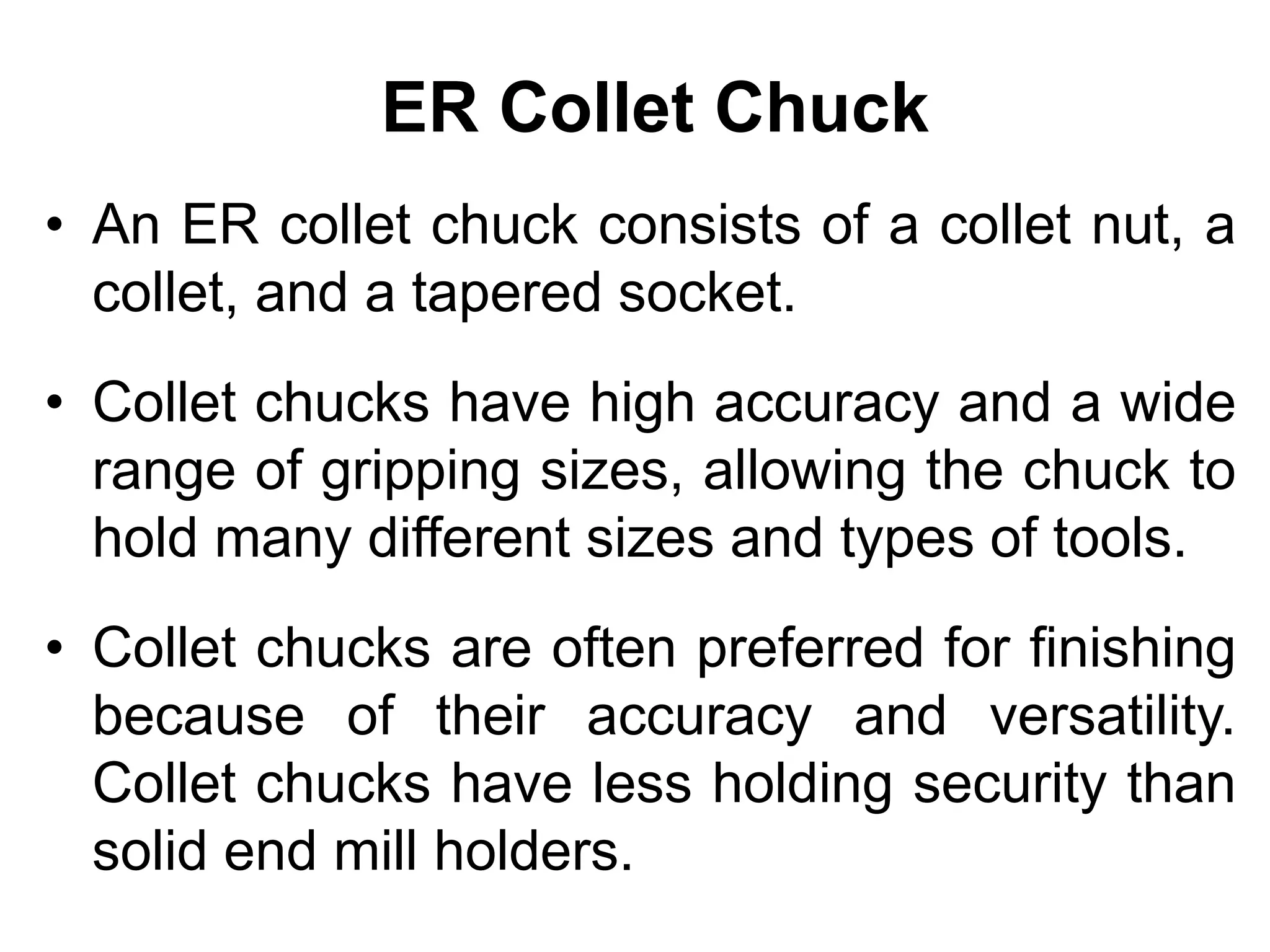
    ER Collet Chuck •An ER collet chuck consists of a collet nut, a collet, and a tapered socket. • Collet chucks have high accuracy and a wide range of gripping sizes, allowing the chuck to hold many different sizes and types of tools. • Collet chucks are often preferred for finishing because of their accuracy and versatility. Collet chucks have less holding security than solid end mill holders.
  • 37.
  • 38.
    Milling Chuck • Millingchucks have a greater gripping power than traditional collet chucks and are more rigid and accurate. Milling chucks are preferred for larger milling tools and high- speed applications.
  • 39.
    Drill Chuck • Drillchucks are convenient and versatile for general hole drilling. • ER collet chucks can also be used to hold drills that do not need to be switched out often.
  • 40.
    Hydraulic Holders &Shrink Fit Holders • These two are specialty holders for high-speed applications. • Hydraulic holders use fluid to center and compress the tool with uniform pressure, allowing for outstanding concentricity and rigidity of the tool during machining. • Shrink fit holders use thermal expansion to center the tool. The diameter of the bored hole is intentionally undersized so that it can expand sufficiently to accommodate the tool after it is heated in an induction heater. Cooling of the holder then creates the clamp when the metal contracts.