
Interpretability beyond feature attribution:
Testing with Concept Activation Vectors
TCAV
Been Kim
Presenting work with a lot of awesome people inside and outside of Google:
Marten Wattenberg, Julius Adebayo, Justin Gilmer, Carrie Cai, James Wexler,
Fernanda Viegas, Ian Goodfellow, Mortiz Hardt, Rory Sayres
My goal
interpretability
!2
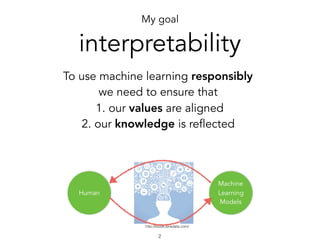
To use machine learning responsibly
we need to ensure that
1. our values are aligned
2. our knowledge is reflected
for everyone.
http://blogs.teradata.com/
Machine
Learning
Models
Human
My goal
interpretability
!3
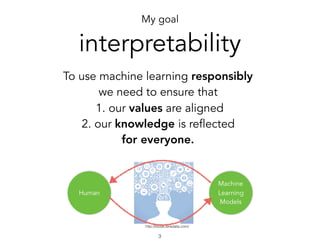
To use machine learning responsibly
we need to ensure that
1. our values are aligned
2. our knowledge is reflected
for everyone.
http://blogs.teradata.com/
Machine
Learning
Models
Human
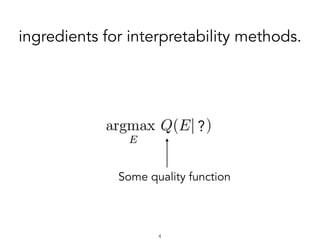
ingredients for interpretability methods.
!4
?
Some quality function
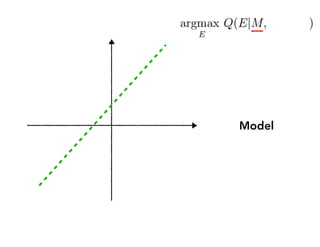
Model
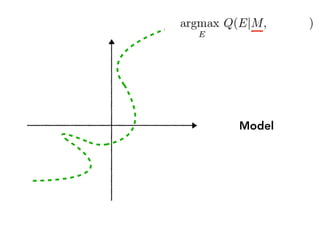
Model
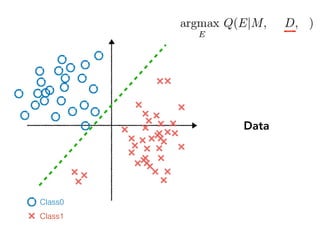
Class1
Class0
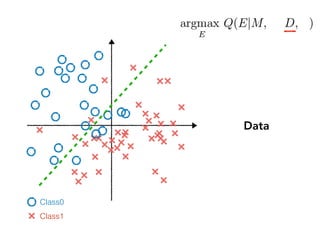
Data
Class1
Class0
Data
Class1
Class0
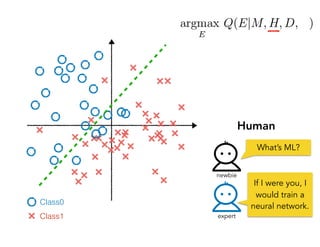
Human
What’s ML?
If I were you, I
would train a
neural network.
newbie
expert
Class1
Class0
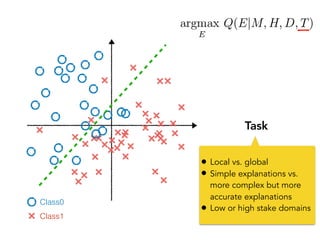
Task
• Local vs. global
• Simple explanations vs.
more complex but more
accurate explanations
• Low or high stake domains
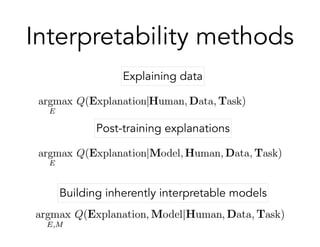
Interpretability methods
Post-training explanations
Building inherently interpretable models
Explaining data
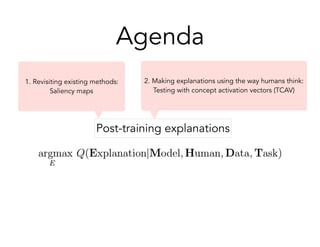
Agenda
Post-training explanations
Agenda
1. Revisiting existing methods:
Saliency maps
2. Making explanations using the way humans think:
Testing with concept activation vectors (TCAV)
Post-training explanations
Agenda
Sanity Checks for Saliency Maps
Joint work with Adebayo, Gilmer, Goodfellow, Hardt, [NIPS 18]
1. Revisiting existing methods:
Saliency maps
2. Making explanations using the way humans think:
Testing with concept activation vectors (TCAV)
Post-training explanations
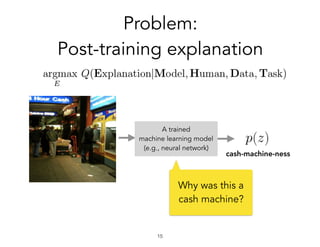
Problem:
Post-training explanation
!15
cash-machine-ness
A trained
machine learning model
(e.g., neural network)
Why was this a
cash machine?
One of the most popular interpretability methods for images:
Saliency maps
!16
SmoothGrad [Smilkov, Thorat, K., Viégas, Wattenberg ’17]
Integrated gradient [Sundararajan, Taly, Yan ’17]
picture credit: @sayres
Caaaaan do! We’ve got
saliency maps to measure
importance of each pixel!
a logit
pixel i,j
One of the most popular interpretability methods for images:
Saliency maps
!17
SmoothGrad [Smilkov, Thorat, K., Viégas, Wattenberg ’17]
Integrated gradient [Sundararajan, Taly, Yan ’17]
widely used
for images
local
undestandingNN
humans’
subjective
judgement
picture credit: @sayres
One of the most popular interpretability methods for images:
Saliency maps
!18
Sanity check:
If I change M a lot, will human
perceive that E has changed a lot?
SmoothGrad [Smilkov, Thorat, K., Viégas, Wattenberg ’17]
Integrated gradient [Sundararajan, Taly, Yan ’17]
widely used
for images
local
undestandingNN
humans’
subjective
judgement
picture credit: @sayres
Some confusing behaviors of saliency maps.
Saliency map
Sanity Checks for Saliency Maps
Joint work with Adebayo, Gilmer, Goodfellow, Hardt, [NIPS 18]
Some confusing behaviors of saliency maps.
Randomized weights!
Network now makes garbage prediction.
Saliency map
Sanity Checks for Saliency Maps
Joint work with Adebayo, Gilmer, Goodfellow, Hardt, [NIPS 18]
Some confusing behaviors of saliency maps.
Saliency map
Randomized weights!
Network now makes garbage prediction.
!!!!!???!?
Sanity Checks for Saliency Maps
Joint work with Adebayo, Gilmer, Goodfellow, Hardt, [NIPS 18]
Some saliency maps look similar
when we randomize the network
(= making the network completely useless)
Before After
Guided
Backprop
Integrated
Gradient
Sanity Checks for Saliency Maps
Joint work with Adebayo, Gilmer, Goodfellow, Hardt, [NIPS 18]
• Potential human confirmation bias: Just because it
“makes sense” to humans, doesn’t mean they reflect
evidence for the prediction.
• Our discovery is consistent with other findings.
[Nie, Zhang, Patel ’18] [Ulyanov, Vedaldi, Lempitsky ’18]
• Some of these methods have been shown to be useful for
humans. Why? More studies needed.
What can we learn from this?
Sanity Checks for Saliency Maps
Joint work with Adebayo, Gilmer, Goodfellow, Hardt, [NIPS 18]
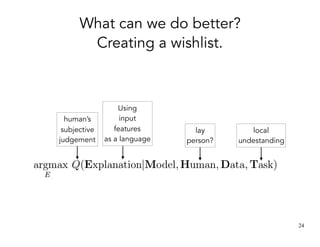
!24
local
undestanding
lay
person?
human’s
subjective
judgement
What can we do better?
Creating a wishlist.
Using
input
features
as a language
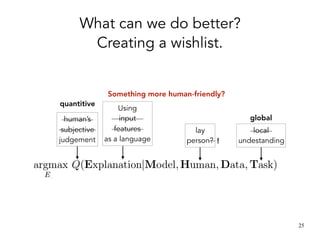
!25
local
undestanding
lay
person?
human’s
subjective
judgement
global
!
quantitive
Using
input
features
as a language
Something more human-friendly?
What can we do better?
Creating a wishlist.
Agenda
TCAV [ICML’18]
Joint work with Wattenberg, Gilmer, Cai, Wexler, Viegas, Sayres
1. Revisiting existing methods:
Saliency maps
2. Making explanations using the way humans think:
Testing with concept activation vectors (TCAV)
Post-training explanations
Problem:
Post-training explanation
!27
cash-machine-ness
A trained
machine learning model
(e.g., neural network)
Why was this a
cash machine?
TCAV [ICML’18]
Joint work with Wattenberg, Gilmer, Cai, Wexler, Viegas, Sayres
prediction:
Cash machine
https://pair-code.github.io/saliency/
SmoothGrad [Smilkov, Thorat, K., Viégas, Wattenberg ’17]
Common solution: Saliency map
!28
Let’s use this to help us
think about what what we
really want to ask.
prediction:
Cash machine
https://pair-code.github.io/saliency/
SmoothGrad [Smilkov, Thorat, K., Viégas, Wattenberg ’17]
What we really want to ask…
!29
Were there more pixels on the cash
machine than on the person?
Did the ‘human’ concept matter?
Did the ‘wheels’ concept matter?
prediction:
Cash machine
https://pair-code.github.io/saliency/
SmoothGrad [Smilkov, Thorat, K., Viégas, Wattenberg ’17]
What we really want to ask…
!30
Were there more pixels on the cash
machine than on the person?
Which concept mattered more?
Is this true for all other cash
machine predictions?
Did the ‘human’ concept matter?
Did the ‘wheels’ concept matter?
prediction:
Cash machine
https://pair-code.github.io/saliency/
SmoothGrad [Smilkov, Thorat, K., Viégas, Wattenberg ’17]
What we really want to ask…
!31
Oh no! I can’t express these concepts
as pixels!!
They weren’t my input features either!
Were there more pixels on the cash
machine than on the person?
Which concept mattered more?
Is this true for all other cash
machine predictions?
Did the ‘human’ concept matter?
Did the ‘wheels’ concept matter?
prediction:
Cash machine
https://pair-code.github.io/saliency/
SmoothGrad [Smilkov, Thorat, K., Viégas, Wattenberg ’17]
What we really want to ask…
!32
Were there more pixels on the cash
machine than on the person?
Which concept mattered more?
Is this true for all other cash
machine predictions?
Wouldn’t it be great if we can
quantitatively measure how
important any of these
user-chosen concepts are?
Did the ‘human’ concept matter?
Did the ‘wheels’ concept matter?
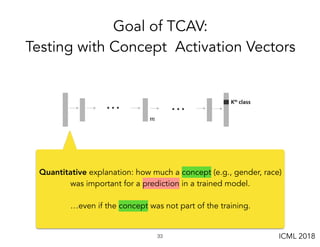
Quantitative explanation: how much a concept (e.g., gender, race)
was important for a prediction in a trained model.
…even if the concept was not part of the training.
Goal of TCAV:
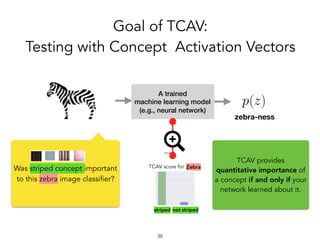
Testing with Concept Activation Vectors
!33 ICML 2018
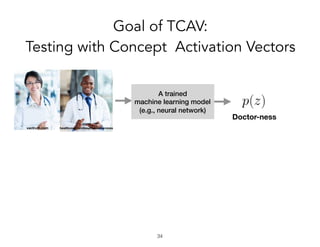
Goal of TCAV:
Testing with Concept Activation Vectors
!34
Doctor-ness
A trained
machine learning model
(e.g., neural network)
vactruth.com healthcommunitiesproviderservices
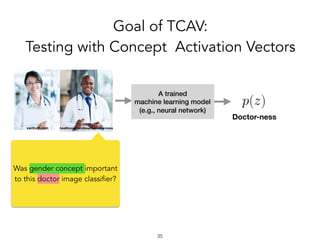
Goal of TCAV:
Testing with Concept Activation Vectors
!35
Doctor-ness
A trained
machine learning model
(e.g., neural network)
Was gender concept important
to this doctor image classifier?
vactruth.com healthcommunitiesproviderservices
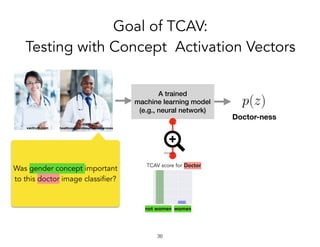
Goal of TCAV:
Testing with Concept Activation Vectors
!36
Doctor-ness
TCAV score for
womennot women
Doctor
A trained
machine learning model
(e.g., neural network)
vactruth.com healthcommunitiesproviderservices
Was gender concept important
to this doctor image classifier?
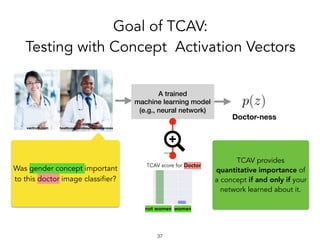
Goal of TCAV:
Testing with Concept Activation Vectors
!37
Doctor-ness
TCAV score for
womennot women
Doctor
A trained
machine learning model
(e.g., neural network)
vactruth.com healthcommunitiesproviderservices
Was gender concept important
to this doctor image classifier?
TCAV provides
quantitative importance of
a concept if and only if your
network learned about it.
Goal of TCAV:
Testing with Concept Activation Vectors
!38
zebra-ness
A trained
machine learning model
(e.g., neural network)
Was striped concept important
to this zebra image classifier?
TCAV score for
not stripedstriped
Zebra
TCAV provides
quantitative importance of
a concept if and only if your
network learned about it.
TCAV
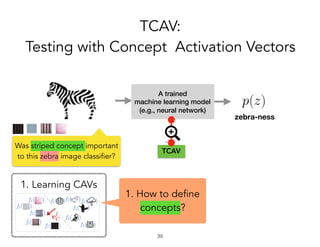
TCAV:
Testing with Concept Activation Vectors
!39
zebra-ness
A trained
machine learning model
(e.g., neural network)
Was striped concept important
to this zebra image classifier?
1. Learning CAVs
1. How to define
concepts?
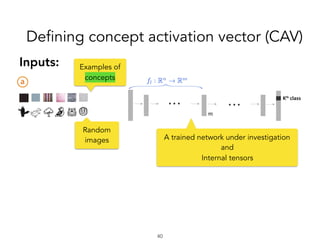
Defining concept activation vector (CAV)
Inputs:
!40
Random
images
Examples of
concepts
A trained network under investigation
and
Internal tensors
!41
Inputs:
Train a linear classifier to
separate activations.
CAV ( ) is the vector
orthogonal to the decision
boundary.
[Smilkov ’17, Bolukbasi ’16 , Schmidt ’15]
Defining concept activation vector (CAV)
TCAV
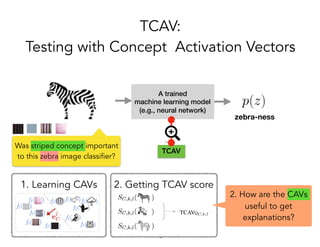
TCAV:
Testing with Concept Activation Vectors
!42
zebra-ness
A trained
machine learning model
(e.g., neural network)
Was striped concept important
to this zebra image classifier?
1. Learning CAVs 2. Getting TCAV score
2. How are the CAVs
useful to get
explanations?
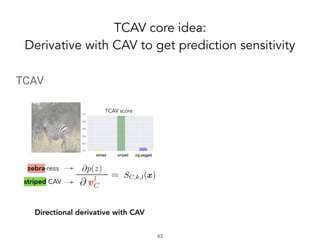
TCAV core idea:
Derivative with CAV to get prediction sensitivity
!43
TCAV score
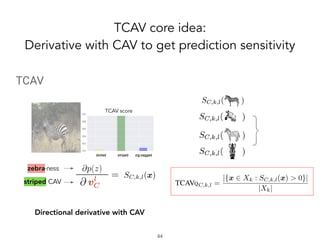
Directional derivative with CAV
striped CAV
TCAV score
Directional derivative with CAV
TCAV core idea:
Derivative with CAV to get prediction sensitivity
!44
TCAV
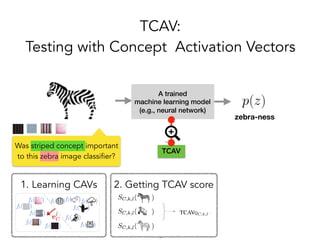
TCAV:
Testing with Concept Activation Vectors
!45
zebra-ness
A trained
machine learning model
(e.g., neural network)
Was striped concept important
to this zebra image classifier?
1. Learning CAVs 2. Getting TCAV score
TCAV
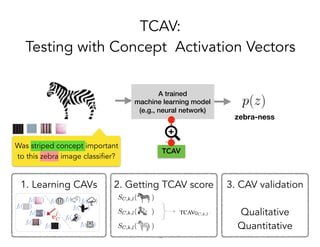
TCAV:
Testing with Concept Activation Vectors
!46
zebra-ness
A trained
machine learning model
(e.g., neural network)
Was striped concept important
to this zebra image classifier?
1. Learning CAVs 2. Getting TCAV score 3. CAV validation
Qualitative
Quantitative
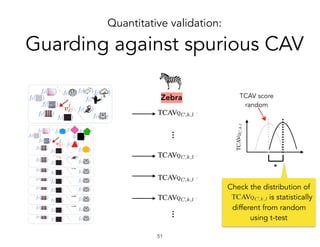
Quantitative validation:
Guarding against spurious CAV
Did my CAVs returned high sensitivity by chance?
!47
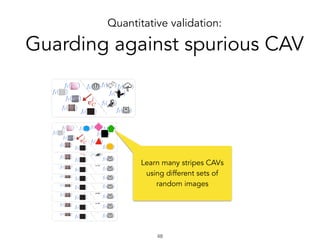
Learn many stripes CAVs
using different sets of
random images
Quantitative validation:
Guarding against spurious CAV
!48
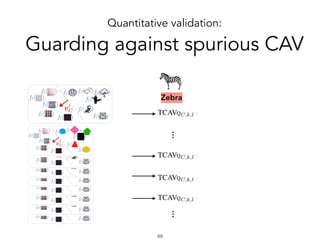
……
Zebra
Quantitative validation:
Guarding against spurious CAV
!49
……
Zebra
Quantitative validation:
Guarding against spurious CAV
!50
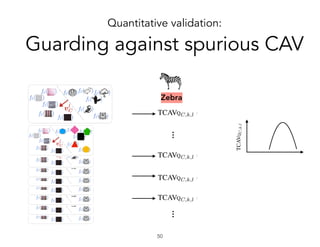
Check the distribution of
is statistically
different from random
using t-test
TCAV score
random
……
Zebra
Quantitative validation:
Guarding against spurious CAV
!51
*
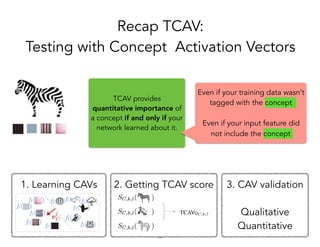
Recap TCAV:
Testing with Concept Activation Vectors
!52
1. Learning CAVs 2. Getting TCAV score 3. CAV validation
Qualitative
Quantitative
TCAV provides
quantitative importance of
a concept if and only if your
network learned about it.
Even if your training data wasn’t
tagged with the concept
Even if your input feature did
not include the concept
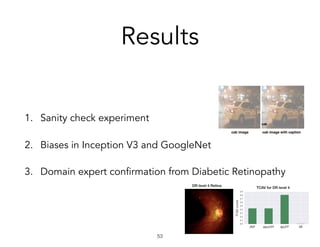
Results
1. Sanity check experiment
2. Biases in Inception V3 and GoogleNet
3. Domain expert confirmation from Diabetic Retinopathy
!53
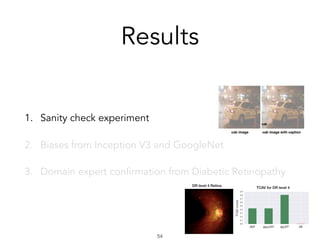
Results
1. Sanity check experiment
2. Biases from Inception V3 and GoogleNet
3. Domain expert confirmation from Diabetic Retinopathy
!54
Sanity check experiment
!55
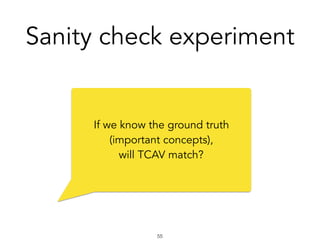
If we know the ground truth
(important concepts),
will TCAV match?
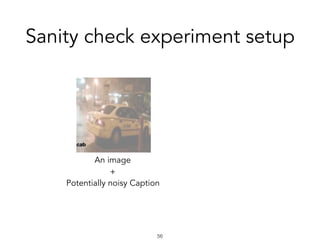
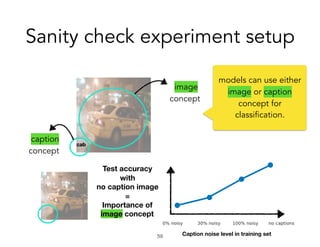
Sanity check experiment setup
!56
An image
+
Potentially noisy Caption
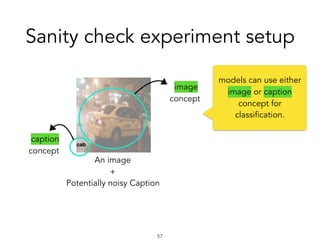
Sanity check experiment setup
!57
An image
+
Potentially noisy Caption
image
concept
models can use either
image or caption
concept for
classification.
caption
concept
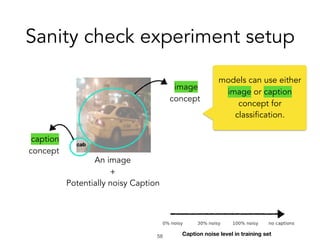
Sanity check experiment setup
!58 Caption noise level in training set
An image
+
Potentially noisy Caption
image
concept
models can use either
image or caption
concept for
classification.
caption
concept
Sanity check experiment setup
!59
Test accuracy
with
no caption image
=
Importance of
image concept
Caption noise level in training set
image
concept
caption
concept
models can use either
image or caption
concept for
classification.
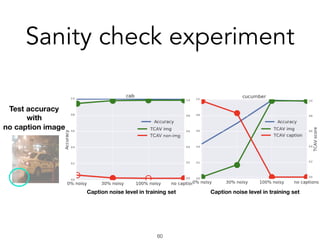
Sanity check experiment
!60
Caption noise level in training set Caption noise level in training set
Test accuracy
with
no caption image
!61
Cool, cool.
Can saliency maps do this too?
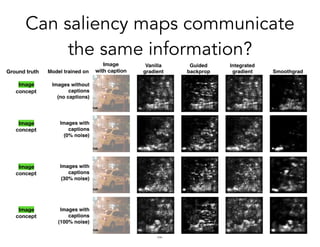
Can saliency maps communicate
the same information?
!62
Ground truth
Image
concept
Image
concept
Image
concept
Image
concept
Image
with caption
Human subject experiment:
Can saliency maps communicate the same
information?
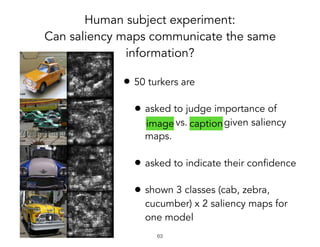
• 50 turkers are
• asked to judge importance of
image vs. c. ept given saliency
maps.
• asked to indicate their confidence
• shown 3 classes (cab, zebra,
cucumber) x 2 saliency maps for
one model
!63
image caption
!64
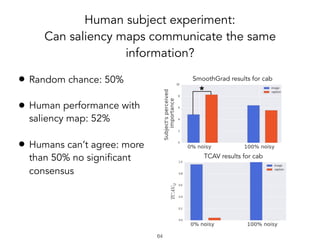
• Random chance: 50%
• Human performance with
saliency map: 52%
• Humans can’t agree: more
than 50% no significant
consensus
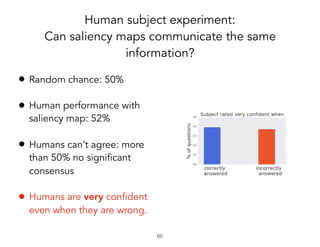
• Humans are very confident
even when they are wrong.
Human subject experiment:
Can saliency maps communicate the same
information?
Human subject experiment:
Can saliency maps communicate the same
information?
• Random chance: 50%
• Human performance with
saliency map: 52%
• Humans can’t agree: more
than 50% no significant
consensus
• Humans are very confident
even when they are wrong.
!65
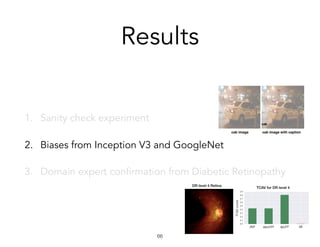
Results
1. Sanity check experiment
2. Biases from Inception V3 and GoogleNet
3. Domain expert confirmation from Diabetic Retinopathy
!66
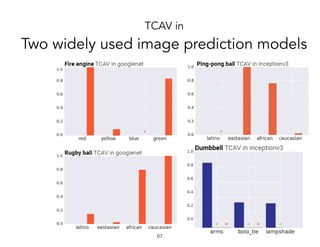
TCAV in
Two widely used image prediction models
!67
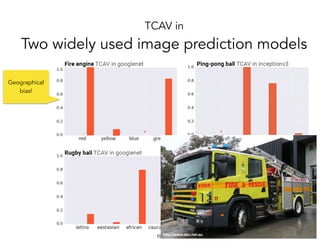
TCAV in
Two widely used image prediction models
!68
Geographical
bias!
http://www.abc.net.au
TCAV in
Two widely used image prediction models
!69
Quantitative
confirmation to
previously
qualitative
findings
[Stock & Cisse,
2017]
Geographical
bias?
TCAV in
Two widely used image prediction models
!70
Quantitative
confirmation to
previously
qualitative
findings
[Stock & Cisse,
2017]
Geographical
bias?
Goal of interpretability:
To use machine learning responsibly
we need to ensure that
1. our values are aligned
2. our knowledge is reflected
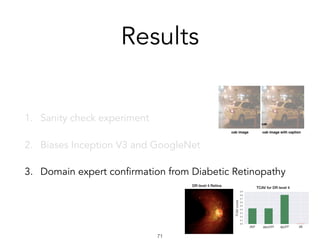
Results
1. Sanity check experiment
2. Biases Inception V3 and GoogleNet
3. Domain expert confirmation from Diabetic Retinopathy
!71
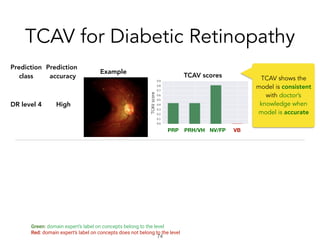
Diabetic Retinopathy
• Treatable but sight-threatening conditions
• Have model to with accurate prediction of DR (85%)
[Krause et al., 2017]
!72
Concepts the ML model uses
Vs
Diagnostic Concepts human doctors use
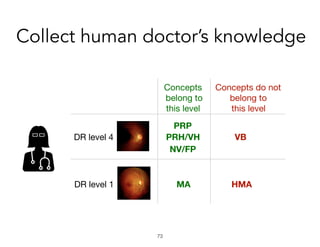
Collect human doctor’s knowledge
!73
PRP
PRH/VH
NV/FP
VB
MA HMA
DR level 4
DR level 1
Concepts

belong to 

this level
Concepts do not 

belong to 

this level
TCAV for Diabetic Retinopathy
!74
PRP PRH/VH NV/FP VB
Green: domain expert’s label on concepts belong to the level
Red: domain expert’s label on concepts does not belong to the level
Prediction
class
DR level 4
Prediction
accuracy
High
Example
TCAV scores TCAV shows the
model is consistent
with doctor’s
knowledge when
model is accurate
PRP PRH/VH NV/FP VB
Green: domain expert’s label on concepts belong to the level
Red: domain expert’s label on concepts does not belong to the level
Prediction
class
DR level 4
Prediction
accuracy
High
Example
TCAV scores TCAV shows the
model is consistent
with doctor’s
knowledge when
model is accurate
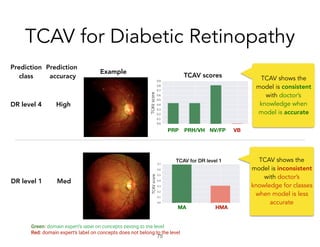
TCAV shows the
model is inconsistent
with doctor’s
knowledge for classes
when model is less
accurate
DR level 1 Med
TCAV for Diabetic Retinopathy
!75
MA HMA
PRP PRH/VH NV/FP VB
Green: domain expert’s label on concepts belong to the level
Red: domain expert’s label on concepts does not belong to the level
Prediction
class
DR level 4
Prediction
accuracy
High
Example
TCAV scores TCAV shows the
model is consistent
with doctor’s
knowledge when
model is accurate
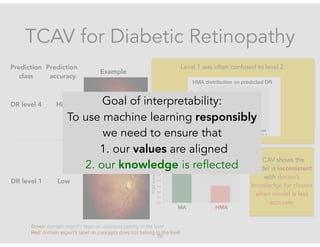
Level 1 was often confused to level 2.
DR level 1 Low
TCAV shows the
model is inconsistent
with doctor’s
knowledge for classes
when model is less
accurate
TCAV for Diabetic Retinopathy
!76
MA HMA
Goal of interpretability:
To use machine learning responsibly
we need to ensure that
1. our values are aligned
2. our knowledge is reflected
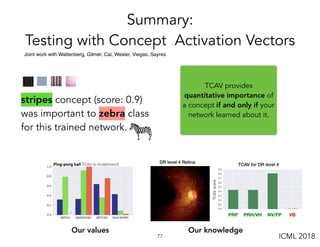
Summary:
Testing with Concept Activation Vectors
!77
stripes concept (score: 0.9)
was important to zebra class
for this trained network.
PRP PRH/VH NV/FP VB
Our values Our knowledge
TCAV provides
quantitative importance of
a concept if and only if your
network learned about it.
Joint work with Wattenberg, Gilmer, Cai, Wexler, Viegas, Sayres
ICML 2018

Interpretability beyond feature attribution quantitative testing with concept activation vectors (tcav)

  • 1.
    Interpretability beyond featureattribution: Testing with Concept Activation Vectors TCAV Been Kim Presenting work with a lot of awesome people inside and outside of Google: Marten Wattenberg, Julius Adebayo, Justin Gilmer, Carrie Cai, James Wexler, Fernanda Viegas, Ian Goodfellow, Mortiz Hardt, Rory Sayres
  • 2.
    My goal interpretability !2 To usemachine learning responsibly we need to ensure that 1. our values are aligned 2. our knowledge is reflected for everyone. http://blogs.teradata.com/ Machine Learning Models Human
  • 3.
    My goal interpretability !3 To usemachine learning responsibly we need to ensure that 1. our values are aligned 2. our knowledge is reflected for everyone. http://blogs.teradata.com/ Machine Learning Models Human
  • 4.
    ingredients for interpretabilitymethods. !4 ? Some quality function
  • 5.
  • 6.
  • 7.
  • 8.
  • 9.
    Class1 Class0 Human What’s ML? If Iwere you, I would train a neural network. newbie expert
  • 10.
    Class1 Class0 Task • Local vs.global • Simple explanations vs. more complex but more accurate explanations • Low or high stake domains
  • 11.
    Interpretability methods Post-training explanations Buildinginherently interpretable models Explaining data
  • 12.
  • 13.
    Agenda 1. Revisiting existingmethods: Saliency maps 2. Making explanations using the way humans think: Testing with concept activation vectors (TCAV) Post-training explanations
  • 14.
    Agenda Sanity Checks forSaliency Maps Joint work with Adebayo, Gilmer, Goodfellow, Hardt, [NIPS 18] 1. Revisiting existing methods: Saliency maps 2. Making explanations using the way humans think: Testing with concept activation vectors (TCAV) Post-training explanations
  • 15.
    Problem: Post-training explanation !15 cash-machine-ness A trained machinelearning model (e.g., neural network) Why was this a cash machine?
  • 16.
    One of themost popular interpretability methods for images: Saliency maps !16 SmoothGrad [Smilkov, Thorat, K., Viégas, Wattenberg ’17] Integrated gradient [Sundararajan, Taly, Yan ’17] picture credit: @sayres Caaaaan do! We’ve got saliency maps to measure importance of each pixel! a logit pixel i,j
  • 17.
    One of themost popular interpretability methods for images: Saliency maps !17 SmoothGrad [Smilkov, Thorat, K., Viégas, Wattenberg ’17] Integrated gradient [Sundararajan, Taly, Yan ’17] widely used for images local undestandingNN humans’ subjective judgement picture credit: @sayres
  • 18.
    One of themost popular interpretability methods for images: Saliency maps !18 Sanity check: If I change M a lot, will human perceive that E has changed a lot? SmoothGrad [Smilkov, Thorat, K., Viégas, Wattenberg ’17] Integrated gradient [Sundararajan, Taly, Yan ’17] widely used for images local undestandingNN humans’ subjective judgement picture credit: @sayres
  • 19.
    Some confusing behaviorsof saliency maps. Saliency map Sanity Checks for Saliency Maps Joint work with Adebayo, Gilmer, Goodfellow, Hardt, [NIPS 18]
  • 20.
    Some confusing behaviorsof saliency maps. Randomized weights! Network now makes garbage prediction. Saliency map Sanity Checks for Saliency Maps Joint work with Adebayo, Gilmer, Goodfellow, Hardt, [NIPS 18]
  • 21.
    Some confusing behaviorsof saliency maps. Saliency map Randomized weights! Network now makes garbage prediction. !!!!!???!? Sanity Checks for Saliency Maps Joint work with Adebayo, Gilmer, Goodfellow, Hardt, [NIPS 18]
  • 22.
    Some saliency mapslook similar when we randomize the network (= making the network completely useless) Before After Guided Backprop Integrated Gradient Sanity Checks for Saliency Maps Joint work with Adebayo, Gilmer, Goodfellow, Hardt, [NIPS 18]
  • 23.
    • Potential humanconfirmation bias: Just because it “makes sense” to humans, doesn’t mean they reflect evidence for the prediction. • Our discovery is consistent with other findings. [Nie, Zhang, Patel ’18] [Ulyanov, Vedaldi, Lempitsky ’18] • Some of these methods have been shown to be useful for humans. Why? More studies needed. What can we learn from this? Sanity Checks for Saliency Maps Joint work with Adebayo, Gilmer, Goodfellow, Hardt, [NIPS 18]
  • 24.
    !24 local undestanding lay person? human’s subjective judgement What can wedo better? Creating a wishlist. Using input features as a language
  • 25.
  • 26.
    Agenda TCAV [ICML’18] Joint workwith Wattenberg, Gilmer, Cai, Wexler, Viegas, Sayres 1. Revisiting existing methods: Saliency maps 2. Making explanations using the way humans think: Testing with concept activation vectors (TCAV) Post-training explanations
  • 27.
    Problem: Post-training explanation !27 cash-machine-ness A trained machinelearning model (e.g., neural network) Why was this a cash machine? TCAV [ICML’18] Joint work with Wattenberg, Gilmer, Cai, Wexler, Viegas, Sayres
  • 28.
    prediction: Cash machine https://pair-code.github.io/saliency/ SmoothGrad [Smilkov,Thorat, K., Viégas, Wattenberg ’17] Common solution: Saliency map !28 Let’s use this to help us think about what what we really want to ask.
  • 29.
    prediction: Cash machine https://pair-code.github.io/saliency/ SmoothGrad [Smilkov,Thorat, K., Viégas, Wattenberg ’17] What we really want to ask… !29 Were there more pixels on the cash machine than on the person? Did the ‘human’ concept matter? Did the ‘wheels’ concept matter?
  • 30.
    prediction: Cash machine https://pair-code.github.io/saliency/ SmoothGrad [Smilkov,Thorat, K., Viégas, Wattenberg ’17] What we really want to ask… !30 Were there more pixels on the cash machine than on the person? Which concept mattered more? Is this true for all other cash machine predictions? Did the ‘human’ concept matter? Did the ‘wheels’ concept matter?
  • 31.
    prediction: Cash machine https://pair-code.github.io/saliency/ SmoothGrad [Smilkov,Thorat, K., Viégas, Wattenberg ’17] What we really want to ask… !31 Oh no! I can’t express these concepts as pixels!! They weren’t my input features either! Were there more pixels on the cash machine than on the person? Which concept mattered more? Is this true for all other cash machine predictions? Did the ‘human’ concept matter? Did the ‘wheels’ concept matter?
  • 32.
    prediction: Cash machine https://pair-code.github.io/saliency/ SmoothGrad [Smilkov,Thorat, K., Viégas, Wattenberg ’17] What we really want to ask… !32 Were there more pixels on the cash machine than on the person? Which concept mattered more? Is this true for all other cash machine predictions? Wouldn’t it be great if we can quantitatively measure how important any of these user-chosen concepts are? Did the ‘human’ concept matter? Did the ‘wheels’ concept matter?
  • 33.
    Quantitative explanation: howmuch a concept (e.g., gender, race) was important for a prediction in a trained model. …even if the concept was not part of the training. Goal of TCAV: Testing with Concept Activation Vectors !33 ICML 2018
  • 34.
    Goal of TCAV: Testingwith Concept Activation Vectors !34 Doctor-ness A trained machine learning model (e.g., neural network) vactruth.com healthcommunitiesproviderservices
  • 35.
    Goal of TCAV: Testingwith Concept Activation Vectors !35 Doctor-ness A trained machine learning model (e.g., neural network) Was gender concept important to this doctor image classifier? vactruth.com healthcommunitiesproviderservices
  • 36.
    Goal of TCAV: Testingwith Concept Activation Vectors !36 Doctor-ness TCAV score for womennot women Doctor A trained machine learning model (e.g., neural network) vactruth.com healthcommunitiesproviderservices Was gender concept important to this doctor image classifier?
  • 37.
    Goal of TCAV: Testingwith Concept Activation Vectors !37 Doctor-ness TCAV score for womennot women Doctor A trained machine learning model (e.g., neural network) vactruth.com healthcommunitiesproviderservices Was gender concept important to this doctor image classifier? TCAV provides quantitative importance of a concept if and only if your network learned about it.
  • 38.
    Goal of TCAV: Testingwith Concept Activation Vectors !38 zebra-ness A trained machine learning model (e.g., neural network) Was striped concept important to this zebra image classifier? TCAV score for not stripedstriped Zebra TCAV provides quantitative importance of a concept if and only if your network learned about it.
  • 39.
    TCAV TCAV: Testing with ConceptActivation Vectors !39 zebra-ness A trained machine learning model (e.g., neural network) Was striped concept important to this zebra image classifier? 1. Learning CAVs 1. How to define concepts?
  • 40.
    Defining concept activationvector (CAV) Inputs: !40 Random images Examples of concepts A trained network under investigation and Internal tensors
  • 41.
    !41 Inputs: Train a linearclassifier to separate activations. CAV ( ) is the vector orthogonal to the decision boundary. [Smilkov ’17, Bolukbasi ’16 , Schmidt ’15] Defining concept activation vector (CAV)
  • 42.
    TCAV TCAV: Testing with ConceptActivation Vectors !42 zebra-ness A trained machine learning model (e.g., neural network) Was striped concept important to this zebra image classifier? 1. Learning CAVs 2. Getting TCAV score 2. How are the CAVs useful to get explanations?
  • 43.
    TCAV core idea: Derivativewith CAV to get prediction sensitivity !43 TCAV score Directional derivative with CAV
  • 44.
    striped CAV TCAV score Directionalderivative with CAV TCAV core idea: Derivative with CAV to get prediction sensitivity !44
  • 45.
    TCAV TCAV: Testing with ConceptActivation Vectors !45 zebra-ness A trained machine learning model (e.g., neural network) Was striped concept important to this zebra image classifier? 1. Learning CAVs 2. Getting TCAV score
  • 46.
    TCAV TCAV: Testing with ConceptActivation Vectors !46 zebra-ness A trained machine learning model (e.g., neural network) Was striped concept important to this zebra image classifier? 1. Learning CAVs 2. Getting TCAV score 3. CAV validation Qualitative Quantitative
  • 47.
    Quantitative validation: Guarding againstspurious CAV Did my CAVs returned high sensitivity by chance? !47
  • 48.
    Learn many stripesCAVs using different sets of random images Quantitative validation: Guarding against spurious CAV !48
  • 49.
  • 50.
  • 51.
    Check the distributionof is statistically different from random using t-test TCAV score random …… Zebra Quantitative validation: Guarding against spurious CAV !51 *
  • 52.
    Recap TCAV: Testing withConcept Activation Vectors !52 1. Learning CAVs 2. Getting TCAV score 3. CAV validation Qualitative Quantitative TCAV provides quantitative importance of a concept if and only if your network learned about it. Even if your training data wasn’t tagged with the concept Even if your input feature did not include the concept
  • 53.
    Results 1. Sanity checkexperiment 2. Biases in Inception V3 and GoogleNet 3. Domain expert confirmation from Diabetic Retinopathy !53
  • 54.
    Results 1. Sanity checkexperiment 2. Biases from Inception V3 and GoogleNet 3. Domain expert confirmation from Diabetic Retinopathy !54
  • 55.
    Sanity check experiment !55 Ifwe know the ground truth (important concepts), will TCAV match?
  • 56.
    Sanity check experimentsetup !56 An image + Potentially noisy Caption
  • 57.
    Sanity check experimentsetup !57 An image + Potentially noisy Caption image concept models can use either image or caption concept for classification. caption concept
  • 58.
    Sanity check experimentsetup !58 Caption noise level in training set An image + Potentially noisy Caption image concept models can use either image or caption concept for classification. caption concept
  • 59.
    Sanity check experimentsetup !59 Test accuracy with no caption image = Importance of image concept Caption noise level in training set image concept caption concept models can use either image or caption concept for classification.
  • 60.
    Sanity check experiment !60 Captionnoise level in training set Caption noise level in training set Test accuracy with no caption image
  • 61.
  • 62.
    Can saliency mapscommunicate the same information? !62 Ground truth Image concept Image concept Image concept Image concept Image with caption
  • 63.
    Human subject experiment: Cansaliency maps communicate the same information? • 50 turkers are • asked to judge importance of image vs. c. ept given saliency maps. • asked to indicate their confidence • shown 3 classes (cab, zebra, cucumber) x 2 saliency maps for one model !63 image caption
  • 64.
    !64 • Random chance:50% • Human performance with saliency map: 52% • Humans can’t agree: more than 50% no significant consensus • Humans are very confident even when they are wrong. Human subject experiment: Can saliency maps communicate the same information?
  • 65.
    Human subject experiment: Cansaliency maps communicate the same information? • Random chance: 50% • Human performance with saliency map: 52% • Humans can’t agree: more than 50% no significant consensus • Humans are very confident even when they are wrong. !65
  • 66.
    Results 1. Sanity checkexperiment 2. Biases from Inception V3 and GoogleNet 3. Domain expert confirmation from Diabetic Retinopathy !66
  • 67.
    TCAV in Two widelyused image prediction models !67
  • 68.
    TCAV in Two widelyused image prediction models !68 Geographical bias! http://www.abc.net.au
  • 69.
    TCAV in Two widelyused image prediction models !69 Quantitative confirmation to previously qualitative findings [Stock & Cisse, 2017] Geographical bias?
  • 70.
    TCAV in Two widelyused image prediction models !70 Quantitative confirmation to previously qualitative findings [Stock & Cisse, 2017] Geographical bias? Goal of interpretability: To use machine learning responsibly we need to ensure that 1. our values are aligned 2. our knowledge is reflected
  • 71.
    Results 1. Sanity checkexperiment 2. Biases Inception V3 and GoogleNet 3. Domain expert confirmation from Diabetic Retinopathy !71
  • 72.
    Diabetic Retinopathy • Treatablebut sight-threatening conditions • Have model to with accurate prediction of DR (85%) [Krause et al., 2017] !72 Concepts the ML model uses Vs Diagnostic Concepts human doctors use
  • 73.
    Collect human doctor’sknowledge !73 PRP PRH/VH NV/FP VB MA HMA DR level 4 DR level 1 Concepts belong to this level Concepts do not belong to this level
  • 74.
    TCAV for DiabeticRetinopathy !74 PRP PRH/VH NV/FP VB Green: domain expert’s label on concepts belong to the level Red: domain expert’s label on concepts does not belong to the level Prediction class DR level 4 Prediction accuracy High Example TCAV scores TCAV shows the model is consistent with doctor’s knowledge when model is accurate
  • 75.
    PRP PRH/VH NV/FPVB Green: domain expert’s label on concepts belong to the level Red: domain expert’s label on concepts does not belong to the level Prediction class DR level 4 Prediction accuracy High Example TCAV scores TCAV shows the model is consistent with doctor’s knowledge when model is accurate TCAV shows the model is inconsistent with doctor’s knowledge for classes when model is less accurate DR level 1 Med TCAV for Diabetic Retinopathy !75 MA HMA
  • 76.
    PRP PRH/VH NV/FPVB Green: domain expert’s label on concepts belong to the level Red: domain expert’s label on concepts does not belong to the level Prediction class DR level 4 Prediction accuracy High Example TCAV scores TCAV shows the model is consistent with doctor’s knowledge when model is accurate Level 1 was often confused to level 2. DR level 1 Low TCAV shows the model is inconsistent with doctor’s knowledge for classes when model is less accurate TCAV for Diabetic Retinopathy !76 MA HMA Goal of interpretability: To use machine learning responsibly we need to ensure that 1. our values are aligned 2. our knowledge is reflected
  • 77.
    Summary: Testing with ConceptActivation Vectors !77 stripes concept (score: 0.9) was important to zebra class for this trained network. PRP PRH/VH NV/FP VB Our values Our knowledge TCAV provides quantitative importance of a concept if and only if your network learned about it. Joint work with Wattenberg, Gilmer, Cai, Wexler, Viegas, Sayres ICML 2018