S C A L A B L E I N T E R A C T I V E T O O L S
I N T E R P R E T A T I O N & A T T R I B U T I O N
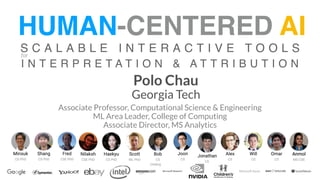
HUMAN-CENTERED AI
Polo Chau 

Georgia Tech
Associate Professor, Computational Science & Engineering

ML Area Leader, College of Computing

Associate Director, MS Analytics

for
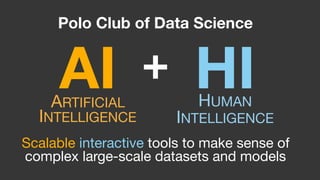
AI HI+
HUMAN 

INTELLIGENCE
ARTIFICIAL 

INTELLIGENCE
Scalable interactive tools to make sense of 

complex large-scale datasets and models
Polo Club of Data Science
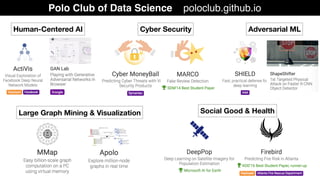
Human-Centered AI Cyber Security
Social Good & HealthLarge Graph Mining & Visualization
Polo Club of Data Science poloclub.github.io
Adversarial ML
Why should we make AI more
human-centered?
Accessible & Interpretable
for people who build and use machine learning
?
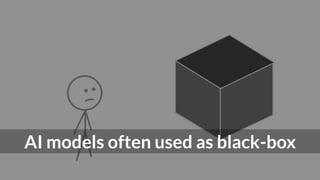
AI models often used as black-box
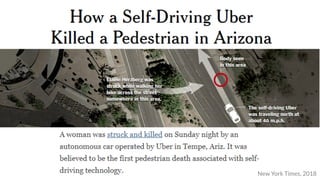
New York Times, 2018
8
Our ShapeShifter Attack: Stop Sign ! Person

Spotlighted in new DARPA GARD program [PKDD’18; with Intel]
Real Stop Sign
Printed Adversarial
Stop Sign
8
Our ShapeShifter Attack: Stop Sign ! Person

Spotlighted in new DARPA GARD program [PKDD’18; with Intel]
SHIELD: Fast Practical Defense for 

Deep Learning via JPEG Compression

[KDD’18 Audience Appreciation Award runner up; with intel]
9
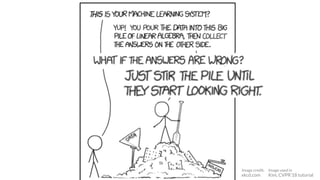
We do NOT know 

why AI attacks and defenses work

Actually nobody does

(e.g., which neurons are under attack?)

Image used in
xkcd.com Kim, CVPR’18 tutorial
Image credit:
Practitioners very interested in 

why and how AI works
Figure from Washington Post
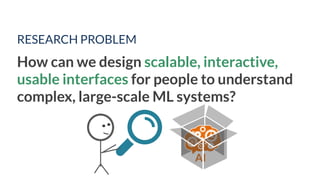
RESEARCH PROBLEM
How can we design scalable, interactive,
usable interfaces for people to understand
complex, large-scale ML systems?
OUR KEY IDEA
Scalable Interactive visualization
as a medium for connecting users
with ML models
15
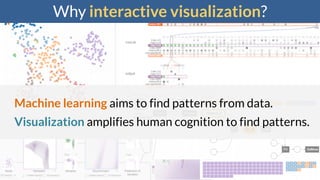
Why interactive visualization?
Machine learning aims to find patterns from data.
Visualization amplifies human cognition to find patterns.
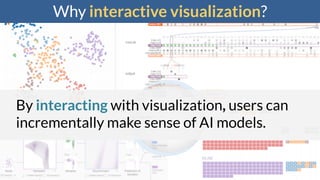
Why interactive visualization?
By interacting with visualization, users can
incrementally make sense of AI models.
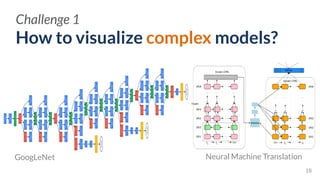
How to visualize complex models?
18
Challenge 1
GoogLeNet Neural Machine Translation
How to scale up to large datasets?
Challenge 2
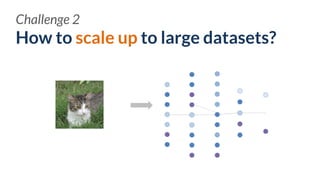
How to scale up to large datasets?
Challenge 2
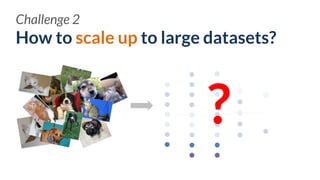
How to scale up to large datasets?
Challenge 2
?
How to make tools easy-to-use for
various users?
Challenge 3
EXPERTS NOVICES
[Hohman, Kahng, Pienta, Chau, TVCG, 2018]
PRACTITIONERS
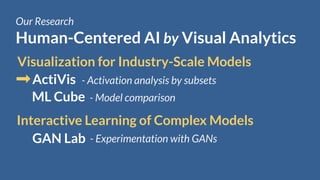
Human-Centered AI by Visual Analytics
Our Research
GAN Lab
ActiVis
Visualization for Industry-Scale Models
Interactive Learning of Complex Models
ML Cube - Model comparison
- Activation analysis by subsets
- Experimentation with GANs
ActiVis
Scaling Visualization to 

Industry-scale Models and Data
Deployed by[Kahng, et al. IEEE VIS’17]
why practitioners want visualization?
Facebook data scientists need visualization
tools to interpret complex models
Those down totags: #mycat, #cute
date: 10/1/2017
location: 33.7, 88.4
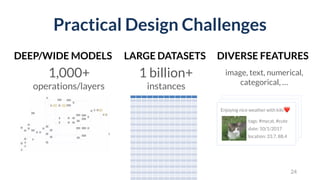
Practical Design Challenges
24
DIVERSE FEATURESDEEP/WIDE MODELS LARGE DATASETS
image, text, numerical,
categorical, …
1,000+ 

operations/layers
1 billion+
instances
Enjoying nice weather with kiki❤
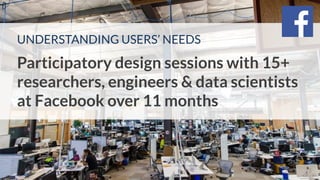
UNDERSTANDING USERS’ NEEDS
Participatory design sessions with 15+
researchers, engineers & data scientists
at Facebook over 11 months
25
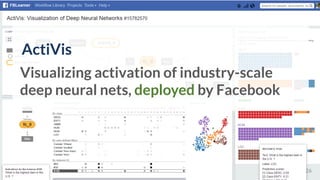
Visualizing activation of industry-scale
deep neural nets, deployed by Facebook
26
ActiVis
ActiVis Research Challenges
1. Many model parameters to visualize
2. Many data instances to analyze
3. Intensive computation for deployment
27
Visualization for industry-scale deep models
Location
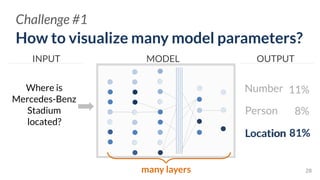
How to visualize many model parameters?
28
Challenge #1
INPUT OUTPUTMODEL
Person
Location 81%
8%
Where is 

Mercedes-Benz
Stadium
located?
Number 11%
many layers
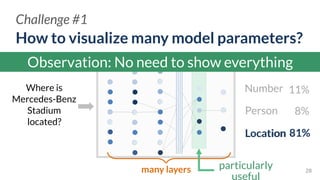
Location
How to visualize many model parameters?
28
Challenge #1
INPUT OUTPUTMODEL
Person
Location 81%
8%
Where is 

Mercedes-Benz
Stadium
located?
Number 11%
particularly
useful
many layers
Observation: No need to show everything
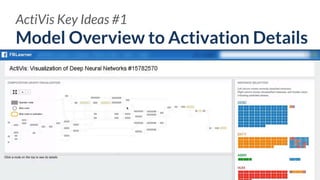
Model Overview to Activation Details
29
ActiVis Key Ideas #1
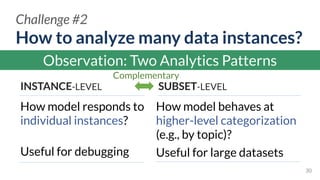
How to analyze many data instances?
30
Challenge #2
SUBSET-LEVELINSTANCE-LEVEL
Complementary
Useful for debugging Useful for large datasets
Observation: Two Analytics Patterns
How model behaves at
higher-level categorization
(e.g., by topic)?
How model responds to 

individual instances?
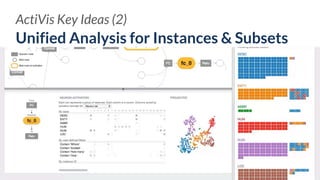
Unified Analysis for Instances & Subsets
ActiVis Key Ideas (2)
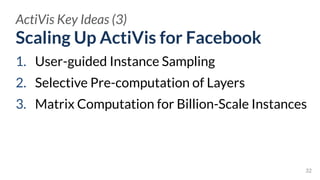
Scaling Up ActiVis for Facebook
1. User-guided Instance Sampling
2. Selective Pre-computation of Layers
3. Matrix Computation for Billion-Scale Instances
32
ActiVis Key Ideas (3)
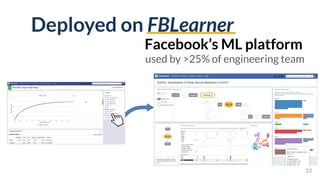
Deployed on FBLearner
33
used by >25% of engineering team
Facebook’s ML platform
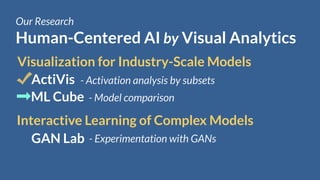
Human-Centered AI by Visual Analytics
Our Research
GAN Lab
ActiVis
Visualization for Industry-Scale Models
Interactive Learning of Complex Models
ML Cube - Model comparison
- Activation analysis by subsets
- Experimentation with GANs
ML Cube
Interactive Model Comparison
Deployed by[Kahng, et al. HILDA’16]
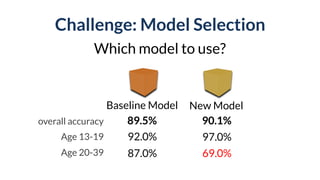
Challenge: Model Selection
Which model to use?
Baseline Model New Model
89.5% 90.1%overall accuracy
Age 20-39
Age 13-19 92.0% 97.0%
87.0% 69.0%
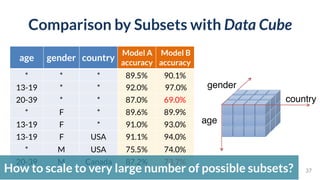
Comparison by Subsets with Data Cube
37
country
age
gender
age gender country
Model A
accuracy
Model B
accuracy
* * * 89.5% 90.1%
13-19 * * 92.0% 97.0%
20-39 * * 87.0% 69.0%
* F * 89.6% 89.9%
13-19 F * 91.0% 93.0%
13-19 F USA 91.1% 94.0%
* M USA 75.5% 74.0%
20-39 M Canada 87.2% 73.7%
How to scale to very large number of possible subsets?
38
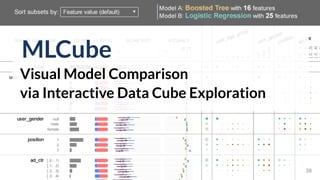
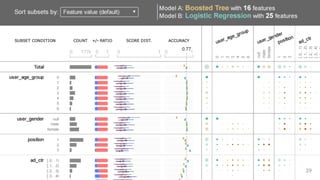
Visual Model Comparison
via Interactive Data Cube Exploration
MLCube
39
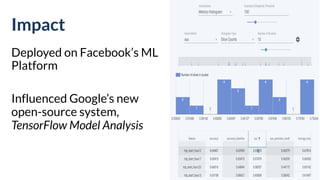
Impact
Deployed on Facebook’s ML
Platform
Influenced Google’s new
open-source system,
TensorFlow Model Analysis
40
Research Contributions from ActiVis & MLCube
How can we scale visualization to
industry-scale models and data?
1.Exploration from overview to details
2.Drilling down into specific parts of data
3.Combination of scalable & interactive methods
(Under review — discover interesting subsets automatically: 

FairVis: Visual Analytics for Discovering Intersectional Bias in Machine Learning)
Human-Centered AI by Visual Analytics
Our Research
GAN Lab
ActiVis
Visualization for Industry-Scale Models
Interactive Learning of Complex Models
ML Cube - Model comparison
- Activation analysis by subsets
- Experimentation with GANs
GAN Lab
Interactive understanding of
complex deep learning models
PAIR | People + AI Research Initiative
[Kahng, et al. IEEE VIS’18]
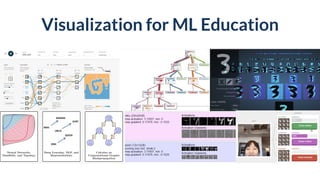
Visualization for ML Education
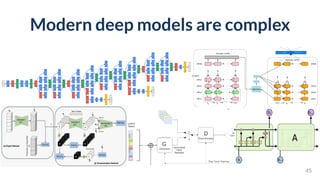
Modern deep models are complex
45
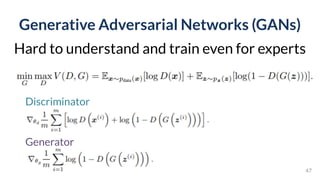
Generative Adversarial Networks (GANs)
46
“the most interesting idea in the last 10 years in ML”
- Yann LeCun
Face images generated by BEGAN [Berthelot et al., 2017]
Generative Adversarial Networks (GANs)
Hard to understand and train even for experts
47
Discriminator
Generator
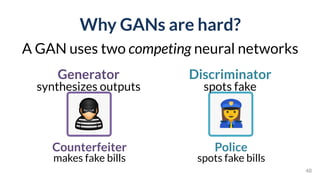
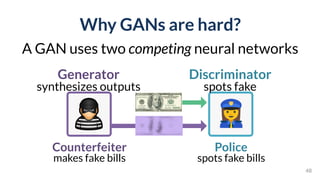
Why GANs are hard?
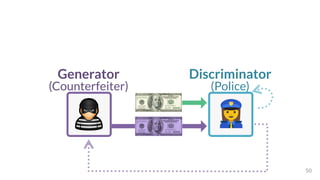
A GAN uses two competing neural networks
48
Discriminator

spots fake
Police

spots fake bills
Generator

synthesizes outputs
Counterfeiter

makes fake bills
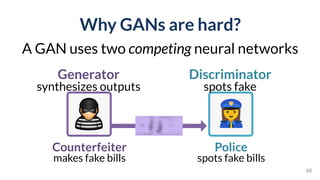
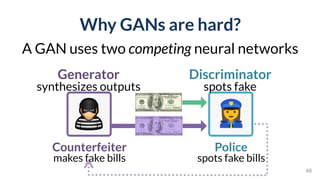
Why GANs are hard?
A GAN uses two competing neural networks
48
Discriminator

spots fake
Police

spots fake bills
Generator

synthesizes outputs
Counterfeiter

makes fake bills
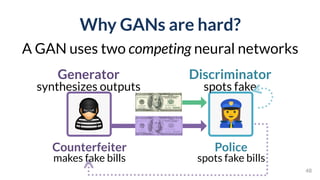
Why GANs are hard?
A GAN uses two competing neural networks
48
Discriminator

spots fake
Police

spots fake bills
Generator

synthesizes outputs
Counterfeiter

makes fake bills
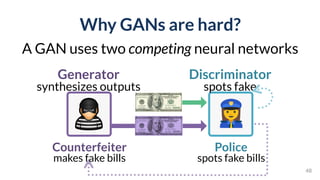
Why GANs are hard?
A GAN uses two competing neural networks
48
Discriminator

spots fake
Police

spots fake bills
Generator

synthesizes outputs
Counterfeiter

makes fake bills
Why GANs are hard?
A GAN uses two competing neural networks
48
Discriminator

spots fake
Police

spots fake bills
Generator

synthesizes outputs
Counterfeiter

makes fake bills
Why GANs are hard?
A GAN uses two competing neural networks
48
Discriminator

spots fake
Police

spots fake bills
Generator

synthesizes outputs
Counterfeiter

makes fake bills
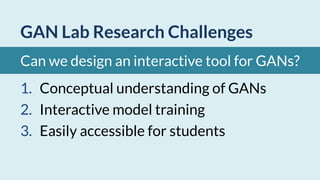
GAN Lab Research Challenges
1. Conceptual understanding of GANs
2. Interactive model training
3. Easily accessible for students
Can we design an interactive tool for GANs?
50
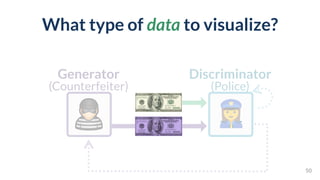
Discriminator

(Police)
Generator

(Counterfeiter)
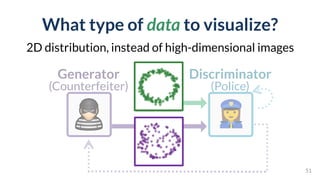
What type of data to visualize?
50
Discriminator

(Police)
Generator

(Counterfeiter)
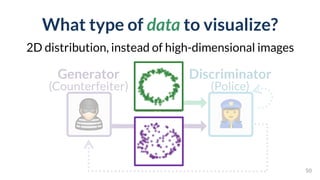
What type of data to visualize?
2D distribution, instead of high-dimensional images
50
Discriminator

(Police)
Generator

(Counterfeiter)
What type of data to visualize?
2D distribution, instead of high-dimensional images
51
Discriminator

(Police)
Generator

(Counterfeiter)
What type of data to visualize?
2D distribution, instead of high-dimensional images
51
Discriminator

(Police)
Generator

(Counterfeiter)
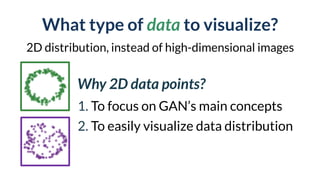
1. To focus on GAN’s main concepts
2. To easily visualize data distribution
Why 2D data points?
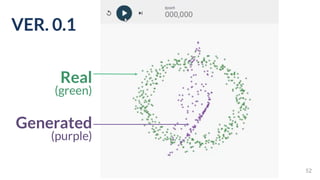
VER. 0.1
52
Real 

(green)
Generated

(purple)
Discriminator

(Police)
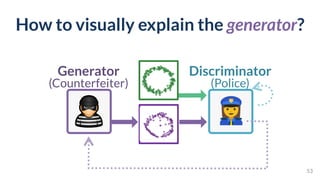
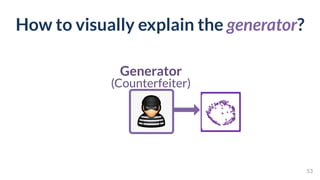
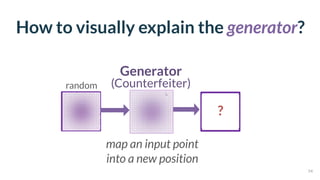
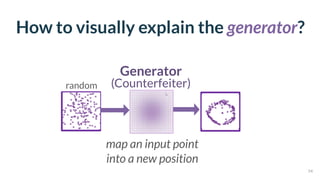
How to visually explain the generator?
53
Generator

(Counterfeiter)
Discriminator

(Police)
How to visually explain the generator?
53
Generator

(Counterfeiter)
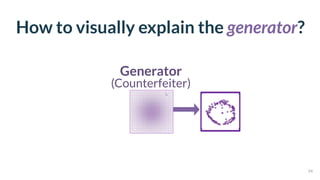
How to visually explain the generator?
54
Generator

(Counterfeiter)
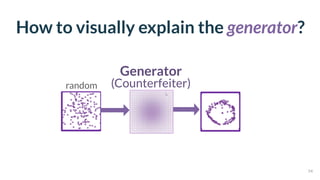
How to visually explain the generator?
random
54
Generator

(Counterfeiter)
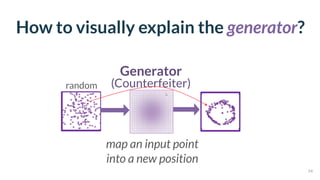
How to visually explain the generator?
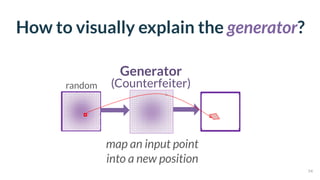
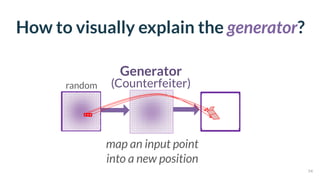
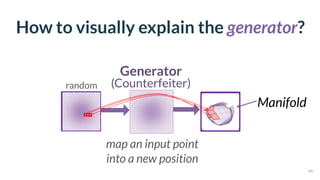
map an input point
into a new position
random
54
Generator

(Counterfeiter)
How to visually explain the generator?
map an input point
into a new position
random
?
54
Generator

(Counterfeiter)
How to visually explain the generator?
map an input point
into a new position
random
?
54
Generator

(Counterfeiter)
How to visually explain the generator?
map an input point
into a new position
random
?
54
Generator

(Counterfeiter)
How to visually explain the generator?
map an input point
into a new position
random
Manifold
?
54
Generator

(Counterfeiter)
How to visually explain the generator?
map an input point
into a new position
random
54
Generator

(Counterfeiter)
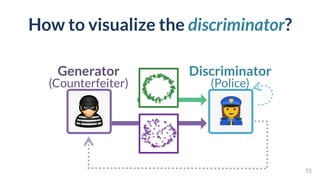
How to visualize the discriminator?
55
Generator

(Counterfeiter)
Discriminator

(Police)
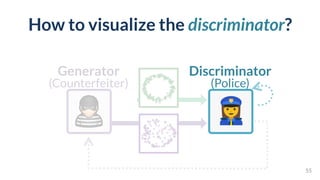
How to visualize the discriminator?
55
Generator

(Counterfeiter)
Discriminator

(Police)
How to visualize the discriminator?
56
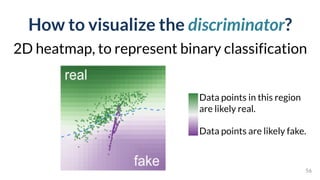
How to visualize the discriminator?
2D heatmap, to represent binary classification
56
Data points in this region
are likely real.
Data points are likely fake.
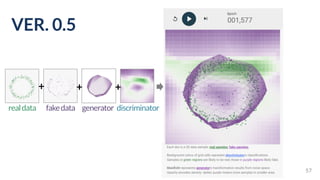
VER. 0.5
57
realdata fakedata generator discriminator
+ + +
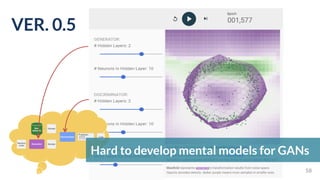
VER. 0.5
58
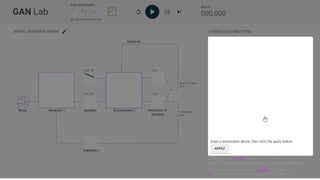
Hard to develop mental models for GANs
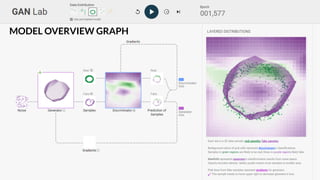
MODEL OVERVIEW GRAPH
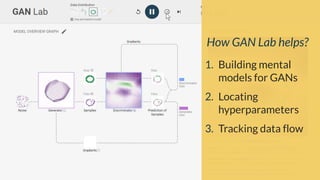
1. Building mental
models for GANs
2. Locating
hyperparameters
3. Tracking data flow
How GAN Lab helps?
61
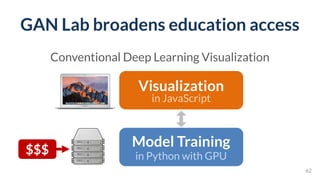
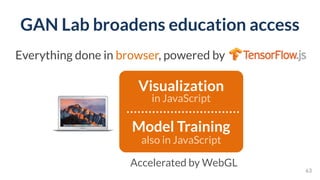
GAN Lab broadens education access
62
Conventional Deep Learning Visualization
in JavaScript
in Python with GPU
Model Training
Visualization
$$$
Everything done in browser, powered by TensorFlow.js
GAN Lab broadens education access
63
Accelerated by WebGL
in JavaScript
Visualization
also in JavaScript
Model Training
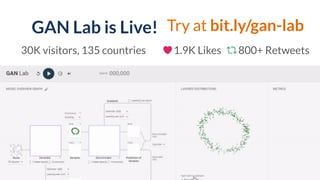
GAN Lab is Live!
64
30K visitors, 135 countries 1.9K Likes 800+ Retweets
Try at bit.ly/gan-lab
Research Contributions from GAN Lab
Can we design tools for non-experts to
understand complex deep models?
1.Visualization of overall structure & components
2.Interactive experimentation of training process
3.Accessible approach using browsers
Visual Analytics in Deep Learning:
An Interrogative Survey for the Next Frontiers
Fred Hohman, Minsuk Kahng, Robert Pienta, Polo Chau

TVCG 2018
!66
!67
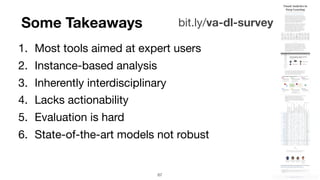
Some Takeaways
1. Most tools aimed at expert users

2. Instance-based analysis

3. Inherently interdisciplinary

4. Lacks actionability

5. Evaluation is hard

6. State-of-the-art models not robust
bit.ly/va-dl-survey
How can we make AI more
human-centered?
Accessible & Interpretable
for people who build and use machine learning
How can we make AI more
human-centered?
Accessible & Interpretable
for people who build and use machine learning
Through the design of visualization tools
that are scalable, interactive & usable, 

we can help users learn and interpret 

large-scale complex ML systems.
Thanks!
Polo Chau Georgia Tech
HUMAN-CENTERED AI
S C A L A B L E I N T E R A C T I V E T O O L S
I N T E R P R E T A T I O N & A T T R I B U T I O N
for

Human-Centered AI: Scalable, Interactive Tools for Interpretation and Attribution

  • 1.
    S C AL A B L E I N T E R A C T I V E T O O L S I N T E R P R E T A T I O N & A T T R I B U T I O N HUMAN-CENTERED AI Polo Chau 
 Georgia Tech Associate Professor, Computational Science & Engineering
 ML Area Leader, College of Computing
 Associate Director, MS Analytics
 for
  • 2.
    AI HI+ HUMAN 
 INTELLIGENCE ARTIFICIAL
 INTELLIGENCE Scalable interactive tools to make sense of 
 complex large-scale datasets and models Polo Club of Data Science
  • 3.
    Human-Centered AI CyberSecurity Social Good & HealthLarge Graph Mining & Visualization Polo Club of Data Science poloclub.github.io Adversarial ML
  • 4.
    Why should wemake AI more human-centered? Accessible & Interpretable for people who build and use machine learning
  • 5.
  • 6.
    AI models oftenused as black-box
  • 7.
  • 8.
    8 Our ShapeShifter Attack:Stop Sign ! Person
 Spotlighted in new DARPA GARD program [PKDD’18; with Intel] Real Stop Sign Printed Adversarial Stop Sign
  • 9.
    8 Our ShapeShifter Attack:Stop Sign ! Person
 Spotlighted in new DARPA GARD program [PKDD’18; with Intel]
  • 10.
    SHIELD: Fast PracticalDefense for 
 Deep Learning via JPEG Compression
 [KDD’18 Audience Appreciation Award runner up; with intel] 9
  • 11.
    We do NOTknow 
 why AI attacks and defenses work Actually nobody does
 (e.g., which neurons are under attack?)

  • 12.
    Image used in xkcd.comKim, CVPR’18 tutorial Image credit:
  • 13.
    Practitioners very interestedin 
 why and how AI works Figure from Washington Post
  • 16.
    RESEARCH PROBLEM How canwe design scalable, interactive, usable interfaces for people to understand complex, large-scale ML systems?
  • 17.
    OUR KEY IDEA ScalableInteractive visualization as a medium for connecting users with ML models 15
  • 18.
    Why interactive visualization? Machinelearning aims to find patterns from data. Visualization amplifies human cognition to find patterns.
  • 19.
    Why interactive visualization? Byinteracting with visualization, users can incrementally make sense of AI models.
  • 20.
    How to visualizecomplex models? 18 Challenge 1 GoogLeNet Neural Machine Translation
  • 21.
    How to scaleup to large datasets? Challenge 2
  • 22.
    How to scaleup to large datasets? Challenge 2
  • 23.
    How to scaleup to large datasets? Challenge 2 ?
  • 24.
    How to maketools easy-to-use for various users? Challenge 3 EXPERTS NOVICES [Hohman, Kahng, Pienta, Chau, TVCG, 2018] PRACTITIONERS
  • 25.
    Human-Centered AI byVisual Analytics Our Research GAN Lab ActiVis Visualization for Industry-Scale Models Interactive Learning of Complex Models ML Cube - Model comparison - Activation analysis by subsets - Experimentation with GANs
  • 26.
    ActiVis Scaling Visualization to
 Industry-scale Models and Data Deployed by[Kahng, et al. IEEE VIS’17]
  • 27.
    why practitioners wantvisualization? Facebook data scientists need visualization tools to interpret complex models
  • 28.
    Those down totags:#mycat, #cute date: 10/1/2017 location: 33.7, 88.4 Practical Design Challenges 24 DIVERSE FEATURESDEEP/WIDE MODELS LARGE DATASETS image, text, numerical, categorical, … 1,000+ 
 operations/layers 1 billion+ instances Enjoying nice weather with kiki❤
  • 29.
    UNDERSTANDING USERS’ NEEDS Participatorydesign sessions with 15+ researchers, engineers & data scientists at Facebook over 11 months 25
  • 30.
    Visualizing activation ofindustry-scale deep neural nets, deployed by Facebook 26 ActiVis
  • 31.
    ActiVis Research Challenges 1.Many model parameters to visualize 2. Many data instances to analyze 3. Intensive computation for deployment 27 Visualization for industry-scale deep models
  • 32.
    Location How to visualizemany model parameters? 28 Challenge #1 INPUT OUTPUTMODEL Person Location 81% 8% Where is 
 Mercedes-Benz Stadium located? Number 11% many layers
  • 33.
    Location How to visualizemany model parameters? 28 Challenge #1 INPUT OUTPUTMODEL Person Location 81% 8% Where is 
 Mercedes-Benz Stadium located? Number 11% particularly useful many layers Observation: No need to show everything
  • 34.
    Model Overview toActivation Details 29 ActiVis Key Ideas #1
  • 35.
    How to analyzemany data instances? 30 Challenge #2 SUBSET-LEVELINSTANCE-LEVEL Complementary Useful for debugging Useful for large datasets Observation: Two Analytics Patterns How model behaves at higher-level categorization (e.g., by topic)? How model responds to 
 individual instances?
  • 36.
    Unified Analysis forInstances & Subsets ActiVis Key Ideas (2)
  • 37.
    Scaling Up ActiVisfor Facebook 1. User-guided Instance Sampling 2. Selective Pre-computation of Layers 3. Matrix Computation for Billion-Scale Instances 32 ActiVis Key Ideas (3)
  • 38.
    Deployed on FBLearner 33 usedby >25% of engineering team Facebook’s ML platform
  • 39.
    Human-Centered AI byVisual Analytics Our Research GAN Lab ActiVis Visualization for Industry-Scale Models Interactive Learning of Complex Models ML Cube - Model comparison - Activation analysis by subsets - Experimentation with GANs
  • 40.
    ML Cube Interactive ModelComparison Deployed by[Kahng, et al. HILDA’16]
  • 41.
    Challenge: Model Selection Whichmodel to use? Baseline Model New Model 89.5% 90.1%overall accuracy Age 20-39 Age 13-19 92.0% 97.0% 87.0% 69.0%
  • 42.
    Comparison by Subsetswith Data Cube 37 country age gender age gender country Model A accuracy Model B accuracy * * * 89.5% 90.1% 13-19 * * 92.0% 97.0% 20-39 * * 87.0% 69.0% * F * 89.6% 89.9% 13-19 F * 91.0% 93.0% 13-19 F USA 91.1% 94.0% * M USA 75.5% 74.0% 20-39 M Canada 87.2% 73.7% How to scale to very large number of possible subsets?
  • 43.
    38 Visual Model Comparison viaInteractive Data Cube Exploration MLCube
  • 44.
  • 45.
    Impact Deployed on Facebook’sML Platform Influenced Google’s new open-source system, TensorFlow Model Analysis 40
  • 46.
    Research Contributions fromActiVis & MLCube How can we scale visualization to industry-scale models and data? 1.Exploration from overview to details 2.Drilling down into specific parts of data 3.Combination of scalable & interactive methods (Under review — discover interesting subsets automatically: 
 FairVis: Visual Analytics for Discovering Intersectional Bias in Machine Learning)
  • 47.
    Human-Centered AI byVisual Analytics Our Research GAN Lab ActiVis Visualization for Industry-Scale Models Interactive Learning of Complex Models ML Cube - Model comparison - Activation analysis by subsets - Experimentation with GANs
  • 48.
    GAN Lab Interactive understandingof complex deep learning models PAIR | People + AI Research Initiative [Kahng, et al. IEEE VIS’18]
  • 49.
  • 50.
    Modern deep modelsare complex 45
  • 51.
    Generative Adversarial Networks(GANs) 46 “the most interesting idea in the last 10 years in ML” - Yann LeCun Face images generated by BEGAN [Berthelot et al., 2017]
  • 52.
    Generative Adversarial Networks(GANs) Hard to understand and train even for experts 47 Discriminator Generator
  • 53.
    Why GANs arehard? A GAN uses two competing neural networks 48 Discriminator
 spots fake Police
 spots fake bills Generator
 synthesizes outputs Counterfeiter
 makes fake bills
  • 54.
    Why GANs arehard? A GAN uses two competing neural networks 48 Discriminator
 spots fake Police
 spots fake bills Generator
 synthesizes outputs Counterfeiter
 makes fake bills
  • 55.
    Why GANs arehard? A GAN uses two competing neural networks 48 Discriminator
 spots fake Police
 spots fake bills Generator
 synthesizes outputs Counterfeiter
 makes fake bills
  • 56.
    Why GANs arehard? A GAN uses two competing neural networks 48 Discriminator
 spots fake Police
 spots fake bills Generator
 synthesizes outputs Counterfeiter
 makes fake bills
  • 57.
    Why GANs arehard? A GAN uses two competing neural networks 48 Discriminator
 spots fake Police
 spots fake bills Generator
 synthesizes outputs Counterfeiter
 makes fake bills
  • 58.
    Why GANs arehard? A GAN uses two competing neural networks 48 Discriminator
 spots fake Police
 spots fake bills Generator
 synthesizes outputs Counterfeiter
 makes fake bills
  • 59.
    GAN Lab ResearchChallenges 1. Conceptual understanding of GANs 2. Interactive model training 3. Easily accessible for students Can we design an interactive tool for GANs?
  • 60.
  • 61.
    What type ofdata to visualize? 50 Discriminator
 (Police) Generator
 (Counterfeiter)
  • 62.
    What type ofdata to visualize? 2D distribution, instead of high-dimensional images 50 Discriminator
 (Police) Generator
 (Counterfeiter)
  • 63.
    What type ofdata to visualize? 2D distribution, instead of high-dimensional images 51 Discriminator
 (Police) Generator
 (Counterfeiter)
  • 64.
    What type ofdata to visualize? 2D distribution, instead of high-dimensional images 51 Discriminator
 (Police) Generator
 (Counterfeiter) 1. To focus on GAN’s main concepts 2. To easily visualize data distribution Why 2D data points?
  • 65.
  • 66.
    Discriminator
 (Police) How to visuallyexplain the generator? 53 Generator
 (Counterfeiter)
  • 67.
    Discriminator
 (Police) How to visuallyexplain the generator? 53 Generator
 (Counterfeiter)
  • 68.
    How to visuallyexplain the generator? 54 Generator
 (Counterfeiter)
  • 69.
    How to visuallyexplain the generator? random 54 Generator
 (Counterfeiter)
  • 70.
    How to visuallyexplain the generator? map an input point into a new position random 54 Generator
 (Counterfeiter)
  • 71.
    How to visuallyexplain the generator? map an input point into a new position random ? 54 Generator
 (Counterfeiter)
  • 72.
    How to visuallyexplain the generator? map an input point into a new position random ? 54 Generator
 (Counterfeiter)
  • 73.
    How to visuallyexplain the generator? map an input point into a new position random ? 54 Generator
 (Counterfeiter)
  • 74.
    How to visuallyexplain the generator? map an input point into a new position random Manifold ? 54 Generator
 (Counterfeiter)
  • 75.
    How to visuallyexplain the generator? map an input point into a new position random 54 Generator
 (Counterfeiter)
  • 76.
    How to visualizethe discriminator? 55 Generator
 (Counterfeiter) Discriminator
 (Police)
  • 77.
    How to visualizethe discriminator? 55 Generator
 (Counterfeiter) Discriminator
 (Police)
  • 78.
    How to visualizethe discriminator? 56
  • 79.
    How to visualizethe discriminator? 2D heatmap, to represent binary classification 56 Data points in this region are likely real. Data points are likely fake.
  • 80.
    VER. 0.5 57 realdata fakedatagenerator discriminator + + +
  • 81.
    VER. 0.5 58 Hard todevelop mental models for GANs
  • 83.
  • 84.
    1. Building mental modelsfor GANs 2. Locating hyperparameters 3. Tracking data flow How GAN Lab helps?
  • 85.
  • 86.
    GAN Lab broadenseducation access 62 Conventional Deep Learning Visualization in JavaScript in Python with GPU Model Training Visualization $$$
  • 87.
    Everything done inbrowser, powered by TensorFlow.js GAN Lab broadens education access 63 Accelerated by WebGL in JavaScript Visualization also in JavaScript Model Training
  • 88.
    GAN Lab isLive! 64 30K visitors, 135 countries 1.9K Likes 800+ Retweets Try at bit.ly/gan-lab
  • 89.
    Research Contributions fromGAN Lab Can we design tools for non-experts to understand complex deep models? 1.Visualization of overall structure & components 2.Interactive experimentation of training process 3.Accessible approach using browsers
  • 90.
    Visual Analytics inDeep Learning: An Interrogative Survey for the Next Frontiers Fred Hohman, Minsuk Kahng, Robert Pienta, Polo Chau
 TVCG 2018 !66
  • 91.
    !67 Some Takeaways 1. Mosttools aimed at expert users 2. Instance-based analysis 3. Inherently interdisciplinary 4. Lacks actionability 5. Evaluation is hard 6. State-of-the-art models not robust bit.ly/va-dl-survey
  • 92.
    How can wemake AI more human-centered? Accessible & Interpretable for people who build and use machine learning
  • 93.
    How can wemake AI more human-centered? Accessible & Interpretable for people who build and use machine learning Through the design of visualization tools that are scalable, interactive & usable, 
 we can help users learn and interpret 
 large-scale complex ML systems.
  • 94.
    Thanks! Polo Chau GeorgiaTech HUMAN-CENTERED AI S C A L A B L E I N T E R A C T I V E T O O L S I N T E R P R E T A T I O N & A T T R I B U T I O N for