A publication of
Avoid icing on your counterflow cooling tower
this winter. Follow these 12 rules for operating
your cooling tower in winter.
Rule #1
Complete a Fall Inspection
Rule #1
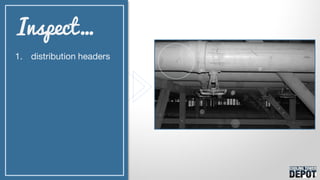
1. distribution headers
Inspect…
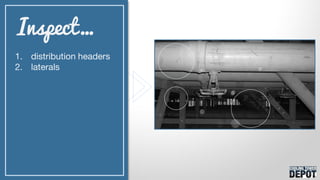
1. distribution headers
2. laterals
Inspect…
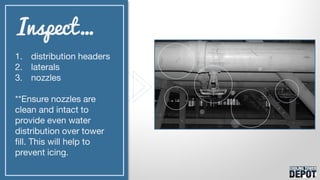
1. distribution headers
2. laterals
3. nozzles
**Ensure nozzles are
clean and intact to
provide even water
distribution over tower
fill. This will help to
prevent icing.
Inspect…
Rule #2
Protect air-inlet opening
Rule #2
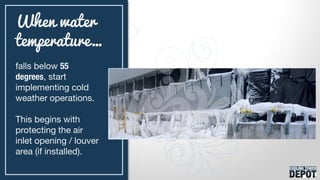
falls below 55
degrees, start
implementing cold
weather operations.
This begins with
protecting the air
inlet opening / louver
area (if installed).
When water
temperature…
falls below 55
degrees, start
implementing cold
weather operations.
This begins with
protecting the air
inlet opening / louver
area (if installed).
When water
temperature…
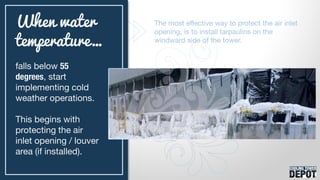
The most effective way to protect the air inlet
opening, is to install tarpaulins on the
windward side of the tower.
Rule #3
High heat load & water
circulation rate
Rule #3
needs to be maintained at
the highest possible level.
Once the air inlet opening
is protected, all other
components are
protected if there is a
substantial amount of
plant heat load.
Plant heat
load…
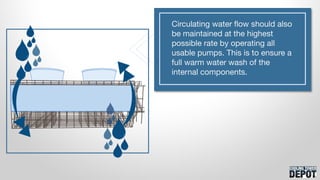
Circulating water flow should also
be maintained at the highest
possible rate by operating all
usable pumps. This is to ensure a
full warm water wash of the
internal components.
Rule #4
What if there is no heat load?
Rule #4
the circulating water
should be bypassed
directly to the cold
water basin.
If your tower is not
equipped with a bypass
capability, then shut
down your tower
completely.
If there is no
heat load…
the circulating water
should be bypassed
directly to the cold
water basin.
If your tower is not
equipped with a bypass
capability, then shut
down your tower
completely.
If there is no
heat load…
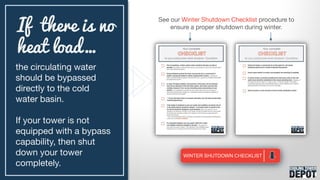
See our Winter Shutdown Checklist procedure to
ensure a proper shutdown during winter.
Rule #5
Complete visual inspections
Rule #5
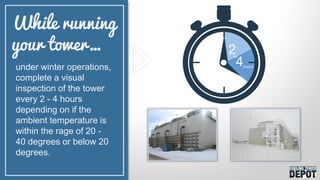
under winter operations,
complete a visual
inspection of the tower
every 2 - 4 hours
depending on if the
ambient temperature is
within the rage of 20 -
40 degrees or below 20
degrees.
While running
your tower…
While running
your tower…
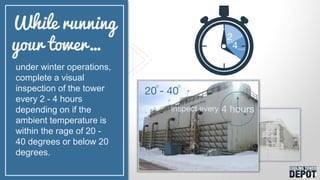
20 - 40
inspect every 4 hours
under winter operations,
complete a visual
inspection of the tower
every 2 - 4 hours
depending on if the
ambient temperature is
within the rage of 20 -
40 degrees or below 20
degrees.
While running
your tower…
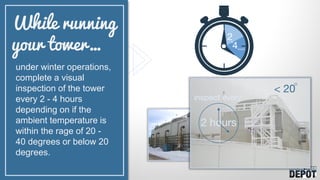
< 20
inspect every
2 hours
under winter operations,
complete a visual
inspection of the tower
every 2 - 4 hours
depending on if the
ambient temperature is
within the rage of 20 -
40 degrees or below 20
degrees.
Rule #6
Maintain cold water temperature
by regulating airflow
Rule #6
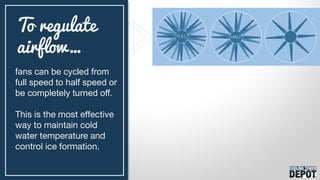
fans can be cycled from
full speed to half speed or
be completely turned off.
This is the most effective
way to maintain cold
water temperature and
control ice formation.
To regulate
airflow…
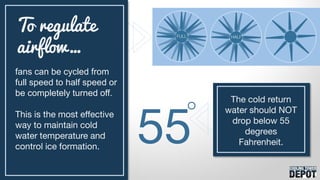
The cold return
water should NOT
drop below 55
degrees
Fahrenheit.55
fans can be cycled from
full speed to half speed or
be completely turned off.
This is the most effective
way to maintain cold
water temperature and
control ice formation.
To regulate
airflow…
Rule #7
When reverse fan
operations are necessary
Rule #7
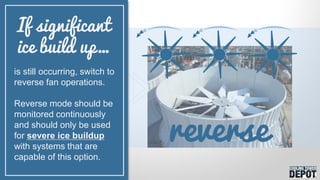
is still occurring, switch to
reverse fan operations.
Reverse mode should be
monitored continuously
and should only be used
for severe ice buildup
with systems that are
capable of this option.
If significant
ice build up…
Rule #8
When shutting fans down
Rule #8
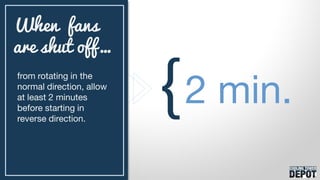
from rotating in the
normal direction, allow
at least 2 minutes
before starting in
reverse direction.
When fans
are shut off…
{2 min.
Rule #9
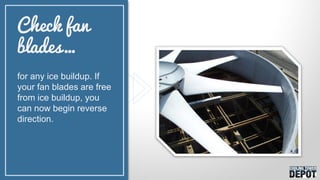
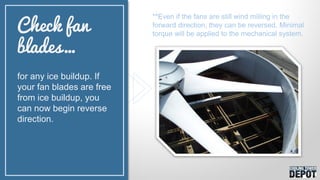
Check the fan blades
Rule #9
for any ice buildup. If
your fan blades are free
from ice buildup, you
can now begin reverse
direction.
Check fan
blades…
for any ice buildup. If
your fan blades are free
from ice buildup, you
can now begin reverse
direction.
Check fan
blades…
**Even if the fans are still wind milling in the
forward direction, they can be reversed. Minimal
torque will be applied to the mechanical system.
Rule #10
Reverse operation
timeline
Rule #10
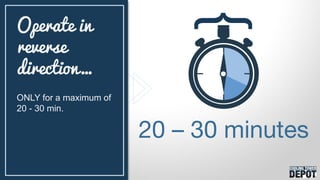
ONLY for a maximum of
20 - 30 min.
Operate in
reverse
direction…
20 – 30 minutes
{
Rule #11
Competing reverse fan
operations
Rule #11
When reverse
operation is
complete…
let the fan come to a complete
stop before re-starting.
let the fan come to a complete
stop before re-starting.
When reverse
operation is
complete…
Now with the fans shut off, flow
water for 15 min to prevent ice
buildup in the plenum area.
Again, visually check the fan
blades for ice buildup.
Rule #12
Never physically remove
ice from structure!
Rule #12
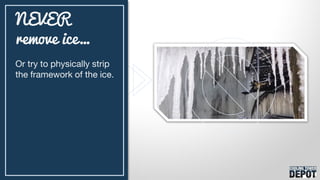
Or try to physically strip
the framework of the ice.
NEVER
remove ice…
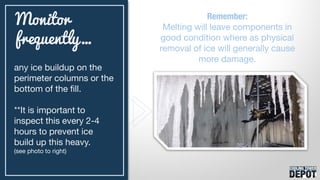
any ice buildup on the
perimeter columns or the
bottom of the fill.
**It is important to
inspect this every 2-4
hours to prevent ice
build up this heavy.
(see photo to right)
Monitor
frequently…
Remember:
Melting will leave components in
good condition where as physical
removal of ice will generally cause
more damage.
Learn more about cooling tower winter operations:
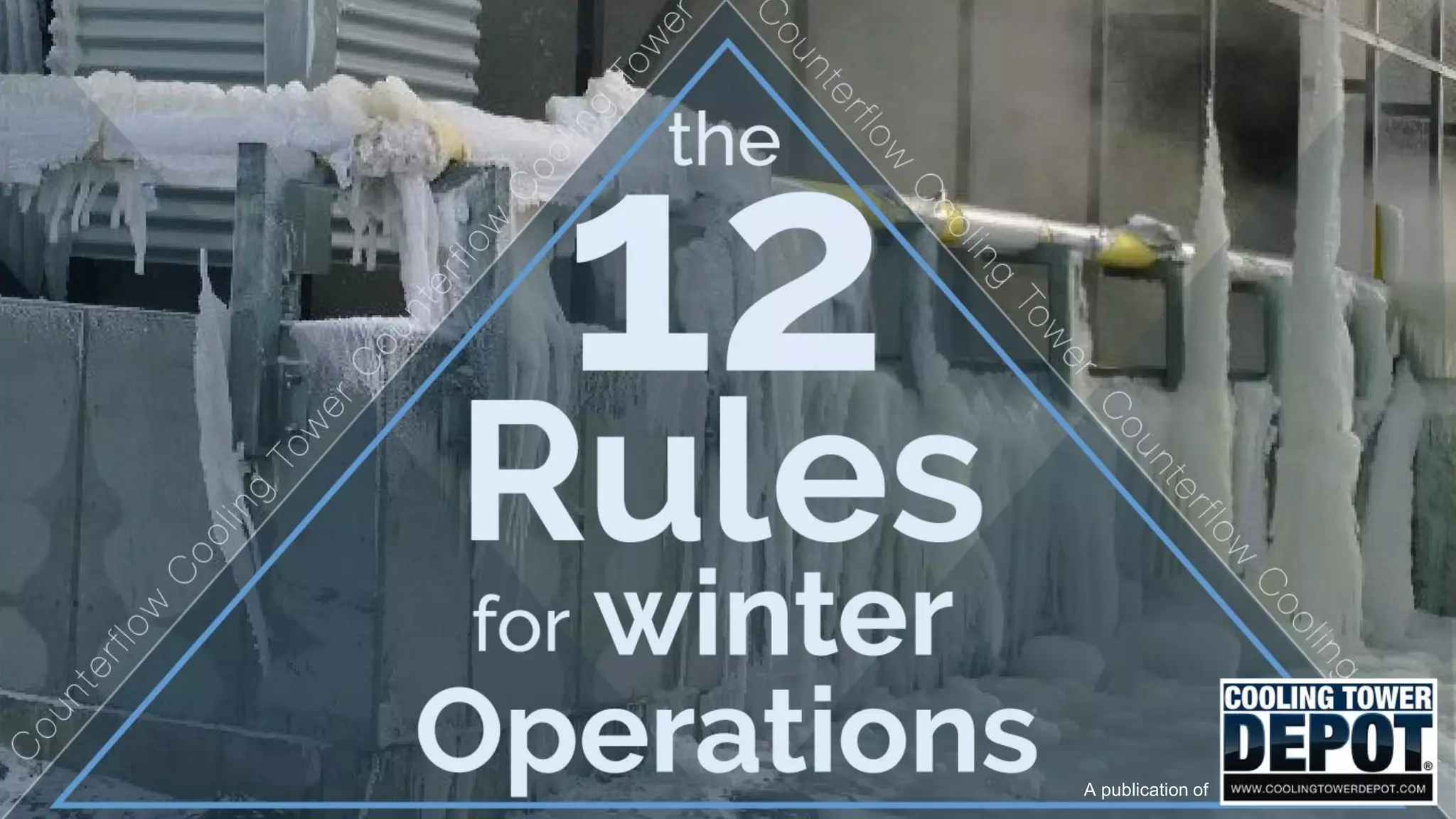
The 12 Rules for Operating Your Cooling Tower in Winter

The 12 Rules for Operating Your Cooling Tower in Winter

  • 1.
  • 2.
    Avoid icing onyour counterflow cooling tower this winter. Follow these 12 rules for operating your cooling tower in winter.
  • 3.
  • 4.
    Complete a FallInspection Rule #1
  • 5.
  • 6.
    1. distribution headers 2.laterals Inspect…
  • 7.
    1. distribution headers 2.laterals 3. nozzles **Ensure nozzles are clean and intact to provide even water distribution over tower fill. This will help to prevent icing. Inspect…
  • 8.
  • 9.
  • 10.
    falls below 55 degrees,start implementing cold weather operations. This begins with protecting the air inlet opening / louver area (if installed). When water temperature…
  • 11.
    falls below 55 degrees,start implementing cold weather operations. This begins with protecting the air inlet opening / louver area (if installed). When water temperature… The most effective way to protect the air inlet opening, is to install tarpaulins on the windward side of the tower.
  • 12.
  • 13.
    High heat load& water circulation rate Rule #3
  • 14.
    needs to bemaintained at the highest possible level. Once the air inlet opening is protected, all other components are protected if there is a substantial amount of plant heat load. Plant heat load…
  • 15.
    Circulating water flowshould also be maintained at the highest possible rate by operating all usable pumps. This is to ensure a full warm water wash of the internal components.
  • 16.
  • 17.
    What if thereis no heat load? Rule #4
  • 18.
    the circulating water shouldbe bypassed directly to the cold water basin. If your tower is not equipped with a bypass capability, then shut down your tower completely. If there is no heat load…
  • 19.
    the circulating water shouldbe bypassed directly to the cold water basin. If your tower is not equipped with a bypass capability, then shut down your tower completely. If there is no heat load… See our Winter Shutdown Checklist procedure to ensure a proper shutdown during winter.
  • 20.
  • 21.
  • 22.
    under winter operations, completea visual inspection of the tower every 2 - 4 hours depending on if the ambient temperature is within the rage of 20 - 40 degrees or below 20 degrees. While running your tower…
  • 23.
    While running your tower… 20- 40 inspect every 4 hours under winter operations, complete a visual inspection of the tower every 2 - 4 hours depending on if the ambient temperature is within the rage of 20 - 40 degrees or below 20 degrees.
  • 24.
    While running your tower… <20 inspect every 2 hours under winter operations, complete a visual inspection of the tower every 2 - 4 hours depending on if the ambient temperature is within the rage of 20 - 40 degrees or below 20 degrees.
  • 25.
  • 26.
    Maintain cold watertemperature by regulating airflow Rule #6
  • 27.
    fans can becycled from full speed to half speed or be completely turned off. This is the most effective way to maintain cold water temperature and control ice formation. To regulate airflow…
  • 28.
    The cold return watershould NOT drop below 55 degrees Fahrenheit.55 fans can be cycled from full speed to half speed or be completely turned off. This is the most effective way to maintain cold water temperature and control ice formation. To regulate airflow…
  • 29.
  • 30.
    When reverse fan operationsare necessary Rule #7
  • 31.
    is still occurring,switch to reverse fan operations. Reverse mode should be monitored continuously and should only be used for severe ice buildup with systems that are capable of this option. If significant ice build up…
  • 32.
  • 33.
    When shutting fansdown Rule #8
  • 34.
    from rotating inthe normal direction, allow at least 2 minutes before starting in reverse direction. When fans are shut off… {2 min.
  • 35.
  • 36.
    Check the fanblades Rule #9
  • 37.
    for any icebuildup. If your fan blades are free from ice buildup, you can now begin reverse direction. Check fan blades…
  • 38.
    for any icebuildup. If your fan blades are free from ice buildup, you can now begin reverse direction. Check fan blades… **Even if the fans are still wind milling in the forward direction, they can be reversed. Minimal torque will be applied to the mechanical system.
  • 39.
  • 40.
  • 41.
    ONLY for amaximum of 20 - 30 min. Operate in reverse direction… 20 – 30 minutes {
  • 42.
  • 43.
  • 44.
    When reverse operation is complete… letthe fan come to a complete stop before re-starting.
  • 45.
    let the fancome to a complete stop before re-starting. When reverse operation is complete… Now with the fans shut off, flow water for 15 min to prevent ice buildup in the plenum area. Again, visually check the fan blades for ice buildup.
  • 46.
  • 47.
    Never physically remove icefrom structure! Rule #12
  • 48.
    Or try tophysically strip the framework of the ice. NEVER remove ice…
  • 49.
    any ice buildupon the perimeter columns or the bottom of the fill. **It is important to inspect this every 2-4 hours to prevent ice build up this heavy. (see photo to right) Monitor frequently… Remember: Melting will leave components in good condition where as physical removal of ice will generally cause more damage.
  • 50.
    Learn more aboutcooling tower winter operations: