RESOURCE
MAPPING
BY,
Santhiya C,
22ENVA16
INTRODUCTION
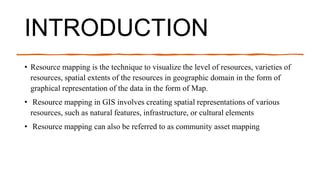
• Resource mapping is the technique to visualize the level of resources, varieties of
resources, spatial extents of the resources in geographic domain in the form of
graphical representation of the data in the form of Map.
• Resource mapping in GIS involves creating spatial representations of various
resources, such as natural features, infrastructure, or cultural elements
• Resource mapping can also be referred to as community asset mapping
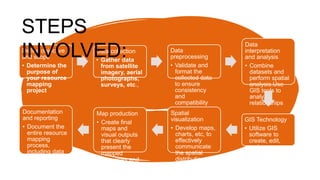
Define objective
and scope
• Determine the
purpose of
your resource
mapping
project
Data collection
• Gather data
from satellite
imagery, aerial
photographs,
surveys, etc.,
Data
preprocessing
• Validate and
format the
collected data
to ensure
consistency
and
compatibility
Data
interpretation
and analysis
• Combine
datasets and
perform spatial
analysis.Use
GIS tools to
analyze
relationships
GIS Technology
• Utilize GIS
software to
create, edit,
and manage
the spatial data.
Spatial
visualization
• Develop maps,
charts, etc, to
effectively
communicate
the spatial
distribution of
resources
Map production
• Create final
maps and
visual outputs
that clearly
present the
mapped
resources and
analysis
results.
Documentation
and reporting
• Document the
entire resource
mapping
process,
including data
sources,
methods used,
and any
assumptions
STEPS
INVOLVED:
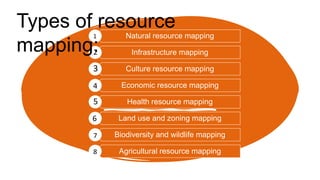
Natural resource mapping
Infrastructure mapping
Culture resource mapping
Economic resource mapping
Health resource mapping
Land use and zoning mapping
Biodiversity and wildlife mapping
Agricultural resource mapping
Types of resource
mapping:
Uses of resource
mapping
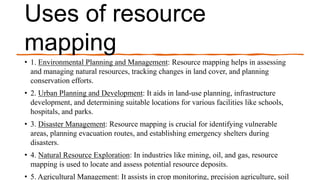
• 1. Environmental Planning and Management: Resource mapping helps in assessing
and managing natural resources, tracking changes in land cover, and planning
conservation efforts.
• 2. Urban Planning and Development: It aids in land-use planning, infrastructure
development, and determining suitable locations for various facilities like schools,
hospitals, and parks.
• 3. Disaster Management: Resource mapping is crucial for identifying vulnerable
areas, planning evacuation routes, and establishing emergency shelters during
disasters.
• 4. Natural Resource Exploration: In industries like mining, oil, and gas, resource
mapping is used to locate and assess potential resource deposits.
• 5. Agricultural Management: It assists in crop monitoring, precision agriculture, soil
Uses of resources
mapping
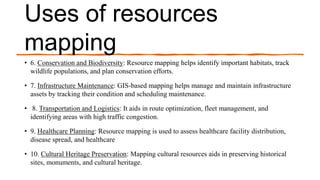
• 6. Conservation and Biodiversity: Resource mapping helps identify important habitats, track
wildlife populations, and plan conservation efforts.
• 7. Infrastructure Maintenance: GIS-based mapping helps manage and maintain infrastructure
assets by tracking their condition and scheduling maintenance.
• 8. Transportation and Logistics: It aids in route optimization, fleet management, and
identifying areas with high traffic congestion.
• 9. Healthcare Planning: Resource mapping is used to assess healthcare facility distribution,
disease spread, and healthcare
• 10. Cultural Heritage Preservation: Mapping cultural resources aids in preserving historical
sites, monuments, and cultural heritage.
THANK YOU

Resource mapping in geographic information system

  • 1.
  • 2.
    INTRODUCTION • Resource mappingis the technique to visualize the level of resources, varieties of resources, spatial extents of the resources in geographic domain in the form of graphical representation of the data in the form of Map. • Resource mapping in GIS involves creating spatial representations of various resources, such as natural features, infrastructure, or cultural elements • Resource mapping can also be referred to as community asset mapping
  • 3.
    Define objective and scope •Determine the purpose of your resource mapping project Data collection • Gather data from satellite imagery, aerial photographs, surveys, etc., Data preprocessing • Validate and format the collected data to ensure consistency and compatibility Data interpretation and analysis • Combine datasets and perform spatial analysis.Use GIS tools to analyze relationships GIS Technology • Utilize GIS software to create, edit, and manage the spatial data. Spatial visualization • Develop maps, charts, etc, to effectively communicate the spatial distribution of resources Map production • Create final maps and visual outputs that clearly present the mapped resources and analysis results. Documentation and reporting • Document the entire resource mapping process, including data sources, methods used, and any assumptions STEPS INVOLVED:
  • 4.
    Natural resource mapping Infrastructuremapping Culture resource mapping Economic resource mapping Health resource mapping Land use and zoning mapping Biodiversity and wildlife mapping Agricultural resource mapping Types of resource mapping:
  • 5.
    Uses of resource mapping •1. Environmental Planning and Management: Resource mapping helps in assessing and managing natural resources, tracking changes in land cover, and planning conservation efforts. • 2. Urban Planning and Development: It aids in land-use planning, infrastructure development, and determining suitable locations for various facilities like schools, hospitals, and parks. • 3. Disaster Management: Resource mapping is crucial for identifying vulnerable areas, planning evacuation routes, and establishing emergency shelters during disasters. • 4. Natural Resource Exploration: In industries like mining, oil, and gas, resource mapping is used to locate and assess potential resource deposits. • 5. Agricultural Management: It assists in crop monitoring, precision agriculture, soil
  • 6.
    Uses of resources mapping •6. Conservation and Biodiversity: Resource mapping helps identify important habitats, track wildlife populations, and plan conservation efforts. • 7. Infrastructure Maintenance: GIS-based mapping helps manage and maintain infrastructure assets by tracking their condition and scheduling maintenance. • 8. Transportation and Logistics: It aids in route optimization, fleet management, and identifying areas with high traffic congestion. • 9. Healthcare Planning: Resource mapping is used to assess healthcare facility distribution, disease spread, and healthcare • 10. Cultural Heritage Preservation: Mapping cultural resources aids in preserving historical sites, monuments, and cultural heritage.
  • 7.