PERSISTENT ORGANIC POLLUTANTS AND
RECALCITRANT POLLUTANTS
By,
Santhiya C,
22ENVA16
INTRODUCTION
• A pollutant is a substance or energy introduced into the environment that has undesired
effects, or adversely affects the usefulness of a resource.
• These can be both naturally forming (i.e. Minerals or extracted compounds like oil) or
anthropogenic in origin (i.e. Manufactured materials or by-products from
biodegradation).
• Pollutants result in environmental pollution or become public health concerns when they
reach a concentration high enough to have significant negative impacts.
2
TYPES OF POLLUTANTS
Many pollutants are within the following notable groups:
Environmental persistent pharmaceutical pollutants (EPPP)
Greenhouse gases (GHGs)
Particulate matter (PM)
Persistent organic pollutants (POPs)
Polycyclic aromatic hydrocarbons (PAHs)
• Volatile organic compounds (VOCs)
3
PERSISTENT ORGANIC POLLUTANTS
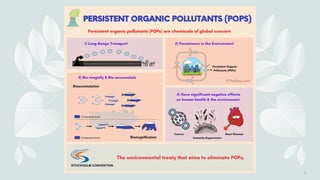
• Persistent organic pollutants (POPs) are organic compounds that are resistant to
degradation through chemical, biological, and photolytic processes.
• They are toxic chemicals that adversely affect human health and the environment
around the world.
• Most POPs are pesticides or insecticides, and some are also solvents,
pharmaceuticals, and industrial chemicals.
• Although some POPs arise naturally (e.g. From volcanoes), most are man-made.
• The “dirty dozen” POPs identified by the Stockholm Convention include aldrin,
chlordane, dieldrin, endrin, heptachlor, HCB, mirex, toxaphene, PCBs, DDT, dioxins,
and polychlorinated dibenzofurans.
4
5
EXAMPLES OF POPs
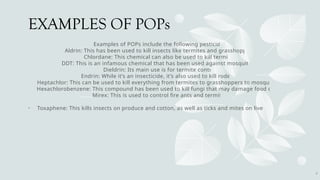
Examples of POPs include the following pesticides:
Aldrin: This has been used to kill insects like termites and grasshoppers.
Chlordane: This chemical can also be used to kill termites.
DDT: This is an infamous chemical that has been used against mosquitoes.
Dieldrin: Its main use is for termite control.
Endrin: While it’s an insecticide, it’s also used to kill rodents.
Heptachlor: This can be used to kill everything from termites to grasshoppers to mosquitoes.
Hexachlorobenzene: This compound has been used to kill fungi that may damage food crops.
Mirex: This is used to control fire ants and termites.
• Toxaphene: This kills insects on produce and cotton, as well as ticks and mites on livestock.
6
How are people exposed to POPs?
• Humans are exposed to these chemicals in a variety of ways: mainly through the food we eat,
but also through the air we breathe, in the outdoors, indoors and at the workplace.
• Many products used in our daily lives may contain POPs, which have been added to improve
product characteristics, such as flame retardants or surfactants.
• POPs bio-magnify throughout the food chain and bio-accumulate in organisms. The highest
concentrations of POPs are thus found in organisms at the top of the food chain.
• Human exposure – even to low levels of POPs – can lead to many health effects including
increased cancer risk, reproductive disorders, alteration of the immune system,
neurobehavioural impairment, endocrine disruption, genotoxicity and increased birth
defects.
7
EFFECTS
• POPs are highly toxic and exposure can take place through diet, environmental
exposure, or accidents. They negatively affect humans, plant and animal species and
natural ecosystems
• Death
• Cancers
• Allergies
• Hypersensitivity
• Developmental changes
• Damage to the central and peripheral nervous systems
• Disruption of the endocrine, reproductive, and immune systems
8
How to manage waste containing POPs?
Products containing persistent chemicals need to be treated in such a way that the
pollutants:
are destroyed (for example, through incineration),
irreversibly transformed or
• permanently stored (for example, in deep, underground, hard rock formations,
salt mines, or a landfill site for hazardous waste)
9
The Stockholm Convention
It is a global treaty to protect human health and the environment from POPs.
• It was opened for signature in 2001 in Stockholm (Sweden) and became effective in 2004.
• Objectives:
• Support the transition to safer alternatives.
• Target additional POPs for action.
• Cleanup old stockpiles and equipment containing POPs.
• Work together for a POPs-free future
• The convention calls to ban nine of the dirty dozen chemicals (key POPs), limit the use of DDT to malaria control,
and curtail inadvertent production of dioxins and furans. The convention listed twelve distinct chemicals in three
categories:
• Eight pesticides (aldrin, chlordane, DDT, dieldrin, endrin, heptachlor, mirex and toxaphene)
• Two industrial chemicals (poly chlorinated biphenyls and hexachlorobenzene)
• Two unintended by-products of many industrial processes (poly chlorinated dibenzo-p-dioxins and dibenzofurans,
commonly referred to as dioxins and furans).
1 0
RECALCITRANT POLLUTANTS
• Pollutants which are not biodegradable or are only biodegradable with difficulty.
• Recalcitrant pollutants, including hydrocarbons, pesticides, some personal care
products, nanomaterials, and different types of toxins, are on the raise and are
attracting increasing attention due to their negative effects, persistence, and bio
magnification in natural and human environments
• Recalcitrant organic pollutants (ROPs) refers to organics like agrochemicals, phenols,
dyes, surfactants, pesticides, and pharmaceuticals that can disperse the environment
and damage animals and human life
11
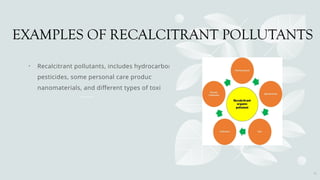
EXAMPLES OF RECALCITRANT POLLUTANTS
• Recalcitrant pollutants, includes hydrocarbons,
pesticides, some personal care products,
nanomaterials, and different types of toxins
1 2
REMEDIATION
• Because of the recalcitrance of the pollutants, conventional remediation techniques (e.g.,
bioremediation and classical physical and chemical processes) are not as effective, as fast,
or generate undesirable by products
• Microbial degradation of such compounds is usually very slow, making them highly
persistent in nature as these chemical substances have no or limited structural analogy to
natural compounds for which degradation pathways have evolved over billions of years.
• If the environmental recalcitrance of a compound is due to the lack or scarcity of microbes
capable of its degradation, inoculation of such organisms could enhance remediation.
1 3
Microbes in degradation of ROCs
The use of microorganisms is now preferred for degradation of recalcitrant compounds
They are cost effective and do not pose toxic effects.
They degrade much complex compounds into simpler molecules that do not harm the environment.
The enzymes produced by them are even advantageous and are efficient degraders.
Anaerobic bacteria seem to have much degrading ability than aerobic ones. Recently it has been seen
from various researches that the use of fungi is also a potential tool for recalcitrant compounds.
• White rot fungi have been extensively studied by many researchers for degradation of many
recalcitrant compounds
14
1 5
THANK YOU

PERSISTENT ORGANIC POLLUTANTS AND RECALCITRANT POLLUTANTS

  • 1.
    PERSISTENT ORGANIC POLLUTANTSAND RECALCITRANT POLLUTANTS By, Santhiya C, 22ENVA16
  • 2.
    INTRODUCTION • A pollutantis a substance or energy introduced into the environment that has undesired effects, or adversely affects the usefulness of a resource. • These can be both naturally forming (i.e. Minerals or extracted compounds like oil) or anthropogenic in origin (i.e. Manufactured materials or by-products from biodegradation). • Pollutants result in environmental pollution or become public health concerns when they reach a concentration high enough to have significant negative impacts. 2
  • 3.
    TYPES OF POLLUTANTS Manypollutants are within the following notable groups: Environmental persistent pharmaceutical pollutants (EPPP) Greenhouse gases (GHGs) Particulate matter (PM) Persistent organic pollutants (POPs) Polycyclic aromatic hydrocarbons (PAHs) • Volatile organic compounds (VOCs) 3
  • 4.
    PERSISTENT ORGANIC POLLUTANTS •Persistent organic pollutants (POPs) are organic compounds that are resistant to degradation through chemical, biological, and photolytic processes. • They are toxic chemicals that adversely affect human health and the environment around the world. • Most POPs are pesticides or insecticides, and some are also solvents, pharmaceuticals, and industrial chemicals. • Although some POPs arise naturally (e.g. From volcanoes), most are man-made. • The “dirty dozen” POPs identified by the Stockholm Convention include aldrin, chlordane, dieldrin, endrin, heptachlor, HCB, mirex, toxaphene, PCBs, DDT, dioxins, and polychlorinated dibenzofurans. 4
  • 5.
  • 6.
    EXAMPLES OF POPs Examplesof POPs include the following pesticides: Aldrin: This has been used to kill insects like termites and grasshoppers. Chlordane: This chemical can also be used to kill termites. DDT: This is an infamous chemical that has been used against mosquitoes. Dieldrin: Its main use is for termite control. Endrin: While it’s an insecticide, it’s also used to kill rodents. Heptachlor: This can be used to kill everything from termites to grasshoppers to mosquitoes. Hexachlorobenzene: This compound has been used to kill fungi that may damage food crops. Mirex: This is used to control fire ants and termites. • Toxaphene: This kills insects on produce and cotton, as well as ticks and mites on livestock. 6
  • 7.
    How are peopleexposed to POPs? • Humans are exposed to these chemicals in a variety of ways: mainly through the food we eat, but also through the air we breathe, in the outdoors, indoors and at the workplace. • Many products used in our daily lives may contain POPs, which have been added to improve product characteristics, such as flame retardants or surfactants. • POPs bio-magnify throughout the food chain and bio-accumulate in organisms. The highest concentrations of POPs are thus found in organisms at the top of the food chain. • Human exposure – even to low levels of POPs – can lead to many health effects including increased cancer risk, reproductive disorders, alteration of the immune system, neurobehavioural impairment, endocrine disruption, genotoxicity and increased birth defects. 7
  • 8.
    EFFECTS • POPs arehighly toxic and exposure can take place through diet, environmental exposure, or accidents. They negatively affect humans, plant and animal species and natural ecosystems • Death • Cancers • Allergies • Hypersensitivity • Developmental changes • Damage to the central and peripheral nervous systems • Disruption of the endocrine, reproductive, and immune systems 8
  • 9.
    How to managewaste containing POPs? Products containing persistent chemicals need to be treated in such a way that the pollutants: are destroyed (for example, through incineration), irreversibly transformed or • permanently stored (for example, in deep, underground, hard rock formations, salt mines, or a landfill site for hazardous waste) 9
  • 10.
    The Stockholm Convention Itis a global treaty to protect human health and the environment from POPs. • It was opened for signature in 2001 in Stockholm (Sweden) and became effective in 2004. • Objectives: • Support the transition to safer alternatives. • Target additional POPs for action. • Cleanup old stockpiles and equipment containing POPs. • Work together for a POPs-free future • The convention calls to ban nine of the dirty dozen chemicals (key POPs), limit the use of DDT to malaria control, and curtail inadvertent production of dioxins and furans. The convention listed twelve distinct chemicals in three categories: • Eight pesticides (aldrin, chlordane, DDT, dieldrin, endrin, heptachlor, mirex and toxaphene) • Two industrial chemicals (poly chlorinated biphenyls and hexachlorobenzene) • Two unintended by-products of many industrial processes (poly chlorinated dibenzo-p-dioxins and dibenzofurans, commonly referred to as dioxins and furans). 1 0
  • 11.
    RECALCITRANT POLLUTANTS • Pollutantswhich are not biodegradable or are only biodegradable with difficulty. • Recalcitrant pollutants, including hydrocarbons, pesticides, some personal care products, nanomaterials, and different types of toxins, are on the raise and are attracting increasing attention due to their negative effects, persistence, and bio magnification in natural and human environments • Recalcitrant organic pollutants (ROPs) refers to organics like agrochemicals, phenols, dyes, surfactants, pesticides, and pharmaceuticals that can disperse the environment and damage animals and human life 11
  • 12.
    EXAMPLES OF RECALCITRANTPOLLUTANTS • Recalcitrant pollutants, includes hydrocarbons, pesticides, some personal care products, nanomaterials, and different types of toxins 1 2
  • 13.
    REMEDIATION • Because ofthe recalcitrance of the pollutants, conventional remediation techniques (e.g., bioremediation and classical physical and chemical processes) are not as effective, as fast, or generate undesirable by products • Microbial degradation of such compounds is usually very slow, making them highly persistent in nature as these chemical substances have no or limited structural analogy to natural compounds for which degradation pathways have evolved over billions of years. • If the environmental recalcitrance of a compound is due to the lack or scarcity of microbes capable of its degradation, inoculation of such organisms could enhance remediation. 1 3
  • 14.
    Microbes in degradationof ROCs The use of microorganisms is now preferred for degradation of recalcitrant compounds They are cost effective and do not pose toxic effects. They degrade much complex compounds into simpler molecules that do not harm the environment. The enzymes produced by them are even advantageous and are efficient degraders. Anaerobic bacteria seem to have much degrading ability than aerobic ones. Recently it has been seen from various researches that the use of fungi is also a potential tool for recalcitrant compounds. • White rot fungi have been extensively studied by many researchers for degradation of many recalcitrant compounds 14
  • 15.