Prepared by:
Sajad Alramahy

Hawler Medical University- Hawler
((Sexual Dysfunction))
Sexual dysfunction is a term usually referring to

either disturbances in sexual desire or functioning.
Although sexual dysfunction is usually thought of to
be a male-related disorder, it may be associated with
either the female or male gender. sexual dysfunction
is a multidimensional phenomenon, composed of
various psychological, social and physical dimensions,
for which there are now several effective options for
treatment.
((Female Sexual dysfunction))
Female sexual dysfunction (FSD) is a term that

include a collection of sexual disorders that can affect
women throughout their adult life. FSD has multiple
causes, with physiological, psychological, and social
determinants.
Hypoactive sexual desire disorder (HSDD):

is the most common type of FSD and has received the
most attention from drug companies. The production
of testosterone, which is known to be important for
maintaining libido in women, decreases with age and
is affected by hormonal status. The ovaries are a
major source of testosterone production, and
oophorectomized women have low levels of
circulating testosterone , so in this case hormone
therapy is the treatment of choice.
((Male sexual dysfunction))
Sexual or Erectile dysfunction(ER): it is the inability

to achieve or maintain penile erection.

It affects 100million men worldwide,39% of them are

over 40 years old.
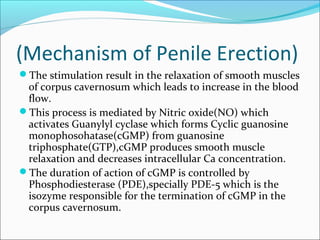
(Mechanism of Penile Erection)
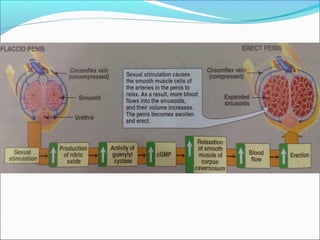
The stimulation result in the relaxation of smooth muscles

of corpus cavernosum which leads to increase in the blood
flow.
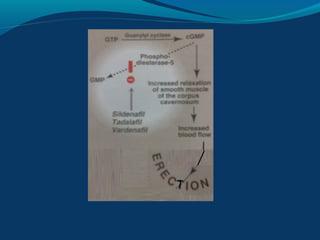
This process is mediated by Nitric oxide(NO) which
activates Guanylyl cyclase which forms Cyclic guanosine
monophosohatase(cGMP) from guanosine
triphosphate(GTP),cGMP produces smooth muscle
relaxation and decreases intracellular Ca concentration.
The duration of action of cGMP is controlled by
Phosphodiesterase (PDE),specially PDE-5 which is the
isozyme responsible for the termination of cGMP in the
corpus cavernosum.
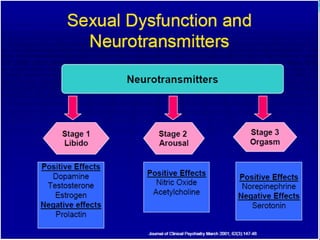
Drugs that increase serotonergic activity have

an inhibitory effect on all 3 stages of the sexual
response
In animal models, increases in serotonin causes
a decrease in dopamine levels
Serotonin increases prolactin levels while
dopamine acts as a prolactin inhibiting factor
(Causes)
 Cardiovascular disease.
 diabetes.
 alcohol .
 psychological factors.
Drug therapy like: antidepressant, phenothiazines,

cyproterone acetate, fibrate, livodopa, histamine H2
recepter blockker, phenytoin, carbamazepine ,Badrenocepter blockers and thiazide diuretics.
((Examples of drugs that cause sexual
dysfunction))
((Antidepressant drugs))
1- SSRIs(Selective serotonin reuptake inhibitor):
Luvox (fluvoxamine)
2- SNRIs(Serotonin–norepinephrine reuptake
inhibitor):Effexor (venlafaxine)
3- MAOIs(Monoamine oxidase inhibitor):Nardil (phenelzine)
4- Tricyclics:Endep (amitriptyline)
SSRIs are the most common group that causes sexual side

effects. these effects include problems with sexual desire,
lack of interest in sex, and anorgasmia (trouble achieving
orgasm). although usually reversible, these sexual side
effects can, in rare cases, last for months or years after the
drug has been completely withdrawn.

The mechanism of these drugs is that they compete with

dopamine receptors and decrease its effect which in turn
decrease norepinephrine and reduce blood flow, and
finally erection problem.
Some SSRI’s are potent nitric oxide synthase
inhibitors, and nitric oxide is a critical element in
the signal transduction cascade mediating penile
erection
((Antihypertensive drugs))
Beta Blockers :

Beta blockers are another class of medications that
are commonly used alone or in combination with
other therapies for men with hypertension.
Unfortunately, beta blockers have a significant
association with erectile dysfunction. For this
reason, if men complain that their erections were
adequate but decreased dramatically when they
started a beta blocker, it is time for a discussion for
the health professional who prescribed the
medication.
Potassium Sparing Diuretics:

Some of the less commonly used medications include
a class of diuretics that are known as the potassium
sparing diuretics. These drugs are commonly used for
hypertension in men with some degree of renal
insufficiency and can have a side effect of erectile
dysfunction because of effects on the hormonal
status of the patient. The potassium sparing diuretics
can also cause painful breast tenderness which can be
quite significant for men.
Alpha Blockers:

The class of medications called alpha blockers includes drugs
such as prazosin, terazosin and doxazosin. These classic alpha
blockers are used for hypertension and more commonly have
been used to treat men for the symptoms related to an enlarged
prostate. These drugs have not been shown to affect the
erection in an adverse way. However, they have been shown to
decrease a man's ability to ejaculate, a condition called
retrograde ejaculation, because of a unique action on the
bladder neck. Retrograde ejaculation is the reason some men do
not like to take alpha blockers. They are usually not primary
therapy for the man with the new diagnosis of hypertension
but are more commonly used in combination therapy. A newer
class of alpha blockers formulated specifically for prostate
disease does not tend to have as many cardiovascular side
effects.
((Chemotherapy))
For women, some types of chemotherapy can cause

vaginal dryness , which can be treated by the use of
water based lubricants.
Erectile dysfunction, or impotence, is a condition in
which a man is unable to achieve or keep an erection.
Some chemotherapy drugs may directly cause
impotence in men.
Cocaine
 Inhibits reuptake of dopamine
 Potent vasoconstrictor
 Increased sexual desire
 Arousal:
 Men:

low doses – prolonged erection
 high doses – erectile failure
 Women: reports of both increased and decreased subjective
arousal
 Delayed or absent orgasm


17
Opioids: Heroin
 Stimulate opiate receptors (enkephalins (body) and endorphins

(brain)) – results in reduction in circulating testosterone
 Produce relaxation/sense of well being
 Analgesic affect – opiate receptors in female genital tract
 Few reports of acute use: lowers drive, delays orgasm
 Male Heroin addicts:
 loss of drive, erectile dysfunction, orgasmic dysfunction
 Withdrawal: increased morning erections, spontaneous
ejaculation, slow return of sex drive, erectile and orgasmic
dysfunction
 Female Heroin addicts:
 Decreased drive, anorgasmia
 Withdrawal: loss of libido

18
(Drugs used for treatment of ED)
1- PDE-5 inhibitors: these drugs inhibits the action of
PDE-5 and prolongs the action of cGMP which leads
to increase the blood flow to the corpus cavernosum,
and these drugs are:
a-Sildenafil (viagra): this drug is taken orally and it take
60mins to produce an effect and it has a half life of 34hrs and its absorption is delayed when it is taken
with food.
b-Vardenafil : this drug is simillar to Sildenafil and its
absorption is also delayed by food intake and it takes
50mins to produce an effect and its half life is 4-5hrs.
c- Tadalafil : it has slower oncet of action(120mins) but
it has along half life (approximately 18hrs),resulting in
enhanced erectile function for at least 36hrs,and the
pharmacokinetics of Tadalafil are not affected by food
or alcohol consumption.
(Adverse effects of PDE inhibitors)
The mot frequent adverse effect of PDE inhibitors are

headache, flushing, dyspepsia and nasal congestion.
And they also lead to disturbance in color vision,
probably because of inhibition of PDE-6(Which is a
PDE found in retina which is important for color
vision) except Tadalafil.
(Contra indication of PDE
inhibitors)
because of the ability of PDE inhibitors to enhance

the activity of NO, there is an absolute
contraindication against the use of organic nitrates.
PDE should not be used with alpha-adrenergic
antagonists due to potential hypotension.
2-Alprostadil:
it is a stable form of prostaglandin E1.
It is powerful vasodilator.
it is effective for psychogenic and neuropathic ED.
(Mechanism of action of
Alprostadil)
this drug increases the arterial inflow and decreases
the venous out flow by contracting the corporal
smooth muscle that occludes draining venules.
3-Papaverine:
it is an alkaloid drug and it is nonspecific
phosphodiesterase inhibiter, and it is used to treat
neurologic and psychogenic ED.
4-Apomorphine:
it is a dopamine agonist and it is given by
subcutaneous injection, and it may cause nausea.
((Treatment of FSD))
Estrogen therapy. Localized estrogen therapy — in

the form of a vaginal ring, cream or tablet — can
improve sexual function in a number of ways,
including improving vaginal tone and elasticity,
increasing vaginal blood flow, enhancing lubrication,
and having a positive effect on brain function and
mood factors that impact sexual response.
Androgen therapy. Androgens include male

hormones, such as testosterone. Testosterone is
important for sexual function in women as well as
men, although testosterone occurs in much lower
amounts in a woman. Androgen therapy for sexual
dysfunction is controversial. Some studies show a
benefit for women who have low testosterone levels
and develop sexual dysfunction; other studies show
little or no benefit.
((References))
Lippincott’s Illustrated Reviews: Pharmacology 3rd

edition.
Clinical pharmacology: P.N. Bennet, M.J.
Brown(ninth edition) .
Wikipedia.
THANKS FOR LISTENING

Sexual dysfunction

  • 1.
    Prepared by: Sajad Alramahy HawlerMedical University- Hawler
  • 2.
    ((Sexual Dysfunction)) Sexual dysfunctionis a term usually referring to either disturbances in sexual desire or functioning. Although sexual dysfunction is usually thought of to be a male-related disorder, it may be associated with either the female or male gender. sexual dysfunction is a multidimensional phenomenon, composed of various psychological, social and physical dimensions, for which there are now several effective options for treatment.
  • 3.
    ((Female Sexual dysfunction)) Femalesexual dysfunction (FSD) is a term that include a collection of sexual disorders that can affect women throughout their adult life. FSD has multiple causes, with physiological, psychological, and social determinants.
  • 4.
    Hypoactive sexual desiredisorder (HSDD): is the most common type of FSD and has received the most attention from drug companies. The production of testosterone, which is known to be important for maintaining libido in women, decreases with age and is affected by hormonal status. The ovaries are a major source of testosterone production, and oophorectomized women have low levels of circulating testosterone , so in this case hormone therapy is the treatment of choice.
  • 5.
    ((Male sexual dysfunction)) Sexualor Erectile dysfunction(ER): it is the inability to achieve or maintain penile erection. It affects 100million men worldwide,39% of them are over 40 years old.
  • 6.
    (Mechanism of PenileErection) The stimulation result in the relaxation of smooth muscles of corpus cavernosum which leads to increase in the blood flow. This process is mediated by Nitric oxide(NO) which activates Guanylyl cyclase which forms Cyclic guanosine monophosohatase(cGMP) from guanosine triphosphate(GTP),cGMP produces smooth muscle relaxation and decreases intracellular Ca concentration. The duration of action of cGMP is controlled by Phosphodiesterase (PDE),specially PDE-5 which is the isozyme responsible for the termination of cGMP in the corpus cavernosum.
  • 9.
    Drugs that increaseserotonergic activity have an inhibitory effect on all 3 stages of the sexual response In animal models, increases in serotonin causes a decrease in dopamine levels Serotonin increases prolactin levels while dopamine acts as a prolactin inhibiting factor
  • 10.
    (Causes)  Cardiovascular disease. diabetes.  alcohol .  psychological factors. Drug therapy like: antidepressant, phenothiazines, cyproterone acetate, fibrate, livodopa, histamine H2 recepter blockker, phenytoin, carbamazepine ,Badrenocepter blockers and thiazide diuretics.
  • 11.
    ((Examples of drugsthat cause sexual dysfunction)) ((Antidepressant drugs)) 1- SSRIs(Selective serotonin reuptake inhibitor): Luvox (fluvoxamine) 2- SNRIs(Serotonin–norepinephrine reuptake inhibitor):Effexor (venlafaxine) 3- MAOIs(Monoamine oxidase inhibitor):Nardil (phenelzine) 4- Tricyclics:Endep (amitriptyline)
  • 12.
    SSRIs are themost common group that causes sexual side effects. these effects include problems with sexual desire, lack of interest in sex, and anorgasmia (trouble achieving orgasm). although usually reversible, these sexual side effects can, in rare cases, last for months or years after the drug has been completely withdrawn. The mechanism of these drugs is that they compete with dopamine receptors and decrease its effect which in turn decrease norepinephrine and reduce blood flow, and finally erection problem. Some SSRI’s are potent nitric oxide synthase inhibitors, and nitric oxide is a critical element in the signal transduction cascade mediating penile erection
  • 13.
    ((Antihypertensive drugs)) Beta Blockers: Beta blockers are another class of medications that are commonly used alone or in combination with other therapies for men with hypertension. Unfortunately, beta blockers have a significant association with erectile dysfunction. For this reason, if men complain that their erections were adequate but decreased dramatically when they started a beta blocker, it is time for a discussion for the health professional who prescribed the medication.
  • 14.
    Potassium Sparing Diuretics: Someof the less commonly used medications include a class of diuretics that are known as the potassium sparing diuretics. These drugs are commonly used for hypertension in men with some degree of renal insufficiency and can have a side effect of erectile dysfunction because of effects on the hormonal status of the patient. The potassium sparing diuretics can also cause painful breast tenderness which can be quite significant for men.
  • 15.
    Alpha Blockers: The classof medications called alpha blockers includes drugs such as prazosin, terazosin and doxazosin. These classic alpha blockers are used for hypertension and more commonly have been used to treat men for the symptoms related to an enlarged prostate. These drugs have not been shown to affect the erection in an adverse way. However, they have been shown to decrease a man's ability to ejaculate, a condition called retrograde ejaculation, because of a unique action on the bladder neck. Retrograde ejaculation is the reason some men do not like to take alpha blockers. They are usually not primary therapy for the man with the new diagnosis of hypertension but are more commonly used in combination therapy. A newer class of alpha blockers formulated specifically for prostate disease does not tend to have as many cardiovascular side effects.
  • 16.
    ((Chemotherapy)) For women, sometypes of chemotherapy can cause vaginal dryness , which can be treated by the use of water based lubricants. Erectile dysfunction, or impotence, is a condition in which a man is unable to achieve or keep an erection. Some chemotherapy drugs may directly cause impotence in men.
  • 17.
    Cocaine  Inhibits reuptakeof dopamine  Potent vasoconstrictor  Increased sexual desire  Arousal:  Men: low doses – prolonged erection  high doses – erectile failure  Women: reports of both increased and decreased subjective arousal  Delayed or absent orgasm  17
  • 18.
    Opioids: Heroin  Stimulateopiate receptors (enkephalins (body) and endorphins (brain)) – results in reduction in circulating testosterone  Produce relaxation/sense of well being  Analgesic affect – opiate receptors in female genital tract  Few reports of acute use: lowers drive, delays orgasm  Male Heroin addicts:  loss of drive, erectile dysfunction, orgasmic dysfunction  Withdrawal: increased morning erections, spontaneous ejaculation, slow return of sex drive, erectile and orgasmic dysfunction  Female Heroin addicts:  Decreased drive, anorgasmia  Withdrawal: loss of libido 18
  • 19.
    (Drugs used fortreatment of ED) 1- PDE-5 inhibitors: these drugs inhibits the action of PDE-5 and prolongs the action of cGMP which leads to increase the blood flow to the corpus cavernosum, and these drugs are:
  • 21.
    a-Sildenafil (viagra): thisdrug is taken orally and it take 60mins to produce an effect and it has a half life of 34hrs and its absorption is delayed when it is taken with food. b-Vardenafil : this drug is simillar to Sildenafil and its absorption is also delayed by food intake and it takes 50mins to produce an effect and its half life is 4-5hrs.
  • 22.
    c- Tadalafil :it has slower oncet of action(120mins) but it has along half life (approximately 18hrs),resulting in enhanced erectile function for at least 36hrs,and the pharmacokinetics of Tadalafil are not affected by food or alcohol consumption.
  • 23.
    (Adverse effects ofPDE inhibitors) The mot frequent adverse effect of PDE inhibitors are headache, flushing, dyspepsia and nasal congestion. And they also lead to disturbance in color vision, probably because of inhibition of PDE-6(Which is a PDE found in retina which is important for color vision) except Tadalafil.
  • 24.
    (Contra indication ofPDE inhibitors) because of the ability of PDE inhibitors to enhance the activity of NO, there is an absolute contraindication against the use of organic nitrates. PDE should not be used with alpha-adrenergic antagonists due to potential hypotension.
  • 25.
    2-Alprostadil: it is astable form of prostaglandin E1. It is powerful vasodilator. it is effective for psychogenic and neuropathic ED.
  • 26.
    (Mechanism of actionof Alprostadil) this drug increases the arterial inflow and decreases the venous out flow by contracting the corporal smooth muscle that occludes draining venules.
  • 27.
    3-Papaverine: it is analkaloid drug and it is nonspecific phosphodiesterase inhibiter, and it is used to treat neurologic and psychogenic ED.
  • 28.
    4-Apomorphine: it is adopamine agonist and it is given by subcutaneous injection, and it may cause nausea.
  • 29.
    ((Treatment of FSD)) Estrogentherapy. Localized estrogen therapy — in the form of a vaginal ring, cream or tablet — can improve sexual function in a number of ways, including improving vaginal tone and elasticity, increasing vaginal blood flow, enhancing lubrication, and having a positive effect on brain function and mood factors that impact sexual response.
  • 30.
    Androgen therapy. Androgensinclude male hormones, such as testosterone. Testosterone is important for sexual function in women as well as men, although testosterone occurs in much lower amounts in a woman. Androgen therapy for sexual dysfunction is controversial. Some studies show a benefit for women who have low testosterone levels and develop sexual dysfunction; other studies show little or no benefit.
  • 31.
    ((References)) Lippincott’s Illustrated Reviews:Pharmacology 3rd edition. Clinical pharmacology: P.N. Bennet, M.J. Brown(ninth edition) . Wikipedia.
  • 32.