Prepared by:
Sajad Abdulredha Ali
Halwer Medical University- Iraq
Introduction
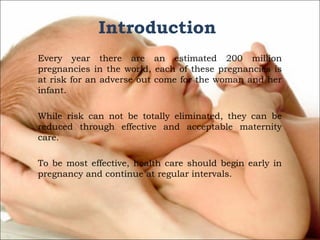
Every year there are an estimated 200 million
pregnancies in the world, each of these pregnancies is
at risk for an adverse out come for the woman and her
infant.
While risk can not be totally eliminated, they can be
reduced through effective and acceptable maternity
care.
To be most effective, health care should begin early in
pregnancy and continue at regular intervals.
Antenatal care

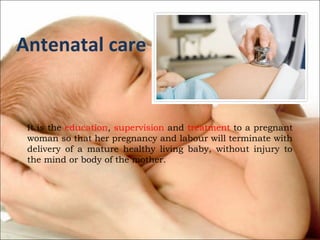
It is the education, supervision and treatment to a pregnant
woman so that her pregnancy and labour will terminate with
delivery of a mature healthy living baby, without injury to
the mind or body of the mother.
Goals
1. Assessment and
management of maternal
risk and symptoms.
2. Assessment and management of fetal risk
3. Prenatal diagnoses and management of fetal
abnormality
4. Diagnoses and management of perinatal complications
5. Decision regarding timing and mode of delivery
6. Parental education regarding pregnancy and childbirth
7. Parental education regarding child-rearing
WHO recommends a minimum of four ANC visits
• First visit: On confirmation of pregnancy
• Second visit: 20-28 weeks
• Third visit: 34-36 weeks
• Fourth visit: before expected date of delivery
or when the pregnant woman feels she
needs to consult health worker
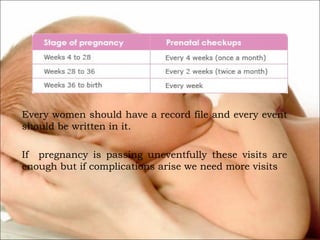
Every women should have a record file and every event
should be written in it.
If pregnancy is passing uneventfully these visits are
enough but if complications arise we need more visits
First Trimester Visit
 
•confirm intrauterine pregnancy and assess
the gestational age.
•We have to deal with complications that
present with vaginal bleeding and abdominal
pain.
•Women
can
be
investigated
using
history,examination,biochemical testing &
transvaginal U/S to exclude non-viable
pregnanacy.ectopic pregnanacy or hydatiform
mole,


Second Trimester Visit
 
Assessment of maternal health & fetal growth
& wellbeing.
The
results of tests performed at 1st
trimester visit are reviewed with the mother
The results of the U/S scan for fetal
abnormality are also reviewed.
Any incidental maternal symptoms are dealt
with ,this period is also important in insuring
the education of the woman regarding the rest
of pregnancy & her delivery,
 
Third Trimester Visit
 
The primary objective of this visit is to
anticipate
any
problems
regarding
the
prospective delivery.
Uterine fundal height ,fetal lie, presentation &
position are mandatory.
Vaginal examination will help us to check for
any abnormaity in the pelvis, cervical status
,fetal presenting part,station & position.
Mode of delivery & planned contraception after
delivery shoud be discussed at this time.

 
Post Dates Visit [ 41 – 42 weeks ]

 
With accurate pregnancy dating, true post
dates pregnancy are identified,
At this visit , a joint decision is taken as to
whether an induction of labour is
appropriate, this is current practice
because of the
reported assossiation
between post dates pregnancy &
pregnancy outcome.
Induction of labour usually performed by
the 42nd week.
In summery at each visit the following
procedure and examination should be
performed :
1- History:
Alarmin signs
present complain,
personal hx,
past medical and surgical hx,
Family hx,
Obestetrical hx…
2- Examination:
•Height: patients measuring 5 feet or less
are more likely to have a small pelvis that
may cause difficulty during delivery.
•Weight gain (11-16 kg)
• Normal weight women should
gain 11.5-15 kg
• Underweight women should gain
12.5-18 kg
• Obese women should gain no
more than 7 kg.
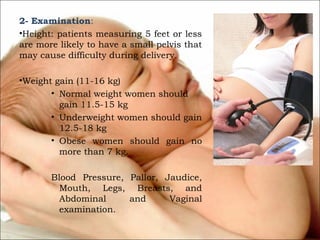
Blood Pressure, Pallor, Jaudice,
Mouth, Legs, Breasts, and
Abdominal
and
Vaginal
examination.
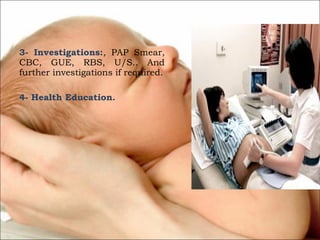
3- Investigations:, PAP Smear,
CBC, GUE, RBS, U/S.. And
further investigations if required.
4- Health Education.
Diet:
Calories (2500 cal/day)
Protein (60gm/day)
Calcium (1.2 gm /day)
Folic acid (400 µg/day)
Supplementary iron therapy is needed
for all pregnant mothers from 20 weeks
onwards.
(30 mg of ferrous / day)
(60-100 mg/day) is given for large women, twin, and those
women who book for ANC late in pregnancy
•Anemic woman should take (200 mg/day).
Hygiene:
Daily bath is recommended, as it stimulation refreshing
and relaxing.
Avoid hot water bath.
Vaginal Douches not favorable.

Bowel care:
As there is increase chance of constipation,
regular bowel movement may be facilitated
by regulation of diet taking plenty of fluids,
vegetables and milk.
Breast Care
Wash the breast with clean tap water.

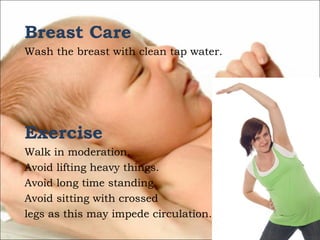
Exercise
Walk in moderation.
Avoid lifting heavy things.
Avoid long time standing.
Avoid sitting with crossed
legs as this may impede circulation.
Sleep
Regular sleep is advised, 8 hrs sleep per day
and increasing
toward term is recommended.
Sleeping on the left side is preferable.

Travel:
Travel is allowed when comfortable
Car safety belts have to be adjusted to be comfortable for
woman
Those traveling more than four hours must take a break
every 4 hours and walk for about of minutes to decrease the
risk of DVT
Sexual Activity
Sexual intercourse is allowed with moderation, it’s
completely safe and normal unless the woman has vaginal
bleeding or rupture memb.
Sexual activity is avoided in early pregnancies in woman
with previous history of Preterm labor

Immunization
One to two doses of tetanus toxoid is given to immunize
against tetanus infection.
Dressing:
Tight clothes and belts are avoided
The patient should wear
loose but comfortable dresses.
High heel shoes are better avoided.

Alcohol, smoking and drugs should be avoided as the
may affect the fetal wellbeing
Alarming Symptoms and signs











Vaginal Bleeding
Severe edema
Escape of fluid from the vagina
Abnormal gain or loss of weight
Decrease or cessation of fetal movement
Sever headache
Epigastric pain
Blurred vision
Fever
Abdominal pain
Conclusion
Antenatal care is an essential aspect of health care delivery for
improving pregnancy out come.
By this service we can detect high risk pregnancies and we can
direct them for proper management
References
1. Obstetrics by ten teachers, 19th edition, by Philip N
Baker and Louise C Kenny.
2. Prevention and Recognition of Obstetric Fistula
Training Package: FACILITATOR’S MANUAL.
3. National Institute for Health and Clinical Excellence,
Issue date: March 2008.
4. http://www.ahunterobstetrics.com/antenatalcare.ht
ml
Antenatal care

Antenatal care

  • 1.
    Prepared by: Sajad AbdulredhaAli Halwer Medical University- Iraq
  • 2.
    Introduction Every year thereare an estimated 200 million pregnancies in the world, each of these pregnancies is at risk for an adverse out come for the woman and her infant. While risk can not be totally eliminated, they can be reduced through effective and acceptable maternity care. To be most effective, health care should begin early in pregnancy and continue at regular intervals.
  • 3.
    Antenatal care It isthe education, supervision and treatment to a pregnant woman so that her pregnancy and labour will terminate with delivery of a mature healthy living baby, without injury to the mind or body of the mother.
  • 4.
    Goals 1. Assessment and managementof maternal risk and symptoms. 2. Assessment and management of fetal risk 3. Prenatal diagnoses and management of fetal abnormality 4. Diagnoses and management of perinatal complications 5. Decision regarding timing and mode of delivery 6. Parental education regarding pregnancy and childbirth 7. Parental education regarding child-rearing
  • 5.
    WHO recommends aminimum of four ANC visits • First visit: On confirmation of pregnancy • Second visit: 20-28 weeks • Third visit: 34-36 weeks • Fourth visit: before expected date of delivery or when the pregnant woman feels she needs to consult health worker
  • 6.
    Every women shouldhave a record file and every event should be written in it. If pregnancy is passing uneventfully these visits are enough but if complications arise we need more visits
  • 7.
    First Trimester Visit   •confirmintrauterine pregnancy and assess the gestational age. •We have to deal with complications that present with vaginal bleeding and abdominal pain. •Women can be investigated using history,examination,biochemical testing & transvaginal U/S to exclude non-viable pregnanacy.ectopic pregnanacy or hydatiform mole,    
  • 8.
    Second Trimester Visit   Assessmentof maternal health & fetal growth & wellbeing. The results of tests performed at 1st trimester visit are reviewed with the mother The results of the U/S scan for fetal abnormality are also reviewed. Any incidental maternal symptoms are dealt with ,this period is also important in insuring the education of the woman regarding the rest of pregnancy & her delivery,  
  • 9.
    Third Trimester Visit   Theprimary objective of this visit is to anticipate any problems regarding the prospective delivery. Uterine fundal height ,fetal lie, presentation & position are mandatory. Vaginal examination will help us to check for any abnormaity in the pelvis, cervical status ,fetal presenting part,station & position. Mode of delivery & planned contraception after delivery shoud be discussed at this time.  
  • 10.
    Post Dates Visit[ 41 – 42 weeks ]   With accurate pregnancy dating, true post dates pregnancy are identified, At this visit , a joint decision is taken as to whether an induction of labour is appropriate, this is current practice because of the reported assossiation between post dates pregnancy & pregnancy outcome. Induction of labour usually performed by the 42nd week.
  • 11.
    In summery ateach visit the following procedure and examination should be performed : 1- History: Alarmin signs present complain, personal hx, past medical and surgical hx, Family hx, Obestetrical hx…
  • 12.
    2- Examination: •Height: patientsmeasuring 5 feet or less are more likely to have a small pelvis that may cause difficulty during delivery. •Weight gain (11-16 kg) • Normal weight women should gain 11.5-15 kg • Underweight women should gain 12.5-18 kg • Obese women should gain no more than 7 kg. Blood Pressure, Pallor, Jaudice, Mouth, Legs, Breasts, and Abdominal and Vaginal examination.
  • 13.
    3- Investigations:, PAPSmear, CBC, GUE, RBS, U/S.. And further investigations if required. 4- Health Education.
  • 14.
    Diet: Calories (2500 cal/day) Protein(60gm/day) Calcium (1.2 gm /day) Folic acid (400 µg/day) Supplementary iron therapy is needed for all pregnant mothers from 20 weeks onwards. (30 mg of ferrous / day) (60-100 mg/day) is given for large women, twin, and those women who book for ANC late in pregnancy •Anemic woman should take (200 mg/day).
  • 15.
    Hygiene: Daily bath isrecommended, as it stimulation refreshing and relaxing. Avoid hot water bath. Vaginal Douches not favorable. Bowel care: As there is increase chance of constipation, regular bowel movement may be facilitated by regulation of diet taking plenty of fluids, vegetables and milk.
  • 16.
    Breast Care Wash thebreast with clean tap water. Exercise Walk in moderation. Avoid lifting heavy things. Avoid long time standing. Avoid sitting with crossed legs as this may impede circulation.
  • 17.
    Sleep Regular sleep isadvised, 8 hrs sleep per day and increasing toward term is recommended. Sleeping on the left side is preferable. Travel: Travel is allowed when comfortable Car safety belts have to be adjusted to be comfortable for woman Those traveling more than four hours must take a break every 4 hours and walk for about of minutes to decrease the risk of DVT
  • 18.
    Sexual Activity Sexual intercourseis allowed with moderation, it’s completely safe and normal unless the woman has vaginal bleeding or rupture memb. Sexual activity is avoided in early pregnancies in woman with previous history of Preterm labor Immunization One to two doses of tetanus toxoid is given to immunize against tetanus infection.
  • 19.
    Dressing: Tight clothes andbelts are avoided The patient should wear loose but comfortable dresses. High heel shoes are better avoided. Alcohol, smoking and drugs should be avoided as the may affect the fetal wellbeing
  • 20.
    Alarming Symptoms andsigns           Vaginal Bleeding Severe edema Escape of fluid from the vagina Abnormal gain or loss of weight Decrease or cessation of fetal movement Sever headache Epigastric pain Blurred vision Fever Abdominal pain
  • 21.
    Conclusion Antenatal care isan essential aspect of health care delivery for improving pregnancy out come. By this service we can detect high risk pregnancies and we can direct them for proper management
  • 23.
    References 1. Obstetrics byten teachers, 19th edition, by Philip N Baker and Louise C Kenny. 2. Prevention and Recognition of Obstetric Fistula Training Package: FACILITATOR’S MANUAL. 3. National Institute for Health and Clinical Excellence, Issue date: March 2008. 4. http://www.ahunterobstetrics.com/antenatalcare.ht ml