Normal  Sexuality By Dr. Helal Uddin Ahmed MD-Part-II Student Department of Psychiatry BSMMU
A dirty book is rarely dusty
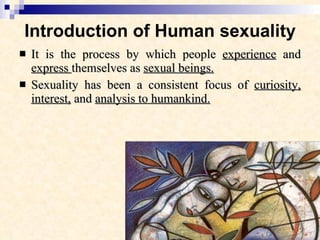
Introduction of Human sexuality It is the process by which people  experience  and  express  themselves as  sexual beings. Sexuality has been a consistent focus of  curiosity, interest,  and  analysis to humankind.
Introduction of Human sexuality    Contd. Sexuality is determined by  anatomy, physiology , the  culture in which a person lives ,  relationships with others , and  developmental experiences throughout the life cycle .  It includes the perception of  being male or female  and  private thoughts  and  fantasies  as well as  behavior .  Normal sexual behavior brings  pleasure to oneself and one's partner , involves  stimulation of the primary sex organs  including  coitus
Introduction of Human sexuality   Contd. Normal sexuality is  devoid of  inappropriate feelings of guilt or anxiety and is not compulsive.  Recreational VS Relational sex- Masturbation,  Various forms of stimulation sex organs, Getting sexual gratification by several ways etc.
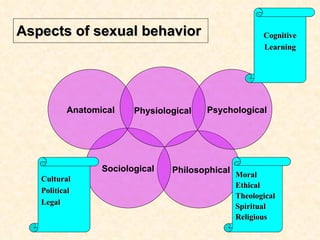
Aspects of sexual behavior Philosophical Sociological Psychological Anatomical Physiological Cognitive Learning Cultural  Political Legal Moral Ethical Theological Spiritual Religious
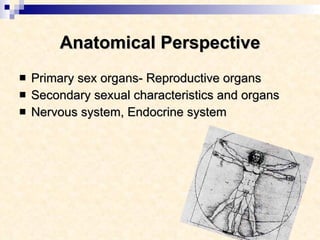
Primary sex organs- Reproductive organs Secondary sexual characteristics and organs Nervous system, Endocrine system  Anatomical Perspective
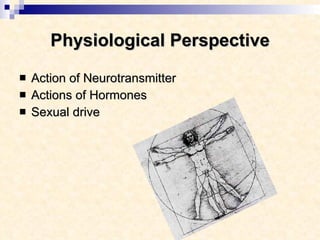
Physiological Perspective Action of Neurotransmitter Actions of Hormones Sexual drive
Cognitive Perspective How a stimulus or situation is interpreted determines how the individual will respond to the stimulus  Perception includes at least three components: detection, labeling, and attribution.  Detection  is defined by an individual's ability to note the presence of a stimulus or to discriminate it from other stimuli. Labeling  is the descriptors that an individual uses to categorize the stimulus event.  Attribution  is an explanation for the perception
Cognitive Perspective    Contd. Another  cognitive factor is  evaluation ; when an individual evaluates a sexual stimulus as good or positive, sexual arousal may be enhanced. On the other hand, when a stimulus is evaluated negatively, sexuality will be diminished
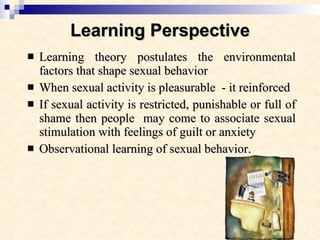
Learning Perspective Learning theory postulates the environmental factors that shape sexual behavior When sexual activity is pleasurable  - it reinforced If sexual activity is restricted, punishable or full of shame then people  may come to associate sexual stimulation with feelings of guilt or anxiety  Observational learning of sexual behavior.
Boccadoro L., Carulli S.   Italian Mentors  “ Human sexuality is not simply imposed by instinct or stereotypical conducts, as it happens in animals, but it is influenced both by  superior mental   activity  and by  social,   cultural, educational  and  normative characteristics of those places  where the subjects grow up and their personality develops. Consequently, the analysis of sexual sphere must be based on the convergence of several lines of development such as  affectivity,   emotions  and  relations  .”
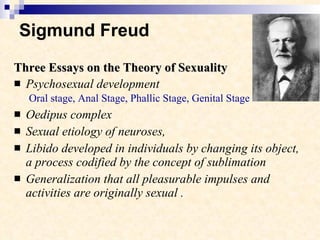
Sigmund Freud Three Essays on the Theory of Sexuality Psychosexual development     Oral stage, Anal Stage, Phallic Stage, Genital Stage Oedipus complex   Sexual etiology of neuroses,  Libido developed in individuals by changing its object, a process codified by the concept of sublimation Generalization that all pleasurable impulses and activities are originally sexual .
Michel Foucault Sexuality are the  activities  and  sensations  determined historically, regionally and culturally.  The construction of sexual meanings, is an  instrumen t by which social institutions (religion, marketing, the educational system, psychiatry, etc.)  control and shape  human relationship.
Sexual ethics and legality Unlike some other sexual activities,  vaginal intercourse  has rarely been made Taboo on religious grounds or by law. Many of the cultures that had prohibited sexual intercourse entirely – Shakers, Roman Catholic Church, Mahayana Buddhist Monks.
Sexual ethics and legality    Contd. Masturbation ( Auto-erotic sexuality) Fornication or Live-together Adultery or Extramarital sex Homosexuality-  Gay, Lesbian Commercial sex or Prostitution Necrophilia (sex with dead body) Incest Child sexual abuse/Pedophilia Bestiality Sexual intercourse during a woman's menstrual period, as prohibited  in Islam and Judaism Sex between members of different tribes / same cast Public decency (exhibitionism and voyeurism) Forceful  Sex   Rape Sexual assault Statutory Rape Lust Murder
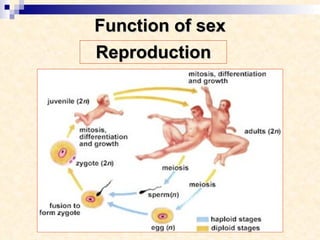
Function of sex Reproduction
Benefits  of  SEX  beyond reproduction
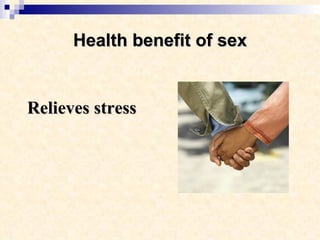
Health benefit of sex Relieves stress
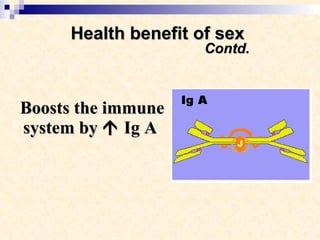
Health benefit of sex    Contd. Boosts the immune system by    Ig A
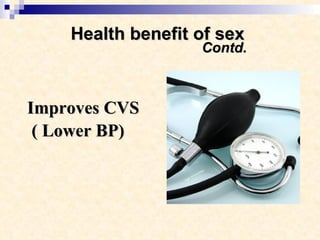
Health benefit of sex    Contd.   Improves CVS ( Lower BP)
Health benefit of sex    Contd.    Self esteem
Health benefit of sex    Contd. Improves intimacy   with partner
Health benefit of sex    Contd. Reduce pain  (+) oxytocin
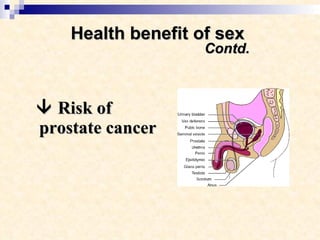
Health benefit of sex    Contd.    Risk of prostate cancer
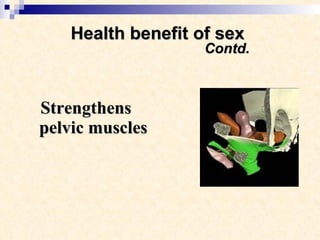
Health benefit of sex    Contd. Strengthens pelvic muscles
Health benefit of sex    Contd. Promotes good sleep
Health benefit of sex    Contd. Improves the sense of smell
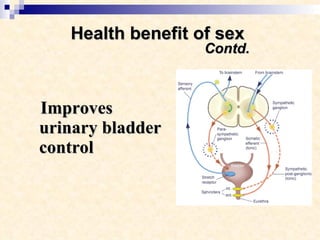
Health benefit of sex    Contd. Improves urinary bladder control
Sexual Identity and Gender Identity   Sexual identity is the pattern of a person's  biological sexual characteristics : chromosomes, external genitalia, internal genitalia, hormonal composition, gonads, and secondary sex characteristics.  Gender identity is a  person's sense  of maleness or femaleness.
Sexual Orientation Sexual orientation describes the object of a person's sexual impulses:   - Heterosexual  (opposite sex),  - Homosexual  (same sex),  - Bisexual  (both sexes).   - Transexuality  (desire to be a member of the    opposite sex) A group of people have defined themselves as “ asexual ” and assert this as a positive identity.  Some researchers believe this lack of attraction to any object is a manifestation of a desire disorder.
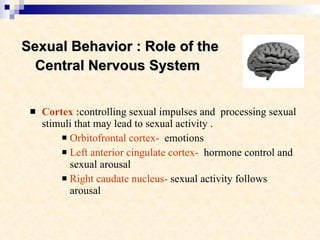
Sexual Behavior : Role of the Central Nervous System   Cortex : controlling sexual impulses and  processing sexual stimuli that may lead to sexual activity . Orbitofrontal cortex-   emotions Left anterior cingulate cortex-   hormone control and sexual arousal Right caudate nucleus-  sexual activity follows arousal
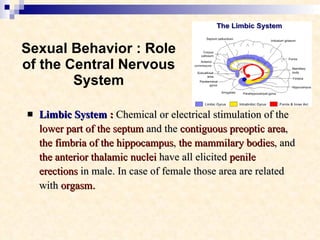
Sexual Behavior : Role of the Central Nervous System Limbic System  :  Chemical or electrical stimulation of the  lower part of the septum  and the  contiguous preoptic area ,  the fimbria of the hippocampus ,  the mammilary bodies , and  the anterior thalamic nuclei  have all elicited  penile erections  in male. In case of female those area are related with  orgasm .
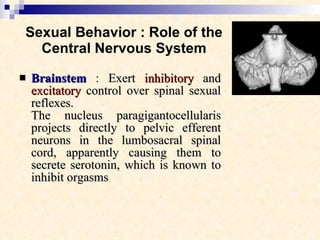
Sexual Behavior : Role of the Central Nervous System Brainstem  :  Exert  inhibitory  and  excitatory  control over spinal sexual reflexes. The nucleus paragigantocellularis projects directly to pelvic efferent neurons in the lumbosacral spinal cord, apparently causing them to secrete serotonin, which is known to inhibit orgasms
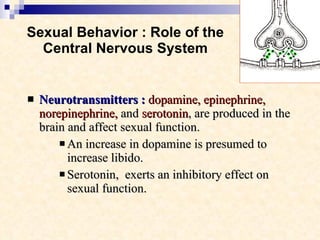
Sexual Behavior : Role of the Central Nervous System Neurotransmitters :   dopamine, epinephrine, norepinephrine,  and  serotonin , are produced in the brain and affect sexual function. An increase in dopamine is presumed to increase libido.  Serotonin,  exerts an inhibitory effect on sexual function.
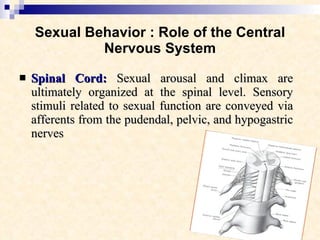
Sexual Behavior : Role of the Central Nervous System Spinal Cord:   Sexual arousal and climax are ultimately organized at the spinal level. Sensory stimuli related to sexual function are conveyed via afferents from the pudendal, pelvic, and hypogastric nerves
Hormones and Sexual Behavior Testosterone  increases libido in both men and women  Estrogen  is a key factor in the  lubrication  involved in female arousal and may increase sensitivity in the woman to stimulation.  Progesterone  mildly depresses desire in men and women as do excessive  prolactin  and  cortisol.   Oxytocin  is involved in pleasurable sensations during sex and is found in higher levels in men and women following orgasm. It reinforces pleasurable activities
Physiological Responses   Sexual response is a true  psychophysiological experience.  Arousal  is triggered by both psychological and physical stimuli;  Levels of tension are experienced both  physiologically  and  emotionally
Physiological Responses   Contd. Psychosexual development Psychological attitudes toward sexuality Attitudes toward one's sexual partner    These 3  are Directly involved  with, and  Affect,   human sexual response.
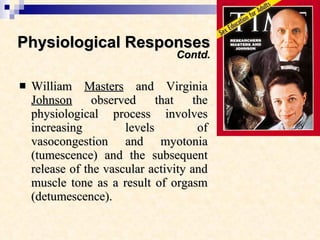
Physiological Responses Contd. William  Masters  and Virginia  Johnson  observed that the physiological process involves increasing levels of vasocongestion and myotonia (tumescence) and the subsequent release of the vascular activity and muscle tone as a result of orgasm (detumescence).
Sexual Stimulation: Foreplay Psychological Stimulation  -use of smell, taste, hearing, sight or fantasy Physical Stimulation-  use of touch pressure or bodily contact 1. Erogenous zones 2. Kissing 3. Breast stimulation 4. Oral-genital stimulation 5. Anal stimulation 6. Manual stimulation of genitals
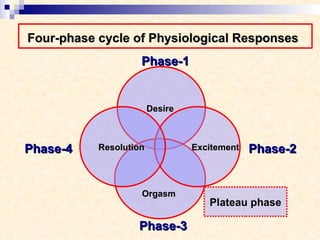
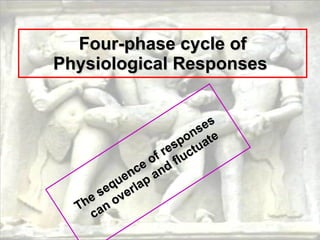
Four-phase cycle of Physiological Responses   Phase-1 Desire  Orgasm  Excitement   Resolution  Phase-2 Phase-3 Phase-4 Plateau phase
Four-phase cycle of Physiological Responses   The sequence of responses can overlap and fluctuate
Phase 1: Desire The desire (or appetitive) phase, identified solely through physiology, reflects the psychiatric concern with  motivations ,  drives , and  personality .  The phase is characterized by  sexual fantasies  and the  desire to have sexual activity .
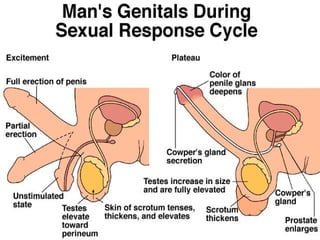
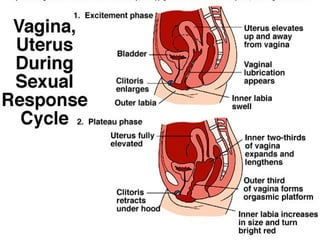
Phase 2: Excitement   The excitement and arousal phase, brought on by  psychological stimulation  (fantasy or the presence of a love object) or  physiological stimulation  ( Foreplays-stroking or kissing) or a  combination  of the two, consists of a  subjective sense of pleasure.
 
 
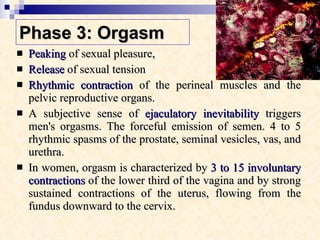
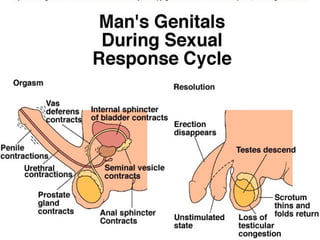
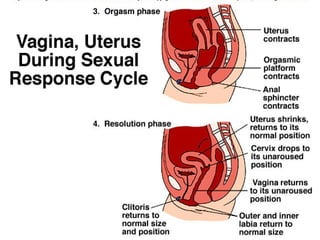
Phase 3: Orgasm   Peaking  of sexual pleasure,  Release  of sexual tension  Rhythmic contraction  of the perineal muscles and the pelvic reproductive organs.  A subjective sense of  ejaculatory inevitability  triggers men's orgasms. The forceful emission of semen. 4 to 5 rhythmic spasms of the prostate, seminal vesicles, vas, and urethra.  In women, orgasm is characterized by  3 to 15 involuntary contractions  of the lower third of the vagina and by strong sustained contractions of the uterus, flowing from the fundus downward to the cervix.
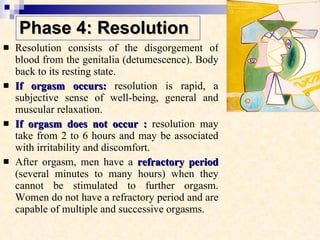
Phase 4: Resolution Resolution consists of the disgorgement of blood from the genitalia (detumescence). Body back to its resting state.  If orgasm occurs:  resolution is rapid, a subjective sense of well-being, general and muscular relaxation.  If orgasm does not occur :  resolution may take from 2 to 6 hours and may be associated with irritability and discomfort.  After orgasm, men have a  refractory period  (several minutes to many hours) when they cannot be stimulated to further orgasm. Women do not have a refractory period and are capable of multiple and successive orgasms.


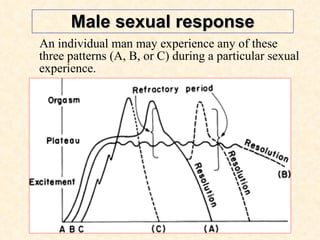
Male sexual response An individual man may experience any of these three patterns (A, B, or C) during a particular sexual experience.
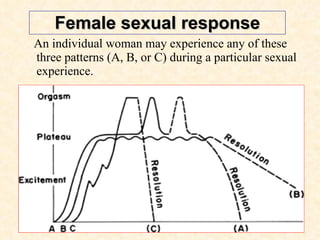
Female sexual response An individual woman may experience any of these three patterns (A, B, or C) during a particular sexual experience.
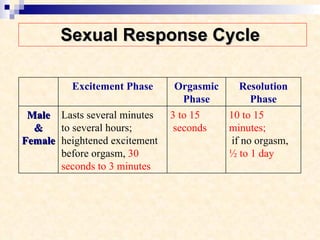
Sexual Response Cycle   10 to 15 minutes; if no orgasm,  ½ to 1 day 3 to 15 seconds Lasts several minutes to several hours;  heightened excitement  before orgasm,  30  seconds to 3 minutes Male & Female Resolution Phase Orgasmic Phase Excitement Phase
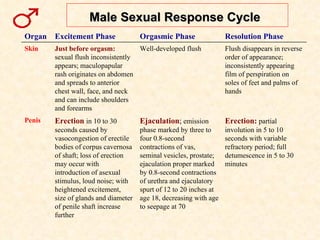
Male Sexual Response Cycle   Erection:  partial involution in 5 to 10 seconds with variable refractory period; full detumescence in 5 to 30 minutes Ejaculation ;  emission phase marked by three to four 0.8-second contractions of vas, seminal vesicles, prostate; ejaculation proper marked by 0.8-second contractions of urethra and ejaculatory spurt of 12 to 20 inches at age 18, decreasing with age to seepage at 70 Erection  in 10 to 30 seconds caused by vasocongestion of erectile bodies of corpus cavernosa of shaft; loss of erection may occur with introduction of asexual stimulus, loud noise; with heightened excitement, size of glands and diameter of penile shaft increase further Penis Flush disappears in reverse order of appearance; inconsistently appearing film of perspiration on soles of feet and palms of hands Well-developed flush Just before orgasm:  sexual flush inconsistently appears; maculopapular rash originates on abdomen and spreads to anterior chest wall, face, and neck and can include shoulders and forearms Skin Resolution Phase Orgasmic Phase Excitement Phase Organ
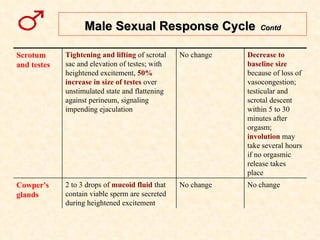
Male Sexual Response Cycle   Contd No change No change 2 to 3 drops of  mucoid fluid  that contain viable sperm are secreted during heightened excitement Cowper's glands Decrease to baseline size  because of loss of vasocongestion; testicular and scrotal descent within 5 to 30 minutes after orgasm;  involution  may take several hours if no orgasmic release takes place No change Tightening and lifting  of scrotal sac and elevation of testes; with heightened excitement,  50% increase in size of testes  over unstimulated state and flattening against perineum, signaling impending ejaculation Scrotum and testes
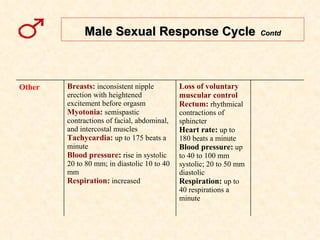
Male Sexual Response Cycle   Contd Loss of voluntary muscular control Rectum:  rhythmical contractions of sphincter Heart rate:  up to 180 beats a minute Blood pressure:  up to 40 to 100 mm systolic; 20 to 50 mm diastolic Respiration:  up to 40 respirations a minute Breasts:  inconsistent nipple erection with heightened excitement before orgasm Myotonia:  semispastic contractions of facial, abdominal, and intercostal muscles Tachycardia:  up to 175 beats a minute Blood pressure :  rise in systolic 20 to 80 mm; in diastolic 10 to 40 mm Respiration:  increased Other
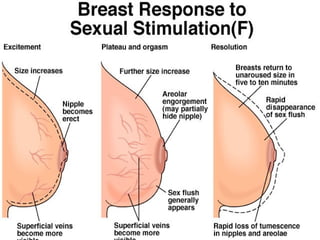
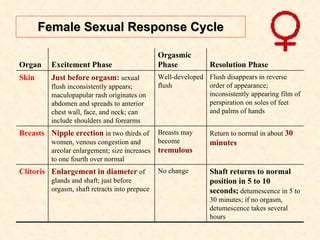
Female Sexual Response Cycle Shaft returns to normal position in 5 to 10 seconds;  detumescence in 5 to 30 minutes; if no orgasm, detumescence takes several hours No change Enlargement in diameter  of glands and shaft; just before orgasm, shaft retracts into prepuce Clitoris Return to normal in about  30 minutes Breasts may become  tremulous Nipple erection  in two thirds of women, venous congestion and areolar enlargement; size increases to one fourth over normal Breasts Flush disappears in reverse order of appearance; inconsistently appearing film of perspiration on soles of feet and palms of hands Well-developed flush Just before orgasm:  sexual flush inconsistently appears; maculopapular rash originates on abdomen and spreads to anterior chest wall, face, and neck; can include shoulders and forearms Skin Resolution Phase Orgasmic Phase Excitement Phase Organ
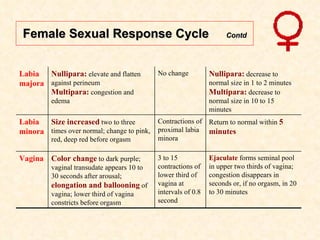
Female Sexual Response Cycle  Contd Ejaculate  forms seminal pool in upper two thirds of vagina; congestion disappears in seconds or, if no orgasm, in 20 to 30 minutes 3 to 15 contractions of lower third of vagina at intervals of 0.8 second Color change  to dark purple; vaginal transudate appears 10 to 30 seconds after arousal;  elongation and ballooning  of vagina; lower third of vagina constricts before orgasm Vagina Return to normal within  5 minutes Contractions of proximal labia minora Size increased  two to three times over normal; change to pink, red, deep red before orgasm Labia minora Nullipara:  decrease to normal size in 1 to 2 minutes Multipara:  decrease to normal size in 10 to 15 minutes No change Nullipara:  elevate and flatten against perineum Multipara:  congestion and edema Labia majora
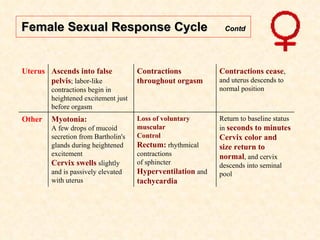
Female Sexual Response Cycle  Contd Return to baseline status in  seconds to minutes Cervix color and size return to normal , and cervix descends into seminal pool Loss of voluntary muscular Control  Rectum:  rhythmical contractions of sphincter Hyperventilation  and  tachycardia Myotonia: A few drops of mucoid secretion from Bartholin's glands during heightened excitement Cervix swells  slightly and is passively elevated with uterus Other Contractions cease , and uterus descends to normal position Contractions  throughout orgasm Ascends into false pelvis ; labor-like contractions begin in heightened excitement just before orgasm Uterus
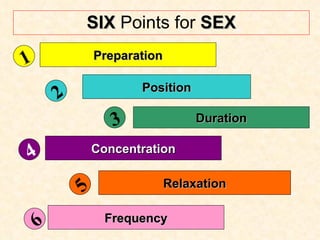
SIX  Points for  SEX Preparation Position Duration Concentration Relaxation 3 2 1 4 5 Frequency 6
Gender Differences in Desire and Erotic Stimuli   Sexual impulses and desire exist both in men and women but males generally possess a  higher baseline level of desire  than do women  Men respond sexually to  visual stimuli  of nude or barely dressed women.  Women report responding sexually to  romantic stories with a tender, demonstrative hero  whose passion for the heroine impels him toward a lifetime commitment to her .
Gender Differences in Desire and Erotic Stimuli Contd. Woman's subjective sense of arousal is  not always congruent with her physiological state  of arousal.  Women’s sense of excitement may  reflect a readiness to be aroused  rather than physiological lubrication. Conversely, she may experience the  physical signs of arousal without being aware  of them.  This situation rarely occurs in men .
Love and Intimacy   Freud postulated that psychological health could be determined by a person's ability to function well in two spheres,  work and love .  A person able to give and receive love  with a minimum of fear and conflict  has the capacity to develop genuinely intimate relationships with others. Sex frequently acts as a  catalyst  in  forming  and  maintaining   intimate relationships.
Frequency of sexual activity Zero (sexual abstinence)  to  15-20  times/week The average frequency of sexual intercourse for married couples in USA is  2 to 3  times /week  It is generally recognized that postmenopausal women experience  declines in frequency  of sexual intercourse Average frequency of intercourse  declines with age  in both men and women.
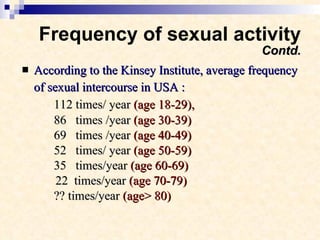
Frequency of sexual activity Contd. According to the Kinsey Institute, average frequency of sexual intercourse in USA :   112 times/ year  (age 18-29),  86  times /year  (age 30-39) 69  times /year  (age 40-49) 52  times/ year  (age 50-59) 35  times/year  (age 60-69)   22  times/year  (age 70-79) ?? times/year  (age> 80)
Conclusion Human sexuality is a very complex and multi-dimensional behavior that is affected by many facets of our lives including anatomy, physiology, cognition, and learning. As well as influenced by culture, ethnicity and even economy and politics.
Conclusion   Contd. Sex Education is very much needed in every society- specially in the school curriculum- otherwise faulty learning about sex  misguided one’s personal life and may produce many sexual as well as psycho-social problem. Accepted Sex-education from Scientific authority .
 
Why should we take advice on sex from the pope?  If he knows anything about it, he shouldn't!   --George Bernard Shaw
THANK YOU

Normal Sexuality

  • 1.
    Normal SexualityBy Dr. Helal Uddin Ahmed MD-Part-II Student Department of Psychiatry BSMMU
  • 2.
    A dirty bookis rarely dusty
  • 3.
    Introduction of Humansexuality It is the process by which people experience and express themselves as sexual beings. Sexuality has been a consistent focus of curiosity, interest, and analysis to humankind.
  • 4.
    Introduction of Humansexuality Contd. Sexuality is determined by anatomy, physiology , the culture in which a person lives , relationships with others , and developmental experiences throughout the life cycle . It includes the perception of being male or female and private thoughts and fantasies as well as behavior . Normal sexual behavior brings pleasure to oneself and one's partner , involves stimulation of the primary sex organs including coitus
  • 5.
    Introduction of Humansexuality Contd. Normal sexuality is devoid of inappropriate feelings of guilt or anxiety and is not compulsive. Recreational VS Relational sex- Masturbation, Various forms of stimulation sex organs, Getting sexual gratification by several ways etc.
  • 6.
    Aspects of sexualbehavior Philosophical Sociological Psychological Anatomical Physiological Cognitive Learning Cultural Political Legal Moral Ethical Theological Spiritual Religious
  • 7.
    Primary sex organs-Reproductive organs Secondary sexual characteristics and organs Nervous system, Endocrine system Anatomical Perspective
  • 8.
    Physiological Perspective Actionof Neurotransmitter Actions of Hormones Sexual drive
  • 9.
    Cognitive Perspective Howa stimulus or situation is interpreted determines how the individual will respond to the stimulus Perception includes at least three components: detection, labeling, and attribution. Detection is defined by an individual's ability to note the presence of a stimulus or to discriminate it from other stimuli. Labeling is the descriptors that an individual uses to categorize the stimulus event. Attribution is an explanation for the perception
  • 10.
    Cognitive Perspective Contd. Another cognitive factor is evaluation ; when an individual evaluates a sexual stimulus as good or positive, sexual arousal may be enhanced. On the other hand, when a stimulus is evaluated negatively, sexuality will be diminished
  • 11.
    Learning Perspective Learningtheory postulates the environmental factors that shape sexual behavior When sexual activity is pleasurable - it reinforced If sexual activity is restricted, punishable or full of shame then people may come to associate sexual stimulation with feelings of guilt or anxiety Observational learning of sexual behavior.
  • 12.
    Boccadoro L., CarulliS. Italian Mentors “ Human sexuality is not simply imposed by instinct or stereotypical conducts, as it happens in animals, but it is influenced both by superior mental activity and by social, cultural, educational and normative characteristics of those places where the subjects grow up and their personality develops. Consequently, the analysis of sexual sphere must be based on the convergence of several lines of development such as affectivity, emotions and relations .”
  • 13.
    Sigmund Freud ThreeEssays on the Theory of Sexuality Psychosexual development Oral stage, Anal Stage, Phallic Stage, Genital Stage Oedipus complex Sexual etiology of neuroses, Libido developed in individuals by changing its object, a process codified by the concept of sublimation Generalization that all pleasurable impulses and activities are originally sexual .
  • 14.
    Michel Foucault Sexualityare the activities and sensations determined historically, regionally and culturally. The construction of sexual meanings, is an instrumen t by which social institutions (religion, marketing, the educational system, psychiatry, etc.) control and shape human relationship.
  • 15.
    Sexual ethics andlegality Unlike some other sexual activities, vaginal intercourse has rarely been made Taboo on religious grounds or by law. Many of the cultures that had prohibited sexual intercourse entirely – Shakers, Roman Catholic Church, Mahayana Buddhist Monks.
  • 16.
    Sexual ethics andlegality Contd. Masturbation ( Auto-erotic sexuality) Fornication or Live-together Adultery or Extramarital sex Homosexuality- Gay, Lesbian Commercial sex or Prostitution Necrophilia (sex with dead body) Incest Child sexual abuse/Pedophilia Bestiality Sexual intercourse during a woman's menstrual period, as prohibited in Islam and Judaism Sex between members of different tribes / same cast Public decency (exhibitionism and voyeurism) Forceful Sex Rape Sexual assault Statutory Rape Lust Murder
  • 17.
    Function of sexReproduction
  • 18.
    Benefits of SEX beyond reproduction
  • 19.
    Health benefit ofsex Relieves stress
  • 20.
    Health benefit ofsex Contd. Boosts the immune system by  Ig A
  • 21.
    Health benefit ofsex Contd. Improves CVS ( Lower BP)
  • 22.
    Health benefit ofsex Contd.  Self esteem
  • 23.
    Health benefit ofsex Contd. Improves intimacy with partner
  • 24.
    Health benefit ofsex Contd. Reduce pain (+) oxytocin
  • 25.
    Health benefit ofsex Contd.  Risk of prostate cancer
  • 26.
    Health benefit ofsex Contd. Strengthens pelvic muscles
  • 27.
    Health benefit ofsex Contd. Promotes good sleep
  • 28.
    Health benefit ofsex Contd. Improves the sense of smell
  • 29.
    Health benefit ofsex Contd. Improves urinary bladder control
  • 30.
    Sexual Identity andGender Identity Sexual identity is the pattern of a person's biological sexual characteristics : chromosomes, external genitalia, internal genitalia, hormonal composition, gonads, and secondary sex characteristics. Gender identity is a person's sense of maleness or femaleness.
  • 31.
    Sexual Orientation Sexualorientation describes the object of a person's sexual impulses: - Heterosexual (opposite sex), - Homosexual (same sex), - Bisexual (both sexes). - Transexuality (desire to be a member of the opposite sex) A group of people have defined themselves as “ asexual ” and assert this as a positive identity. Some researchers believe this lack of attraction to any object is a manifestation of a desire disorder.
  • 32.
    Sexual Behavior :Role of the Central Nervous System Cortex : controlling sexual impulses and processing sexual stimuli that may lead to sexual activity . Orbitofrontal cortex- emotions Left anterior cingulate cortex- hormone control and sexual arousal Right caudate nucleus- sexual activity follows arousal
  • 33.
    Sexual Behavior :Role of the Central Nervous System Limbic System : Chemical or electrical stimulation of the lower part of the septum and the contiguous preoptic area , the fimbria of the hippocampus , the mammilary bodies , and the anterior thalamic nuclei have all elicited penile erections in male. In case of female those area are related with orgasm .
  • 34.
    Sexual Behavior :Role of the Central Nervous System Brainstem : Exert inhibitory and excitatory control over spinal sexual reflexes. The nucleus paragigantocellularis projects directly to pelvic efferent neurons in the lumbosacral spinal cord, apparently causing them to secrete serotonin, which is known to inhibit orgasms
  • 35.
    Sexual Behavior :Role of the Central Nervous System Neurotransmitters : dopamine, epinephrine, norepinephrine, and serotonin , are produced in the brain and affect sexual function. An increase in dopamine is presumed to increase libido. Serotonin, exerts an inhibitory effect on sexual function.
  • 36.
    Sexual Behavior :Role of the Central Nervous System Spinal Cord: Sexual arousal and climax are ultimately organized at the spinal level. Sensory stimuli related to sexual function are conveyed via afferents from the pudendal, pelvic, and hypogastric nerves
  • 37.
    Hormones and SexualBehavior Testosterone increases libido in both men and women Estrogen is a key factor in the lubrication involved in female arousal and may increase sensitivity in the woman to stimulation. Progesterone mildly depresses desire in men and women as do excessive prolactin and cortisol. Oxytocin is involved in pleasurable sensations during sex and is found in higher levels in men and women following orgasm. It reinforces pleasurable activities
  • 38.
    Physiological Responses Sexual response is a true psychophysiological experience. Arousal is triggered by both psychological and physical stimuli; Levels of tension are experienced both physiologically and emotionally
  • 39.
    Physiological Responses Contd. Psychosexual development Psychological attitudes toward sexuality Attitudes toward one's sexual partner These 3 are Directly involved with, and Affect, human sexual response.
  • 40.
    Physiological Responses Contd.William Masters and Virginia Johnson observed that the physiological process involves increasing levels of vasocongestion and myotonia (tumescence) and the subsequent release of the vascular activity and muscle tone as a result of orgasm (detumescence).
  • 41.
    Sexual Stimulation: ForeplayPsychological Stimulation -use of smell, taste, hearing, sight or fantasy Physical Stimulation- use of touch pressure or bodily contact 1. Erogenous zones 2. Kissing 3. Breast stimulation 4. Oral-genital stimulation 5. Anal stimulation 6. Manual stimulation of genitals
  • 42.
    Four-phase cycle ofPhysiological Responses Phase-1 Desire Orgasm Excitement Resolution Phase-2 Phase-3 Phase-4 Plateau phase
  • 43.
    Four-phase cycle ofPhysiological Responses The sequence of responses can overlap and fluctuate
  • 44.
    Phase 1: DesireThe desire (or appetitive) phase, identified solely through physiology, reflects the psychiatric concern with motivations , drives , and personality . The phase is characterized by sexual fantasies and the desire to have sexual activity .
  • 45.
    Phase 2: Excitement The excitement and arousal phase, brought on by psychological stimulation (fantasy or the presence of a love object) or physiological stimulation ( Foreplays-stroking or kissing) or a combination of the two, consists of a subjective sense of pleasure.
  • 46.
  • 47.
  • 48.
    Phase 3: Orgasm Peaking of sexual pleasure, Release of sexual tension Rhythmic contraction of the perineal muscles and the pelvic reproductive organs. A subjective sense of ejaculatory inevitability triggers men's orgasms. The forceful emission of semen. 4 to 5 rhythmic spasms of the prostate, seminal vesicles, vas, and urethra. In women, orgasm is characterized by 3 to 15 involuntary contractions of the lower third of the vagina and by strong sustained contractions of the uterus, flowing from the fundus downward to the cervix.
  • 49.
    Phase 4: ResolutionResolution consists of the disgorgement of blood from the genitalia (detumescence). Body back to its resting state. If orgasm occurs: resolution is rapid, a subjective sense of well-being, general and muscular relaxation. If orgasm does not occur : resolution may take from 2 to 6 hours and may be associated with irritability and discomfort. After orgasm, men have a refractory period (several minutes to many hours) when they cannot be stimulated to further orgasm. Women do not have a refractory period and are capable of multiple and successive orgasms.
  • 50.
  • 51.
  • 52.
  • 53.
    Male sexual responseAn individual man may experience any of these three patterns (A, B, or C) during a particular sexual experience.
  • 54.
    Female sexual responseAn individual woman may experience any of these three patterns (A, B, or C) during a particular sexual experience.
  • 55.
    Sexual Response Cycle 10 to 15 minutes; if no orgasm, ½ to 1 day 3 to 15 seconds Lasts several minutes to several hours; heightened excitement before orgasm, 30 seconds to 3 minutes Male & Female Resolution Phase Orgasmic Phase Excitement Phase
  • 56.
    Male Sexual ResponseCycle Erection: partial involution in 5 to 10 seconds with variable refractory period; full detumescence in 5 to 30 minutes Ejaculation ; emission phase marked by three to four 0.8-second contractions of vas, seminal vesicles, prostate; ejaculation proper marked by 0.8-second contractions of urethra and ejaculatory spurt of 12 to 20 inches at age 18, decreasing with age to seepage at 70 Erection in 10 to 30 seconds caused by vasocongestion of erectile bodies of corpus cavernosa of shaft; loss of erection may occur with introduction of asexual stimulus, loud noise; with heightened excitement, size of glands and diameter of penile shaft increase further Penis Flush disappears in reverse order of appearance; inconsistently appearing film of perspiration on soles of feet and palms of hands Well-developed flush Just before orgasm: sexual flush inconsistently appears; maculopapular rash originates on abdomen and spreads to anterior chest wall, face, and neck and can include shoulders and forearms Skin Resolution Phase Orgasmic Phase Excitement Phase Organ
  • 57.
    Male Sexual ResponseCycle Contd No change No change 2 to 3 drops of mucoid fluid that contain viable sperm are secreted during heightened excitement Cowper's glands Decrease to baseline size because of loss of vasocongestion; testicular and scrotal descent within 5 to 30 minutes after orgasm; involution may take several hours if no orgasmic release takes place No change Tightening and lifting of scrotal sac and elevation of testes; with heightened excitement, 50% increase in size of testes over unstimulated state and flattening against perineum, signaling impending ejaculation Scrotum and testes
  • 58.
    Male Sexual ResponseCycle Contd Loss of voluntary muscular control Rectum: rhythmical contractions of sphincter Heart rate: up to 180 beats a minute Blood pressure: up to 40 to 100 mm systolic; 20 to 50 mm diastolic Respiration: up to 40 respirations a minute Breasts: inconsistent nipple erection with heightened excitement before orgasm Myotonia: semispastic contractions of facial, abdominal, and intercostal muscles Tachycardia: up to 175 beats a minute Blood pressure : rise in systolic 20 to 80 mm; in diastolic 10 to 40 mm Respiration: increased Other
  • 59.
    Female Sexual ResponseCycle Shaft returns to normal position in 5 to 10 seconds; detumescence in 5 to 30 minutes; if no orgasm, detumescence takes several hours No change Enlargement in diameter of glands and shaft; just before orgasm, shaft retracts into prepuce Clitoris Return to normal in about 30 minutes Breasts may become tremulous Nipple erection in two thirds of women, venous congestion and areolar enlargement; size increases to one fourth over normal Breasts Flush disappears in reverse order of appearance; inconsistently appearing film of perspiration on soles of feet and palms of hands Well-developed flush Just before orgasm: sexual flush inconsistently appears; maculopapular rash originates on abdomen and spreads to anterior chest wall, face, and neck; can include shoulders and forearms Skin Resolution Phase Orgasmic Phase Excitement Phase Organ
  • 60.
    Female Sexual ResponseCycle Contd Ejaculate forms seminal pool in upper two thirds of vagina; congestion disappears in seconds or, if no orgasm, in 20 to 30 minutes 3 to 15 contractions of lower third of vagina at intervals of 0.8 second Color change to dark purple; vaginal transudate appears 10 to 30 seconds after arousal; elongation and ballooning of vagina; lower third of vagina constricts before orgasm Vagina Return to normal within 5 minutes Contractions of proximal labia minora Size increased two to three times over normal; change to pink, red, deep red before orgasm Labia minora Nullipara: decrease to normal size in 1 to 2 minutes Multipara: decrease to normal size in 10 to 15 minutes No change Nullipara: elevate and flatten against perineum Multipara: congestion and edema Labia majora
  • 61.
    Female Sexual ResponseCycle Contd Return to baseline status in seconds to minutes Cervix color and size return to normal , and cervix descends into seminal pool Loss of voluntary muscular Control Rectum: rhythmical contractions of sphincter Hyperventilation and tachycardia Myotonia: A few drops of mucoid secretion from Bartholin's glands during heightened excitement Cervix swells slightly and is passively elevated with uterus Other Contractions cease , and uterus descends to normal position Contractions throughout orgasm Ascends into false pelvis ; labor-like contractions begin in heightened excitement just before orgasm Uterus
  • 62.
    SIX Pointsfor SEX Preparation Position Duration Concentration Relaxation 3 2 1 4 5 Frequency 6
  • 63.
    Gender Differences inDesire and Erotic Stimuli Sexual impulses and desire exist both in men and women but males generally possess a higher baseline level of desire than do women Men respond sexually to visual stimuli of nude or barely dressed women. Women report responding sexually to romantic stories with a tender, demonstrative hero whose passion for the heroine impels him toward a lifetime commitment to her .
  • 64.
    Gender Differences inDesire and Erotic Stimuli Contd. Woman's subjective sense of arousal is not always congruent with her physiological state of arousal. Women’s sense of excitement may reflect a readiness to be aroused rather than physiological lubrication. Conversely, she may experience the physical signs of arousal without being aware of them. This situation rarely occurs in men .
  • 65.
    Love and Intimacy Freud postulated that psychological health could be determined by a person's ability to function well in two spheres, work and love . A person able to give and receive love with a minimum of fear and conflict has the capacity to develop genuinely intimate relationships with others. Sex frequently acts as a catalyst in forming and maintaining intimate relationships.
  • 66.
    Frequency of sexualactivity Zero (sexual abstinence) to 15-20 times/week The average frequency of sexual intercourse for married couples in USA is 2 to 3 times /week It is generally recognized that postmenopausal women experience declines in frequency of sexual intercourse Average frequency of intercourse declines with age in both men and women.
  • 67.
    Frequency of sexualactivity Contd. According to the Kinsey Institute, average frequency of sexual intercourse in USA : 112 times/ year (age 18-29), 86 times /year (age 30-39) 69 times /year (age 40-49) 52 times/ year (age 50-59) 35 times/year (age 60-69) 22 times/year (age 70-79) ?? times/year (age> 80)
  • 68.
    Conclusion Human sexualityis a very complex and multi-dimensional behavior that is affected by many facets of our lives including anatomy, physiology, cognition, and learning. As well as influenced by culture, ethnicity and even economy and politics.
  • 69.
    Conclusion Contd. Sex Education is very much needed in every society- specially in the school curriculum- otherwise faulty learning about sex misguided one’s personal life and may produce many sexual as well as psycho-social problem. Accepted Sex-education from Scientific authority .
  • 70.
  • 71.
    Why should wetake advice on sex from the pope?  If he knows anything about it, he shouldn't!  --George Bernard Shaw
  • 72.