Tmo gynae c unit
LRH
Defination
Significance
Background
Incidence
Antenatal screening
First trimester screening
Second trimester screening
Down syndrome
Conclusion
Take home message
The detection of abnormalities in the fetus, before
birth’
Screening is the process of surveying a population,
using a specific marker or markers to identify the
individuals in the population at higher risk for a
particular disorder.
 The purpose of prenatal diagnosis is not
simply to detect abnormalities in fetal life
and allow termination.It rather have
following goals :
 Provides information.
 Provide reassurance & remove anxiety.
 Confirmatory testing.
 Plan for appropriate management .
 Prenatal treatment of the fetus.
 Routinely offered.
 Always explain pros and cons.
 High prevalence in the population.
 Knowledge about the disease and its progression.
 Highly sensitive and specific.
 Acceptable to population.
 Availability of other diagnostic test.
 Problem solution.
 Cost effective.
 National screening programmes were first
introduced in UK 1996 and these includes :-
 Screening for down syndrome.
 Fetal anomaly screening.
 Screening for sickle cell anemia and
thalassaemia.
 Screening for infectious diseases.
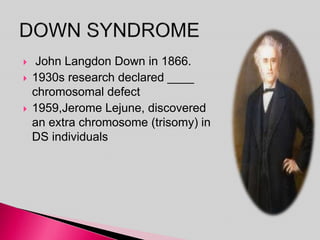
 John Langdon Down in 1866.
 1930s research declared ____
chromosomal defect
 1959,Jerome Lejune, discovered
an extra chromosome (trisomy) in
DS individuals
 Down syndrome is a chromosomal disorder.
 Error in cell division, the likelihood of such an
error occuring increases with maternal age.
 This means that an older mother is more likely
to give birth to a child with Down syndrome than
her younger counterpart.
 The likelihood of a woman under 30 years of
age giving birth to a child with Down syndrome
is less than 1:1000, but increases the older the
woman gets , with an incidence of about 1:100
and 1:30 at 40 and 45 years of age respectively.
 6000 infants/year are born with down
syndrome
 1979-2010 incidence is increased by
30%
 In 2010,_____USA was about 250,700.
 Genetic testing is on increase
 5.3% of pregnancies with DS are conti…
 90% of pregnancies e DS terminated in New
Zealand
 92% in USA
 93% in UK
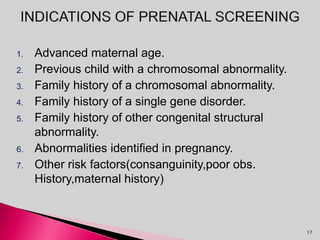
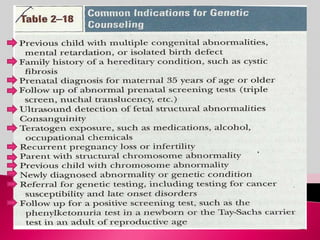
1. Advanced maternal age.
2. Previous child with a chromosomal abnormality.
3. Family history of a chromosomal abnormality.
4. Family history of a single gene disorder.
5. Family history of other congenital structural
abnormality.
6. Abnormalities identified in pregnancy.
7. Other risk factors(consanguinity,poor obs.
History,maternal history)
17
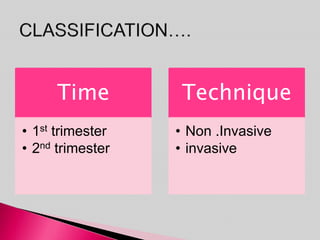
Time
• 1st trimester
• 2nd trimester
Technique
• Non .Invasive
• invasive
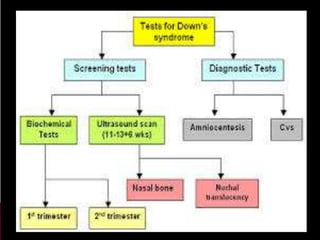
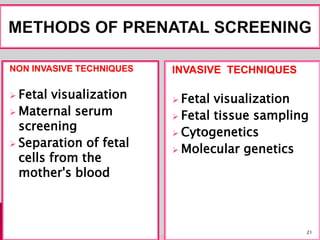
NON INVASIVE TECHNIQUES
 Fetal visualization
 Maternal serum
screening
 Separation of fetal
cells from the
mother's blood
INVASIVE TECHNIQUES
 Fetal visualization
 Fetal tissue sampling
 Cytogenetics
 Molecular genetics
21
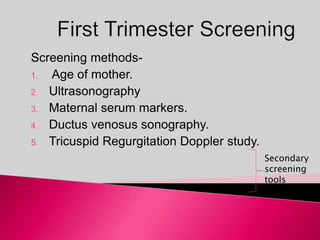
Screening methods-
1. Age of mother.
2. Ultrasonography
3. Maternal serum markers.
4. Ductus venosus sonography.
5. Tricuspid Regurgitation Doppler study.
Secondary
screening
tools
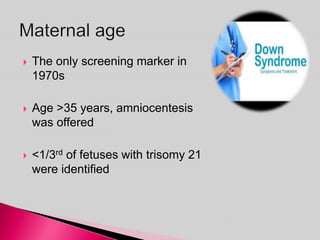
 The only screening marker in
1970s
 Age >35 years, amniocentesis
was offered
 <1/3rd of fetuses with trisomy 21
were identified
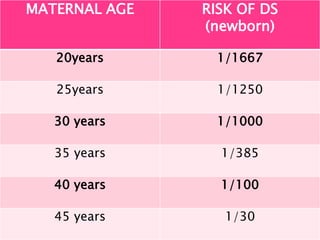
MATERNAL AGE RISK OF DS
(newborn)
20years 1/1667
25years 1/1250
30 years 1/1000
35 years 1/385
40 years 1/100
45 years 1/30
ULTRASONOGRAPHY :
The developing embryo can first be visualized at
about 6 weeks gestation.
Recognition of the major internal organs &
extremities to determine if any are abnormal can
best be accomplished between 16 to 20 weeks
gestation.
25
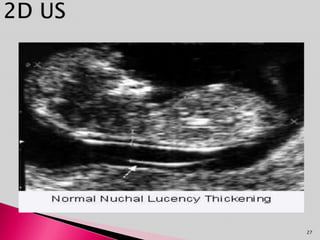
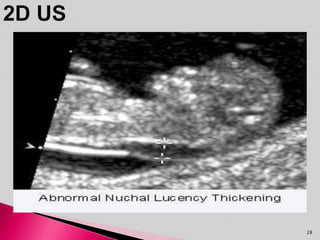
• Nuchal Translucency(NT) refers to the normal
subcutaneous fluid filled space between the back of
the neck and underlying skin.
27
28
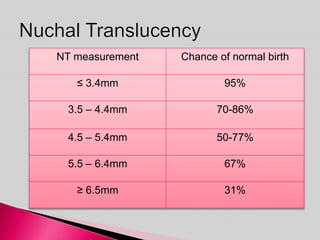
NT measurement Chance of normal birth
≤ 3.4mm 95%
3.5 – 4.4mm 70-86%
4.5 – 5.4mm 50-77%
5.5 – 6.4mm 67%
≥ 6.5mm 31%
 Trisomies 21, 18, 13.
 Spontaneous fetal loss
 Cardiac defects, diaphragmatic hernia,
pulmonary defects.
 skeletal dysplasias, congenital infection.
 Normal pregnancy .
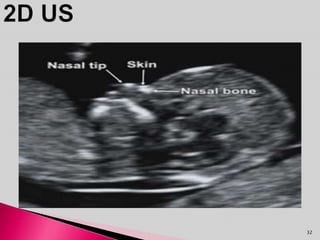
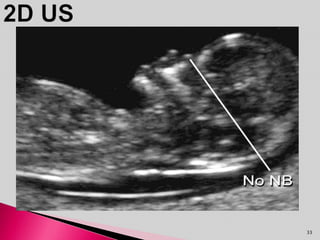
 Absent nasal bone on USG done at 11 to 13
weeks is another marker of Downs syndrome.
 Absence of Nasal bone is not related to NT
and can be combined in one scan.
 Detection rate of DS is 67%.
 When combined with NT detection rate is 90%.
32
33
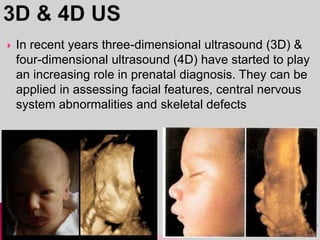
 In recent years three-dimensional ultrasound (3D) &
four-dimensional ultrasound (4D) have started to play
an increasing role in prenatal diagnosis. They can be
applied in assessing facial features, central nervous
system abnormalities and skeletal defects
34
 Findings are based upon views of the fetus, the
estimated gestational age, sonographer
experience, & the degree of anomaly severity.
35
• Congenital heart lesions as early as 17-19 wk of gestation.
• When this technique is used with duplex or color flow
Doppler,
it can identify a number of major structural cardiac defects &
• rhythm.
• 59% to 93% of aneuploid fetus has abnormal ductus
venosus flow.
• Down syndrome detection rate during 11 to 13 weeks is
68% alone.
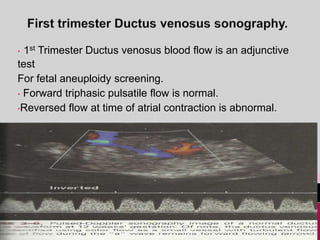
• 1st Trimester Ductus venosus blood flow is an adjunctive
test
For fetal aneuploidy screening.
• Forward triphasic pulsatile flow is normal.
•Reversed flow at time of atrial contraction is abnormal.
• Abnormal tricuspid regurgitation in 1st trimester is
associated with fetal aneupoidy.
• TR ______ if a regurgitant jet of at least 60cm/sec is
noted extending to over half of systole.
• Down syndrome detection rate during 11 to 13 weeks is
68% alone.
• Not recommended for routine screening.
• Has a role as second line screening test with detection
rate of 92%.
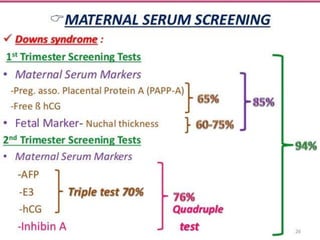
 Maternal serum screening is used to identify women at
increased risk of having a child with trisomies 18 or 21
or and open neural tube defect (NTD), while posing no
risk to the pregnancy.
 Screening in the first trimester involves the
measurement of PAPP & free b HCG levels in
maternal serum.
39
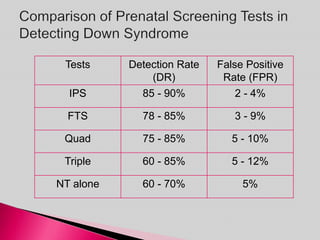
Tests Detection Rate
(DR)
False Positive
Rate (FPR)
IPS 85 - 90% 2 - 4%
FTS 78 - 85% 3 - 9%
Quad 75 - 85% 5 - 10%
Triple 60 - 85% 5 - 12%
NT alone 60 - 70% 5%
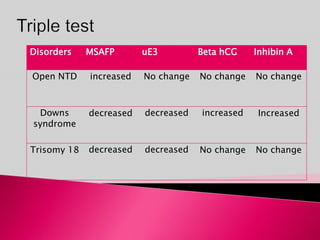
Disorders MSAFP uE3 Beta hCG Inhibin A
Open NTD increased No change No change No change
Downs
syndrome
decreased decreased increased Increased
Trisomy 18 decreased decreased No change No change
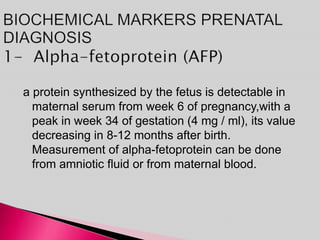
a protein synthesized by the fetus is detectable in
maternal serum from week 6 of pregnancy,with a
peak in week 34 of gestation (4 mg / ml), its value
decreasing in 8-12 months after birth.
Measurement of alpha-fetoprotein can be done
from amniotic fluid or from maternal blood.
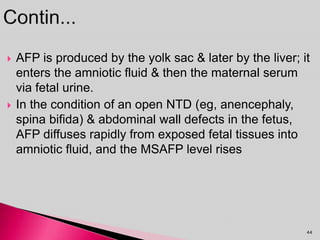
 AFP is produced by the yolk sac & later by the liver; it
enters the amniotic fluid & then the maternal serum
via fetal urine.
 In the condition of an open NTD (eg, anencephaly,
spina bifida) & abdominal wall defects in the fetus,
AFP diffuses rapidly from exposed fetal tissues into
amniotic fluid, and the MSAFP level rises
44
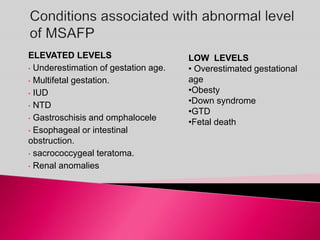
ELEVATED LEVELS
• Underestimation of gestation age.
• Multifetal gestation.
• IUD
• NTD
• Gastroschisis and omphalocele
• Esophageal or intestinal
obstruction.
• sacrococcygeal teratoma.
• Renal anomalies
LOW LEVELS
• Overestimated gestational
age
•Obesty
•Down syndrome
•GTD
•Fetal death
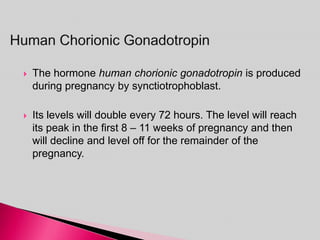
 The hormone human chorionic gonadotropin is produced
during pregnancy by synctiotrophoblast.
 Its levels will double every 72 hours. The level will reach
its peak in the first 8 – 11 weeks of pregnancy and then
will decline and level off for the remainder of the
pregnancy.
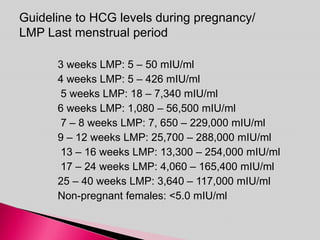
3 weeks LMP: 5 – 50 mIU/ml
4 weeks LMP: 5 – 426 mIU/ml
5 weeks LMP: 18 – 7,340 mIU/ml
6 weeks LMP: 1,080 – 56,500 mIU/ml
7 – 8 weeks LMP: 7, 650 – 229,000 mIU/ml
9 – 12 weeks LMP: 25,700 – 288,000 mIU/ml
13 – 16 weeks LMP: 13,300 – 254,000 mIU/ml
17 – 24 weeks LMP: 4,060 – 165,400 mIU/ml
25 – 40 weeks LMP: 3,640 – 117,000 mIU/ml
Non-pregnant females: <5.0 mIU/ml
Guideline to HCG levels during pregnancy/
LMP Last menstrual period
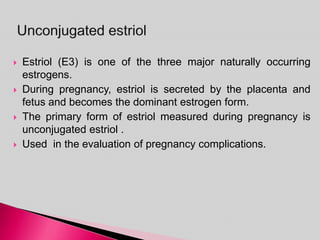
 Estriol (E3) is one of the three major naturally occurring
estrogens.
 During pregnancy, estriol is secreted by the placenta and
fetus and becomes the dominant estrogen form.
 The primary form of estriol measured during pregnancy is
unconjugated estriol .
 Used in the evaluation of pregnancy complications.
 Glycoprotein hormones .
 Its a better marker of placental function than hcG
because of its shorter half-life.
 The measurement of inhibin A in early pregnancy could
be in predicting miscarriage, Down's syndrome,
preeclampsia, and fetal growth restriction in the first
and/or second trimester.
 It largest proteins produced by both the embryo and the
placenta.
 This protein have several different functions, including
preventing recognition of the fetus by the maternal immune
system, matrix mineralization and angiogenesis.
 Detection of this protein helps in first and second trimester
diagnostic test for aneuploidies, including Trisomies 21 or
Down’s Syndrome
 It involves isolating fetal cells from maternal blood
to analyse fetal chromosomes and/or DNA.
Ordinarily, only a very small number of fetal cells
enter the maternal circulation; but once they
enter,can be readily identified.
 These cells can be collected safely from
approximately 12-18 weeks' gestation onward.
51
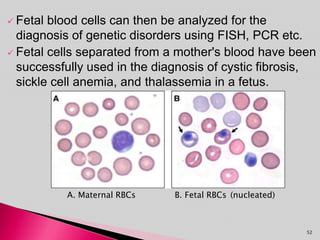
 Fetal blood cells can then be analyzed for the
diagnosis of genetic disorders using FISH, PCR etc.
 Fetal cells separated from a mother's blood have been
successfully used in the diagnosis of cystic fibrosis,
sickle cell anemia, and thalassemia in a fetus.
A. Maternal RBCs B. Fetal RBCs (nucleated)
52
Invasive
• Amniocentesis
• Chorionic villous sampling
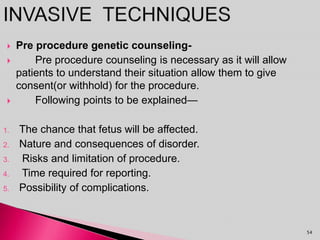
 Pre procedure genetic counseling-
 Pre procedure counseling is necessary as it will allow
patients to understand their situation allow them to give
consent(or withhold) for the procedure.
 Following points to be explained—
1. The chance that fetus will be affected.
2. Nature and consequences of disorder.
3. Risks and limitation of procedure.
4. Time required for reporting.
5. Possibility of complications.
54
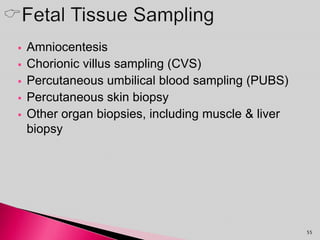
 Amniocentesis
 Chorionic villus sampling (CVS)
 Percutaneous umbilical blood sampling (PUBS)
 Percutaneous skin biopsy
 Other organ biopsies, including muscle & liver
biopsy
55
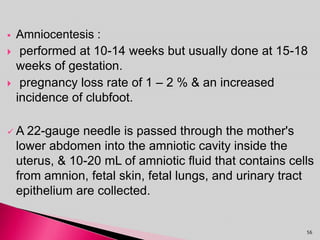
 Amniocentesis :
 performed at 10-14 weeks but usually done at 15-18
weeks of gestation.
 pregnancy loss rate of 1 – 2 % & an increased
incidence of clubfoot.
 A 22-gauge needle is passed through the mother's
lower abdomen into the amniotic cavity inside the
uterus, & 10-20 mL of amniotic fluid that contains cells
from amnion, fetal skin, fetal lungs, and urinary tract
epithelium are collected.
56
1. The Cells are grown in culture for chromosomal, biochemical,
& molecular biologic analyses.
2. The Supernatant amniotic fluid is used for the
measurement of substances such as AFP, AChE,bilirubin &
pulmonary surfactant
3. In the third trimester of pregnancy, the amniotic fluid can be
analyzed for determination of fetal lung maturity.
 The results of cytogenetic and biochemical
studies on amniotic cell cultures are more than
90% accurate.
57
 Under USG guidance, a sample of placental tissue is
obtained through a catheter places either
transcervically or transabdominally.
 Performed at or after 10 wks’ gestation,
 CVS provides the earliest possible detection of a
genetically abnormal fetus through analysis of
trophoblast cells.
58
 Transabdominal CVS can also be used as late
as the 3rd trimester when amniotic fluid is not
available or when fetal blood sampling cannot
be performed.
 CVS, if preformed before 10 wks’ gestation , can
be ass. with an increased risk of fetal limb
reduction defects & oromandibular
malformations.
 Direct preparations of rapidly dividing cytotrophoblasts
can be prepared, making a full karyotype analysis
available in 2 days.
 Although direct preparation minimize maternal cell
contamination, most centers also analyse cultured
trophoblast cells, which are embryologically closer to
the fetus.This procedure takes 8 – 12 days.
60
 In approximately 2% of CVS samples, both
karyotypically normal & abnormal cells are
identified. Because CVS acquired cells reflect
placental constitution, in these cases,
amniocentesis is typically performed as a
followup study to analyze fetal cells.
Approximatally 1/3rd of CVS mosaicisms are
confirmed in the fetus through amniocentesis.
 Chromosome Analysis ( Karyotype
Analysis )
 Fluorescence in situ Hybridization
(FISH)
62
Direct DNA Analysis
Linkage Analysis(indirect DNA analysis)
DNA Sequencing
63
 In the most situations the diagnosis of prenatal
abnormalities has a subsequent option of
termination of the pregnancy.
 While this applies in most situations, there is
cautious optimism that with the advent of gene
therapy prenatal diagnosis will, in time, lead to
effective treatment in utero.
64
• Clinical Genetics is the discipline concerned with the
diagnosis and management of the medical, social,
and psychological aspect of hereditary diseases.
• Genetic counseling is an integral part of genetic
testing /prenatal Testing.
• The process of genetic counseling involves
components like
1)validation of diagnosis
2)obtaining the family history,
3)estimation of risk of recurrence
4)and by all these helping the family to reach
decisions and take appropriate action and follow up.
• Nondirective counseling is adopted as standard, In
this patients are not told what decision to make with
regards to testing and management options but,
instead, are provided information and support.
screening for down syndrome

screening for down syndrome

  • 2.
    Tmo gynae cunit LRH
  • 4.
    Defination Significance Background Incidence Antenatal screening First trimesterscreening Second trimester screening Down syndrome Conclusion Take home message
  • 5.
    The detection ofabnormalities in the fetus, before birth’ Screening is the process of surveying a population, using a specific marker or markers to identify the individuals in the population at higher risk for a particular disorder.
  • 6.
     The purposeof prenatal diagnosis is not simply to detect abnormalities in fetal life and allow termination.It rather have following goals :
  • 7.
     Provides information. Provide reassurance & remove anxiety.  Confirmatory testing.  Plan for appropriate management .  Prenatal treatment of the fetus.  Routinely offered.  Always explain pros and cons.
  • 8.
     High prevalencein the population.  Knowledge about the disease and its progression.  Highly sensitive and specific.  Acceptable to population.  Availability of other diagnostic test.  Problem solution.  Cost effective.
  • 9.
     National screeningprogrammes were first introduced in UK 1996 and these includes :-  Screening for down syndrome.  Fetal anomaly screening.  Screening for sickle cell anemia and thalassaemia.  Screening for infectious diseases.
  • 10.
     John LangdonDown in 1866.  1930s research declared ____ chromosomal defect  1959,Jerome Lejune, discovered an extra chromosome (trisomy) in DS individuals
  • 12.
     Down syndromeis a chromosomal disorder.  Error in cell division, the likelihood of such an error occuring increases with maternal age.  This means that an older mother is more likely to give birth to a child with Down syndrome than her younger counterpart.
  • 13.
     The likelihoodof a woman under 30 years of age giving birth to a child with Down syndrome is less than 1:1000, but increases the older the woman gets , with an incidence of about 1:100 and 1:30 at 40 and 45 years of age respectively.
  • 15.
     6000 infants/yearare born with down syndrome  1979-2010 incidence is increased by 30%  In 2010,_____USA was about 250,700.
  • 16.
     Genetic testingis on increase  5.3% of pregnancies with DS are conti…  90% of pregnancies e DS terminated in New Zealand  92% in USA  93% in UK
  • 17.
    1. Advanced maternalage. 2. Previous child with a chromosomal abnormality. 3. Family history of a chromosomal abnormality. 4. Family history of a single gene disorder. 5. Family history of other congenital structural abnormality. 6. Abnormalities identified in pregnancy. 7. Other risk factors(consanguinity,poor obs. History,maternal history) 17
  • 18.
    Time • 1st trimester •2nd trimester Technique • Non .Invasive • invasive
  • 21.
    NON INVASIVE TECHNIQUES Fetal visualization  Maternal serum screening  Separation of fetal cells from the mother's blood INVASIVE TECHNIQUES  Fetal visualization  Fetal tissue sampling  Cytogenetics  Molecular genetics 21
  • 22.
    Screening methods- 1. Ageof mother. 2. Ultrasonography 3. Maternal serum markers. 4. Ductus venosus sonography. 5. Tricuspid Regurgitation Doppler study. Secondary screening tools
  • 23.
     The onlyscreening marker in 1970s  Age >35 years, amniocentesis was offered  <1/3rd of fetuses with trisomy 21 were identified
  • 24.
    MATERNAL AGE RISKOF DS (newborn) 20years 1/1667 25years 1/1250 30 years 1/1000 35 years 1/385 40 years 1/100 45 years 1/30
  • 25.
    ULTRASONOGRAPHY : The developingembryo can first be visualized at about 6 weeks gestation. Recognition of the major internal organs & extremities to determine if any are abnormal can best be accomplished between 16 to 20 weeks gestation. 25
  • 26.
    • Nuchal Translucency(NT)refers to the normal subcutaneous fluid filled space between the back of the neck and underlying skin.
  • 27.
  • 28.
  • 29.
    NT measurement Chanceof normal birth ≤ 3.4mm 95% 3.5 – 4.4mm 70-86% 4.5 – 5.4mm 50-77% 5.5 – 6.4mm 67% ≥ 6.5mm 31%
  • 30.
     Trisomies 21,18, 13.  Spontaneous fetal loss  Cardiac defects, diaphragmatic hernia, pulmonary defects.  skeletal dysplasias, congenital infection.  Normal pregnancy .
  • 31.
     Absent nasalbone on USG done at 11 to 13 weeks is another marker of Downs syndrome.  Absence of Nasal bone is not related to NT and can be combined in one scan.  Detection rate of DS is 67%.  When combined with NT detection rate is 90%.
  • 32.
  • 33.
  • 34.
     In recentyears three-dimensional ultrasound (3D) & four-dimensional ultrasound (4D) have started to play an increasing role in prenatal diagnosis. They can be applied in assessing facial features, central nervous system abnormalities and skeletal defects 34
  • 35.
     Findings arebased upon views of the fetus, the estimated gestational age, sonographer experience, & the degree of anomaly severity. 35
  • 36.
    • Congenital heartlesions as early as 17-19 wk of gestation. • When this technique is used with duplex or color flow Doppler, it can identify a number of major structural cardiac defects & • rhythm. • 59% to 93% of aneuploid fetus has abnormal ductus venosus flow. • Down syndrome detection rate during 11 to 13 weeks is 68% alone.
  • 37.
    • 1st TrimesterDuctus venosus blood flow is an adjunctive test For fetal aneuploidy screening. • Forward triphasic pulsatile flow is normal. •Reversed flow at time of atrial contraction is abnormal.
  • 38.
    • Abnormal tricuspidregurgitation in 1st trimester is associated with fetal aneupoidy. • TR ______ if a regurgitant jet of at least 60cm/sec is noted extending to over half of systole. • Down syndrome detection rate during 11 to 13 weeks is 68% alone. • Not recommended for routine screening. • Has a role as second line screening test with detection rate of 92%.
  • 39.
     Maternal serumscreening is used to identify women at increased risk of having a child with trisomies 18 or 21 or and open neural tube defect (NTD), while posing no risk to the pregnancy.  Screening in the first trimester involves the measurement of PAPP & free b HCG levels in maternal serum. 39
  • 41.
    Tests Detection Rate (DR) FalsePositive Rate (FPR) IPS 85 - 90% 2 - 4% FTS 78 - 85% 3 - 9% Quad 75 - 85% 5 - 10% Triple 60 - 85% 5 - 12% NT alone 60 - 70% 5%
  • 42.
    Disorders MSAFP uE3Beta hCG Inhibin A Open NTD increased No change No change No change Downs syndrome decreased decreased increased Increased Trisomy 18 decreased decreased No change No change
  • 43.
    a protein synthesizedby the fetus is detectable in maternal serum from week 6 of pregnancy,with a peak in week 34 of gestation (4 mg / ml), its value decreasing in 8-12 months after birth. Measurement of alpha-fetoprotein can be done from amniotic fluid or from maternal blood.
  • 44.
     AFP isproduced by the yolk sac & later by the liver; it enters the amniotic fluid & then the maternal serum via fetal urine.  In the condition of an open NTD (eg, anencephaly, spina bifida) & abdominal wall defects in the fetus, AFP diffuses rapidly from exposed fetal tissues into amniotic fluid, and the MSAFP level rises 44
  • 45.
    ELEVATED LEVELS • Underestimationof gestation age. • Multifetal gestation. • IUD • NTD • Gastroschisis and omphalocele • Esophageal or intestinal obstruction. • sacrococcygeal teratoma. • Renal anomalies LOW LEVELS • Overestimated gestational age •Obesty •Down syndrome •GTD •Fetal death
  • 46.
     The hormonehuman chorionic gonadotropin is produced during pregnancy by synctiotrophoblast.  Its levels will double every 72 hours. The level will reach its peak in the first 8 – 11 weeks of pregnancy and then will decline and level off for the remainder of the pregnancy.
  • 47.
    3 weeks LMP:5 – 50 mIU/ml 4 weeks LMP: 5 – 426 mIU/ml 5 weeks LMP: 18 – 7,340 mIU/ml 6 weeks LMP: 1,080 – 56,500 mIU/ml 7 – 8 weeks LMP: 7, 650 – 229,000 mIU/ml 9 – 12 weeks LMP: 25,700 – 288,000 mIU/ml 13 – 16 weeks LMP: 13,300 – 254,000 mIU/ml 17 – 24 weeks LMP: 4,060 – 165,400 mIU/ml 25 – 40 weeks LMP: 3,640 – 117,000 mIU/ml Non-pregnant females: <5.0 mIU/ml Guideline to HCG levels during pregnancy/ LMP Last menstrual period
  • 48.
     Estriol (E3)is one of the three major naturally occurring estrogens.  During pregnancy, estriol is secreted by the placenta and fetus and becomes the dominant estrogen form.  The primary form of estriol measured during pregnancy is unconjugated estriol .  Used in the evaluation of pregnancy complications.
  • 49.
     Glycoprotein hormones.  Its a better marker of placental function than hcG because of its shorter half-life.  The measurement of inhibin A in early pregnancy could be in predicting miscarriage, Down's syndrome, preeclampsia, and fetal growth restriction in the first and/or second trimester.
  • 50.
     It largestproteins produced by both the embryo and the placenta.  This protein have several different functions, including preventing recognition of the fetus by the maternal immune system, matrix mineralization and angiogenesis.  Detection of this protein helps in first and second trimester diagnostic test for aneuploidies, including Trisomies 21 or Down’s Syndrome
  • 51.
     It involvesisolating fetal cells from maternal blood to analyse fetal chromosomes and/or DNA. Ordinarily, only a very small number of fetal cells enter the maternal circulation; but once they enter,can be readily identified.  These cells can be collected safely from approximately 12-18 weeks' gestation onward. 51
  • 52.
     Fetal bloodcells can then be analyzed for the diagnosis of genetic disorders using FISH, PCR etc.  Fetal cells separated from a mother's blood have been successfully used in the diagnosis of cystic fibrosis, sickle cell anemia, and thalassemia in a fetus. A. Maternal RBCs B. Fetal RBCs (nucleated) 52
  • 53.
  • 54.
     Pre proceduregenetic counseling-  Pre procedure counseling is necessary as it will allow patients to understand their situation allow them to give consent(or withhold) for the procedure.  Following points to be explained— 1. The chance that fetus will be affected. 2. Nature and consequences of disorder. 3. Risks and limitation of procedure. 4. Time required for reporting. 5. Possibility of complications. 54
  • 55.
     Amniocentesis  Chorionicvillus sampling (CVS)  Percutaneous umbilical blood sampling (PUBS)  Percutaneous skin biopsy  Other organ biopsies, including muscle & liver biopsy 55
  • 56.
     Amniocentesis : performed at 10-14 weeks but usually done at 15-18 weeks of gestation.  pregnancy loss rate of 1 – 2 % & an increased incidence of clubfoot.  A 22-gauge needle is passed through the mother's lower abdomen into the amniotic cavity inside the uterus, & 10-20 mL of amniotic fluid that contains cells from amnion, fetal skin, fetal lungs, and urinary tract epithelium are collected. 56
  • 57.
    1. The Cellsare grown in culture for chromosomal, biochemical, & molecular biologic analyses. 2. The Supernatant amniotic fluid is used for the measurement of substances such as AFP, AChE,bilirubin & pulmonary surfactant 3. In the third trimester of pregnancy, the amniotic fluid can be analyzed for determination of fetal lung maturity.  The results of cytogenetic and biochemical studies on amniotic cell cultures are more than 90% accurate. 57
  • 58.
     Under USGguidance, a sample of placental tissue is obtained through a catheter places either transcervically or transabdominally.  Performed at or after 10 wks’ gestation,  CVS provides the earliest possible detection of a genetically abnormal fetus through analysis of trophoblast cells. 58
  • 59.
     Transabdominal CVScan also be used as late as the 3rd trimester when amniotic fluid is not available or when fetal blood sampling cannot be performed.  CVS, if preformed before 10 wks’ gestation , can be ass. with an increased risk of fetal limb reduction defects & oromandibular malformations.
  • 60.
     Direct preparationsof rapidly dividing cytotrophoblasts can be prepared, making a full karyotype analysis available in 2 days.  Although direct preparation minimize maternal cell contamination, most centers also analyse cultured trophoblast cells, which are embryologically closer to the fetus.This procedure takes 8 – 12 days. 60
  • 61.
     In approximately2% of CVS samples, both karyotypically normal & abnormal cells are identified. Because CVS acquired cells reflect placental constitution, in these cases, amniocentesis is typically performed as a followup study to analyze fetal cells. Approximatally 1/3rd of CVS mosaicisms are confirmed in the fetus through amniocentesis.
  • 62.
     Chromosome Analysis( Karyotype Analysis )  Fluorescence in situ Hybridization (FISH) 62
  • 63.
    Direct DNA Analysis LinkageAnalysis(indirect DNA analysis) DNA Sequencing 63
  • 64.
     In themost situations the diagnosis of prenatal abnormalities has a subsequent option of termination of the pregnancy.  While this applies in most situations, there is cautious optimism that with the advent of gene therapy prenatal diagnosis will, in time, lead to effective treatment in utero. 64
  • 65.
    • Clinical Geneticsis the discipline concerned with the diagnosis and management of the medical, social, and psychological aspect of hereditary diseases. • Genetic counseling is an integral part of genetic testing /prenatal Testing. • The process of genetic counseling involves components like 1)validation of diagnosis 2)obtaining the family history, 3)estimation of risk of recurrence 4)and by all these helping the family to reach decisions and take appropriate action and follow up. • Nondirective counseling is adopted as standard, In this patients are not told what decision to make with regards to testing and management options but, instead, are provided information and support.