Ruthvik
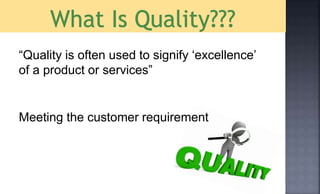
“Quality is often used to signify ‘excellence’
of a product or services”
Meeting the customer requirement
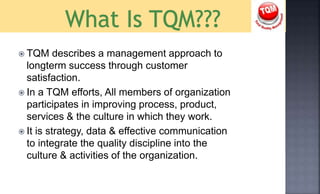
 TQM describes a management approach to
longterm success through customer
satisfaction.
 In a TQM efforts, All members of organization
participates in improving process, product,
services & the culture in which they work.
 It is strategy, data & effective communication
to integrate the quality discipline into the
culture & activities of the organization.
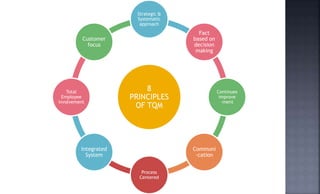
8
PRINCIPLES
OF TQM
Strategic &
Systematic
approach
Fact
based on
decision
making
Continues
improve
-ment
Communi
-cation
Process
Centered
Integrated
System
Total
Employee
involvement
Customer
focus
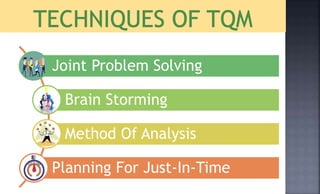
Joint Problem Solving
Brain Storming
Method Of Analysis
Planning For Just-In-Time
 The key to success in introducing total quality within
an organization, involving task group & quality circle
in seeking way of continues improvement to quality,
is based on systematic approach to joint problem
solving.
THE PRINCIPLES IS BASED ON:
 Depersonalizing conflicts by diluting emotions & do
systematic approach.
 Integrating the objectives of the organization & the
people working in it.
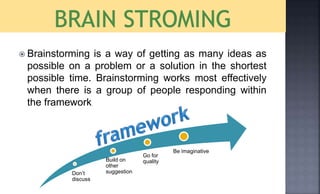
 Brainstorming is a way of getting as many ideas as
possible on a problem or a solution in the shortest
possible time. Brainstorming works most effectively
when there is a group of people responding within
the framework
Don’t
discuss
Build on
other
suggestion
Go for
quality
Be imaginative
 Analysis of quality problems in order to determine
solutions needs to be based on data collected on
quality performance.
 whether it be simple, such as the number of rejects
and the reason for the rejects on a particular line, or
a more complex cost analysis.
 The process of collecting data is based first on
brainstorming a list of all the factors likely to
contribute to a particular situation
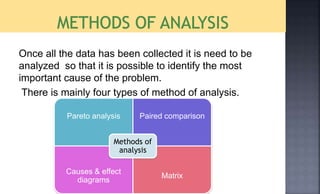
Once all the data has been collected it is need to be
analyzed so that it is possible to identify the most
important cause of the problem.
There is mainly four types of method of analysis.
Pareto analysis Paired comparison
Causes & effect
diagrams
Matrix
Methods of
analysis
A strategy for inventory management in which raw
materials and components are delivered from the
vendor or supplier immediately before they are needed
in the manufacturing process
 Basically JIT is a program directed towards ensuring
that the right quantities are purchased or produced at
the right time, and that there is no waste.
 Anyone who perceives it purely as a material control
system, however, is bound to fail with JIT.
 JIT fits well under the TQM umbrella, for many of the
ideas and techniques are very similar and, moreover,
JIT will not work without TQM in operation.
 An important outcome of JIT is a disciplined program for
improving productivity and reducing waste.
 This program leads to cost-effective production or
operation and delivery of only the required goods or
services, in the correct quantity, at the right time and
place.
 This is achieved with the minimum amount of
resources - facilities, equipment, materials, and people.
 The correct selection & use of techniques is
vital component of any successful TQM
implementation plan.
 The TQM techniques can be divided into simple
tools for solving a special problem & complex one
that cover all functions within the company.
 The usage & the scope of technique & the
product characteristics should be considered
carefully.
Techniques of TQM

Techniques of TQM

  • 1.
  • 2.
    “Quality is oftenused to signify ‘excellence’ of a product or services” Meeting the customer requirement
  • 4.
     TQM describesa management approach to longterm success through customer satisfaction.  In a TQM efforts, All members of organization participates in improving process, product, services & the culture in which they work.  It is strategy, data & effective communication to integrate the quality discipline into the culture & activities of the organization.
  • 6.
    8 PRINCIPLES OF TQM Strategic & Systematic approach Fact basedon decision making Continues improve -ment Communi -cation Process Centered Integrated System Total Employee involvement Customer focus
  • 8.
    Joint Problem Solving BrainStorming Method Of Analysis Planning For Just-In-Time
  • 9.
     The keyto success in introducing total quality within an organization, involving task group & quality circle in seeking way of continues improvement to quality, is based on systematic approach to joint problem solving. THE PRINCIPLES IS BASED ON:  Depersonalizing conflicts by diluting emotions & do systematic approach.  Integrating the objectives of the organization & the people working in it.
  • 10.
     Brainstorming isa way of getting as many ideas as possible on a problem or a solution in the shortest possible time. Brainstorming works most effectively when there is a group of people responding within the framework Don’t discuss Build on other suggestion Go for quality Be imaginative
  • 11.
     Analysis ofquality problems in order to determine solutions needs to be based on data collected on quality performance.  whether it be simple, such as the number of rejects and the reason for the rejects on a particular line, or a more complex cost analysis.  The process of collecting data is based first on brainstorming a list of all the factors likely to contribute to a particular situation
  • 12.
    Once all thedata has been collected it is need to be analyzed so that it is possible to identify the most important cause of the problem. There is mainly four types of method of analysis. Pareto analysis Paired comparison Causes & effect diagrams Matrix Methods of analysis
  • 13.
    A strategy forinventory management in which raw materials and components are delivered from the vendor or supplier immediately before they are needed in the manufacturing process
  • 14.
     Basically JITis a program directed towards ensuring that the right quantities are purchased or produced at the right time, and that there is no waste.  Anyone who perceives it purely as a material control system, however, is bound to fail with JIT.  JIT fits well under the TQM umbrella, for many of the ideas and techniques are very similar and, moreover, JIT will not work without TQM in operation.
  • 15.
     An importantoutcome of JIT is a disciplined program for improving productivity and reducing waste.  This program leads to cost-effective production or operation and delivery of only the required goods or services, in the correct quantity, at the right time and place.  This is achieved with the minimum amount of resources - facilities, equipment, materials, and people.
  • 16.
     The correctselection & use of techniques is vital component of any successful TQM implementation plan.  The TQM techniques can be divided into simple tools for solving a special problem & complex one that cover all functions within the company.  The usage & the scope of technique & the product characteristics should be considered carefully.