BODE PLOT
Dr.R.Subasri
Professor, Kongu Engineering College,
Perundurai, Erode, Tamilnadu, INDIA
1Dr.R.Subasri,KEC,INDIA
2
Frequency Response Techniques
• Analysing the system on frequency basis
e.g communication systems
• Developed by Nyquist and Bode in 1930
• Older than root locus method given by
Evan in 1948
Dr.R.Subasri,KEC,INDIA
3
Frequency Response Techniques
– Radio telescopes used for deep space
communication require precise positioning to
function effectively. To achieve a high degree
of precision ,an accurate mathematical model
of antenna dynamics is to used.
– To construct the model, engineers can test
the antenna by vibrating it with sinusoidal
forces of different frequencies and measuring
the vibrations. These measurements form the
basis for the model.
Dr.R.Subasri,KEC,INDIA
4
Chapter objectives
• Definition of frequency response
• How to plot frequency response
• How to use frequency response to analyse
stability
• How to use frequency response to design
the gain to meet stability specifications.
Dr.R.Subasri,KEC,INDIA
5
Frequency Response Techniques
-Advantages
• modelling transfer functions from physical
data.
• Designing compensators to meet steady
state error and transient response
requirements.
• Finding stability of systems
Dr.R.Subasri,KEC,INDIA
6
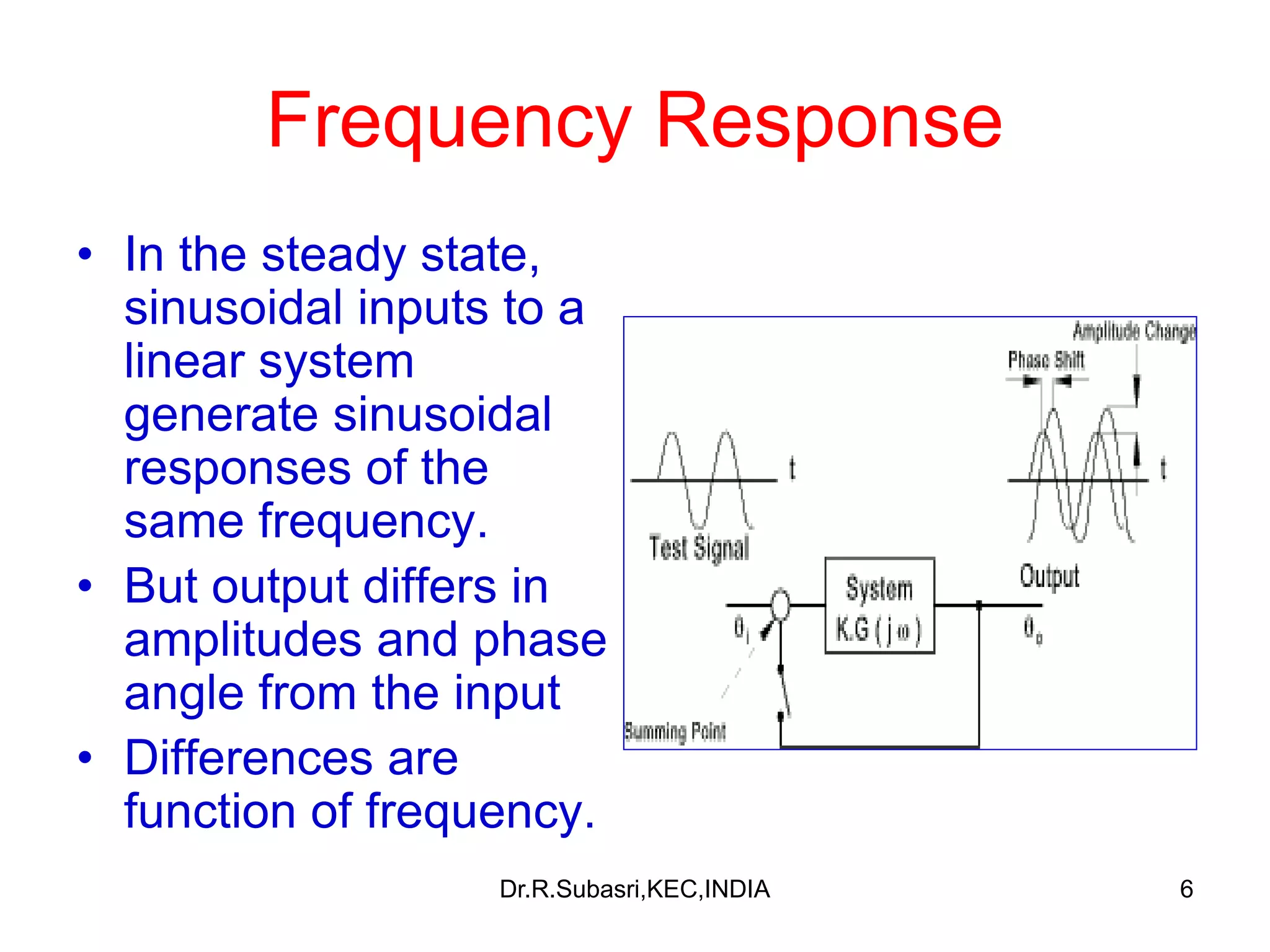
Frequency Response
• In the steady state,
sinusoidal inputs to a
linear system
generate sinusoidal
responses of the
same frequency.
• But output differs in
amplitudes and phase
angle from the input
• Differences are
function of frequency.
Dr.R.Subasri,KEC,INDIA
7
Frequency Response
)(
)(
)(



i
o
M
M
M =
)()()(  io −=
)()(  M
)()(  iiM  )()(  ooM 
)()(  ooM  = )]()([)()(  + iMiM
Magnitude frequency response =
Phase frequency response =
Combination of magnitude and phase frequency responses is Frequency
response
In general Frequency response of a system with transfer function G(s) is
)()(  M
 jSsGjG →= /)()(Dr.R.Subasri,KEC,INDIA
8
Frequency response plots
❖Bode plot(or)Asymptotic
Approximation Plot (or)Logarithmic
plot
❖Polar plot – Nyquist plot
❖Log Magnitude Vs phase angle
Dr.R.Subasri,KEC,INDIA
9
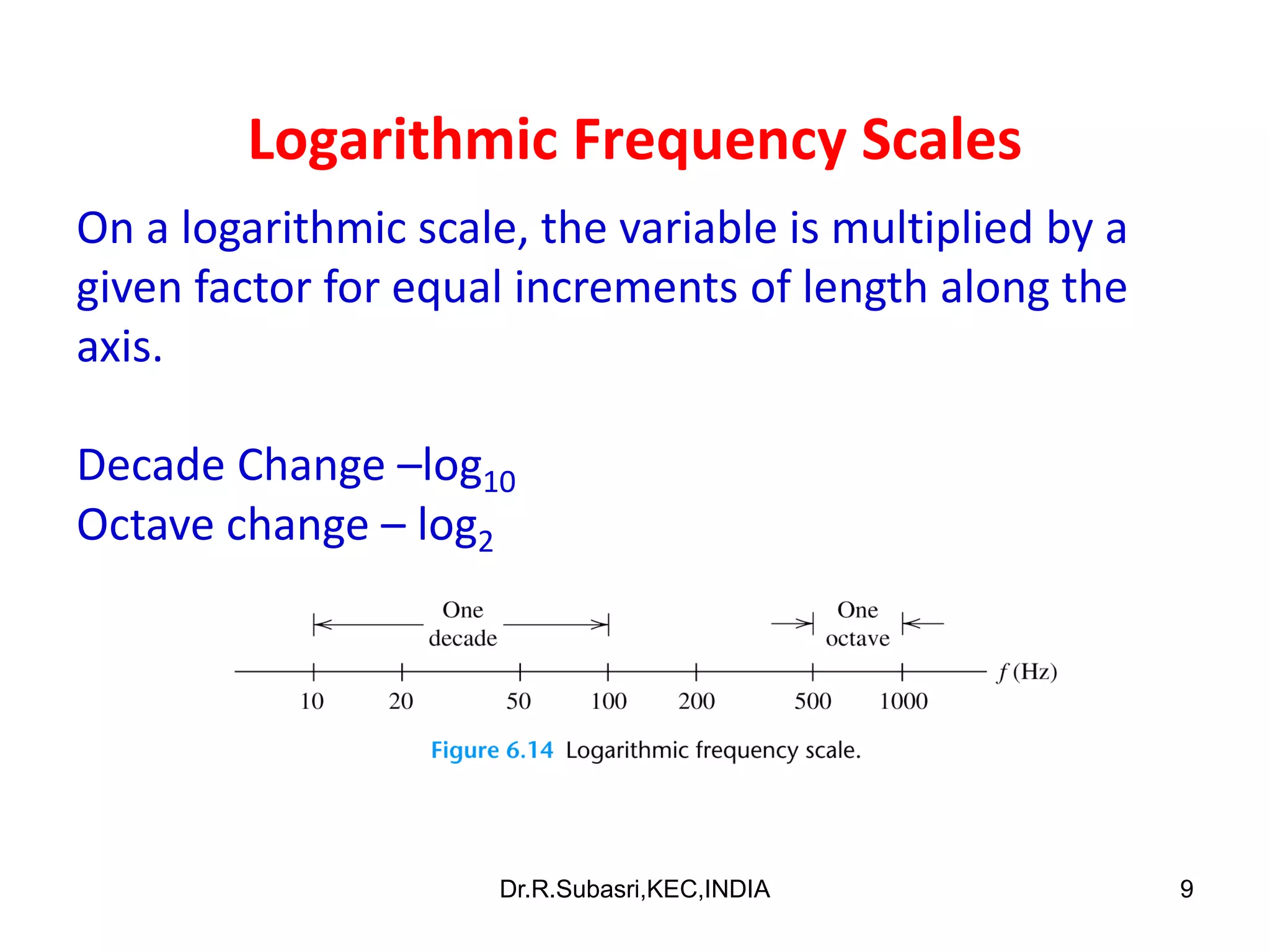
Logarithmic Frequency Scales
On a logarithmic scale, the variable is multiplied by a
given factor for equal increments of length along the
axis.
Decade Change –log10
Octave change – log2
Dr.R.Subasri,KEC,INDIA
10
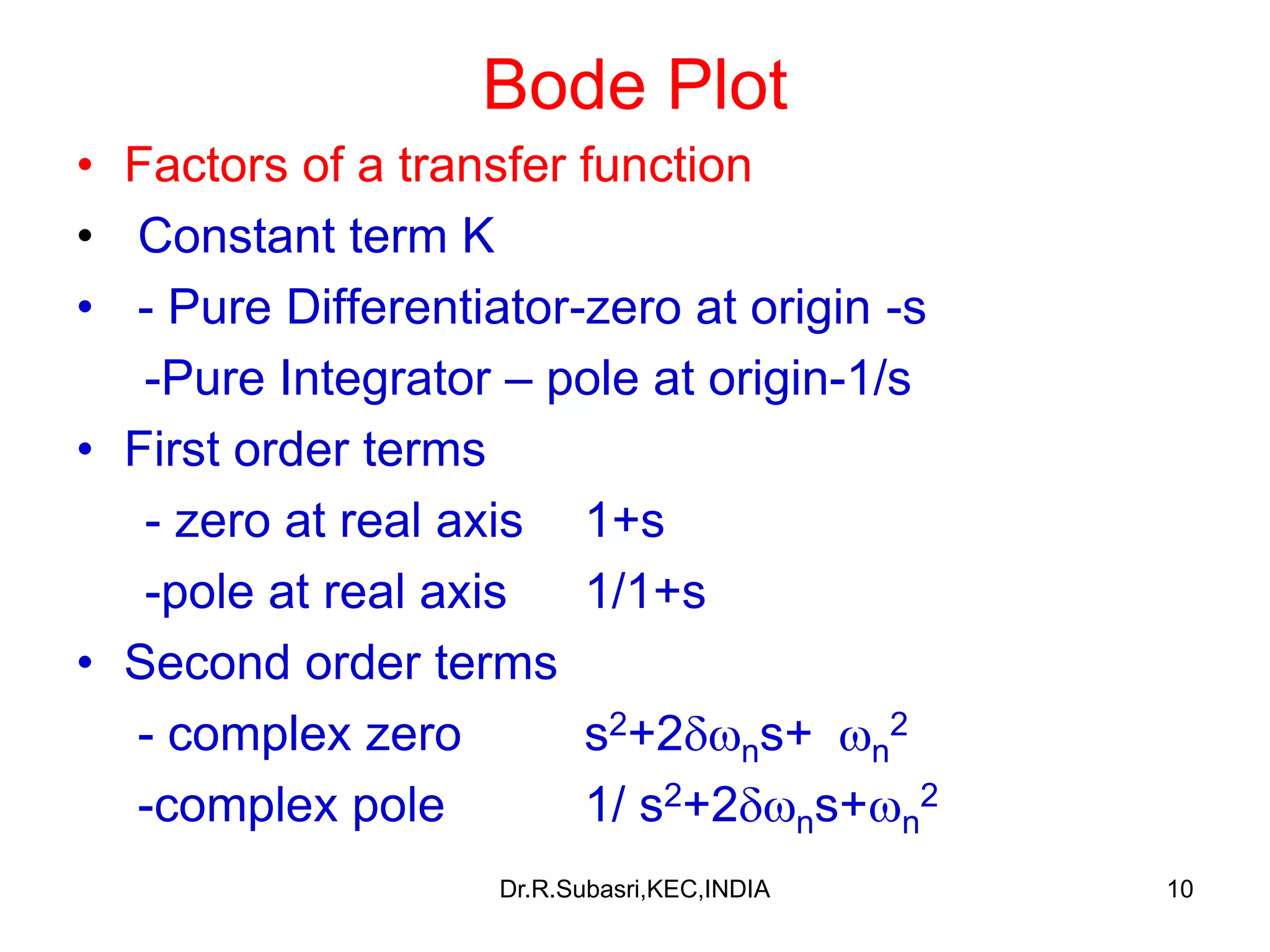
Bode Plot
• Factors of a transfer function
• Constant term K
• - Pure Differentiator-zero at origin -s
-Pure Integrator – pole at origin-1/s
• First order terms
- zero at real axis 1+s
-pole at real axis 1/1+s
• Second order terms
- complex zero s2+2ns+ n
2
-complex pole 1/ s2+2ns+n
2
Dr.R.Subasri,KEC,INDIA
11
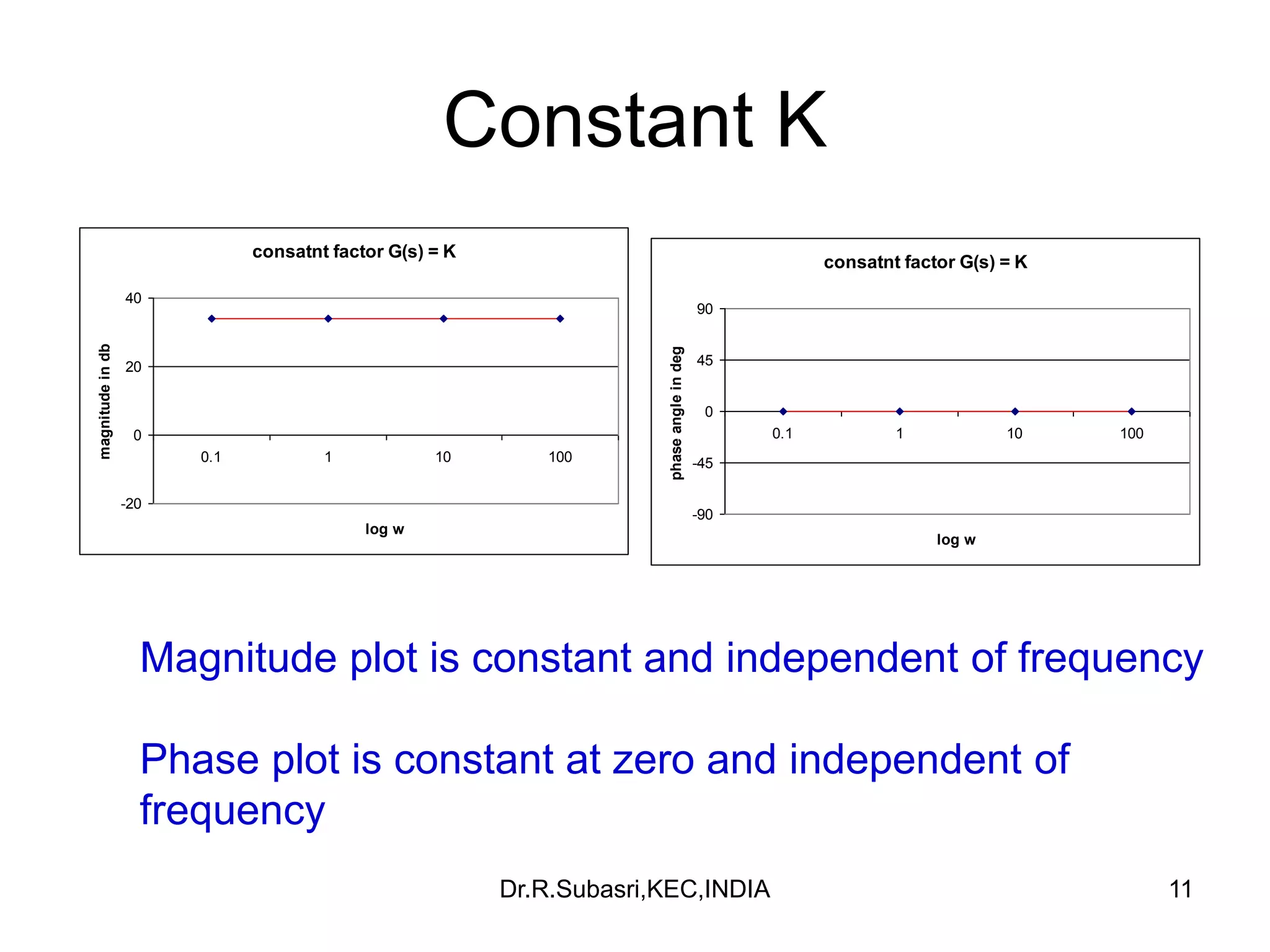
Constant K
consatnt factor G(s) = K
-20
0
20
40
0.1 1 10 100
log w
magnitudeindb
consatnt factor G(s) = K
-90
-45
0
45
90
0.1 1 10 100
log w
phaseangleindeg
Magnitude plot is constant and independent of frequency
Phase plot is constant at zero and independent of
frequency
Dr.R.Subasri,KEC,INDIA
12
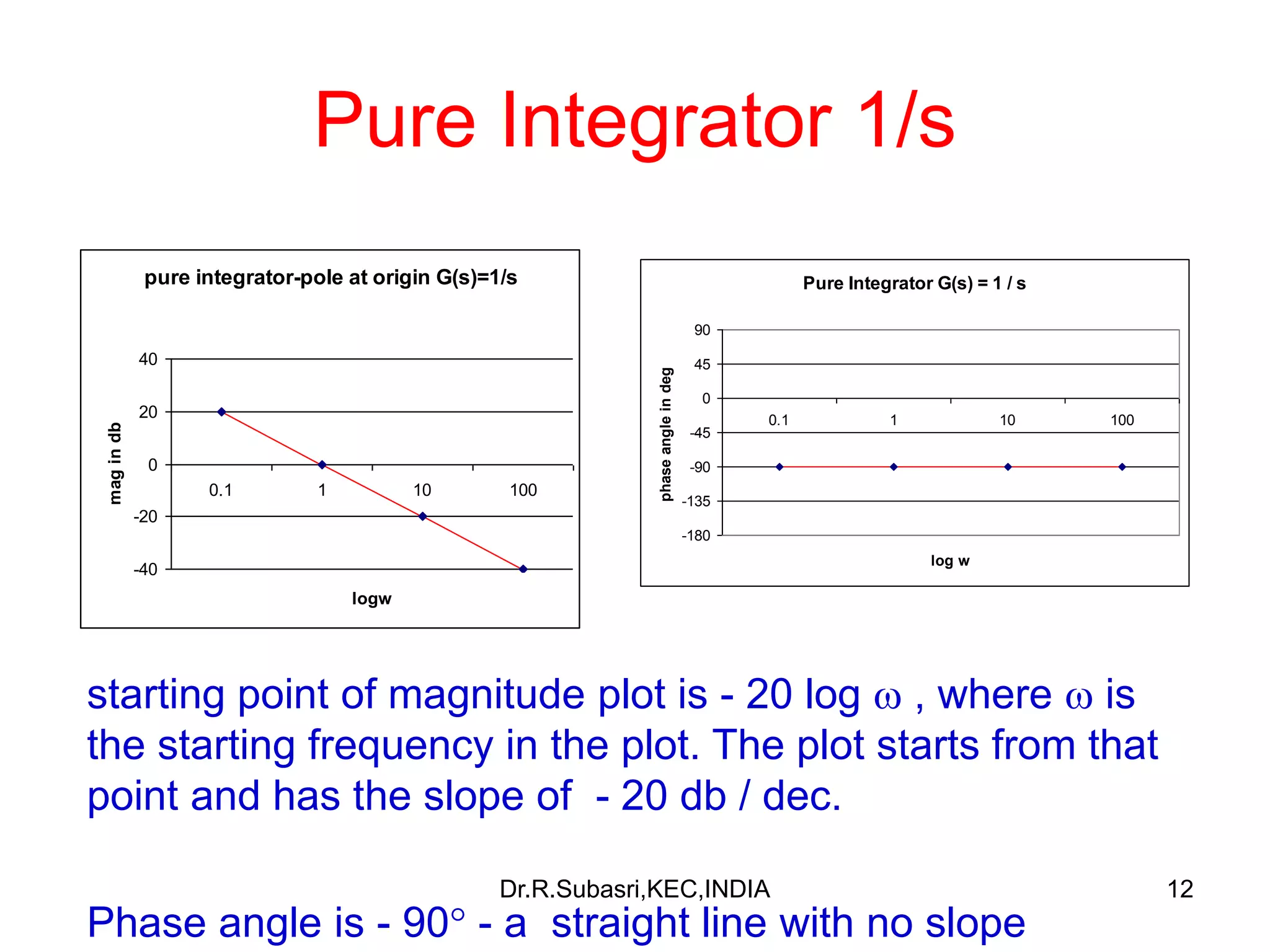
Pure Integrator 1/s
pure integrator-pole at origin G(s)=1/s
-40
-20
0
20
40
0.1 1 10 100
logw
magindb
Pure Integrator G(s) = 1 / s
-180
-135
-90
-45
0
45
90
0.1 1 10 100
log w
phaseangleindeg
starting point of magnitude plot is - 20 log  , where  is
the starting frequency in the plot. The plot starts from that
point and has the slope of - 20 db / dec.
Phase angle is - 90 - a straight line with no slope
Dr.R.Subasri,KEC,INDIA
13
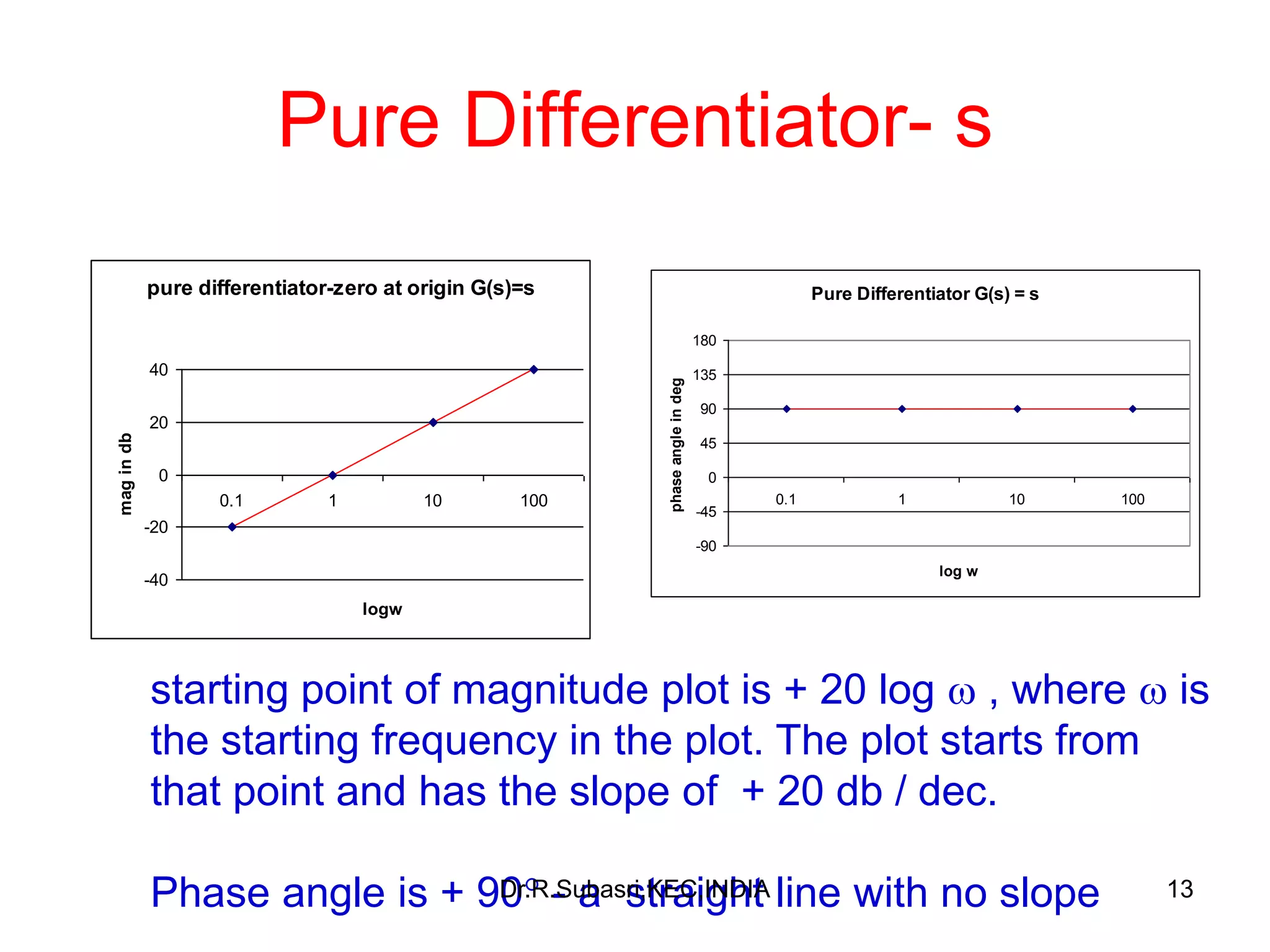
Pure Differentiator- s
pure differentiator-zero at origin G(s)=s
-40
-20
0
20
40
0.1 1 10 100
logw
magindb
Pure Differentiator G(s) = s
-90
-45
0
45
90
135
180
0.1 1 10 100
log w
phaseangleindeg
starting point of magnitude plot is + 20 log  , where  is
the starting frequency in the plot. The plot starts from
that point and has the slope of + 20 db / dec.
Phase angle is + 90 - a straight line with no slopeDr.R.Subasri,KEC,INDIA
14
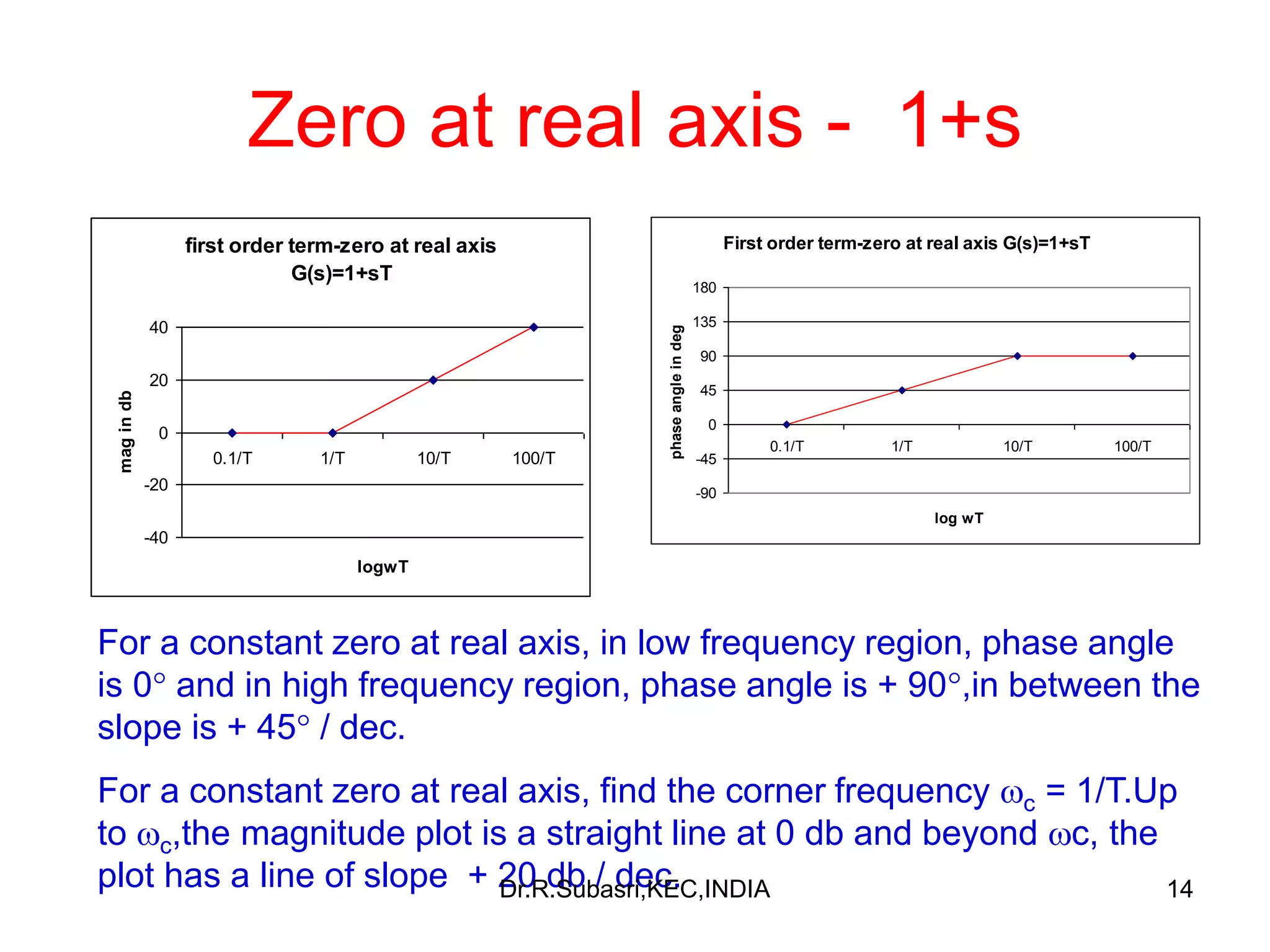
Zero at real axis - 1+s
first order term-zero at real axis
G(s)=1+sT
-40
-20
0
20
40
0.1/T 1/T 10/T 100/T
logwT
magindb
First order term-zero at real axis G(s)=1+sT
-90
-45
0
45
90
135
180
0.1/T 1/T 10/T 100/T
log wT
phaseangleindeg
For a constant zero at real axis, in low frequency region, phase angle
is 0 and in high frequency region, phase angle is + 90,in between the
slope is + 45 / dec.
For a constant zero at real axis, find the corner frequency c = 1/T.Up
to c,the magnitude plot is a straight line at 0 db and beyond c, the
plot has a line of slope + 20 db / dec.Dr.R.Subasri,KEC,INDIA
15
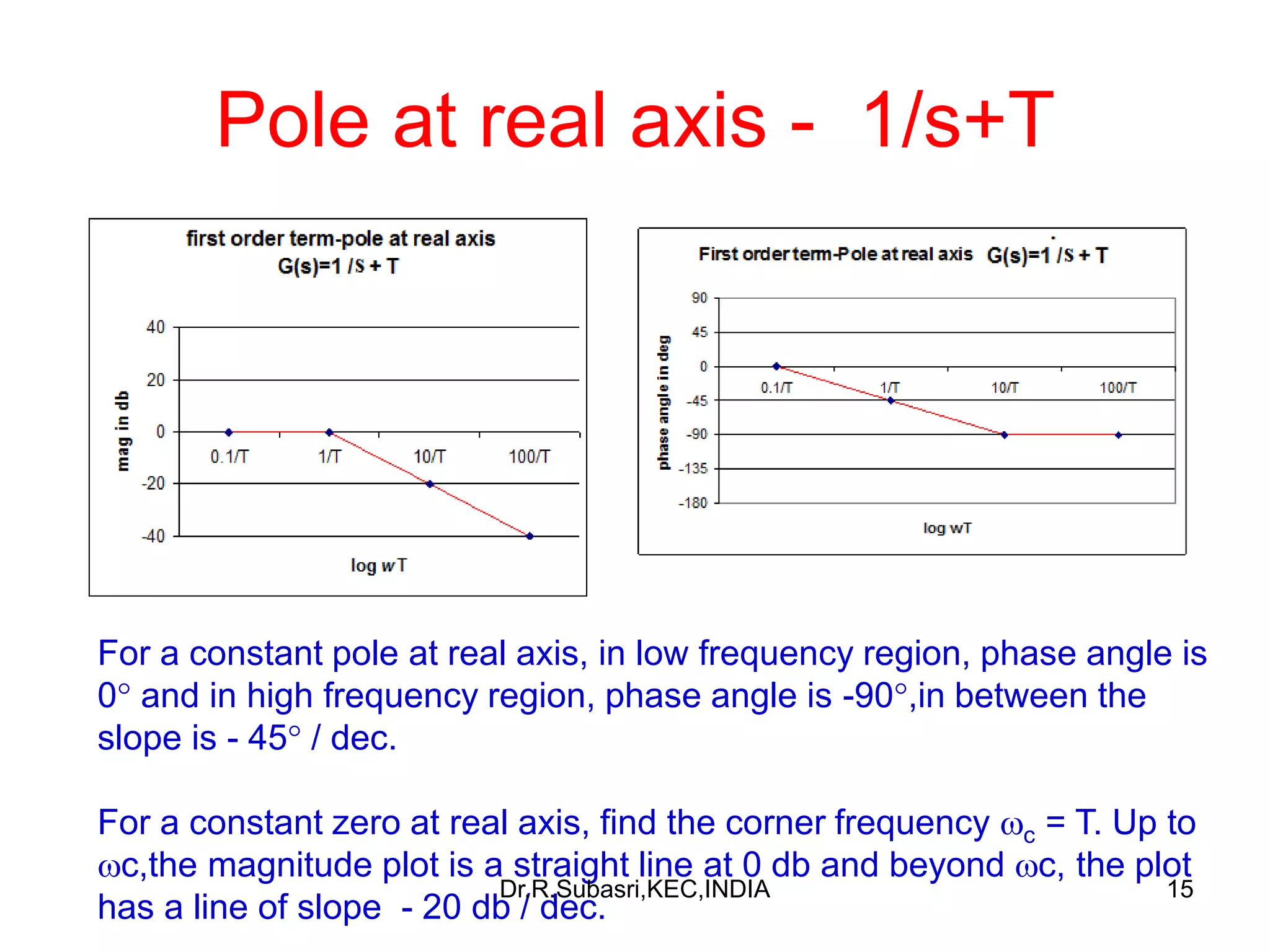
Pole at real axis - 1/s+T
For a constant pole at real axis, in low frequency region, phase angle is
0 and in high frequency region, phase angle is -90,in between the
slope is - 45 / dec.
For a constant zero at real axis, find the corner frequency c = T. Up to
c,the magnitude plot is a straight line at 0 db and beyond c, the plot
has a line of slope - 20 db / dec.
Dr.R.Subasri,KEC,INDIA
16
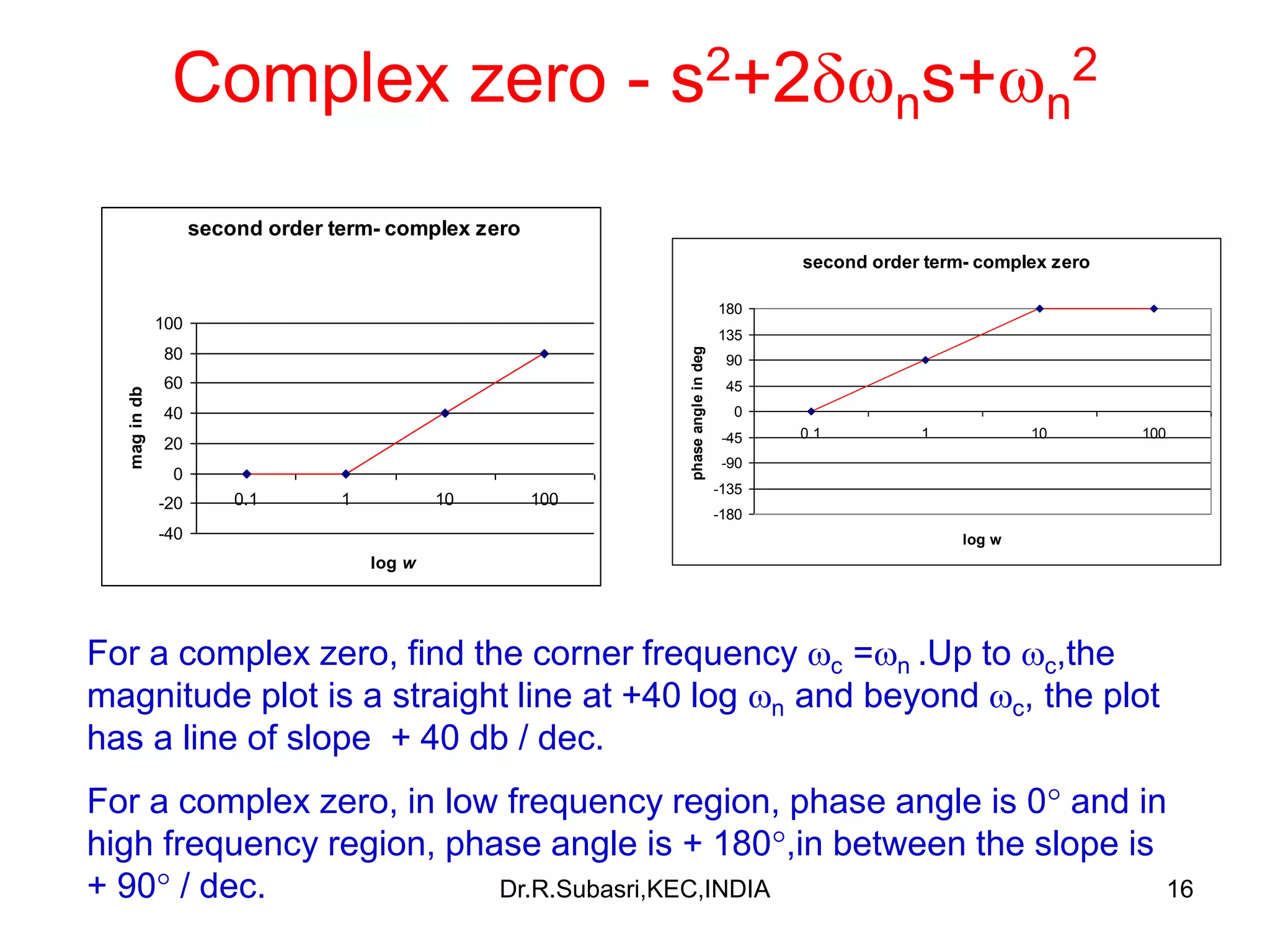
Complex zero - s2+2ns+n
2
second order term- complex zero
-40
-20
0
20
40
60
80
100
0.1 1 10 100
log w
magindb
second order term- complex zero
-180
-135
-90
-45
0
45
90
135
180
0.1 1 10 100
log w
phaseangleindeg
For a complex zero, find the corner frequency c =n .Up to c,the
magnitude plot is a straight line at +40 log n and beyond c, the plot
has a line of slope + 40 db / dec.
For a complex zero, in low frequency region, phase angle is 0 and in
high frequency region, phase angle is + 180,in between the slope is
+ 90 / dec. Dr.R.Subasri,KEC,INDIA
17
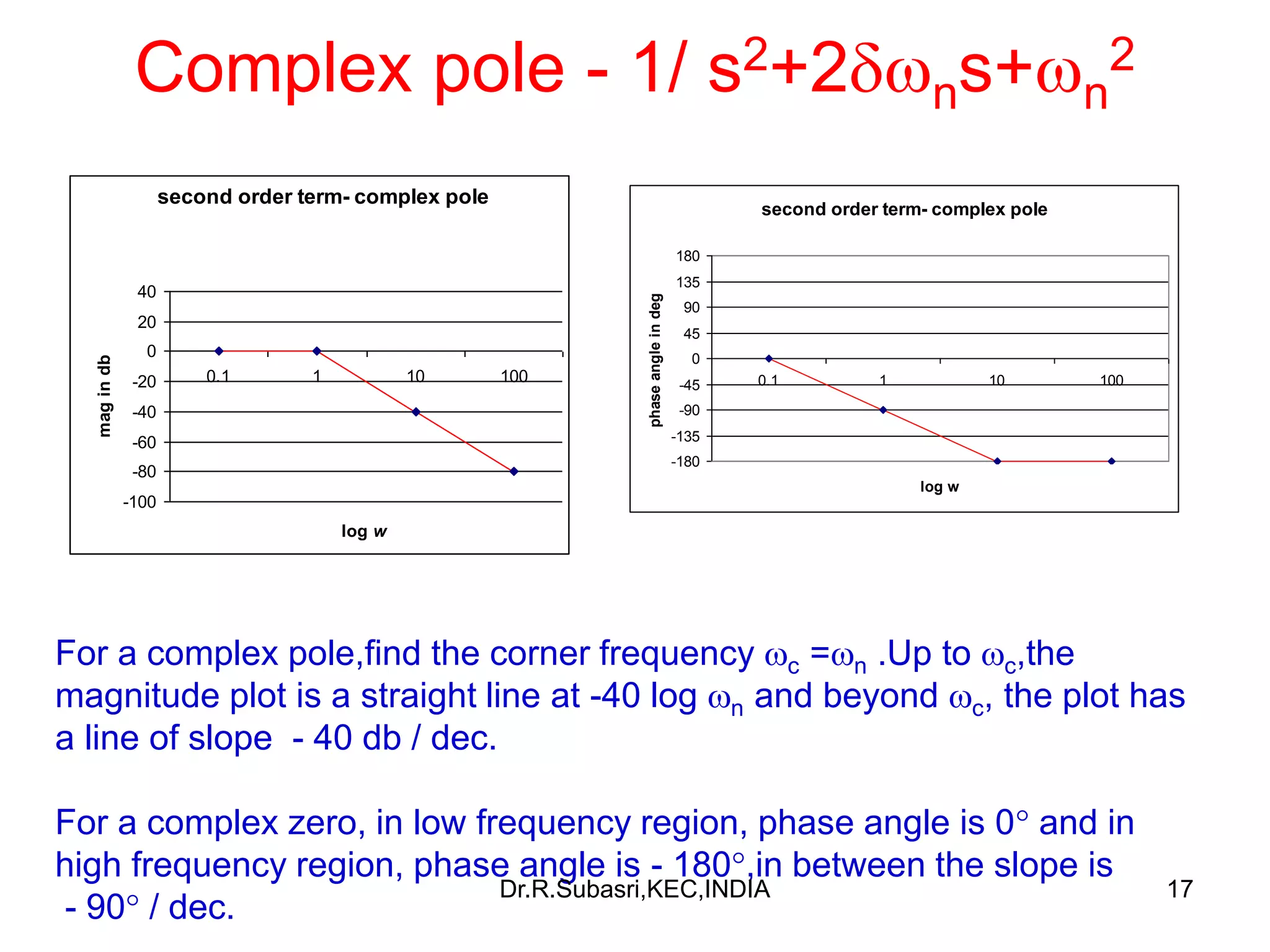
Complex pole - 1/ s2+2ns+n
2
second order term- complex pole
-100
-80
-60
-40
-20
0
20
40
0.1 1 10 100
log w
magindb
second order term- complex pole
-180
-135
-90
-45
0
45
90
135
180
0.1 1 10 100
log w
phaseangleindegFor a complex pole,find the corner frequency c =n .Up to c,the
magnitude plot is a straight line at -40 log n and beyond c, the plot has
a line of slope - 40 db / dec.
For a complex zero, in low frequency region, phase angle is 0 and in
high frequency region, phase angle is - 180,in between the slope is
- 90 / dec.
Dr.R.Subasri,KEC,INDIA
18
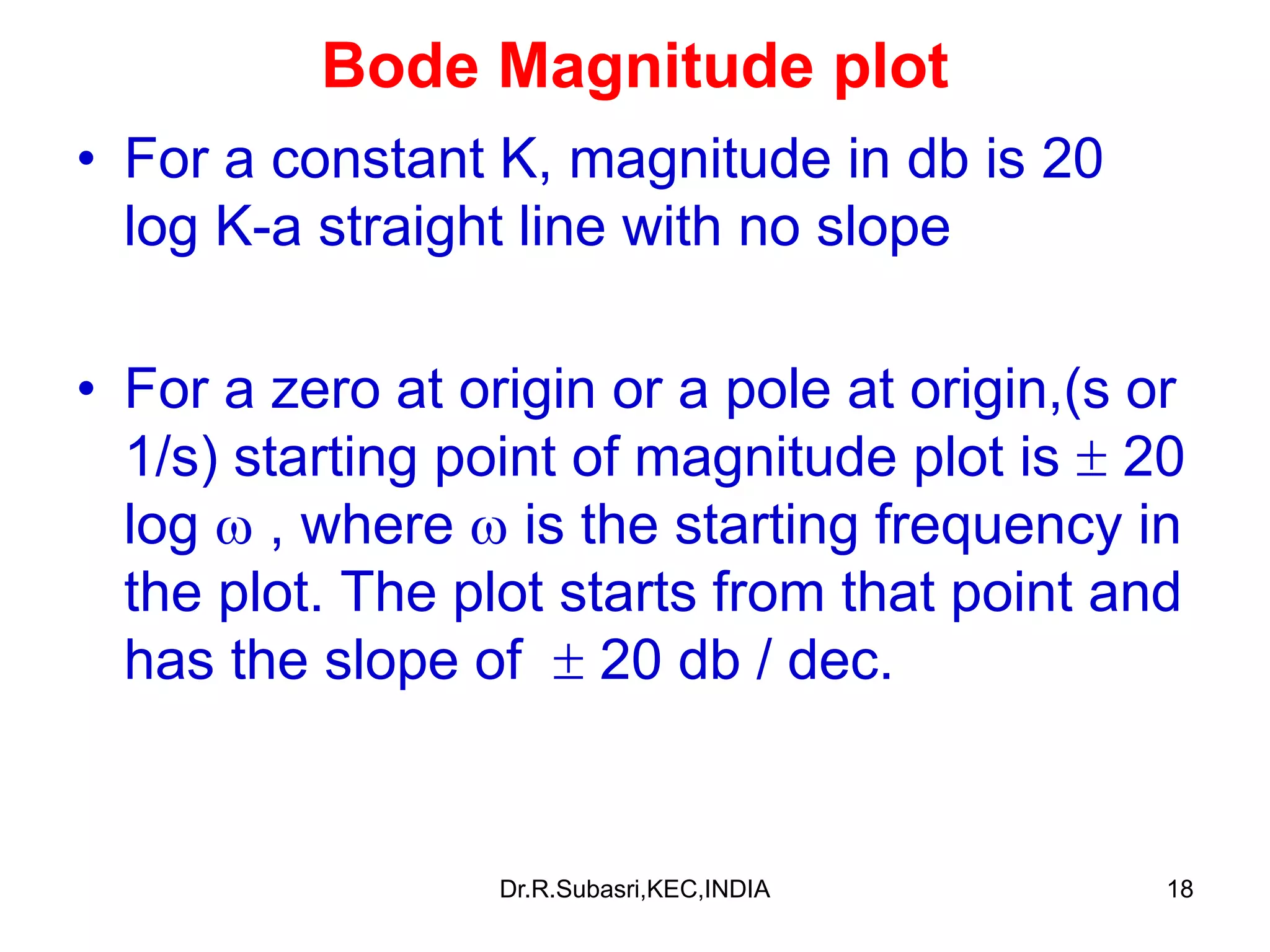
Bode Magnitude plot
• For a constant K, magnitude in db is 20
log K-a straight line with no slope
• For a zero at origin or a pole at origin,(s or
1/s) starting point of magnitude plot is  20
log  , where  is the starting frequency in
the plot. The plot starts from that point and
has the slope of  20 db / dec.
Dr.R.Subasri,KEC,INDIA
19
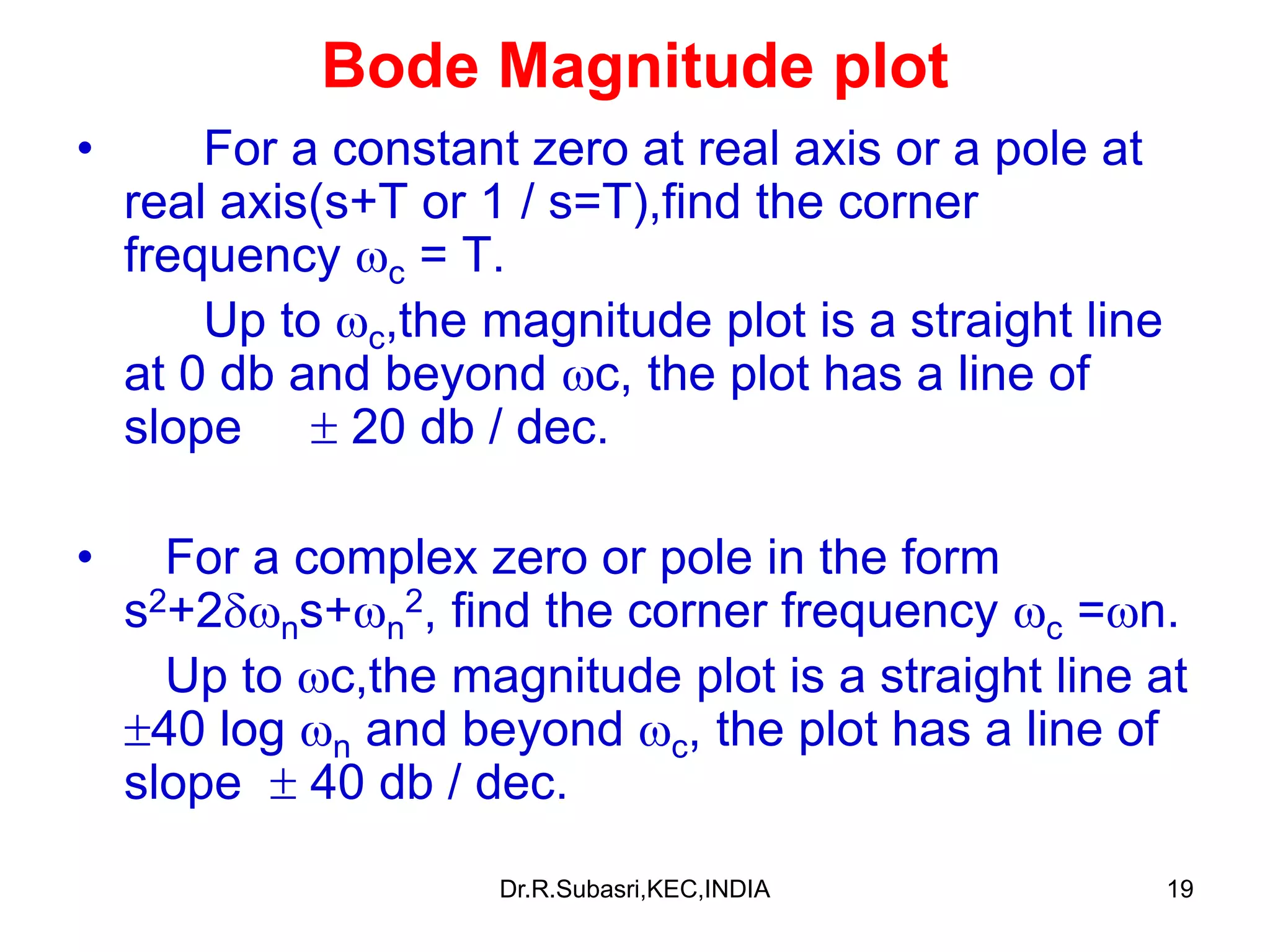
Bode Magnitude plot
• For a constant zero at real axis or a pole at
real axis(s+T or 1 / s=T),find the corner
frequency c = T.
Up to c,the magnitude plot is a straight line
at 0 db and beyond c, the plot has a line of
slope  20 db / dec.
• For a complex zero or pole in the form
s2+2ns+n
2, find the corner frequency c =n.
Up to c,the magnitude plot is a straight line at
40 log n and beyond c, the plot has a line of
slope  40 db / dec.
Dr.R.Subasri,KEC,INDIA
20
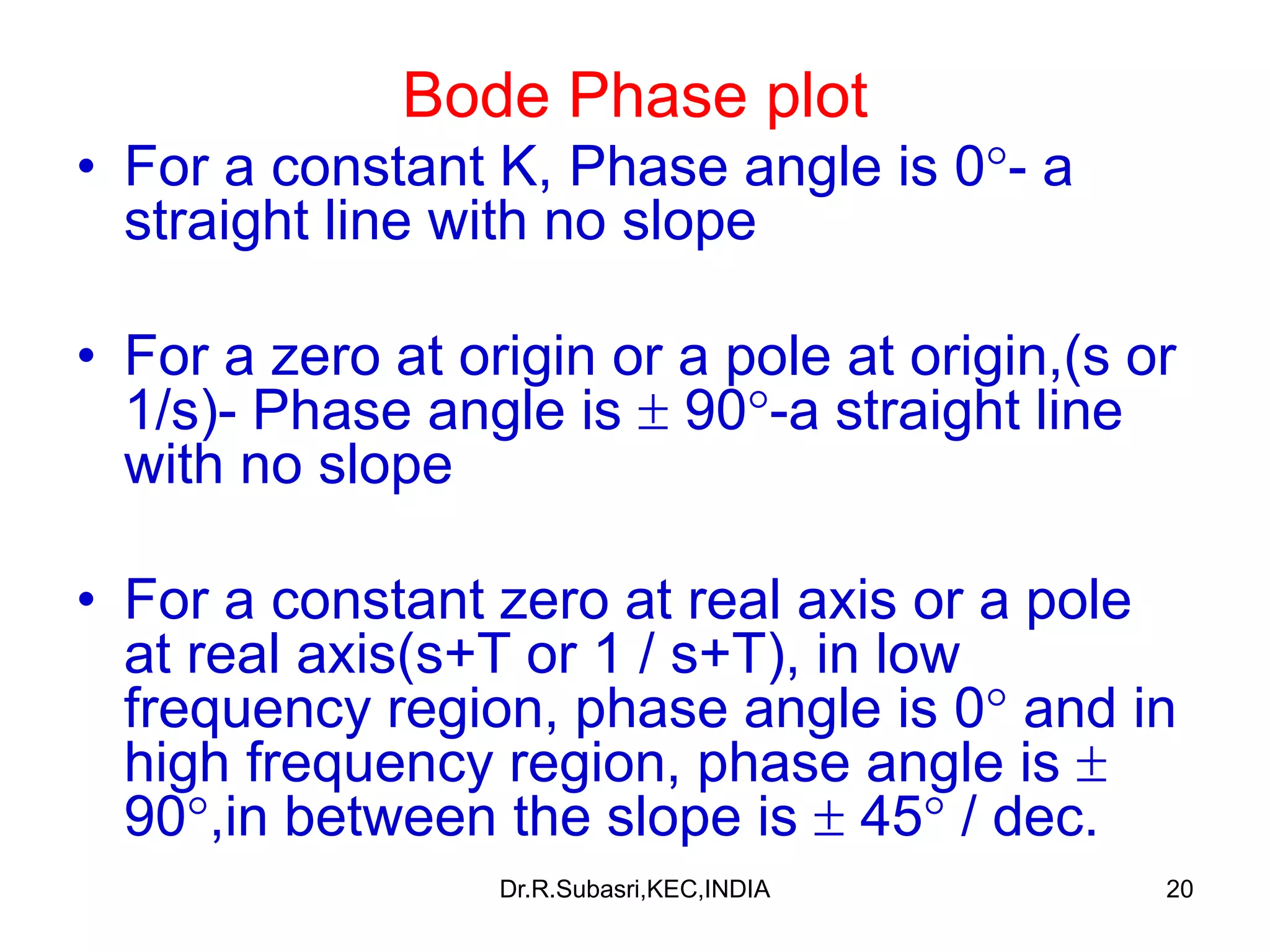
Bode Phase plot
• For a constant K, Phase angle is 0- a
straight line with no slope
• For a zero at origin or a pole at origin,(s or
1/s)- Phase angle is  90-a straight line
with no slope
• For a constant zero at real axis or a pole
at real axis(s+T or 1 / s+T), in low
frequency region, phase angle is 0 and in
high frequency region, phase angle is 
90,in between the slope is  45 / dec.
Dr.R.Subasri,KEC,INDIA
21
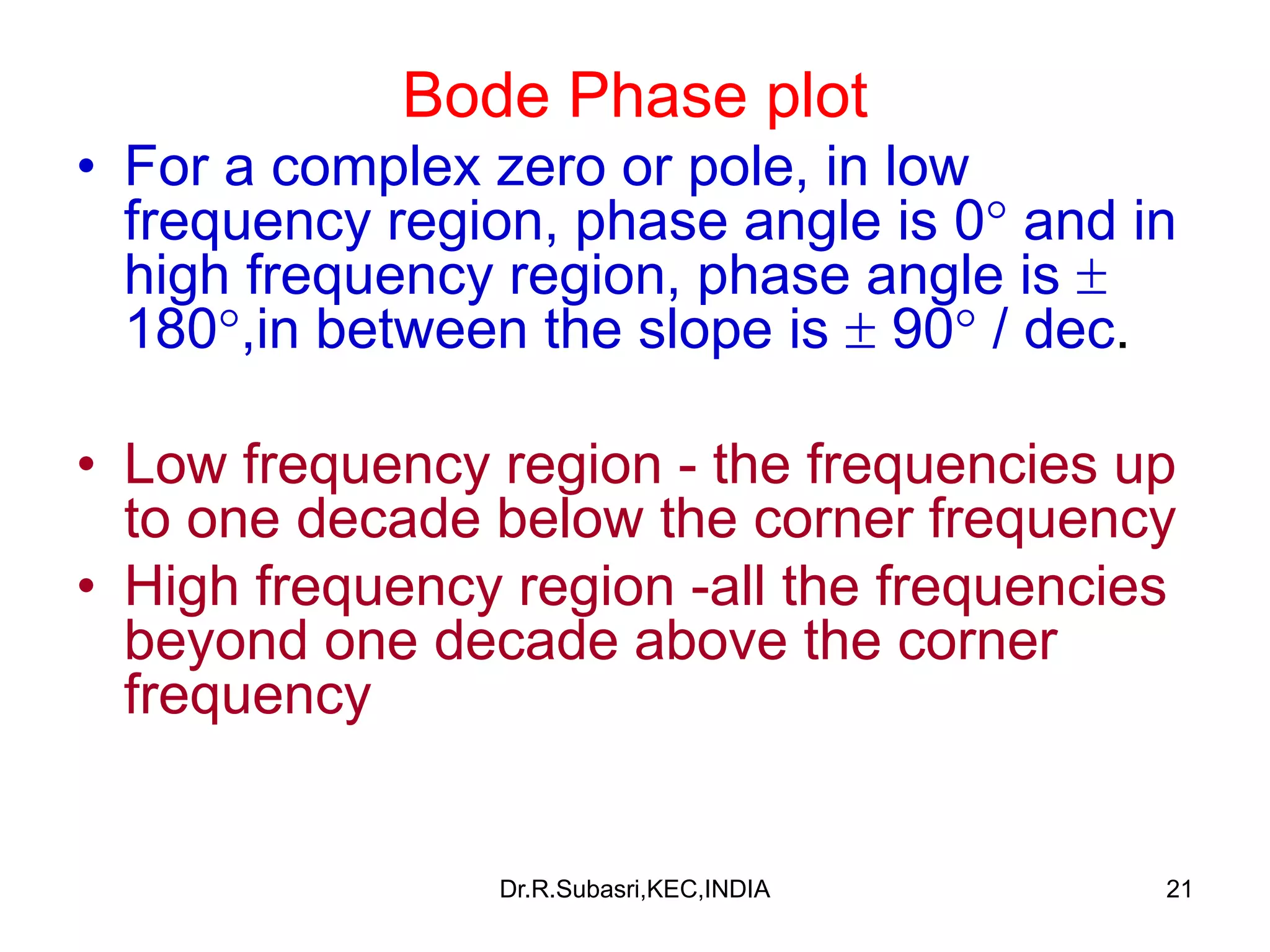
Bode Phase plot
• For a complex zero or pole, in low
frequency region, phase angle is 0 and in
high frequency region, phase angle is 
180,in between the slope is  90 / dec.
• Low frequency region - the frequencies up
to one decade below the corner frequency
• High frequency region -all the frequencies
beyond one decade above the corner
frequency
Dr.R.Subasri,KEC,INDIA
22
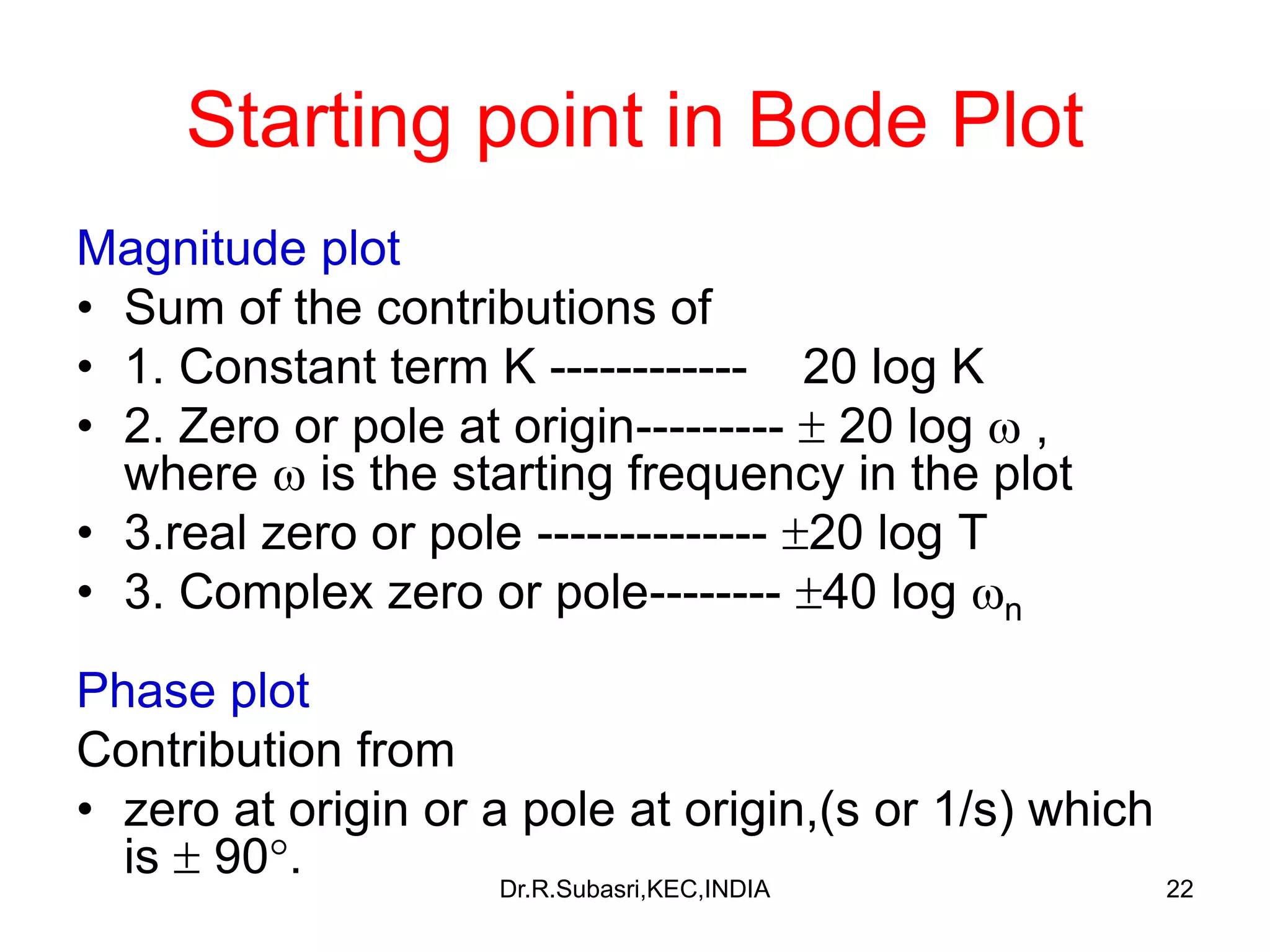
Starting point in Bode Plot
Magnitude plot
• Sum of the contributions of
• 1. Constant term K ------------ 20 log K
• 2. Zero or pole at origin---------  20 log  ,
where  is the starting frequency in the plot
• 3.real zero or pole -------------- 20 log T
• 3. Complex zero or pole-------- 40 log n
Phase plot
Contribution from
• zero at origin or a pole at origin,(s or 1/s) which
is  90. Dr.R.Subasri,KEC,INDIA
23
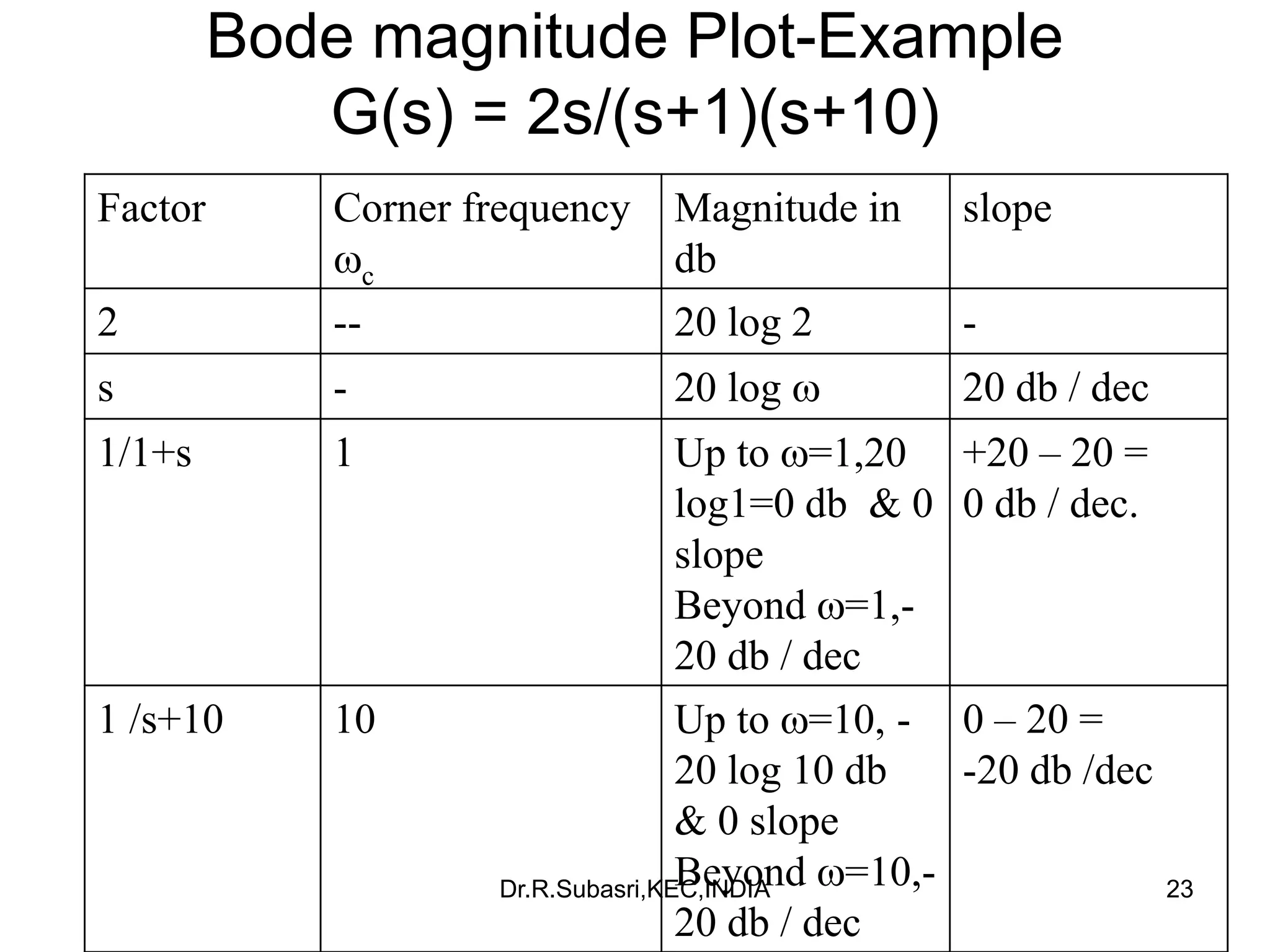
Bode magnitude Plot-Example
G(s) = 2s/(s+1)(s+10)
Factor Corner frequency
c
Magnitude in
db
slope
2 -- 20 log 2 -
s - 20 log  20 db / dec
1/1+s 1 Up to =1,20
log1=0 db & 0
slope
Beyond =1,-
20 db / dec
+20 – 20 =
0 db / dec.
1 /s+10 10 Up to =10, -
20 log 10 db
& 0 slope
Beyond =10,-
20 db / dec
0 – 20 =
-20 db /dec
Dr.R.Subasri,KEC,INDIA
24
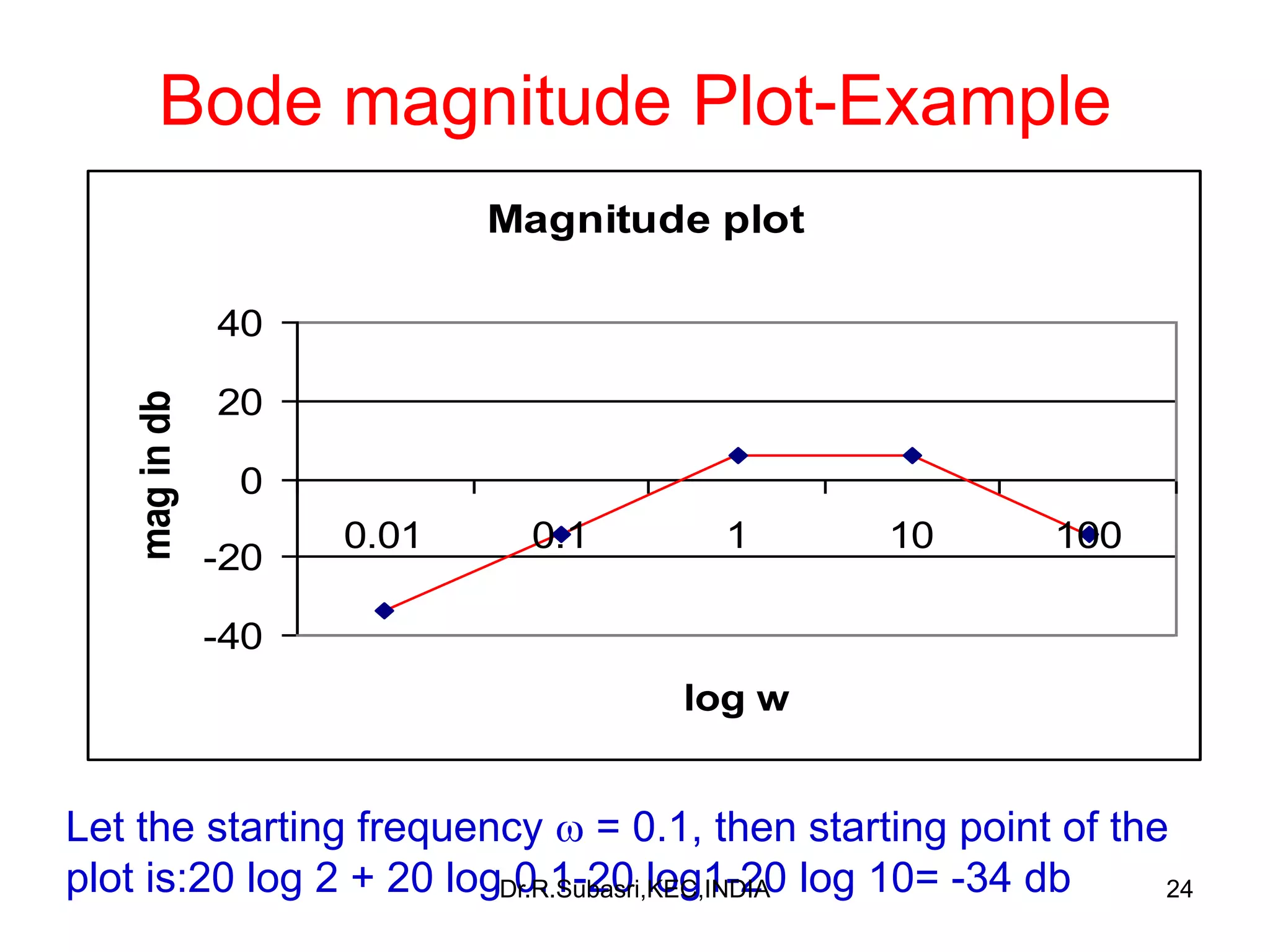
Bode magnitude Plot-Example
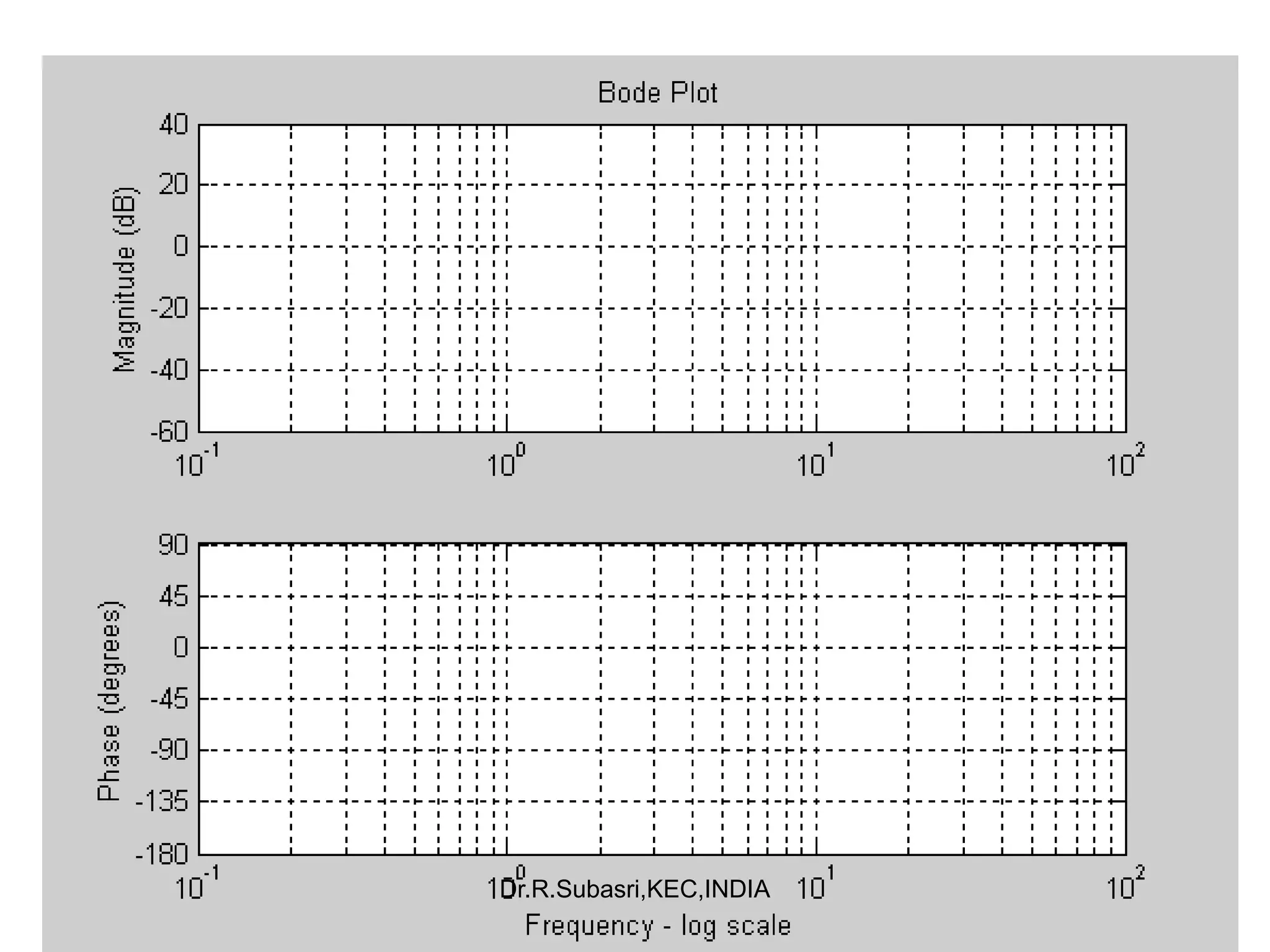
Magnitude plot
-40
-20
0
20
40
0.01 0.1 1 10 100
log w
magindb
Let the starting frequency  = 0.1, then starting point of the
plot is:20 log 2 + 20 log 0.1-20 log1-20 log 10= -34 dbDr.R.Subasri,KEC,INDIA
25
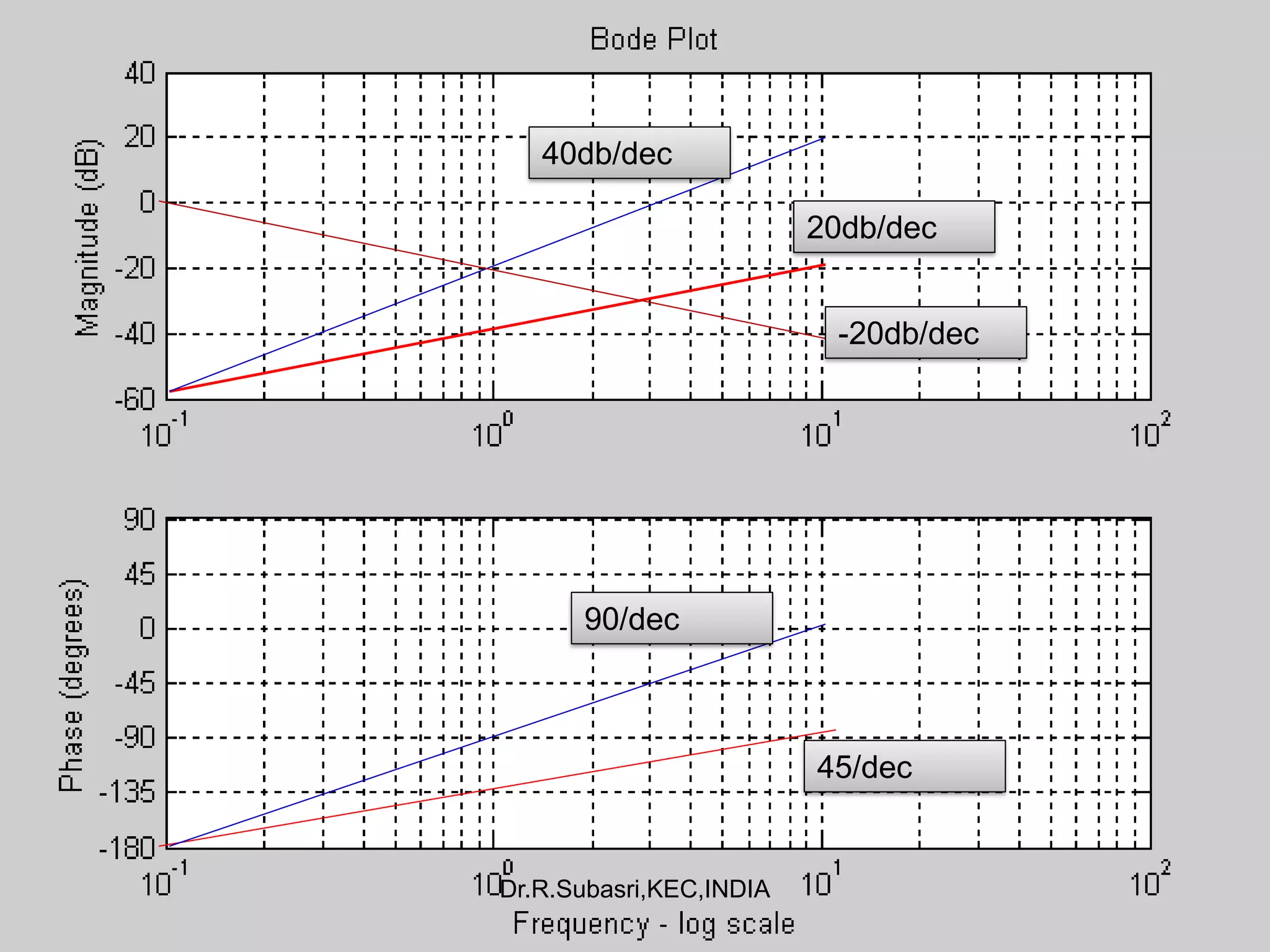
40db/dec
20db/dec
-20db/dec
45/dec
90/dec
Dr.R.Subasri,KEC,INDIA
26Dr.R.Subasri,KEC,INDIA
27
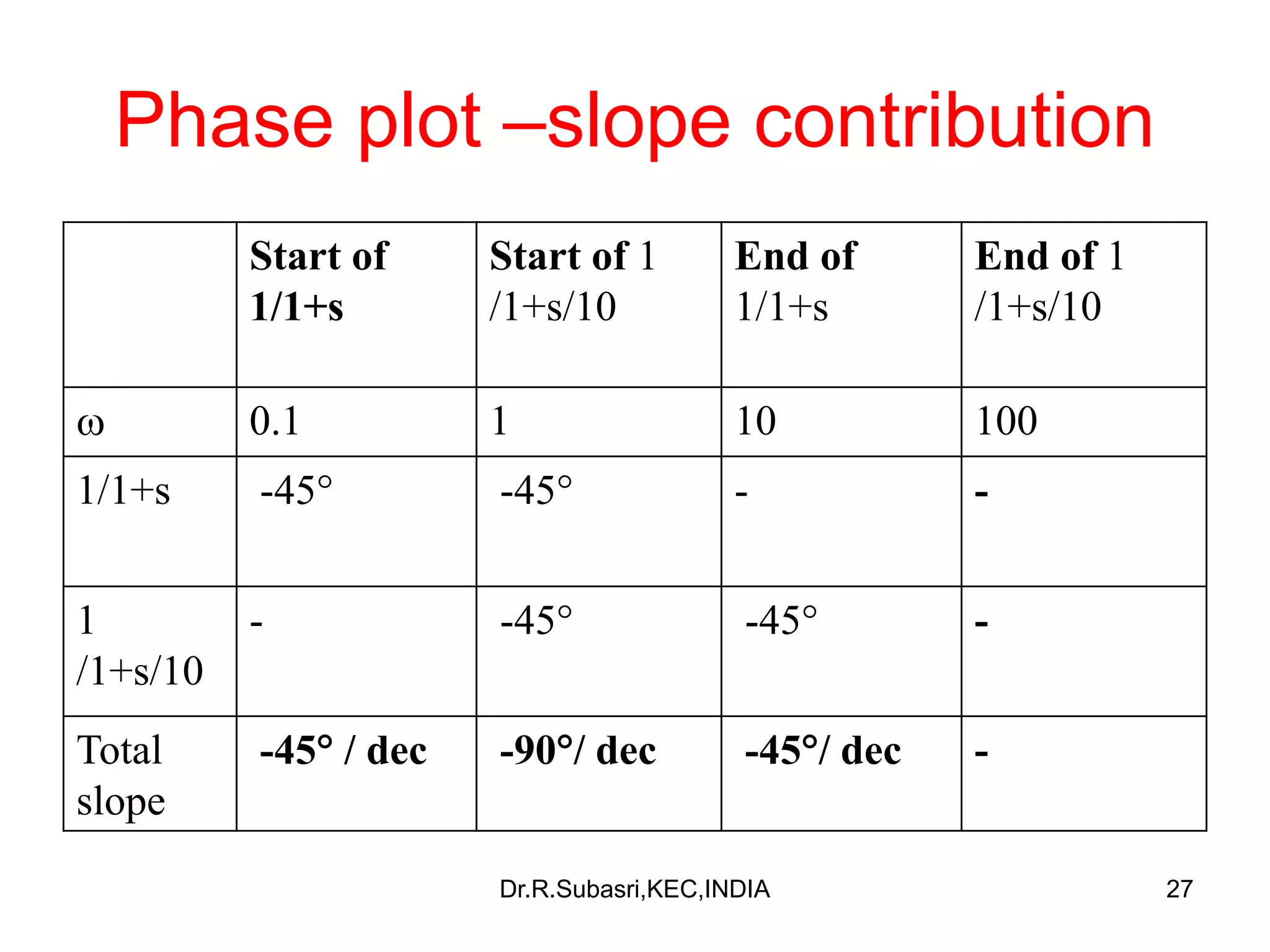
Phase plot –slope contribution
Start of
1/1+s
Start of 1
/1+s/10
End of
1/1+s
End of 1
/1+s/10
 0.1 1 10 100
1/1+s -45 -45 - -
1
/1+s/10
- -45 -45 -
Total
slope
-45 / dec -90/ dec -45/ dec -
Dr.R.Subasri,KEC,INDIA
28
Phase plot
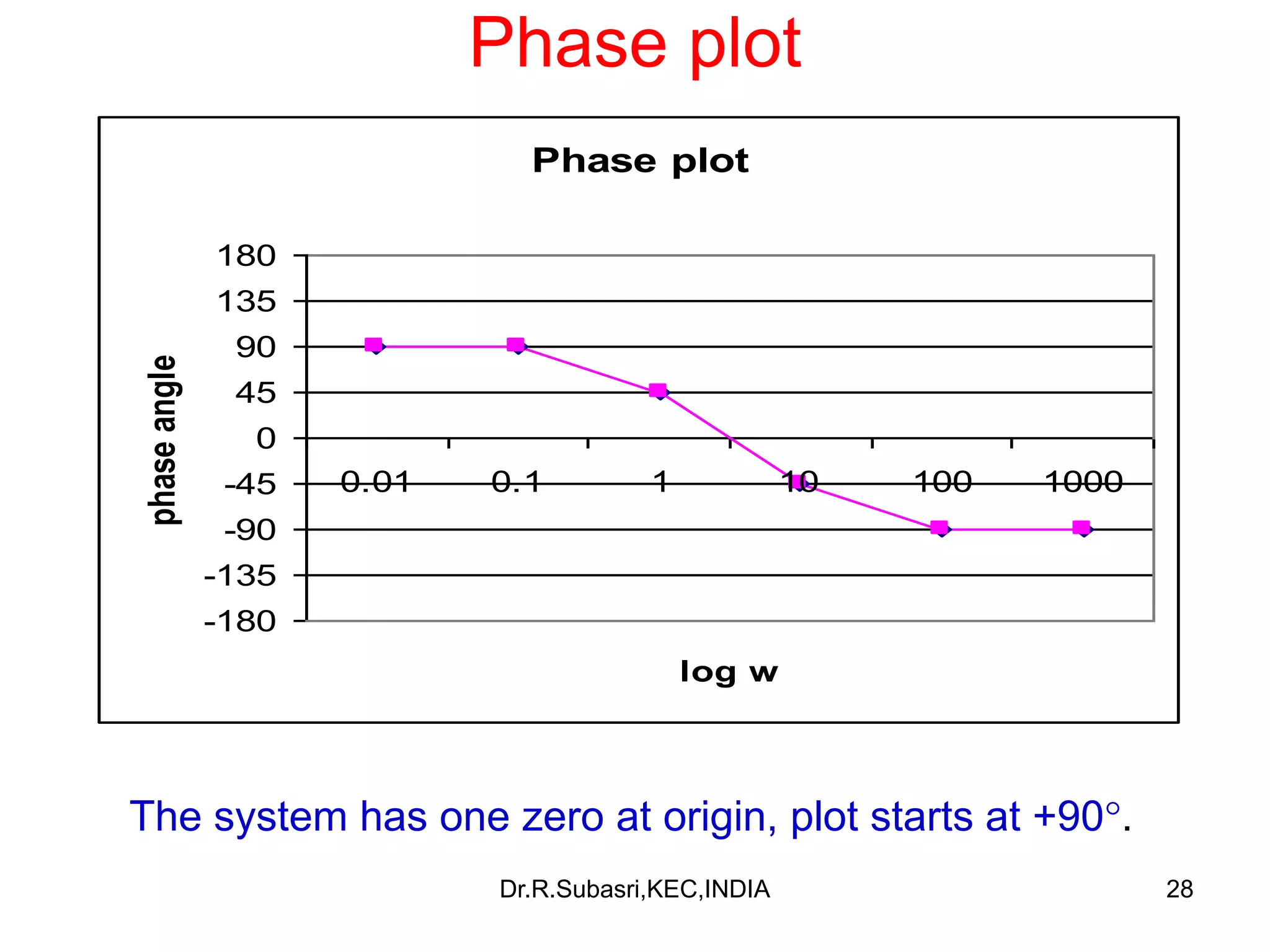
The system has one zero at origin, plot starts at +90.
Phase plot
-180
-135
-90
-45
0
45
90
135
180
0.01 0.1 1 10 100 1000
log w
phaseangle
Dr.R.Subasri,KEC,INDIA
29
Plot to transfer function
Magnitude plot
-12
-8
-4
0
1 2.5 10 25 50
log w
magindb
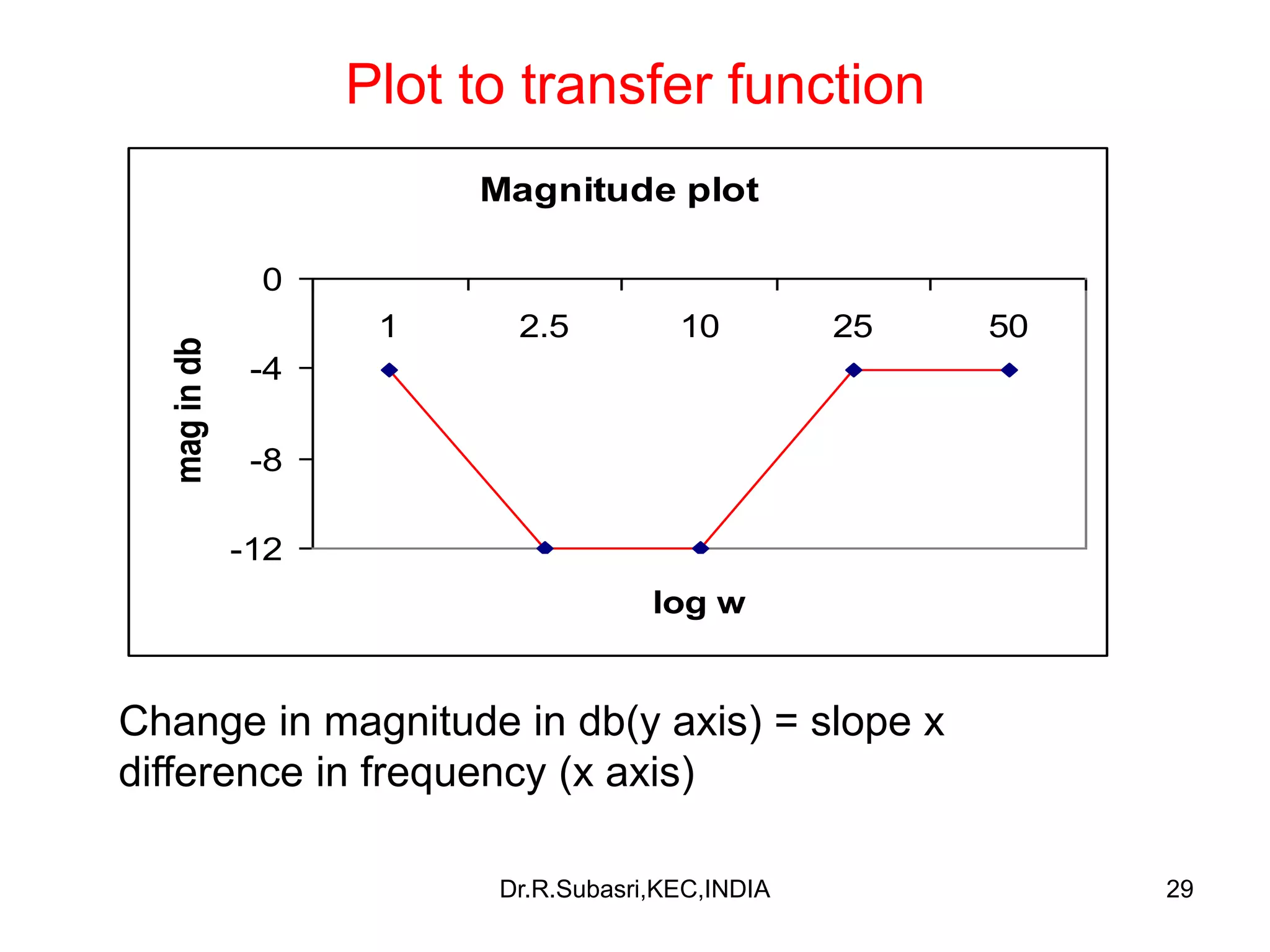
Change in magnitude in db(y axis) = slope x
difference in frequency (x axis)
Dr.R.Subasri,KEC,INDIA
30
Plot to transfer function
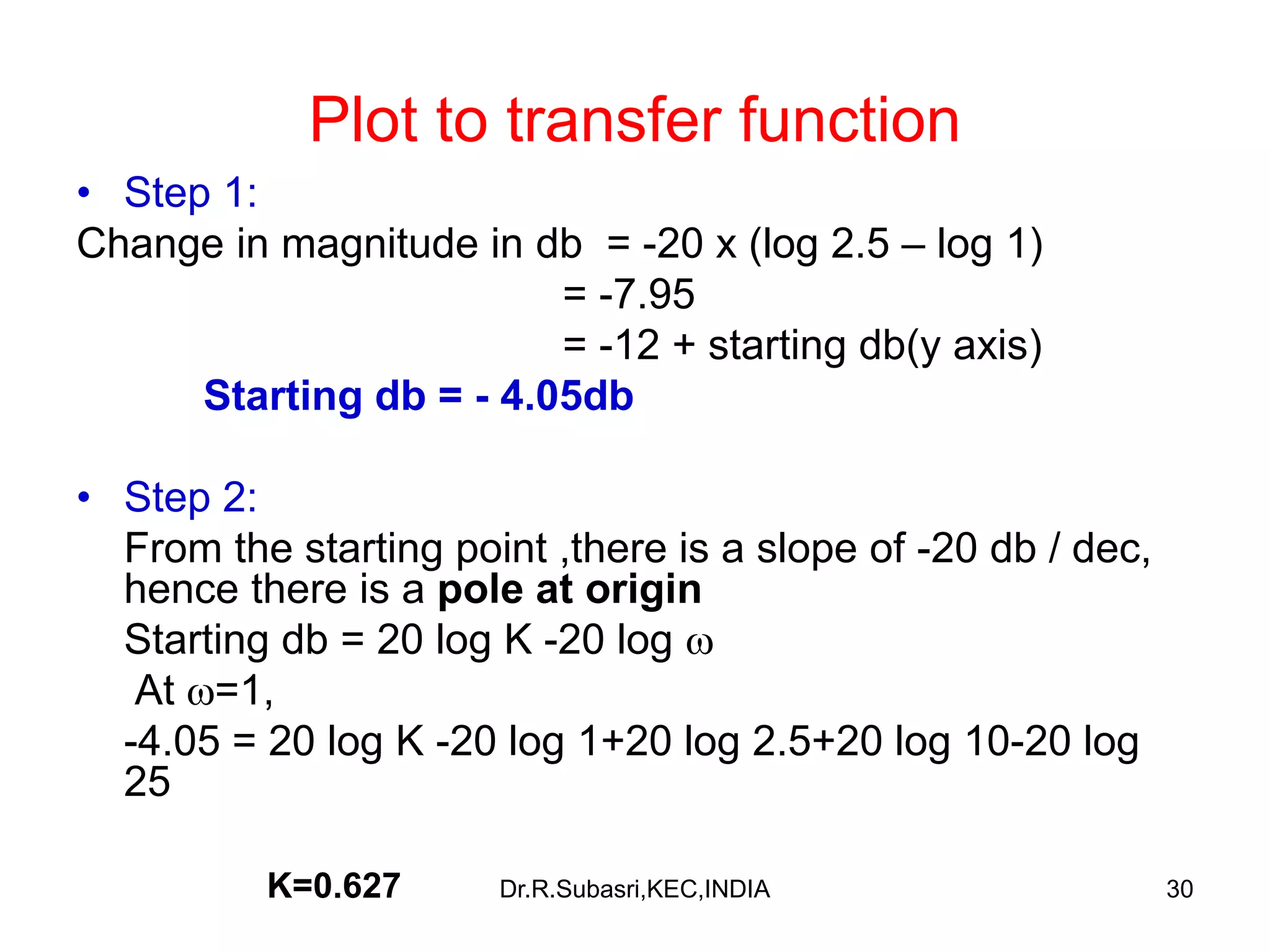
• Step 1:
Change in magnitude in db = -20 x (log 2.5 – log 1)
= -7.95
= -12 + starting db(y axis)
Starting db = - 4.05db
• Step 2:
From the starting point ,there is a slope of -20 db / dec,
hence there is a pole at origin
Starting db = 20 log K -20 log 
At =1,
-4.05 = 20 log K -20 log 1+20 log 2.5+20 log 10-20 log
25
K=0.627 Dr.R.Subasri,KEC,INDIA
31
Plot to transfer function
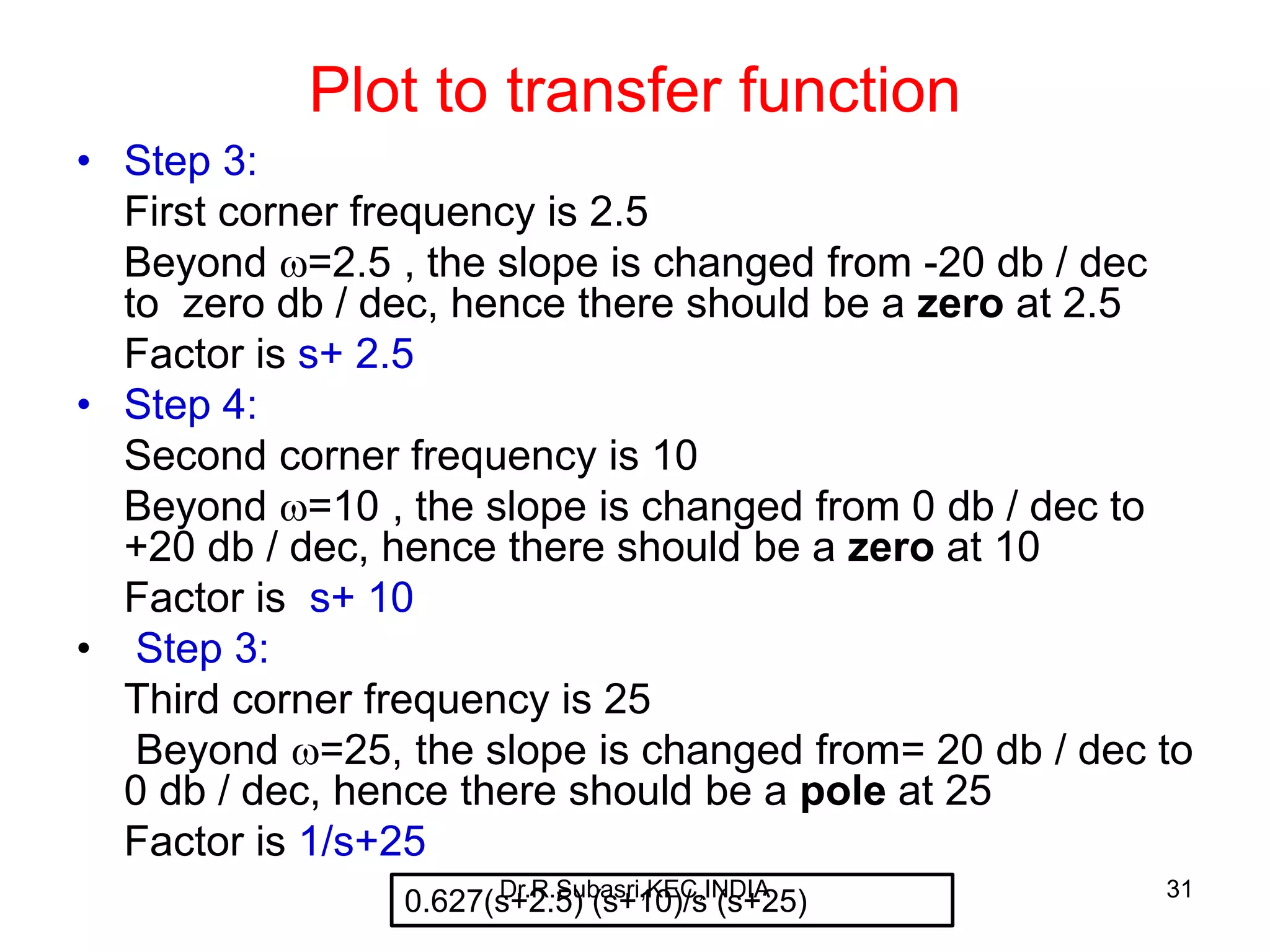
• Step 3:
First corner frequency is 2.5
Beyond =2.5 , the slope is changed from -20 db / dec
to zero db / dec, hence there should be a zero at 2.5
Factor is s+ 2.5
• Step 4:
Second corner frequency is 10
Beyond =10 , the slope is changed from 0 db / dec to
+20 db / dec, hence there should be a zero at 10
Factor is s+ 10
• Step 3:
Third corner frequency is 25
Beyond =25, the slope is changed from= 20 db / dec to
0 db / dec, hence there should be a pole at 25
Factor is 1/s+25
0.627(s+2.5) (s+10)/s (s+25)Dr.R.Subasri,KEC,INDIA
Dr.R.Subasri,KEC,INDIA 32
Thank you
Dr.R.Subasri,KEC,INDIA 33

Bode plot

  • 1.
    BODE PLOT Dr.R.Subasri Professor, KonguEngineering College, Perundurai, Erode, Tamilnadu, INDIA 1Dr.R.Subasri,KEC,INDIA
  • 2.
    2 Frequency Response Techniques •Analysing the system on frequency basis e.g communication systems • Developed by Nyquist and Bode in 1930 • Older than root locus method given by Evan in 1948 Dr.R.Subasri,KEC,INDIA
  • 3.
    3 Frequency Response Techniques –Radio telescopes used for deep space communication require precise positioning to function effectively. To achieve a high degree of precision ,an accurate mathematical model of antenna dynamics is to used. – To construct the model, engineers can test the antenna by vibrating it with sinusoidal forces of different frequencies and measuring the vibrations. These measurements form the basis for the model. Dr.R.Subasri,KEC,INDIA
  • 4.
    4 Chapter objectives • Definitionof frequency response • How to plot frequency response • How to use frequency response to analyse stability • How to use frequency response to design the gain to meet stability specifications. Dr.R.Subasri,KEC,INDIA
  • 5.
    5 Frequency Response Techniques -Advantages •modelling transfer functions from physical data. • Designing compensators to meet steady state error and transient response requirements. • Finding stability of systems Dr.R.Subasri,KEC,INDIA
  • 6.
    6 Frequency Response • Inthe steady state, sinusoidal inputs to a linear system generate sinusoidal responses of the same frequency. • But output differs in amplitudes and phase angle from the input • Differences are function of frequency. Dr.R.Subasri,KEC,INDIA
  • 7.
    7 Frequency Response )( )( )(    i o M M M = )()()( io −= )()(  M )()(  iiM  )()(  ooM  )()(  ooM  = )]()([)()(  + iMiM Magnitude frequency response = Phase frequency response = Combination of magnitude and phase frequency responses is Frequency response In general Frequency response of a system with transfer function G(s) is )()(  M  jSsGjG →= /)()(Dr.R.Subasri,KEC,INDIA
  • 8.
    8 Frequency response plots ❖Bodeplot(or)Asymptotic Approximation Plot (or)Logarithmic plot ❖Polar plot – Nyquist plot ❖Log Magnitude Vs phase angle Dr.R.Subasri,KEC,INDIA
  • 9.
    9 Logarithmic Frequency Scales Ona logarithmic scale, the variable is multiplied by a given factor for equal increments of length along the axis. Decade Change –log10 Octave change – log2 Dr.R.Subasri,KEC,INDIA
  • 10.
    10 Bode Plot • Factorsof a transfer function • Constant term K • - Pure Differentiator-zero at origin -s -Pure Integrator – pole at origin-1/s • First order terms - zero at real axis 1+s -pole at real axis 1/1+s • Second order terms - complex zero s2+2ns+ n 2 -complex pole 1/ s2+2ns+n 2 Dr.R.Subasri,KEC,INDIA
  • 11.
    11 Constant K consatnt factorG(s) = K -20 0 20 40 0.1 1 10 100 log w magnitudeindb consatnt factor G(s) = K -90 -45 0 45 90 0.1 1 10 100 log w phaseangleindeg Magnitude plot is constant and independent of frequency Phase plot is constant at zero and independent of frequency Dr.R.Subasri,KEC,INDIA
  • 12.
    12 Pure Integrator 1/s pureintegrator-pole at origin G(s)=1/s -40 -20 0 20 40 0.1 1 10 100 logw magindb Pure Integrator G(s) = 1 / s -180 -135 -90 -45 0 45 90 0.1 1 10 100 log w phaseangleindeg starting point of magnitude plot is - 20 log  , where  is the starting frequency in the plot. The plot starts from that point and has the slope of - 20 db / dec. Phase angle is - 90 - a straight line with no slope Dr.R.Subasri,KEC,INDIA
  • 13.
    13 Pure Differentiator- s puredifferentiator-zero at origin G(s)=s -40 -20 0 20 40 0.1 1 10 100 logw magindb Pure Differentiator G(s) = s -90 -45 0 45 90 135 180 0.1 1 10 100 log w phaseangleindeg starting point of magnitude plot is + 20 log  , where  is the starting frequency in the plot. The plot starts from that point and has the slope of + 20 db / dec. Phase angle is + 90 - a straight line with no slopeDr.R.Subasri,KEC,INDIA
  • 14.
    14 Zero at realaxis - 1+s first order term-zero at real axis G(s)=1+sT -40 -20 0 20 40 0.1/T 1/T 10/T 100/T logwT magindb First order term-zero at real axis G(s)=1+sT -90 -45 0 45 90 135 180 0.1/T 1/T 10/T 100/T log wT phaseangleindeg For a constant zero at real axis, in low frequency region, phase angle is 0 and in high frequency region, phase angle is + 90,in between the slope is + 45 / dec. For a constant zero at real axis, find the corner frequency c = 1/T.Up to c,the magnitude plot is a straight line at 0 db and beyond c, the plot has a line of slope + 20 db / dec.Dr.R.Subasri,KEC,INDIA
  • 15.
    15 Pole at realaxis - 1/s+T For a constant pole at real axis, in low frequency region, phase angle is 0 and in high frequency region, phase angle is -90,in between the slope is - 45 / dec. For a constant zero at real axis, find the corner frequency c = T. Up to c,the magnitude plot is a straight line at 0 db and beyond c, the plot has a line of slope - 20 db / dec. Dr.R.Subasri,KEC,INDIA
  • 16.
    16 Complex zero -s2+2ns+n 2 second order term- complex zero -40 -20 0 20 40 60 80 100 0.1 1 10 100 log w magindb second order term- complex zero -180 -135 -90 -45 0 45 90 135 180 0.1 1 10 100 log w phaseangleindeg For a complex zero, find the corner frequency c =n .Up to c,the magnitude plot is a straight line at +40 log n and beyond c, the plot has a line of slope + 40 db / dec. For a complex zero, in low frequency region, phase angle is 0 and in high frequency region, phase angle is + 180,in between the slope is + 90 / dec. Dr.R.Subasri,KEC,INDIA
  • 17.
    17 Complex pole -1/ s2+2ns+n 2 second order term- complex pole -100 -80 -60 -40 -20 0 20 40 0.1 1 10 100 log w magindb second order term- complex pole -180 -135 -90 -45 0 45 90 135 180 0.1 1 10 100 log w phaseangleindegFor a complex pole,find the corner frequency c =n .Up to c,the magnitude plot is a straight line at -40 log n and beyond c, the plot has a line of slope - 40 db / dec. For a complex zero, in low frequency region, phase angle is 0 and in high frequency region, phase angle is - 180,in between the slope is - 90 / dec. Dr.R.Subasri,KEC,INDIA
  • 18.
    18 Bode Magnitude plot •For a constant K, magnitude in db is 20 log K-a straight line with no slope • For a zero at origin or a pole at origin,(s or 1/s) starting point of magnitude plot is  20 log  , where  is the starting frequency in the plot. The plot starts from that point and has the slope of  20 db / dec. Dr.R.Subasri,KEC,INDIA
  • 19.
    19 Bode Magnitude plot •For a constant zero at real axis or a pole at real axis(s+T or 1 / s=T),find the corner frequency c = T. Up to c,the magnitude plot is a straight line at 0 db and beyond c, the plot has a line of slope  20 db / dec. • For a complex zero or pole in the form s2+2ns+n 2, find the corner frequency c =n. Up to c,the magnitude plot is a straight line at 40 log n and beyond c, the plot has a line of slope  40 db / dec. Dr.R.Subasri,KEC,INDIA
  • 20.
    20 Bode Phase plot •For a constant K, Phase angle is 0- a straight line with no slope • For a zero at origin or a pole at origin,(s or 1/s)- Phase angle is  90-a straight line with no slope • For a constant zero at real axis or a pole at real axis(s+T or 1 / s+T), in low frequency region, phase angle is 0 and in high frequency region, phase angle is  90,in between the slope is  45 / dec. Dr.R.Subasri,KEC,INDIA
  • 21.
    21 Bode Phase plot •For a complex zero or pole, in low frequency region, phase angle is 0 and in high frequency region, phase angle is  180,in between the slope is  90 / dec. • Low frequency region - the frequencies up to one decade below the corner frequency • High frequency region -all the frequencies beyond one decade above the corner frequency Dr.R.Subasri,KEC,INDIA
  • 22.
    22 Starting point inBode Plot Magnitude plot • Sum of the contributions of • 1. Constant term K ------------ 20 log K • 2. Zero or pole at origin---------  20 log  , where  is the starting frequency in the plot • 3.real zero or pole -------------- 20 log T • 3. Complex zero or pole-------- 40 log n Phase plot Contribution from • zero at origin or a pole at origin,(s or 1/s) which is  90. Dr.R.Subasri,KEC,INDIA
  • 23.
    23 Bode magnitude Plot-Example G(s)= 2s/(s+1)(s+10) Factor Corner frequency c Magnitude in db slope 2 -- 20 log 2 - s - 20 log  20 db / dec 1/1+s 1 Up to =1,20 log1=0 db & 0 slope Beyond =1,- 20 db / dec +20 – 20 = 0 db / dec. 1 /s+10 10 Up to =10, - 20 log 10 db & 0 slope Beyond =10,- 20 db / dec 0 – 20 = -20 db /dec Dr.R.Subasri,KEC,INDIA
  • 24.
    24 Bode magnitude Plot-Example Magnitudeplot -40 -20 0 20 40 0.01 0.1 1 10 100 log w magindb Let the starting frequency  = 0.1, then starting point of the plot is:20 log 2 + 20 log 0.1-20 log1-20 log 10= -34 dbDr.R.Subasri,KEC,INDIA
  • 25.
  • 26.
  • 27.
    27 Phase plot –slopecontribution Start of 1/1+s Start of 1 /1+s/10 End of 1/1+s End of 1 /1+s/10  0.1 1 10 100 1/1+s -45 -45 - - 1 /1+s/10 - -45 -45 - Total slope -45 / dec -90/ dec -45/ dec - Dr.R.Subasri,KEC,INDIA
  • 28.
    28 Phase plot The systemhas one zero at origin, plot starts at +90. Phase plot -180 -135 -90 -45 0 45 90 135 180 0.01 0.1 1 10 100 1000 log w phaseangle Dr.R.Subasri,KEC,INDIA
  • 29.
    29 Plot to transferfunction Magnitude plot -12 -8 -4 0 1 2.5 10 25 50 log w magindb Change in magnitude in db(y axis) = slope x difference in frequency (x axis) Dr.R.Subasri,KEC,INDIA
  • 30.
    30 Plot to transferfunction • Step 1: Change in magnitude in db = -20 x (log 2.5 – log 1) = -7.95 = -12 + starting db(y axis) Starting db = - 4.05db • Step 2: From the starting point ,there is a slope of -20 db / dec, hence there is a pole at origin Starting db = 20 log K -20 log  At =1, -4.05 = 20 log K -20 log 1+20 log 2.5+20 log 10-20 log 25 K=0.627 Dr.R.Subasri,KEC,INDIA
  • 31.
    31 Plot to transferfunction • Step 3: First corner frequency is 2.5 Beyond =2.5 , the slope is changed from -20 db / dec to zero db / dec, hence there should be a zero at 2.5 Factor is s+ 2.5 • Step 4: Second corner frequency is 10 Beyond =10 , the slope is changed from 0 db / dec to +20 db / dec, hence there should be a zero at 10 Factor is s+ 10 • Step 3: Third corner frequency is 25 Beyond =25, the slope is changed from= 20 db / dec to 0 db / dec, hence there should be a pole at 25 Factor is 1/s+25 0.627(s+2.5) (s+10)/s (s+25)Dr.R.Subasri,KEC,INDIA
  • 32.
  • 33.