Rajendra Akerkar1 and Priti Srinivas Sajja2

   1Senior
    S i    Researcher, Vestlandsforsking, Norway
           R       h    V tl d f     ki     N
2Associate Professor, Sardar Patel University, India
     1 rak@vestforsk.no 2 priti_sajja@yahoo.com
NEURO-FUZZY COMPUTING


                         Neural Nets                      Fuzzy Logic
 Knowledge
 K     l d       Implicit, th
                 I li it the system cannot
                                  t       t       Explicit,
                                                  E li it verification and
                                                               ifi ti    d
Representation   be easily interpreted or         optimization easy and
                 modified (-)                     efficient (+++)

                 Trains itself by learning from   None,
                                                  None you have to define
 Trainability    data sets (+++)                  everything explicitly (-)


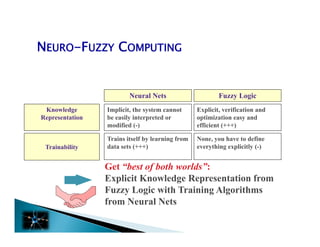
                 Get “best of both worlds”:
                            f
                 Explicit Knowledge Representation from
                 Fuzzy Logic with Training Algorithms
                 from Neural Nets
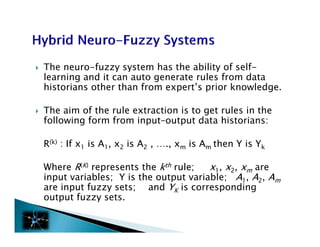
   The neuro-fuzzy system has the ability of self-
    learning and it can auto generate rules from data
    historians other than from expert’s prior knowledge.

   The i
    Th aim of the rule extraction is to get rules in the
              f th   l    t ti    i t     t l i th
    following form from input–output data historians:

    R(k) : If x1 is A1, x2 is A2 , …., xm is Am then Y is Yk

    Where R(K) represents the kth rule;
       e e      ep ese ts t e      u e;   x1, x2, xm are
                                                     a e
    input variables; Y is the output variable; A1, A2, Am
    are input fuzzy sets; and YK is corresponding
    output fuzzy sets.
       p        y
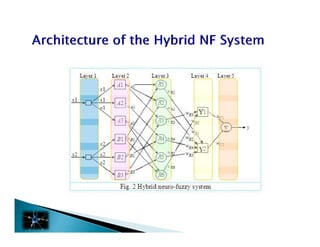
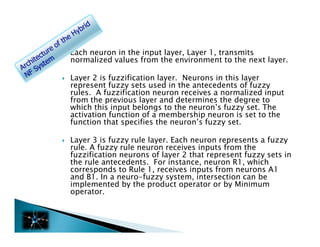
   Each neuron in the input layer, Layer 1, transmits
    normalized values from the environment to the next layer.

   Layer 2 is fuzzification layer Neurons in this layer
                             layer.
    represent fuzzy sets used in the antecedents of fuzzy
    rules. A fuzzification neuron receives a normalized input
    from the previous layer and determines the degree to
    which this input belongs to the neuron s fuzzy set. The
                                    neuron’s         set
    activation function of a membership neuron is set to the
    function that specifies the neuron’s fuzzy set.

   Layer 3 is fuzzy rule layer Each neuron represents a fuzzy
                          layer.
    rule. A fuzzy rule neuron receives inputs from the
    fuzzification neurons of layer 2 that represent fuzzy sets in
    the rule antecedents. For instance, neuron R1, which
    corresponds to Rule 1, receives inputs from neurons A1
                          1
    and B1. In a neuro-fuzzy system, intersection can be
    implemented by the product operator or by Minimum
    operator.
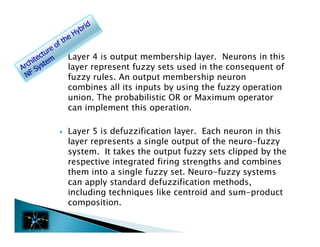
   Layer 4 is output membership layer. Neurons in this
    layer represent fuzzy sets used in the consequent of
    fuzzy rules An output membership neuron
           rules.
    combines all its inputs by using the fuzzy operation
    union. The probabilistic OR or Maximum operator
    can implement this operation.
                        operation

   Layer 5 is defuzzification layer. Each neuron in this
    layer represents a single output of the neuro-fuzzy
    l              t     i l     t t f th          f
    system. It takes the output fuzzy sets clipped by the
    respective integrated firing strengths and combines
    them into a single ffuzzy set Ne ro f
                              set. Neuro-fuzzy s stems
                                               systems
    can apply standard defuzzification methods,
    including techniques like centroid and sum-product
    composition.
    composition
   Importance of small scale system in economy
   Though data is available, generalization of
    rules is difficult
   Expertise i scarce resource
    E      i is
   Requirement
    ◦ Need of effective advisory
    ◦ User interface
    ◦ Self-learning
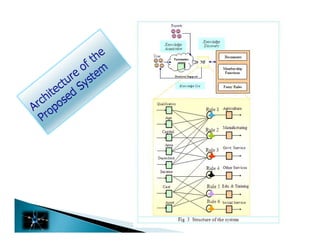
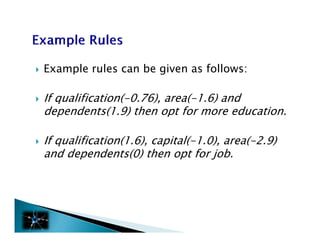
   Example rules can be given as follows:

   If qualification(-0.76), area(-1.6) and
    dependents(1.9) then opt f more education.
    d      d      (1 9) h       for        d i

   If qualification(1 6) capital(-1.0), area( 2 9)
       qualification(1.6), capital( 1 0) area(-2.9)
    and dependents(0) then opt for job.
   Such advisory system can be more
    generalized and can be considered as a step
    towards expert system shell with empty
    knowledge base and an additional editor to
    document domain knowledge.
A neuro fuzzy decision support system

A neuro fuzzy decision support system

  • 1.
    Rajendra Akerkar1 andPriti Srinivas Sajja2 1Senior S i Researcher, Vestlandsforsking, Norway R h V tl d f ki N 2Associate Professor, Sardar Patel University, India 1 rak@vestforsk.no 2 priti_sajja@yahoo.com
  • 2.
    NEURO-FUZZY COMPUTING Neural Nets Fuzzy Logic Knowledge K l d Implicit, th I li it the system cannot t t Explicit, E li it verification and ifi ti d Representation be easily interpreted or optimization easy and modified (-) efficient (+++) Trains itself by learning from None, None you have to define Trainability data sets (+++) everything explicitly (-) Get “best of both worlds”: f Explicit Knowledge Representation from Fuzzy Logic with Training Algorithms from Neural Nets
  • 4.
    The neuro-fuzzy system has the ability of self- learning and it can auto generate rules from data historians other than from expert’s prior knowledge.  The i Th aim of the rule extraction is to get rules in the f th l t ti i t t l i th following form from input–output data historians: R(k) : If x1 is A1, x2 is A2 , …., xm is Am then Y is Yk Where R(K) represents the kth rule; e e ep ese ts t e u e; x1, x2, xm are a e input variables; Y is the output variable; A1, A2, Am are input fuzzy sets; and YK is corresponding output fuzzy sets. p y
  • 6.
    Each neuron in the input layer, Layer 1, transmits normalized values from the environment to the next layer.  Layer 2 is fuzzification layer Neurons in this layer layer. represent fuzzy sets used in the antecedents of fuzzy rules. A fuzzification neuron receives a normalized input from the previous layer and determines the degree to which this input belongs to the neuron s fuzzy set. The neuron’s set activation function of a membership neuron is set to the function that specifies the neuron’s fuzzy set.  Layer 3 is fuzzy rule layer Each neuron represents a fuzzy layer. rule. A fuzzy rule neuron receives inputs from the fuzzification neurons of layer 2 that represent fuzzy sets in the rule antecedents. For instance, neuron R1, which corresponds to Rule 1, receives inputs from neurons A1 1 and B1. In a neuro-fuzzy system, intersection can be implemented by the product operator or by Minimum operator.
  • 7.
    Layer 4 is output membership layer. Neurons in this layer represent fuzzy sets used in the consequent of fuzzy rules An output membership neuron rules. combines all its inputs by using the fuzzy operation union. The probabilistic OR or Maximum operator can implement this operation. operation  Layer 5 is defuzzification layer. Each neuron in this layer represents a single output of the neuro-fuzzy l t i l t t f th f system. It takes the output fuzzy sets clipped by the respective integrated firing strengths and combines them into a single ffuzzy set Ne ro f set. Neuro-fuzzy s stems systems can apply standard defuzzification methods, including techniques like centroid and sum-product composition. composition
  • 8.
    Importance of small scale system in economy  Though data is available, generalization of rules is difficult  Expertise i scarce resource E i is  Requirement ◦ Need of effective advisory ◦ User interface ◦ Self-learning
  • 10.
    Example rules can be given as follows:  If qualification(-0.76), area(-1.6) and dependents(1.9) then opt f more education. d d (1 9) h for d i  If qualification(1 6) capital(-1.0), area( 2 9) qualification(1.6), capital( 1 0) area(-2.9) and dependents(0) then opt for job.
  • 14.
    Such advisory system can be more generalized and can be considered as a step towards expert system shell with empty knowledge base and an additional editor to document domain knowledge.