Financial Strategy and
Financial Objectives
“Running by the Numbers”
Financial Strategy
answers these ?
How much will it cost to startup?
How much will it cost to run the venture?
 Short

term cash needs when revenue low

Revenue and Expenses- operations
Capital (for fixed assets and business
expansion), how much and when.
Sources of capital
 Investors

– equity
 Loans - debt
Financial Strategy Components
Sales forecasts
Selling costs
Gross profit
Admin. Costs
Pre-tax profit
Balance sheet
Working Capital
Return on Investment
Repayment proposal
Collateral
Financial Strategy
Provide specific
details about when
and how much
money is needed
Provide HI-MID-LO
estimates of future
performance


For sales, profits and
loan repayments
Financial Planning Process
1.
2.
3.
4.

Establish Financial
Objectives
Prepare a Personal
Budget
Estimate Revenue
& Expenses
Prepare a cash
flow projection

5.

6.
7.

Calculate startup
costs and
operating
expenses
Prepare a personal
balance sheet
Prepare income
forecasts and
projected balance
sheets
Financial Strategy
Used to “capitalize”
the venture
Finance
 A –L = OE
 How much Owners
Equity?
 How much Debt?

Financial Objectives
 All companies need money, therefore, financial
objectives must be established and reached.
  Examples of financial objectives:
  Canadian Cancer Society


Raise $5 for every Canadian
Breakeven

 Gus’s Pizza
 

To increase market share to 10%
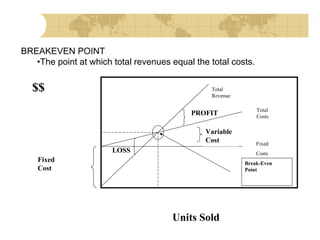
BREAKEVEN POINT
•The point at which total revenues equal the total costs.

$$

Total
Revenue

PROFIT
Variable
Cost
LOSS

Total
Costs

Fixed
Costs

Fixed
Cost

Break-Even
Point

Units Sold
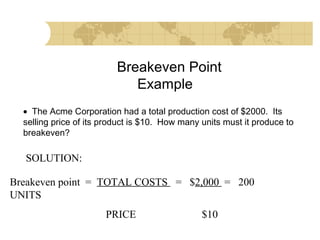
Breakeven Point
Example
• The Acme Corporation had a total production cost of $2000. Its
selling price of its product is $10. How many units must it produce to
breakeven?

SOLUTION:
Breakeven point = TOTAL COSTS = $2,000 = 200
UNITS
PRICE

$10
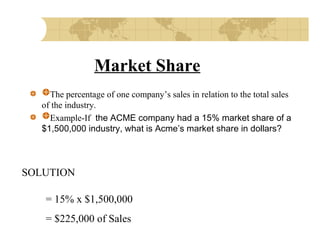
Market Share
The percentage of one company’s sales in relation to the total sales
of the industry.
Example-If the ACME company had a 15% market share of a
$1,500,000 industry, what is Acme’s market share in dollars?

SOLUTION
= 15% x $1,500,000
= $225,000 of Sales
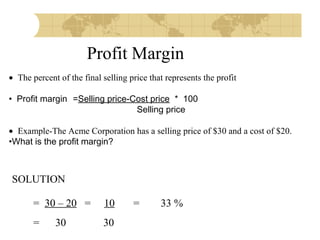
Profit Margin
• The percent of the final selling price that represents the profit
 
• Profit margin =Selling price-Cost price * 100
Selling price
 
• Example-The Acme Corporation has a selling price of $30 and a cost of $20.
•What is the profit margin?

SOLUTION
= 30 – 20 =

10

=

30

30

=

33 %
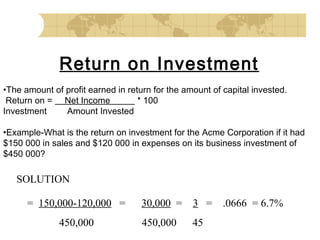
Return on Investment
•The amount of profit earned in return for the amount of capital invested.
 Return on = Net Income
* 100
Investment
Amount Invested
 
•Example-What is the return on investment for the Acme Corporation if it had
$150 000 in sales and $120 000 in expenses on its business investment of
$450 000?

SOLUTION
= 150,000-120,000 =

30,000 =

3 = .0666 = 6.7%

450,000

450,000

45
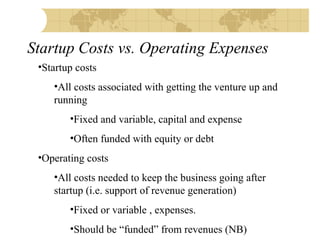
Startup Costs vs. Operating Expenses
•Startup costs
•All costs associated with getting the venture up and
running
•Fixed and variable, capital and expense
•Often funded with equity or debt
•Operating costs
•All costs needed to keep the business going after
startup (i.e. support of revenue generation)
•Fixed or variable , expenses.
•Should be “funded” from revenues (NB)

Financial strategy

  • 1.
    Financial Strategy and FinancialObjectives “Running by the Numbers”
  • 2.
    Financial Strategy answers these? How much will it cost to startup? How much will it cost to run the venture?  Short term cash needs when revenue low Revenue and Expenses- operations Capital (for fixed assets and business expansion), how much and when. Sources of capital  Investors – equity  Loans - debt
  • 3.
    Financial Strategy Components Salesforecasts Selling costs Gross profit Admin. Costs Pre-tax profit Balance sheet Working Capital Return on Investment Repayment proposal Collateral
  • 4.
    Financial Strategy Provide specific detailsabout when and how much money is needed Provide HI-MID-LO estimates of future performance  For sales, profits and loan repayments
  • 5.
    Financial Planning Process 1. 2. 3. 4. EstablishFinancial Objectives Prepare a Personal Budget Estimate Revenue & Expenses Prepare a cash flow projection 5. 6. 7. Calculate startup costs and operating expenses Prepare a personal balance sheet Prepare income forecasts and projected balance sheets
  • 6.
    Financial Strategy Used to“capitalize” the venture Finance  A –L = OE  How much Owners Equity?  How much Debt? 
  • 7.
    Financial Objectives  All companiesneed money, therefore, financial objectives must be established and reached.   Examples of financial objectives:   Canadian Cancer Society         Raise $5 for every Canadian Breakeven  Gus’s Pizza   To increase market share to 10%
  • 8.
    BREAKEVEN POINT •The pointat which total revenues equal the total costs. $$ Total Revenue PROFIT Variable Cost LOSS Total Costs Fixed Costs Fixed Cost Break-Even Point Units Sold
  • 9.
    Breakeven Point Example • TheAcme Corporation had a total production cost of $2000. Its selling price of its product is $10. How many units must it produce to breakeven? SOLUTION: Breakeven point = TOTAL COSTS = $2,000 = 200 UNITS PRICE $10
  • 10.
    Market Share The percentageof one company’s sales in relation to the total sales of the industry. Example-If the ACME company had a 15% market share of a $1,500,000 industry, what is Acme’s market share in dollars? SOLUTION = 15% x $1,500,000 = $225,000 of Sales
  • 11.
    Profit Margin • Thepercent of the final selling price that represents the profit   • Profit margin =Selling price-Cost price * 100 Selling price   • Example-The Acme Corporation has a selling price of $30 and a cost of $20. •What is the profit margin? SOLUTION = 30 – 20 = 10 = 30 30 = 33 %
  • 12.
    Return on Investment •Theamount of profit earned in return for the amount of capital invested.  Return on = Net Income * 100 Investment Amount Invested   •Example-What is the return on investment for the Acme Corporation if it had $150 000 in sales and $120 000 in expenses on its business investment of $450 000? SOLUTION = 150,000-120,000 = 30,000 = 3 = .0666 = 6.7% 450,000 450,000 45
  • 13.
    Startup Costs vs.Operating Expenses •Startup costs •All costs associated with getting the venture up and running •Fixed and variable, capital and expense •Often funded with equity or debt •Operating costs •All costs needed to keep the business going after startup (i.e. support of revenue generation) •Fixed or variable , expenses. •Should be “funded” from revenues (NB)