UNCLASSIFIED
UNCLASSIFIED
UNCLASSIFIED
UNCLASSIFIED
Welcome
Introduction to Seminar
What do you hope to learn in the next two hours:
Burning issues?
Topics of interest?
Opportunity to network
Have fun!
UNCLASSIFIED
UNCLASSIFIED
Setting Financial Strategy
Do you have a road map to drive your business
to where you want it to be?
When planning a holiday we:
Decide where we want to go
Decide when we want to go
Work out how will we get there
Work out how much will it cost
Decide if we can afford to pay for the type of
holiday we want
UNCLASSIFIED
UNCLASSIFIED
Did you have a plan when you first started in
business?
Do you want your business to be the best it
can be?
Financial strategy supports the strategic
objectives of the business
The tools you learn today when utilised effectively
will assist to evaluate and monitor the effectiveness
of your strategic plans as they are implemented
Setting Financial Strategy
UNCLASSIFIED
UNCLASSIFIED
Topics for today’s seminar
Good practice business strategy
Aligning your finances to your business strategy
How to develop a profit budget that works
The importance of forecasting cash flow
Cash flow forecasting made easy
UNCLASSIFIED
UNCLASSIFIED
Good practice business strategy
Improved business performance = stronger
financial results
You need to plan where you
want your business to be in
order for your business to get
there
Don’t over think it, and don’t
make it too long – a one page
plan will work just a well as a
100 page document
UNCLASSIFIED
UNCLASSIFIED
Good practice business strategy
Identifies performance issues
Identifies long-term objectives
Recognises capabilities and resources needed
Documents activities required to achieve the objectives
within a specific time frame
Objectives need to be:
Clear, concise and achievable
Focusing on the key drivers in business
Monitored and measured
What does business success look like and what
needs to be done to achieve it?
UNCLASSIFIED
UNCLASSIFIED
Good practice business strategy
Your annual business plan should include:
What worked and what didn’t
Are there any changes to your:
Market
Customers
Competition
Your objectives and goals for the year
How will you measure these?
What are the changes you want to make?
Any operational changes/resource requirements
Let’s spend a little time completing the table on page 6
to help you set some goals for the next year.
UNCLASSIFIED
UNCLASSIFIED
Aligning finance & business strategy
Your financial strategy should be a continuous
process of directing and allocating financial
resources of the business to meet your
strategic goals and objectives.
Need to regularly review the potential future
financial position to assess the ability of your
business to meet the business strategy.
UNCLASSIFIED
UNCLASSIFIED
Aligning finance & business strategy
Budgets and forecasts are critical tools that will
predict the future financial position of your
business.
Budget vs Forecast:
Budget: sets out the financial goals of the business in
line with the strategic plan
Forecast: tracks the actual financial outcomes in line
with budget predictions, providing a valuable tool to
assess the likelihood of the achievement of the
budget
UNCLASSIFIED
UNCLASSIFIED
Good Financial Strategy
Realistic targets that align with:
Strategic business plans
Historical trading activities
Credible assumptions and targets in line with
industry trends.
Documented assumptions, including source of
information.
UNCLASSIFIED
UNCLASSIFIED
Good Financial Strategy
Budgeted timelines aligning to:
Strategic business plans
Financial statements timelines
Regular comparison of budgets against actual
financial results.
Scope to amend activities and targets where
budgeted outcomes will not be met.
UNCLASSIFIED
UNCLASSIFIED
Benefits of Good Financial Strategy
Clarity on the key drivers of your business
Tools to measure and monitor performance
Improved profitability
Increase efficiency in the use of resources and
assets
Increase productivity
Increased market share
Improved cashflow
UNCLASSIFIED
UNCLASSIFIED
A profit budget that works
Good practice budgeting requires the following:
Preparation of strategic goals
Budgeted timelines that align to financial
statements
Regular comparison of budgets against actual
financial results
Scope for amending activities and targets where
actual results indicate that budgeted outcomes
will not be met
UNCLASSIFIED
UNCLASSIFIED
A profit budget that works
Profit budgets are one of the most important
financial statements
They provide information on the predicted future
financial performance of the business
Will be the central financial statement to monitor
the financial impact of the implementation of your
strategic plans.
UNCLASSIFIED
UNCLASSIFIED
Profit and Loss Budget
Important tool for your business
Summary of expected income and expenses
Timeline usually one year
Monitor results regularly
UNCLASSIFIED
UNCLASSIFIED
Profit and Loss Budget Hint
By preparing a profit and loss budget annually,
you will be in a position to determine if your
future business plans will support the ongoing
activities of your business.
UNCLASSIFIED
UNCLASSIFIED
Getting Started
Undertake in orderly manner
Involve key staff
Document all steps
Two types:
Incremental – using previous year’s activities
Zero-based – no consideration of past activities
UNCLASSIFIED
UNCLASSIFIED
Getting Started
Review strategic plan and note activities for
the budget
Separate activities into existing and new
Document all assumptions
Review prior year’s profit and loss statements
UNCLASSIFIED
UNCLASSIFIED
Budgeting Tip
An independent profit and loss budget can be
developed for separate projects to assess the
financial viability of each project.
UNCLASSIFIED
UNCLASSIFIED
Assumptions
Estimated events that will have a financial impact
in the future
Use realistic targets that will be achievable
Use historic financial information
Look for any trends
Industry information will give your assumptions
credibility
Document assumptions
Attach to budget
Let’s look at the assumptions table on page 9
UNCLASSIFIED
UNCLASSIFIED
Profit and Loss Budget
Let’s look at the Profit and Loss Budget
on page 10.
A template for a profit and loss budget can be
found by searching “profit and loss budget” at
www.business.vic.gov.au
UNCLASSIFIED
UNCLASSIFIED
Managing Profit and Loss Budget
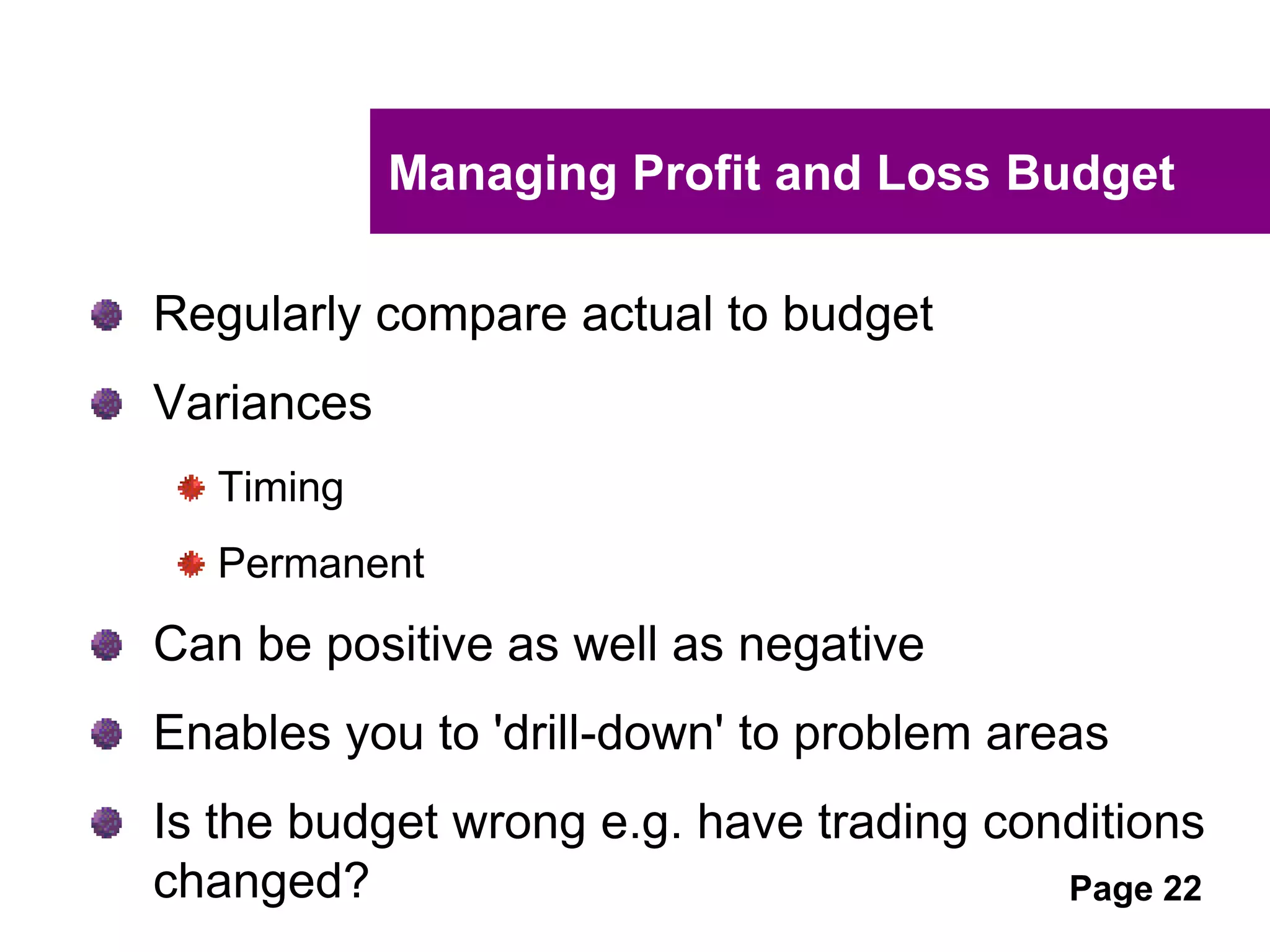
Regularly compare actual to budget
Variances
Timing
Permanent
Can be positive as well as negative
Enables you to 'drill-down' to problem areas
Is the budget wrong e.g. have trading conditions
changed?
UNCLASSIFIED
UNCLASSIFIED
Managing Profit and Loss Budget Hint
The more regular the reports, the quicker
operations can be reviewed for financial
impact and action can be implemented
immediately where required.
UNCLASSIFIED
UNCLASSIFIED
BUDGET is where we would like to be:
Based on annual business plan
With intervention built in to achieve objectives
Usually once a year
To provide a planned outcome
A budget should not be amended unless the
goals and objectives have changed.
Budget versus Forecast
UNCLASSIFIED
UNCLASSIFIED
Forecast is planned events translated into
financial statements based on actual events
Without intervention
Real cash movements
Continually updated
A monitoring tool where the actual results are recorded to
provide a “forecast” of the planned outcomes based on how
the business is currently operating.
Let’s look at Sofie’s example on page on page 12.
Budget versus Forecast
UNCLASSIFIED
UNCLASSIFIED
Cashflow Forecasting
Planning future cashflows
Important for business planning:
Support business operations
Business expansion
Essential for financial survival
Usually over a twelve month period
‘Rolling plan’ is the most useful
UNCLASSIFIED
UNCLASSIFIED
Profit versus Cash
PROFIT DOES NOT EQUAL CASH!
A profitable business can still have cashflow issues.
Profit - is the amount remaining after total sales
value less costs for stock and all other expenses.
Cash - is generated from all cash inflows less all
cash outflows.
UNCLASSIFIED
UNCLASSIFIED
Profit versus Cash
Profit Cash
GST
Principle loan
repayments
Interest loan
repayments
Proceeds from sale
of assets
Depreciation
UNCLASSIFIED
UNCLASSIFIED
Cashflow Forecasting Hint
Remember that cashflow is all about timing
and the flow of cash, so when preparing your
cashflow forecast, make sure you are as
accurate as possible on the timing of the
cashflows.
UNCLASSIFIED
UNCLASSIFIED
Cashflow Forecasting
Five step approach:
1. Prepare a list of assumptions
2. Prepare the anticipated income or sales for
the business – sales forecast
3. Prepare detail on any other estimated cash
inflows
4. Prepare detail on all estimated cash outflows
5. Put all information together – cashflow
forecast
UNCLASSIFIED
UNCLASSIFIED
Cashflow Forecasting
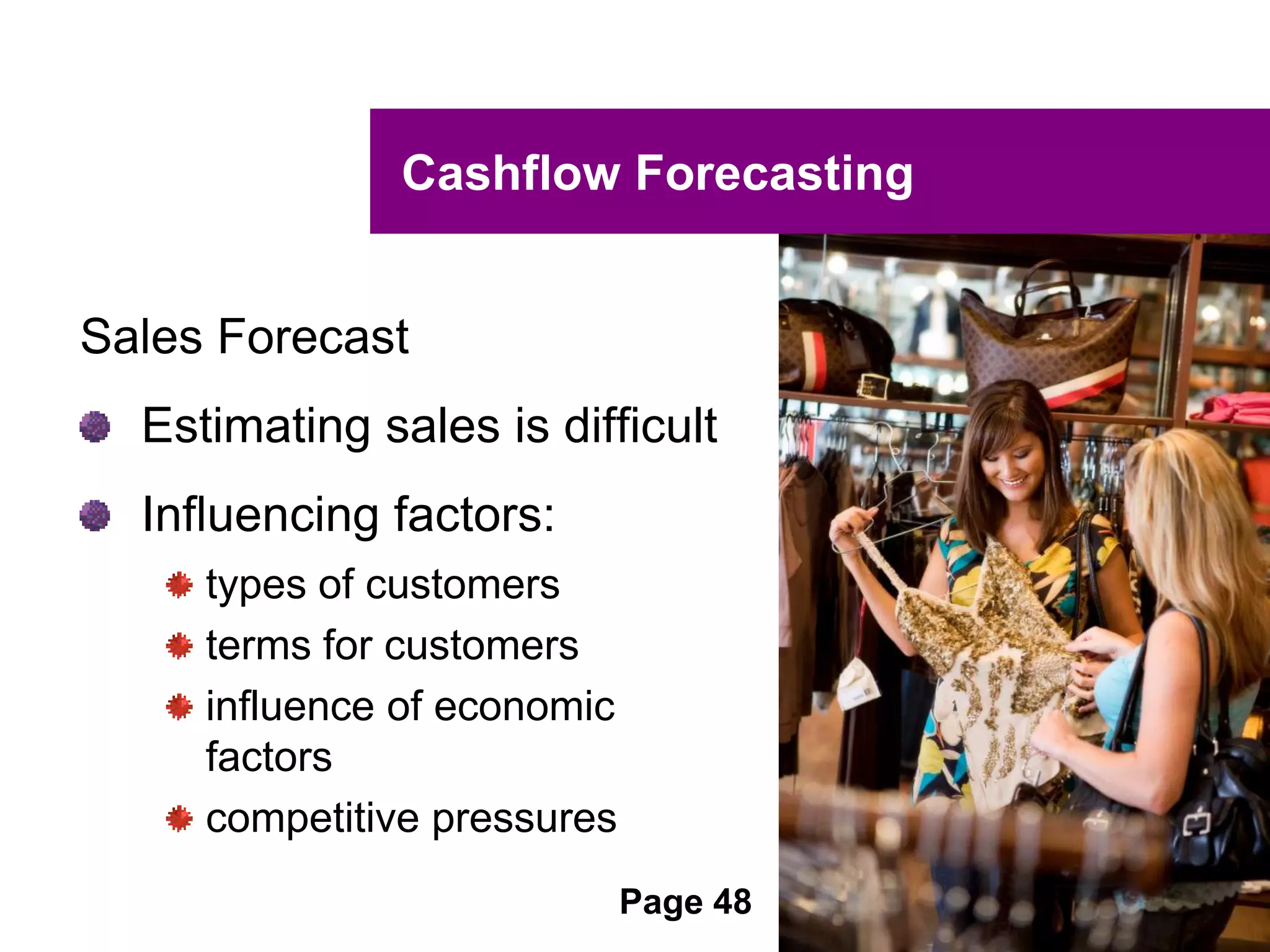
Sales Forecast
Estimating sales is difficult
Influencing factors:
Types of customers
Terms for customers
Influence of economic
factors
Competitive pressures
UNCLASSIFIED
UNCLASSIFIED
Cashflow Forecasting
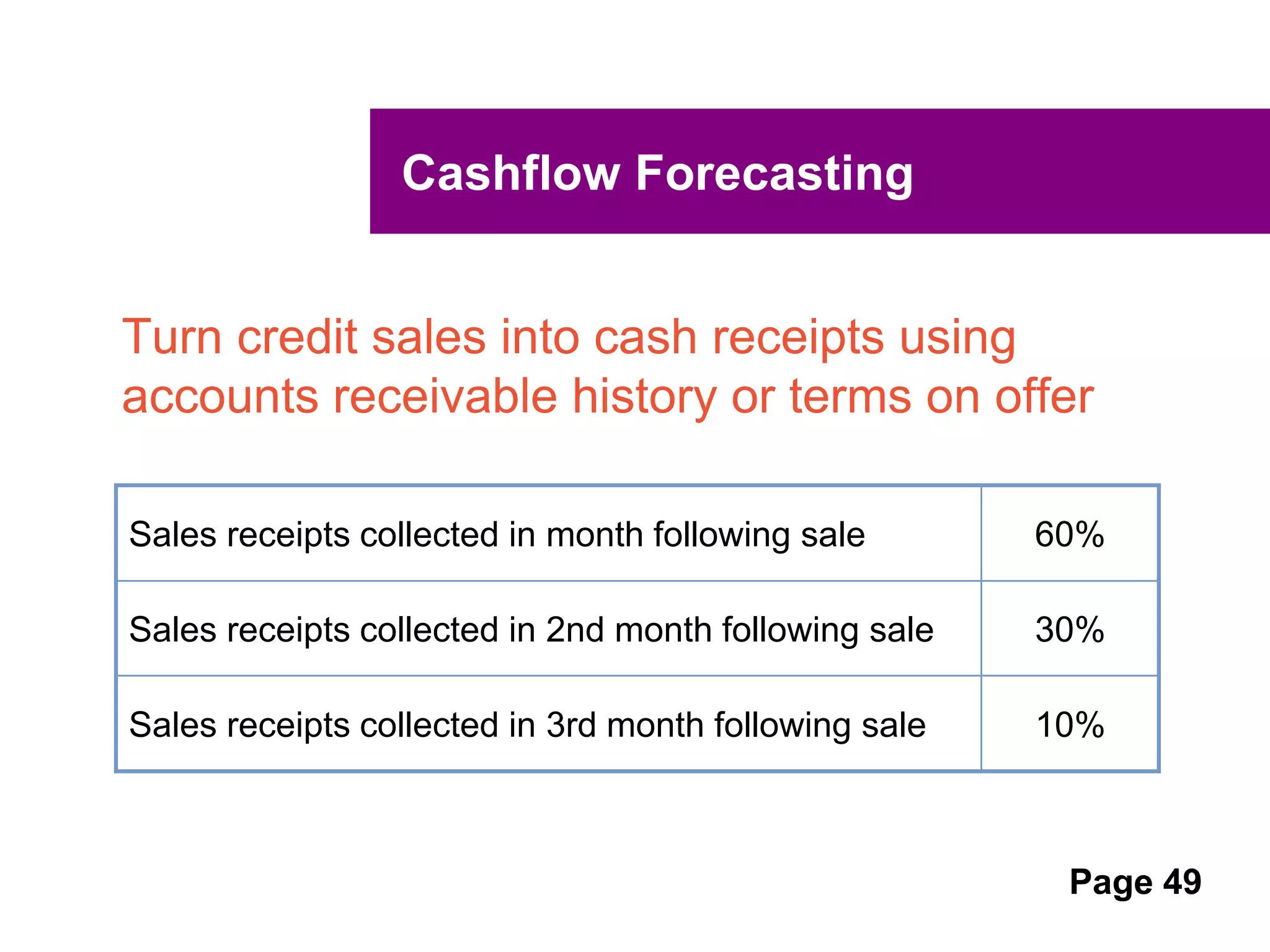
Turn credit sales into cash receipts
using accounts receivable history or
terms on offer.
Let’s look at an example on page on page 16
Sales receipts collected in month following sale 60%
Sales receipts collected in 2nd month following sale 30%
Sales receipts collected in 3rd month following sale 10%
UNCLASSIFIED
UNCLASSIFIED
Cashflow Forecasting
Applying the percentages on the previous slide to
his estimated sales for the next year, Joe has been
able to calculate the estimated actual cash receipts
from sales.
See page 17 of your workbook.
UNCLASSIFIED
UNCLASSIFIED
Cashflow Forecasting
GST rebates
Additional equity
contribution
Tax refunds
Grants
Loan proceeds
Proceeds from sale of
assets
Other sources of
income not included in
sales, such as royalties,
franchise fees, license
fees
Other cash inflows:
UNCLASSIFIED
UNCLASSIFIED
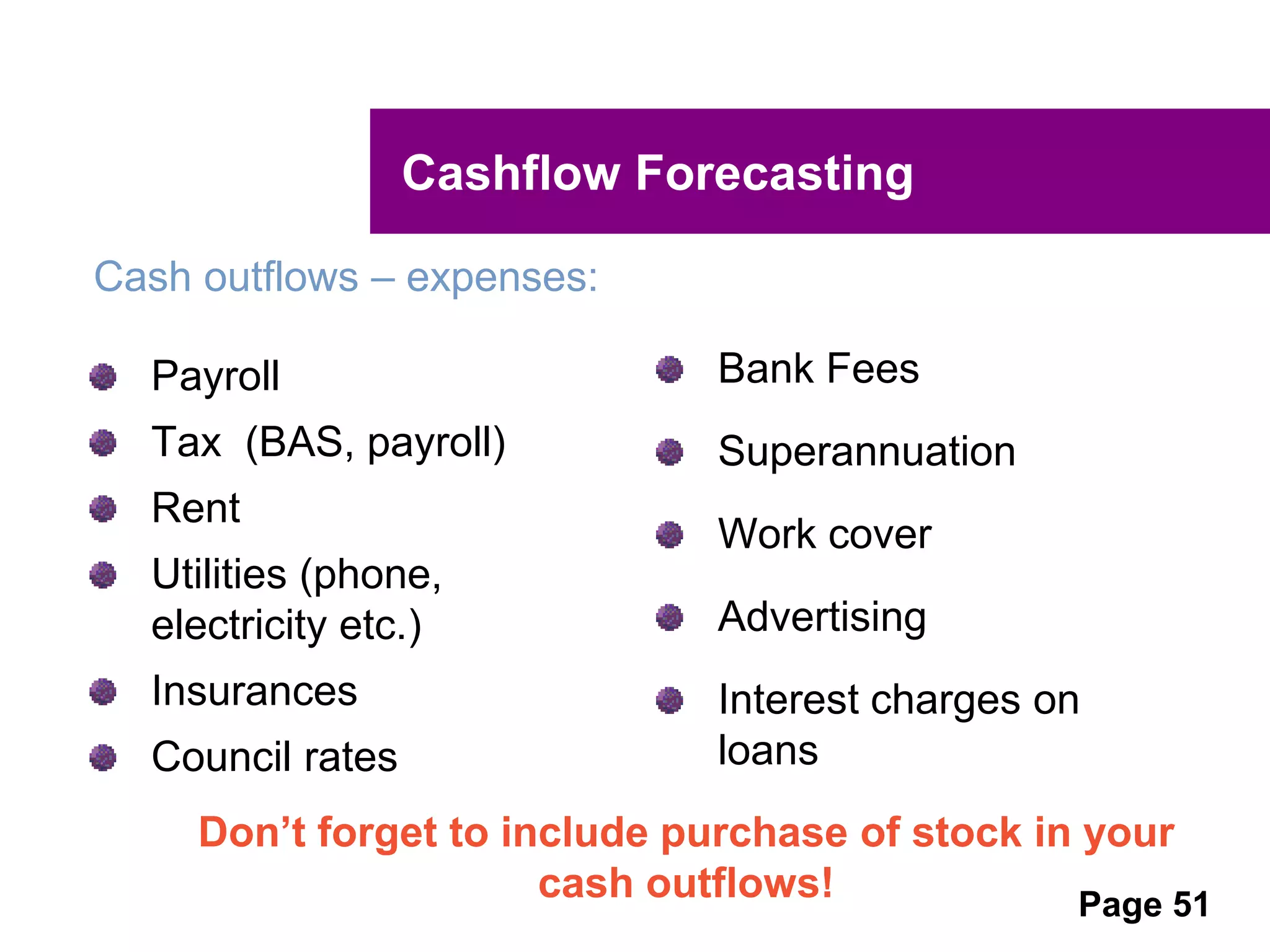
Cashflow Forecasting
Payroll
Tax (BAS, payroll)
Rent
Utilities (phone,
electricity etc.)
Insurances
Council rates
Bank Fees
Superannuation
Work cover
Advertising
Interest charges on
loans
Cash outflows – expenses:
Don’t forget to include purchase of stock in your
cash outflows!
UNCLASSIFIED
UNCLASSIFIED
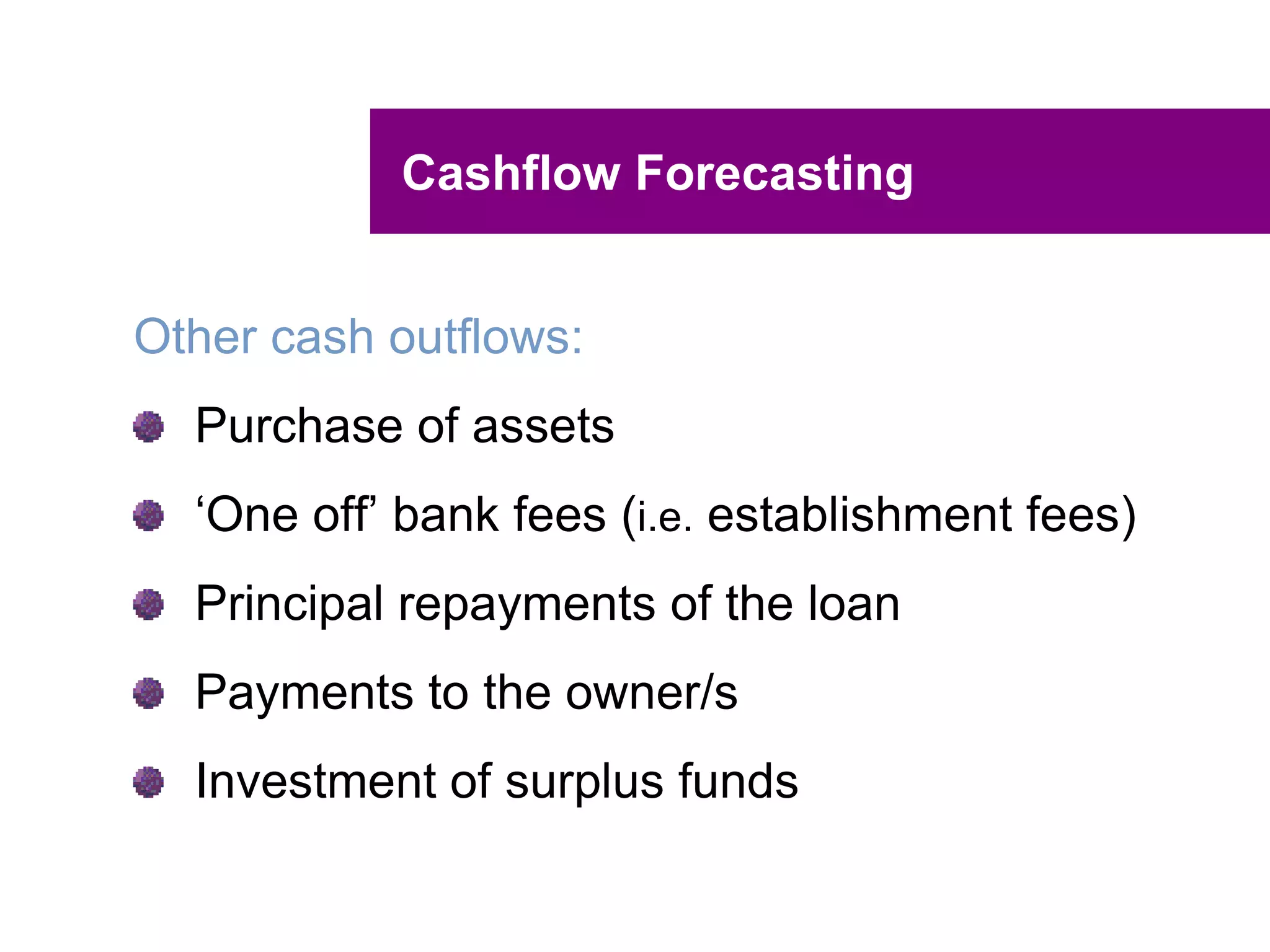
Cashflow Forecasting
Other cash outflows:
Purchase of assets
‘One off’ bank fees (i.e. establishment fees)
Principal repayments of the loan
Payments to the owner/s
Investment of surplus funds
UNCLASSIFIED
UNCLASSIFIED
Cashflow Forecasting
See page 20 for an example
of Joe’s cashflow forecast
The template for this cashflow forecast can be
found on Business Victoria’s website – page 19
has the link.
UNCLASSIFIED
UNCLASSIFIED
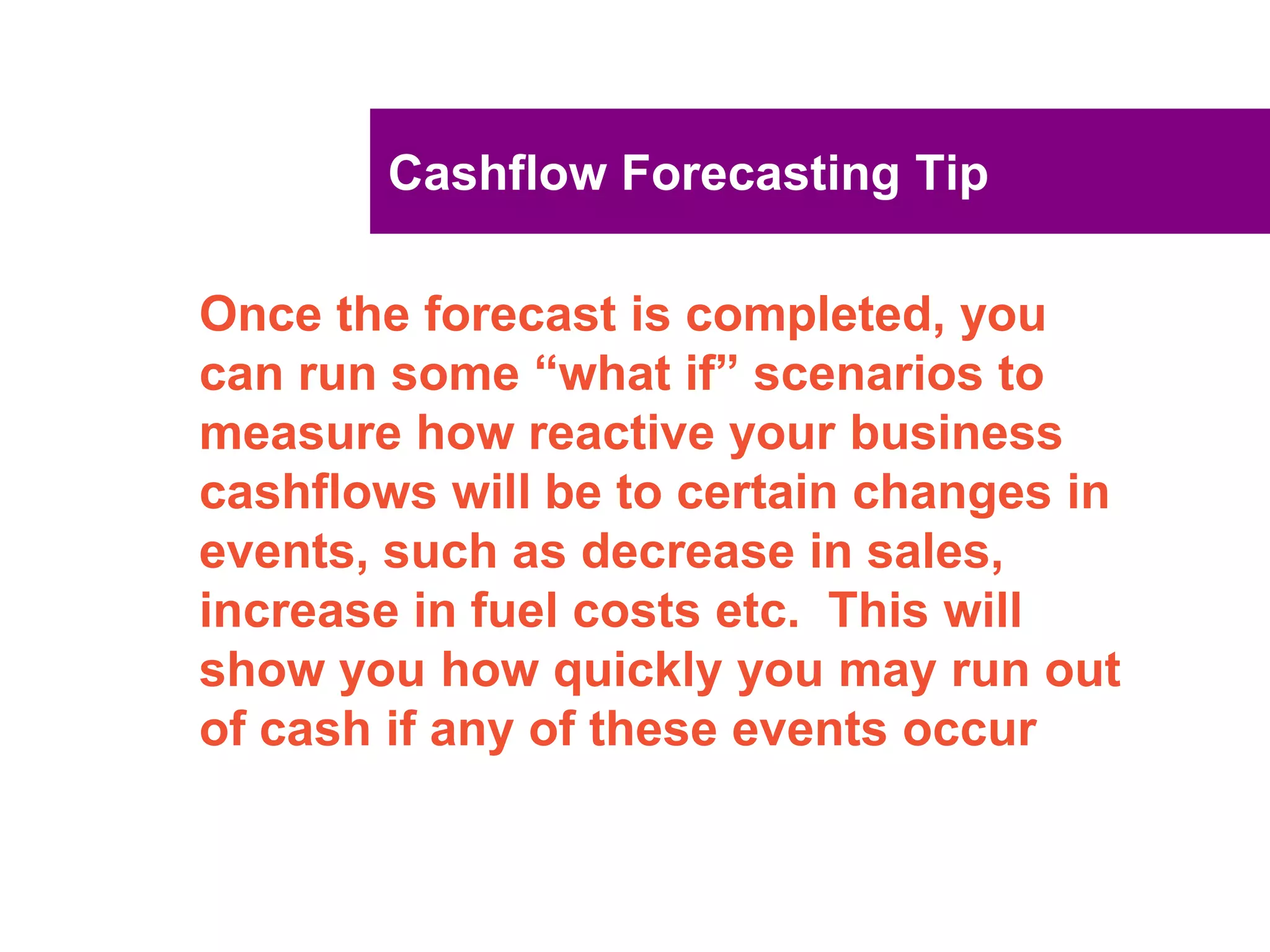
Cashflow Forecasting Tip
Once the forecast is completed, you can
run some “what if” scenarios to measure
how reactive your business cashflows will
be to certain changes in events, such as
decrease in sales, increase in fuel costs
etc. This will show you how quickly you
may run out of cash if any of these events
occur.
UNCLASSIFIED
UNCLASSIFIED
Todays Top Tips
Effective business planning will determine
what business success looks like and what
needs to be done to achieve it
Start with an annual business plan
Develop a profit and loss budget to confirm
that your plans are financially viable
Do a cashflow forecast based on your plans
to ensure that you will have adequate
cashflow
UNCLASSIFIED
UNCLASSIFIED
List 3 actions you will follow
through with as a result of this
workshop
Then
List 3 things that you’ve learned
in this seminar
List 3 actions you will follow
through with as a result of this
seminar
List 3 things that you’ve learned in
this seminar
UNCLASSIFIED
UNCLASSIFIED
Business mentors help you to identify a clear direction
for you and your business.
Business mentors can also advise you on how to:
conduct market research
work out your break-even point
price and/or cost your products or services
develop an effective marketing strategy
use other business management tools
To arrange a free mentoring session with a business mentor
complete the evaluation form and select FREE Mentoring Session
on page 2. You will then receive an email with details on claiming
your free mentoring session.
FREE mentoring session
UNCLASSIFIED
UNCLASSIFIED
Questions?
Thank you for attending
Check out
business.vic.gov.au/events
for more workshop information

Setting Financial Strategy seminar

  • 1.
  • 2.
    UNCLASSIFIED UNCLASSIFIED Welcome Introduction to Seminar Whatdo you hope to learn in the next two hours: Burning issues? Topics of interest? Opportunity to network Have fun!
  • 3.
    UNCLASSIFIED UNCLASSIFIED Setting Financial Strategy Doyou have a road map to drive your business to where you want it to be? When planning a holiday we: Decide where we want to go Decide when we want to go Work out how will we get there Work out how much will it cost Decide if we can afford to pay for the type of holiday we want
  • 4.
    UNCLASSIFIED UNCLASSIFIED Did you havea plan when you first started in business? Do you want your business to be the best it can be? Financial strategy supports the strategic objectives of the business The tools you learn today when utilised effectively will assist to evaluate and monitor the effectiveness of your strategic plans as they are implemented Setting Financial Strategy
  • 5.
    UNCLASSIFIED UNCLASSIFIED Topics for today’sseminar Good practice business strategy Aligning your finances to your business strategy How to develop a profit budget that works The importance of forecasting cash flow Cash flow forecasting made easy
  • 6.
    UNCLASSIFIED UNCLASSIFIED Good practice businessstrategy Improved business performance = stronger financial results You need to plan where you want your business to be in order for your business to get there Don’t over think it, and don’t make it too long – a one page plan will work just a well as a 100 page document
  • 7.
    UNCLASSIFIED UNCLASSIFIED Good practice businessstrategy Identifies performance issues Identifies long-term objectives Recognises capabilities and resources needed Documents activities required to achieve the objectives within a specific time frame Objectives need to be: Clear, concise and achievable Focusing on the key drivers in business Monitored and measured What does business success look like and what needs to be done to achieve it?
  • 8.
    UNCLASSIFIED UNCLASSIFIED Good practice businessstrategy Your annual business plan should include: What worked and what didn’t Are there any changes to your: Market Customers Competition Your objectives and goals for the year How will you measure these? What are the changes you want to make? Any operational changes/resource requirements Let’s spend a little time completing the table on page 6 to help you set some goals for the next year.
  • 9.
    UNCLASSIFIED UNCLASSIFIED Aligning finance &business strategy Your financial strategy should be a continuous process of directing and allocating financial resources of the business to meet your strategic goals and objectives. Need to regularly review the potential future financial position to assess the ability of your business to meet the business strategy.
  • 10.
    UNCLASSIFIED UNCLASSIFIED Aligning finance &business strategy Budgets and forecasts are critical tools that will predict the future financial position of your business. Budget vs Forecast: Budget: sets out the financial goals of the business in line with the strategic plan Forecast: tracks the actual financial outcomes in line with budget predictions, providing a valuable tool to assess the likelihood of the achievement of the budget
  • 11.
    UNCLASSIFIED UNCLASSIFIED Good Financial Strategy Realistictargets that align with: Strategic business plans Historical trading activities Credible assumptions and targets in line with industry trends. Documented assumptions, including source of information.
  • 12.
    UNCLASSIFIED UNCLASSIFIED Good Financial Strategy Budgetedtimelines aligning to: Strategic business plans Financial statements timelines Regular comparison of budgets against actual financial results. Scope to amend activities and targets where budgeted outcomes will not be met.
  • 13.
    UNCLASSIFIED UNCLASSIFIED Benefits of GoodFinancial Strategy Clarity on the key drivers of your business Tools to measure and monitor performance Improved profitability Increase efficiency in the use of resources and assets Increase productivity Increased market share Improved cashflow
  • 14.
    UNCLASSIFIED UNCLASSIFIED A profit budgetthat works Good practice budgeting requires the following: Preparation of strategic goals Budgeted timelines that align to financial statements Regular comparison of budgets against actual financial results Scope for amending activities and targets where actual results indicate that budgeted outcomes will not be met
  • 15.
    UNCLASSIFIED UNCLASSIFIED A profit budgetthat works Profit budgets are one of the most important financial statements They provide information on the predicted future financial performance of the business Will be the central financial statement to monitor the financial impact of the implementation of your strategic plans.
  • 16.
    UNCLASSIFIED UNCLASSIFIED Profit and LossBudget Important tool for your business Summary of expected income and expenses Timeline usually one year Monitor results regularly
  • 17.
    UNCLASSIFIED UNCLASSIFIED Profit and LossBudget Hint By preparing a profit and loss budget annually, you will be in a position to determine if your future business plans will support the ongoing activities of your business.
  • 18.
    UNCLASSIFIED UNCLASSIFIED Getting Started Undertake inorderly manner Involve key staff Document all steps Two types: Incremental – using previous year’s activities Zero-based – no consideration of past activities
  • 19.
    UNCLASSIFIED UNCLASSIFIED Getting Started Review strategicplan and note activities for the budget Separate activities into existing and new Document all assumptions Review prior year’s profit and loss statements
  • 20.
    UNCLASSIFIED UNCLASSIFIED Budgeting Tip An independentprofit and loss budget can be developed for separate projects to assess the financial viability of each project.
  • 21.
    UNCLASSIFIED UNCLASSIFIED Assumptions Estimated events thatwill have a financial impact in the future Use realistic targets that will be achievable Use historic financial information Look for any trends Industry information will give your assumptions credibility Document assumptions Attach to budget Let’s look at the assumptions table on page 9
  • 22.
    UNCLASSIFIED UNCLASSIFIED Profit and LossBudget Let’s look at the Profit and Loss Budget on page 10. A template for a profit and loss budget can be found by searching “profit and loss budget” at www.business.vic.gov.au
  • 23.
    UNCLASSIFIED UNCLASSIFIED Managing Profit andLoss Budget Regularly compare actual to budget Variances Timing Permanent Can be positive as well as negative Enables you to 'drill-down' to problem areas Is the budget wrong e.g. have trading conditions changed?
  • 24.
    UNCLASSIFIED UNCLASSIFIED Managing Profit andLoss Budget Hint The more regular the reports, the quicker operations can be reviewed for financial impact and action can be implemented immediately where required.
  • 25.
    UNCLASSIFIED UNCLASSIFIED BUDGET is wherewe would like to be: Based on annual business plan With intervention built in to achieve objectives Usually once a year To provide a planned outcome A budget should not be amended unless the goals and objectives have changed. Budget versus Forecast
  • 26.
    UNCLASSIFIED UNCLASSIFIED Forecast is plannedevents translated into financial statements based on actual events Without intervention Real cash movements Continually updated A monitoring tool where the actual results are recorded to provide a “forecast” of the planned outcomes based on how the business is currently operating. Let’s look at Sofie’s example on page on page 12. Budget versus Forecast
  • 27.
    UNCLASSIFIED UNCLASSIFIED Cashflow Forecasting Planning futurecashflows Important for business planning: Support business operations Business expansion Essential for financial survival Usually over a twelve month period ‘Rolling plan’ is the most useful
  • 28.
    UNCLASSIFIED UNCLASSIFIED Profit versus Cash PROFITDOES NOT EQUAL CASH! A profitable business can still have cashflow issues. Profit - is the amount remaining after total sales value less costs for stock and all other expenses. Cash - is generated from all cash inflows less all cash outflows.
  • 29.
    UNCLASSIFIED UNCLASSIFIED Profit versus Cash ProfitCash GST Principle loan repayments Interest loan repayments Proceeds from sale of assets Depreciation
  • 30.
    UNCLASSIFIED UNCLASSIFIED Cashflow Forecasting Hint Rememberthat cashflow is all about timing and the flow of cash, so when preparing your cashflow forecast, make sure you are as accurate as possible on the timing of the cashflows.
  • 31.
    UNCLASSIFIED UNCLASSIFIED Cashflow Forecasting Five stepapproach: 1. Prepare a list of assumptions 2. Prepare the anticipated income or sales for the business – sales forecast 3. Prepare detail on any other estimated cash inflows 4. Prepare detail on all estimated cash outflows 5. Put all information together – cashflow forecast
  • 32.
    UNCLASSIFIED UNCLASSIFIED Cashflow Forecasting Sales Forecast Estimatingsales is difficult Influencing factors: Types of customers Terms for customers Influence of economic factors Competitive pressures
  • 33.
    UNCLASSIFIED UNCLASSIFIED Cashflow Forecasting Turn creditsales into cash receipts using accounts receivable history or terms on offer. Let’s look at an example on page on page 16 Sales receipts collected in month following sale 60% Sales receipts collected in 2nd month following sale 30% Sales receipts collected in 3rd month following sale 10%
  • 34.
    UNCLASSIFIED UNCLASSIFIED Cashflow Forecasting Applying thepercentages on the previous slide to his estimated sales for the next year, Joe has been able to calculate the estimated actual cash receipts from sales. See page 17 of your workbook.
  • 35.
    UNCLASSIFIED UNCLASSIFIED Cashflow Forecasting GST rebates Additionalequity contribution Tax refunds Grants Loan proceeds Proceeds from sale of assets Other sources of income not included in sales, such as royalties, franchise fees, license fees Other cash inflows:
  • 36.
    UNCLASSIFIED UNCLASSIFIED Cashflow Forecasting Payroll Tax (BAS,payroll) Rent Utilities (phone, electricity etc.) Insurances Council rates Bank Fees Superannuation Work cover Advertising Interest charges on loans Cash outflows – expenses: Don’t forget to include purchase of stock in your cash outflows!
  • 37.
    UNCLASSIFIED UNCLASSIFIED Cashflow Forecasting Other cashoutflows: Purchase of assets ‘One off’ bank fees (i.e. establishment fees) Principal repayments of the loan Payments to the owner/s Investment of surplus funds
  • 38.
    UNCLASSIFIED UNCLASSIFIED Cashflow Forecasting See page20 for an example of Joe’s cashflow forecast The template for this cashflow forecast can be found on Business Victoria’s website – page 19 has the link.
  • 39.
    UNCLASSIFIED UNCLASSIFIED Cashflow Forecasting Tip Oncethe forecast is completed, you can run some “what if” scenarios to measure how reactive your business cashflows will be to certain changes in events, such as decrease in sales, increase in fuel costs etc. This will show you how quickly you may run out of cash if any of these events occur.
  • 40.
    UNCLASSIFIED UNCLASSIFIED Todays Top Tips Effectivebusiness planning will determine what business success looks like and what needs to be done to achieve it Start with an annual business plan Develop a profit and loss budget to confirm that your plans are financially viable Do a cashflow forecast based on your plans to ensure that you will have adequate cashflow
  • 41.
    UNCLASSIFIED UNCLASSIFIED List 3 actionsyou will follow through with as a result of this workshop Then List 3 things that you’ve learned in this seminar List 3 actions you will follow through with as a result of this seminar List 3 things that you’ve learned in this seminar
  • 42.
    UNCLASSIFIED UNCLASSIFIED Business mentors helpyou to identify a clear direction for you and your business. Business mentors can also advise you on how to: conduct market research work out your break-even point price and/or cost your products or services develop an effective marketing strategy use other business management tools To arrange a free mentoring session with a business mentor complete the evaluation form and select FREE Mentoring Session on page 2. You will then receive an email with details on claiming your free mentoring session. FREE mentoring session
  • 43.
    UNCLASSIFIED UNCLASSIFIED Questions? Thank you forattending Check out business.vic.gov.au/events for more workshop information