

Break Even  Why Every Contractor Needs to Know It PDCA Residential Forum Advanced Shop Talk July 16, 2010
Knowing Your Break-Even Point Critical skill that every painting contractor should have.  At any time, you should be able to quickly analyze your break-even for the year, the month or even the week Know what number you need to hit to stay profitable (or at least not have a loss!)
What we’ll discuss today How to calculate your break-even point based on annual and monthly budgets How to determine what it takes to make an investment in overhead pay for itself Analyze your situation to determine what costs can be cut to lower your break-even Determine how and when it makes sense to increase your overhead
Financial Best Practices Accounting system is fully & accurately functioning Controls are in place to ensure accuracy The company has a Budget/Profit Plan for the year Financial Monitoring is up to date and being used effectively as a business tool Key Metrics are up to date and being used to keep your finger on the financial pulse of your business Owner reviews Financial Data and Metrics at least monthly, (if not weekly) and takes action where indicated An adequate credit line is in place The business has a good accountant and banker who understand and effectively support the business goals  Company is profitable, solvent and able to finance its growth and reward stakeholders
Key Performance Indicators Factors that indicate the current and future performance of a business in areas that are critical to the company's success.
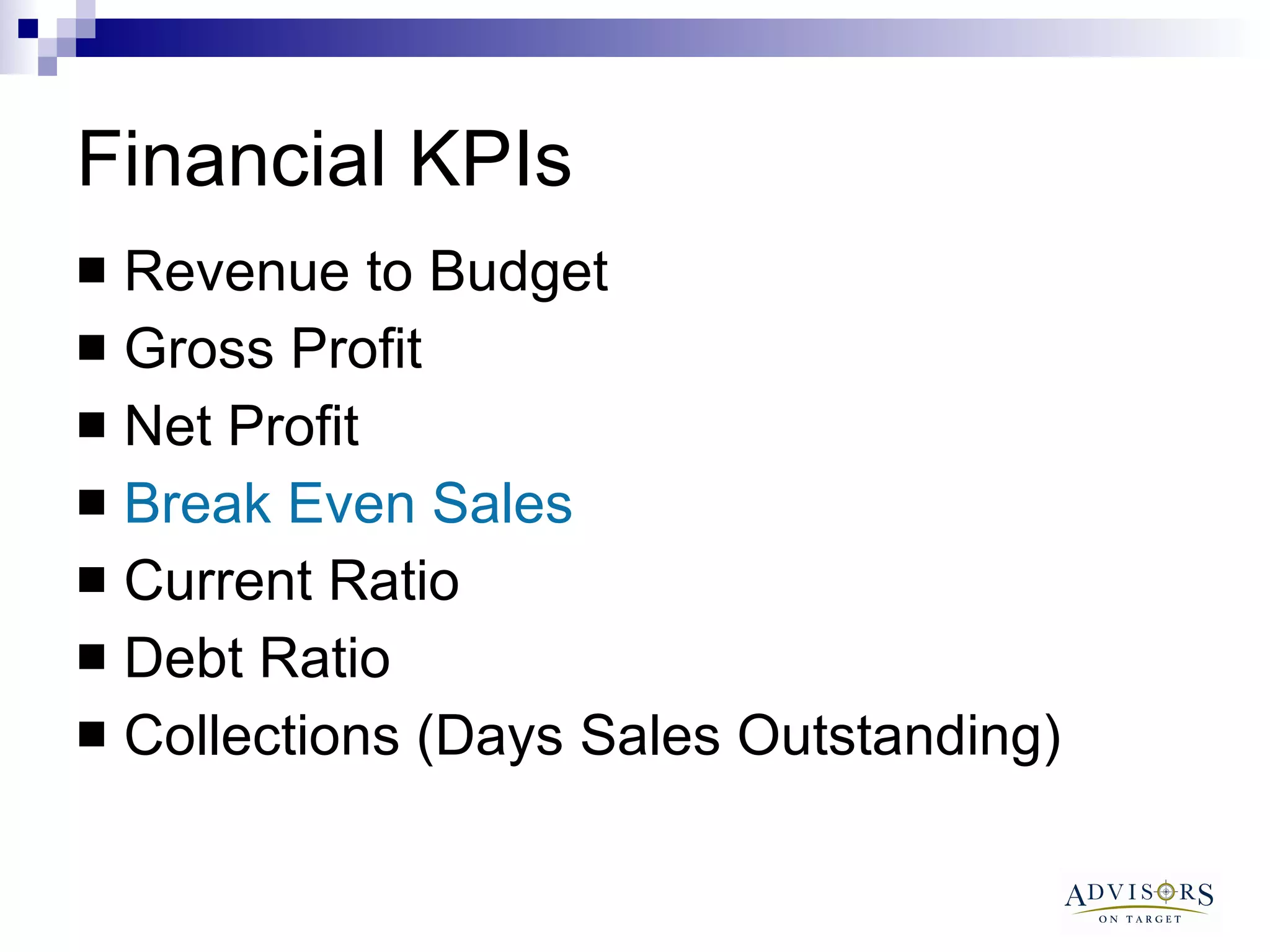
Financial KPIs Revenue to Budget Gross Profit Net Profit Break Even Sales Current Ratio Debt Ratio Collections (Days Sales Outstanding)
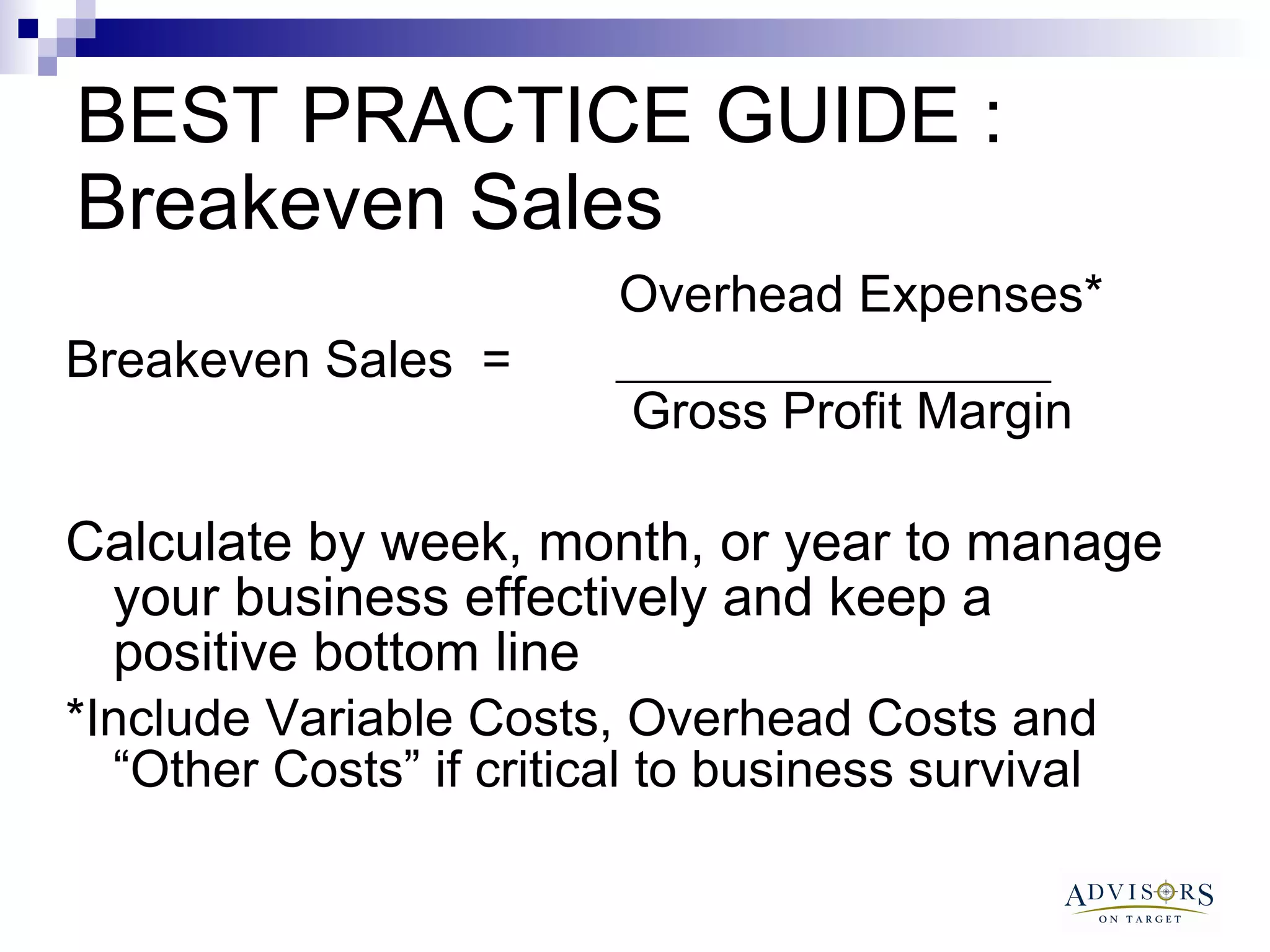
BEST PRACTICE GUIDE :  Breakeven Sales   Overhead Expenses* Breakeven Sales  =   __________________________   Gross Profit Margin Calculate by week, month, or year to manage your business effectively and keep a positive bottom line *Include Variable Costs, Overhead Costs and “Other Costs” if critical to business survival
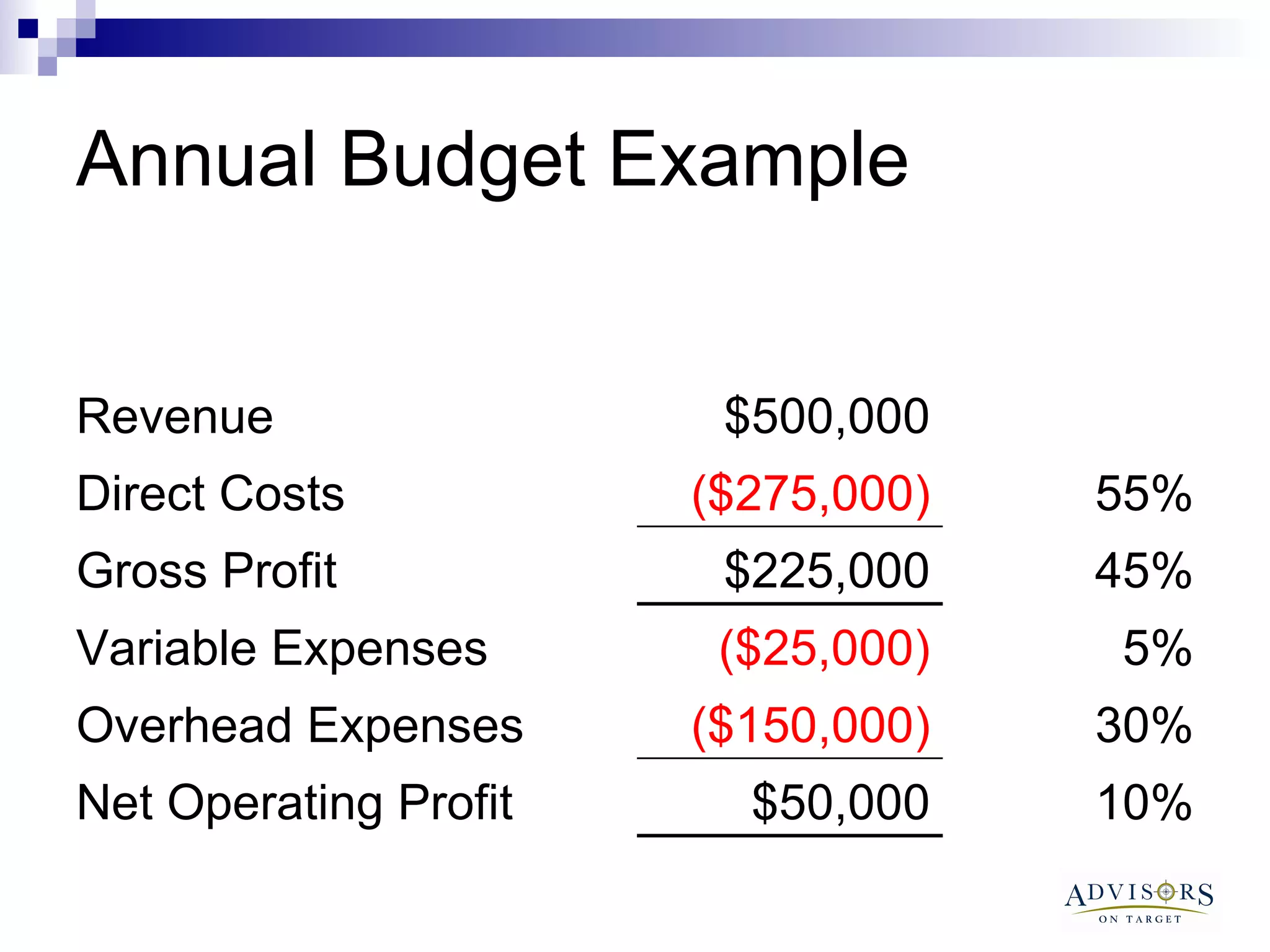
Annual Budget Example 10% $50,000 Net Operating Profit 30% ($150,000) Overhead Expenses 5% ($25,000) Variable Expenses 45% $225,000 Gross Profit 55% ($275,000) Direct Costs $500,000 Revenue
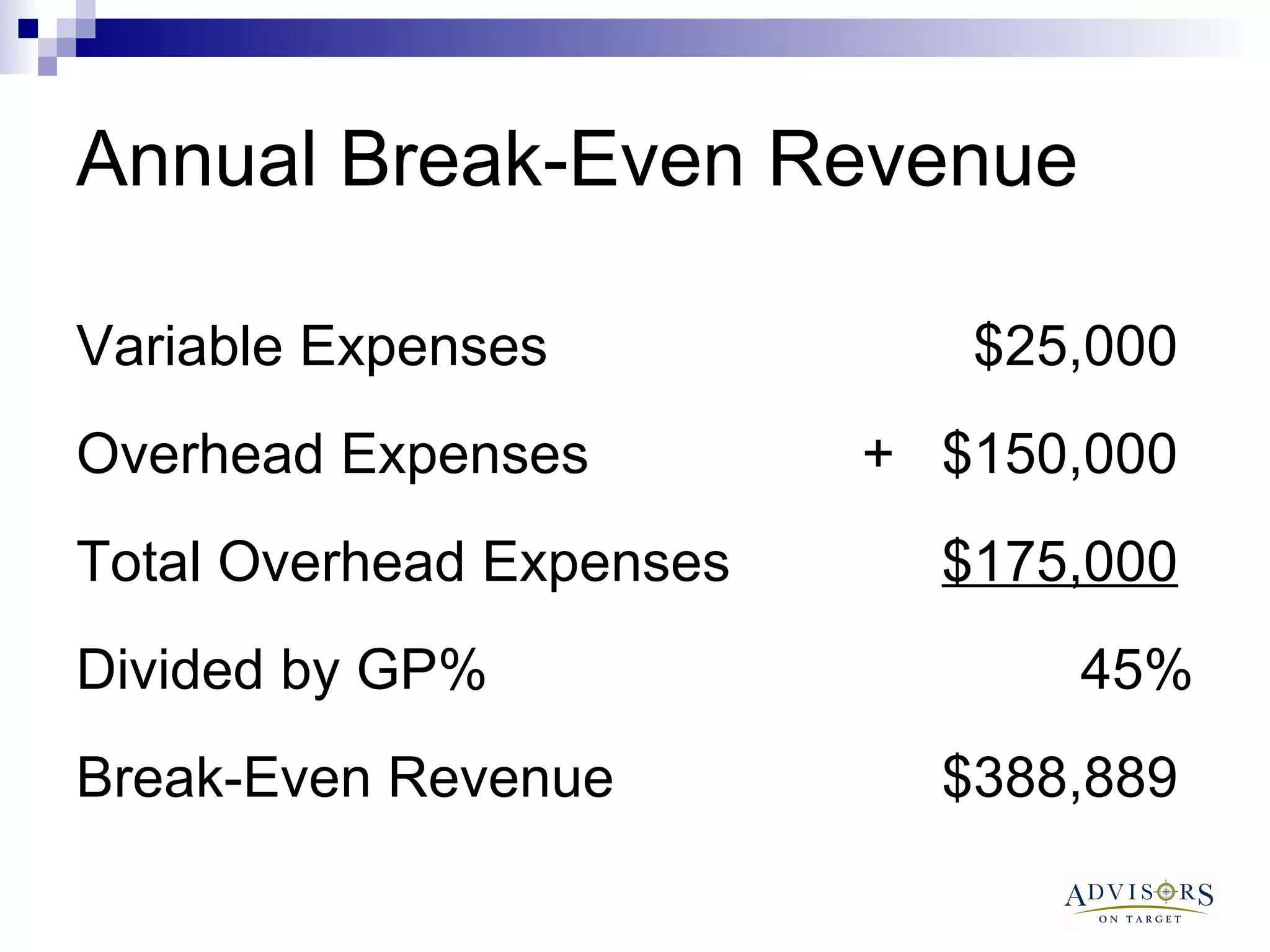
Annual Break-Even Revenue $388,889  Break-Even Revenue 45% Divided by GP% $175,000   Total Overhead Expenses +  $150,000  Overhead Expenses $25,000  Variable Expenses
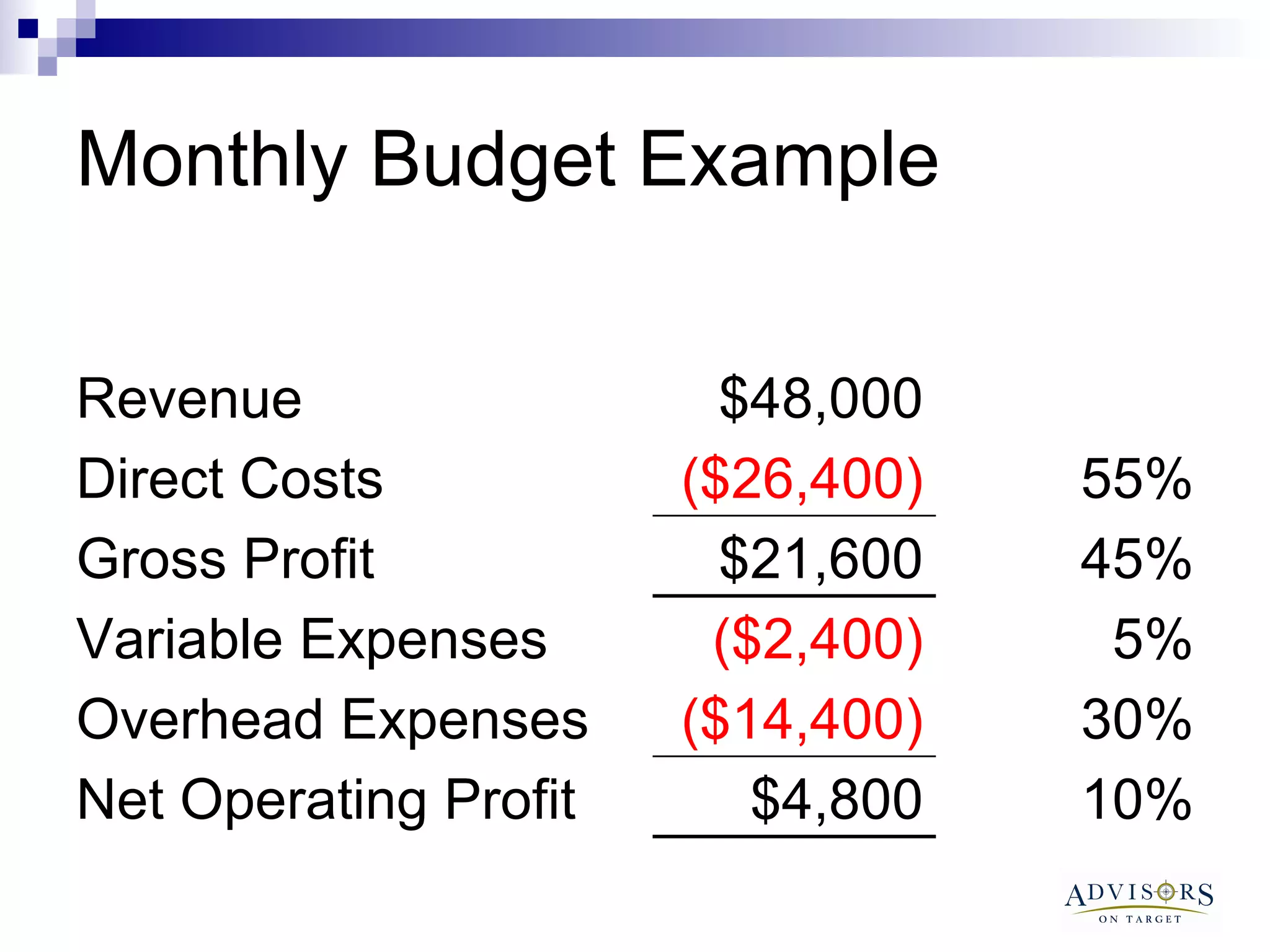
Monthly Budget Example 10% $4,800 Net Operating Profit 30% ($14,400) Overhead Expenses 5% ($2,400) Variable Expenses 45% $21,600 Gross Profit 55% ($26,400) Direct Costs $48,000 Revenue
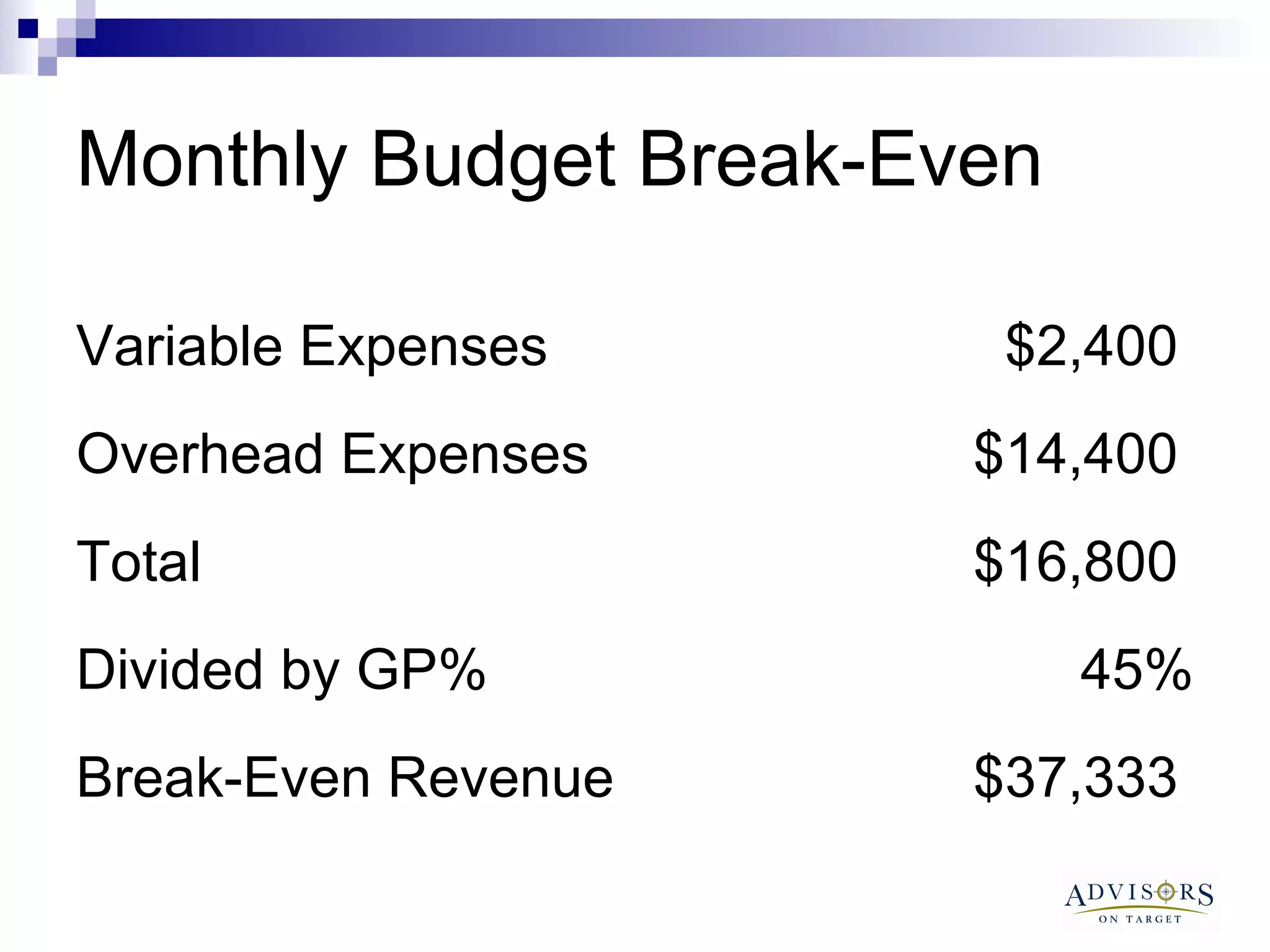
Monthly Budget Break-Even $37,333  Break-Even Revenue 45% Divided by GP% $16,800  Total  $14,400  Overhead Expenses $2,400  Variable Expenses
Calculating Break-Even Hours Monthly Budget $48,000 Based on 6 painters @ 160 hours each Total Budget Hours 960 Projected Sales Price per hour $50 (including materials) If Break-Even Revenue is $37,333 Break-Even Hours are 747 for month  (approx 174 hours per week)
What about other expenses? Take into account other expenses that don’t hit the Profit and Loss Owner Draws/Loans to Shareholders Loan Payments Credit Card Payments not included in monthly operating expenses
Changed Break-Even  Break-Even Hours are now 780 for the month $39,000  Break-Even Revenue 45% Divided by GP% $17,550  Total  $750  Vehicle Loan  $14,400  Overhead Expenses $2,400  Variable Expenses
What if your GP% decreases? Break-Even just increased by almost $5,000!  $43,875  Break-Even Revenue 40% Divided by GP% $17,550  Total  $750  Vehicle Loan  $14,400  Overhead Expenses $2,400  Variable Expenses
Using Break-Even Analysis to Add Infrastructure How much more revenue do you need for new overhead to at least pay for itself?
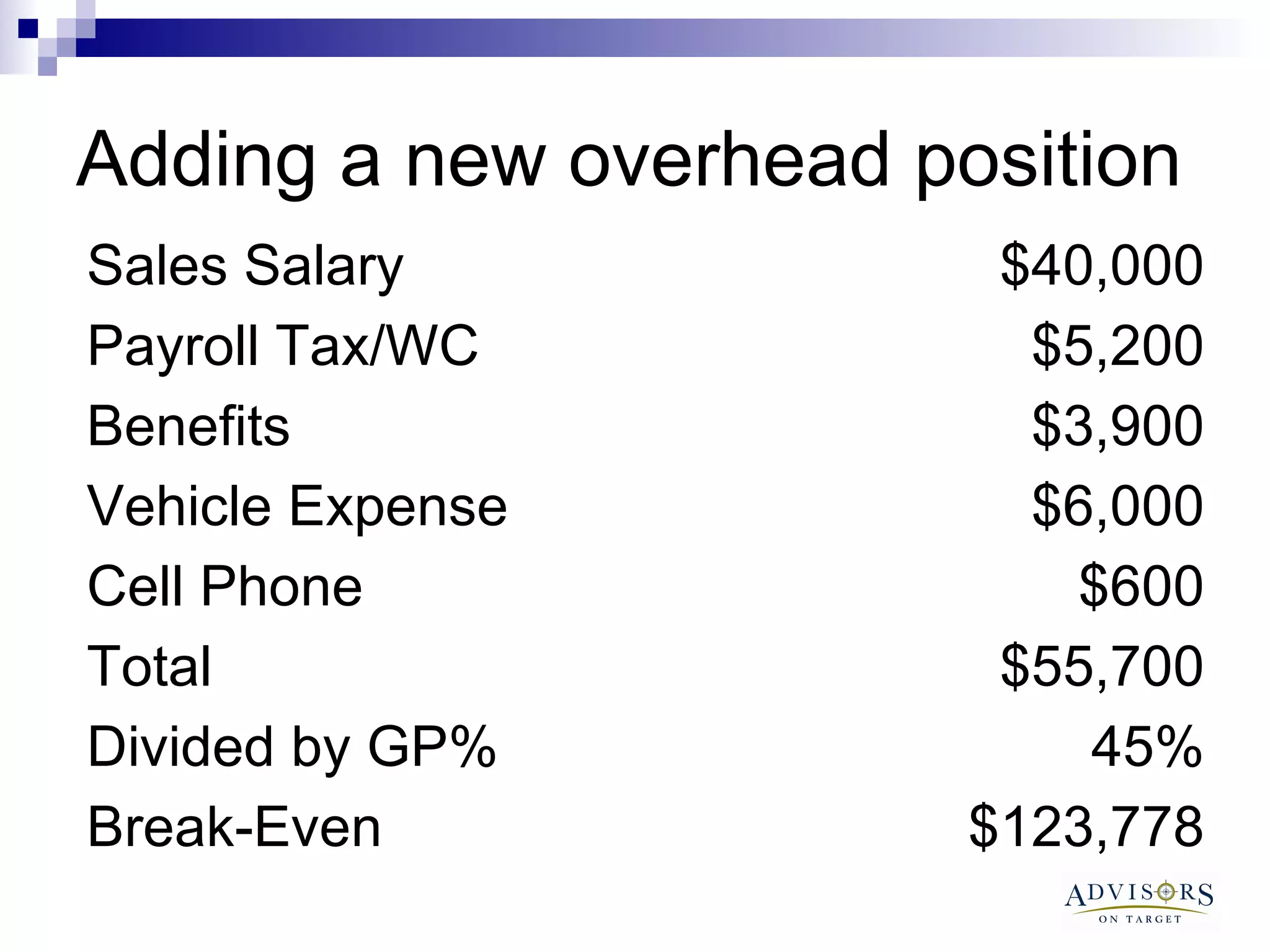
Adding a new overhead position $123,778 Break-Even 45% Divided by GP% $55,700 Total  $600 Cell Phone $6,000 Vehicle Expense $3,900 Benefits $5,200 Payroll Tax/WC $40,000 Sales Salary
When to lower Break-Even Consistently not meeting monthly budgets Trending lack of sales or hours to hit monthly break-even  Projection for Year shows a loss
Ways to Reduce Break-Even Increase Gross Profit Margin Increase Productivity Raise Prices Reduce Direct Costs Reduce Variable Costs Reduce Vehicle Expenses Reduce Benefits Reduce Overhead Costs  Reduce or eliminate discretionary overhead costs Re-negotiate with vendors Reduce wages or hours of overhead personnel Eliminate overhead positions Relocate to less expensive office Enlist the team in helping you find ways reduce costs & gain efficiency!
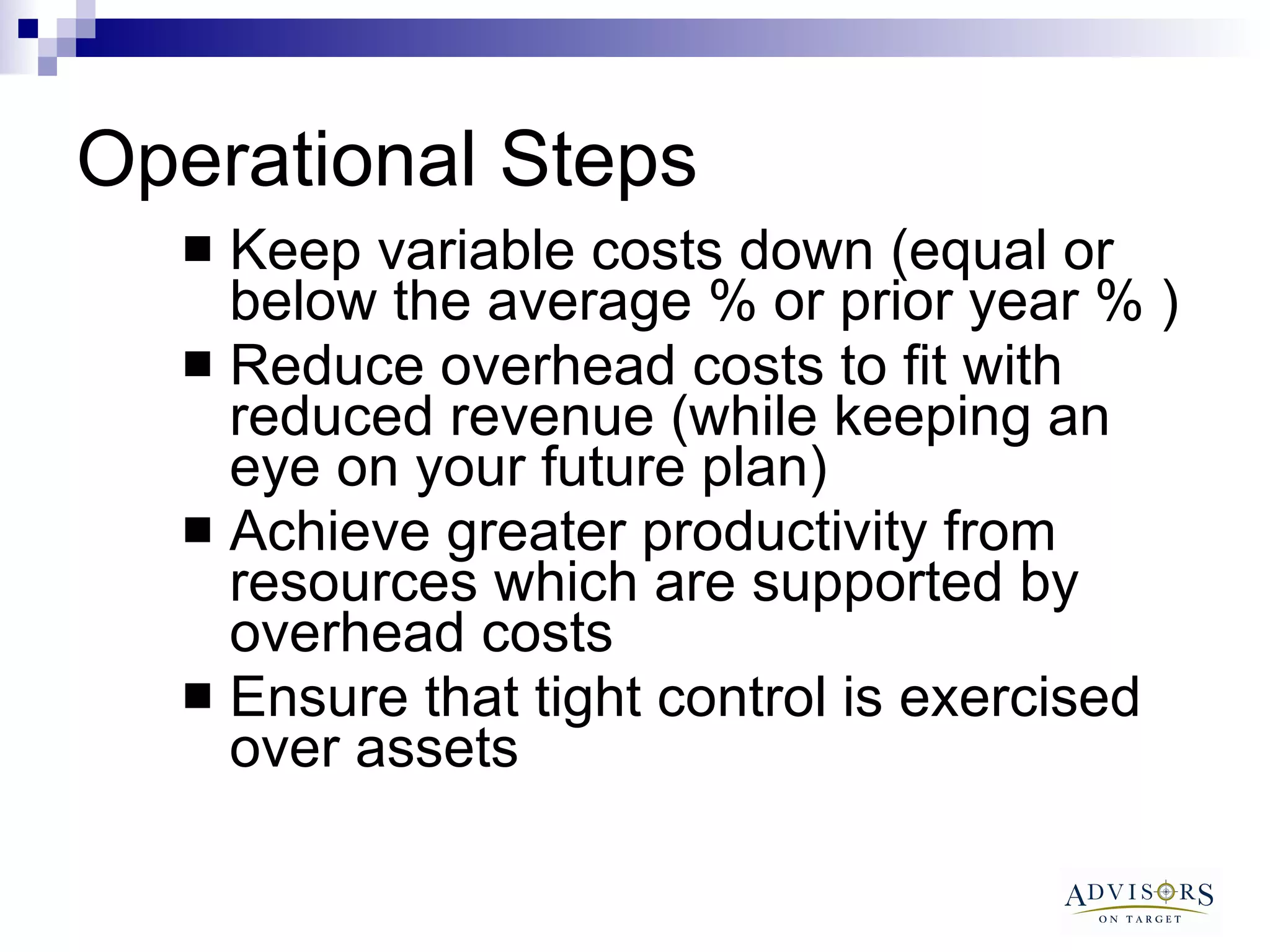
Operational Steps Keep variable costs down (equal or below the average % or prior year % ) Reduce overhead costs to fit with reduced revenue (while keeping an eye on your future plan) Achieve greater productivity from resources which are supported by overhead costs Ensure that tight control is exercised over assets
Operational Steps – the first round Challenge the team to be more productive in the field and the office  Training Incentives Coaching  Re-negotiate with vendors on pricing or payment terms Cut out “nice to have” costs that don’t add to the top or bottom line Tighten up on wasteful or thoughtless spending Engage the team in saving money on expenses
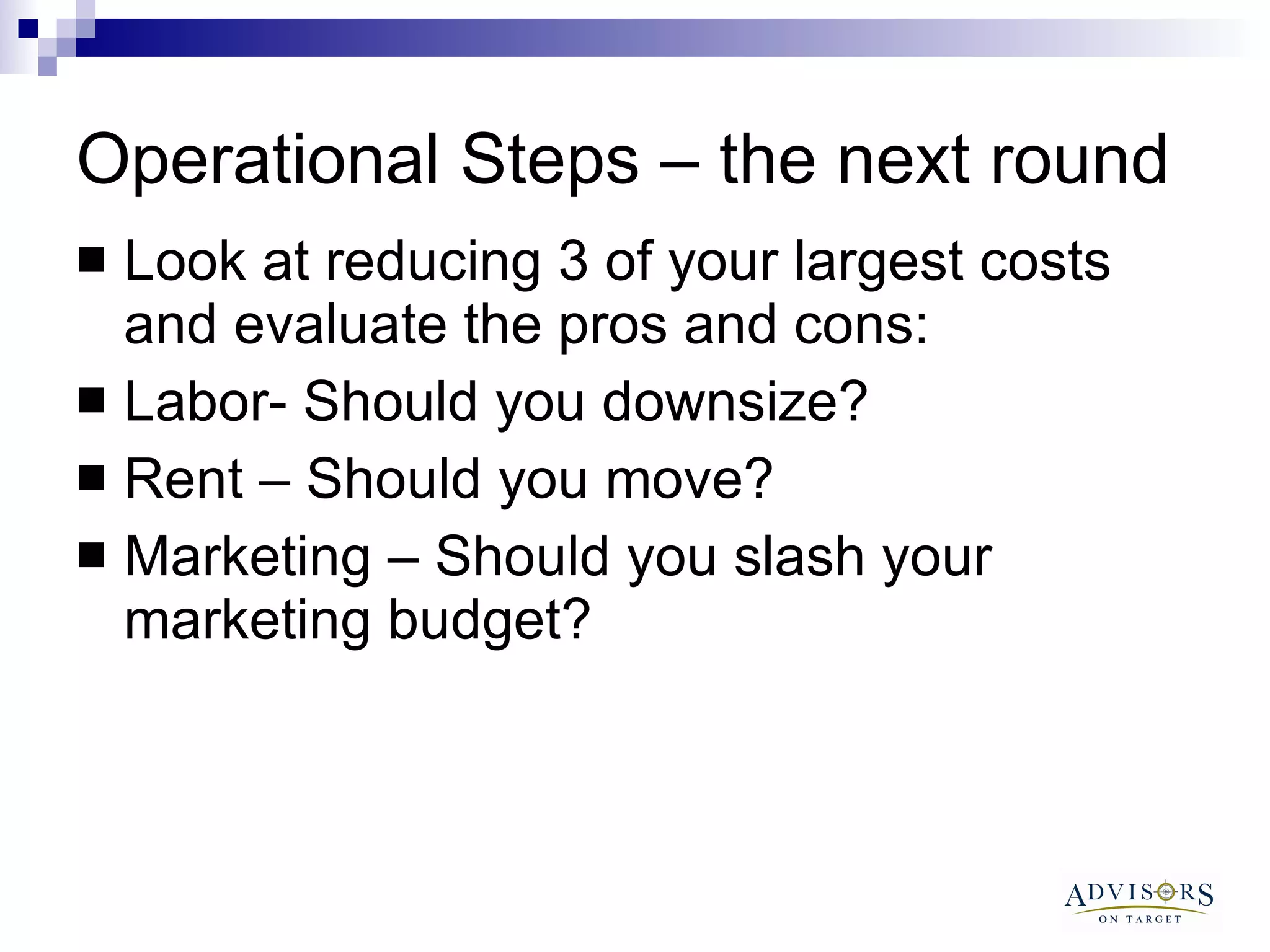
Operational Steps – the next round Look at reducing 3 of your largest costs and evaluate the pros and cons:  Labor- Should you downsize? Rent – Should you move? Marketing – Should you slash your marketing budget?
When to Increase Overhead  Need more leads to hit revenue targets or keep crews booked with work Current overhead personnel can’t take advantage of opportunities to grow the business Business is in growth mode
Increasing Costs can raise your Break-Even (in a good way) Lower Gross Profit Margin Raise wages or hire more expensive (more competent) workers Use better materials  Add Overhead Infrastructure Add Overhead personnel Increase Advertising/Marketing Costs Attract higher functioning team members Add benefits Increase wages/salaries Increase capacity Bigger shop/office Purchase Vehicles or equipment Add a spray booth
Stay on top of Break-Even  Update Projection Monthly Focus on Marketing Activities Focus on Productivity on Jobs Keep Revenue and Hours targets top of mind  Implement weekly management & sales meetings for accountability Stay informed with continuous monitoring Take action quickly when indicated
Knowledge is power Knowing your numbers and learning how even small but timely changes affect your profitability increase your opportunities for success in any economy.
Contact us to help get your business On Target for success in 2010!   Advisors On Target Linnea Blair Office: 619.291.3700 Email:  [email_address] Web: AdvisorsOnTarget.com Twitter: AdvisorOnTarget Facebook:facebook.com/AdvisorsOnTarget LinkedIn:linkedin.com/in/linneablair

Break Even

  • 1.
    Break Even Why Every Contractor Needs to Know It PDCA Residential Forum Advanced Shop Talk July 16, 2010
  • 2.
    Knowing Your Break-EvenPoint Critical skill that every painting contractor should have. At any time, you should be able to quickly analyze your break-even for the year, the month or even the week Know what number you need to hit to stay profitable (or at least not have a loss!)
  • 3.
    What we’ll discusstoday How to calculate your break-even point based on annual and monthly budgets How to determine what it takes to make an investment in overhead pay for itself Analyze your situation to determine what costs can be cut to lower your break-even Determine how and when it makes sense to increase your overhead
  • 4.
    Financial Best PracticesAccounting system is fully & accurately functioning Controls are in place to ensure accuracy The company has a Budget/Profit Plan for the year Financial Monitoring is up to date and being used effectively as a business tool Key Metrics are up to date and being used to keep your finger on the financial pulse of your business Owner reviews Financial Data and Metrics at least monthly, (if not weekly) and takes action where indicated An adequate credit line is in place The business has a good accountant and banker who understand and effectively support the business goals Company is profitable, solvent and able to finance its growth and reward stakeholders
  • 5.
    Key Performance IndicatorsFactors that indicate the current and future performance of a business in areas that are critical to the company's success.
  • 6.
    Financial KPIs Revenueto Budget Gross Profit Net Profit Break Even Sales Current Ratio Debt Ratio Collections (Days Sales Outstanding)
  • 7.
    BEST PRACTICE GUIDE: Breakeven Sales Overhead Expenses* Breakeven Sales = __________________________ Gross Profit Margin Calculate by week, month, or year to manage your business effectively and keep a positive bottom line *Include Variable Costs, Overhead Costs and “Other Costs” if critical to business survival
  • 8.
    Annual Budget Example10% $50,000 Net Operating Profit 30% ($150,000) Overhead Expenses 5% ($25,000) Variable Expenses 45% $225,000 Gross Profit 55% ($275,000) Direct Costs $500,000 Revenue
  • 9.
    Annual Break-Even Revenue$388,889 Break-Even Revenue 45% Divided by GP% $175,000 Total Overhead Expenses + $150,000 Overhead Expenses $25,000 Variable Expenses
  • 10.
    Monthly Budget Example10% $4,800 Net Operating Profit 30% ($14,400) Overhead Expenses 5% ($2,400) Variable Expenses 45% $21,600 Gross Profit 55% ($26,400) Direct Costs $48,000 Revenue
  • 11.
    Monthly Budget Break-Even$37,333 Break-Even Revenue 45% Divided by GP% $16,800 Total $14,400 Overhead Expenses $2,400 Variable Expenses
  • 12.
    Calculating Break-Even HoursMonthly Budget $48,000 Based on 6 painters @ 160 hours each Total Budget Hours 960 Projected Sales Price per hour $50 (including materials) If Break-Even Revenue is $37,333 Break-Even Hours are 747 for month (approx 174 hours per week)
  • 13.
    What about otherexpenses? Take into account other expenses that don’t hit the Profit and Loss Owner Draws/Loans to Shareholders Loan Payments Credit Card Payments not included in monthly operating expenses
  • 14.
    Changed Break-Even Break-Even Hours are now 780 for the month $39,000 Break-Even Revenue 45% Divided by GP% $17,550 Total $750 Vehicle Loan $14,400 Overhead Expenses $2,400 Variable Expenses
  • 15.
    What if yourGP% decreases? Break-Even just increased by almost $5,000! $43,875 Break-Even Revenue 40% Divided by GP% $17,550 Total $750 Vehicle Loan $14,400 Overhead Expenses $2,400 Variable Expenses
  • 16.
    Using Break-Even Analysisto Add Infrastructure How much more revenue do you need for new overhead to at least pay for itself?
  • 17.
    Adding a newoverhead position $123,778 Break-Even 45% Divided by GP% $55,700 Total $600 Cell Phone $6,000 Vehicle Expense $3,900 Benefits $5,200 Payroll Tax/WC $40,000 Sales Salary
  • 18.
    When to lowerBreak-Even Consistently not meeting monthly budgets Trending lack of sales or hours to hit monthly break-even Projection for Year shows a loss
  • 19.
    Ways to ReduceBreak-Even Increase Gross Profit Margin Increase Productivity Raise Prices Reduce Direct Costs Reduce Variable Costs Reduce Vehicle Expenses Reduce Benefits Reduce Overhead Costs Reduce or eliminate discretionary overhead costs Re-negotiate with vendors Reduce wages or hours of overhead personnel Eliminate overhead positions Relocate to less expensive office Enlist the team in helping you find ways reduce costs & gain efficiency!
  • 20.
    Operational Steps Keepvariable costs down (equal or below the average % or prior year % ) Reduce overhead costs to fit with reduced revenue (while keeping an eye on your future plan) Achieve greater productivity from resources which are supported by overhead costs Ensure that tight control is exercised over assets
  • 21.
    Operational Steps –the first round Challenge the team to be more productive in the field and the office Training Incentives Coaching Re-negotiate with vendors on pricing or payment terms Cut out “nice to have” costs that don’t add to the top or bottom line Tighten up on wasteful or thoughtless spending Engage the team in saving money on expenses
  • 22.
    Operational Steps –the next round Look at reducing 3 of your largest costs and evaluate the pros and cons: Labor- Should you downsize? Rent – Should you move? Marketing – Should you slash your marketing budget?
  • 23.
    When to IncreaseOverhead Need more leads to hit revenue targets or keep crews booked with work Current overhead personnel can’t take advantage of opportunities to grow the business Business is in growth mode
  • 24.
    Increasing Costs canraise your Break-Even (in a good way) Lower Gross Profit Margin Raise wages or hire more expensive (more competent) workers Use better materials Add Overhead Infrastructure Add Overhead personnel Increase Advertising/Marketing Costs Attract higher functioning team members Add benefits Increase wages/salaries Increase capacity Bigger shop/office Purchase Vehicles or equipment Add a spray booth
  • 25.
    Stay on topof Break-Even Update Projection Monthly Focus on Marketing Activities Focus on Productivity on Jobs Keep Revenue and Hours targets top of mind Implement weekly management & sales meetings for accountability Stay informed with continuous monitoring Take action quickly when indicated
  • 26.
    Knowledge is powerKnowing your numbers and learning how even small but timely changes affect your profitability increase your opportunities for success in any economy.
  • 27.
    Contact us tohelp get your business On Target for success in 2010! Advisors On Target Linnea Blair Office: 619.291.3700 Email: [email_address] Web: AdvisorsOnTarget.com Twitter: AdvisorOnTarget Facebook:facebook.com/AdvisorsOnTarget LinkedIn:linkedin.com/in/linneablair

Editor's Notes

  • #21 So, coming back to our topic, what is the main financial responsibility of management and what do these key financial indicators have to do with it? In broad outline, the function of management is to:   Increase sales revenue by increasing price and/or volume While… Keeping variable costs down (at least equal to or below the rate of increase in revenue) And… Achieving greater productivity from the resources which are financed through overheads And… Ensuring that tight control is exercised over assets (in particular stock and debtors) So that… CASH FLOW INCREASES SIMULTANEOUSLY WITH THE INCREASE IN NET PROFIT.