Retailing Management 8e © The McGraw-Hill Companies, All rights reserved. 6 - 1
CHAPTER 2CHAPTER 1CHAPTER 1CHAPTER 6
Financial Strategy
CHAPTER 6
Retailing Management 8e © The McGraw-Hill Companies, All rights reserved. 6 - 2
CHAPTER 2CHAPTER 1CHAPTER 1CHAPTER 6Retailing Strategy
Retail Market Strategy
Financial Strategy
Retail Locations
Retail Site Location
Human Resource Management
Information Systems and Supply Chain Management
Customer Relationship Management
Retailing Management 8e © The McGraw-Hill Companies, All rights reserved. 6 - 3
CHAPTER 2CHAPTER 1CHAPTER 1CHAPTER 6Questions
• How is a retail strategy reflected in retailers’ financial
objectives?
• How do retailers need to evaluate their performance?
• What is the strategic profit model, and how is it used?
• What measures do retailers use to assess their
performance?
Retailing Management 8e © The McGraw-Hill Companies, All rights reserved. 6 - 4
CHAPTER 2CHAPTER 1CHAPTER 1CHAPTER 6Objectives and Goals
• Financial – not necessarily profits, but return on
investment (ROI) – primary focus
• Societal – helping to improve the world around us
• Personal – self-gratification, status, respect
Retailing Management 8e © The McGraw-Hill Companies, All rights reserved. 6 - 5
CHAPTER 2CHAPTER 1CHAPTER 1CHAPTER 6
Components of the
Strategic Profit Model
Retailing Management 8e © The McGraw-Hill Companies, All rights reserved. 6 - 6
CHAPTER 2CHAPTER 1CHAPTER 1CHAPTER 6
The Strategic Profit Model:
An Overview
Profit Margin x Asset turnover = Return on assets
Net profit x Net sales (crossed out) = Net profit
Net sales (crossed out) Total assets Total assets
Net Profit Margin: reflects the profits generated from each dollar of sales
Asset Turnover: assesses the productivity of a firm’s investment in its assets
Retailing Management 8e © The McGraw-Hill Companies, All rights reserved. 6 - 7
CHAPTER 2CHAPTER 1CHAPTER 1CHAPTER 6Profit Margin Management Path
• Net Sales = Gross Sales + Promotional
Allowances - Return
• Cost of Good Sold (COGs)
• Gross Margin (GM) = Net Sales - COGs
Retailing Management 8e © The McGraw-Hill Companies, All rights reserved. 6 - 8
CHAPTER 2CHAPTER 1CHAPTER 1CHAPTER 6Profit Margin Management Path
• Operating Expense
• Variable (e.g.. sales commissions)
• Fixed (rent, depreciation, staff salaries)
• Selling, general, and administrative (SG&A) expenses
• Operating profit margin
• Operating profit margin = Gross margin - Operating expenses –
Extraordinary (recurring) operating expenses
• Net profit margin = Operating profit margin - Taxes - Interest -
Extraordinary nonrecurring expenses
Retailing Management 8e © The McGraw-Hill Companies, All rights reserved. 6 - 9
CHAPTER 2CHAPTER 1CHAPTER 1CHAPTER 6Profit Margin Management Path
• Gross margin percentage is gross margin divided by net
sales.
• Retailers use to compare
• the performance of various types of merchandise
• their own performance with that of other retailers
with higher or lower levels of sales.
Gross margin
Net sales
= Gross margin %
Retailing Management 8e © The McGraw-Hill Companies, All rights reserved. 6 - 10
CHAPTER 2CHAPTER 1CHAPTER 1CHAPTER 6Profit Margin Management Path
• SG & A or operating expenses can be expressed as a
percentage of net sales to facilitate comparisons across
items, stores, and merchandise categories within and
between firms.
Operating expenses
Net sales
= Operating expenses %
Retailing Management 8e © The McGraw-Hill Companies, All rights reserved. 6 - 11
CHAPTER 2CHAPTER 1CHAPTER 1CHAPTER 6Profit Margin Management Path
• Net operating profit percentage is gross margin minus
operating expenses divided by net sales
Gross margin - Operating expenses
Net sales
= Net operating profit %
Retailing Management 8e © The McGraw-Hill Companies, All rights reserved. 6 - 12
CHAPTER 2CHAPTER 1CHAPTER 1CHAPTER 6Asset Management Path
• Assets:
• Economic Resources (e.g., inventory, buildings,
computers, store fixtures) owned or controlled by a
firm
• Current Asset and Fixed Asset
• Current Assets = Cash + Account Receivable +
Inventory + Other current assets
Retailing Management 8e © The McGraw-Hill Companies, All rights reserved. 6 - 13
CHAPTER 2CHAPTER 1CHAPTER 1CHAPTER 6Asset Management Path
• Accounts receivable are primarily the monies owed to
the retailer by customers that have bought merchandise
on credit.
• Fixed Assets = Fixture, Stores (owned)
• Asset Turnover = Sales/Total Assets
• Inventory Turnover = COGS/Avg. Inventory (cost)
Net sales
Total assets
= Asset turnover
Cost of goods sold
Average inventory at cost
= Inventory turnover
Retailing Management 8e © The McGraw-Hill Companies, All rights reserved. 6 - 14
CHAPTER 2CHAPTER 1CHAPTER 1CHAPTER 6Inventory Turnover
• A Measure of the Productivity of Inventory:
• It is used to evaluate how effectively retailers utilize
their investment in inventory
• Shows how many times, on average, inventory cycles
through the store during a specific period of time
(usually a year)
Inventory Turnover = COGS/avg inventory (cost)
Inventory Turnover = Sales/ avg inventory (retail)
Retailing Management 8e © The McGraw-Hill Companies, All rights reserved. 6 - 15
CHAPTER 2CHAPTER 1CHAPTER 1CHAPTER 6Analysis of Financial Strength
• Cash-Flow Analysis
• Debt-Equity Ratio
• Current Ratio
• Quick Ratio
Retailing Management 8e © The McGraw-Hill Companies, All rights reserved. 6 - 16
CHAPTER 2CHAPTER 1CHAPTER 1CHAPTER 6
Setting and
Measuring Performance Objectives
• Retailers will be better able to gauge performance if it
has specific objectives in mind to compare performance.
• Should include:
• numerical index of performance desired
• time frame for performance
• necessary resources to achieve objectives
Retailing Management 8e © The McGraw-Hill Companies, All rights reserved. 6 - 17
CHAPTER 2CHAPTER 1CHAPTER 1CHAPTER 6
Setting Objectives
in Large Retail Organizations
Top-Down Planning
Corporate Developmental Strategy
Category, Departments
and sales associates
implement strategy
Retailing Management 8e © The McGraw-Hill Companies, All rights reserved. 6 - 18
CHAPTER 2CHAPTER 1CHAPTER 1CHAPTER 6
Setting Objectives
in Large Retail Organizations
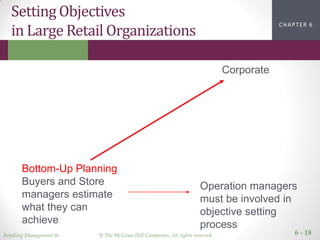
Bottom-Up Planning
Buyers and Store
managers estimate
what they can
achieve
Corporate
Operation managers
must be involved in
objective setting
process
Retailing Management 8e © The McGraw-Hill Companies, All rights reserved. 6 - 19
CHAPTER 2CHAPTER 1CHAPTER 1CHAPTER 6Productivity Measures
Input Measures – assess the amount of resources or
money used by the retailer to achieve outputs such as
sales
Output measures – asses the results of a retailer’s
investment decisions
Productivity measure – determines how effectively
retailers use their resource – what return (e.g., profits)
they get on their investments (e.g., expenses)
Retailing Management 8e © The McGraw-Hill Companies, All rights reserved. 6 - 20
CHAPTER 2CHAPTER 1CHAPTER 1CHAPTER 6
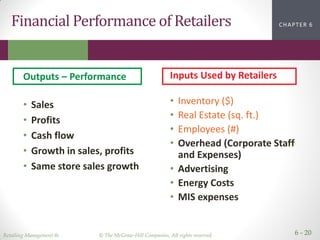
Outputs – Performance
• Sales
• Profits
• Cash flow
• Growth in sales, profits
• Same store sales growth
Inputs Used by Retailers
• Inventory ($)
• Real Estate (sq. ft.)
• Employees (#)
• Overhead (Corporate Staff
and Expenses)
• Advertising
• Energy Costs
• MIS expenses
Financial Performance of Retailers
Retailing Management 8e © The McGraw-Hill Companies, All rights reserved. 6 - 21
CHAPTER 2CHAPTER 1CHAPTER 1CHAPTER 6
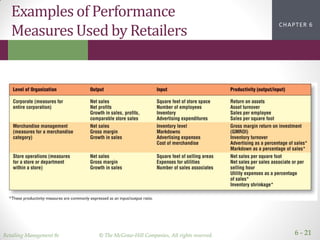
Examples of Performance
Measures Used by Retailers
Retailing Management 8e © The McGraw-Hill Companies, All rights reserved. 6 - 22
CHAPTER 2CHAPTER 1CHAPTER 1CHAPTER 6Assessing Performance
• Growth in Stockholder Value – Stock Price
• Accounting Measures – ROA (Risk adjusted)
• Benchmark
• Performance Over Time
• Compare performance indicator for three years
• Performance Compared to Competitors
• Compare performance indicators with major competitors for
one year, most recent

Chapter061

  • 1.
    Retailing Management 8e© The McGraw-Hill Companies, All rights reserved. 6 - 1 CHAPTER 2CHAPTER 1CHAPTER 1CHAPTER 6 Financial Strategy CHAPTER 6
  • 2.
    Retailing Management 8e© The McGraw-Hill Companies, All rights reserved. 6 - 2 CHAPTER 2CHAPTER 1CHAPTER 1CHAPTER 6Retailing Strategy Retail Market Strategy Financial Strategy Retail Locations Retail Site Location Human Resource Management Information Systems and Supply Chain Management Customer Relationship Management
  • 3.
    Retailing Management 8e© The McGraw-Hill Companies, All rights reserved. 6 - 3 CHAPTER 2CHAPTER 1CHAPTER 1CHAPTER 6Questions • How is a retail strategy reflected in retailers’ financial objectives? • How do retailers need to evaluate their performance? • What is the strategic profit model, and how is it used? • What measures do retailers use to assess their performance?
  • 4.
    Retailing Management 8e© The McGraw-Hill Companies, All rights reserved. 6 - 4 CHAPTER 2CHAPTER 1CHAPTER 1CHAPTER 6Objectives and Goals • Financial – not necessarily profits, but return on investment (ROI) – primary focus • Societal – helping to improve the world around us • Personal – self-gratification, status, respect
  • 5.
    Retailing Management 8e© The McGraw-Hill Companies, All rights reserved. 6 - 5 CHAPTER 2CHAPTER 1CHAPTER 1CHAPTER 6 Components of the Strategic Profit Model
  • 6.
    Retailing Management 8e© The McGraw-Hill Companies, All rights reserved. 6 - 6 CHAPTER 2CHAPTER 1CHAPTER 1CHAPTER 6 The Strategic Profit Model: An Overview Profit Margin x Asset turnover = Return on assets Net profit x Net sales (crossed out) = Net profit Net sales (crossed out) Total assets Total assets Net Profit Margin: reflects the profits generated from each dollar of sales Asset Turnover: assesses the productivity of a firm’s investment in its assets
  • 7.
    Retailing Management 8e© The McGraw-Hill Companies, All rights reserved. 6 - 7 CHAPTER 2CHAPTER 1CHAPTER 1CHAPTER 6Profit Margin Management Path • Net Sales = Gross Sales + Promotional Allowances - Return • Cost of Good Sold (COGs) • Gross Margin (GM) = Net Sales - COGs
  • 8.
    Retailing Management 8e© The McGraw-Hill Companies, All rights reserved. 6 - 8 CHAPTER 2CHAPTER 1CHAPTER 1CHAPTER 6Profit Margin Management Path • Operating Expense • Variable (e.g.. sales commissions) • Fixed (rent, depreciation, staff salaries) • Selling, general, and administrative (SG&A) expenses • Operating profit margin • Operating profit margin = Gross margin - Operating expenses – Extraordinary (recurring) operating expenses • Net profit margin = Operating profit margin - Taxes - Interest - Extraordinary nonrecurring expenses
  • 9.
    Retailing Management 8e© The McGraw-Hill Companies, All rights reserved. 6 - 9 CHAPTER 2CHAPTER 1CHAPTER 1CHAPTER 6Profit Margin Management Path • Gross margin percentage is gross margin divided by net sales. • Retailers use to compare • the performance of various types of merchandise • their own performance with that of other retailers with higher or lower levels of sales. Gross margin Net sales = Gross margin %
  • 10.
    Retailing Management 8e© The McGraw-Hill Companies, All rights reserved. 6 - 10 CHAPTER 2CHAPTER 1CHAPTER 1CHAPTER 6Profit Margin Management Path • SG & A or operating expenses can be expressed as a percentage of net sales to facilitate comparisons across items, stores, and merchandise categories within and between firms. Operating expenses Net sales = Operating expenses %
  • 11.
    Retailing Management 8e© The McGraw-Hill Companies, All rights reserved. 6 - 11 CHAPTER 2CHAPTER 1CHAPTER 1CHAPTER 6Profit Margin Management Path • Net operating profit percentage is gross margin minus operating expenses divided by net sales Gross margin - Operating expenses Net sales = Net operating profit %
  • 12.
    Retailing Management 8e© The McGraw-Hill Companies, All rights reserved. 6 - 12 CHAPTER 2CHAPTER 1CHAPTER 1CHAPTER 6Asset Management Path • Assets: • Economic Resources (e.g., inventory, buildings, computers, store fixtures) owned or controlled by a firm • Current Asset and Fixed Asset • Current Assets = Cash + Account Receivable + Inventory + Other current assets
  • 13.
    Retailing Management 8e© The McGraw-Hill Companies, All rights reserved. 6 - 13 CHAPTER 2CHAPTER 1CHAPTER 1CHAPTER 6Asset Management Path • Accounts receivable are primarily the monies owed to the retailer by customers that have bought merchandise on credit. • Fixed Assets = Fixture, Stores (owned) • Asset Turnover = Sales/Total Assets • Inventory Turnover = COGS/Avg. Inventory (cost) Net sales Total assets = Asset turnover Cost of goods sold Average inventory at cost = Inventory turnover
  • 14.
    Retailing Management 8e© The McGraw-Hill Companies, All rights reserved. 6 - 14 CHAPTER 2CHAPTER 1CHAPTER 1CHAPTER 6Inventory Turnover • A Measure of the Productivity of Inventory: • It is used to evaluate how effectively retailers utilize their investment in inventory • Shows how many times, on average, inventory cycles through the store during a specific period of time (usually a year) Inventory Turnover = COGS/avg inventory (cost) Inventory Turnover = Sales/ avg inventory (retail)
  • 15.
    Retailing Management 8e© The McGraw-Hill Companies, All rights reserved. 6 - 15 CHAPTER 2CHAPTER 1CHAPTER 1CHAPTER 6Analysis of Financial Strength • Cash-Flow Analysis • Debt-Equity Ratio • Current Ratio • Quick Ratio
  • 16.
    Retailing Management 8e© The McGraw-Hill Companies, All rights reserved. 6 - 16 CHAPTER 2CHAPTER 1CHAPTER 1CHAPTER 6 Setting and Measuring Performance Objectives • Retailers will be better able to gauge performance if it has specific objectives in mind to compare performance. • Should include: • numerical index of performance desired • time frame for performance • necessary resources to achieve objectives
  • 17.
    Retailing Management 8e© The McGraw-Hill Companies, All rights reserved. 6 - 17 CHAPTER 2CHAPTER 1CHAPTER 1CHAPTER 6 Setting Objectives in Large Retail Organizations Top-Down Planning Corporate Developmental Strategy Category, Departments and sales associates implement strategy
  • 18.
    Retailing Management 8e© The McGraw-Hill Companies, All rights reserved. 6 - 18 CHAPTER 2CHAPTER 1CHAPTER 1CHAPTER 6 Setting Objectives in Large Retail Organizations Bottom-Up Planning Buyers and Store managers estimate what they can achieve Corporate Operation managers must be involved in objective setting process
  • 19.
    Retailing Management 8e© The McGraw-Hill Companies, All rights reserved. 6 - 19 CHAPTER 2CHAPTER 1CHAPTER 1CHAPTER 6Productivity Measures Input Measures – assess the amount of resources or money used by the retailer to achieve outputs such as sales Output measures – asses the results of a retailer’s investment decisions Productivity measure – determines how effectively retailers use their resource – what return (e.g., profits) they get on their investments (e.g., expenses)
  • 20.
    Retailing Management 8e© The McGraw-Hill Companies, All rights reserved. 6 - 20 CHAPTER 2CHAPTER 1CHAPTER 1CHAPTER 6 Outputs – Performance • Sales • Profits • Cash flow • Growth in sales, profits • Same store sales growth Inputs Used by Retailers • Inventory ($) • Real Estate (sq. ft.) • Employees (#) • Overhead (Corporate Staff and Expenses) • Advertising • Energy Costs • MIS expenses Financial Performance of Retailers
  • 21.
    Retailing Management 8e© The McGraw-Hill Companies, All rights reserved. 6 - 21 CHAPTER 2CHAPTER 1CHAPTER 1CHAPTER 6 Examples of Performance Measures Used by Retailers
  • 22.
    Retailing Management 8e© The McGraw-Hill Companies, All rights reserved. 6 - 22 CHAPTER 2CHAPTER 1CHAPTER 1CHAPTER 6Assessing Performance • Growth in Stockholder Value – Stock Price • Accounting Measures – ROA (Risk adjusted) • Benchmark • Performance Over Time • Compare performance indicator for three years • Performance Compared to Competitors • Compare performance indicators with major competitors for one year, most recent