TYPES OF PLANNING
R.ArunKumar,AP/Mech,RIT
PLANNING TYPES:
R.ArunKumar,AP/Mech,RIT
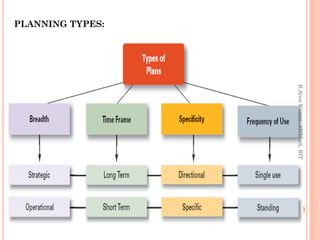
PLANNING TYPES:
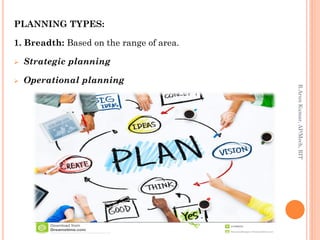
1. Breadth: Based on the range of area.
 Strategic planning
 Operational planning
R.ArunKumar,AP/Mech,RIT
PLANNING TYPES:
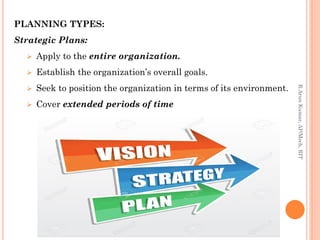
Strategic Plans:
 Apply to the entire organization.
 Establish the organization’s overall goals.
 Seek to position the organization in terms of its environment.
 Cover extended periods of time
R.ArunKumar,AP/Mech,RIT
PLANNING TYPES:
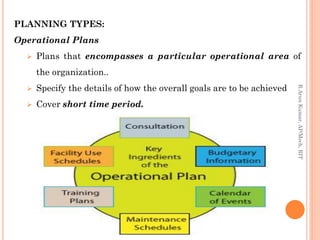
Operational Plans
 Plans that encompasses a particular operational area of
the organization..
 Specify the details of how the overall goals are to be achieved
 Cover short time period.
R.ArunKumar,AP/Mech,RIT
PLANNING TYPES:
2. Time frame: Based on duration for achieving the goal.
 Long term goal
 Short term goal
R.ArunKumar,AP/Mech,RIT
PLANNING TYPES:
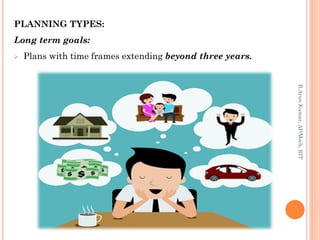
Long term goals:
 Plans with time frames extending beyond three years.
R.ArunKumar,AP/Mech,RIT
PLANNING TYPES:
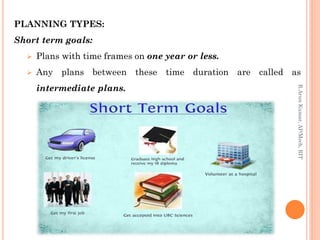
Short term goals:
 Plans with time frames on one year or less.
 Any plans between these time duration are called as
intermediate plans.
R.ArunKumar,AP/Mech,RIT
PLANNING TYPES:
3. Specificity: Based on range of defining.
 Specific plans
 Directional plans
R.ArunKumar,AP/Mech,RIT
PLANNING TYPES:
Specific Plans
 Plans that are clearly defined and leave no room for
interpretation.
 They have clearly defined objectives.
 No uncertainty
R.ArunKumar,AP/Mech,RIT
PLANNING TYPES:
Directional Plans
 Flexible plans that set out general guidelines, provide focus,
yet allow freedom in implementation.
 Directional plans are used when uncertainty is high.
 They provide focus but do not lock managers into specific goals
or courses of action.
R.ArunKumar,AP/Mech,RIT
PLANNING TYPES:
4. Frequency of use: Based on usage of planning.
 Single-Use Plan
 Standing Plans
R.ArunKumar,AP/Mech,RIT
PLANNING TYPES:
Single-Use Plan
 A one-time plan specifically designed to meet the need of a
unique situation.
R.ArunKumar,AP/Mech,RIT
PLANNING TYPES:
Standing Plans
 Ongoing plans that provide guidance for activities performed
repeatedly.
R.ArunKumar,AP/Mech,RIT
SINGLE USE PLANS VS STANDING PLANS
Single use plans
1.Programmes
2.Budgets
3.Projects
Standard/Repeated use plans
1.Objectives
2.Policies
3.Procedures
4.Rules
5.Strategies
R.ArunKumar,AP/Mech,RIT
Single Use Plans:
1. Programmes
 A specific plan devised to meet a particular situation.
2. Budget
 A financial or quantitative statement prepared prior to a definite
period of time.
3. Project
 Part of general programme.
R.ArunKumar,AP/Mech,RIT
Standing Use Plans:
1. Objectives
 Specific goals or targets to be accomplished.
 Realistic, flexible.
2. Policies
 Guiding principles established by the company to govern actions
usually under repetitive conditions.
3. Procedures
 Prescribe the manner or method by which the work is to be
performed.
R.ArunKumar,AP/Mech,RIT
Standing Use Plans:
4. Rules
 A decision made by the management regarding what is to be done
and what is not to be done in a given situation.
5. Strategy
 A special kind of plan formulated in order to meet the challenge
of the polices of competitors.
R.ArunKumar,AP/Mech,RIT
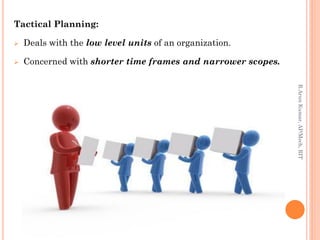
Tactical Planning:
 Deals with the low level units of an organization.
 Concerned with shorter time frames and narrower scopes.
R.ArunKumar,AP/Mech,RIT
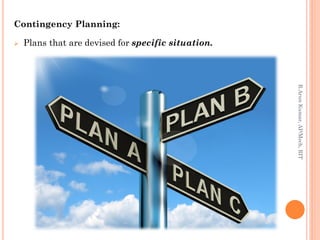
Contingency Planning:
 Plans that are devised for specific situation.
R.ArunKumar,AP/Mech,RIT
Advantages of Planning:
 Helps in achieving objectives.
 Better utilization of resources.
 Economy in operation.
 Reduces uncertainty and risk.
 Effective control.
 Improves coordination.
 Guides in decision making.
 Improves output of an organization.
 Provides decentralization.
R.ArunKumar,AP/Mech,RIT
Disadvantages of Planning:
 Lack of accuracy.
 Time and cost.
 Inflexibility.
 Delay during emergency period.
R.ArunKumar,AP/Mech,RIT

Types of planning

  • 1.
  • 2.
  • 3.
    PLANNING TYPES: 1. Breadth:Based on the range of area.  Strategic planning  Operational planning R.ArunKumar,AP/Mech,RIT
  • 4.
    PLANNING TYPES: Strategic Plans: Apply to the entire organization.  Establish the organization’s overall goals.  Seek to position the organization in terms of its environment.  Cover extended periods of time R.ArunKumar,AP/Mech,RIT
  • 5.
    PLANNING TYPES: Operational Plans Plans that encompasses a particular operational area of the organization..  Specify the details of how the overall goals are to be achieved  Cover short time period. R.ArunKumar,AP/Mech,RIT
  • 6.
    PLANNING TYPES: 2. Timeframe: Based on duration for achieving the goal.  Long term goal  Short term goal R.ArunKumar,AP/Mech,RIT
  • 7.
    PLANNING TYPES: Long termgoals:  Plans with time frames extending beyond three years. R.ArunKumar,AP/Mech,RIT
  • 8.
    PLANNING TYPES: Short termgoals:  Plans with time frames on one year or less.  Any plans between these time duration are called as intermediate plans. R.ArunKumar,AP/Mech,RIT
  • 9.
    PLANNING TYPES: 3. Specificity:Based on range of defining.  Specific plans  Directional plans R.ArunKumar,AP/Mech,RIT
  • 10.
    PLANNING TYPES: Specific Plans Plans that are clearly defined and leave no room for interpretation.  They have clearly defined objectives.  No uncertainty R.ArunKumar,AP/Mech,RIT
  • 11.
    PLANNING TYPES: Directional Plans Flexible plans that set out general guidelines, provide focus, yet allow freedom in implementation.  Directional plans are used when uncertainty is high.  They provide focus but do not lock managers into specific goals or courses of action. R.ArunKumar,AP/Mech,RIT
  • 12.
    PLANNING TYPES: 4. Frequencyof use: Based on usage of planning.  Single-Use Plan  Standing Plans R.ArunKumar,AP/Mech,RIT
  • 13.
    PLANNING TYPES: Single-Use Plan A one-time plan specifically designed to meet the need of a unique situation. R.ArunKumar,AP/Mech,RIT
  • 14.
    PLANNING TYPES: Standing Plans Ongoing plans that provide guidance for activities performed repeatedly. R.ArunKumar,AP/Mech,RIT
  • 15.
    SINGLE USE PLANSVS STANDING PLANS Single use plans 1.Programmes 2.Budgets 3.Projects Standard/Repeated use plans 1.Objectives 2.Policies 3.Procedures 4.Rules 5.Strategies R.ArunKumar,AP/Mech,RIT
  • 16.
    Single Use Plans: 1.Programmes  A specific plan devised to meet a particular situation. 2. Budget  A financial or quantitative statement prepared prior to a definite period of time. 3. Project  Part of general programme. R.ArunKumar,AP/Mech,RIT
  • 17.
    Standing Use Plans: 1.Objectives  Specific goals or targets to be accomplished.  Realistic, flexible. 2. Policies  Guiding principles established by the company to govern actions usually under repetitive conditions. 3. Procedures  Prescribe the manner or method by which the work is to be performed. R.ArunKumar,AP/Mech,RIT
  • 18.
    Standing Use Plans: 4.Rules  A decision made by the management regarding what is to be done and what is not to be done in a given situation. 5. Strategy  A special kind of plan formulated in order to meet the challenge of the polices of competitors. R.ArunKumar,AP/Mech,RIT
  • 19.
    Tactical Planning:  Dealswith the low level units of an organization.  Concerned with shorter time frames and narrower scopes. R.ArunKumar,AP/Mech,RIT
  • 20.
    Contingency Planning:  Plansthat are devised for specific situation. R.ArunKumar,AP/Mech,RIT
  • 21.
    Advantages of Planning: Helps in achieving objectives.  Better utilization of resources.  Economy in operation.  Reduces uncertainty and risk.  Effective control.  Improves coordination.  Guides in decision making.  Improves output of an organization.  Provides decentralization. R.ArunKumar,AP/Mech,RIT
  • 22.
    Disadvantages of Planning: Lack of accuracy.  Time and cost.  Inflexibility.  Delay during emergency period. R.ArunKumar,AP/Mech,RIT