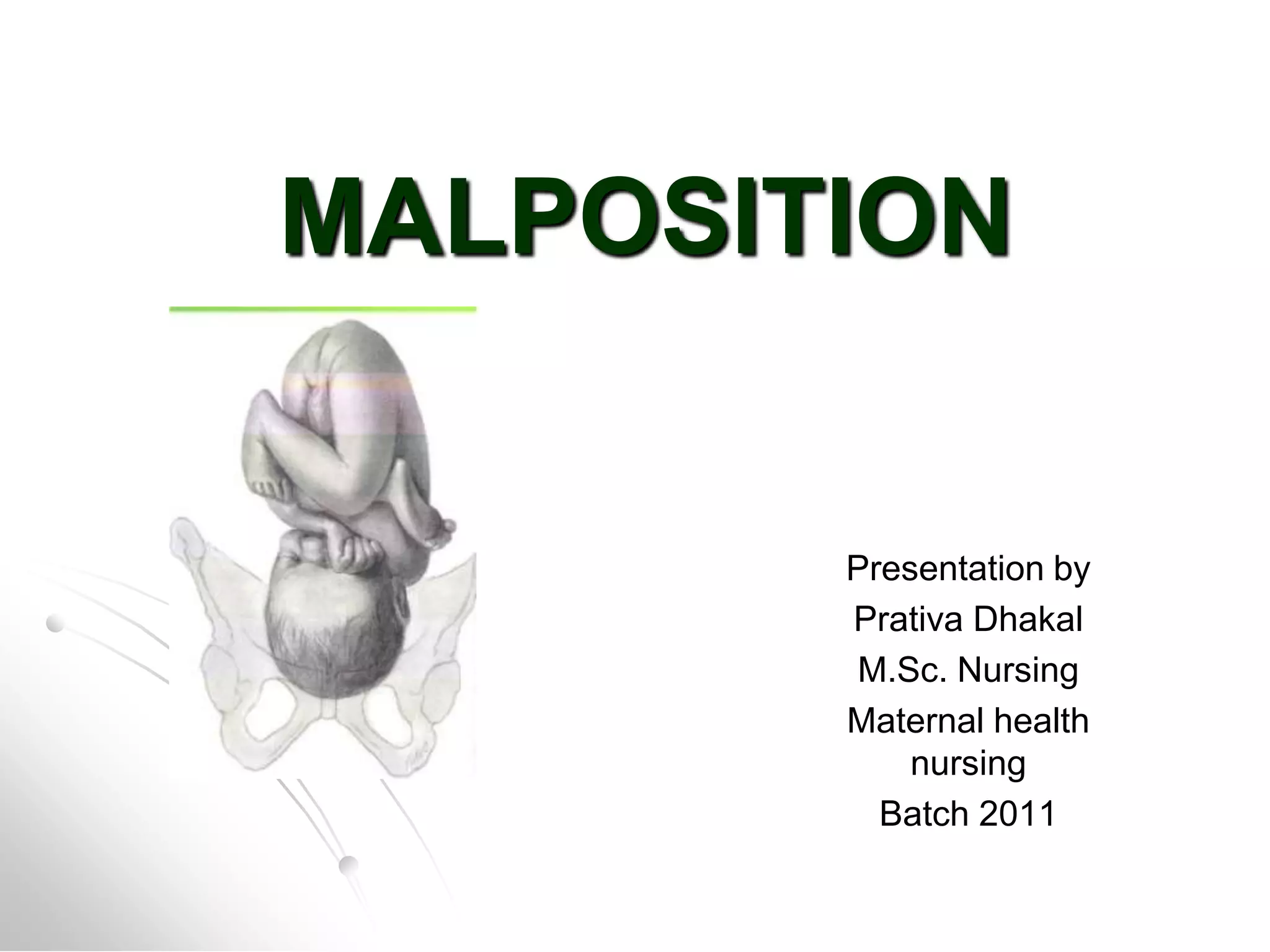
MALPOSITION

Presentation by
Prativa Dhakal
M.Sc. Nursing
Maternal health
nursing
Batch 2011
Contents













Occipito posterior position
Causes
Abdominal examination
Mechanism of labour
Persistent occipitoposterior position
Deep transverse arrest
Diagnosis
Management and care of mother having OPP
Complications
Research Evidence
References
Malposition


It is the vertex position where the occiput is placed
posteriorly over the sacro-ilical joint or directly over the
sacrum, it is called an occipito-posterior position.



When the occiput is placed over the right sacroiliac joint,
the position is called right occipito posterior (R.O.P)
position and when placed over the left sacro-iliac joint, is
called left occipito posterior (L.O.P) position.



When it points towards the sacrum it is called direct
occipito posterior position.
Occipito-posterior position


Occipito-posterior position is an abnormal position of the
vertex rather than an abnormal presentation.



Occurs in approximately 10% of labours.



A persistent occipito-posterior position results from a
failure of internal rotation prior to birth.



Occurs in 5% of the births.



ROP is five times more common than LOP
Causes


The direct cause is often unknown. But the following are
the responsible factors:


Shape of the pelvic inlet: associated with either an
anthropoid or android pelvis.



Fetal factors: Marked deflexion of fetal head.



Uterine factors: Abnormal uterine contraction
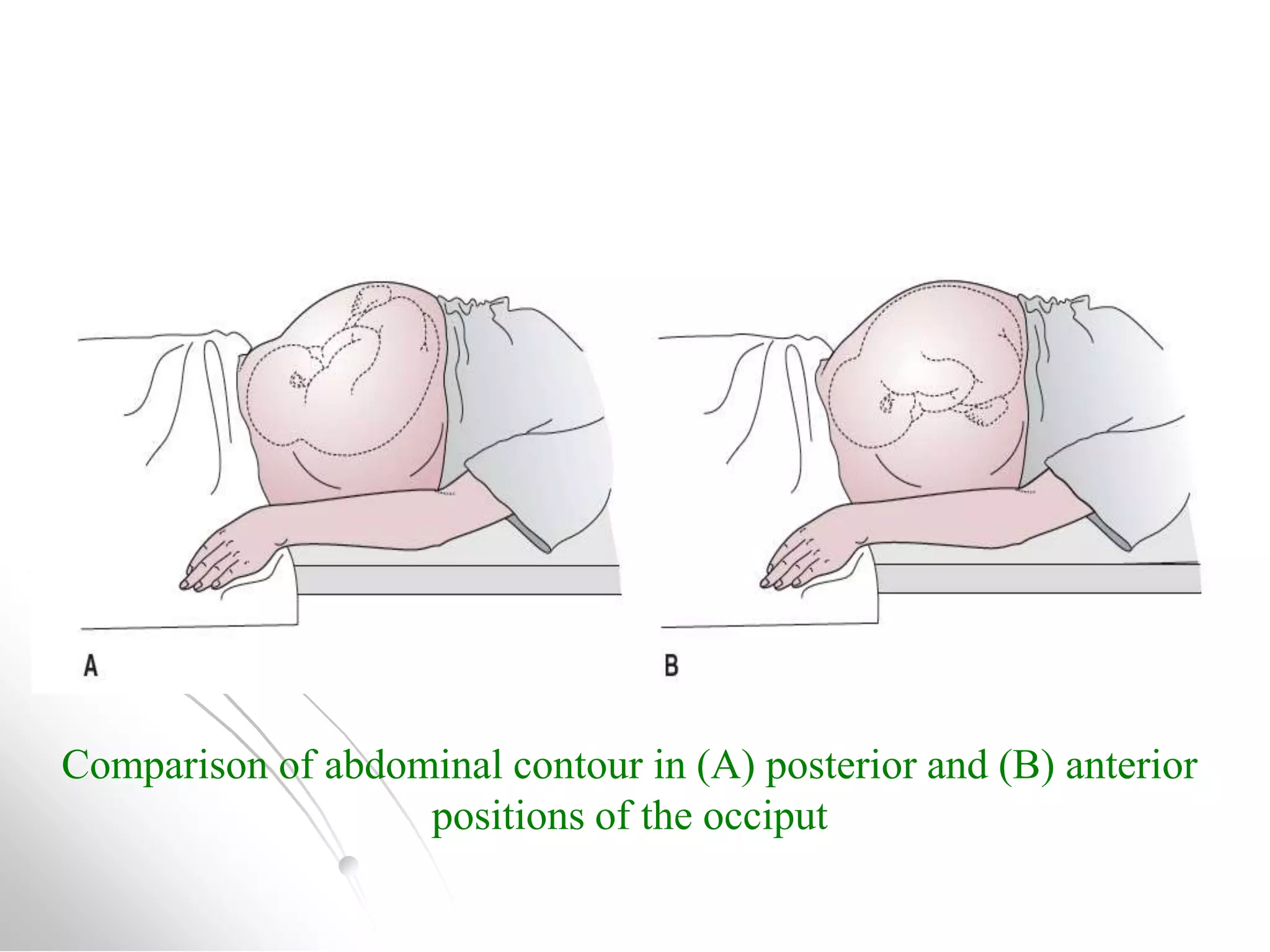
Abdominal examination
Listen to the mother: Complain of backache and she may feel that her
baby’s bottom is very high up against her ribs.
Inspection:
• Abdomen looks flat, below the
umbilicus.
• Presence of saucer shaped
depression.
• The outline created by
high, unengaged head can look
like a full bladder

Palpation:
• Fetal limbs are felt more easily
near midline on either side.
•Fetal back is felt far away from
midline on flank.

• Anterior shoulder lies far away
from midline.
• Head is not engaged.
• Cephalic prominence is not felt
so much prominent

Most common cause of non engagement in a primigravida at term.
Comparison of abdominal contour in (A) posterior and (B) anterior
positions of the occiput
Examination cont…
Auscultation
• The fetal back is not well
flexed so chest is thrust
forward, therefore the fetal
heart can be heard in the
midline.
• Heart rate may be heard
more easily at the flank on the
same side as the back.

Vaginal examination
• Elongated bag of membranes

•Sagittal suture occupies any of
the oblique diameters of pelvis.
• Posterior fontanelle is felt
near the sacro-iliac joint
• Anterior fontanelle is felt more
easily



In late labour, the diagnosis is often difficult because of
caput formation.



In such cases, the ear is to be located and the unfolded
pinna points towards the occiput.
Fate of OPP
OPP

Engaging diameter :- occipito-frontal
11.5cm or sub-occipitofrontal 10cm.

Unfavorable (10%)
Favorable (90%)
3/8th rotation
occipit comes under
symphysis pubis (rt/lt
occipito anterior)
Normal vaginal delivery

Mild deflexion Moderate deflexion Severe deflexion
Occiput rotate by
1/8th circle
Deep
transverse
arrest

Non-rotation
Oblique
posterior
arrest

Occiput rotate
posteriorly by 1/8th

POPP/ occipitosacral position

Face to pubis delivery

Arrest
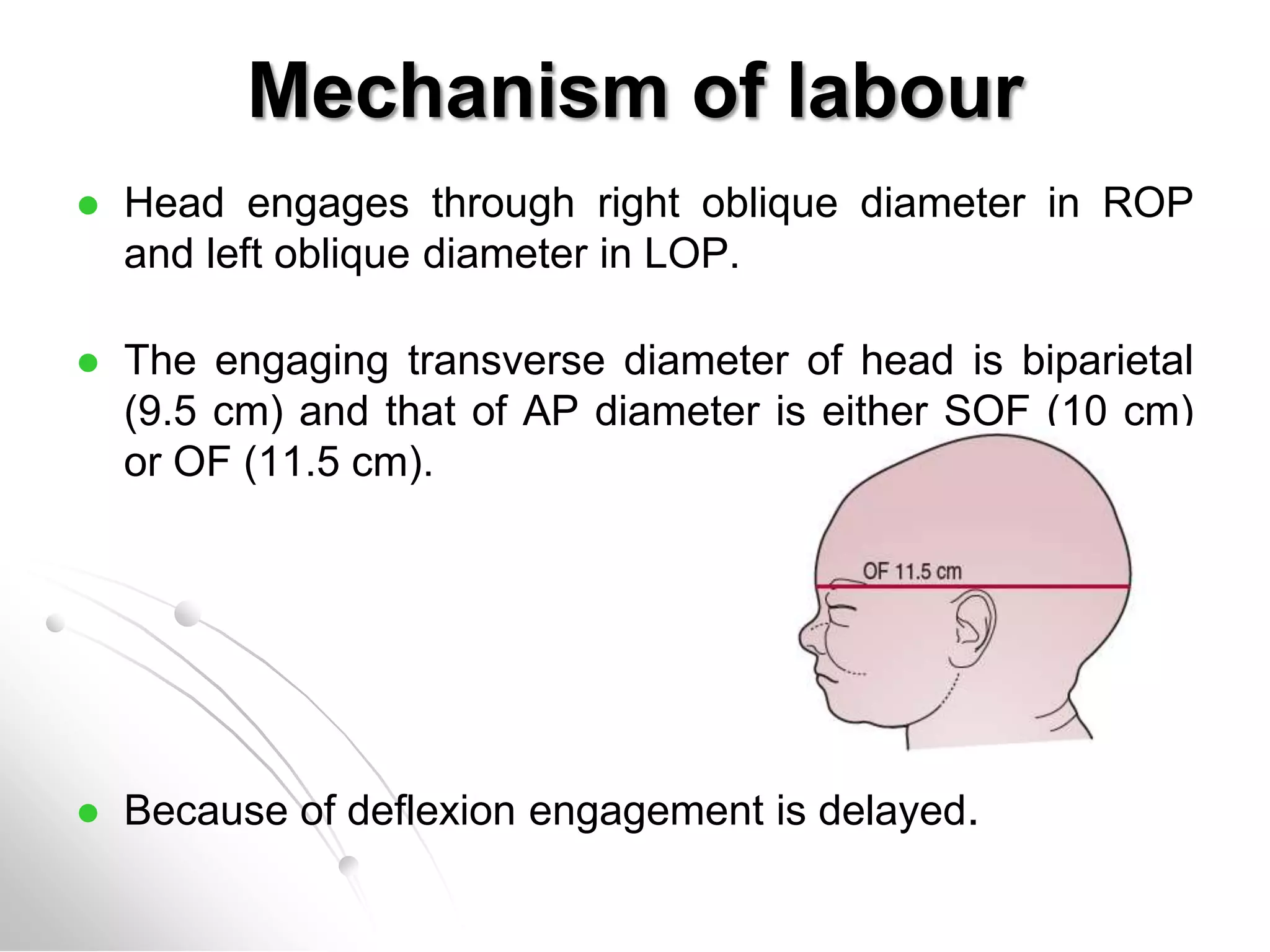
Mechanism of labour


Head engages through right oblique diameter in ROP
and left oblique diameter in LOP.



The engaging transverse diameter of head is biparietal
(9.5 cm) and that of AP diameter is either SOF (10 cm)
or OF (11.5 cm).



Because of deflexion engagement is delayed.
Mechanism of labour cont…










Lie: longitudinal
The attitude of the head is deflexed
Presentation: vertex
Position: Right occipitoposterior
Denominator: Occiput
Presenting part: Middle or anterior area of left parietal
bone

The OF diameter 11.5 cm lies in the right oblique
diameter of the pelvic brim. The occiput points to the
right sacroiliac joint and the sinciput to the left
iliopectineal eminence.
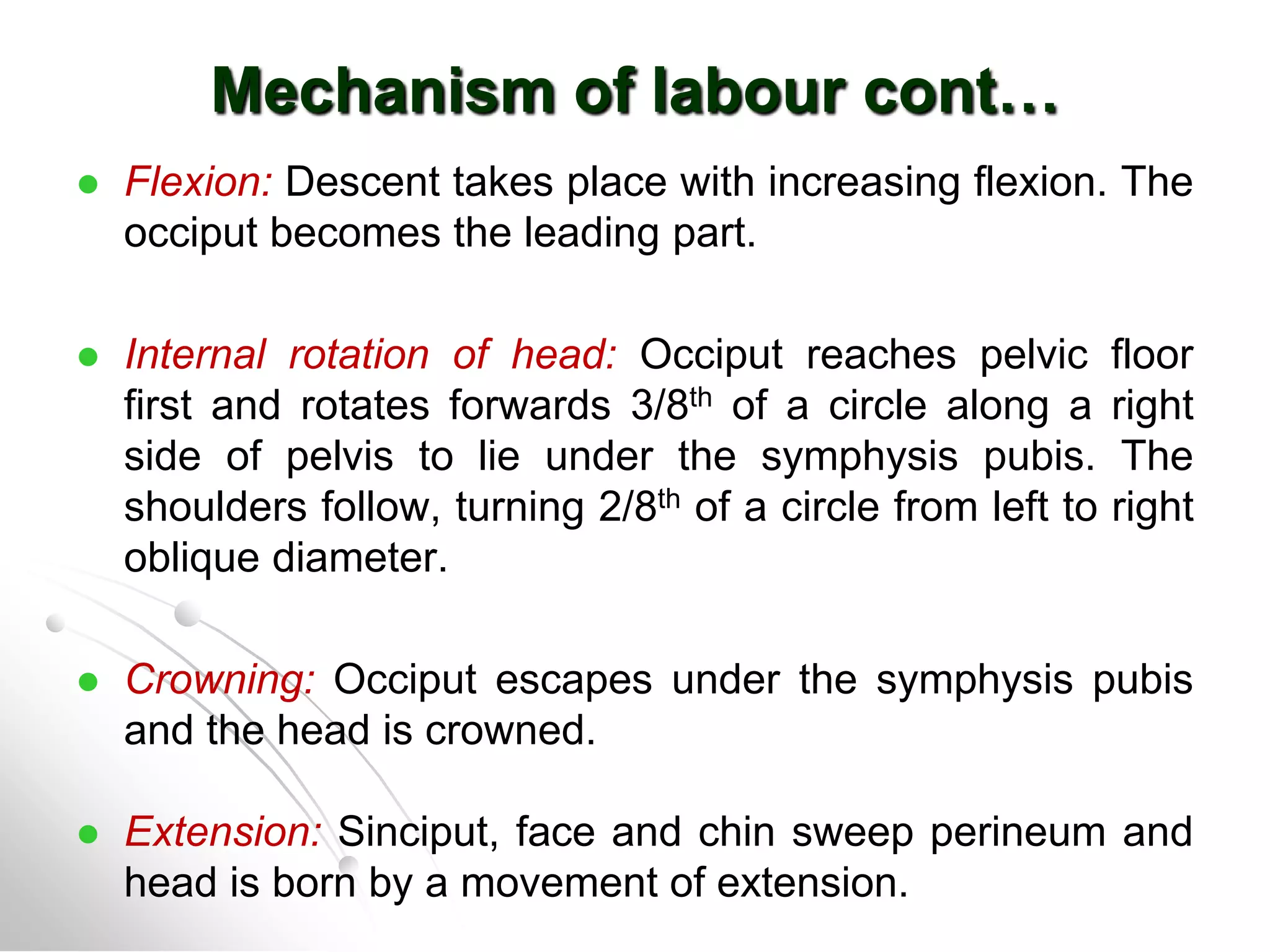
Mechanism of labour cont…


Flexion: Descent takes place with increasing flexion. The
occiput becomes the leading part.



Internal rotation of head: Occiput reaches pelvic
first and rotates forwards 3/8th of a circle along a
side of pelvis to lie under the symphysis pubis.
shoulders follow, turning 2/8th of a circle from left to
oblique diameter.



Crowning: Occiput escapes under the symphysis pubis
and the head is crowned.



Extension: Sinciput, face and chin sweep perineum and
head is born by a movement of extension.

floor
right
The
right
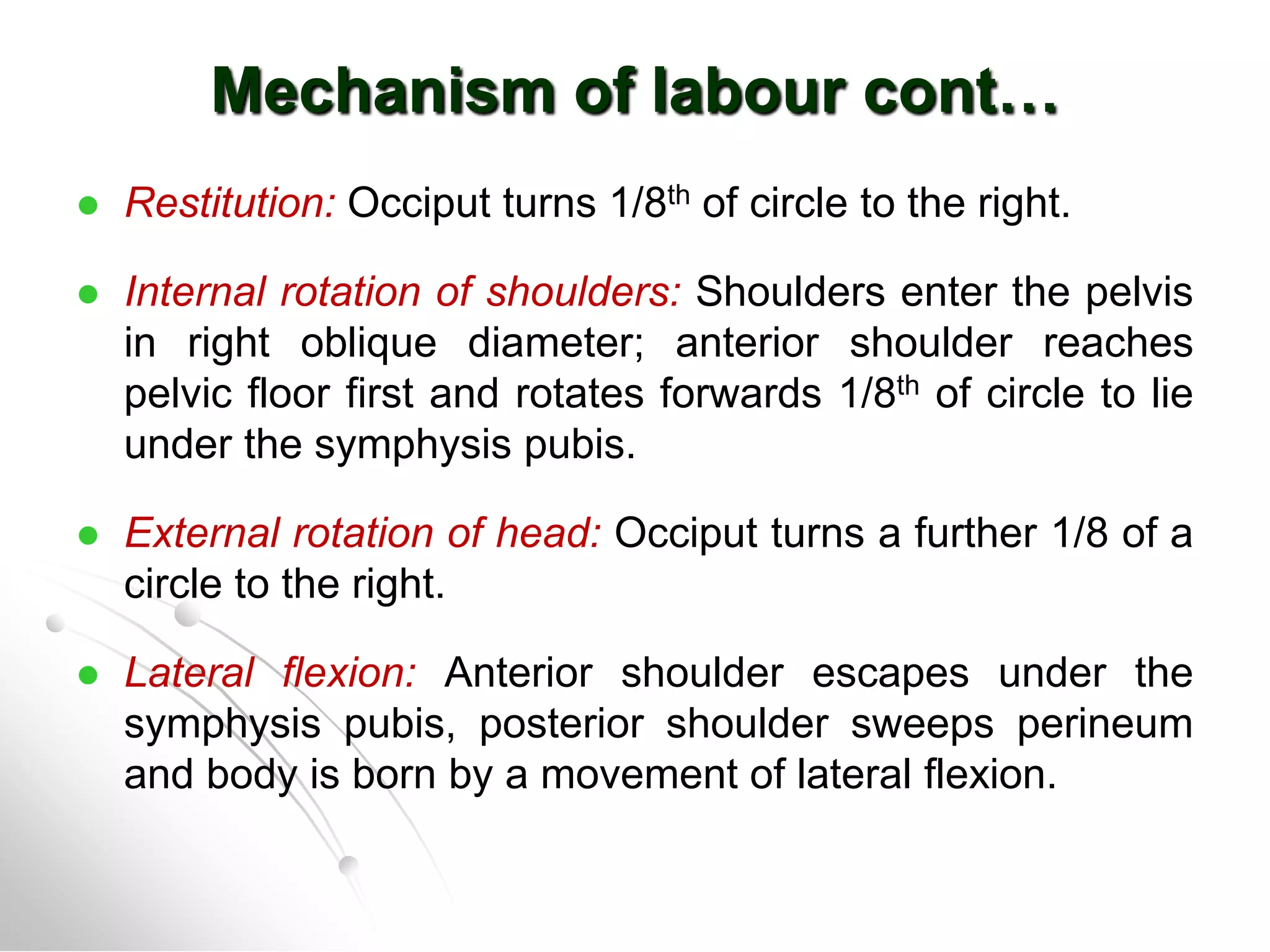
Mechanism of labour cont…


Restitution: Occiput turns 1/8th of circle to the right.



Internal rotation of shoulders: Shoulders enter the pelvis
in right oblique diameter; anterior shoulder reaches
pelvic floor first and rotates forwards 1/8th of circle to lie
under the symphysis pubis.



External rotation of head: Occiput turns a further 1/8 of a
circle to the right.



Lateral flexion: Anterior shoulder escapes under the
symphysis pubis, posterior shoulder sweeps perineum
and body is born by a movement of lateral flexion.
Mechanism of labour in right occipito posterior diameter
Mechanism of face to pubis delivery


Further descent occurs until the root of nose hinges
under symphysis pubis.



Flexion occurs —releasing successively the brow, vertex
and occiput out of the stretched perineum and then the
face is born by extension.



Restitution: Head moves 1/8th of circle in opposite
direction of internal rotation thus turning the face to look
towards the mother’s left thigh in ROP and right thigh in
LOP.



External rotation: Occiput further rotates to the same
direction of restitution to 1/8th of a circle placing finally
face looking directly towards the left thigh in ROP and
the right thigh in LOP.
Persistent Occipito posterior


It is an abnormal mechanism of the occipito posterior
position where there is malrotation of the occiput
posteriorly towards the sacral hollow.



Delivery may occur spontaneously as face to pubis but
arrest may occur in this position and is called occipito
sacral arrest



Cause: Failure of flexion
Delivery of head in a persistent
occipitoposterior position

Allowing the sinciput to escape as far as the glabella and
the occiput sweeps the perineum, sinciput held back to
maintain flexion
Delivery of head in a persistent
occipitoposterior position

Grasping the head to bring the face down from under the
symphysis pubis and Extension of the head
Upward moulding (dotted line) following
persistent occipito posterior position
Deep transverse arrest


The head is deep into the cavity, the sagittal suture is
placed in the transverse bipsinous diameter and there is
no prognosis in descent of the head even after ½ -1 hour
following full dilatation of cervix.



May be end result of incomplete anterior rotation of the
oblique OPP, or it may be due to non rotation of the
commonly primary occipito transverse position of normal
mechanism of labour.
Deep transverse arrest cont…
Causes:
 Faulty pelvic architecture
 Prominent ischial spine,
 Flat sacrum and convergent side walls,
 Deflexion of head,
 Weak uterine contraction,
 Laxity of the pelvic floor muscles.
Diagnosis
 Head is engaged
 Sagittal suture lies in transverse bispinous diameter,
 Anterior fontanelle is palpable,
 Faulty pelvic architecture may be detected.
Deep transverse arrest cont…
Management:
 Vaginal delivery is found safe.


Ventouse



Manual rotation and application of forceps



Forceps rotation and delivery with Keilland in hands
of an expert.



Vaginal delivery is not safe: caesarean section.



Craniotomy in dead pelvis.
Diagnosis of OP position
First stage of labour:
 Signs
are those of any posterior position of
occiput, namely a deflexed head and the fetal heart
heard in the flank or in the midline.


Descent is slow

Second stage of labour:
 Delay is common.


Vaginal examination: Anterior fontanelle is felt behind
symphysis pubis. If the pinna of the ear is felt pointing
towards the mothers sacrum, this indicates a posterior
position.
Diagnosis of OP position cont..
The birth
 Sinciput will first emerge from under symphysis pubis as
far as the root of the nose and flexion should be
maintained by restraining it from escaping further than
the glabella, allowing the occiput to sweep the perineum
and be born.


Extends the head by grasping it and bringing the face
down from under the symphysis pubis.



Perineal trauma and PPH are common. An episiotomy
may be required, owing to the larger presenting
diameter.
Mode of delivery


Long anterior rotation of the occiput: Spontaneous or
aided vaginal delivery usually occurs (90%)



Short posterior rotation: Spontaneous or aided vaginal
delivery may occur as face to pubis.



Non-rotation or short anterior rotation: Spontaneous
vaginal delivery is unlikely except in favourable
circumstances.



Moulding: The characteristic moulding of head occurs in
face to pubis delivery. There is compression of the
occipito-frontal diameter with elongation of the vault at
right angle to it. The frontal bones are displaced beneath
the parietal bones.
Management of labour


Diagnosis and evaluation: Fetal back on the flank with
FHS not being easily located, early rupture of
membranes should arouse the suspicion. Internal
examination is confirmatory.



Pelvic assessment: Inclination of pelvis, configuration of
inlet, sacrum, ischial spines and the side walls are to be
noted.



Early caesarean section: Pelvic inadequacy or its
unfavourable configuration, along with obstetric
complications like, preeclampsia, post caesarean
pregnancy, big baby
Management of labour cont..
First stage: In uncomplicated cases, the labour is allowed
to proceed in a manner similar to normal labour.
 Intravenous infusion is started.


Progress of labour is judged



Weak pain, persistence of deflexion and nonrotation of
the occiput are the triad too often coexistent. In such
situation, oxytocin infusion is started for augmentation of
labour.



Indication of caesarean section arrest of labour,
incoordinate uterine action, fetal distress.
Management of labour cont..
Second stage: In majority anterior rotation of the occiput is
completed and the delivery is either spontaneous or can be
accomplished by low forceps or ventouse.
 In minority: watchful expectancy for anterior rotation of the
occiput and descent of the head.


In occipito-sacral position, spontaneous delivery of face to
pubis may occur.

Third stage:
 Tendency of PPH can be prevented by prophylactic IV
ergometrine 0.25 mg with the delivery of anterior shoulder.


Following vaginal delivery meticulous inspection of the
cervix and lower genital tract should be made to detect any
injury.
Care in labour
First stage of labour
 Continuous support


Provide physical support: Back massage and other comfort
measures and suggest changes of posture and position.



Prevent the mother from being dehydrated or ketotic.



Oxytocin infusion



Change in position and the use of breathing techniques or
inhalational analgesia to enhance relaxation.



Suggest the women the alternative method of pain relief.
Care in labour cont…
Second stage of labour
 Confirm full dilatation of cervix by vaginal examination. If the
head is not visible at the onset of second stage of labour
encourage the women to remain in upright position.


Closely monitor the maternal and fetal conditions throughout
the second stage.



The length of second stage is generally increased when the
occiput is posterior and there is increased likelihood of
operative delivery.
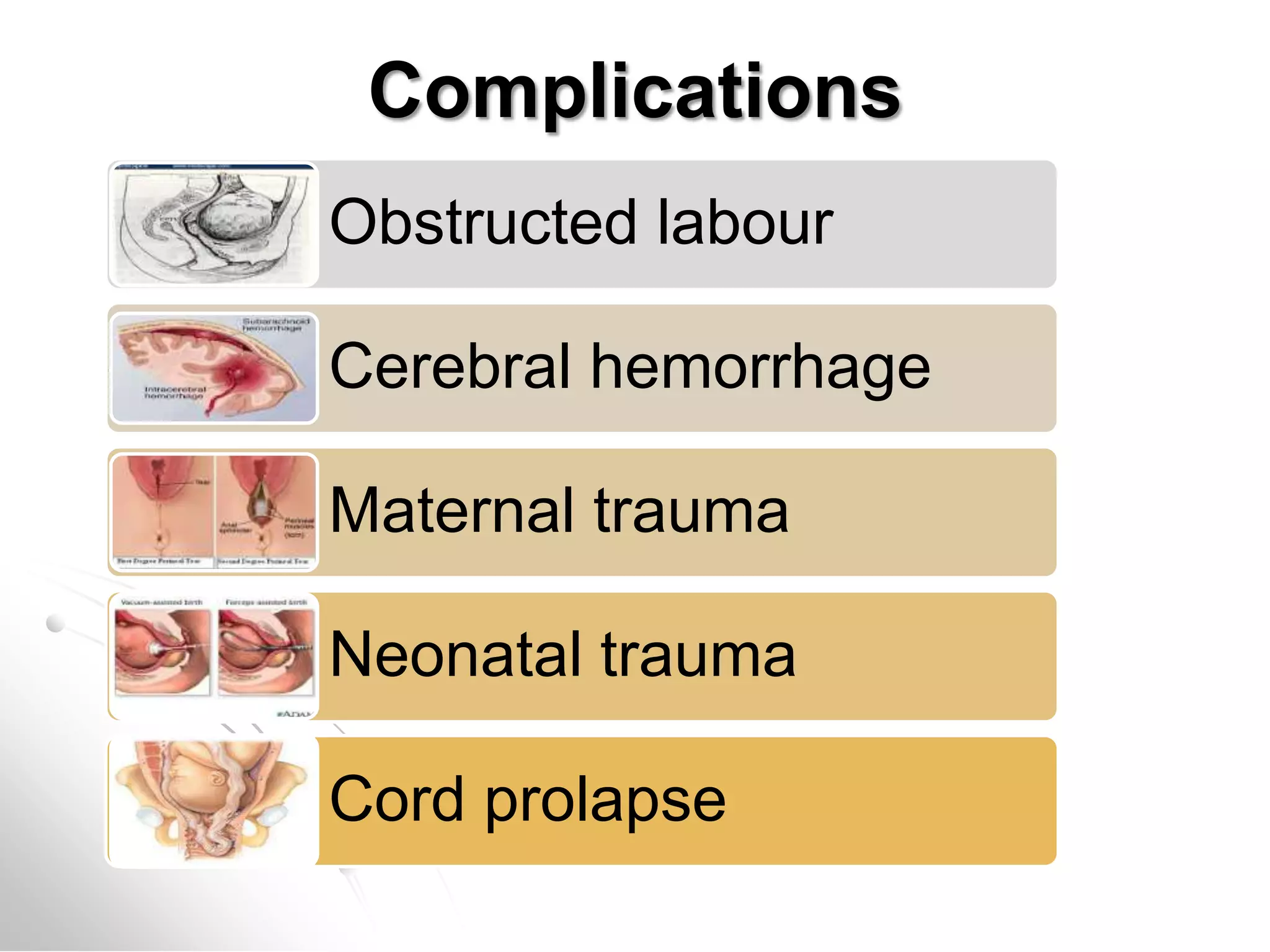
Complications
Obstructed labour
Cerebral hemorrhage
Maternal trauma
Neonatal trauma

Cord prolapse
References
1.

Fraser DM, Cooper MA. Myles Textbook for
Midwives.15th edition. Philadelphia:Churchill livingstone
elsevier;2009

2.

Dutta DC. Textbook of obstetrics.
Calcutta:New central book agency;2004

3.

Pillitteri A. Maternal and child health nursing. Care of
the childbearing and childrearing family. Sixth edition.
Philadelphia; Lippincott Williams & Wilkins: 2010.

4.

Cunningham, Leveno, Bloom. William’s obstetrics. 23rd
edition. United states of America; Mcgraw Hill
companies: 2010.

6th

edition.
Malposition

Malposition

  • 1.
    MALPOSITION Presentation by Prativa Dhakal M.Sc.Nursing Maternal health nursing Batch 2011
  • 2.
    Contents            Occipito posterior position Causes Abdominalexamination Mechanism of labour Persistent occipitoposterior position Deep transverse arrest Diagnosis Management and care of mother having OPP Complications Research Evidence References
  • 3.
    Malposition  It is thevertex position where the occiput is placed posteriorly over the sacro-ilical joint or directly over the sacrum, it is called an occipito-posterior position.  When the occiput is placed over the right sacroiliac joint, the position is called right occipito posterior (R.O.P) position and when placed over the left sacro-iliac joint, is called left occipito posterior (L.O.P) position.  When it points towards the sacrum it is called direct occipito posterior position.
  • 4.
    Occipito-posterior position  Occipito-posterior positionis an abnormal position of the vertex rather than an abnormal presentation.  Occurs in approximately 10% of labours.  A persistent occipito-posterior position results from a failure of internal rotation prior to birth.  Occurs in 5% of the births.  ROP is five times more common than LOP
  • 6.
    Causes  The direct causeis often unknown. But the following are the responsible factors:  Shape of the pelvic inlet: associated with either an anthropoid or android pelvis.  Fetal factors: Marked deflexion of fetal head.  Uterine factors: Abnormal uterine contraction
  • 7.
    Abdominal examination Listen tothe mother: Complain of backache and she may feel that her baby’s bottom is very high up against her ribs. Inspection: • Abdomen looks flat, below the umbilicus. • Presence of saucer shaped depression. • The outline created by high, unengaged head can look like a full bladder Palpation: • Fetal limbs are felt more easily near midline on either side. •Fetal back is felt far away from midline on flank. • Anterior shoulder lies far away from midline. • Head is not engaged. • Cephalic prominence is not felt so much prominent Most common cause of non engagement in a primigravida at term.
  • 8.
    Comparison of abdominalcontour in (A) posterior and (B) anterior positions of the occiput
  • 9.
    Examination cont… Auscultation • Thefetal back is not well flexed so chest is thrust forward, therefore the fetal heart can be heard in the midline. • Heart rate may be heard more easily at the flank on the same side as the back. Vaginal examination • Elongated bag of membranes •Sagittal suture occupies any of the oblique diameters of pelvis. • Posterior fontanelle is felt near the sacro-iliac joint • Anterior fontanelle is felt more easily  In late labour, the diagnosis is often difficult because of caput formation.  In such cases, the ear is to be located and the unfolded pinna points towards the occiput.
  • 10.
    Fate of OPP OPP Engagingdiameter :- occipito-frontal 11.5cm or sub-occipitofrontal 10cm. Unfavorable (10%) Favorable (90%) 3/8th rotation occipit comes under symphysis pubis (rt/lt occipito anterior) Normal vaginal delivery Mild deflexion Moderate deflexion Severe deflexion Occiput rotate by 1/8th circle Deep transverse arrest Non-rotation Oblique posterior arrest Occiput rotate posteriorly by 1/8th POPP/ occipitosacral position Face to pubis delivery Arrest
  • 11.
    Mechanism of labour  Headengages through right oblique diameter in ROP and left oblique diameter in LOP.  The engaging transverse diameter of head is biparietal (9.5 cm) and that of AP diameter is either SOF (10 cm) or OF (11.5 cm).  Because of deflexion engagement is delayed.
  • 12.
    Mechanism of labourcont…        Lie: longitudinal The attitude of the head is deflexed Presentation: vertex Position: Right occipitoposterior Denominator: Occiput Presenting part: Middle or anterior area of left parietal bone The OF diameter 11.5 cm lies in the right oblique diameter of the pelvic brim. The occiput points to the right sacroiliac joint and the sinciput to the left iliopectineal eminence.
  • 13.
    Mechanism of labourcont…  Flexion: Descent takes place with increasing flexion. The occiput becomes the leading part.  Internal rotation of head: Occiput reaches pelvic first and rotates forwards 3/8th of a circle along a side of pelvis to lie under the symphysis pubis. shoulders follow, turning 2/8th of a circle from left to oblique diameter.  Crowning: Occiput escapes under the symphysis pubis and the head is crowned.  Extension: Sinciput, face and chin sweep perineum and head is born by a movement of extension. floor right The right
  • 14.
    Mechanism of labourcont…  Restitution: Occiput turns 1/8th of circle to the right.  Internal rotation of shoulders: Shoulders enter the pelvis in right oblique diameter; anterior shoulder reaches pelvic floor first and rotates forwards 1/8th of circle to lie under the symphysis pubis.  External rotation of head: Occiput turns a further 1/8 of a circle to the right.  Lateral flexion: Anterior shoulder escapes under the symphysis pubis, posterior shoulder sweeps perineum and body is born by a movement of lateral flexion.
  • 15.
    Mechanism of labourin right occipito posterior diameter
  • 16.
    Mechanism of faceto pubis delivery  Further descent occurs until the root of nose hinges under symphysis pubis.  Flexion occurs —releasing successively the brow, vertex and occiput out of the stretched perineum and then the face is born by extension.  Restitution: Head moves 1/8th of circle in opposite direction of internal rotation thus turning the face to look towards the mother’s left thigh in ROP and right thigh in LOP.  External rotation: Occiput further rotates to the same direction of restitution to 1/8th of a circle placing finally face looking directly towards the left thigh in ROP and the right thigh in LOP.
  • 17.
    Persistent Occipito posterior  Itis an abnormal mechanism of the occipito posterior position where there is malrotation of the occiput posteriorly towards the sacral hollow.  Delivery may occur spontaneously as face to pubis but arrest may occur in this position and is called occipito sacral arrest  Cause: Failure of flexion
  • 18.
    Delivery of headin a persistent occipitoposterior position Allowing the sinciput to escape as far as the glabella and the occiput sweeps the perineum, sinciput held back to maintain flexion
  • 19.
    Delivery of headin a persistent occipitoposterior position Grasping the head to bring the face down from under the symphysis pubis and Extension of the head
  • 20.
    Upward moulding (dottedline) following persistent occipito posterior position
  • 21.
    Deep transverse arrest  Thehead is deep into the cavity, the sagittal suture is placed in the transverse bipsinous diameter and there is no prognosis in descent of the head even after ½ -1 hour following full dilatation of cervix.  May be end result of incomplete anterior rotation of the oblique OPP, or it may be due to non rotation of the commonly primary occipito transverse position of normal mechanism of labour.
  • 22.
    Deep transverse arrestcont… Causes:  Faulty pelvic architecture  Prominent ischial spine,  Flat sacrum and convergent side walls,  Deflexion of head,  Weak uterine contraction,  Laxity of the pelvic floor muscles. Diagnosis  Head is engaged  Sagittal suture lies in transverse bispinous diameter,  Anterior fontanelle is palpable,  Faulty pelvic architecture may be detected.
  • 23.
    Deep transverse arrestcont… Management:  Vaginal delivery is found safe.  Ventouse  Manual rotation and application of forceps  Forceps rotation and delivery with Keilland in hands of an expert.  Vaginal delivery is not safe: caesarean section.  Craniotomy in dead pelvis.
  • 24.
    Diagnosis of OPposition First stage of labour:  Signs are those of any posterior position of occiput, namely a deflexed head and the fetal heart heard in the flank or in the midline.  Descent is slow Second stage of labour:  Delay is common.  Vaginal examination: Anterior fontanelle is felt behind symphysis pubis. If the pinna of the ear is felt pointing towards the mothers sacrum, this indicates a posterior position.
  • 25.
    Diagnosis of OPposition cont.. The birth  Sinciput will first emerge from under symphysis pubis as far as the root of the nose and flexion should be maintained by restraining it from escaping further than the glabella, allowing the occiput to sweep the perineum and be born.  Extends the head by grasping it and bringing the face down from under the symphysis pubis.  Perineal trauma and PPH are common. An episiotomy may be required, owing to the larger presenting diameter.
  • 26.
    Mode of delivery  Longanterior rotation of the occiput: Spontaneous or aided vaginal delivery usually occurs (90%)  Short posterior rotation: Spontaneous or aided vaginal delivery may occur as face to pubis.  Non-rotation or short anterior rotation: Spontaneous vaginal delivery is unlikely except in favourable circumstances.  Moulding: The characteristic moulding of head occurs in face to pubis delivery. There is compression of the occipito-frontal diameter with elongation of the vault at right angle to it. The frontal bones are displaced beneath the parietal bones.
  • 27.
    Management of labour  Diagnosisand evaluation: Fetal back on the flank with FHS not being easily located, early rupture of membranes should arouse the suspicion. Internal examination is confirmatory.  Pelvic assessment: Inclination of pelvis, configuration of inlet, sacrum, ischial spines and the side walls are to be noted.  Early caesarean section: Pelvic inadequacy or its unfavourable configuration, along with obstetric complications like, preeclampsia, post caesarean pregnancy, big baby
  • 28.
    Management of labourcont.. First stage: In uncomplicated cases, the labour is allowed to proceed in a manner similar to normal labour.  Intravenous infusion is started.  Progress of labour is judged  Weak pain, persistence of deflexion and nonrotation of the occiput are the triad too often coexistent. In such situation, oxytocin infusion is started for augmentation of labour.  Indication of caesarean section arrest of labour, incoordinate uterine action, fetal distress.
  • 29.
    Management of labourcont.. Second stage: In majority anterior rotation of the occiput is completed and the delivery is either spontaneous or can be accomplished by low forceps or ventouse.  In minority: watchful expectancy for anterior rotation of the occiput and descent of the head.  In occipito-sacral position, spontaneous delivery of face to pubis may occur. Third stage:  Tendency of PPH can be prevented by prophylactic IV ergometrine 0.25 mg with the delivery of anterior shoulder.  Following vaginal delivery meticulous inspection of the cervix and lower genital tract should be made to detect any injury.
  • 31.
    Care in labour Firststage of labour  Continuous support  Provide physical support: Back massage and other comfort measures and suggest changes of posture and position.  Prevent the mother from being dehydrated or ketotic.  Oxytocin infusion  Change in position and the use of breathing techniques or inhalational analgesia to enhance relaxation.  Suggest the women the alternative method of pain relief.
  • 32.
    Care in labourcont… Second stage of labour  Confirm full dilatation of cervix by vaginal examination. If the head is not visible at the onset of second stage of labour encourage the women to remain in upright position.  Closely monitor the maternal and fetal conditions throughout the second stage.  The length of second stage is generally increased when the occiput is posterior and there is increased likelihood of operative delivery.
  • 33.
  • 34.
    References 1. Fraser DM, CooperMA. Myles Textbook for Midwives.15th edition. Philadelphia:Churchill livingstone elsevier;2009 2. Dutta DC. Textbook of obstetrics. Calcutta:New central book agency;2004 3. Pillitteri A. Maternal and child health nursing. Care of the childbearing and childrearing family. Sixth edition. Philadelphia; Lippincott Williams & Wilkins: 2010. 4. Cunningham, Leveno, Bloom. William’s obstetrics. 23rd edition. United states of America; Mcgraw Hill companies: 2010. 6th edition.