AUTOMATION IN
BIOCHEMISTRY
SALEHA NASEEM
M.Sc. MLS
HIMSR, Jamia Hamdard
New Delhi, India
WHAT IS AUTOMATION?
Automation is a process by which instruments perform many tests with the
least involvement of an analyst.
Many steps that were previously performed manually can now be performed
automatically.
The International Union of Pure and Applied Chemistry (IUPAC) define
automation as "The replacement of human manipulative effort and facilities in
the performance of a given process by mechanical and instrumental devices that
are regulated by feedback of information so that an apparatus is self-monitoring
or self adjusting”.
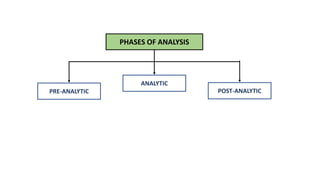
PHASES OF ANALYSIS
PRE-ANALYTIC
ANALYTIC
POST-ANALYTIC
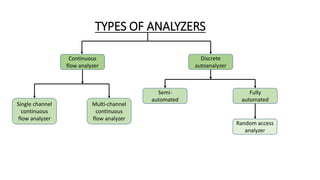
TYPES OF ANALYZERS
Continuous
flow analyzer
Single channel
continuous
flow analyzer
Discrete
autoanalyzer
Multi-channel
continuous
flow analyzer
Random access
analyzer
Fully
automated
Semi-
automated
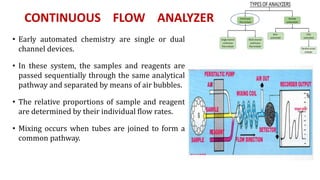
CONTINUOUS FLOW ANALYZER
• Early automated chemistry are single or dual
channel devices.
• In these system, the samples and reagents are
passed sequentially through the same analytical
pathway and separated by means of air bubbles.
• The relative proportions of sample and reagent
are determined by their individual flow rates.
• Mixing occurs when tubes are joined to form a
common pathway.
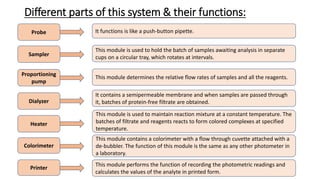
It functions is like a push-button pipette.Probe
Sampler
Proportioning
pump
Dialyzer
Heater
Colorimeter
Printer
This module is used to hold the batch of samples awaiting analysis in separate
cups on a circular tray, which rotates at intervals.
This module determines the relative flow rates of samples and all the reagents.
It contains a semipermeable membrane and when samples are passed through
it, batches of protein-free filtrate are obtained.
This module is used to maintain reaction mixture at a constant temperature. The
batches of filtrate and reagents reacts to form colored complexes at specified
temperature.
This module contains a colorimeter with a flow through cuvette attached with a
de-bubbler. The function of this module is the same as any other photometer in
a laboratory.
This module performs the function of recording the photometric readings and
calculates the values of the analyte in printed form.
Different parts of this system & their functions:
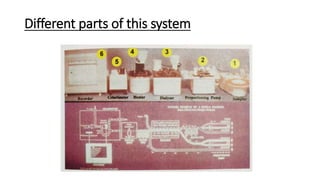
Different parts of this system
Single Channel Continuous Flow
Analyzer
Advantage:
• It is possible to test large number of specimens for a
particular test, accurately and precisely, in a short duration.
Disadvantage :
• At a time, only one type of determination is performed by
single channel continuous flow analyzer.
• This autoanalyzer occupies a larger space in the laboratory.
Multi-channel Continuous Flow Analyzer
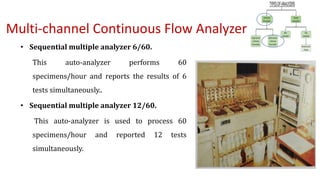
• Sequential multiple analyzer 6/60.
This auto-analyzer performs 60
specimens/hour and reports the results of 6
tests simultaneously..
• Sequential multiple analyzer 12/60.
This auto-analyzer is used to process 60
specimens/hour and reported 12 tests
simultaneously.
•These auto-analyzers
occupies larger space in the
laboratory
•Only 6 to 12 fixed test
determinations per hour.
Disadvantages
of SMA:
Discrete Autoanalyzers
• Discrete analyzer separates each sample and reagents in a separate container.
• Discrete analyzer have the capability of running multiple tests on one sample at
a time or multiple samples one test at a time.
• They are the most popular and versatile analyzers and have almost completely
replaced continuous flow.
• This requires components such as specimen handling, reagent systems, optics
and computers to be fully integrated with one another.
• The significant introduction of computers improves the quality of 'discrete
auto-analyzer' considerably.
Types of Discrete Auto-analyzers
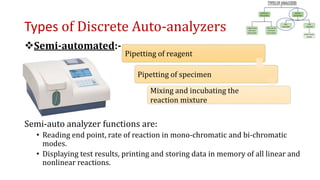
Semi-automated:-
Semi-auto analyzer functions are:
• Reading end point, rate of reaction in mono-chromatic and bi-chromatic
modes.
• Displaying test results, printing and storing data in memory of all linear and
nonlinear reactions.
Pipetting of reagent
Pipetting of specimen
Mixing and incubating the
reaction mixture
• Disadvantages of Semi Autoanalyzers
• More time consuming.
• More amount of sample is needed.
• More chances of error.
• Higher labor cost.
Fully automated
• Example of fully automated is: Random access analyzers
Automatic dispensing of reagents
Automatic dispensing of samples
Automatic mixing of reaction mixtures
Incubating of reaction mixtures, etc
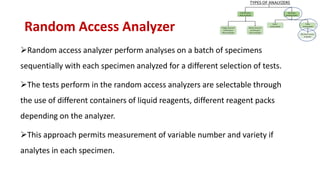
Random Access Analyzer
Random access analyzer perform analyses on a batch of specimens
sequentially with each specimen analyzed for a different selection of tests.
The tests perform in the random access analyzers are selectable through
the use of different containers of liquid reagents, different reagent packs
depending on the analyzer.
This approach permits measurement of variable number and variety if
analytes in each specimen.
Features Of Random Access Analyzer
• Level sensors for samples and reagents.
• Sample rack system: Individual racks for samples, controls calibrators
and Q.C. sera.
• Bar code identification of samples and reagents.
• Facility for continuous loading of samples.
• Facility for auto-dilution.
• Plotting of daily and monthly Q.C. charts.
• Availability of optional Ion Selective Electrode module for the
determination of sodium, potassium and chlorides.
• Capability to perform 2 to 3 reagent tests.
AUTOMATED MACHINES IN OUR LAB
• Beckman coulter AU-480 analyzer
• Cobas e 411 analyzer
• D-10 HbA1C analyzer
• 9180 electrolyte analyzer
BECKMAN COULTER AU-480
Parts of analyzer and functions:
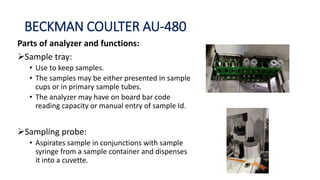
Sample tray:
• Use to keep samples.
• The samples may be either presented in sample
cups or in primary sample tubes.
• The analyzer may have on board bar code
reading capacity or manual entry of sample Id.
Sampling probe:
• Aspirates sample in conjunctions with sample
syringe from a sample container and dispenses
it into a cuvette.
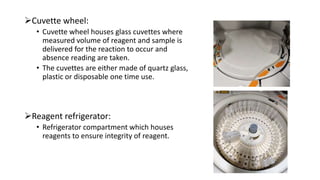
Cuvette wheel:
• Cuvette wheel houses glass cuvettes where
measured volume of reagent and sample is
delivered for the reaction to occur and
absence reading are taken.
• The cuvettes are either made of quartz glass,
plastic or disposable one time use.
Reagent refrigerator:
• Refrigerator compartment which houses
reagents to ensure integrity of reagent.
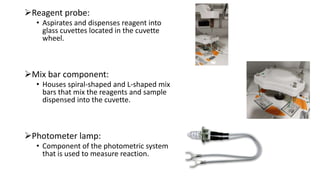
Reagent probe:
• Aspirates and dispenses reagent into
glass cuvettes located in the cuvette
wheel.
Mix bar component:
• Houses spiral-shaped and L-shaped mix
bars that mix the reagents and sample
dispensed into the cuvette.
Photometer lamp:
• Component of the photometric system
that is used to measure reaction.
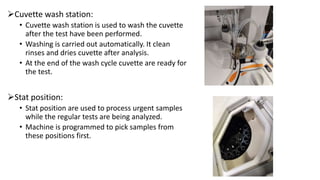
Cuvette wash station:
• Cuvette wash station is used to wash the cuvette
after the test have been performed.
• Washing is carried out automatically. It clean
rinses and dries cuvette after analysis.
• At the end of the wash cycle cuvette are ready for
the test.
Stat position:
• Stat position are used to process urgent samples
while the regular tests are being analyzed.
• Machine is programmed to pick samples from
these positions first.
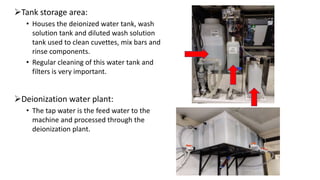
Tank storage area:
• Houses the deionized water tank, wash
solution tank and diluted wash solution
tank used to clean cuvettes, mix bars and
rinse components.
• Regular cleaning of this water tank and
filters is very important.
Deionization water plant:
• The tap water is the feed water to the
machine and processed through the
deionization plant.
Daily Start Procedure:
• Set the start condition
• Perform daily analyzer maintenance
• Check the analyzer status
• Check and replenish reagents
• Perform analyte calibration (if required)
• Process quality control(qc)
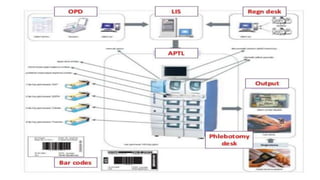
STEPS IN PRE-ANALYTICAL PROCESSES
Specimen acquisition
• Robotic phlebotomy
Specimen identification
• Labelling -Automatic phlebotomy tube labeller
• Bar coding
Specimen delivery to laboratory
• Pneumatic tube system
• Electric track vehicles
• Mobile robot
Specimen preparation
• Centrifugation
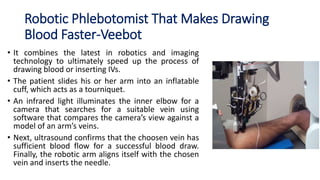
Robotic Phlebotomist That Makes Drawing
Blood Faster-Veebot
• It combines the latest in robotics and imaging
technology to ultimately speed up the process of
drawing blood or inserting IVs.
• The patient slides his or her arm into an inflatable
cuff, which acts as a tourniquet.
• An infrared light illuminates the inner elbow for a
camera that searches for a suitable vein using
software that compares the camera’s view against a
model of an arm’s veins.
• Next, ultrasound confirms that the choosen vein has
sufficient blood flow for a successful blood draw.
Finally, the robotic arm aligns itself with the chosen
vein and inserts the needle.
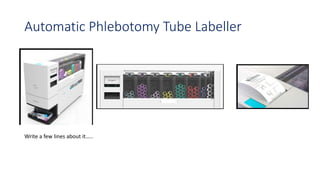
Automatic Phlebotomy Tube Labeller
Write a few lines about it…..
STEPS IN POST-ANALYTICAL PROCESSES
Report generation
Automated specimen storage and retrieval
BENEFITS OF AUTOMATION
• More samples can be analyzed in a given unit of time .
• Minimize the variations in results from one person to another.
• Minimize errors found in manual analysis ,pipetting etc.
• Use less sample and reagent for each test.
• Labor saving.
• Improved quality and consistency.
DISADVANTAGE OF AUTOMATION
• Excessive development costs.
• High initial cost.
• Displaces workers due to job replacement.
ThankYou

Automation in Biochemistry (Autoanalyzers)

  • 1.
    AUTOMATION IN BIOCHEMISTRY SALEHA NASEEM M.Sc.MLS HIMSR, Jamia Hamdard New Delhi, India
  • 2.
    WHAT IS AUTOMATION? Automationis a process by which instruments perform many tests with the least involvement of an analyst. Many steps that were previously performed manually can now be performed automatically. The International Union of Pure and Applied Chemistry (IUPAC) define automation as "The replacement of human manipulative effort and facilities in the performance of a given process by mechanical and instrumental devices that are regulated by feedback of information so that an apparatus is self-monitoring or self adjusting”.
  • 3.
  • 4.
    TYPES OF ANALYZERS Continuous flowanalyzer Single channel continuous flow analyzer Discrete autoanalyzer Multi-channel continuous flow analyzer Random access analyzer Fully automated Semi- automated
  • 5.
    CONTINUOUS FLOW ANALYZER •Early automated chemistry are single or dual channel devices. • In these system, the samples and reagents are passed sequentially through the same analytical pathway and separated by means of air bubbles. • The relative proportions of sample and reagent are determined by their individual flow rates. • Mixing occurs when tubes are joined to form a common pathway.
  • 6.
    It functions islike a push-button pipette.Probe Sampler Proportioning pump Dialyzer Heater Colorimeter Printer This module is used to hold the batch of samples awaiting analysis in separate cups on a circular tray, which rotates at intervals. This module determines the relative flow rates of samples and all the reagents. It contains a semipermeable membrane and when samples are passed through it, batches of protein-free filtrate are obtained. This module is used to maintain reaction mixture at a constant temperature. The batches of filtrate and reagents reacts to form colored complexes at specified temperature. This module contains a colorimeter with a flow through cuvette attached with a de-bubbler. The function of this module is the same as any other photometer in a laboratory. This module performs the function of recording the photometric readings and calculates the values of the analyte in printed form. Different parts of this system & their functions:
  • 7.
    Different parts ofthis system
  • 8.
    Single Channel ContinuousFlow Analyzer Advantage: • It is possible to test large number of specimens for a particular test, accurately and precisely, in a short duration. Disadvantage : • At a time, only one type of determination is performed by single channel continuous flow analyzer. • This autoanalyzer occupies a larger space in the laboratory.
  • 9.
    Multi-channel Continuous FlowAnalyzer • Sequential multiple analyzer 6/60. This auto-analyzer performs 60 specimens/hour and reports the results of 6 tests simultaneously.. • Sequential multiple analyzer 12/60. This auto-analyzer is used to process 60 specimens/hour and reported 12 tests simultaneously.
  • 10.
    •These auto-analyzers occupies largerspace in the laboratory •Only 6 to 12 fixed test determinations per hour. Disadvantages of SMA:
  • 11.
    Discrete Autoanalyzers • Discreteanalyzer separates each sample and reagents in a separate container. • Discrete analyzer have the capability of running multiple tests on one sample at a time or multiple samples one test at a time. • They are the most popular and versatile analyzers and have almost completely replaced continuous flow. • This requires components such as specimen handling, reagent systems, optics and computers to be fully integrated with one another. • The significant introduction of computers improves the quality of 'discrete auto-analyzer' considerably.
  • 12.
    Types of DiscreteAuto-analyzers Semi-automated:- Semi-auto analyzer functions are: • Reading end point, rate of reaction in mono-chromatic and bi-chromatic modes. • Displaying test results, printing and storing data in memory of all linear and nonlinear reactions. Pipetting of reagent Pipetting of specimen Mixing and incubating the reaction mixture
  • 13.
    • Disadvantages ofSemi Autoanalyzers • More time consuming. • More amount of sample is needed. • More chances of error. • Higher labor cost.
  • 14.
    Fully automated • Exampleof fully automated is: Random access analyzers Automatic dispensing of reagents Automatic dispensing of samples Automatic mixing of reaction mixtures Incubating of reaction mixtures, etc
  • 15.
    Random Access Analyzer Randomaccess analyzer perform analyses on a batch of specimens sequentially with each specimen analyzed for a different selection of tests. The tests perform in the random access analyzers are selectable through the use of different containers of liquid reagents, different reagent packs depending on the analyzer. This approach permits measurement of variable number and variety if analytes in each specimen.
  • 16.
    Features Of RandomAccess Analyzer • Level sensors for samples and reagents. • Sample rack system: Individual racks for samples, controls calibrators and Q.C. sera. • Bar code identification of samples and reagents. • Facility for continuous loading of samples. • Facility for auto-dilution. • Plotting of daily and monthly Q.C. charts. • Availability of optional Ion Selective Electrode module for the determination of sodium, potassium and chlorides. • Capability to perform 2 to 3 reagent tests.
  • 17.
    AUTOMATED MACHINES INOUR LAB • Beckman coulter AU-480 analyzer • Cobas e 411 analyzer • D-10 HbA1C analyzer • 9180 electrolyte analyzer
  • 18.
    BECKMAN COULTER AU-480 Partsof analyzer and functions: Sample tray: • Use to keep samples. • The samples may be either presented in sample cups or in primary sample tubes. • The analyzer may have on board bar code reading capacity or manual entry of sample Id. Sampling probe: • Aspirates sample in conjunctions with sample syringe from a sample container and dispenses it into a cuvette.
  • 19.
    Cuvette wheel: • Cuvettewheel houses glass cuvettes where measured volume of reagent and sample is delivered for the reaction to occur and absence reading are taken. • The cuvettes are either made of quartz glass, plastic or disposable one time use. Reagent refrigerator: • Refrigerator compartment which houses reagents to ensure integrity of reagent.
  • 20.
    Reagent probe: • Aspiratesand dispenses reagent into glass cuvettes located in the cuvette wheel. Mix bar component: • Houses spiral-shaped and L-shaped mix bars that mix the reagents and sample dispensed into the cuvette. Photometer lamp: • Component of the photometric system that is used to measure reaction.
  • 21.
    Cuvette wash station: •Cuvette wash station is used to wash the cuvette after the test have been performed. • Washing is carried out automatically. It clean rinses and dries cuvette after analysis. • At the end of the wash cycle cuvette are ready for the test. Stat position: • Stat position are used to process urgent samples while the regular tests are being analyzed. • Machine is programmed to pick samples from these positions first.
  • 22.
    Tank storage area: •Houses the deionized water tank, wash solution tank and diluted wash solution tank used to clean cuvettes, mix bars and rinse components. • Regular cleaning of this water tank and filters is very important. Deionization water plant: • The tap water is the feed water to the machine and processed through the deionization plant.
  • 23.
    Daily Start Procedure: •Set the start condition • Perform daily analyzer maintenance • Check the analyzer status • Check and replenish reagents • Perform analyte calibration (if required) • Process quality control(qc)
  • 24.
    STEPS IN PRE-ANALYTICALPROCESSES Specimen acquisition • Robotic phlebotomy Specimen identification • Labelling -Automatic phlebotomy tube labeller • Bar coding Specimen delivery to laboratory • Pneumatic tube system • Electric track vehicles • Mobile robot Specimen preparation • Centrifugation
  • 25.
    Robotic Phlebotomist ThatMakes Drawing Blood Faster-Veebot • It combines the latest in robotics and imaging technology to ultimately speed up the process of drawing blood or inserting IVs. • The patient slides his or her arm into an inflatable cuff, which acts as a tourniquet. • An infrared light illuminates the inner elbow for a camera that searches for a suitable vein using software that compares the camera’s view against a model of an arm’s veins. • Next, ultrasound confirms that the choosen vein has sufficient blood flow for a successful blood draw. Finally, the robotic arm aligns itself with the chosen vein and inserts the needle.
  • 26.
    Automatic Phlebotomy TubeLabeller Write a few lines about it…..
  • 28.
    STEPS IN POST-ANALYTICALPROCESSES Report generation Automated specimen storage and retrieval
  • 29.
    BENEFITS OF AUTOMATION •More samples can be analyzed in a given unit of time . • Minimize the variations in results from one person to another. • Minimize errors found in manual analysis ,pipetting etc. • Use less sample and reagent for each test. • Labor saving. • Improved quality and consistency.
  • 30.
    DISADVANTAGE OF AUTOMATION •Excessive development costs. • High initial cost. • Displaces workers due to job replacement.
  • 31.

Editor's Notes

  • #4 The analytic process can be divided into three major phases:-pre-analytic, analytic, and post-analytic—corresponding to sample collection, chemical analysis, and data management, respectively. Substantial improvements have occurred in all three areas during the past decade. The analytic phase is the most automated, and more research and development efforts are focusing on increasing automation of the pre-analytic and post-analytic processes.
  • #10 Multi-channel introduced following auto-analyzers subsequently, which could perform 6 to 12 different tests simultaneously. Disadvantages of SMA: These auto-analyzers occupied larger space in the laboratory Only 6 to 12 fixed determinations
  • #12 Discrete clinical chemistry analyzers coordinate multiple operations into a smoothly functioning system.