The changing world of librarians
Lee Rainie - @lrainie
Director
Pew Research Center’s Internet & American Life Project
Presented to: DC/SLA Spring Workshop
April 24, 2013
2
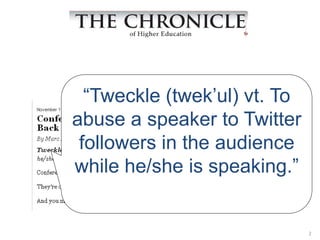
“Tweckle (twek’ul) vt. To
abuse a speaker to Twitter
followers in the audience
while he/she is speaking.”
3
4
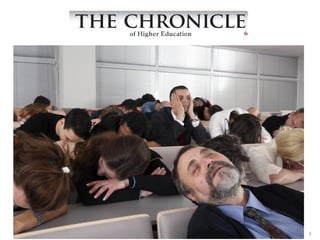
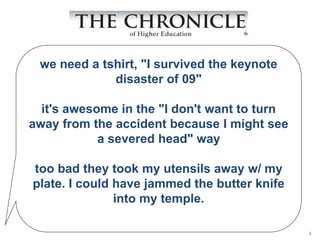
we need a tshirt, "I survived the keynote
disaster of 09"
it's awesome in the "I don't want to turn
away from the accident because I might see
a severed head" way
too bad they took my utensils away w/ my
plate. I could have jammed the butter knife
into my temple.
3 tech
revolutions
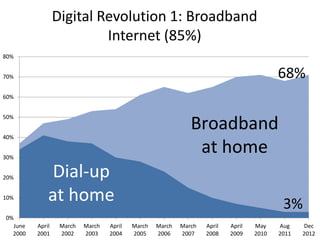
Digital Revolution 1: Broadband
Internet (85%)
0%
10%
20%
30%
40%
50%
60%
70%
80%
June
2000
April
2001
March
2002
March
2003
April
2004
March
2005
March
2006
March
2007
April
2008
April
2009
May
2010
Aug
2011
Dec
2012
Broadband
at home
Dial-up
at home
68%
3%
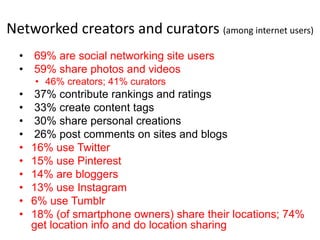
Networked creators and curators (among internet users)
• 69% are social networking site users
• 59% share photos and videos
• 46% creators; 41% curators
• 37% contribute rankings and ratings
• 33% create content tags
• 30% share personal creations
• 26% post comments on sites and blogs
• 16% use Twitter
• 15% use Pinterest
• 14% are bloggers
• 13% use Instagram
• 6% use Tumblr
• 18% (of smartphone owners) share their locations; 74%
get location info and do location sharing
Impact on librarians
• Collections moved from atoms to bits
• More volume, velocity, and variety of
information
• More self-starter searches; more complicated
search and synthesis demanded of librarians
• Rise of “fifth estate” of civic and community
actors
• More arguments in the culture – library
“referees”?
• Collapsed contexts of messaging
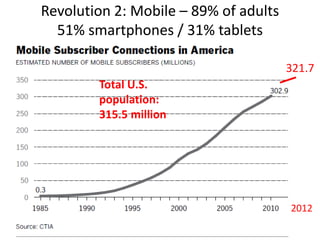
Revolution 2: Mobile – 89% of adults
51% smartphones / 31% tablets
321.7
Total U.S.
population:
315.5 million
2012
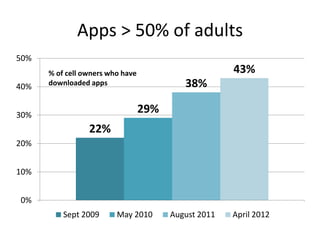
Apps > 50% of adults
22%
29%
38%
43%
0%
10%
20%
30%
40%
50%
Sept 2009 May 2010 August 2011 April 2012
% of cell owners who have
downloaded apps
• Attention zones change
– “Continuous partial attention”
– Deep dives
– Info snacking
• Real-time, just-in-time searches and availability
change process of acquiring and using
information
– Spontaneous activities
– Be “ready for your closeup”
• Augmented reality highlights the merger of data
world and real world
Impact on librarians
9%
49%
67%
76%
86% 87% 92%
7%
8%
25%
48%
61%
68% 73%
6%
4%
11%
25%
47%
49% 57%
1%
7%
13%
26%
29%
38%
0%
20%
40%
60%
80%
100%
2005 2006 2007 2008 2009 2010 2011 2012
18-29 30-49 50-64 65+
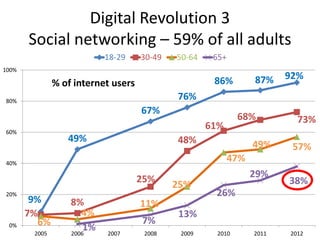
Digital Revolution 3
Social networking – 59% of all adults
% of internet users
• Composition and character of people’s social
networks changes AND networks become
important channels of …
– learning
– trust
– influence
• Organizations can become media companies
themselves …
• … and “helper nodes” in people’s networks
Impact on organizations and
their librarians
About our libraries research
• Goal: To study the changing role of public
libraries and library users in the digital age
• Funded by a three-year grant from the Bill &
Melinda Gates Foundation
libraries.pewinternet.org
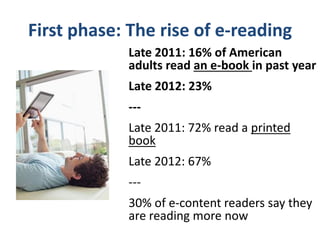
First phase: The rise of e-reading
Late 2011: 16% of American
adults read an e-book in past year
Late 2012: 23%
---
Late 2011: 72% read a printed
book
Late 2012: 67%
---
30% of e-content readers say they
are reading more now
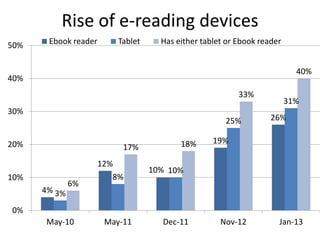
Rise of e-reading devices
4%
12%
10%
19%
26%
3%
8%
10%
25%
31%
6%
17% 18%
33%
40%
0%
10%
20%
30%
40%
50%
May-10 May-11 Dec-11 Nov-12 Jan-13
Ebook reader Tablet Has either tablet or Ebook reader
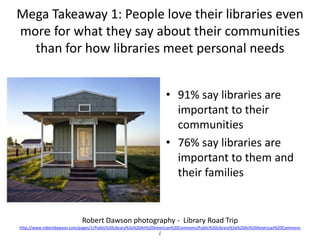
Mega Takeaway 1: People love their libraries even
more for what they say about their communities
than for how libraries meet personal needs
• 91% say libraries are
important to their
communities
• 76% say libraries are
important to them and
their families
Robert Dawson photography - Library Road Trip
http://www.robertdawson.com/pages/1/Public%20Library%3a%20An%20American%20Commons/Public%20Library%3a%20An%20American%20Commons
/
18
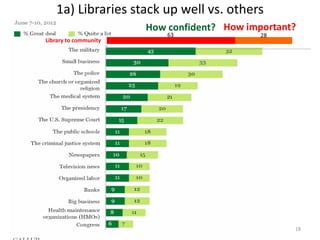
1a) Libraries stack up well vs. others
How confident? How important?
63 28
Library to community
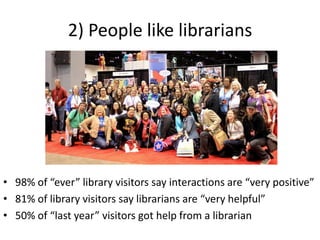
2) People like librarians
• 98% of “ever” library visitors say interactions are “very positive”
• 81% of library visitors say librarians are “very helpful”
• 50% of “last year” visitors got help from a librarian
Mega Takeaway 3: Libraries have
rebranded themselves as tech hubs
• 80% of Americans say
borrowing books is a
“very important” service
libraries provide
• 80% say reference
librarians are a “very
important” service
• 77% say free access to
computers and the
internet is a “very
important” service
Mega Takeaway 4: Libraries have a PR
problem / opportunity
• 22% say that they know
all or most of the
services their libraries
offer
• 46% say they know
some of what their
libraries offer
• 31% said they know not
much or nothing at all
of what their libraries
offer
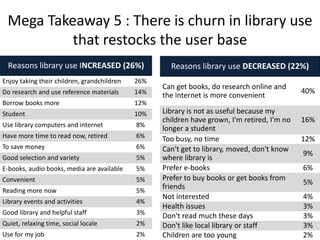
Mega Takeaway 5 : There is churn in library use
that restocks the user base
Reasons library use INCREASED (26%)
Enjoy taking their children, grandchildren 26%
Do research and use reference materials 14%
Borrow books more 12%
Student 10%
Use library computers and internet 8%
Have more time to read now, retired 6%
To save money 6%
Good selection and variety 5%
E-books, audio books, media are available 5%
Convenient 5%
Reading more now 5%
Library events and activities 4%
Good library and helpful staff 3%
Quiet, relaxing time, social locale 2%
Use for my job 2%
Reasons library use DECREASED (22%)
Can get books, do research online and
the internet is more convenient
40%
Library is not as useful because my
children have grown, I'm retired, I'm no
longer a student
16%
Too busy, no time 12%
Can't get to library, moved, don't know
where library is
9%
Prefer e-books 6%
Prefer to buy books or get books from
friends
5%
Not interested 4%
Health issues 3%
Don't read much these days 3%
Don't like local library or staff 3%
Children are too young 2%
Mega Takeaway 6: There is a truly detached
population out there that matters to you
• 20% never saw a
family member use a
library when they
were growing up
• 16% have never
visited a library
• 23% didn’t read a
book last 12 months
How you can help us
• Help us think through a study on “information
omnivores”
– Talks with Janice Lachance and Brent Mai
• Help think through a study on “information rich
and information poor”
• Sign up to participate in our research (and
encourage your friends!):
http://libraries.pewinternet.org/participate/
Libraries.pewinternet.org
Lee Rainie
Email: lrainie@pewinternet.org
Twitter: @Lrainie
Kathryn Zickuhr
Email: kzickuhr@pewinternet.org
Twitter: @kzickuhr
Kristen Purcell
Email: @kpurcell@pewinternet.org
Twitter: @kristenpurcell

The changing world of librarians

  • 1.
    The changing worldof librarians Lee Rainie - @lrainie Director Pew Research Center’s Internet & American Life Project Presented to: DC/SLA Spring Workshop April 24, 2013
  • 2.
    2 “Tweckle (twek’ul) vt.To abuse a speaker to Twitter followers in the audience while he/she is speaking.”
  • 3.
  • 4.
    4 we need atshirt, "I survived the keynote disaster of 09" it's awesome in the "I don't want to turn away from the accident because I might see a severed head" way too bad they took my utensils away w/ my plate. I could have jammed the butter knife into my temple.
  • 5.
  • 6.
    Digital Revolution 1:Broadband Internet (85%) 0% 10% 20% 30% 40% 50% 60% 70% 80% June 2000 April 2001 March 2002 March 2003 April 2004 March 2005 March 2006 March 2007 April 2008 April 2009 May 2010 Aug 2011 Dec 2012 Broadband at home Dial-up at home 68% 3%
  • 7.
    Networked creators andcurators (among internet users) • 69% are social networking site users • 59% share photos and videos • 46% creators; 41% curators • 37% contribute rankings and ratings • 33% create content tags • 30% share personal creations • 26% post comments on sites and blogs • 16% use Twitter • 15% use Pinterest • 14% are bloggers • 13% use Instagram • 6% use Tumblr • 18% (of smartphone owners) share their locations; 74% get location info and do location sharing
  • 8.
    Impact on librarians •Collections moved from atoms to bits • More volume, velocity, and variety of information • More self-starter searches; more complicated search and synthesis demanded of librarians • Rise of “fifth estate” of civic and community actors • More arguments in the culture – library “referees”? • Collapsed contexts of messaging
  • 9.
    Revolution 2: Mobile– 89% of adults 51% smartphones / 31% tablets 321.7 Total U.S. population: 315.5 million 2012
  • 10.
    Apps > 50%of adults 22% 29% 38% 43% 0% 10% 20% 30% 40% 50% Sept 2009 May 2010 August 2011 April 2012 % of cell owners who have downloaded apps
  • 11.
    • Attention zoneschange – “Continuous partial attention” – Deep dives – Info snacking • Real-time, just-in-time searches and availability change process of acquiring and using information – Spontaneous activities – Be “ready for your closeup” • Augmented reality highlights the merger of data world and real world Impact on librarians
  • 12.
    9% 49% 67% 76% 86% 87% 92% 7% 8% 25% 48% 61% 68%73% 6% 4% 11% 25% 47% 49% 57% 1% 7% 13% 26% 29% 38% 0% 20% 40% 60% 80% 100% 2005 2006 2007 2008 2009 2010 2011 2012 18-29 30-49 50-64 65+ Digital Revolution 3 Social networking – 59% of all adults % of internet users
  • 13.
    • Composition andcharacter of people’s social networks changes AND networks become important channels of … – learning – trust – influence • Organizations can become media companies themselves … • … and “helper nodes” in people’s networks Impact on organizations and their librarians
  • 14.
    About our librariesresearch • Goal: To study the changing role of public libraries and library users in the digital age • Funded by a three-year grant from the Bill & Melinda Gates Foundation libraries.pewinternet.org
  • 15.
    First phase: Therise of e-reading Late 2011: 16% of American adults read an e-book in past year Late 2012: 23% --- Late 2011: 72% read a printed book Late 2012: 67% --- 30% of e-content readers say they are reading more now
  • 16.
    Rise of e-readingdevices 4% 12% 10% 19% 26% 3% 8% 10% 25% 31% 6% 17% 18% 33% 40% 0% 10% 20% 30% 40% 50% May-10 May-11 Dec-11 Nov-12 Jan-13 Ebook reader Tablet Has either tablet or Ebook reader
  • 17.
    Mega Takeaway 1:People love their libraries even more for what they say about their communities than for how libraries meet personal needs • 91% say libraries are important to their communities • 76% say libraries are important to them and their families Robert Dawson photography - Library Road Trip http://www.robertdawson.com/pages/1/Public%20Library%3a%20An%20American%20Commons/Public%20Library%3a%20An%20American%20Commons /
  • 18.
    18 1a) Libraries stackup well vs. others How confident? How important? 63 28 Library to community
  • 19.
    2) People likelibrarians • 98% of “ever” library visitors say interactions are “very positive” • 81% of library visitors say librarians are “very helpful” • 50% of “last year” visitors got help from a librarian
  • 20.
    Mega Takeaway 3:Libraries have rebranded themselves as tech hubs • 80% of Americans say borrowing books is a “very important” service libraries provide • 80% say reference librarians are a “very important” service • 77% say free access to computers and the internet is a “very important” service
  • 21.
    Mega Takeaway 4:Libraries have a PR problem / opportunity • 22% say that they know all or most of the services their libraries offer • 46% say they know some of what their libraries offer • 31% said they know not much or nothing at all of what their libraries offer
  • 22.
    Mega Takeaway 5: There is churn in library use that restocks the user base Reasons library use INCREASED (26%) Enjoy taking their children, grandchildren 26% Do research and use reference materials 14% Borrow books more 12% Student 10% Use library computers and internet 8% Have more time to read now, retired 6% To save money 6% Good selection and variety 5% E-books, audio books, media are available 5% Convenient 5% Reading more now 5% Library events and activities 4% Good library and helpful staff 3% Quiet, relaxing time, social locale 2% Use for my job 2% Reasons library use DECREASED (22%) Can get books, do research online and the internet is more convenient 40% Library is not as useful because my children have grown, I'm retired, I'm no longer a student 16% Too busy, no time 12% Can't get to library, moved, don't know where library is 9% Prefer e-books 6% Prefer to buy books or get books from friends 5% Not interested 4% Health issues 3% Don't read much these days 3% Don't like local library or staff 3% Children are too young 2%
  • 23.
    Mega Takeaway 6:There is a truly detached population out there that matters to you • 20% never saw a family member use a library when they were growing up • 16% have never visited a library • 23% didn’t read a book last 12 months
  • 24.
    How you canhelp us • Help us think through a study on “information omnivores” – Talks with Janice Lachance and Brent Mai • Help think through a study on “information rich and information poor” • Sign up to participate in our research (and encourage your friends!): http://libraries.pewinternet.org/participate/
  • 25.
    Libraries.pewinternet.org Lee Rainie Email: lrainie@pewinternet.org Twitter:@Lrainie Kathryn Zickuhr Email: kzickuhr@pewinternet.org Twitter: @kzickuhr Kristen Purcell Email: @kpurcell@pewinternet.org Twitter: @kristenpurcell